ThoughtWorks
Application Development Approach

© ThoughtWorks 2009
The origin of Agile concepts
Software Project Outcomes: 2006

65%

Over-budget
Over-time
Under-delivered

Failed

“The CHAOS Chronicles 2006”, The Standish Group
Why are they considered failures?

Over budget by 189%
Over schedule by 220%
Only 61% of features are delivered

The Standish Group CHAOS Reports
Waste – majority of projects are over scoped

And the result is ..... waste
Always or often used : 20%
Always
7%

Often
13%

Rarely or never used : 64%
Sometimes
16%
Rarely
19%

Never 45%
Study by The Standish Group, Jim Johnson Chairman
2002
Reducing Waste is the
Single Biggest Opportunity For Cost Reduction

Waste in
requirements
capture

Scope

Functional and
Technical scope
not needed

Minimised Cost

Cost to build

Waste in
defect
correction
Agile/Lean Principles
• Eliminate Waste
• Develop iteratively/Release often
– Realise business value earlier
– Allow for regular reprioritisation

• Test continuously (and earlier in the process)
• Create visibility and maximise feedback
– Between Business and IT
– Business IT management and development teams
– Within teams
A typical Agile project lifecycle
Inception Phase of an Agile project
QuickStart workshops
QuickStart: Agile Requirements Gathering
Time Boxed

Pre-meet

Final Showcase

Weekly Showcases

2 – 4 Weeks

© ThoughtWorks 2008
QuickStart: Collaborative and Inclusive

© ThoughtWorks 2008
Clear communication is the foundation

“I’m glad we’re all agreed then.”
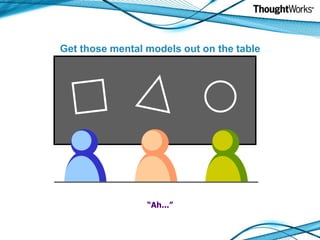
Get those mental models out on the table

“Ah...”
An explicit
model allows convergence through iteration

“Ah!”
A genuinely shared understanding

“I’m glad we’re all agreed then.”
Outputs of QuickStart workshops
Potential outputs
•
•
•
•
•
•
•

Prioritised business objectives
Business vision
Roadmap
Architecture model
Low fidelity prototypes / prototypes
Prioritised estimated master requirements list
High level release plan
The master requirements list
• Master requirements list
–
–

It collects the output of the analysis as requirements (units of value)
These requirements are qualified by risks, issues, assumptions, dependencies and constraints

• For each requirement:
–
–

The business has an understanding of its business value
Those implementing the requirement (e.g. IT) have an understanding of the required effort (an estimate)

• The business then prioritises based on:
–
–
–

The estimate
Their knowledge of the business value
Input from those implementing the requirement, e.g. IT
(dependencies, end-to-end slice)
High level release plan
• The estimated and prioritised master requirements list provides an
excellent foundation for the creation of the high level release
plan
• In turn this gives preliminary answers to important planning
questions, e.g.
–
–
–
–

Number of releases
Content of those releases
Sequencing / dependencies
Duration

• All of which position the business to make the required decisions
about implementation
Delivery Phase
Example of Release Cycle – as executed at clients
50% through

Itr 2 Itr 3

Itr .

Release

Test Release

Itr 1

80% through
Test Release

Production
Candidate

Itr .

Itr .

Itr .

Itr .

Itr .

Itr n Deploy

End to End process review in every iteration
Solution Architecture evolves ongoing through all iterations
Ongoing testing: Unit Testing, Acceptance Testing, System Testing, Exploratory Testing, Performance Profiling
Show
case

Show
case

Show
case

Show
case

Show
case

Show
case

Show
case

Show
case

Show
case

Show
case

UAT

UAT

UAT

Performance
, Security
and
Operations
Testing

Performance
, Security
and
Operations
Testing

Performance,
Security and
Operations Testing

System
Integration
Test

System
Integration
Test

System
Integration Test

Regression
Test

Regression
Test

Regression Test
Test earlier and continuously
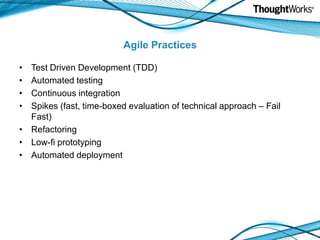
Agile Practices
•
•
•
•

Test Driven Development (TDD)
Automated testing
Continuous integration
Spikes (fast, time-boxed evaluation of technical approach – Fail
Fast)
• Refactoring
• Low-fi prototyping
• Automated deployment
Measuring Progress – Burn Charts
Used to Show
– Total Scope and any changes over time (scope creep)
– Completed Scope (completed means tested, production quality
software)
– Scope remaining to be completed
– Helps drive decisions – scope Vs budget Vs time
Project Burn Up Chart
300
250

Points

•

200
150
100
50
0
1

2

3

4

5

6

7

8

9

Iteration
Start Scope

Current Scope

Complete

Planned Burn
Burn-up chart
180
160
140
120

Original Scope

100

Actual Scope

80

Actual Points

60

Predicted Velocity

40
20
0
1

2

3

4

5

6

7

8

9

10
Example: One Click Showcase
Pr oj ect Tr acki ng
Ti m i ne – R ease 1
el
el
20/ 08

15/ 10

W ar e her e.
e
I t er at i on
0

I t er at i on
1

I t er at i on
2

I t er at i on 3+4
( com ned)
bi

I t er at i on 5+6 ( t est
& depl oy)

% C pl et e – R ease 1
om
el
I‟ n 1
–
34pt s

0%
0

55 pt s ( 49%
)

W ar e her e
e
© ThoughtWorks 2008

100%
212 pt s
Waterfall compared with Agile
Project Plan/Estimation
Requirements Gathering
Use Cases /
Functional Specs
Design
Specifications
Code
Inception

Test

Release 1

$

Release 2

• Short Iterations
• Frequent Releases
• Earlier ROI

Fix / Integrate

$

$

Release 3

$

Release 4

$
Lower cost of change through higher quality software
Cost of change curve

Agile system cost profile
Benefits of Agile
•
•
•
•
•
•
•
•

Delivers business value early, and often
Faster time to market
Maximises return on investment (business value prioritised)
Encourages higher quality, simpler code (lower maintenance costs)
Better Business-IT alignment
Increases visibility into project progress and reduces risk
Handles changing requirements and priorities
Lowers cost of change
Discipline in an Agile project
Rigour in the Agile methodology (1)
• To be able to deliver effectively in an Agile project, much more discipline
is required than in traditional projects. The constant feedback and
transparency give the business on-going control and a mechanism to
make and change decisions from beginning to end of the project.
Surprises late in the project are prevented.
• Part of the Initiation phase are QuickStart workshops which provide:
–
–
–
–
–
–

Input for Business Case
Release Plan
Estimates
Technical vision
Architecture Design
Test Strategy
Rigour in the Agile methodology (2)
• The Solution Architecture is developed and reviewed on-going
through the iterations.
• Each iteration delivers a showcase which provides the business and
stakeholders with a sign-off point on progress regarding scope, time
and budget.
• Documentation is produced on the „just enough‟ principle making it
efficient and effective by ensuring that what is produced will be
used, thereby reducing waste. The documentation deliverables are
adapted to the clients requirements.
Traditional vs Agile planning
With any kind of planning
– A little effort helps a lot (80/20 rule).
– A lot more effort only helps a little.

•

Traditional Planning: Spend a lot of time
upfront and understand the problem in detail
to come up with an “accurate” plan.
Agile Planning:
– Spend just enough time upfront to get
started and plan to change as the project
travels.
– Do just enough to enable effective
decision making, covering:
• Business case
• Requirements
• Architecture
• Design
– Review these artefacts on an ongoing
basis at iteration checkpoints.
Goal of agile planning is to establish a
process that embraces changing the plan by
making change easy to manage.

•

•

Accuracy

•

Effort
When do we plan?

Stories
QuickStart

1

2

…

n

1

Release 1

Initial Planning

2

…

Release N

m

Iterations
Releases

Constant
Planning and
Re-Planning
34
Why ThoughtWorks?
ThoughtWorks is
• A thought leader in application development
• A world leader in the application of Agile practices
ThoughtWorks delivers the best value for money through
• Short time to benefit / market
• The ability to adapt to changing requirements continuously
• Minimising risk

ThoughtWorks Approach 2009

  • 1.
  • 2.
    The origin ofAgile concepts
  • 3.
    Software Project Outcomes:2006 65% Over-budget Over-time Under-delivered Failed “The CHAOS Chronicles 2006”, The Standish Group
  • 4.
    Why are theyconsidered failures? Over budget by 189% Over schedule by 220% Only 61% of features are delivered The Standish Group CHAOS Reports
  • 5.
    Waste – majorityof projects are over scoped And the result is ..... waste Always or often used : 20% Always 7% Often 13% Rarely or never used : 64% Sometimes 16% Rarely 19% Never 45% Study by The Standish Group, Jim Johnson Chairman 2002
  • 6.
    Reducing Waste isthe Single Biggest Opportunity For Cost Reduction Waste in requirements capture Scope Functional and Technical scope not needed Minimised Cost Cost to build Waste in defect correction
  • 7.
    Agile/Lean Principles • EliminateWaste • Develop iteratively/Release often – Realise business value earlier – Allow for regular reprioritisation • Test continuously (and earlier in the process) • Create visibility and maximise feedback – Between Business and IT – Business IT management and development teams – Within teams
  • 8.
    A typical Agileproject lifecycle
  • 9.
    Inception Phase ofan Agile project QuickStart workshops
  • 10.
    QuickStart: Agile RequirementsGathering Time Boxed Pre-meet Final Showcase Weekly Showcases 2 – 4 Weeks © ThoughtWorks 2008
  • 11.
    QuickStart: Collaborative andInclusive © ThoughtWorks 2008
  • 12.
    Clear communication isthe foundation “I’m glad we’re all agreed then.”
  • 13.
    Get those mentalmodels out on the table “Ah...”
  • 14.
    An explicit model allowsconvergence through iteration “Ah!”
  • 15.
    A genuinely sharedunderstanding “I’m glad we’re all agreed then.”
  • 16.
  • 17.
    Potential outputs • • • • • • • Prioritised businessobjectives Business vision Roadmap Architecture model Low fidelity prototypes / prototypes Prioritised estimated master requirements list High level release plan
  • 18.
    The master requirementslist • Master requirements list – – It collects the output of the analysis as requirements (units of value) These requirements are qualified by risks, issues, assumptions, dependencies and constraints • For each requirement: – – The business has an understanding of its business value Those implementing the requirement (e.g. IT) have an understanding of the required effort (an estimate) • The business then prioritises based on: – – – The estimate Their knowledge of the business value Input from those implementing the requirement, e.g. IT (dependencies, end-to-end slice)
  • 19.
    High level releaseplan • The estimated and prioritised master requirements list provides an excellent foundation for the creation of the high level release plan • In turn this gives preliminary answers to important planning questions, e.g. – – – – Number of releases Content of those releases Sequencing / dependencies Duration • All of which position the business to make the required decisions about implementation
  • 20.
  • 21.
    Example of ReleaseCycle – as executed at clients 50% through Itr 2 Itr 3 Itr . Release Test Release Itr 1 80% through Test Release Production Candidate Itr . Itr . Itr . Itr . Itr . Itr n Deploy End to End process review in every iteration Solution Architecture evolves ongoing through all iterations Ongoing testing: Unit Testing, Acceptance Testing, System Testing, Exploratory Testing, Performance Profiling Show case Show case Show case Show case Show case Show case Show case Show case Show case Show case UAT UAT UAT Performance , Security and Operations Testing Performance , Security and Operations Testing Performance, Security and Operations Testing System Integration Test System Integration Test System Integration Test Regression Test Regression Test Regression Test
  • 22.
    Test earlier andcontinuously
  • 23.
    Agile Practices • • • • Test DrivenDevelopment (TDD) Automated testing Continuous integration Spikes (fast, time-boxed evaluation of technical approach – Fail Fast) • Refactoring • Low-fi prototyping • Automated deployment
  • 24.
    Measuring Progress –Burn Charts Used to Show – Total Scope and any changes over time (scope creep) – Completed Scope (completed means tested, production quality software) – Scope remaining to be completed – Helps drive decisions – scope Vs budget Vs time Project Burn Up Chart 300 250 Points • 200 150 100 50 0 1 2 3 4 5 6 7 8 9 Iteration Start Scope Current Scope Complete Planned Burn
  • 25.
    Burn-up chart 180 160 140 120 Original Scope 100 ActualScope 80 Actual Points 60 Predicted Velocity 40 20 0 1 2 3 4 5 6 7 8 9 10
  • 26.
    Example: One ClickShowcase Pr oj ect Tr acki ng Ti m i ne – R ease 1 el el 20/ 08 15/ 10 W ar e her e. e I t er at i on 0 I t er at i on 1 I t er at i on 2 I t er at i on 3+4 ( com ned) bi I t er at i on 5+6 ( t est & depl oy) % C pl et e – R ease 1 om el I‟ n 1 – 34pt s 0% 0 55 pt s ( 49% ) W ar e her e e © ThoughtWorks 2008 100% 212 pt s
  • 27.
    Waterfall compared withAgile Project Plan/Estimation Requirements Gathering Use Cases / Functional Specs Design Specifications Code Inception Test Release 1 $ Release 2 • Short Iterations • Frequent Releases • Earlier ROI Fix / Integrate $ $ Release 3 $ Release 4 $
  • 28.
    Lower cost ofchange through higher quality software Cost of change curve Agile system cost profile
  • 29.
    Benefits of Agile • • • • • • • • Deliversbusiness value early, and often Faster time to market Maximises return on investment (business value prioritised) Encourages higher quality, simpler code (lower maintenance costs) Better Business-IT alignment Increases visibility into project progress and reduces risk Handles changing requirements and priorities Lowers cost of change
  • 30.
    Discipline in anAgile project
  • 31.
    Rigour in theAgile methodology (1) • To be able to deliver effectively in an Agile project, much more discipline is required than in traditional projects. The constant feedback and transparency give the business on-going control and a mechanism to make and change decisions from beginning to end of the project. Surprises late in the project are prevented. • Part of the Initiation phase are QuickStart workshops which provide: – – – – – – Input for Business Case Release Plan Estimates Technical vision Architecture Design Test Strategy
  • 32.
    Rigour in theAgile methodology (2) • The Solution Architecture is developed and reviewed on-going through the iterations. • Each iteration delivers a showcase which provides the business and stakeholders with a sign-off point on progress regarding scope, time and budget. • Documentation is produced on the „just enough‟ principle making it efficient and effective by ensuring that what is produced will be used, thereby reducing waste. The documentation deliverables are adapted to the clients requirements.
  • 33.
    Traditional vs Agileplanning With any kind of planning – A little effort helps a lot (80/20 rule). – A lot more effort only helps a little. • Traditional Planning: Spend a lot of time upfront and understand the problem in detail to come up with an “accurate” plan. Agile Planning: – Spend just enough time upfront to get started and plan to change as the project travels. – Do just enough to enable effective decision making, covering: • Business case • Requirements • Architecture • Design – Review these artefacts on an ongoing basis at iteration checkpoints. Goal of agile planning is to establish a process that embraces changing the plan by making change easy to manage. • • Accuracy • Effort
  • 34.
    When do weplan? Stories QuickStart 1 2 … n 1 Release 1 Initial Planning 2 … Release N m Iterations Releases Constant Planning and Re-Planning 34
  • 35.
    Why ThoughtWorks? ThoughtWorks is •A thought leader in application development • A world leader in the application of Agile practices ThoughtWorks delivers the best value for money through • Short time to benefit / market • The ability to adapt to changing requirements continuously • Minimising risk