Measuring & Maximizing the
Business Impact of Network
Automation
How to create opportunities for greater business transformation
and growth with a metric-driven automation strategy.
Morgan Stern
VP of Automation Strategy,
Itential
WEBINAR
©2020 Itential Confidential and Proprietary
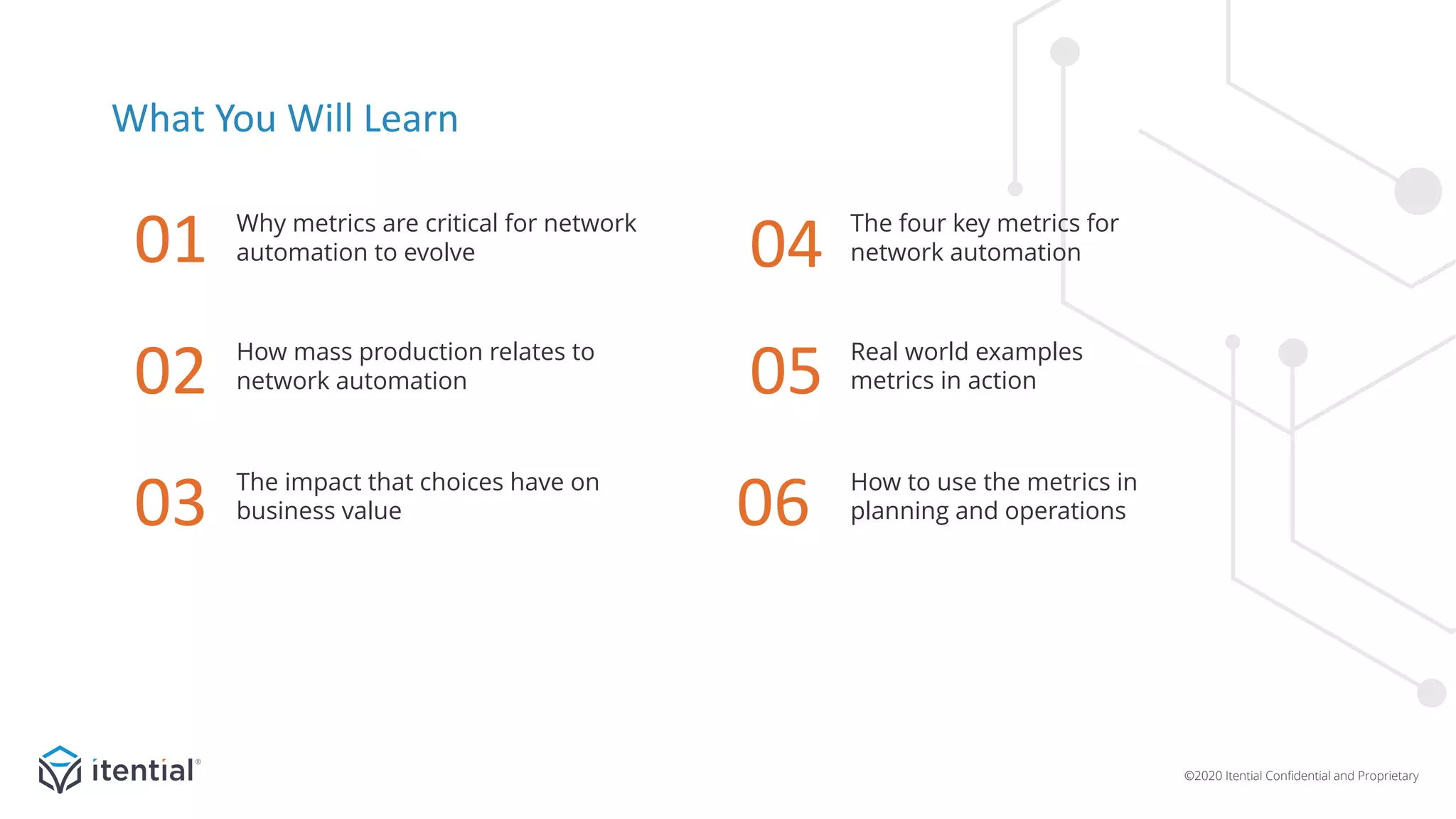
How to use the metrics in
planning and operations
What You Will Learn
Why metrics are critical for network
automation to evolve
How mass production relates to
network automation
The impact that choices have on
business value
The four key metrics for
network automation
Real world examples
metrics in action
01
02
03
04
05
06
©2020 Itential Confidential and Proprietary
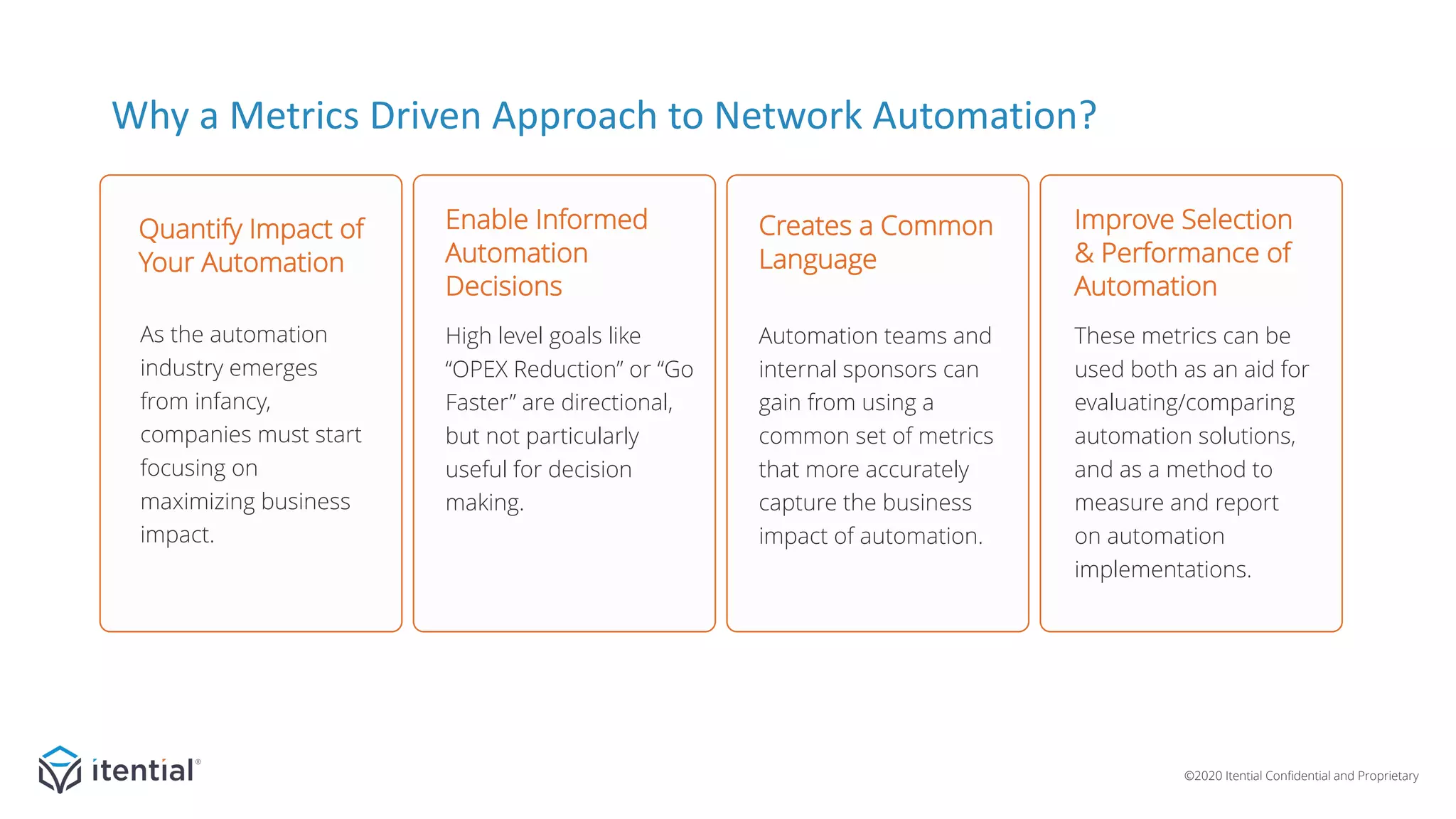
Improve Selection
& Performance of
Automation
These metrics can be
used both as an aid for
evaluating/comparing
automation solutions,
and as a method to
measure and report
on automation
implementations.
Creates a Common
Language
Automation teams and
internal sponsors can
gain from using a
common set of metrics
that more accurately
capture the business
impact of automation.
Enable Informed
Automation
Decisions
High level goals like
“OPEX Reduction” or “Go
Faster” are directional,
but not particularly
useful for decision
making.
Quantify Impact of
Your Automation
As the automation
industry emerges
from infancy,
companies must start
focusing on
maximizing business
impact.
Why a Metrics Driven Approach to Network Automation?
©2020 Itential Confidential and Proprietary
One-Offs are Easy, Factories are Not
It’s relatively easy to make a prototype but extremely difficult to
mass manufacture a vehicle reliably at scale…For cars it’s maybe
100 times harder to design the manufacturing system than the
car itself.
Elon Musk
”
“
©2020 Itential Confidential and Proprietary
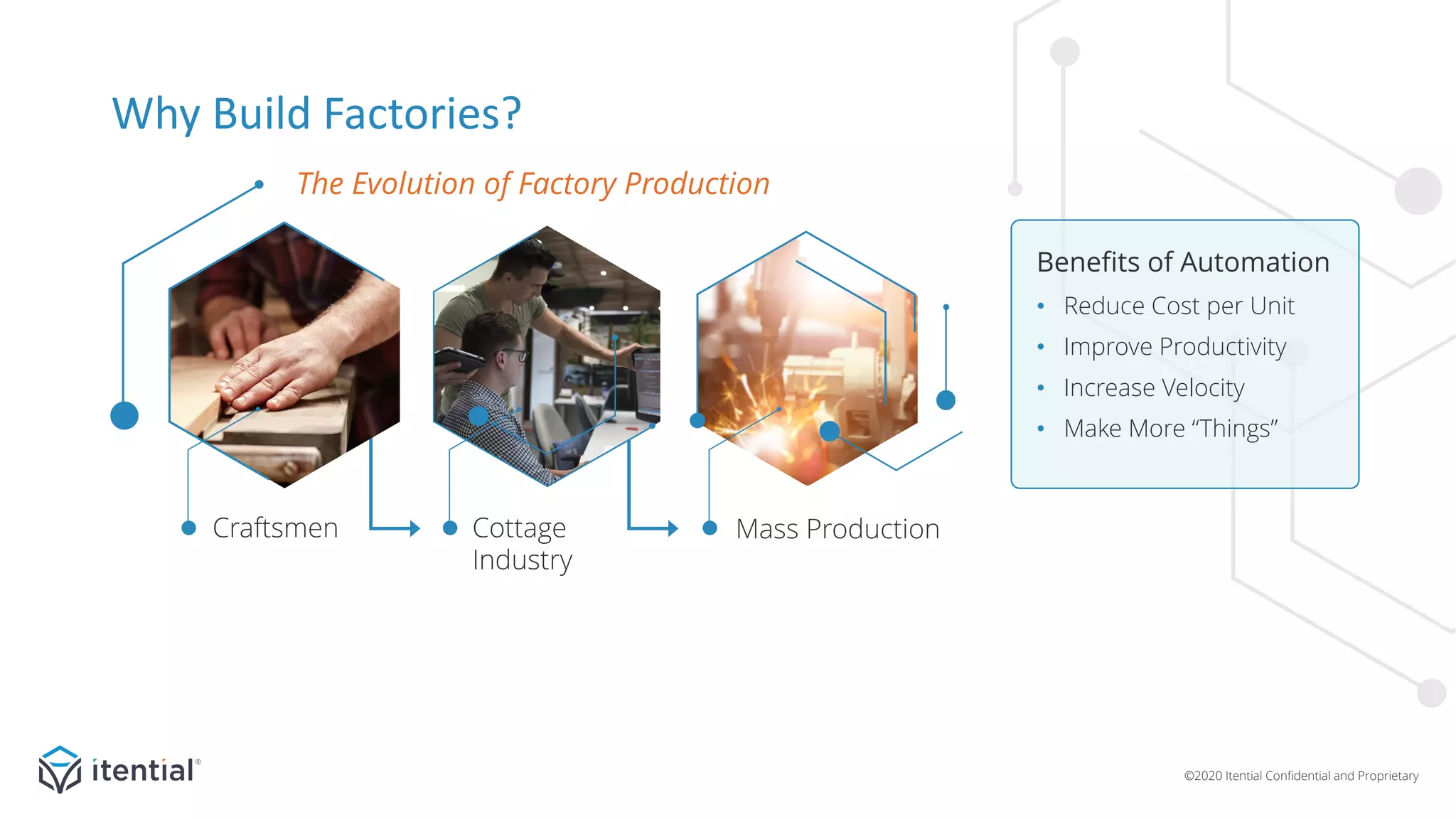
Why Build Factories?
Craftsmen Cottage
Industry
Mass Production
The Evolution of Factory Production
Benefits of Automation
• Reduce Cost per Unit
• Improve Productivity
• Increase Velocity
• Make More “Things”
©2020 Itential Confidential and Proprietary
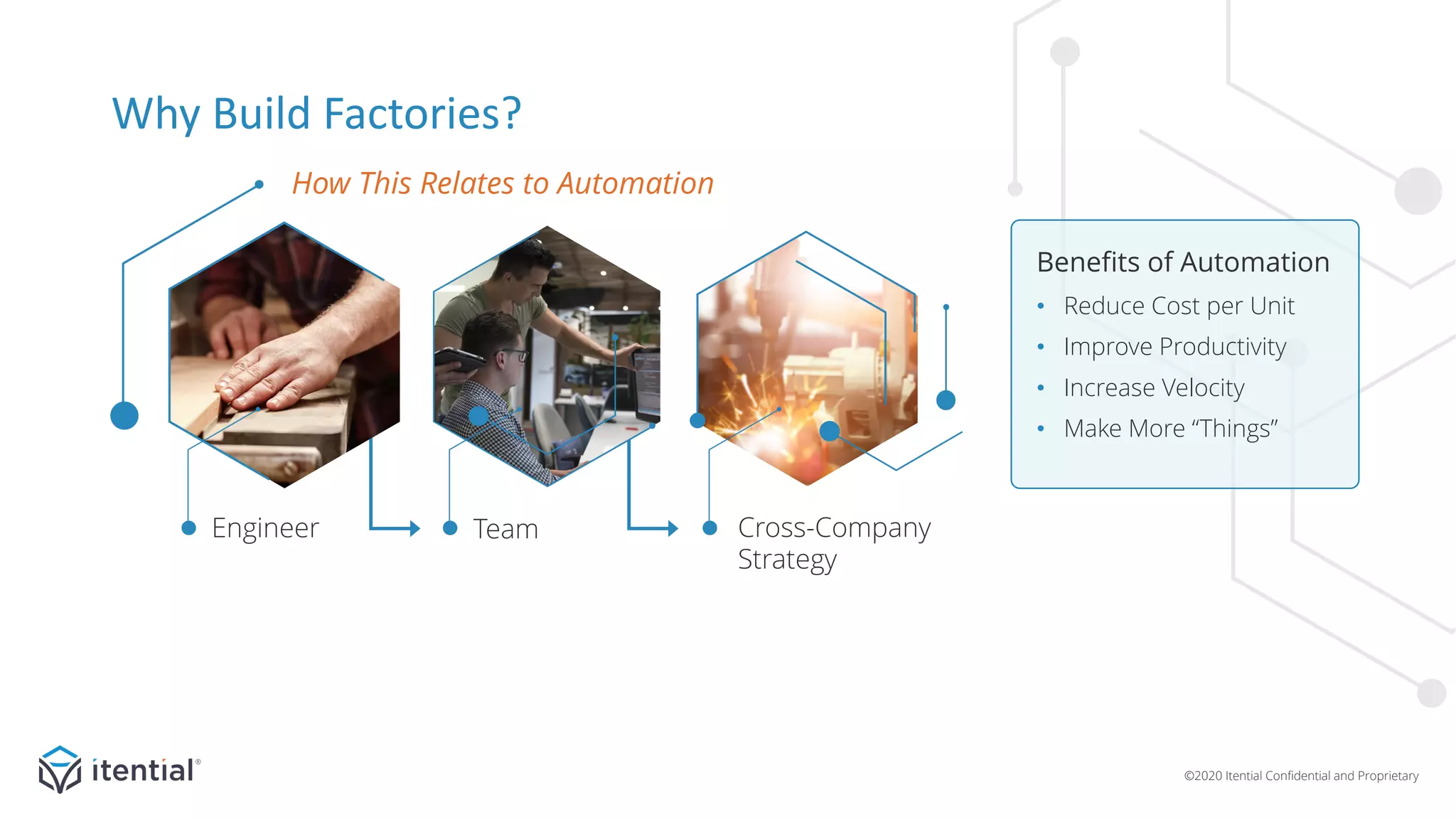
Engineer Team Cross-Company
Strategy
Why Build Factories?
How This Relates to Automation
Benefits of Automation
• Reduce Cost per Unit
• Improve Productivity
• Increase Velocity
• Make More “Things”
©2020 Itential Confidential and Proprietary
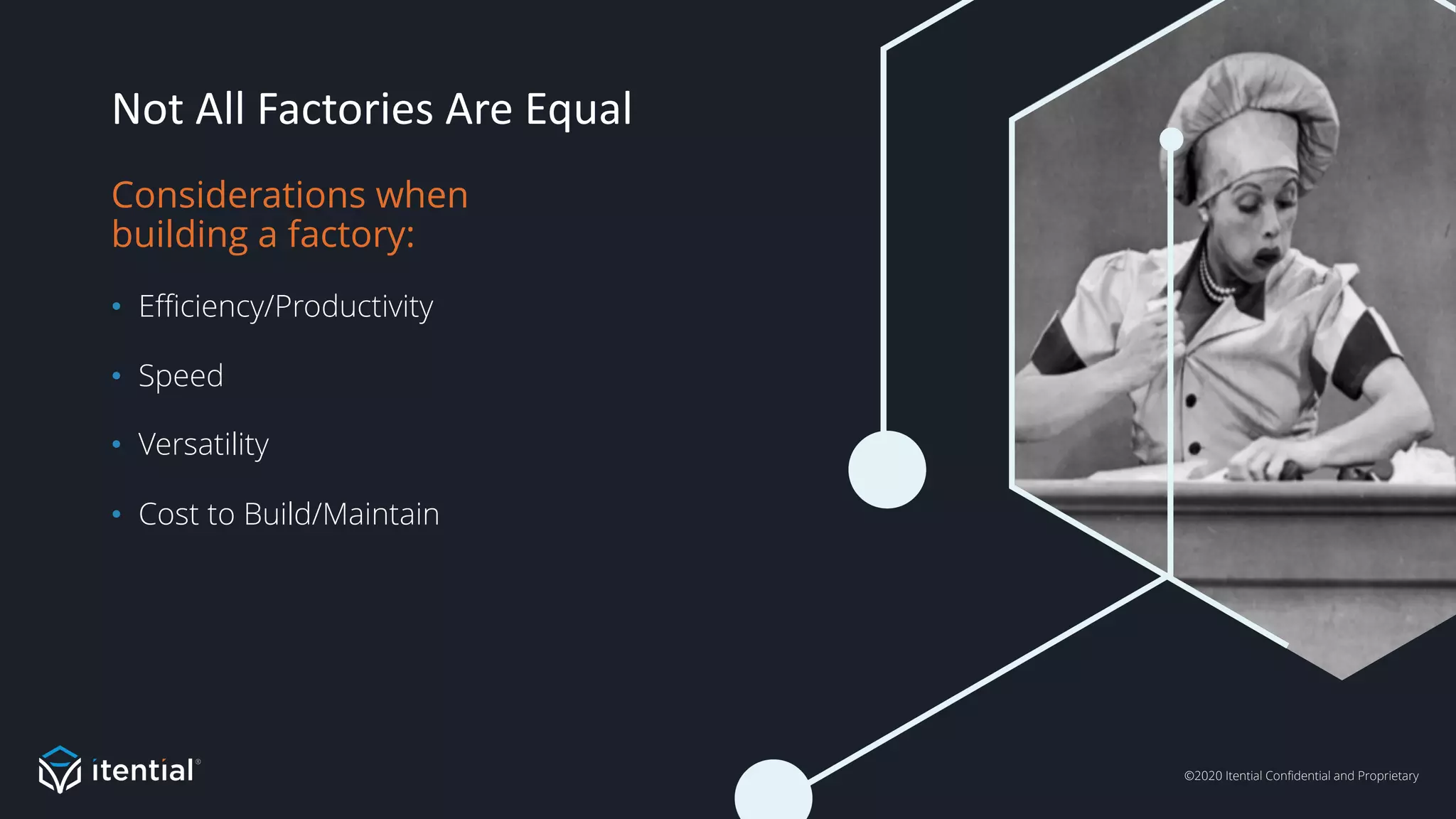
Not All Factories Are Equal
Considerations when
building a factory:
• Efficiency/Productivity
• Speed
• Versatility
• Cost to Build/Maintain
©2020 Itential Confidential and Proprietary
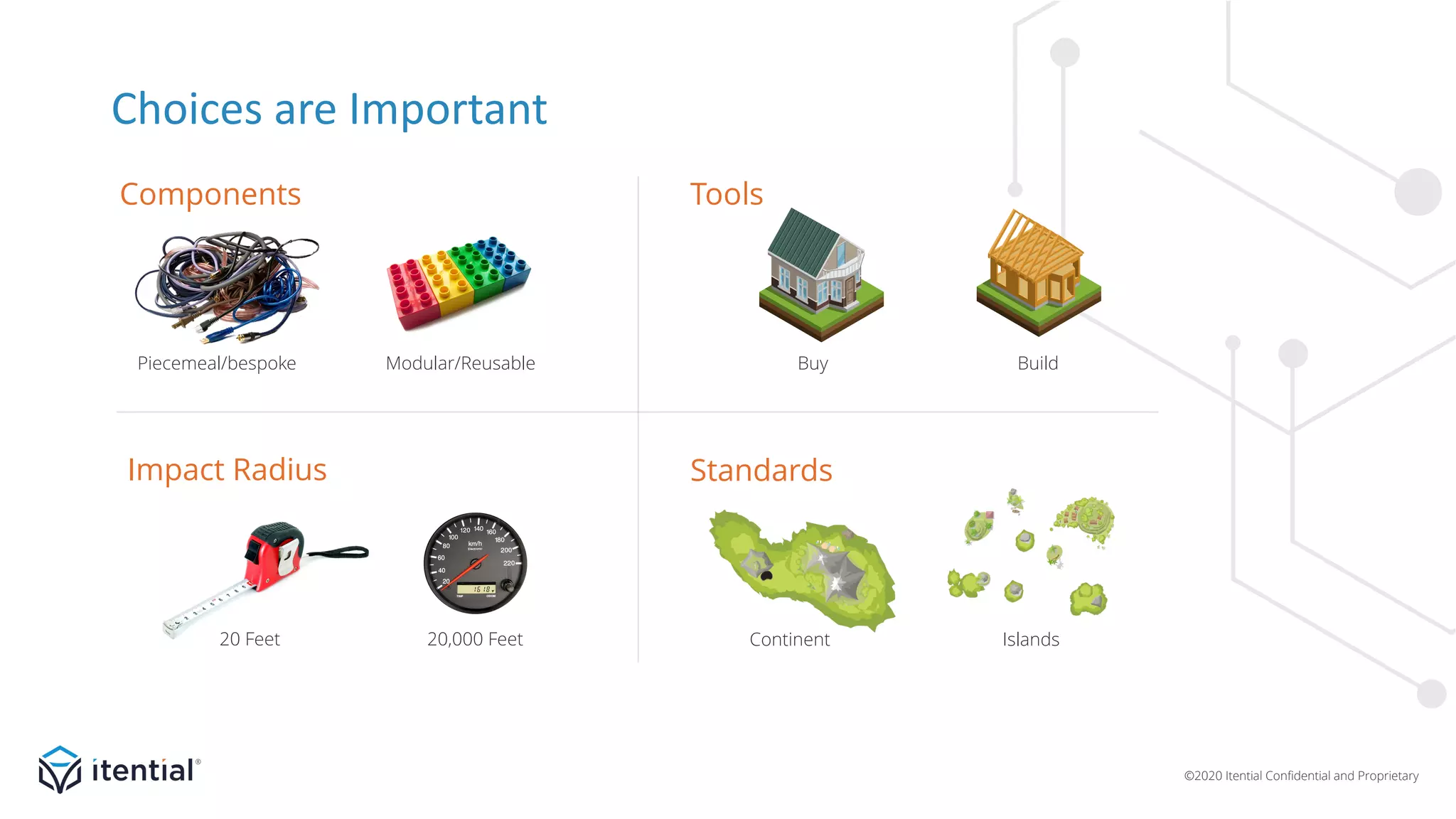
Choices are Important
Piecemeal/bespoke Modular/Reusable
Components
Buy Build
Tools
Continent Islands
Standards
20 Feet 20,000 Feet
Impact Radius
©2020 Itential Confidential and Proprietary
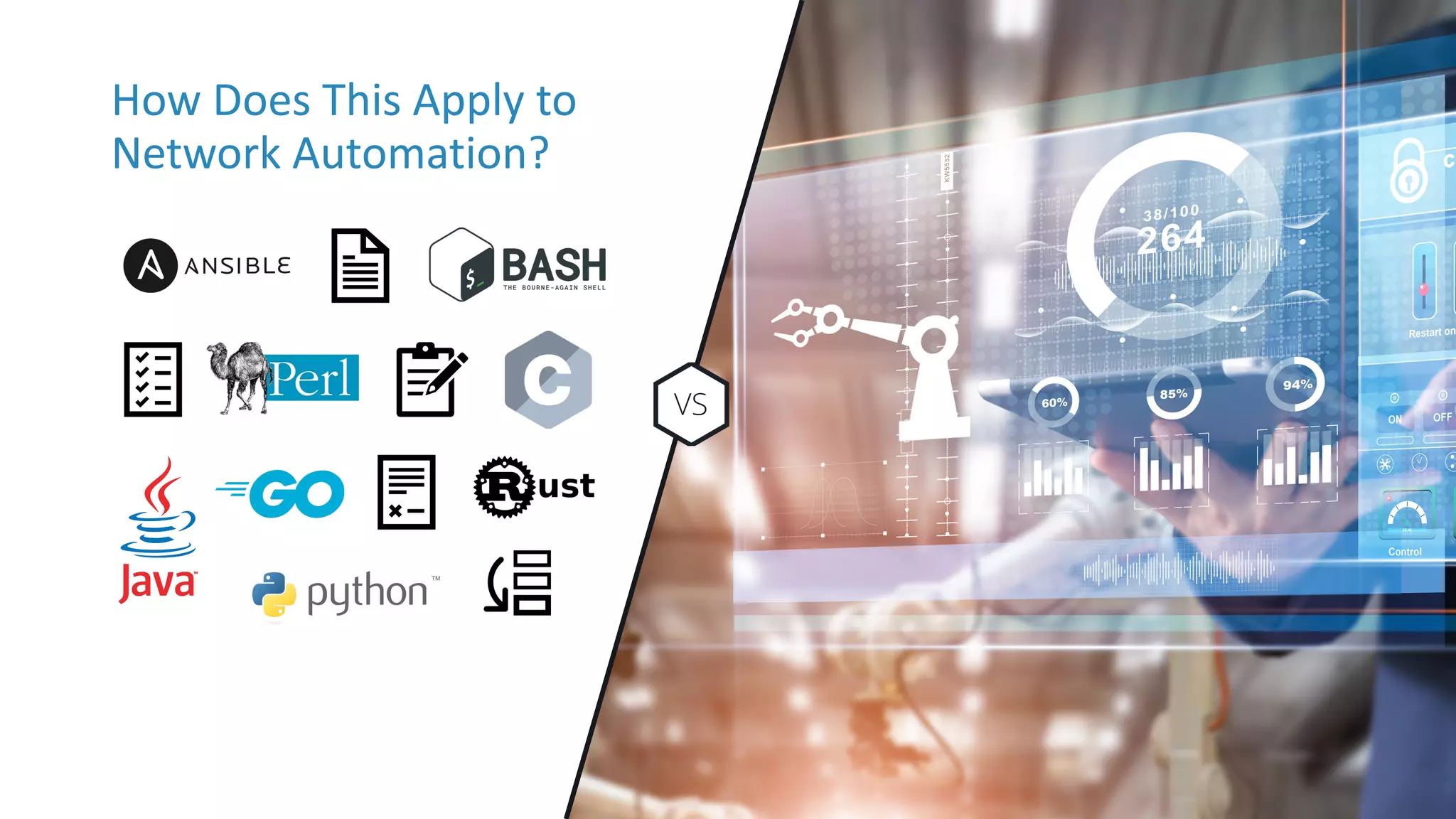
How Does This Apply to
Network Automation?
VS
©2020 Itential Confidential and Proprietary
Workload Unit Cost
Decision Criteria: Select the solution that will offer the lowest cost per unit of automation.
Efficiency/Productivity
Decision Criteria: Select the solution that maximizes the productivity of the workforce by focusing
on automation units/person.
Time-to-Complete
Decision Criteria: Select the solution that can provide the shortest start-to-finish, end-to-end
automation of the business process by automating the full process, not just the execution.
Versatility and Reach
Decision Criteria: Select the solution that offers the highest level of versatility, the ability to
maximize impact radius and to replicate existing tasks vs. ability to drive innovation.
Network Automation Metrics That
Maximize Business Value
©2020 Itential Confidential and Proprietary
Workload Unit Cost
Total Cost
Total Activities Completed
=
Total # of Activities performed over a sufficient time period
Total Costs vs. Incremental Costs
Both are important, but must look at total costs when making
the business case:
• Include the costs of systems, tools, and human effort
required to perform the activity.
• Include the costs to build and maintain the system, along
with the human effort, etc.
• Three or five year view is typical.
©2020 Itential Confidential and Proprietary
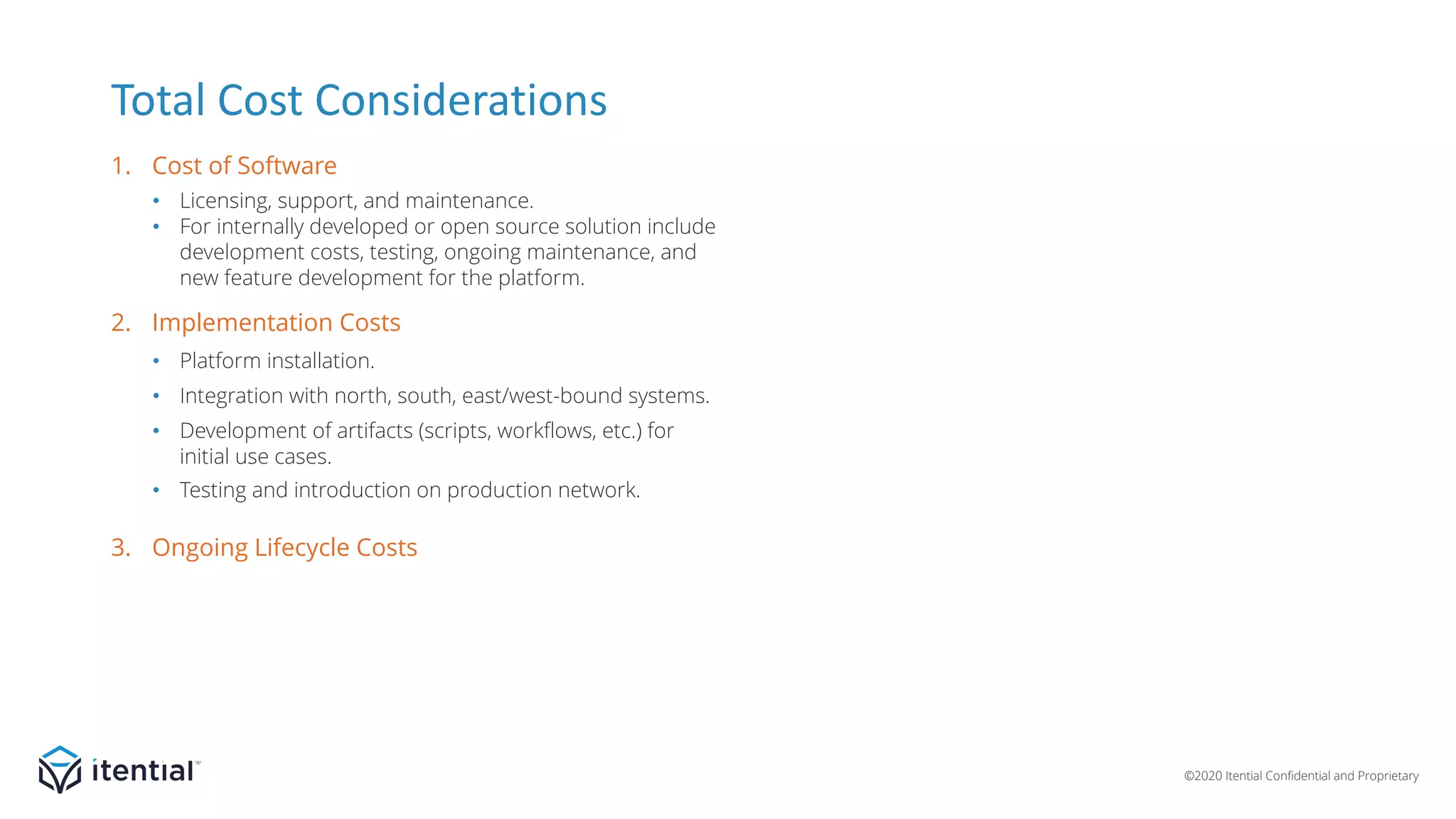
• Licensing, support, and maintenance.
• For internally developed or open source solution include
development costs, testing, ongoing maintenance, and
new feature development for the platform.
• Platform installation.
• Integration with north, south, east/west-bound systems.
• Development of artifacts (scripts, workflows, etc.) for
initial use cases.
• Testing and introduction on production network.
• Hardware/resources to host the system.
• Administration and management of platform.
• Development resources for developing new
artifacts and maintaining/updating existing artifacts.
• Capacity addition.
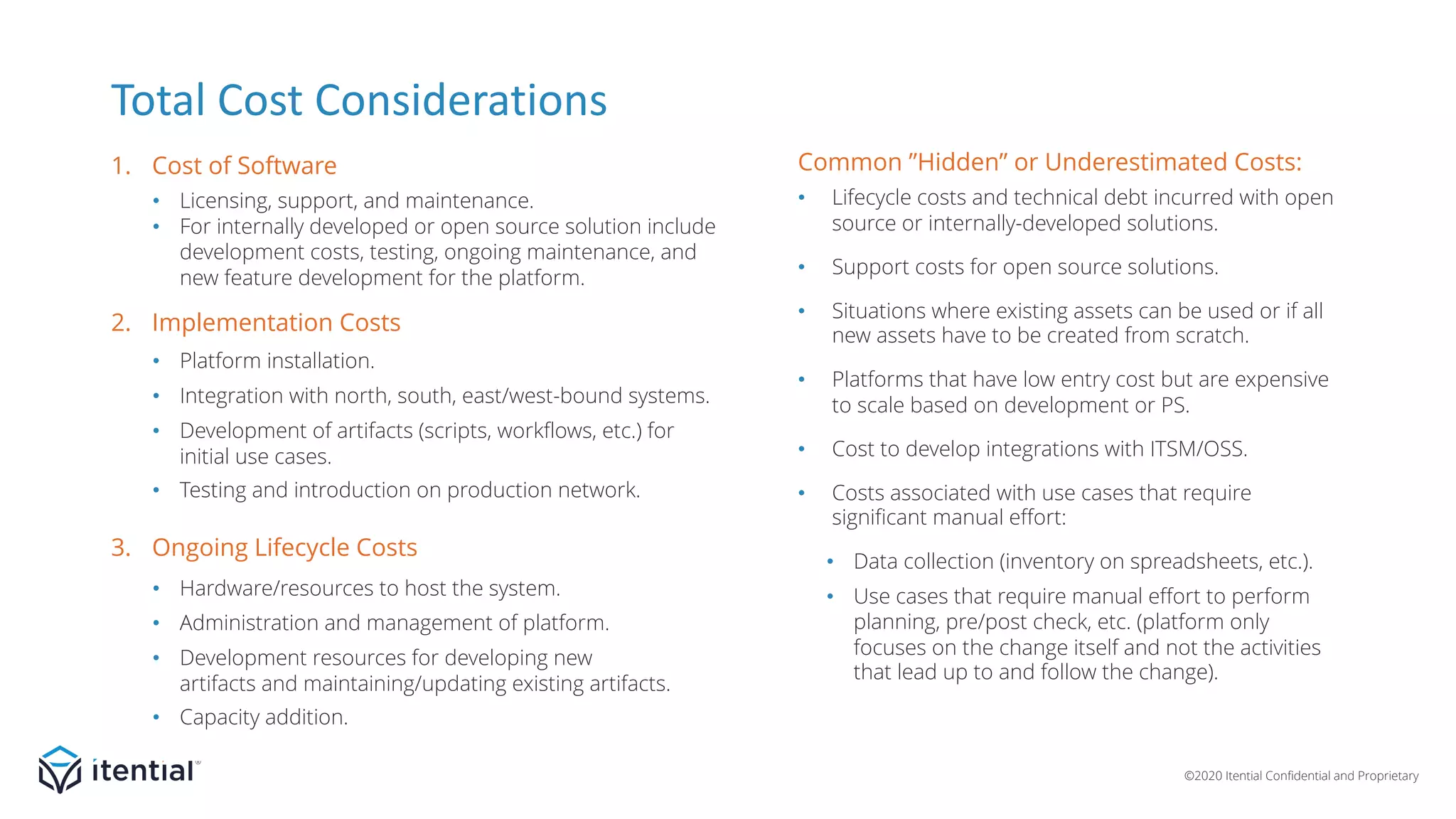
Total Cost Considerations
1. Cost of Software
3. Ongoing Lifecycle Costs
2. Implementation Costs
©2020 Itential Confidential and Proprietary
• Licensing, support, and maintenance.
• For internally developed or open source solution include
development costs, testing, ongoing maintenance, and
new feature development for the platform.
• Platform installation.
• Integration with north, south, east/west-bound systems.
• Development of artifacts (scripts, workflows, etc.) for
initial use cases.
• Testing and introduction on production network.
• Hardware/resources to host the system.
• Administration and management of platform.
• Development resources for developing new
artifacts and maintaining/updating existing artifacts.
• Capacity addition.
Total Cost Considerations
1. Cost of Software
3. Ongoing Lifecycle Costs
2. Implementation Costs
©2020 Itential Confidential and Proprietary
• Licensing, support, and maintenance.
• For internally developed or open source solution include
development costs, testing, ongoing maintenance, and
new feature development for the platform.
• Platform installation.
• Integration with north, south, east/west-bound systems.
• Development of artifacts (scripts, workflows, etc.) for
initial use cases.
• Testing and introduction on production network.
• Hardware/resources to host the system.
• Administration and management of platform.
• Development resources for developing new
artifacts and maintaining/updating existing artifacts.
• Capacity addition.
Total Cost Considerations
1. Cost of Software
3. Ongoing Lifecycle Costs
2. Implementation Costs
©2020 Itential Confidential and Proprietary
• Licensing, support, and maintenance.
• For internally developed or open source solution include
development costs, testing, ongoing maintenance, and
new feature development for the platform.
• Platform installation.
• Integration with north, south, east/west-bound systems.
• Development of artifacts (scripts, workflows, etc.) for
initial use cases.
• Testing and introduction on production network.
• Hardware/resources to host the system.
• Administration and management of platform.
• Development resources for developing new
artifacts and maintaining/updating existing artifacts.
• Capacity addition.
Total Cost Considerations
1. Cost of Software
3. Ongoing Lifecycle Costs
2. Implementation Costs
Common ”Hidden” or Underestimated Costs:
• Lifecycle costs and technical debt incurred with open
source or internally-developed solutions.
• Support costs for open source solutions.
• Situations where existing assets can be used or if all
new assets have to be created from scratch.
• Platforms that have low entry cost but are expensive
to scale based on development or PS.
• Cost to develop integrations with ITSM/OSS.
• Costs associated with use cases that require
significant manual effort:
• Data collection (inventory on spreadsheets, etc.).
• Use cases that require manual effort to perform
planning, pre/post check, etc. (platform only
focuses on the change itself and not the activities
that lead up to and follow the change).
©2020 Itential Confidential and Proprietary
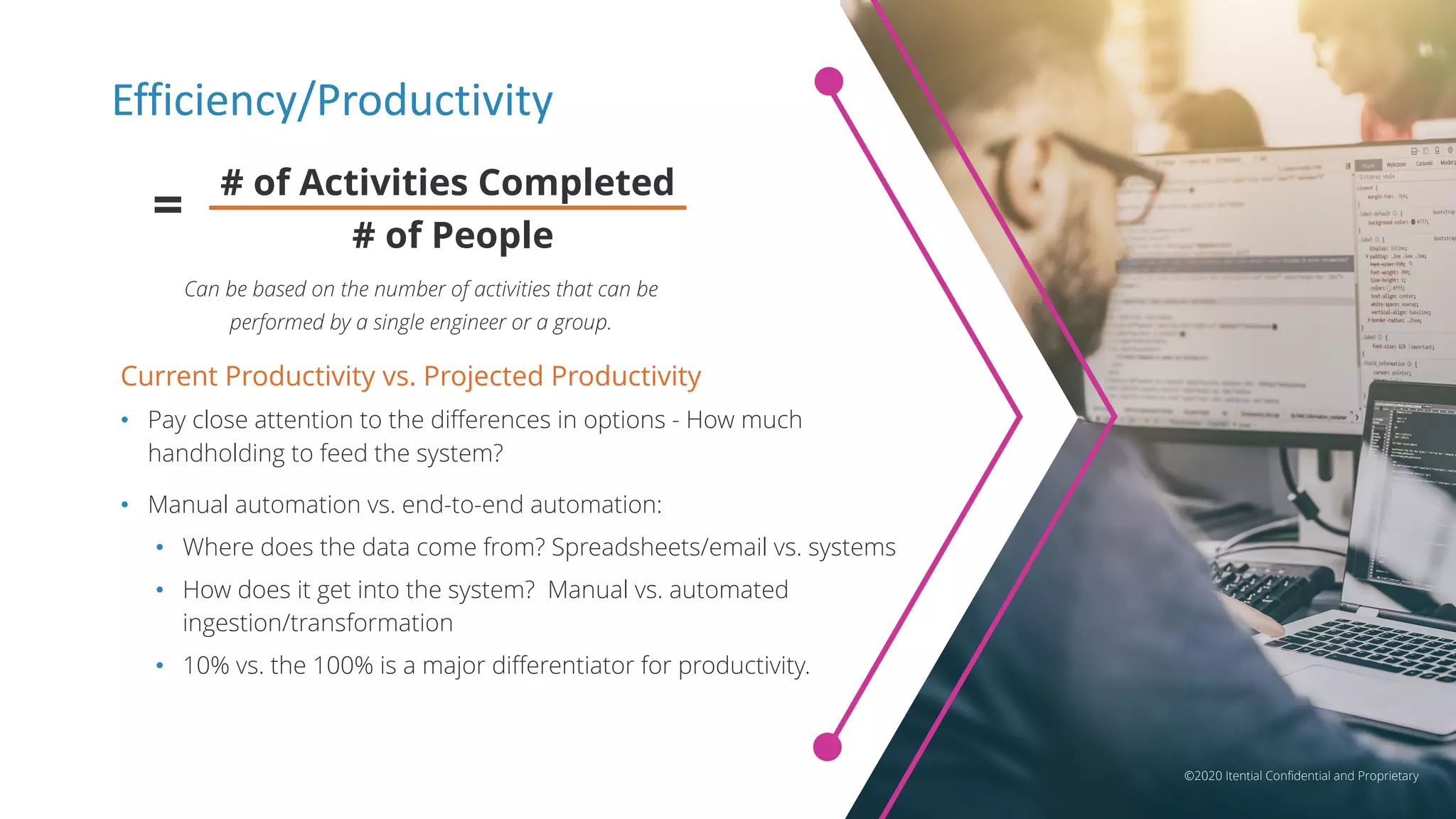
Efficiency/Productivity
Current Productivity vs. Projected Productivity
• Pay close attention to the differences in options - How much
handholding to feed the system?
• Manual automation vs. end-to-end automation:
• Where does the data come from? Spreadsheets/email vs. systems
• How does it get into the system? Manual vs. automated
ingestion/transformation
• 10% vs. the 100% is a major differentiator for productivity.
# of Activities Completed
# of People
=
Can be based on the number of activities that can be
performed by a single engineer or a group.
©2020 Itential Confidential and Proprietary
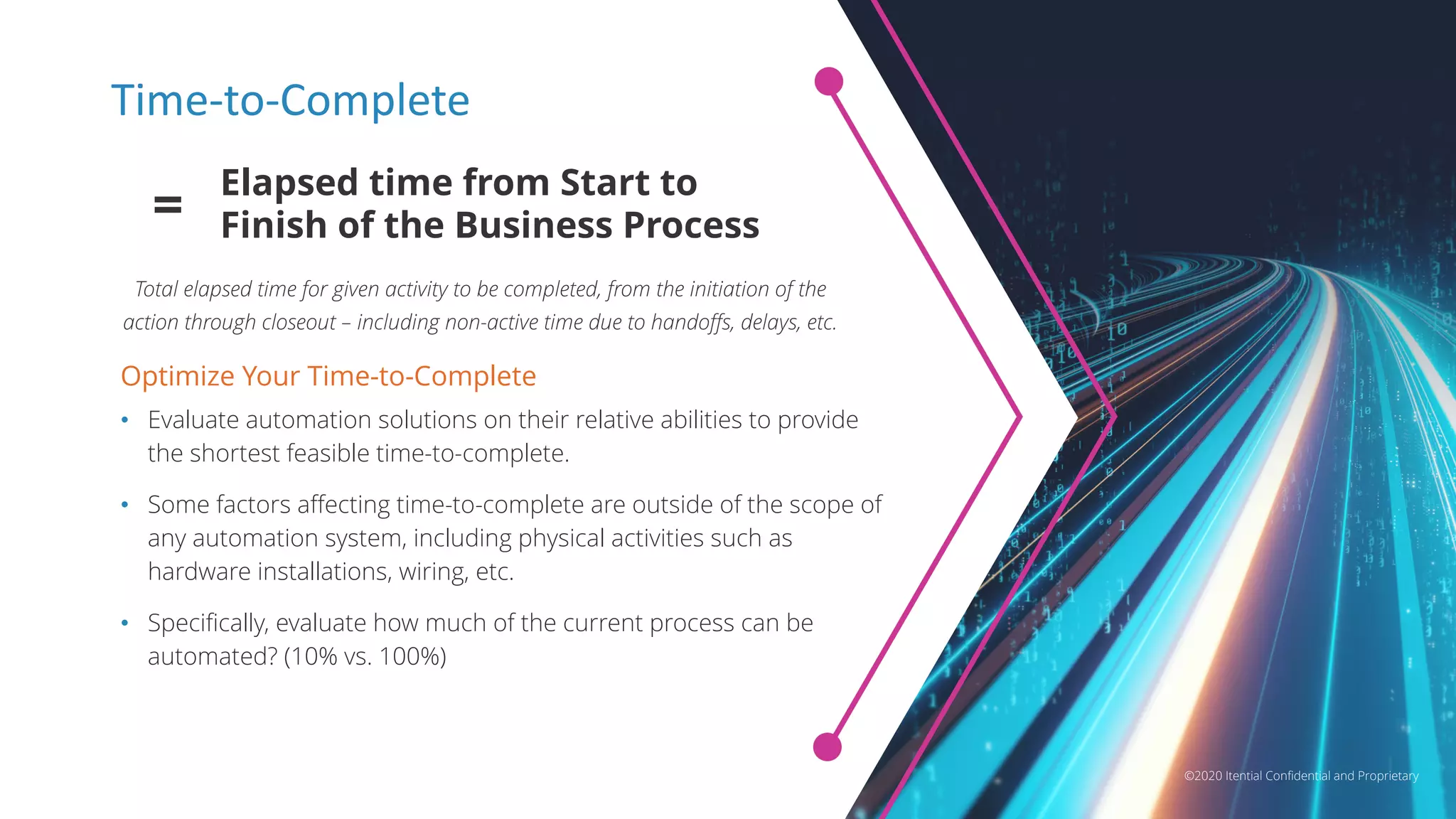
Time-to-Complete
Optimize Your Time-to-Complete
• Evaluate automation solutions on their relative abilities to provide
the shortest feasible time-to-complete.
• Some factors affecting time-to-complete are outside of the scope of
any automation system, including physical activities such as
hardware installations, wiring, etc.
• Specifically, evaluate how much of the current process can be
automated? (10% vs. 100%)
Elapsed time from Start to
Finish of the Business Process=
Total elapsed time for given activity to be completed, from the initiation of the
action through closeout – including non-active time due to handoffs, delays, etc.
©2020 Itential Confidential and Proprietary
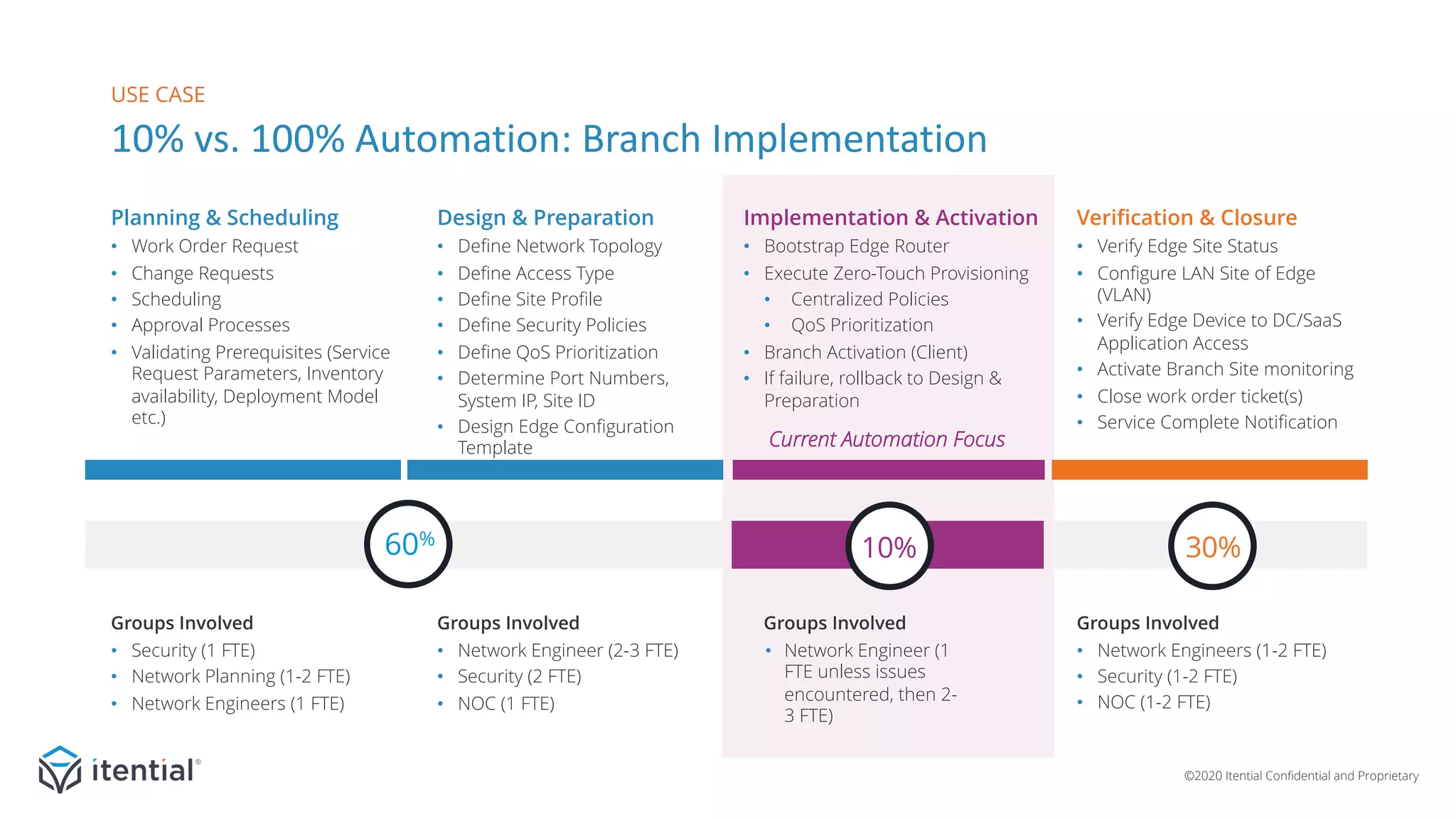
USE CASE
10% vs. 100% Automation: Branch Implementation
Planning & Scheduling
• Work Order Request
• Change Requests
• Scheduling
• Approval Processes
• Validating Prerequisites (Service
Request Parameters, Inventory
availability, Deployment Model
etc.)
Implementation & Activation
• Bootstrap Edge Router
• Execute Zero-Touch Provisioning
• Centralized Policies
• QoS Prioritization
• Branch Activation (Client)
• If failure, rollback to Design &
Preparation
Verification & Closure
• Verify Edge Site Status
• Configure LAN Site of Edge
(VLAN)
• Verify Edge Device to DC/SaaS
Application Access
• Activate Branch Site monitoring
• Close work order ticket(s)
• Service Complete Notification
Current Automation Focus
Design & Preparation
• Define Network Topology
• Define Access Type
• Define Site Profile
• Define Security Policies
• Define QoS Prioritization
• Determine Port Numbers,
System IP, Site ID
• Design Edge Configuration
Template
60%
10% 30%
Groups Involved
• Network Engineers (1-2 FTE)
• Security (1-2 FTE)
• NOC (1-2 FTE)
Groups Involved
• Network Engineer (1
FTE unless issues
encountered, then 2-
3 FTE)
Groups Involved
• Network Engineer (2-3 FTE)
• Security (2 FTE)
• NOC (1 FTE)
Groups Involved
• Security (1 FTE)
• Network Planning (1-2 FTE)
• Network Engineers (1 FTE)
©2020 Itential Confidential and Proprietary
Time-to-Complete Directly Impacts
Service Level Agreements
• Today’s SLAs are based on human-processes, and upon expectations of
reasonable timeframes for execution of tasks by humans.
• Automation provides ability to overperform on SLAs, creating opportunity for
incentives for timely execution.
• SLAs will and must evolve based on automation.
• The automation strategy should include a focus on providing data to the
automation team and the customers to:
• Demonstrate delivery performance within SLAs.
• Provide visibility to activities within the automation that may have high
variability and potential to negatively impact SLA compliance.
• Utilize data to develop new SLA structures based on automated processes.
©2020 Itential Confidential and Proprietary
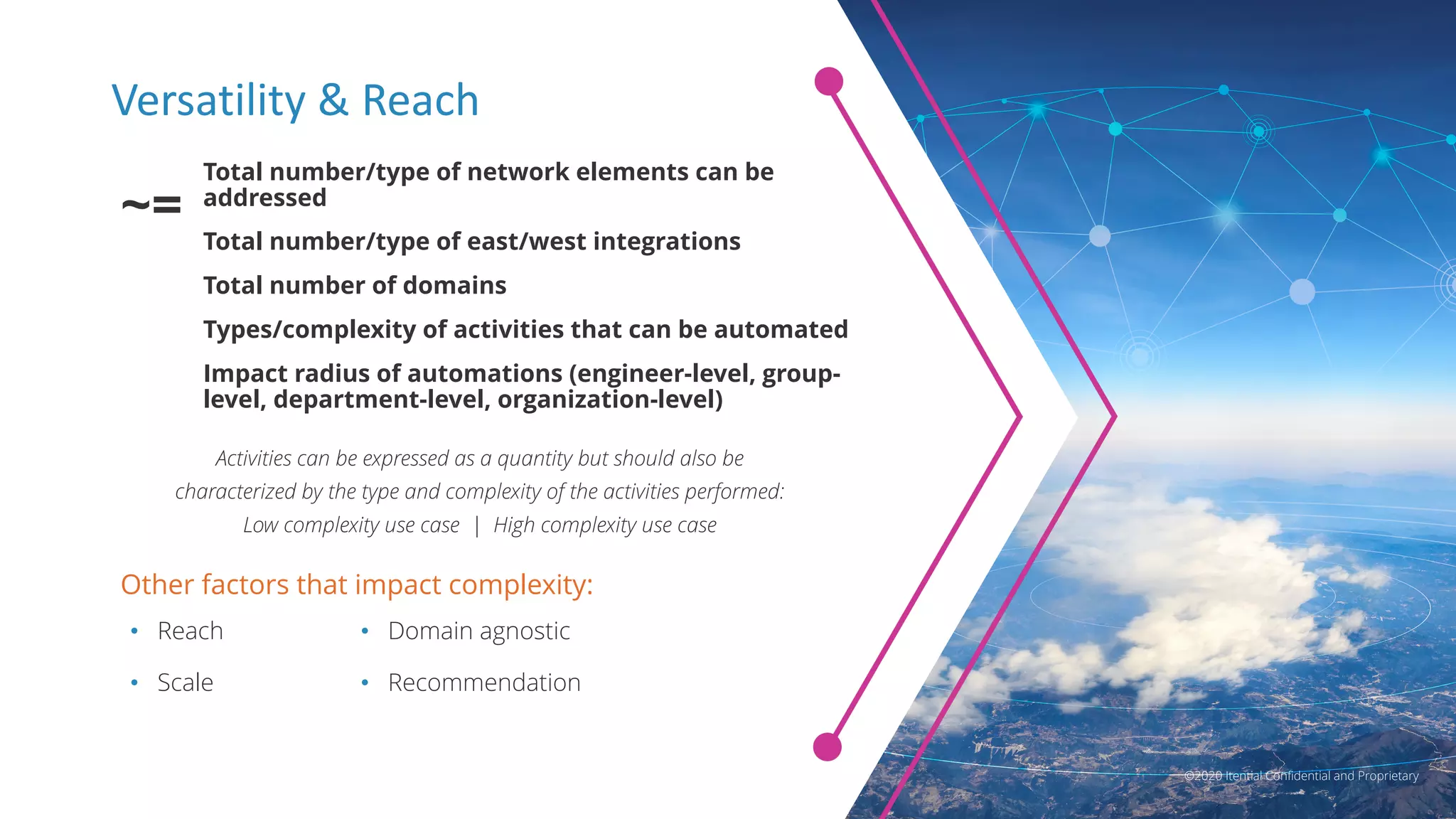
Versatility & Reach
Other factors that impact complexity:
Total number/type of network elements can be
addressed
Total number/type of east/west integrations
Total number of domains
Types/complexity of activities that can be automated
Impact radius of automations (engineer-level, group-
level, department-level, organization-level)
~=
Activities can be expressed as a quantity but should also be
characterized by the type and complexity of the activities performed:
Low complexity use case | High complexity use case
• Reach
• Scale
• Domain agnostic
• Recommendation
©2020 Itential Confidential and Proprietary
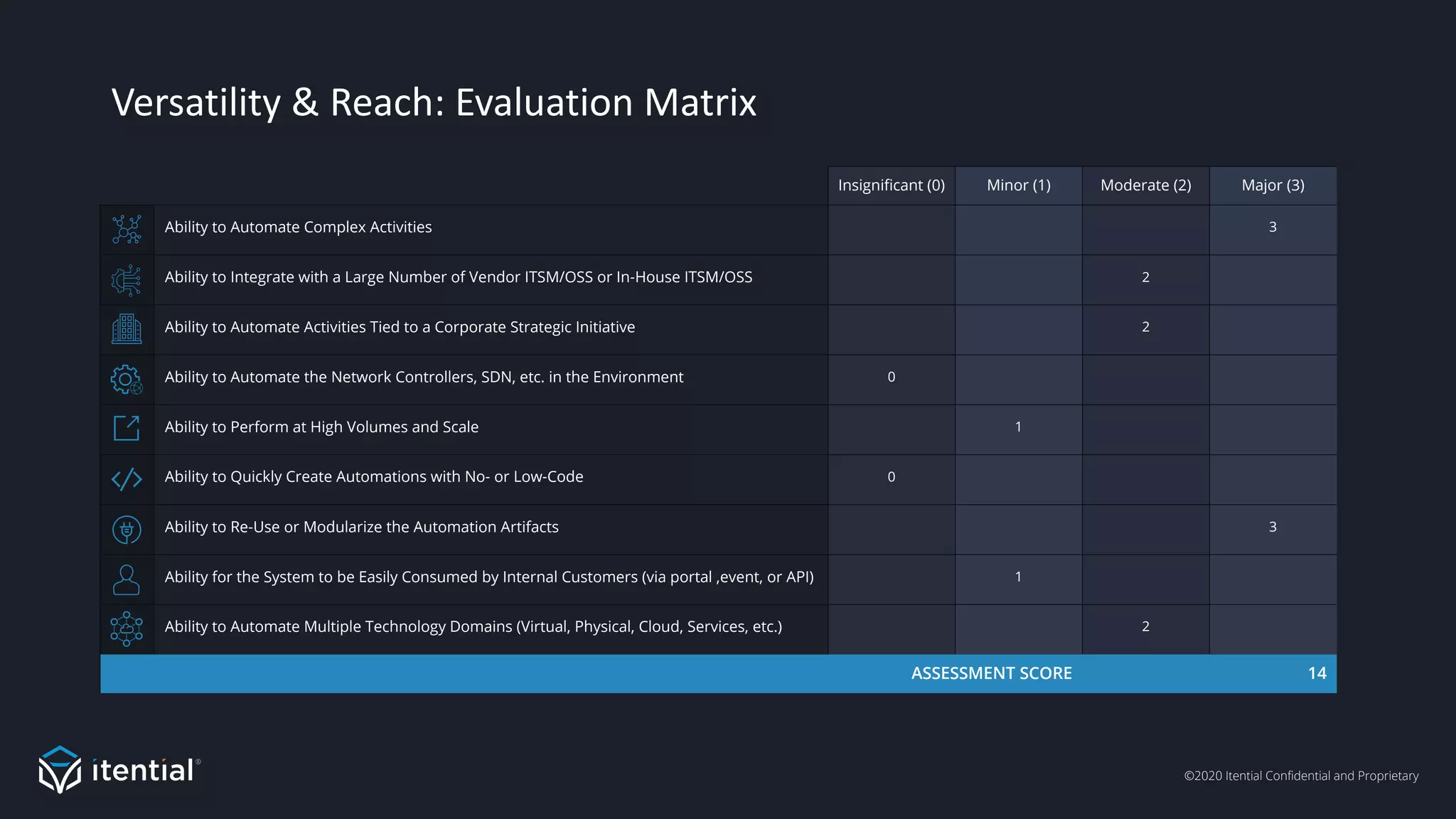
Versatility & Reach: Evaluation Matrix
Insignificant (0) Minor (1) Moderate (2) Major (3)
Ability to Automate Complex Activities 3
Ability to Integrate with a Large Number of Vendor ITSM/OSS or In-House ITSM/OSS 2
Ability to Automate Activities Tied to a Corporate Strategic Initiative 2
Ability to Automate the Network Controllers, SDN, etc. in the Environment 0
Ability to Perform at High Volumes and Scale 1
Ability to Quickly Create Automations with No- or Low-Code 0
Ability to Re-Use or Modularize the Automation Artifacts 3
Ability for the System to be Easily Consumed by Internal Customers (via portal ,event, or API) 1
Ability to Automate Multiple Technology Domains (Virtual, Physical, Cloud, Services, etc.) 2
ASSESSMENT SCORE 14
©2020 Itential Confidential and Proprietary
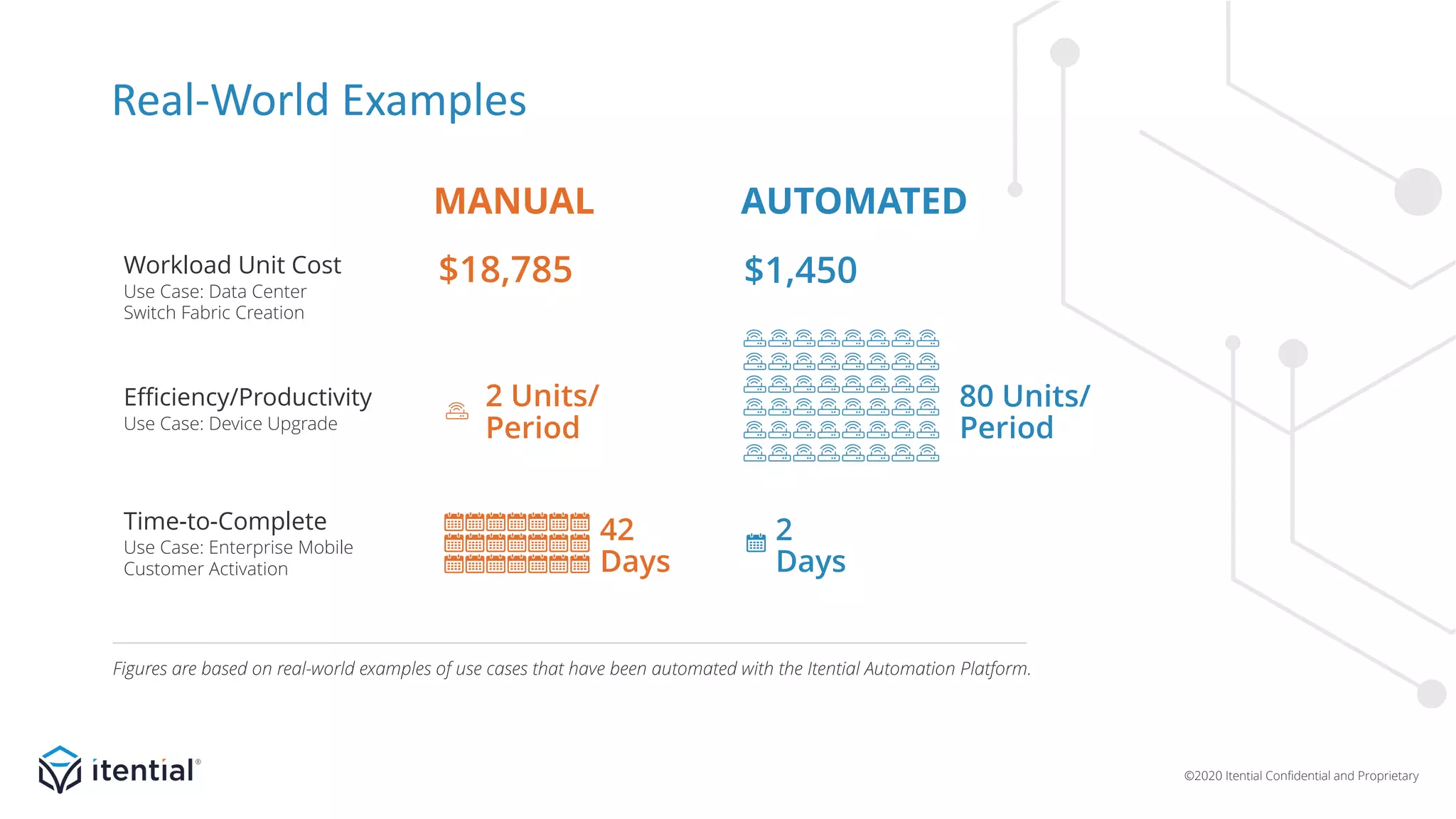
Real-World Examples
Figures are based on real-world examples of use cases that have been automated with the Itential Automation Platform.
MANUAL AUTOMATED
42
Days
Workload Unit Cost
Use Case: Data Center
Switch Fabric Creation
2 Units/
Period
80 Units/
Period
$18,785 $1,450
Efficiency/Productivity
Use Case: Device Upgrade
Time-to-Complete
Use Case: Enterprise Mobile
Customer Activation
2
Days
©2020 Itential Confidential and Proprietary
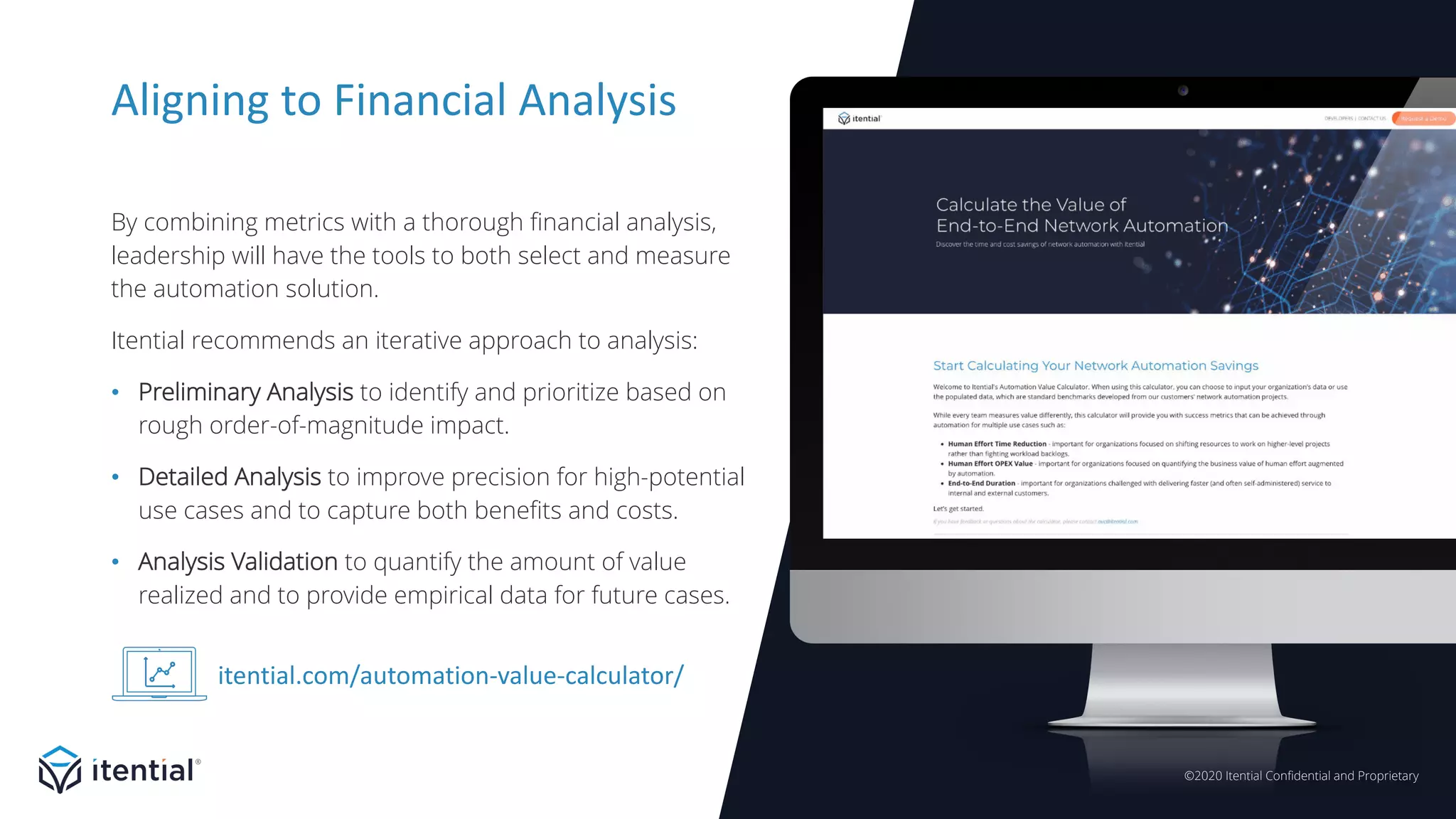
Aligning to Financial Analysis
By combining metrics with a thorough financial analysis,
leadership will have the tools to both select and measure
the automation solution.
Itential recommends an iterative approach to analysis:
• Preliminary Analysis to identify and prioritize based on
rough order-of-magnitude impact.
• Detailed Analysis to improve precision for high-potential
use cases and to capture both benefits and costs.
• Analysis Validation to quantify the amount of value
realized and to provide empirical data for future cases.
itential.com/automation-value-calculator/
©2020 Itential Confidential and Proprietary
How to Use the Metrics
Consider the following for your automation approach:
Workload Unit Cost: Does the capacity and cost of the option provide the lowest Workload Unit Cost?
Time-to-Complete: Does this option have the ability and connectivity to optimize time-to-complete?
Productivity/Efficiency: Does this option require heavy human interaction or can it run unattended
and maximize productivity?
Versatility/Reach: Does this option have the capability to touch as much of the network and business
as possible? Can it automate the variety of use cases required by the business?
Communicate with business leadership for measuring and managing the business:
1. Include metrics in the business justification.
2. Set targets for the automation initiatives.
3. Measure results and provide feedback to leadership.
4. Use the results to inform direction and decisions to grow automation.
©2020 Itential Confidential and Proprietary
Workload Unit Cost
Efficiency / Productivity
Takeaways
• Automation provides opportunities to re-engineer business processes and move away from human-centric
process models to machine-centric in order to maximize business value.
• Evolving automation into a mass production model provides a framework for evaluating and measuring options.
• The key metrics that organizations should consider when evaluating automation solutions are:
Metrics + financial analysis provide the tools for executives to:
• Make Choices
• Measure Performance
• Approve Investments
Time-to-Complete
Versatility & Reach
©2020 Itential Confidential and Proprietary
Q / A
info@itential.com
twitter.com/itentialdeveloper.itential.io
itential.com

Measuring and Maximizing the Business Impact of Network Automation

  • 1.
    Measuring & Maximizingthe Business Impact of Network Automation How to create opportunities for greater business transformation and growth with a metric-driven automation strategy. Morgan Stern VP of Automation Strategy, Itential WEBINAR
  • 2.
    ©2020 Itential Confidentialand Proprietary How to use the metrics in planning and operations What You Will Learn Why metrics are critical for network automation to evolve How mass production relates to network automation The impact that choices have on business value The four key metrics for network automation Real world examples metrics in action 01 02 03 04 05 06
  • 3.
    ©2020 Itential Confidentialand Proprietary Improve Selection & Performance of Automation These metrics can be used both as an aid for evaluating/comparing automation solutions, and as a method to measure and report on automation implementations. Creates a Common Language Automation teams and internal sponsors can gain from using a common set of metrics that more accurately capture the business impact of automation. Enable Informed Automation Decisions High level goals like “OPEX Reduction” or “Go Faster” are directional, but not particularly useful for decision making. Quantify Impact of Your Automation As the automation industry emerges from infancy, companies must start focusing on maximizing business impact. Why a Metrics Driven Approach to Network Automation?
  • 4.
    ©2020 Itential Confidentialand Proprietary One-Offs are Easy, Factories are Not It’s relatively easy to make a prototype but extremely difficult to mass manufacture a vehicle reliably at scale…For cars it’s maybe 100 times harder to design the manufacturing system than the car itself. Elon Musk ” “
  • 5.
    ©2020 Itential Confidentialand Proprietary Why Build Factories? Craftsmen Cottage Industry Mass Production The Evolution of Factory Production Benefits of Automation • Reduce Cost per Unit • Improve Productivity • Increase Velocity • Make More “Things”
  • 6.
    ©2020 Itential Confidentialand Proprietary Engineer Team Cross-Company Strategy Why Build Factories? How This Relates to Automation Benefits of Automation • Reduce Cost per Unit • Improve Productivity • Increase Velocity • Make More “Things”
  • 7.
    ©2020 Itential Confidentialand Proprietary Not All Factories Are Equal Considerations when building a factory: • Efficiency/Productivity • Speed • Versatility • Cost to Build/Maintain
  • 8.
    ©2020 Itential Confidentialand Proprietary Choices are Important Piecemeal/bespoke Modular/Reusable Components Buy Build Tools Continent Islands Standards 20 Feet 20,000 Feet Impact Radius
  • 9.
    ©2020 Itential Confidentialand Proprietary How Does This Apply to Network Automation? VS
  • 10.
    ©2020 Itential Confidentialand Proprietary Workload Unit Cost Decision Criteria: Select the solution that will offer the lowest cost per unit of automation. Efficiency/Productivity Decision Criteria: Select the solution that maximizes the productivity of the workforce by focusing on automation units/person. Time-to-Complete Decision Criteria: Select the solution that can provide the shortest start-to-finish, end-to-end automation of the business process by automating the full process, not just the execution. Versatility and Reach Decision Criteria: Select the solution that offers the highest level of versatility, the ability to maximize impact radius and to replicate existing tasks vs. ability to drive innovation. Network Automation Metrics That Maximize Business Value
  • 11.
    ©2020 Itential Confidentialand Proprietary Workload Unit Cost Total Cost Total Activities Completed = Total # of Activities performed over a sufficient time period Total Costs vs. Incremental Costs Both are important, but must look at total costs when making the business case: • Include the costs of systems, tools, and human effort required to perform the activity. • Include the costs to build and maintain the system, along with the human effort, etc. • Three or five year view is typical. ©2020 Itential Confidential and Proprietary
  • 12.
    ©2020 Itential Confidentialand Proprietary • Licensing, support, and maintenance. • For internally developed or open source solution include development costs, testing, ongoing maintenance, and new feature development for the platform. • Platform installation. • Integration with north, south, east/west-bound systems. • Development of artifacts (scripts, workflows, etc.) for initial use cases. • Testing and introduction on production network. • Hardware/resources to host the system. • Administration and management of platform. • Development resources for developing new artifacts and maintaining/updating existing artifacts. • Capacity addition. Total Cost Considerations 1. Cost of Software 3. Ongoing Lifecycle Costs 2. Implementation Costs
  • 13.
    ©2020 Itential Confidentialand Proprietary • Licensing, support, and maintenance. • For internally developed or open source solution include development costs, testing, ongoing maintenance, and new feature development for the platform. • Platform installation. • Integration with north, south, east/west-bound systems. • Development of artifacts (scripts, workflows, etc.) for initial use cases. • Testing and introduction on production network. • Hardware/resources to host the system. • Administration and management of platform. • Development resources for developing new artifacts and maintaining/updating existing artifacts. • Capacity addition. Total Cost Considerations 1. Cost of Software 3. Ongoing Lifecycle Costs 2. Implementation Costs
  • 14.
    ©2020 Itential Confidentialand Proprietary • Licensing, support, and maintenance. • For internally developed or open source solution include development costs, testing, ongoing maintenance, and new feature development for the platform. • Platform installation. • Integration with north, south, east/west-bound systems. • Development of artifacts (scripts, workflows, etc.) for initial use cases. • Testing and introduction on production network. • Hardware/resources to host the system. • Administration and management of platform. • Development resources for developing new artifacts and maintaining/updating existing artifacts. • Capacity addition. Total Cost Considerations 1. Cost of Software 3. Ongoing Lifecycle Costs 2. Implementation Costs
  • 15.
    ©2020 Itential Confidentialand Proprietary • Licensing, support, and maintenance. • For internally developed or open source solution include development costs, testing, ongoing maintenance, and new feature development for the platform. • Platform installation. • Integration with north, south, east/west-bound systems. • Development of artifacts (scripts, workflows, etc.) for initial use cases. • Testing and introduction on production network. • Hardware/resources to host the system. • Administration and management of platform. • Development resources for developing new artifacts and maintaining/updating existing artifacts. • Capacity addition. Total Cost Considerations 1. Cost of Software 3. Ongoing Lifecycle Costs 2. Implementation Costs Common ”Hidden” or Underestimated Costs: • Lifecycle costs and technical debt incurred with open source or internally-developed solutions. • Support costs for open source solutions. • Situations where existing assets can be used or if all new assets have to be created from scratch. • Platforms that have low entry cost but are expensive to scale based on development or PS. • Cost to develop integrations with ITSM/OSS. • Costs associated with use cases that require significant manual effort: • Data collection (inventory on spreadsheets, etc.). • Use cases that require manual effort to perform planning, pre/post check, etc. (platform only focuses on the change itself and not the activities that lead up to and follow the change).
  • 16.
    ©2020 Itential Confidentialand Proprietary Efficiency/Productivity Current Productivity vs. Projected Productivity • Pay close attention to the differences in options - How much handholding to feed the system? • Manual automation vs. end-to-end automation: • Where does the data come from? Spreadsheets/email vs. systems • How does it get into the system? Manual vs. automated ingestion/transformation • 10% vs. the 100% is a major differentiator for productivity. # of Activities Completed # of People = Can be based on the number of activities that can be performed by a single engineer or a group. ©2020 Itential Confidential and Proprietary
  • 17.
    ©2020 Itential Confidentialand Proprietary Time-to-Complete Optimize Your Time-to-Complete • Evaluate automation solutions on their relative abilities to provide the shortest feasible time-to-complete. • Some factors affecting time-to-complete are outside of the scope of any automation system, including physical activities such as hardware installations, wiring, etc. • Specifically, evaluate how much of the current process can be automated? (10% vs. 100%) Elapsed time from Start to Finish of the Business Process= Total elapsed time for given activity to be completed, from the initiation of the action through closeout – including non-active time due to handoffs, delays, etc. ©2020 Itential Confidential and Proprietary
  • 18.
    ©2020 Itential Confidentialand Proprietary USE CASE 10% vs. 100% Automation: Branch Implementation Planning & Scheduling • Work Order Request • Change Requests • Scheduling • Approval Processes • Validating Prerequisites (Service Request Parameters, Inventory availability, Deployment Model etc.) Implementation & Activation • Bootstrap Edge Router • Execute Zero-Touch Provisioning • Centralized Policies • QoS Prioritization • Branch Activation (Client) • If failure, rollback to Design & Preparation Verification & Closure • Verify Edge Site Status • Configure LAN Site of Edge (VLAN) • Verify Edge Device to DC/SaaS Application Access • Activate Branch Site monitoring • Close work order ticket(s) • Service Complete Notification Current Automation Focus Design & Preparation • Define Network Topology • Define Access Type • Define Site Profile • Define Security Policies • Define QoS Prioritization • Determine Port Numbers, System IP, Site ID • Design Edge Configuration Template 60% 10% 30% Groups Involved • Network Engineers (1-2 FTE) • Security (1-2 FTE) • NOC (1-2 FTE) Groups Involved • Network Engineer (1 FTE unless issues encountered, then 2- 3 FTE) Groups Involved • Network Engineer (2-3 FTE) • Security (2 FTE) • NOC (1 FTE) Groups Involved • Security (1 FTE) • Network Planning (1-2 FTE) • Network Engineers (1 FTE)
  • 19.
    ©2020 Itential Confidentialand Proprietary Time-to-Complete Directly Impacts Service Level Agreements • Today’s SLAs are based on human-processes, and upon expectations of reasonable timeframes for execution of tasks by humans. • Automation provides ability to overperform on SLAs, creating opportunity for incentives for timely execution. • SLAs will and must evolve based on automation. • The automation strategy should include a focus on providing data to the automation team and the customers to: • Demonstrate delivery performance within SLAs. • Provide visibility to activities within the automation that may have high variability and potential to negatively impact SLA compliance. • Utilize data to develop new SLA structures based on automated processes.
  • 20.
    ©2020 Itential Confidentialand Proprietary Versatility & Reach Other factors that impact complexity: Total number/type of network elements can be addressed Total number/type of east/west integrations Total number of domains Types/complexity of activities that can be automated Impact radius of automations (engineer-level, group- level, department-level, organization-level) ~= Activities can be expressed as a quantity but should also be characterized by the type and complexity of the activities performed: Low complexity use case | High complexity use case • Reach • Scale • Domain agnostic • Recommendation ©2020 Itential Confidential and Proprietary
  • 21.
    ©2020 Itential Confidentialand Proprietary Versatility & Reach: Evaluation Matrix Insignificant (0) Minor (1) Moderate (2) Major (3) Ability to Automate Complex Activities 3 Ability to Integrate with a Large Number of Vendor ITSM/OSS or In-House ITSM/OSS 2 Ability to Automate Activities Tied to a Corporate Strategic Initiative 2 Ability to Automate the Network Controllers, SDN, etc. in the Environment 0 Ability to Perform at High Volumes and Scale 1 Ability to Quickly Create Automations with No- or Low-Code 0 Ability to Re-Use or Modularize the Automation Artifacts 3 Ability for the System to be Easily Consumed by Internal Customers (via portal ,event, or API) 1 Ability to Automate Multiple Technology Domains (Virtual, Physical, Cloud, Services, etc.) 2 ASSESSMENT SCORE 14
  • 22.
    ©2020 Itential Confidentialand Proprietary Real-World Examples Figures are based on real-world examples of use cases that have been automated with the Itential Automation Platform. MANUAL AUTOMATED 42 Days Workload Unit Cost Use Case: Data Center Switch Fabric Creation 2 Units/ Period 80 Units/ Period $18,785 $1,450 Efficiency/Productivity Use Case: Device Upgrade Time-to-Complete Use Case: Enterprise Mobile Customer Activation 2 Days
  • 23.
    ©2020 Itential Confidentialand Proprietary Aligning to Financial Analysis By combining metrics with a thorough financial analysis, leadership will have the tools to both select and measure the automation solution. Itential recommends an iterative approach to analysis: • Preliminary Analysis to identify and prioritize based on rough order-of-magnitude impact. • Detailed Analysis to improve precision for high-potential use cases and to capture both benefits and costs. • Analysis Validation to quantify the amount of value realized and to provide empirical data for future cases. itential.com/automation-value-calculator/
  • 24.
    ©2020 Itential Confidentialand Proprietary How to Use the Metrics Consider the following for your automation approach: Workload Unit Cost: Does the capacity and cost of the option provide the lowest Workload Unit Cost? Time-to-Complete: Does this option have the ability and connectivity to optimize time-to-complete? Productivity/Efficiency: Does this option require heavy human interaction or can it run unattended and maximize productivity? Versatility/Reach: Does this option have the capability to touch as much of the network and business as possible? Can it automate the variety of use cases required by the business? Communicate with business leadership for measuring and managing the business: 1. Include metrics in the business justification. 2. Set targets for the automation initiatives. 3. Measure results and provide feedback to leadership. 4. Use the results to inform direction and decisions to grow automation.
  • 25.
    ©2020 Itential Confidentialand Proprietary Workload Unit Cost Efficiency / Productivity Takeaways • Automation provides opportunities to re-engineer business processes and move away from human-centric process models to machine-centric in order to maximize business value. • Evolving automation into a mass production model provides a framework for evaluating and measuring options. • The key metrics that organizations should consider when evaluating automation solutions are: Metrics + financial analysis provide the tools for executives to: • Make Choices • Measure Performance • Approve Investments Time-to-Complete Versatility & Reach ©2020 Itential Confidential and Proprietary
  • 26.
    ©2020 Itential Confidentialand Proprietary Q / A info@itential.com twitter.com/itentialdeveloper.itential.io itential.com