How do you implement
Continuous Delivery?
Part 3: All about Pipelines
Pipeline for
progressive testing
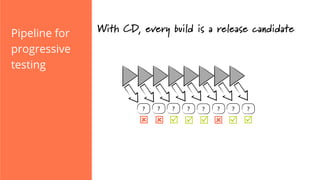
With CD, every build is a release candidatePipeline for
progressive
testing
þ þý ý þ þ ý þ þ
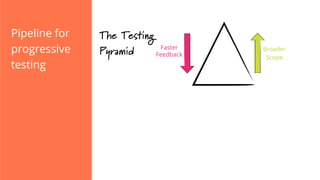
The Testing
Pyramid
Pipeline for
progressive
testing
Faster
Feedback
Broader
Scope
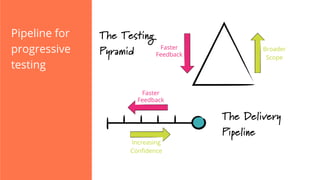
The Testing
Pyramid
Pipeline for
progressive
testing
The Delivery
Pipeline
Faster
Feedback
Broader
Scope
Faster
Feedback
Increasing
Confidence
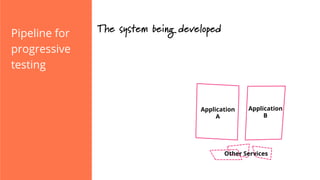
The system being developedPipeline for
progressive
testing
Other Services
Application
A
Application
B
Pipeline for
progressive
testing
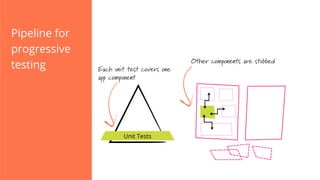
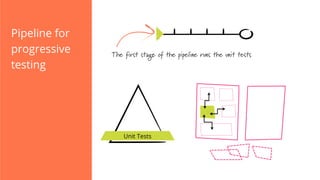
Unit Tests
Each unit test covers one
app component
Other components are stubbed
Pipeline for
progressive
testing
The first stage of the pipeline runs the unit tests
Unit Tests
Pipeline for
progressive
testing
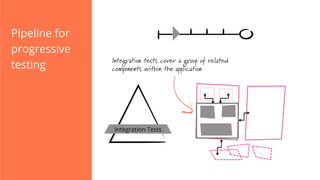
Integration Tests
Integration tests cover a group of related
components within the application
Pipeline for
progressive
testing
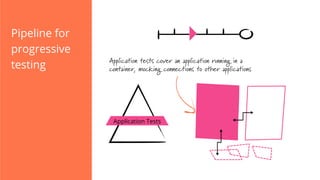
Application Tests
Application tests cover an application running in a
container, mocking connections to other applications
Pipeline for
progressive
testing
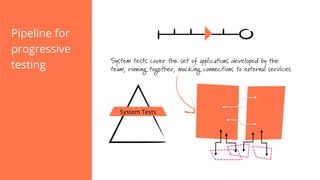
System Tests
System tests cover the set of applications developed by the
team, running together, mocking connections to external services
Pipeline for
progressive
testing
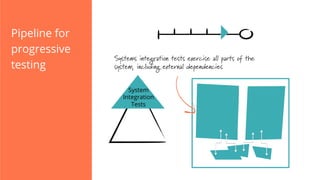
System
Integration
Tests
Systems integration tests exercise all parts of the
system, including external dependencies
Pipeline
Design Patterns
Pipeline
Design Patterns
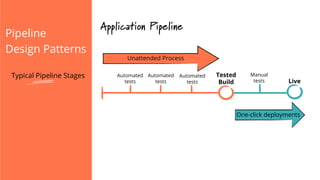
Application Pipeline
Automated
tests
Automated
tests
Automated
tests
Tested
Build
Manual
tests Live
Unattended Process
One-click deployments
Typical Pipeline Stages
Pipeline
Design Patterns
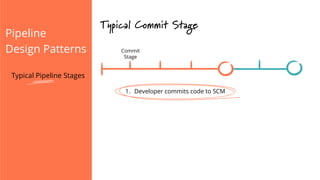
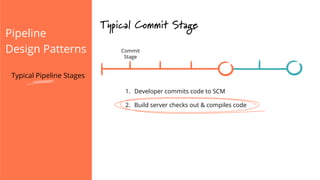
Typical Commit Stage
Commit
Stage
1.  Developer commits code to SCM
Typical Pipeline Stages
Pipeline
Design Patterns
Typical Commit Stage
Commit
Stage
1.  Developer commits code to SCM
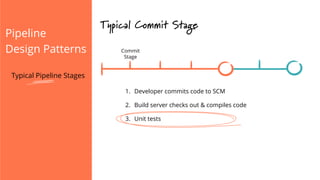
2.  Build server checks out & compiles code
Typical Pipeline Stages
Pipeline
Design Patterns
Typical Commit Stage
Commit
Stage
1.  Developer commits code to SCM
2.  Build server checks out & compiles code
3.  Unit tests
Typical Pipeline Stages
Pipeline
Design Patterns
Typical Commit Stage
Commit
Stage
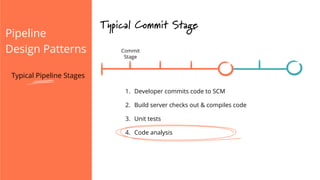
1.  Developer commits code to SCM
2.  Build server checks out & compiles code
3.  Unit tests
4.  Code analysis
Typical Pipeline Stages
Pipeline
Design Patterns
Typical Commit Stage
Commit
Stage
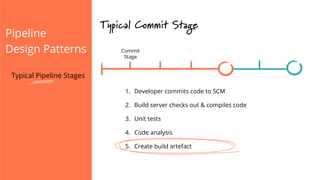
1.  Developer commits code to SCM
2.  Build server checks out & compiles code
3.  Unit tests
4.  Code analysis
5.  Create build artefact
Typical Pipeline Stages
Pipeline
Design Patterns
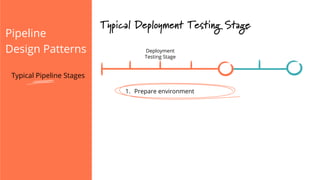
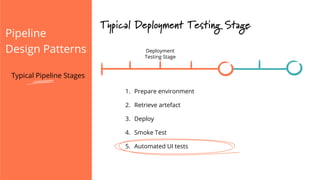
Typical Deployment Testing Stage
Deployment
Testing Stage
1.  Prepare environment
Typical Pipeline Stages
Pipeline
Design Patterns
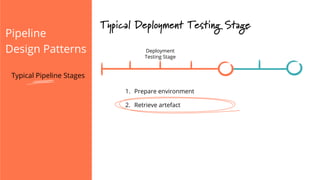
Typical Deployment Testing Stage
Deployment
Testing Stage
1.  Prepare environment
2.  Retrieve artefact
Typical Pipeline Stages
Pipeline
Design Patterns
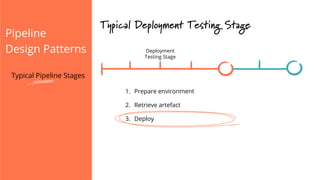
Typical Deployment Testing Stage
Deployment
Testing Stage
1.  Prepare environment
2.  Retrieve artefact
3.  Deploy
Typical Pipeline Stages
Pipeline
Design Patterns
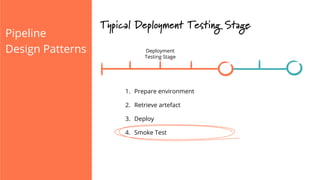
Typical Deployment Testing Stage
Deployment
Testing Stage
1.  Prepare environment
2.  Retrieve artefact
3.  Deploy
4.  Smoke Test
Pipeline
Design Patterns
Typical Deployment Testing Stage
Deployment
Testing Stage
1.  Prepare environment
2.  Retrieve artefact
3.  Deploy
4.  Smoke Test
5.  Automated UI tests
Typical Pipeline Stages
Pipeline
Design Patterns
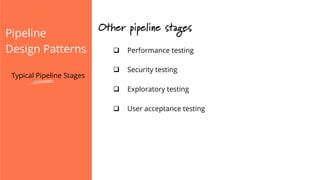
Other pipeline stages
q  Performance testing
q  Security testing
q  Exploratory testing
q  User acceptance testing
Typical Pipeline Stages
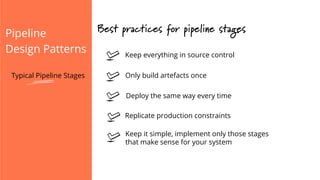
Best practices for pipeline stages
Keep everything in source control
Only build artefacts once
Replicate production constraints
Deploy the same way every time
Pipeline
Design Patterns
Typical Pipeline Stages
Keep it simple, implement only those stages
that make sense for your system
Pipeline
Design Patterns
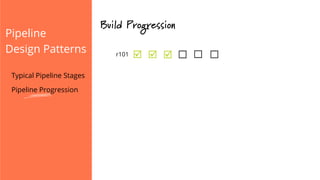
Build Progression
þ þ þr101
Typical Pipeline Stages
Pipeline Progression
Pipeline
Design Patterns
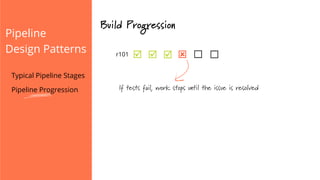
Build Progression
þ þ þr101 ý
If tests fail, work stops until the issue is resolved
Typical Pipeline Stages
Pipeline Progression
Pipeline
Design Patterns
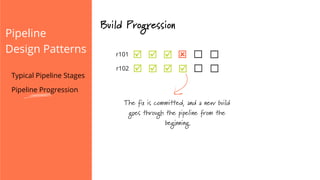
Build Progression
þ þ þr101 ý
The fix is committed, and a new build
goes through the pipeline from the
beginning
þ þr102 þ þ
Typical Pipeline Stages
Pipeline Progression
Pipeline
Design Patterns
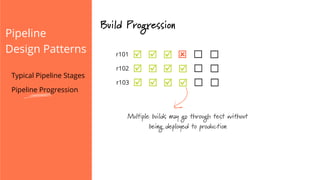
Build Progression
þ þ þr101 ý
Multiple builds may go through test without
being deployed to production
þ þr102 þ þ
þ þr103 þ þ
Typical Pipeline Stages
Pipeline Progression
Pipeline
Design Patterns
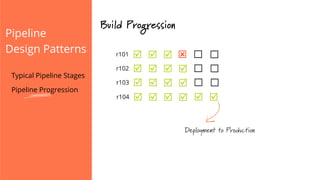
Build Progression
þ þ þr101 ý
Deployment to Production
þ þr102 þ þ
þ þr103 þ þ
þ þr104 þ þ þ þ
Typical Pipeline Stages
Pipeline Progression
Joining multiple applications
Pipeline
Design Patterns
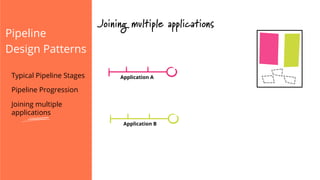
Application A
Application B
Typical Pipeline Stages
Pipeline Progression
Joining multiple
applications
Pipeline
Design Patterns
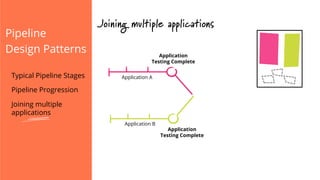
Application A
Application B
Application
Testing Complete
Application
Testing Complete
Joining multiple applications
Typical Pipeline Stages
Pipeline Progression
Joining multiple
applications
Pipeline
Design Patterns
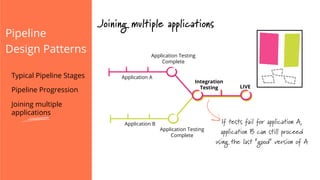
Application A
Application B
Application Testing
Complete
Application Testing
Complete
Integration
Testing
Joining multiple applications
If tests fail for application A,
application B can still proceed
using the last “good” version of A
Typical Pipeline Stages
Pipeline Progression
Joining multiple
applications
LIVE
Pipeline
Design Patterns
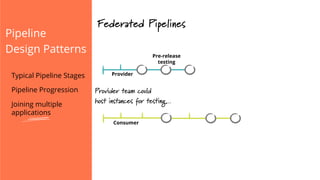
Provider
Consumer
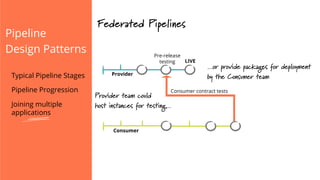
Federated Pipelines
Pre-release
testing
Typical Pipeline Stages
Pipeline Progression
Joining multiple
applications
Provider team could
host instances for testing…
Pipeline
Design Patterns
Provider
Consumer
Federated Pipelines
Pre-release
testing LIVE
Consumer contract tests
…or provide packages for deployment
by the Consumer teamTypical Pipeline Stages
Pipeline Progression
Joining multiple
applications
Provider team could
host instances for testing…
Automated Testing
Stay tuned for Part 4…
Deploy a great product faster.
Agile teams deliver working software early and often.
Go automates and streamlines the build-test-release
cycle for worry-free, continuous delivery of your
product.
Learn More See how Go can help you in
your CD journeygo
Continuous Delivery

How do you implement Continuous Delivery? Part 3: All about Pipelines