Guide to College Reading , 8/e Kathleen T. McWhorter   Chapter 8 Following the Author’s Thought Patterns PowerPoint by Gretchen Starks-Martin St. Cloud State University, MN Copyright 2008 Pearson Education, Inc., publishing by Longman Publishers
THIS CHAPTER WILL SHOW YOU HOW TO: Improve your understanding and recall by recognizing thought patterns Identify commonly used thought patterns Learn transitional words and phrases that signal thought patterns Copyright 2008 Pearson Education, Inc., publishing by Longman Publishers
Six Common Thought Patterns Recognizing the author’s thought pattern will improve comprehension and recall. Six common thought patterns are:  Illustration/Example Definition Comparison/Contrast Cause/Effect Classification Chronological Order/Process Copyright 2008 Pearson Education, Inc., publishing by Longman Publishers
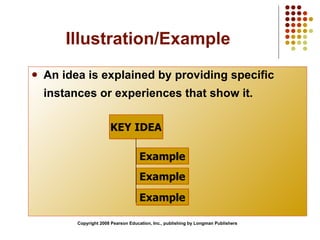
Illustration/Example An idea is explained by providing specific instances or experiences that show it.   Copyright 2008 Pearson Education, Inc., publishing by Longman Publishers KEY IDEA Example Example Example
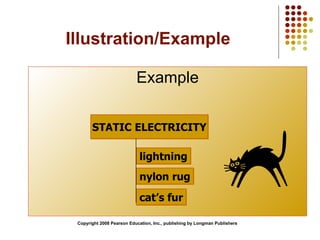
Illustration/Example Example Copyright 2008 Pearson Education, Inc., publishing by Longman Publishers STATIC ELECTRICITY lightning nylon rug cat’s fur
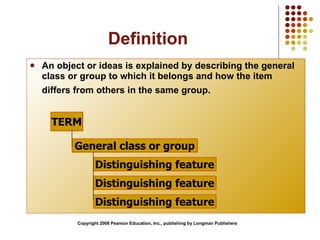
Definition An object or ideas is explained by describing the general class or group to which it belongs and how the item differs from others in the same group.   Copyright 2008 Pearson Education, Inc., publishing by Longman Publishers TERM General class or group Distinguishing feature Distinguishing feature Distinguishing feature
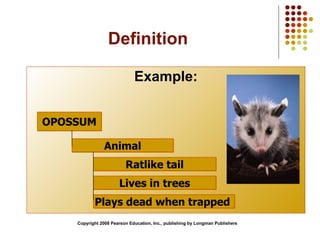
Definition Example: Copyright 2008 Pearson Education, Inc., publishing by Longman Publishers OPOSSUM Animal Ratlike tail Lives in trees Plays dead when trapped
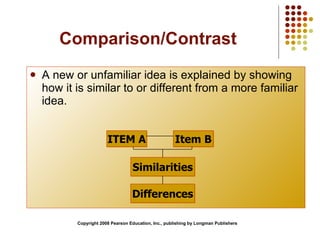
Comparison/Contrast A new or unfamiliar idea is explained by showing how it is similar to or different from a more familiar idea. Copyright 2008 Pearson Education, Inc., publishing by Longman Publishers ITEM A Item B Similarities Differences
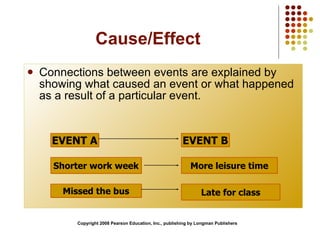
Cause/Effect Connections between events are explained by showing what caused an event or what happened as a result of a particular event. Copyright 2008 Pearson Education, Inc., publishing by Longman Publishers EVENT A Shorter work week Late for class More leisure time EVENT B Missed the bus
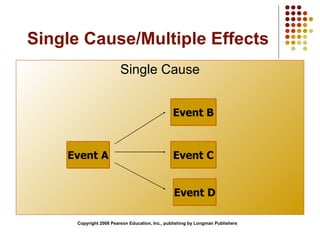
Single Cause/Multiple Effects Single Cause Copyright 2008 Pearson Education, Inc., publishing by Longman Publishers Event A Event B Event C Event D
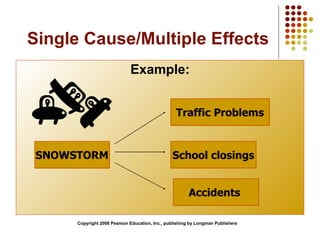
Single Cause/Multiple Effects Example: Copyright 2008 Pearson Education, Inc., publishing by Longman Publishers SNOWSTORM Traffic Problems School closings Accidents
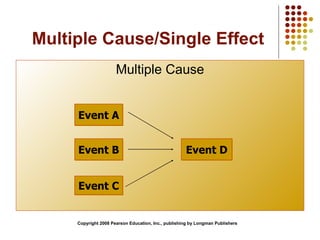
Multiple Cause Multiple Cause/Single Effect Copyright 2008 Pearson Education, Inc., publishing by Longman Publishers Event A Event B Event C Event D
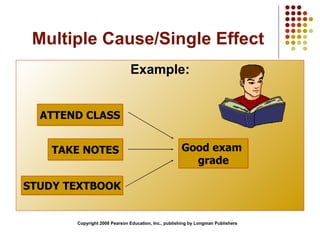
Example: Multiple Cause/Single Effect Copyright 2008 Pearson Education, Inc., publishing by Longman Publishers ATTEND CLASS TAKE NOTES STUDY TEXTBOOK Good exam  grade
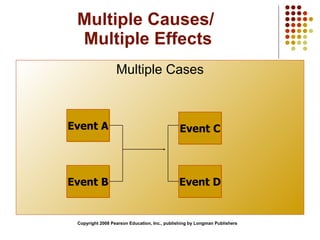
Multiple Causes/  Multiple Effects Multiple Cases Copyright 2008 Pearson Education, Inc., publishing by Longman Publishers Event A Event B Event C Event D
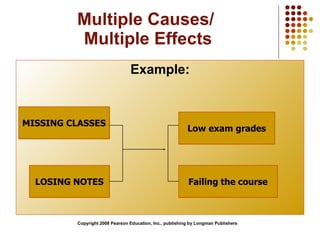
Multiple Causes/  Multiple Effects Example: Copyright 2008 Pearson Education, Inc., publishing by Longman Publishers MISSING CLASSES LOSING NOTES Low exam grades Failing the course
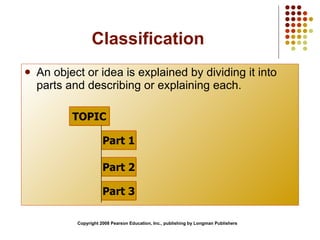
Classification An object or idea is explained by dividing it into parts and describing or explaining each. Copyright 2008 Pearson Education, Inc., publishing by Longman Publishers TOPIC Part 1 Part 2 Part 3
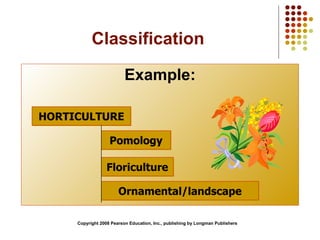
Classification Example: Copyright 2008 Pearson Education, Inc., publishing by Longman Publishers HORTICULTURE Pomology Floriculture Ornamental/landscape
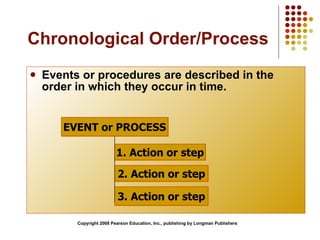
Chronological Order/Process Events or procedures are described in the order in which they occur in time.  Copyright 2008 Pearson Education, Inc., publishing by Longman Publishers EVENT or PROCESS 1. Action or step 2. Action or step 3. Action or step
OTHER USEFUL PATTERNS OF ORGANIZATION Statement and Clarification A statement of fact and then clarification or an explanation of the fact. Transitional words are in Table 8-2. Summary A condensed statement that provides the key points of a larger idea or piece of writing. Summaries of textbook chapters are examples. Copyright 2008 Pearson Education, Inc., publishing by Longman Publishers
OTHER USEFUL PATTERNS OF ORGANIZATION Addition Introduction of an idea and then additional information about that idea or statement. Transitional words are in Table 8-2. Spatial Order Statements about the physical location or position in space will be described. Example: description of parts of a camera. Copyright 2008 Pearson Education, Inc., publishing by Longman Publishers
Using Transitional Words Transitional words (clue words, directional words) help you identify organizational patterns. They also help discover or clarify relationships between and among ideas. Example:  If you see “ in conclusion,”  you know that the writer will present a summary. See  Table 8-1  for a list of transitional words that fit into certain organizational patterns. Copyright 2008 Pearson Education, Inc., publishing by Longman Publishers
LEARNING STYLE TIPS Spatial Learner:  drawing a diagram of the ideas in the passage. Verbal Learner:  outlining a passage. Copyright 2008 Pearson Education, Inc., publishing by Longman Publishers Are you a spatial learner or a verbal learner?
SELF-TEST SUMMARY How can you better comprehend and recall paragraphs you read? What is a thought pattern? What are the six common thought patterns? What other thought patterns are used in academic writing? How can transitional words and phrases help you understand thought patterns? Copyright 2008 Pearson Education, Inc., publishing by Longman Publishers
Visit the Companion Website For additional readings, exercises, and Internet activities, visit this book’s Companion Website at:  www.ablongman.com/mcwhorter If you need a user name or password, see your instructor.   Copyright 2008 Pearson Education, Inc., publishing by Longman Publishers
My Reading Lab For more practice on thought patterns, visit MyReadingLab, click on the Reading Skills tab, and then click on Active Reading Strategies---New York Harbor. www.ablongman.com/myreadinglab   Copyright 2008 Pearson Education, Inc., publishing by Longman Publishers
TEST-TAKING TIPS:  Answering Questions About Thought Patterns Study the transitions.  They suggest a pattern. Ask: “How does the author explain his or her main idea?” A question may ask:  “The writer supports her ideas by….”  This is asking for a pattern. The topic sentence of a paragraph often reveals or suggests the pattern to be used. Copyright 2008 Pearson Education, Inc., publishing by Longman Publishers

Thought patterns

  • 1.
    Guide to CollegeReading , 8/e Kathleen T. McWhorter Chapter 8 Following the Author’s Thought Patterns PowerPoint by Gretchen Starks-Martin St. Cloud State University, MN Copyright 2008 Pearson Education, Inc., publishing by Longman Publishers
  • 2.
    THIS CHAPTER WILLSHOW YOU HOW TO: Improve your understanding and recall by recognizing thought patterns Identify commonly used thought patterns Learn transitional words and phrases that signal thought patterns Copyright 2008 Pearson Education, Inc., publishing by Longman Publishers
  • 3.
    Six Common ThoughtPatterns Recognizing the author’s thought pattern will improve comprehension and recall. Six common thought patterns are: Illustration/Example Definition Comparison/Contrast Cause/Effect Classification Chronological Order/Process Copyright 2008 Pearson Education, Inc., publishing by Longman Publishers
  • 4.
    Illustration/Example An ideais explained by providing specific instances or experiences that show it. Copyright 2008 Pearson Education, Inc., publishing by Longman Publishers KEY IDEA Example Example Example
  • 5.
    Illustration/Example Example Copyright2008 Pearson Education, Inc., publishing by Longman Publishers STATIC ELECTRICITY lightning nylon rug cat’s fur
  • 6.
    Definition An objector ideas is explained by describing the general class or group to which it belongs and how the item differs from others in the same group. Copyright 2008 Pearson Education, Inc., publishing by Longman Publishers TERM General class or group Distinguishing feature Distinguishing feature Distinguishing feature
  • 7.
    Definition Example: Copyright2008 Pearson Education, Inc., publishing by Longman Publishers OPOSSUM Animal Ratlike tail Lives in trees Plays dead when trapped
  • 8.
    Comparison/Contrast A newor unfamiliar idea is explained by showing how it is similar to or different from a more familiar idea. Copyright 2008 Pearson Education, Inc., publishing by Longman Publishers ITEM A Item B Similarities Differences
  • 9.
    Cause/Effect Connections betweenevents are explained by showing what caused an event or what happened as a result of a particular event. Copyright 2008 Pearson Education, Inc., publishing by Longman Publishers EVENT A Shorter work week Late for class More leisure time EVENT B Missed the bus
  • 10.
    Single Cause/Multiple EffectsSingle Cause Copyright 2008 Pearson Education, Inc., publishing by Longman Publishers Event A Event B Event C Event D
  • 11.
    Single Cause/Multiple EffectsExample: Copyright 2008 Pearson Education, Inc., publishing by Longman Publishers SNOWSTORM Traffic Problems School closings Accidents
  • 12.
    Multiple Cause MultipleCause/Single Effect Copyright 2008 Pearson Education, Inc., publishing by Longman Publishers Event A Event B Event C Event D
  • 13.
    Example: Multiple Cause/SingleEffect Copyright 2008 Pearson Education, Inc., publishing by Longman Publishers ATTEND CLASS TAKE NOTES STUDY TEXTBOOK Good exam grade
  • 14.
    Multiple Causes/ Multiple Effects Multiple Cases Copyright 2008 Pearson Education, Inc., publishing by Longman Publishers Event A Event B Event C Event D
  • 15.
    Multiple Causes/ Multiple Effects Example: Copyright 2008 Pearson Education, Inc., publishing by Longman Publishers MISSING CLASSES LOSING NOTES Low exam grades Failing the course
  • 16.
    Classification An objector idea is explained by dividing it into parts and describing or explaining each. Copyright 2008 Pearson Education, Inc., publishing by Longman Publishers TOPIC Part 1 Part 2 Part 3
  • 17.
    Classification Example: Copyright2008 Pearson Education, Inc., publishing by Longman Publishers HORTICULTURE Pomology Floriculture Ornamental/landscape
  • 18.
    Chronological Order/Process Eventsor procedures are described in the order in which they occur in time. Copyright 2008 Pearson Education, Inc., publishing by Longman Publishers EVENT or PROCESS 1. Action or step 2. Action or step 3. Action or step
  • 19.
    OTHER USEFUL PATTERNSOF ORGANIZATION Statement and Clarification A statement of fact and then clarification or an explanation of the fact. Transitional words are in Table 8-2. Summary A condensed statement that provides the key points of a larger idea or piece of writing. Summaries of textbook chapters are examples. Copyright 2008 Pearson Education, Inc., publishing by Longman Publishers
  • 20.
    OTHER USEFUL PATTERNSOF ORGANIZATION Addition Introduction of an idea and then additional information about that idea or statement. Transitional words are in Table 8-2. Spatial Order Statements about the physical location or position in space will be described. Example: description of parts of a camera. Copyright 2008 Pearson Education, Inc., publishing by Longman Publishers
  • 21.
    Using Transitional WordsTransitional words (clue words, directional words) help you identify organizational patterns. They also help discover or clarify relationships between and among ideas. Example: If you see “ in conclusion,” you know that the writer will present a summary. See Table 8-1 for a list of transitional words that fit into certain organizational patterns. Copyright 2008 Pearson Education, Inc., publishing by Longman Publishers
  • 22.
    LEARNING STYLE TIPSSpatial Learner: drawing a diagram of the ideas in the passage. Verbal Learner: outlining a passage. Copyright 2008 Pearson Education, Inc., publishing by Longman Publishers Are you a spatial learner or a verbal learner?
  • 23.
    SELF-TEST SUMMARY Howcan you better comprehend and recall paragraphs you read? What is a thought pattern? What are the six common thought patterns? What other thought patterns are used in academic writing? How can transitional words and phrases help you understand thought patterns? Copyright 2008 Pearson Education, Inc., publishing by Longman Publishers
  • 24.
    Visit the CompanionWebsite For additional readings, exercises, and Internet activities, visit this book’s Companion Website at: www.ablongman.com/mcwhorter If you need a user name or password, see your instructor. Copyright 2008 Pearson Education, Inc., publishing by Longman Publishers
  • 25.
    My Reading LabFor more practice on thought patterns, visit MyReadingLab, click on the Reading Skills tab, and then click on Active Reading Strategies---New York Harbor. www.ablongman.com/myreadinglab Copyright 2008 Pearson Education, Inc., publishing by Longman Publishers
  • 26.
    TEST-TAKING TIPS: Answering Questions About Thought Patterns Study the transitions. They suggest a pattern. Ask: “How does the author explain his or her main idea?” A question may ask: “The writer supports her ideas by….” This is asking for a pattern. The topic sentence of a paragraph often reveals or suggests the pattern to be used. Copyright 2008 Pearson Education, Inc., publishing by Longman Publishers