
Patterns of
OrganizationTEACHER: MANOLO L. GIRON
SUBJECT: ENGLISH FOR ACADEMIC AND PROFESSIONAL PURPOSES
SCHOOL: ZAMBALES NATIONAL HIGH SCHOOL
Objective
 The learners learn various techniques in summarizing a variety of academic
texts
Patterns of Organization
 There are many patterns a writer can use to
organize his/her ideas.
 There are many different ways of organizing the
same information, and often two or more different
organizational patterns are combined to create a
final outline of information.
Chronological Patterns
 A chronological pattern of organization arranges information
according to a progression of time, either forward or backward.
 When a topic is best understood in terms of different segments of
time, a chronological format works well.
 When using a chronological pattern, each main section of information
represents a particular period of time, and the sub-points contained
within each main section refer to significant events that occurred
within that time frame.
 A variation of this organizational pattern involves dividing a topic into
"past-present-future" or" before-during-after" segments.
Chronological Pattern Example
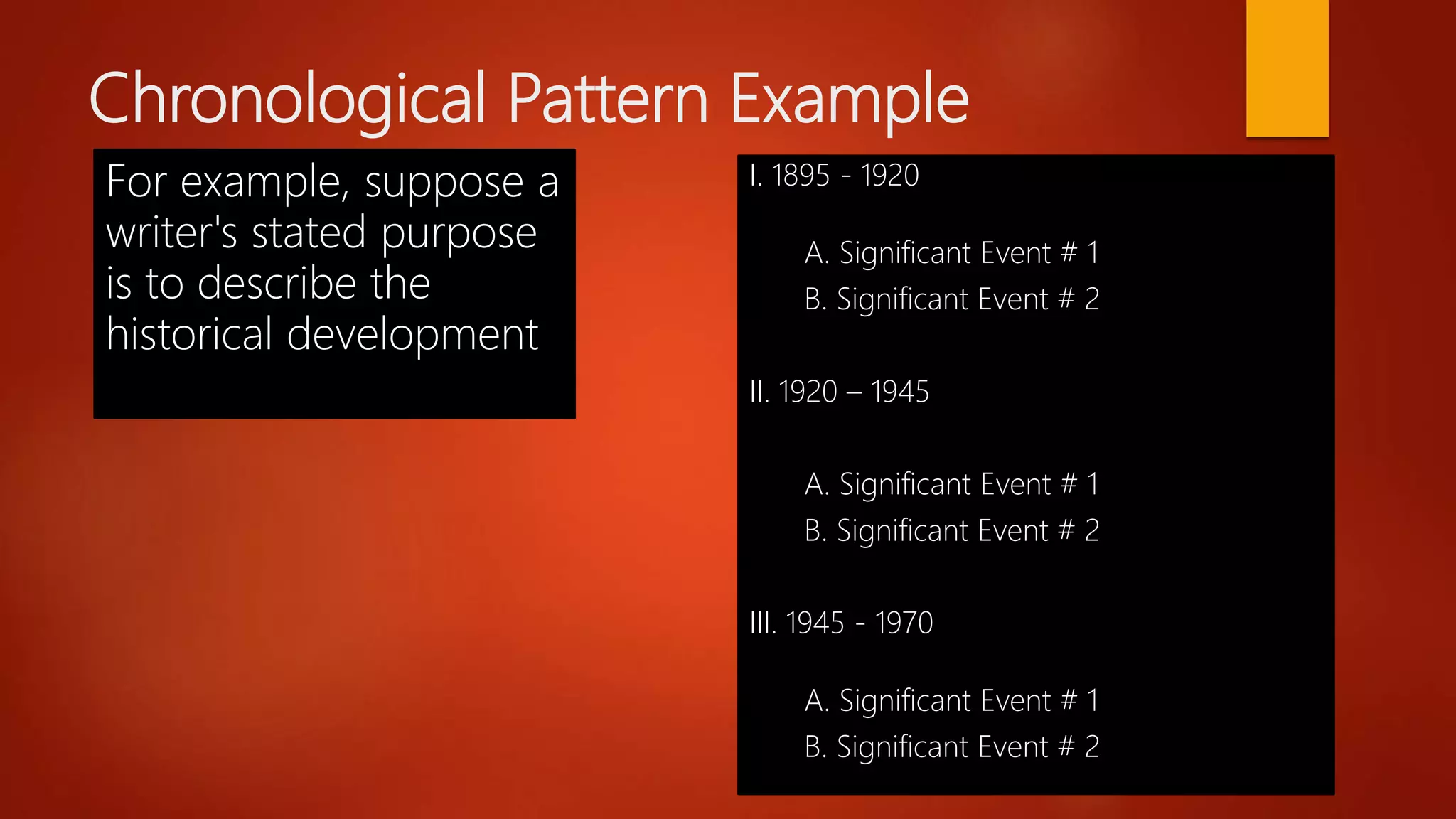
I. 1895 - 1920
A. Significant Event # 1
B. Significant Event # 2
II. 1920 – 1945
A. Significant Event # 1
B. Significant Event # 2
III. 1945 - 1970
A. Significant Event # 1
B. Significant Event # 2
For example, suppose a
writer's stated purpose
is to describe the
historical development
Sequential Patterns
 A sequential pattern of organization is similar to a chronological
pattern, but arranges information according to a step-by-step
sequence that describes a particular process.
 Using a sequential pattern, each main section of information
represents a main step that one would follow in the actual process.
 The points included within each main section represent the sub-
steps one would follow.
 When one wishes to describe a process that follows a specific series
of steps in a particular order, then, a sequential pattern works well.
Sequential Pattern Example
I. Step One: Harvest the grapes
A. Harvesting procedure number one
B. Harvesting procedure number two
II. Step Two: Prepare the grapes
A. Preparation procedure number one
B. Preparation procedure number two
III. Step Three: Ferment the grapes
A. Fermenting procedure number one
B. Fermenting procedure number two
IV. Step Four: Press the grapes
A. Pressing procedure number one
B. Pressing procedure number two
V. Step Five: Age the wine
A. Aging procedure number one
B. Aging procedure number two
For example,
suppose a writer's
stated purpose is
to explain how
wine is made.
Spatial Patterns
 A spatial pattern of organization arranges information
according to how things fit together in physical space; i.e.,
where one thing exists in relation to another.
 This pattern works well when a writer wishes to create a mental
picture of something which has various parts distinguished by
physical location.
 Topics involving geography, for example, are often best
organized using a spatial pattern.
Spatial Pattern Example
I. Downtown Waterfront
A. Aquarium
B. Pike Place Market
II. Seattle Center
A. Space Needle
B. Pacific Science Center
III. University District
A. University of Washington campus
B. The "Ave" (shops on University Avenue)
For example, suppose
a writer wished to
describe the forms of
entertainment
available to tourists
visiting Seattle.
Compare-Contrast Patterns
 A compare and contrast pattern arranges
information according to how two or more things
are similar to or different from one another (or
both).
 This is an effective pattern to use when the reader
can better understand one subject when it is
described in relation to another.
 If the reader is familiar with one topic, the writer can
compare or contrast it with another topic to shed
insight on it.
Compare and Contrast Pattern Example
I. Cost of Tuition
A. Two-year
B. Four-year
II. Quality of Education
A. Two-year
B. Four-year
III. Educational Programs
A. Two-year
B. Four-year
For example, suppose a
writer's stated purpose is
to help the reader make
an informed decision
about whether to attend a
two-year college or a
four-year university.
Advantages-Disadvantages Patterns
 This pattern organizes information about a topic by
dividing it up into its "good" and "bad" parts, or
pro's and con's.
 It is effective to use when a writer wishes to
objectively discuss both sides of an issue without
taking a persuasive stance.
 This allows the reader to weigh both sides of an
issue.
Advantages and Disadvantages Example
I. Advantages
A. Cost
B. Accessibility
II. Disadvantages
A. Number of educational programs
B. Quality of instruction
Suppose, for
example, that a
writer's stated
purpose is to
describe the
advantages and
disadvantages of
attending a two-
year college.
Cause-Effect Patterns
 This pattern is used to show the different causes and effects of
various conditions.
 This pattern is particularly effective when writing a persuasive
document in which the writer advocates some action to solve a
problem, because it demonstrates important relationships between
variables.
 There are two major variations to this pattern;
 (a) dividing the outline into two major sections comprised of
causes and effects; or
 (b) dividing the outline according to the different causes, with
the effects of each cause contained within the larger "causes"
section. See the examples below.
Cause and Effect Pattern Example One
I. Causes of Conflict Escalation
A. Expanding the issues
B. Personal attacks
II. Effects of these causes
A. Lose focus on original issue
B. Cycle of defensive responses
C. Win-Lose orientation
D. Negative emotions
Suppose a writer's
stated purpose is to
explain the causes of
conflict escalation
and their effects.
Problem-Solution Patterns
 A problem-solution pattern divides information into two main
sections, one that describes a problem and one that describes a
solution.
 In the problem section, the writer identifies different aspects of
the problem being discussed and offers evidence of these
problems.
 In the solution section, the writer identifies a potential solution
and supports the effectiveness of this solution over others.
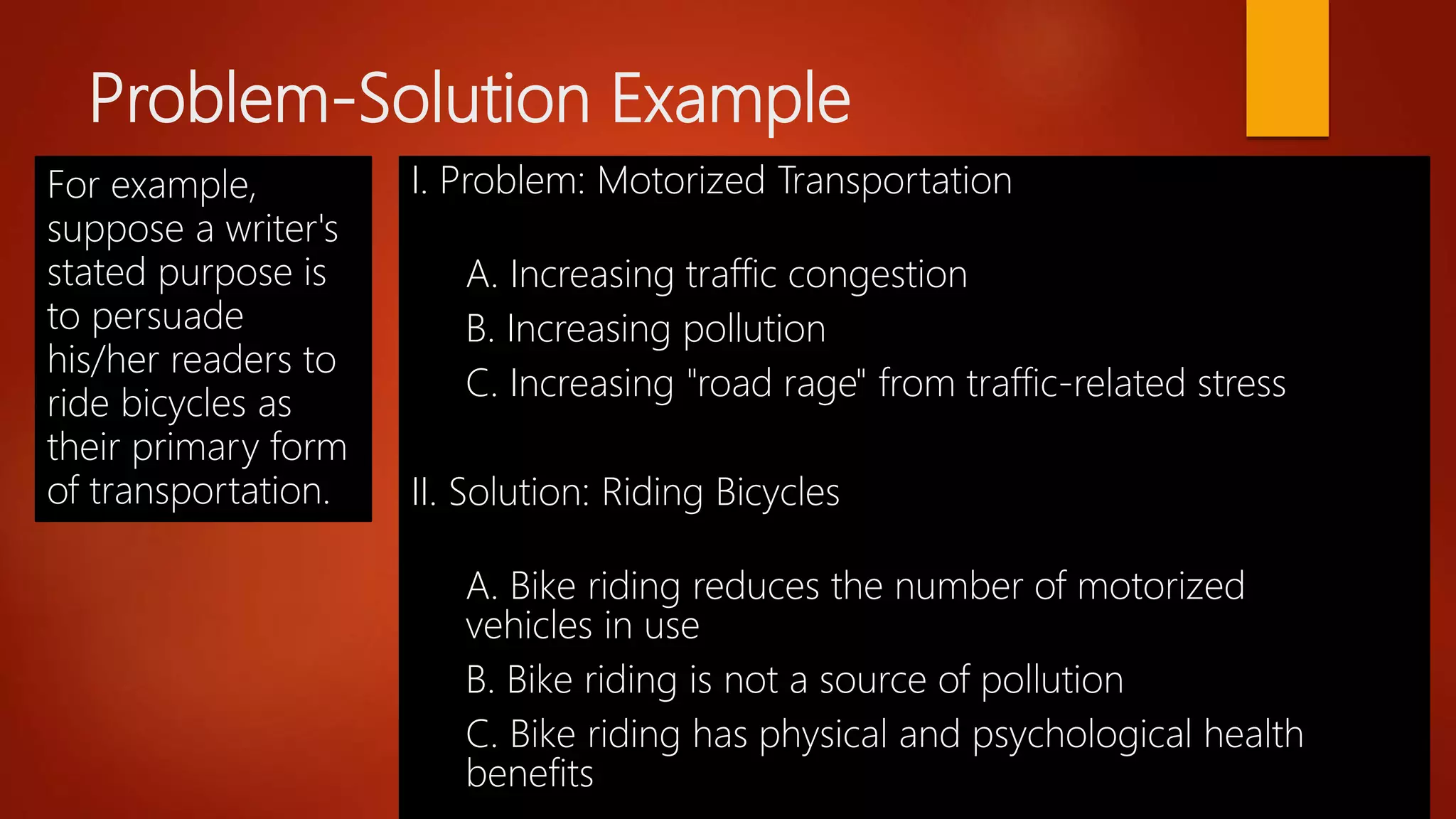
Problem-Solution Example
I. Problem: Motorized Transportation
A. Increasing traffic congestion
B. Increasing pollution
C. Increasing "road rage" from traffic-related stress
II. Solution: Riding Bicycles
A. Bike riding reduces the number of motorized
vehicles in use
B. Bike riding is not a source of pollution
C. Bike riding has physical and psychological health
benefits
For example,
suppose a writer's
stated purpose is
to persuade
his/her readers to
ride bicycles as
their primary form
of transportation.
Topical Pattern
 This pattern is the most commonly used
format, and will typically work when the other
patterns do not.
 A topical pattern arranges information
according to different sub-topics within a
larger topic, or the "types" of things that fall
within a larger category.
Topical Pattern Example
I. Red Wines
A. European
1. Burgundy
2. Chianti
B. Californian
1. Pinot Noir
2. Zinfandel
II. White Wines
A. European
1. Burgundy
2. Mosel
B. Californian
1. Chardonnay
2. Riesling
For example,
suppose a writer
wished to
describe various
types of wine.
References
 http://faculty.washington.edu/ezent/impo.htm

Patterns of organization

  • 1.
    Patterns of OrganizationTEACHER: MANOLOL. GIRON SUBJECT: ENGLISH FOR ACADEMIC AND PROFESSIONAL PURPOSES SCHOOL: ZAMBALES NATIONAL HIGH SCHOOL
  • 2.
    Objective  The learnerslearn various techniques in summarizing a variety of academic texts
  • 3.
    Patterns of Organization There are many patterns a writer can use to organize his/her ideas.  There are many different ways of organizing the same information, and often two or more different organizational patterns are combined to create a final outline of information.
  • 4.
    Chronological Patterns  Achronological pattern of organization arranges information according to a progression of time, either forward or backward.  When a topic is best understood in terms of different segments of time, a chronological format works well.  When using a chronological pattern, each main section of information represents a particular period of time, and the sub-points contained within each main section refer to significant events that occurred within that time frame.  A variation of this organizational pattern involves dividing a topic into "past-present-future" or" before-during-after" segments.
  • 5.
    Chronological Pattern Example I.1895 - 1920 A. Significant Event # 1 B. Significant Event # 2 II. 1920 – 1945 A. Significant Event # 1 B. Significant Event # 2 III. 1945 - 1970 A. Significant Event # 1 B. Significant Event # 2 For example, suppose a writer's stated purpose is to describe the historical development
  • 6.
    Sequential Patterns  Asequential pattern of organization is similar to a chronological pattern, but arranges information according to a step-by-step sequence that describes a particular process.  Using a sequential pattern, each main section of information represents a main step that one would follow in the actual process.  The points included within each main section represent the sub- steps one would follow.  When one wishes to describe a process that follows a specific series of steps in a particular order, then, a sequential pattern works well.
  • 7.
    Sequential Pattern Example I.Step One: Harvest the grapes A. Harvesting procedure number one B. Harvesting procedure number two II. Step Two: Prepare the grapes A. Preparation procedure number one B. Preparation procedure number two III. Step Three: Ferment the grapes A. Fermenting procedure number one B. Fermenting procedure number two IV. Step Four: Press the grapes A. Pressing procedure number one B. Pressing procedure number two V. Step Five: Age the wine A. Aging procedure number one B. Aging procedure number two For example, suppose a writer's stated purpose is to explain how wine is made.
  • 8.
    Spatial Patterns  Aspatial pattern of organization arranges information according to how things fit together in physical space; i.e., where one thing exists in relation to another.  This pattern works well when a writer wishes to create a mental picture of something which has various parts distinguished by physical location.  Topics involving geography, for example, are often best organized using a spatial pattern.
  • 9.
    Spatial Pattern Example I.Downtown Waterfront A. Aquarium B. Pike Place Market II. Seattle Center A. Space Needle B. Pacific Science Center III. University District A. University of Washington campus B. The "Ave" (shops on University Avenue) For example, suppose a writer wished to describe the forms of entertainment available to tourists visiting Seattle.
  • 10.
    Compare-Contrast Patterns  Acompare and contrast pattern arranges information according to how two or more things are similar to or different from one another (or both).  This is an effective pattern to use when the reader can better understand one subject when it is described in relation to another.  If the reader is familiar with one topic, the writer can compare or contrast it with another topic to shed insight on it.
  • 11.
    Compare and ContrastPattern Example I. Cost of Tuition A. Two-year B. Four-year II. Quality of Education A. Two-year B. Four-year III. Educational Programs A. Two-year B. Four-year For example, suppose a writer's stated purpose is to help the reader make an informed decision about whether to attend a two-year college or a four-year university.
  • 12.
    Advantages-Disadvantages Patterns  Thispattern organizes information about a topic by dividing it up into its "good" and "bad" parts, or pro's and con's.  It is effective to use when a writer wishes to objectively discuss both sides of an issue without taking a persuasive stance.  This allows the reader to weigh both sides of an issue.
  • 13.
    Advantages and DisadvantagesExample I. Advantages A. Cost B. Accessibility II. Disadvantages A. Number of educational programs B. Quality of instruction Suppose, for example, that a writer's stated purpose is to describe the advantages and disadvantages of attending a two- year college.
  • 14.
    Cause-Effect Patterns  Thispattern is used to show the different causes and effects of various conditions.  This pattern is particularly effective when writing a persuasive document in which the writer advocates some action to solve a problem, because it demonstrates important relationships between variables.  There are two major variations to this pattern;  (a) dividing the outline into two major sections comprised of causes and effects; or  (b) dividing the outline according to the different causes, with the effects of each cause contained within the larger "causes" section. See the examples below.
  • 15.
    Cause and EffectPattern Example One I. Causes of Conflict Escalation A. Expanding the issues B. Personal attacks II. Effects of these causes A. Lose focus on original issue B. Cycle of defensive responses C. Win-Lose orientation D. Negative emotions Suppose a writer's stated purpose is to explain the causes of conflict escalation and their effects.
  • 16.
    Problem-Solution Patterns  Aproblem-solution pattern divides information into two main sections, one that describes a problem and one that describes a solution.  In the problem section, the writer identifies different aspects of the problem being discussed and offers evidence of these problems.  In the solution section, the writer identifies a potential solution and supports the effectiveness of this solution over others.
  • 17.
    Problem-Solution Example I. Problem:Motorized Transportation A. Increasing traffic congestion B. Increasing pollution C. Increasing "road rage" from traffic-related stress II. Solution: Riding Bicycles A. Bike riding reduces the number of motorized vehicles in use B. Bike riding is not a source of pollution C. Bike riding has physical and psychological health benefits For example, suppose a writer's stated purpose is to persuade his/her readers to ride bicycles as their primary form of transportation.
  • 18.
    Topical Pattern  Thispattern is the most commonly used format, and will typically work when the other patterns do not.  A topical pattern arranges information according to different sub-topics within a larger topic, or the "types" of things that fall within a larger category.
  • 19.
    Topical Pattern Example I.Red Wines A. European 1. Burgundy 2. Chianti B. Californian 1. Pinot Noir 2. Zinfandel II. White Wines A. European 1. Burgundy 2. Mosel B. Californian 1. Chardonnay 2. Riesling For example, suppose a writer wished to describe various types of wine.
  • 20.