Chapter 6: Following the
Author’s Thought Patterns
What is a Thought Pattern?
 It is the way an author organizes the
information.
Why is it important for me to
recognize the author’s thought
pattern?
 If you can recognize the way a
passage is organized,
 You will be able to make accurate
predictions
 You can make better study charts/ notes
for review
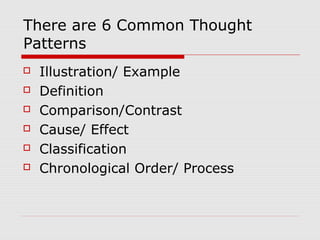
There are 6 Common Thought
Patterns
 Illustration/ Example
 Definition
 Comparison/Contrast
 Cause/ Effect
 Classification
 Chronological Order/ Process
Group Work: Jigsaw
 I will split the class up into 6 groups.
 Each group is responsible for
 Teaching the concept to the class
 What are the characteristics?
 When is that type of organization used?
 Providing an example
 Choosing an exercise to do with the class
(from the book or original)
Other Useful Patterns of
Organization (pages 216- 218)
 Statement and Clarification
 Summary
 Addition
 Spatial Order
Statement and Clarification
 Indicates that information explaining
an idea or concept will follow
 Corrects misconceptions
 Prove a statement with additional
details
Summary
 Indicates that a condensed review of
an idea or piece of writing will follow
 Provides key points
 Textbooks summarize research that
supports main points
 Shakespeare texts often summarize
acts or scenes
Addition
 Indicates that additional information
will follow
 Similar to clarification, but expands,
not just explains
Spatial Order
 Describes physical location or position
in space
 Used only in certain disciplines
 Directions
 Photography
 Setting
 Auto tech
Remember: Use Transition Words
 Recognize which transition words are
used with each organizational
structure.
 Use appropriate transition words in
your own writing.
Homework
 You will have a vocab and a CH. 6
review quiz next week. I suggest you
review.
 Chapter 6 Mastery Tests 1 and 2
 Write one paragraph based on the
organizational pattern assigned to your
group and one based on a pattern of
your choice about a topic of your choice.
Use a graphic organizer before writing.
Research Project
 Begin your project. Choose a topic,
visit the library and ask the librarian
how to get information on your topic.
 This is an extremely important skill to
have in college—one that crosses
disciplines and will help you most in
life no matter what you decide to do.
 No one can stop you if you can get
the right information.

Chapter 6

  • 1.
    Chapter 6: Followingthe Author’s Thought Patterns
  • 2.
    What is aThought Pattern?  It is the way an author organizes the information.
  • 3.
    Why is itimportant for me to recognize the author’s thought pattern?  If you can recognize the way a passage is organized,  You will be able to make accurate predictions  You can make better study charts/ notes for review
  • 4.
    There are 6Common Thought Patterns  Illustration/ Example  Definition  Comparison/Contrast  Cause/ Effect  Classification  Chronological Order/ Process
  • 5.
    Group Work: Jigsaw I will split the class up into 6 groups.  Each group is responsible for  Teaching the concept to the class  What are the characteristics?  When is that type of organization used?  Providing an example  Choosing an exercise to do with the class (from the book or original)
  • 6.
    Other Useful Patternsof Organization (pages 216- 218)  Statement and Clarification  Summary  Addition  Spatial Order
  • 7.
    Statement and Clarification Indicates that information explaining an idea or concept will follow  Corrects misconceptions  Prove a statement with additional details
  • 8.
    Summary  Indicates thata condensed review of an idea or piece of writing will follow  Provides key points  Textbooks summarize research that supports main points  Shakespeare texts often summarize acts or scenes
  • 9.
    Addition  Indicates thatadditional information will follow  Similar to clarification, but expands, not just explains
  • 10.
    Spatial Order  Describesphysical location or position in space  Used only in certain disciplines  Directions  Photography  Setting  Auto tech
  • 11.
    Remember: Use TransitionWords  Recognize which transition words are used with each organizational structure.  Use appropriate transition words in your own writing.
  • 12.
    Homework  You willhave a vocab and a CH. 6 review quiz next week. I suggest you review.  Chapter 6 Mastery Tests 1 and 2  Write one paragraph based on the organizational pattern assigned to your group and one based on a pattern of your choice about a topic of your choice. Use a graphic organizer before writing.
  • 13.
    Research Project  Beginyour project. Choose a topic, visit the library and ask the librarian how to get information on your topic.  This is an extremely important skill to have in college—one that crosses disciplines and will help you most in life no matter what you decide to do.  No one can stop you if you can get the right information.