Writing a Comparative
Essay
English 11: Periods 4,5,7,9
Understanding the Prompt
Read the assignment thoroughly

Be sure you can answer, “What is this prompt
asking me to do?” completely.

Look at the rubric before, during, and after you
write your essay
Brainstorming
Do not begin writing until you have completed this
step!

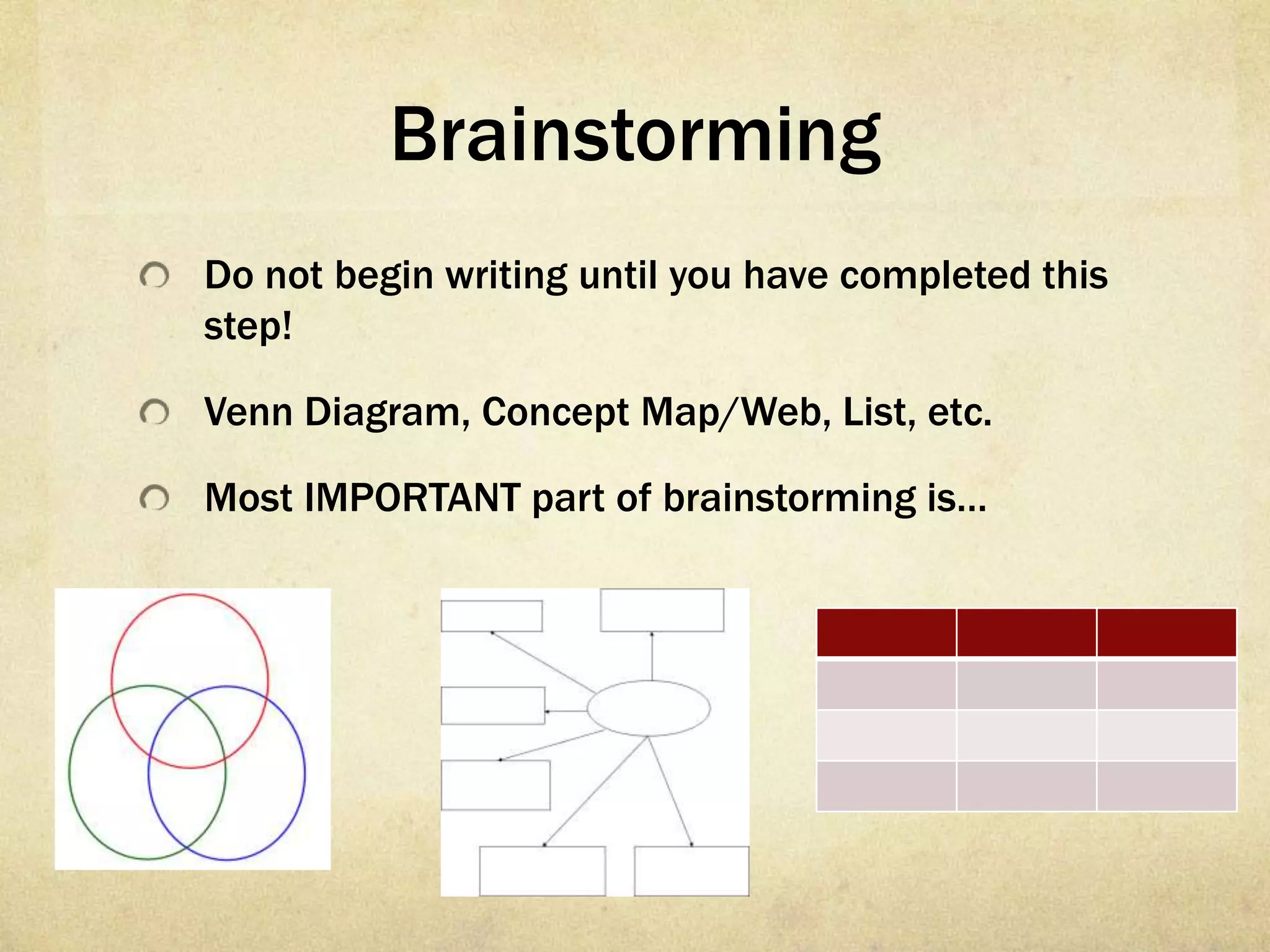
Venn Diagram, Concept Map/Web, List, etc.

Most IMPORTANT part of brainstorming is…
Find a Focus
Select the THREE most important comparisons
between the texts

While you may find several others, do not include
them in your essay
Introduction
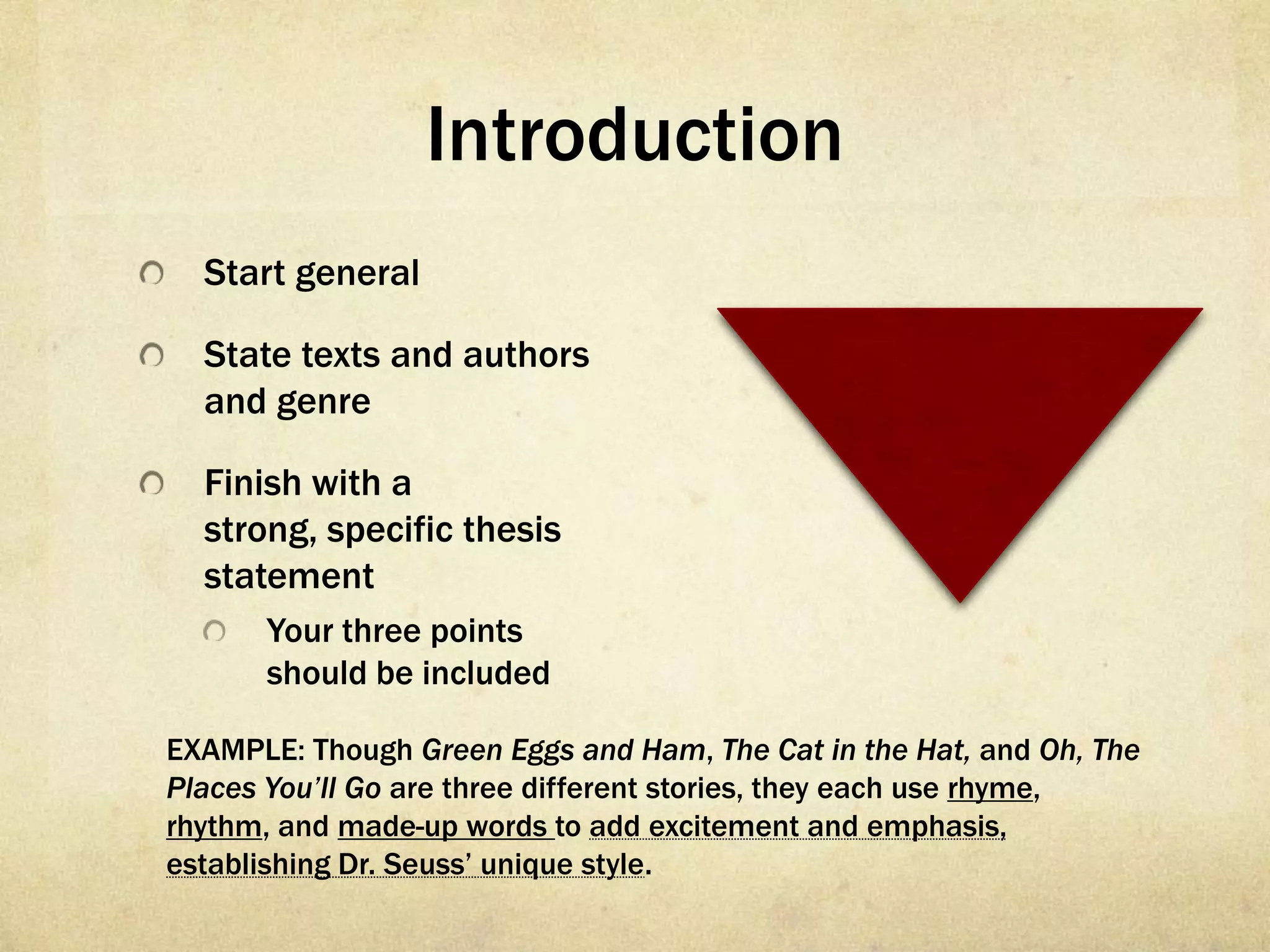
  Start general

  State texts and authors
  and genre

  Finish with a
  strong, specific thesis
  statement
      Your three points
      should be included

EXAMPLE: Though Green Eggs and Ham, The Cat in the Hat, and Oh, The
Places You’ll Go are three different stories, they each use rhyme,
rhythm, and made-up words to add excitement and emphasis,
establishing Dr. Seuss’ unique style.
Body Paragraphs
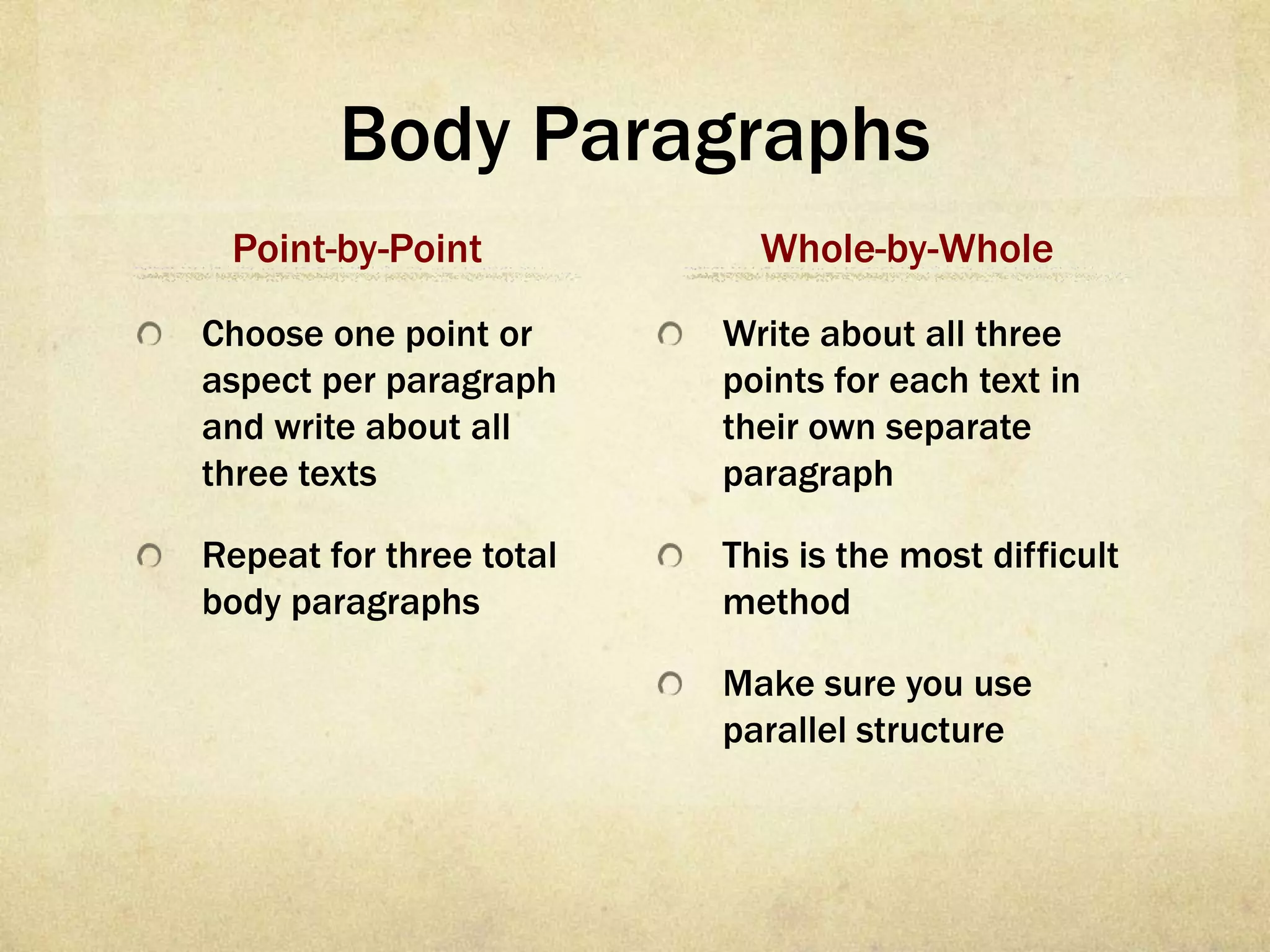
 Point-by-Point            Whole-by-Whole
Choose one point or      Write about all three
aspect per paragraph     points for each text in
and write about all      their own separate
three texts              paragraph

Repeat for three total   This is the most difficult
body paragraphs          method

                         Make sure you use
                         parallel structure
Conclusion
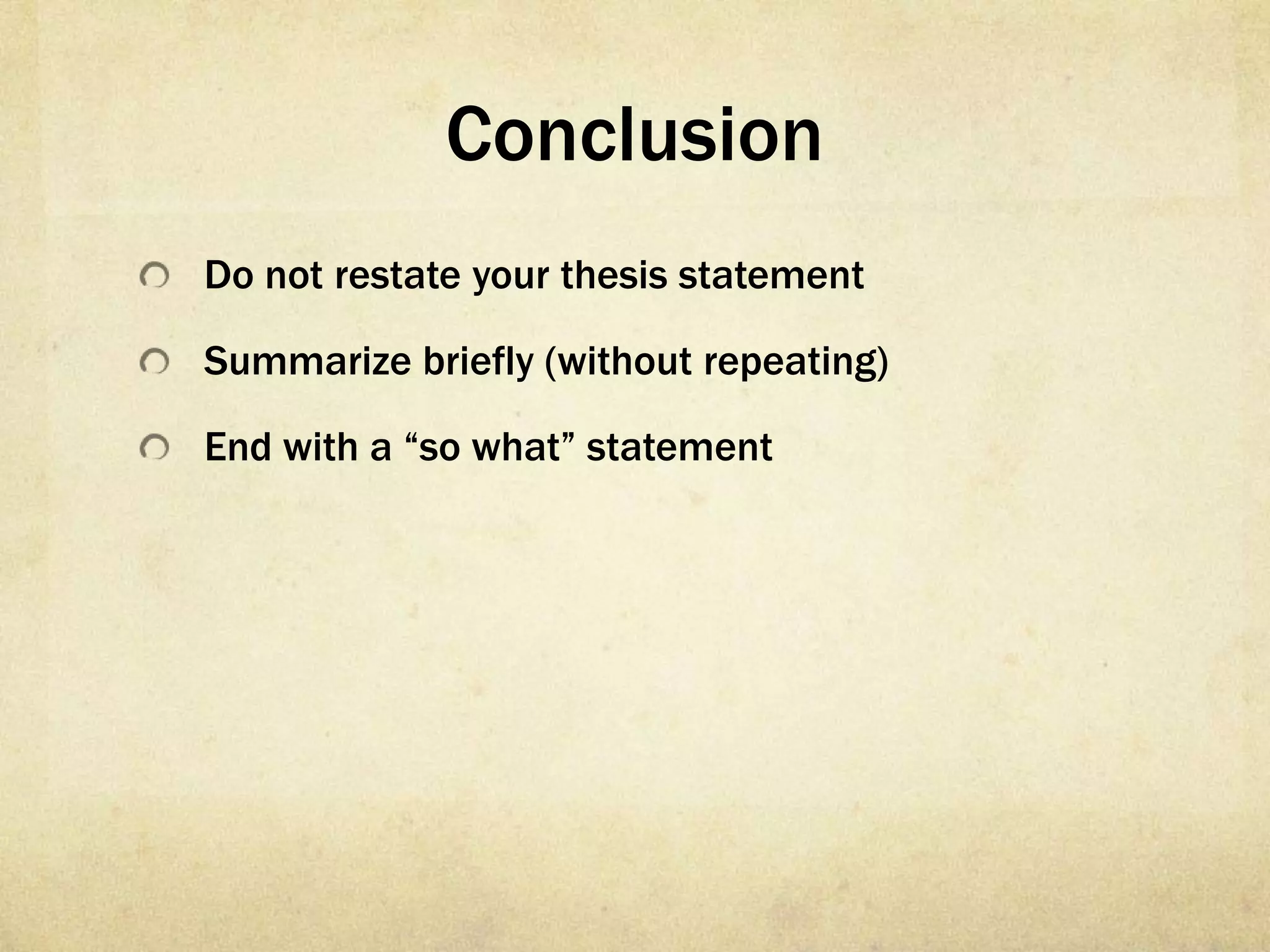
Do not restate your thesis statement

Summarize briefly (without repeating)

End with a “so what” statement
Revision
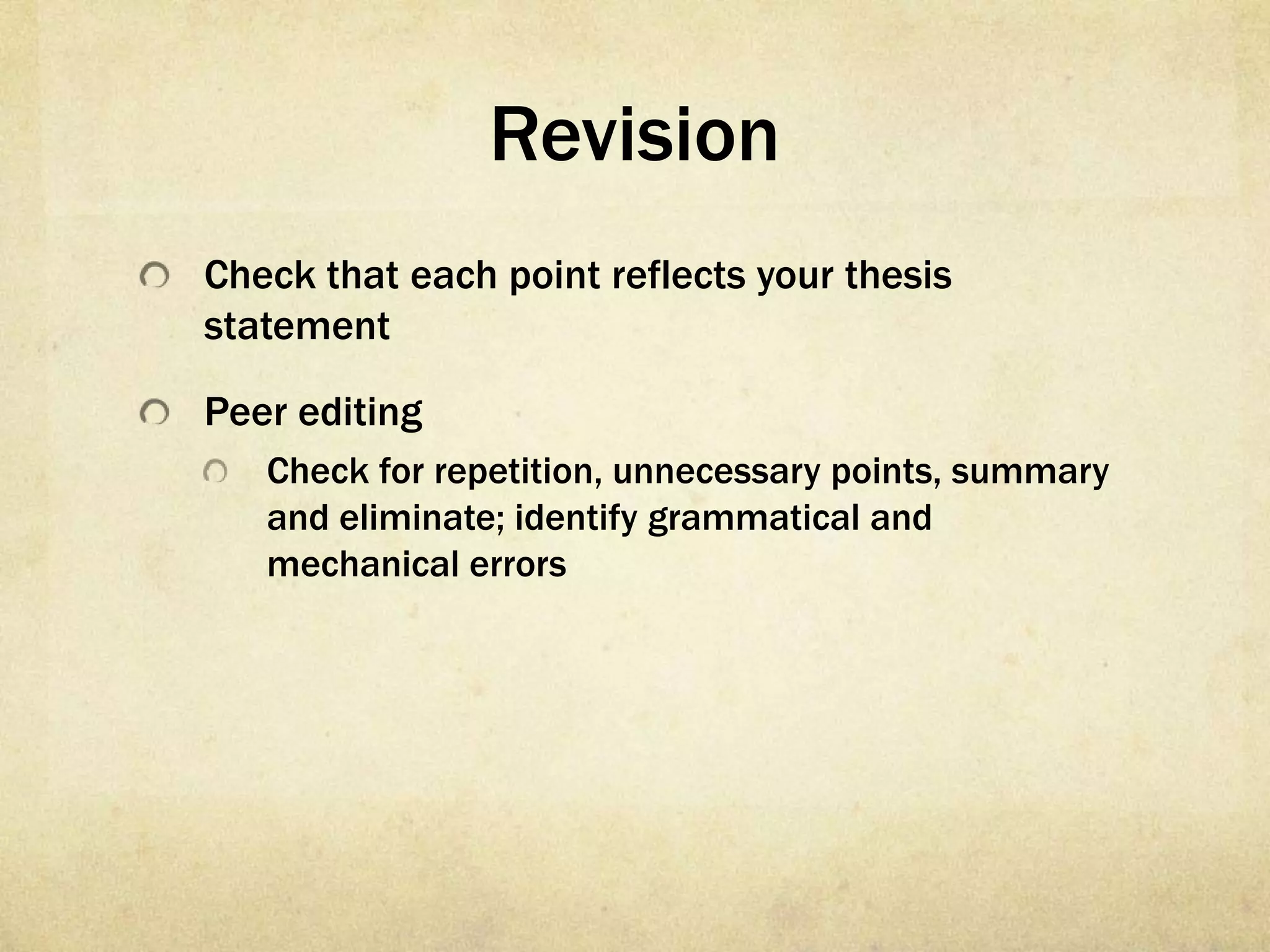
Check that each point reflects your thesis
statement

Peer editing
   Check for repetition, unnecessary points, summary
   and eliminate; identify grammatical and
   mechanical errors

Writing a Comparative Essay

  • 1.
  • 2.
    Understanding the Prompt Readthe assignment thoroughly Be sure you can answer, “What is this prompt asking me to do?” completely. Look at the rubric before, during, and after you write your essay
  • 3.
    Brainstorming Do not beginwriting until you have completed this step! Venn Diagram, Concept Map/Web, List, etc. Most IMPORTANT part of brainstorming is…
  • 4.
    Find a Focus Selectthe THREE most important comparisons between the texts While you may find several others, do not include them in your essay
  • 5.
    Introduction Startgeneral State texts and authors and genre Finish with a strong, specific thesis statement Your three points should be included EXAMPLE: Though Green Eggs and Ham, The Cat in the Hat, and Oh, The Places You’ll Go are three different stories, they each use rhyme, rhythm, and made-up words to add excitement and emphasis, establishing Dr. Seuss’ unique style.
  • 6.
    Body Paragraphs Point-by-Point Whole-by-Whole Choose one point or Write about all three aspect per paragraph points for each text in and write about all their own separate three texts paragraph Repeat for three total This is the most difficult body paragraphs method Make sure you use parallel structure
  • 7.
    Conclusion Do not restateyour thesis statement Summarize briefly (without repeating) End with a “so what” statement
  • 8.
    Revision Check that eachpoint reflects your thesis statement Peer editing Check for repetition, unnecessary points, summary and eliminate; identify grammatical and mechanical errors

Editor's Notes

  • #3 It is crucial that you understand the assignment before you begin brainstorming and writing. Be sure you can answer, “What is this prompt asking me to do?” completely. In addition to understanding the assignment, you also need to be checking your rubrics BEFORE, DURING, and AFTER you write your essay. It may ask you to include specific items, such as a Works Cited page or a particular number of pages or paragraphs.
  • #4 The next step is to brainstorm. Do NOT begin writing until you have completed this step. Oftentimes, we begin writing because we’re anxious to finish the assignment and get it all down on paper. I promise you, however, that you will be much more successful if you organize your thoughts logically before you begin writing. There are several ways you can brainstorm effectively. I find that using a graphic organizer is the best tool to organizing ideas. Here are some examples. The Venn Diagram is a great visual tool where the common ideas can be written in the middle overlap, while contrasting thoughts are placed in the outside circles. The second picture is a concept map. The concept, or idea, is placed in the middle circle, and ideas and quotes related to it are written in the squares. Finally, the last picture is a list or a chart. This is a nice, simple, organized way to write down thoughts with headings. But the number one most IMPORTANT part of brainstorming is to write down specific quotations and PAGE NUMBERS to support your ideas. If you do not do this step now, you will be rushed for time later.
  • #5 It is really important that while you’re coming up with ideas you remember to narrow your focus. Try to be as specific as possible. For example, in your upcoming assignment, you will be asked to select THREE of the most important aspects of the societies to compare. While there are many things that you could compare, try to find the three most significant.
  • #6 Let’s talk about the introduction to a comparative essay. In any paper, you need to start off general. Maybe make a broad statement about the three texts and how they are related or why they should be compared. In the introduction, you also want to state the names and authors of each text. Your titles should be in italics. In this particular assignment, you will also be asked to include the GENRE (Science fiction). Finally, you will end your introduction with a strong, specific thesis statement. Your thesis statement should include the three points you will be discussing and the insights they bring to readers. Here’s an example of a good thesis statement comparing three Dr. Seuss books.
  • #7 There are several ways you can write the body of your comparative essay. Here are the two most common ways. First, is the point-by-point method. Each paragraph discusses ONE aspect, but covers each of the three texts. You would have a total of three body paragraphs. In the whole-by-whole method, you would write about all three aspects for each separate text. Again, you would have three body paragraphs, but all of the aspects would be covered in each one. This is the most difficult method because you have to use strict parallel structure. How you phrase the concept in the first paragraph is how you need to phrase it in the other paragraphs. I highly recommend the point-by-point method. Also, don’t forget: do not summarize or retell the story of each book in your paper. Assume that the reader of your paper has some background knowledge of each text.
  • #8 Finally, you end with a strong conclusions. Conclusions are very difficult to write. We have been taught to just restate what we’ve already said, but this is juvenile. Summarize your paper briefly without repeating yourself. Then end with a “so what” statement. This gives your readers a reason why it is important to understand your paper.
  • #9 After you finish your conclusion, you are NOT finished! You must go back and revise. We are all guilty of being lazy with this step. However, be sure to go back through and check for mechanics, grammar, and spelling. Most importantly, however, check to make sure every point you make reflects back to your thesis statement. Then you can have a fellow peer check over your paper for any errors you missed.