THIRD DIMENSION OF PRONUNCIATION: Prosodic
Features and Related Coarticulatory Phenomena.

A PPT FOR A PRESENTATION
IN PHONETICS CLASS.
NOVEMBER 2013.
IFDC SAN LUIS.
Ppt for “my part” of the group presentation.
STUDENT: ADELA PEREZ DEL VISO.
TEACHERS: CHRISTI SUAREZ and CECILIA
ARELLANO.
THIRD DIMENSION OF PRONUNCIATION: Prosodic
Features and Related Coarticulatory Phenomena.

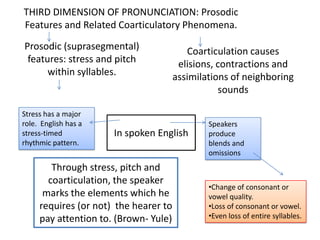
Prosodic (suprasegmental)
features: stress and pitch
within syllables.

Stress has a major
role. English has a
stress-timed
rhythmic pattern.

Coarticulation causes
elisions, contractions and
assimilations of neighboring
sounds

In spoken English

Through stress, pitch and
coarticulation, the speaker
marks the elements which he
requires (or not) the hearer to
pay attention to. (Brown- Yule)

Speakers
produce
blends and
omissions

•Change of consonant or
vowel quality.
•Loss of consonant or vowel.
•Even loss of entire syllables.
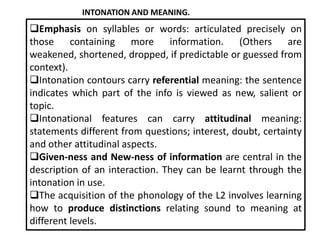
INTONATION AND MEANING.

Emphasis on syllables or words: articulated precisely on
those containing more information. (Others are
weakened, shortened, dropped, if predictable or guessed from
context).
Intonation contours carry referential meaning: the sentence
indicates which part of the info is viewed as new, salient or
topic.
Intonational features can carry attitudinal meaning:
statements different from questions; interest, doubt, certainty
and other attitudinal aspects.
Given-ness and New-ness of information are central in the
description of an interaction. They can be learnt through the
intonation in use.
The acquisition of the phonology of the L2 involves learning
how to produce distinctions relating sound to meaning at
different levels.
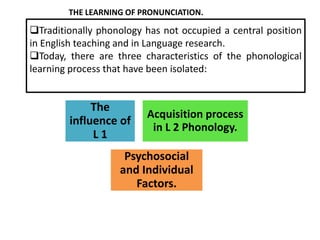
THE LEARNING OF PRONUNCIATION.

Traditionally phonology has not occupied a central position
in English teaching and in Language research.
Today, there are three characteristics of the phonological
learning process that have been isolated:

The
influence of
L1

Acquisition process
in L 2 Phonology.

Psychosocial
and Individual
Factors.
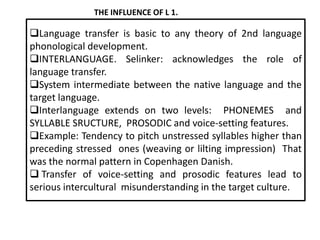
THE INFLUENCE OF L 1.

Language transfer is basic to any theory of 2nd language
phonological development.
INTERLANGUAGE. Selinker: acknowledges the role of
language transfer.
System intermediate between the native language and the
target language.
Interlanguage extends on two levels: PHONEMES and
SYLLABLE SRUCTURE, PROSODIC and voice-setting features.
Example: Tendency to pitch unstressed syllables higher than
preceding stressed ones (weaving or lilting impression) That
was the normal pattern in Copenhagen Danish.
 Transfer of voice-setting and prosodic features lead to
serious intercultural misunderstanding in the target culture.
SOURCE

Pennington, Martha, Pronunciation Revisited. University of
Hawaii at Manoa.

Third dimension of pronunciation

  • 1.
    THIRD DIMENSION OFPRONUNCIATION: Prosodic Features and Related Coarticulatory Phenomena. A PPT FOR A PRESENTATION IN PHONETICS CLASS. NOVEMBER 2013. IFDC SAN LUIS. Ppt for “my part” of the group presentation. STUDENT: ADELA PEREZ DEL VISO. TEACHERS: CHRISTI SUAREZ and CECILIA ARELLANO.
  • 2.
    THIRD DIMENSION OFPRONUNCIATION: Prosodic Features and Related Coarticulatory Phenomena. Prosodic (suprasegmental) features: stress and pitch within syllables. Stress has a major role. English has a stress-timed rhythmic pattern. Coarticulation causes elisions, contractions and assimilations of neighboring sounds In spoken English Through stress, pitch and coarticulation, the speaker marks the elements which he requires (or not) the hearer to pay attention to. (Brown- Yule) Speakers produce blends and omissions •Change of consonant or vowel quality. •Loss of consonant or vowel. •Even loss of entire syllables.
  • 3.
    INTONATION AND MEANING. Emphasison syllables or words: articulated precisely on those containing more information. (Others are weakened, shortened, dropped, if predictable or guessed from context). Intonation contours carry referential meaning: the sentence indicates which part of the info is viewed as new, salient or topic. Intonational features can carry attitudinal meaning: statements different from questions; interest, doubt, certainty and other attitudinal aspects. Given-ness and New-ness of information are central in the description of an interaction. They can be learnt through the intonation in use. The acquisition of the phonology of the L2 involves learning how to produce distinctions relating sound to meaning at different levels.
  • 4.
    THE LEARNING OFPRONUNCIATION. Traditionally phonology has not occupied a central position in English teaching and in Language research. Today, there are three characteristics of the phonological learning process that have been isolated: The influence of L1 Acquisition process in L 2 Phonology. Psychosocial and Individual Factors.
  • 5.
    THE INFLUENCE OFL 1. Language transfer is basic to any theory of 2nd language phonological development. INTERLANGUAGE. Selinker: acknowledges the role of language transfer. System intermediate between the native language and the target language. Interlanguage extends on two levels: PHONEMES and SYLLABLE SRUCTURE, PROSODIC and voice-setting features. Example: Tendency to pitch unstressed syllables higher than preceding stressed ones (weaving or lilting impression) That was the normal pattern in Copenhagen Danish.  Transfer of voice-setting and prosodic features lead to serious intercultural misunderstanding in the target culture.
  • 6.
    SOURCE Pennington, Martha, PronunciationRevisited. University of Hawaii at Manoa.