Thiourea-Mediated Regioselective Synthesis of Symmetrical and
Unsymmetrical Diversified Thioethers
Pitchai Manivel,†
Kamalakannan Prabakaran,†
Varadhan Krishnakumar,†
Fazlur-Rahman Nawaz Khan,*,†
and Thandavarayan Maiyalagan‡
†
Organic and Medicinal Chemistry Research Laboratory, Organic Chemistry Division, School of Advanced Sciences, VIT-University,
Vellore 632 014, Tamil Nadu India
‡
Materials Science and Engineering Program The University of Texas at Austin, Austin, Texas 78712, United States
*S Supporting Information
ABSTRACT: An efficient and simple thiourea-mediated regioselective synthesis of symmetrical and unsymmetrical diversified
thioethers is reported. The regioselective reaction avoids byproduct formation and offers simplified methodology, wider
applicability, and easy workability and an environmentally friendly approach toward symmetrical and unsymmetrical thioethers.
The mechanism of formation of thiols and symmetrical and unsymmetrical thioethers involving a sulfur surrogate is described.
1. INTRODUCTION
Organo sulfur compounds, especially thiols, play a significant
role because of the presence of a sulfur atom, a reactive center
of variable valency, and form an important part in many
chemical transformations and biochemical processes as
metabolic products.1
Organosulfur compounds such as thiols
and thioethers are versatile intermediates for synthetic
transformations.2
The photochemical reactions of aryl halides
with thiourea afford aryl methyl sulfides, diaryl sulfides, diaryl
disulfides, and arylthiols.3
Several methodologies in the
regioselective synthesis of thioethers are known;4
however,
they suffer from regiocontrol, side product formation of
disulfides by self-oxidation, etc. For example, there are reports
on thioether preparations utilizing thiourea, such as the reaction
of pyrrole with iodine or potassium triiodide and thiourea with
the formation of isothiouranium iodides, which react with
halides to offer thioethers; however, this required a two-step
reaction and also the involvement of additives such as hydrazine
hydrates to avoid side products.5
Similarly, photoinduced
reactions of aryl halides and a thiourea anion afford arene
thiolate ions in dimethyl sulfoxide (DMSO), which upon
subsequent aliphatic nucleophilic substitution yield aryl methyl
sulfides, also with the formation of disulfides; this reaction again
required the initiator t-BuOK, irradiation for 3 h to form a
thiolate anion, and subsequent reaction with aryl halides3a
to
afford a mixture of products including dehalogenated arenes,
disulfides, etc. There is a report on thioethers from the
chlorodipicolinates utilizing thiourea; these reactions exclu-
sively provide symmetrical thioethers.3b
In order to overcome
these drawbacks, an effort was made to develop an efficient
methodology for the regioselective synthesis of symmetrical
and unsymmetrical thioether, which is reported. It is evident
that the amount of thiourea plays an important role in the
regioselective control of thiol formation of symmetrical and
unsymmetrical thioethers (Scheme 1).
2. EXPERIMENTAL SECTION
2.1. Methods and Materials. Melting points were
measured on a open-capillary melting point apparatus and are
uncorrected. The purity of the compounds was checked using
precoated thin-layer chromatography (TLC) plates (Merck,
60F-254). IR spectra (KBr, ν in cm−1
) were recorded on a
PerkinElmer BX series Fourier transform infrared (FTIR)
spectrophotometer. 1
H NMR (400 MHz) and 13
C NMR (100
MHz) spectra were recorded on a Bruker 400 MHz
spectrometer in CDCl3 or DMSO (with tetramethylsilane for
1
H NMR and DMSO for 13
C NMR as internal references).
Liquid chromatography−mass spectrometry (LC−MS) anal-
yses were performed with a LCMS Agilent 1100 series ion trap.
2.2. General Preparation of 1-Chloroisoquinolines
1a−1l. 3-Arylisoquinolinone (15 g, 0.068 mol) and phosphoryl
chloride (90 mL) were mixed. The mixture was refluxed
overnight under a nitrogen atmosphere in an oil bath until TLC
showed completion of the reaction. Then the reaction mixture
was added to ice-cold water, and it was extracted with ethyl
acetate. The extract was dried over anhydrous sodium sulfate.
Removal of the solvent under vacuum gave a crude product,
which was further purified by column chromatography on silica
gel (230−400 mesh) with ethyl acetate−hexane (2%) as the
eluent to afford the pure products 1-chloro-3-phenylisoquino-
line (1a) in 92% yield, which are characterized by their 1
H and
13
C NMR spectra and compared with reports in the
literature.6,7
2.3. General Procedure for the Synthesis of 3-
Substituted Isoquinoline-1-thiols 3a−3l. 1-Chloro-3-aryli-
soquinoline (1; 2.04 mmol, 1.0 equiv) and thiourea (2; 1.938
mmol, 0.95 equiv) were mixed in an absolute ethanol solvent
(10 mL, 20 vol) at ambient temperature under a nitrogen
Received: January 11, 2014
Revised: March 29, 2014
Accepted: April 14, 2014
Published: April 14, 2014
Article
pubs.acs.org/IECR
© 2014 American Chemical Society 7866 dx.doi.org/10.1021/ie500119p | Ind. Eng. Chem. Res. 2014, 53, 7866−7870
atmosphere. The resulting mixture was refluxed for 6 h. The
reaction progress was monitored by TLC. Usually all reaction
completed in a 6−12 h period; upon completion, the reaction
mixture was cooled to ambient temperature, and the product
slowly crystallized and was filtered off, washed with 5 mL of
petroleum ether, and dried under reduced pressure over a
period of 1 h. In some cases, the solid was not formed at this
stage; under such circumstances, ethanol was completely
stripped off and 10 mL of petroleum ether was added. Solid
precipitates were filtered and dried under reduced pressure over
a period of 1 h. A yellow crystalline solid was obtained in all
cases with high purity and good yield (79−91%).
2.4. General Procedure for the Synthesis of Sym-
metrical Thioethers 4a−4k. Chloro compounds 1 (2.04
mmol, 1.0 equiv) and thiourea 2 (1.02 mmol, 0.5 equiv) were
mixed in an absolute ethanol solvent (10 mL, 20 vol) at
ambient temperature under a nitrogen atmosphere. The
resulting mixture was refluxed for 6 h. The reaction progress
was monitored by TLC. Usually all reaction completed in a 6−
8 h period; upon completion, the reaction mixture was cooled
to ambient temperature, and the product slowly crystallized and
was filtered off, washed with 5 mL of petroleum ether, and
dried under reduced pressure over a period of 1 h. A yellow
crystalline solid was obtained in all cases with high purity and
good yield (79−95%).
2.5. General Procedure for the Synthesis of Unsym-
metrical Thioethers 6a−6e. Chloro compounds 1a (2.04
mmol, 1.0 equiv) and thiourea 2 (1.938 mmol, 0.95 equiv)
were mixed in an absolute ethanol solvent (10 mL, 20 vol) at
ambient temperature under a nitrogen atmosphere. The
resulting mixture was refluxed for 6 h. The reaction progress
was monitored by TLC. After 6 h, the reaction mixture was
cooled to ambient temperature. At ambient temperature, R1Cl
(5; 2.04 mmol) was added, and reflux was continued for a
period of 6−8 h. Upon completion, the reaction mixture was
cooled to ambient temperature, and the product slowly
crystallized and was filtered off, washed with 5 mL of petroleum
ether, and dried under reduced pressure over a period of 1 h. A
yellow crystalline solid was obtained in all cases with high
purity and good yield (84−91%).
3. RESULTS AND DISCUSSION
In a continuation of our research in isoquinolines,6
initially 3-
substituted chloroisoquinolines7
were similarly derived from
homophthalic acid, which were when thionated with equimolar
thiourea in ethanol and afforded thiols (Scheme 2) successfully
in 6 h with good yield.
Optimization of the reaction conditions was carried out with
thionation of 1-chloro-3-(4-chlorophenyl)isoquinoline 1b and
Scheme 1. Synthesis of Symmetrical and Unsymmetrical Thioethers and 3-Arylisoquinoline-1-thiols
Scheme 2. Synthesis of 3-Arylisoquinoline-1-thiol 3b
Industrial & Engineering Chemistry Research Article
dx.doi.org/10.1021/ie500119p | Ind. Eng. Chem. Res. 2014, 53, 7866−78707867
thiourea 2 as the model reaction (Scheme 2 and Table 1). As
shown in Table 1, the reaction proceeds with equimolar
thiourea, with an excellent product yield. However, higher
concentration reduced the yields (Table 1, entries 5−7)
because of the formation of a disulfide byproduct (5−15%).
With the optimized conditions in hand, varoius isoquinoline
thiols were prepared from their corresponding chloro
compounds (Scheme 2 and Table1; see Table 1s in the
Supporting Information, SI) in good yield without the
formation of a thiol dimer.
Interestingly, lesser loading of thiourea produced lesser yields
of thiols (Table 1, entries 1−4) because of the formation of
symmetrical thioether as a byproduct in the reaction. It is
envisioned that symmetrical thioether could be obtained in
excellent yield by reduced loading (50%) of thiourea.
In the further screening of thiourea 2, loading gave exciting
results, as shown in Table 2. The results illustrated that the
formation of symmetrical thioether can be achieved by varying
the concentration of thiourea. The increase in the concen-
tration of thiourea proportionally increased symmetrical
thioether 4b (Table 2, entries 1−3), and the optimized amount
of 0.5 equiv produced higher yield. It should be noted that in
this concentration range no thiol formation is observed (entries
1−3) and that thiol product is seen to form at above 0.5 equiv
of thiourea. Thus, an optimized amount of 0.5 equiv of the
thiourea concentration is necessary for the regioselective
synthesis of symmetrical thioethers in good yield and purity.
In our continued interest in symmetrical thioether, we
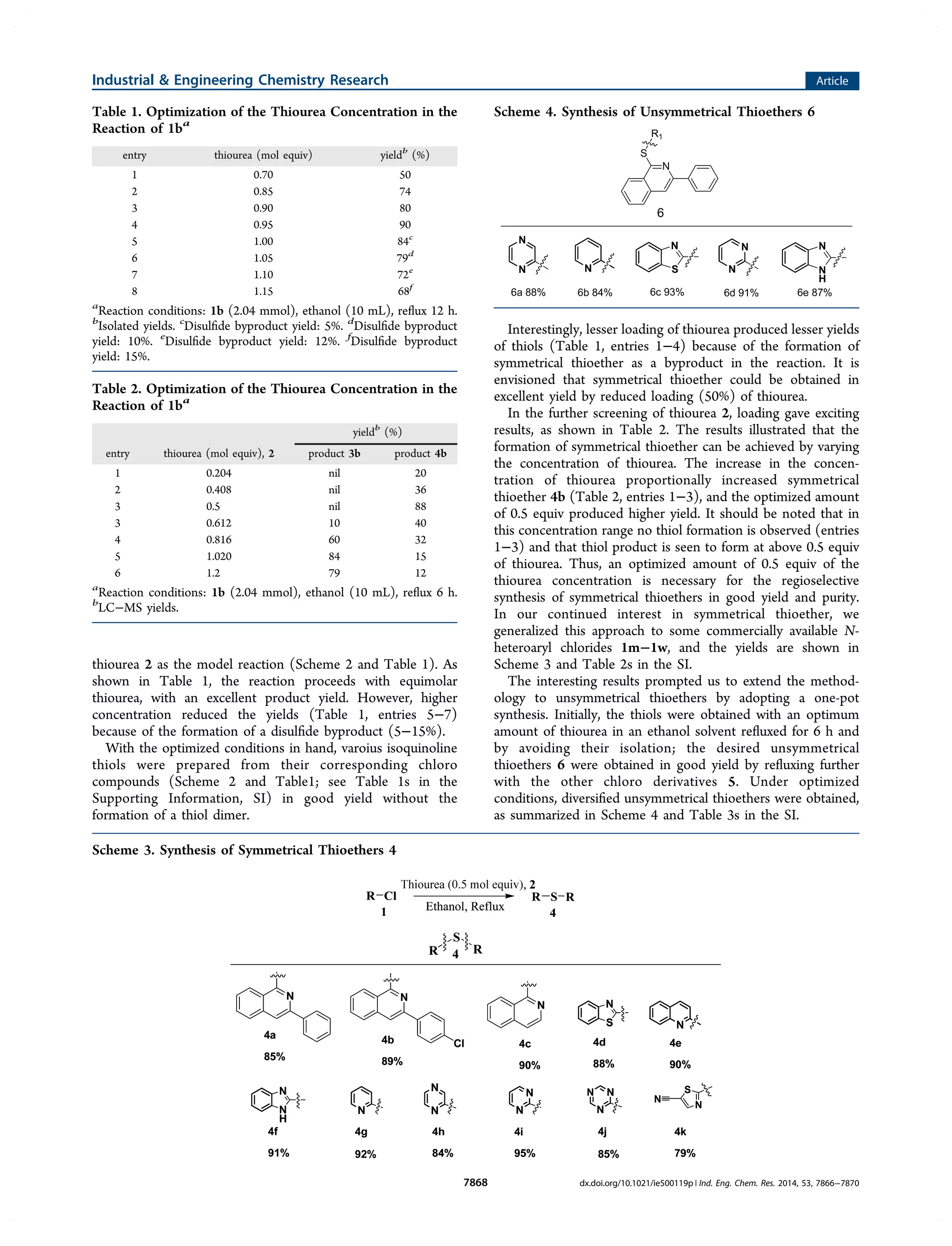
generalized this approach to some commercially available N-
heteroaryl chlorides 1m−1w, and the yields are shown in
Scheme 3 and Table 2s in the SI.
The interesting results prompted us to extend the method-
ology to unsymmetrical thioethers by adopting a one-pot
synthesis. Initially, the thiols were obtained with an optimum
amount of thiourea in an ethanol solvent refluxed for 6 h and
by avoiding their isolation; the desired unsymmetrical
thioethers 6 were obtained in good yield by refluxing further
with the other chloro derivatives 5. Under optimized
conditions, diversified unsymmetrical thioethers were obtained,
as summarized in Scheme 4 and Table 3s in the SI.
Table 1. Optimization of the Thiourea Concentration in the
Reaction of 1ba
entry thiourea (mol equiv) yieldb
(%)
1 0.70 50
2 0.85 74
3 0.90 80
4 0.95 90
5 1.00 84c
6 1.05 79d
7 1.10 72e
8 1.15 68f
a
Reaction conditions: 1b (2.04 mmol), ethanol (10 mL), reflux 12 h.
b
Isolated yields. c
Disulfide byproduct yield: 5%. d
Disulfide byproduct
yield: 10%. e
Disulfide byproduct yield: 12%. f
Disulfide byproduct
yield: 15%.
Table 2. Optimization of the Thiourea Concentration in the
Reaction of 1ba
yieldb
(%)
entry thiourea (mol equiv), 2 product 3b product 4b
1 0.204 nil 20
2 0.408 nil 36
3 0.5 nil 88
3 0.612 10 40
4 0.816 60 32
5 1.020 84 15
6 1.2 79 12
a
Reaction conditions: 1b (2.04 mmol), ethanol (10 mL), reflux 6 h.
b
LC−MS yields.
Scheme 3. Synthesis of Symmetrical Thioethers 4
Scheme 4. Synthesis of Unsymmetrical Thioethers 6
Industrial & Engineering Chemistry Research Article
dx.doi.org/10.1021/ie500119p | Ind. Eng. Chem. Res. 2014, 53, 7866−78707868
The products of all three regioselective reactions were
isolated and purified by recrystallization in an ethanol/
petroleum ether solvent mixture. All of the pure compounds
were identified by various spectral techniques such as FTIR, 1
H
and 13
C NMR, LC−MS, and CHN analysis.
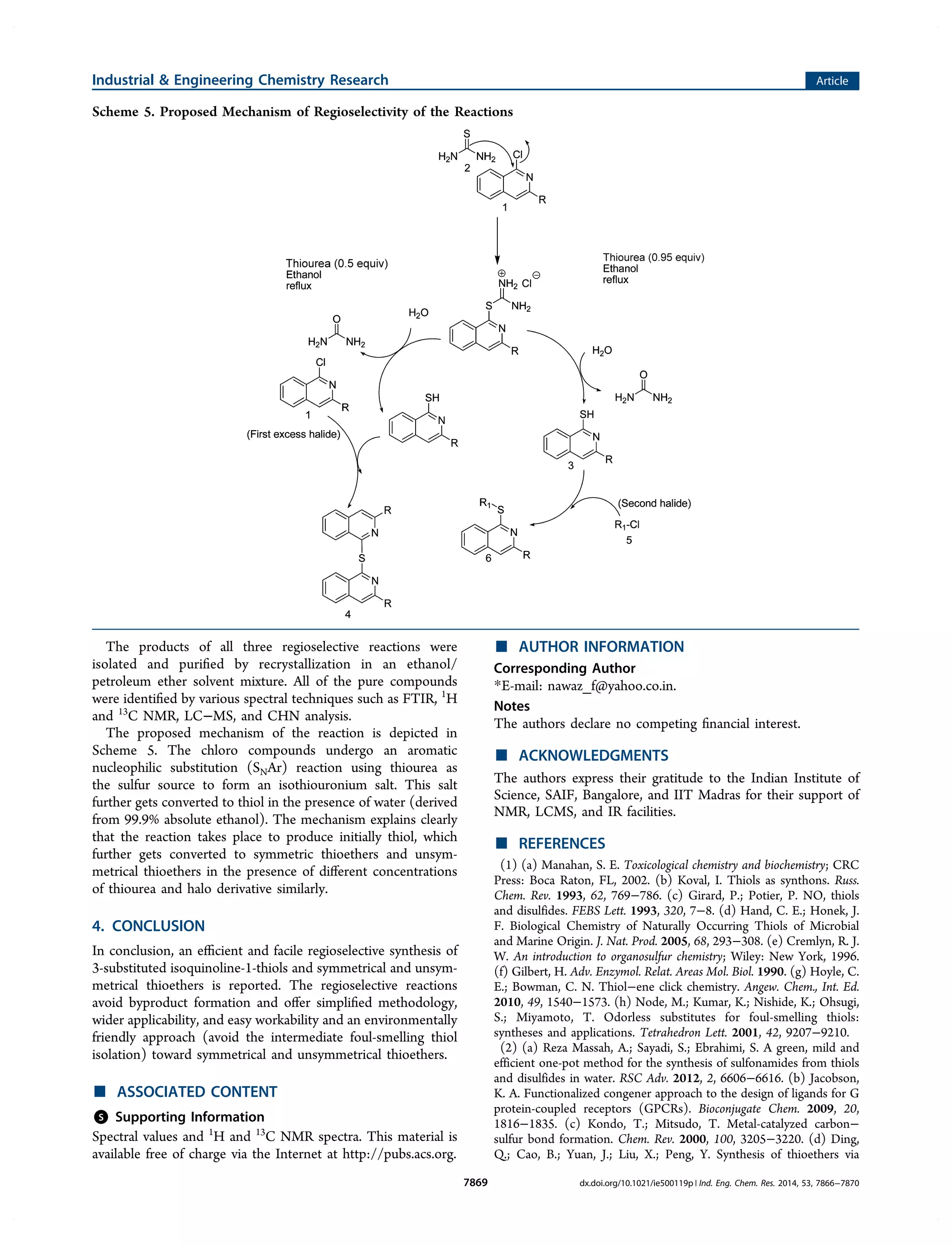
The proposed mechanism of the reaction is depicted in
Scheme 5. The chloro compounds undergo an aromatic
nucleophilic substitution (SNAr) reaction using thiourea as
the sulfur source to form an isothiouronium salt. This salt
further gets converted to thiol in the presence of water (derived
from 99.9% absolute ethanol). The mechanism explains clearly
that the reaction takes place to produce initially thiol, which
further gets converted to symmetric thioethers and unsym-
metrical thioethers in the presence of different concentrations
of thiourea and halo derivative similarly.
4. CONCLUSION
In conclusion, an efficient and facile regioselective synthesis of
3-substituted isoquinoline-1-thiols and symmetrical and unsym-
metrical thioethers is reported. The regioselective reactions
avoid byproduct formation and offer simplified methodology,
wider applicability, and easy workability and an environmentally
friendly approach (avoid the intermediate foul-smelling thiol
isolation) toward symmetrical and unsymmetrical thioethers.
■ ASSOCIATED CONTENT
*S Supporting Information
Spectral values and 1
H and 13
C NMR spectra. This material is
available free of charge via the Internet at http://pubs.acs.org.
■ AUTHOR INFORMATION
Corresponding Author
*E-mail: nawaz_f@yahoo.co.in.
Notes
The authors declare no competing financial interest.
■ ACKNOWLEDGMENTS
The authors express their gratitude to the Indian Institute of
Science, SAIF, Bangalore, and IIT Madras for their support of
NMR, LCMS, and IR facilities.
■ REFERENCES
(1) (a) Manahan, S. E. Toxicological chemistry and biochemistry; CRC
Press: Boca Raton, FL, 2002. (b) Koval, I. Thiols as synthons. Russ.
Chem. Rev. 1993, 62, 769−786. (c) Girard, P.; Potier, P. NO, thiols
and disulfides. FEBS Lett. 1993, 320, 7−8. (d) Hand, C. E.; Honek, J.
F. Biological Chemistry of Naturally Occurring Thiols of Microbial
and Marine Origin. J. Nat. Prod. 2005, 68, 293−308. (e) Cremlyn, R. J.
W. An introduction to organosulfur chemistry; Wiley: New York, 1996.
(f) Gilbert, H. Adv. Enzymol. Relat. Areas Mol. Biol. 1990. (g) Hoyle, C.
E.; Bowman, C. N. Thiol−ene click chemistry. Angew. Chem., Int. Ed.
2010, 49, 1540−1573. (h) Node, M.; Kumar, K.; Nishide, K.; Ohsugi,
S.; Miyamoto, T. Odorless substitutes for foul-smelling thiols:
syntheses and applications. Tetrahedron Lett. 2001, 42, 9207−9210.
(2) (a) Reza Massah, A.; Sayadi, S.; Ebrahimi, S. A green, mild and
efficient one-pot method for the synthesis of sulfonamides from thiols
and disulfides in water. RSC Adv. 2012, 2, 6606−6616. (b) Jacobson,
K. A. Functionalized congener approach to the design of ligands for G
protein-coupled receptors (GPCRs). Bioconjugate Chem. 2009, 20,
1816−1835. (c) Kondo, T.; Mitsudo, T. Metal-catalyzed carbon−
sulfur bond formation. Chem. Rev. 2000, 100, 3205−3220. (d) Ding,
Q.; Cao, B.; Yuan, J.; Liu, X.; Peng, Y. Synthesis of thioethers via
Scheme 5. Proposed Mechanism of Regioselectivity of the Reactions
Industrial & Engineering Chemistry Research Article
dx.doi.org/10.1021/ie500119p | Ind. Eng. Chem. Res. 2014, 53, 7866−78707869
metal-free reductive coupling of tosylhydrazones with thiols. Org.
Biomol. Chem. 2011, 9, 748−751. (e) Badoiu, A.; Bernardinelli, G.;
Besnard, C.; Kundig, E. P. Asymmetric ruthenium-catalyzed 1,4-
additions of aryl thiols to enones. Org. Biomol. Chem. 2010, 8, 193−
200. (f) Levin, E.; Anaby, A.; Diesendruck, C. E.; Berkovich-Berger,
D.; Fuchs, B.; Lemcoff, N. G. Oligomerisation reactions of beta
substituted thiols in water. RSC Adv. 2013.
(3) (a) Argüello, J. E.; Schmidt, L. C.; Peñéñory, A. B. “One-Pot”
Two-Step Synthesis of Aryl Sulfur Compounds by Photoinduced
Reactions of Thiourea Anion with Aryl Halides. Org. Lett. 2003, 5,
4133−4136. (b) Markees, D. G. Derivatives of 4-Mercaptodipicolinic
Acid. J. Org. Chem. 1963, 28, 2530−2533.
(4) (a) Kondrashov, E.; Rudyakova, E.; Rozentsveig, I.; Ushakova, I.;
Rozentsveig, G.; Savosik, V.; Chernyshev, K.; Krivdin, L.; Levkovskaya,
G. Reactions of N-(Polychloroethylidene) arene and trifluorometha-
nesulfonamides with indoles. Russ. J. Org. Chem. 2008, 44, 86−94.
(b) Salvatore, R. N.; Smith, R. A.; Nischwitz, A. K.; Gavin, T. A mild
and highly convenient chemoselective alkylation of thiols using
Cs2CO3−TBAI. Tetrahedron Lett. 2005, 46, 8931−8935. (c) Sudalai,
A.; Kanagasabapathy, S.; Benicewicz, B. C. Phosphorus Pentasulfide: A
Mild and Versatile Catalyst/Reagent for the Preparation of
Dithiocarboxylic Esters. Org. Lett. 2000, 2, 3213−3216. (d) Kanagasa-
bapathy, S.; Sudalai, A.; Benicewicz, B. C. Montmorillonite K 10-
catalyzed regioselective addition of thiols and thiobenzoic acids onto
olefins: an efficient synthesis of dithiocarboxylic esters. Tetrahedron
Lett. 2001, 42, 3791−3794. (e) Thang, S. H.; Chong, Y. K.;
Mayadunne, R. T. A.; Moad, G.; Rizzardo, E. A novel synthesis of
functional dithioesters, dithiocarbamates, xanthates and trithiocarbon-
ates. Tetrahedron Lett. 1999, 40, 2435−2438. (f) Movassagha, B.;
Shaygana, P. Michael addition of thiols to α,β-unsaturated carbonyl
compounds under solvent-free conditions. ARKIVOC 2006, 12, 130−
137. (g) Falck, J. R.; Lai, J.-Y.; Cho, S.-D.; Yu, J. Alkylthioether
synthesis via imidazole mediated mitsunobu condensation. Tetrahedron
Lett. 1999, 40, 2903−2906. (h) Perrier, S.; Takolpuckdee, P.
Macromolecular design via reversible addition−fragmentation chain
transfer (RAFT)/xanthates (MADIX) polymerization. J. Polym. Sci.,
Part A: Polym. Chem. 2005, 43, 5347−5393.
(5) Mirskova, A.; Levkovskaya, G.; Mirskov, R.; Voronkov, M.
Hydroxyalkylammonium salts of organylsulfanyl (sulfonyl) acetic
acidsNew stimulators of biological processes. Russ. J. Org. Chem.
2008, 44, 1478−1485.
(6) (a) Krishnakumar, V.; Kumar, K. M.; Mandal, B. K.; Khan, F. R.
N. Zinc Oxide Nanoparticles Catalyzed Condensation Reaction of
Isocoumarins and 1,7-Heptadiamine in the Formation of Bis-
Isoquinolinones. Sci. World J. 2012, 2012. (b) Nawaz Khan, F.;
Manivel, P.; Prabakaran, K.; Jin, J. S.; Jeong, E. D.; Kim, H. G.;
Maiyalagan, T. Iron-oxide nanoparticles mediated cyclization of 3-(4-
chlorophenyl)-1-hydrazinylisoquinoline to 1-(4,5-dihydropyrazol-1-yl)
isoquinolines. Res. Chem. Intermed. 2012, 38, 571−582. (c) Prabakaran,
K.; Nawaz Khan, F.; Jin, J. S. Ligand-free, PdCl2(PPh3)2 catalyzed,
microwave-assisted Suzuki coupling of 1-chloro-3-phenylisoquinoline
in the synthesis of diversified 1,3-disubstituted isoquinolines. Res.
Chem. Intermed. 2012, 38, 337−346. (d) Prabakaran, K.; Nawaz Khan,
F.; Jin, J. S.; Manivel, P. Indium bromide catalysed, ultrasound-assisted,
regio-selective synthesis of ethyl-5-(trifluoromethyl)-1-(3-substituted
isoquinolin-1-yl)-1H-pyrazole-4-carboxylates. Res. Chem. Intermed.
2012, 38, 429−441. (e) Khan, F. N.; Manivel, P.; Krishnakumar, V.;
Hathwar, V. R.; Ng, S. W. 1-[3-(4-Chlorophenyl)isoquinolin-1-yl]-3,5-
diphenyl-1H-pyrazole. Acta Crystallogr., Sect. E: Struct. Rep. Online
2010, 66 (2), o369. (f) Manivel, P.; Khan, F. N. Synthesis of some new
2,4-disubstituted hydrazinothiazoles and 2,5-disubstituted thiazolidi-
nones. Phosphorus, Sulfur Silicon Relat. Elem. 2009, 184, 2910−2922.
(g) Manivel, P.; Khan, F. N.; Hatwar, V. R Synthesis of diversified
thioethers, 1- aroylalkylisoquinolin-1-yl thioethers, by electrophilic s-
alkylation of 3-phenylisoquinoline-1(2H)-thione. Phosphorus, Sulfur
Silicon Relat. Elem. 2010, 185, 1932−1942.
(7) (a) Prabakaran, K.; Manivel, P.; Nawaz Khan, F. An effective
BINAP and microwave accelerated palladium-catalyzed amination of
1-chloroisoquinolines in the synthesis of new 1,3-disubstituted
isoquinolines. Tetrahedron Lett. 2010, 51, 4340−4343. (b) Prabakaran,
K.; Nawaz Khan, F.; Jin, J. S. An efficient copper-free Pd(OAc)2/
Ruphos-catalyzed Sonogashira coupling of 1-chloroisoquinolines in the
formation of 1-alkynyl-3-substituted isoquinolines. Tetrahedron Lett.
2011, 52, 2566−2570.
Industrial & Engineering Chemistry Research Article
dx.doi.org/10.1021/ie500119p | Ind. Eng. Chem. Res. 2014, 53, 7866−78707870

Thiourea mediated regioselective synthesis of symmetrical and unsymmetrical diversified thioetheres

  • 1.
    Thiourea-Mediated Regioselective Synthesisof Symmetrical and Unsymmetrical Diversified Thioethers Pitchai Manivel,† Kamalakannan Prabakaran,† Varadhan Krishnakumar,† Fazlur-Rahman Nawaz Khan,*,† and Thandavarayan Maiyalagan‡ † Organic and Medicinal Chemistry Research Laboratory, Organic Chemistry Division, School of Advanced Sciences, VIT-University, Vellore 632 014, Tamil Nadu India ‡ Materials Science and Engineering Program The University of Texas at Austin, Austin, Texas 78712, United States *S Supporting Information ABSTRACT: An efficient and simple thiourea-mediated regioselective synthesis of symmetrical and unsymmetrical diversified thioethers is reported. The regioselective reaction avoids byproduct formation and offers simplified methodology, wider applicability, and easy workability and an environmentally friendly approach toward symmetrical and unsymmetrical thioethers. The mechanism of formation of thiols and symmetrical and unsymmetrical thioethers involving a sulfur surrogate is described. 1. INTRODUCTION Organo sulfur compounds, especially thiols, play a significant role because of the presence of a sulfur atom, a reactive center of variable valency, and form an important part in many chemical transformations and biochemical processes as metabolic products.1 Organosulfur compounds such as thiols and thioethers are versatile intermediates for synthetic transformations.2 The photochemical reactions of aryl halides with thiourea afford aryl methyl sulfides, diaryl sulfides, diaryl disulfides, and arylthiols.3 Several methodologies in the regioselective synthesis of thioethers are known;4 however, they suffer from regiocontrol, side product formation of disulfides by self-oxidation, etc. For example, there are reports on thioether preparations utilizing thiourea, such as the reaction of pyrrole with iodine or potassium triiodide and thiourea with the formation of isothiouranium iodides, which react with halides to offer thioethers; however, this required a two-step reaction and also the involvement of additives such as hydrazine hydrates to avoid side products.5 Similarly, photoinduced reactions of aryl halides and a thiourea anion afford arene thiolate ions in dimethyl sulfoxide (DMSO), which upon subsequent aliphatic nucleophilic substitution yield aryl methyl sulfides, also with the formation of disulfides; this reaction again required the initiator t-BuOK, irradiation for 3 h to form a thiolate anion, and subsequent reaction with aryl halides3a to afford a mixture of products including dehalogenated arenes, disulfides, etc. There is a report on thioethers from the chlorodipicolinates utilizing thiourea; these reactions exclu- sively provide symmetrical thioethers.3b In order to overcome these drawbacks, an effort was made to develop an efficient methodology for the regioselective synthesis of symmetrical and unsymmetrical thioether, which is reported. It is evident that the amount of thiourea plays an important role in the regioselective control of thiol formation of symmetrical and unsymmetrical thioethers (Scheme 1). 2. EXPERIMENTAL SECTION 2.1. Methods and Materials. Melting points were measured on a open-capillary melting point apparatus and are uncorrected. The purity of the compounds was checked using precoated thin-layer chromatography (TLC) plates (Merck, 60F-254). IR spectra (KBr, ν in cm−1 ) were recorded on a PerkinElmer BX series Fourier transform infrared (FTIR) spectrophotometer. 1 H NMR (400 MHz) and 13 C NMR (100 MHz) spectra were recorded on a Bruker 400 MHz spectrometer in CDCl3 or DMSO (with tetramethylsilane for 1 H NMR and DMSO for 13 C NMR as internal references). Liquid chromatography−mass spectrometry (LC−MS) anal- yses were performed with a LCMS Agilent 1100 series ion trap. 2.2. General Preparation of 1-Chloroisoquinolines 1a−1l. 3-Arylisoquinolinone (15 g, 0.068 mol) and phosphoryl chloride (90 mL) were mixed. The mixture was refluxed overnight under a nitrogen atmosphere in an oil bath until TLC showed completion of the reaction. Then the reaction mixture was added to ice-cold water, and it was extracted with ethyl acetate. The extract was dried over anhydrous sodium sulfate. Removal of the solvent under vacuum gave a crude product, which was further purified by column chromatography on silica gel (230−400 mesh) with ethyl acetate−hexane (2%) as the eluent to afford the pure products 1-chloro-3-phenylisoquino- line (1a) in 92% yield, which are characterized by their 1 H and 13 C NMR spectra and compared with reports in the literature.6,7 2.3. General Procedure for the Synthesis of 3- Substituted Isoquinoline-1-thiols 3a−3l. 1-Chloro-3-aryli- soquinoline (1; 2.04 mmol, 1.0 equiv) and thiourea (2; 1.938 mmol, 0.95 equiv) were mixed in an absolute ethanol solvent (10 mL, 20 vol) at ambient temperature under a nitrogen Received: January 11, 2014 Revised: March 29, 2014 Accepted: April 14, 2014 Published: April 14, 2014 Article pubs.acs.org/IECR © 2014 American Chemical Society 7866 dx.doi.org/10.1021/ie500119p | Ind. Eng. Chem. Res. 2014, 53, 7866−7870
  • 2.
    atmosphere. The resultingmixture was refluxed for 6 h. The reaction progress was monitored by TLC. Usually all reaction completed in a 6−12 h period; upon completion, the reaction mixture was cooled to ambient temperature, and the product slowly crystallized and was filtered off, washed with 5 mL of petroleum ether, and dried under reduced pressure over a period of 1 h. In some cases, the solid was not formed at this stage; under such circumstances, ethanol was completely stripped off and 10 mL of petroleum ether was added. Solid precipitates were filtered and dried under reduced pressure over a period of 1 h. A yellow crystalline solid was obtained in all cases with high purity and good yield (79−91%). 2.4. General Procedure for the Synthesis of Sym- metrical Thioethers 4a−4k. Chloro compounds 1 (2.04 mmol, 1.0 equiv) and thiourea 2 (1.02 mmol, 0.5 equiv) were mixed in an absolute ethanol solvent (10 mL, 20 vol) at ambient temperature under a nitrogen atmosphere. The resulting mixture was refluxed for 6 h. The reaction progress was monitored by TLC. Usually all reaction completed in a 6− 8 h period; upon completion, the reaction mixture was cooled to ambient temperature, and the product slowly crystallized and was filtered off, washed with 5 mL of petroleum ether, and dried under reduced pressure over a period of 1 h. A yellow crystalline solid was obtained in all cases with high purity and good yield (79−95%). 2.5. General Procedure for the Synthesis of Unsym- metrical Thioethers 6a−6e. Chloro compounds 1a (2.04 mmol, 1.0 equiv) and thiourea 2 (1.938 mmol, 0.95 equiv) were mixed in an absolute ethanol solvent (10 mL, 20 vol) at ambient temperature under a nitrogen atmosphere. The resulting mixture was refluxed for 6 h. The reaction progress was monitored by TLC. After 6 h, the reaction mixture was cooled to ambient temperature. At ambient temperature, R1Cl (5; 2.04 mmol) was added, and reflux was continued for a period of 6−8 h. Upon completion, the reaction mixture was cooled to ambient temperature, and the product slowly crystallized and was filtered off, washed with 5 mL of petroleum ether, and dried under reduced pressure over a period of 1 h. A yellow crystalline solid was obtained in all cases with high purity and good yield (84−91%). 3. RESULTS AND DISCUSSION In a continuation of our research in isoquinolines,6 initially 3- substituted chloroisoquinolines7 were similarly derived from homophthalic acid, which were when thionated with equimolar thiourea in ethanol and afforded thiols (Scheme 2) successfully in 6 h with good yield. Optimization of the reaction conditions was carried out with thionation of 1-chloro-3-(4-chlorophenyl)isoquinoline 1b and Scheme 1. Synthesis of Symmetrical and Unsymmetrical Thioethers and 3-Arylisoquinoline-1-thiols Scheme 2. Synthesis of 3-Arylisoquinoline-1-thiol 3b Industrial & Engineering Chemistry Research Article dx.doi.org/10.1021/ie500119p | Ind. Eng. Chem. Res. 2014, 53, 7866−78707867
  • 3.
    thiourea 2 asthe model reaction (Scheme 2 and Table 1). As shown in Table 1, the reaction proceeds with equimolar thiourea, with an excellent product yield. However, higher concentration reduced the yields (Table 1, entries 5−7) because of the formation of a disulfide byproduct (5−15%). With the optimized conditions in hand, varoius isoquinoline thiols were prepared from their corresponding chloro compounds (Scheme 2 and Table1; see Table 1s in the Supporting Information, SI) in good yield without the formation of a thiol dimer. Interestingly, lesser loading of thiourea produced lesser yields of thiols (Table 1, entries 1−4) because of the formation of symmetrical thioether as a byproduct in the reaction. It is envisioned that symmetrical thioether could be obtained in excellent yield by reduced loading (50%) of thiourea. In the further screening of thiourea 2, loading gave exciting results, as shown in Table 2. The results illustrated that the formation of symmetrical thioether can be achieved by varying the concentration of thiourea. The increase in the concen- tration of thiourea proportionally increased symmetrical thioether 4b (Table 2, entries 1−3), and the optimized amount of 0.5 equiv produced higher yield. It should be noted that in this concentration range no thiol formation is observed (entries 1−3) and that thiol product is seen to form at above 0.5 equiv of thiourea. Thus, an optimized amount of 0.5 equiv of the thiourea concentration is necessary for the regioselective synthesis of symmetrical thioethers in good yield and purity. In our continued interest in symmetrical thioether, we generalized this approach to some commercially available N- heteroaryl chlorides 1m−1w, and the yields are shown in Scheme 3 and Table 2s in the SI. The interesting results prompted us to extend the method- ology to unsymmetrical thioethers by adopting a one-pot synthesis. Initially, the thiols were obtained with an optimum amount of thiourea in an ethanol solvent refluxed for 6 h and by avoiding their isolation; the desired unsymmetrical thioethers 6 were obtained in good yield by refluxing further with the other chloro derivatives 5. Under optimized conditions, diversified unsymmetrical thioethers were obtained, as summarized in Scheme 4 and Table 3s in the SI. Table 1. Optimization of the Thiourea Concentration in the Reaction of 1ba entry thiourea (mol equiv) yieldb (%) 1 0.70 50 2 0.85 74 3 0.90 80 4 0.95 90 5 1.00 84c 6 1.05 79d 7 1.10 72e 8 1.15 68f a Reaction conditions: 1b (2.04 mmol), ethanol (10 mL), reflux 12 h. b Isolated yields. c Disulfide byproduct yield: 5%. d Disulfide byproduct yield: 10%. e Disulfide byproduct yield: 12%. f Disulfide byproduct yield: 15%. Table 2. Optimization of the Thiourea Concentration in the Reaction of 1ba yieldb (%) entry thiourea (mol equiv), 2 product 3b product 4b 1 0.204 nil 20 2 0.408 nil 36 3 0.5 nil 88 3 0.612 10 40 4 0.816 60 32 5 1.020 84 15 6 1.2 79 12 a Reaction conditions: 1b (2.04 mmol), ethanol (10 mL), reflux 6 h. b LC−MS yields. Scheme 3. Synthesis of Symmetrical Thioethers 4 Scheme 4. Synthesis of Unsymmetrical Thioethers 6 Industrial & Engineering Chemistry Research Article dx.doi.org/10.1021/ie500119p | Ind. Eng. Chem. Res. 2014, 53, 7866−78707868
  • 4.
    The products ofall three regioselective reactions were isolated and purified by recrystallization in an ethanol/ petroleum ether solvent mixture. All of the pure compounds were identified by various spectral techniques such as FTIR, 1 H and 13 C NMR, LC−MS, and CHN analysis. The proposed mechanism of the reaction is depicted in Scheme 5. The chloro compounds undergo an aromatic nucleophilic substitution (SNAr) reaction using thiourea as the sulfur source to form an isothiouronium salt. This salt further gets converted to thiol in the presence of water (derived from 99.9% absolute ethanol). The mechanism explains clearly that the reaction takes place to produce initially thiol, which further gets converted to symmetric thioethers and unsym- metrical thioethers in the presence of different concentrations of thiourea and halo derivative similarly. 4. CONCLUSION In conclusion, an efficient and facile regioselective synthesis of 3-substituted isoquinoline-1-thiols and symmetrical and unsym- metrical thioethers is reported. The regioselective reactions avoid byproduct formation and offer simplified methodology, wider applicability, and easy workability and an environmentally friendly approach (avoid the intermediate foul-smelling thiol isolation) toward symmetrical and unsymmetrical thioethers. ■ ASSOCIATED CONTENT *S Supporting Information Spectral values and 1 H and 13 C NMR spectra. This material is available free of charge via the Internet at http://pubs.acs.org. ■ AUTHOR INFORMATION Corresponding Author *E-mail: nawaz_f@yahoo.co.in. Notes The authors declare no competing financial interest. ■ ACKNOWLEDGMENTS The authors express their gratitude to the Indian Institute of Science, SAIF, Bangalore, and IIT Madras for their support of NMR, LCMS, and IR facilities. ■ REFERENCES (1) (a) Manahan, S. E. Toxicological chemistry and biochemistry; CRC Press: Boca Raton, FL, 2002. (b) Koval, I. Thiols as synthons. Russ. Chem. Rev. 1993, 62, 769−786. (c) Girard, P.; Potier, P. NO, thiols and disulfides. FEBS Lett. 1993, 320, 7−8. (d) Hand, C. E.; Honek, J. F. Biological Chemistry of Naturally Occurring Thiols of Microbial and Marine Origin. J. Nat. Prod. 2005, 68, 293−308. (e) Cremlyn, R. J. W. An introduction to organosulfur chemistry; Wiley: New York, 1996. (f) Gilbert, H. Adv. Enzymol. Relat. Areas Mol. Biol. 1990. (g) Hoyle, C. E.; Bowman, C. N. Thiol−ene click chemistry. Angew. Chem., Int. Ed. 2010, 49, 1540−1573. (h) Node, M.; Kumar, K.; Nishide, K.; Ohsugi, S.; Miyamoto, T. Odorless substitutes for foul-smelling thiols: syntheses and applications. Tetrahedron Lett. 2001, 42, 9207−9210. (2) (a) Reza Massah, A.; Sayadi, S.; Ebrahimi, S. A green, mild and efficient one-pot method for the synthesis of sulfonamides from thiols and disulfides in water. RSC Adv. 2012, 2, 6606−6616. (b) Jacobson, K. A. Functionalized congener approach to the design of ligands for G protein-coupled receptors (GPCRs). Bioconjugate Chem. 2009, 20, 1816−1835. (c) Kondo, T.; Mitsudo, T. Metal-catalyzed carbon− sulfur bond formation. Chem. Rev. 2000, 100, 3205−3220. (d) Ding, Q.; Cao, B.; Yuan, J.; Liu, X.; Peng, Y. Synthesis of thioethers via Scheme 5. Proposed Mechanism of Regioselectivity of the Reactions Industrial & Engineering Chemistry Research Article dx.doi.org/10.1021/ie500119p | Ind. Eng. Chem. Res. 2014, 53, 7866−78707869
  • 5.
    metal-free reductive couplingof tosylhydrazones with thiols. Org. Biomol. Chem. 2011, 9, 748−751. (e) Badoiu, A.; Bernardinelli, G.; Besnard, C.; Kundig, E. P. Asymmetric ruthenium-catalyzed 1,4- additions of aryl thiols to enones. Org. Biomol. Chem. 2010, 8, 193− 200. (f) Levin, E.; Anaby, A.; Diesendruck, C. E.; Berkovich-Berger, D.; Fuchs, B.; Lemcoff, N. G. Oligomerisation reactions of beta substituted thiols in water. RSC Adv. 2013. (3) (a) Argüello, J. E.; Schmidt, L. C.; Peñéñory, A. B. “One-Pot” Two-Step Synthesis of Aryl Sulfur Compounds by Photoinduced Reactions of Thiourea Anion with Aryl Halides. Org. Lett. 2003, 5, 4133−4136. (b) Markees, D. G. Derivatives of 4-Mercaptodipicolinic Acid. J. Org. Chem. 1963, 28, 2530−2533. (4) (a) Kondrashov, E.; Rudyakova, E.; Rozentsveig, I.; Ushakova, I.; Rozentsveig, G.; Savosik, V.; Chernyshev, K.; Krivdin, L.; Levkovskaya, G. Reactions of N-(Polychloroethylidene) arene and trifluorometha- nesulfonamides with indoles. Russ. J. Org. Chem. 2008, 44, 86−94. (b) Salvatore, R. N.; Smith, R. A.; Nischwitz, A. K.; Gavin, T. A mild and highly convenient chemoselective alkylation of thiols using Cs2CO3−TBAI. Tetrahedron Lett. 2005, 46, 8931−8935. (c) Sudalai, A.; Kanagasabapathy, S.; Benicewicz, B. C. Phosphorus Pentasulfide: A Mild and Versatile Catalyst/Reagent for the Preparation of Dithiocarboxylic Esters. Org. Lett. 2000, 2, 3213−3216. (d) Kanagasa- bapathy, S.; Sudalai, A.; Benicewicz, B. C. Montmorillonite K 10- catalyzed regioselective addition of thiols and thiobenzoic acids onto olefins: an efficient synthesis of dithiocarboxylic esters. Tetrahedron Lett. 2001, 42, 3791−3794. (e) Thang, S. H.; Chong, Y. K.; Mayadunne, R. T. A.; Moad, G.; Rizzardo, E. A novel synthesis of functional dithioesters, dithiocarbamates, xanthates and trithiocarbon- ates. Tetrahedron Lett. 1999, 40, 2435−2438. (f) Movassagha, B.; Shaygana, P. Michael addition of thiols to α,β-unsaturated carbonyl compounds under solvent-free conditions. ARKIVOC 2006, 12, 130− 137. (g) Falck, J. R.; Lai, J.-Y.; Cho, S.-D.; Yu, J. Alkylthioether synthesis via imidazole mediated mitsunobu condensation. Tetrahedron Lett. 1999, 40, 2903−2906. (h) Perrier, S.; Takolpuckdee, P. Macromolecular design via reversible addition−fragmentation chain transfer (RAFT)/xanthates (MADIX) polymerization. J. Polym. Sci., Part A: Polym. Chem. 2005, 43, 5347−5393. (5) Mirskova, A.; Levkovskaya, G.; Mirskov, R.; Voronkov, M. Hydroxyalkylammonium salts of organylsulfanyl (sulfonyl) acetic acidsNew stimulators of biological processes. Russ. J. Org. Chem. 2008, 44, 1478−1485. (6) (a) Krishnakumar, V.; Kumar, K. M.; Mandal, B. K.; Khan, F. R. N. Zinc Oxide Nanoparticles Catalyzed Condensation Reaction of Isocoumarins and 1,7-Heptadiamine in the Formation of Bis- Isoquinolinones. Sci. World J. 2012, 2012. (b) Nawaz Khan, F.; Manivel, P.; Prabakaran, K.; Jin, J. S.; Jeong, E. D.; Kim, H. G.; Maiyalagan, T. Iron-oxide nanoparticles mediated cyclization of 3-(4- chlorophenyl)-1-hydrazinylisoquinoline to 1-(4,5-dihydropyrazol-1-yl) isoquinolines. Res. Chem. Intermed. 2012, 38, 571−582. (c) Prabakaran, K.; Nawaz Khan, F.; Jin, J. S. Ligand-free, PdCl2(PPh3)2 catalyzed, microwave-assisted Suzuki coupling of 1-chloro-3-phenylisoquinoline in the synthesis of diversified 1,3-disubstituted isoquinolines. Res. Chem. Intermed. 2012, 38, 337−346. (d) Prabakaran, K.; Nawaz Khan, F.; Jin, J. S.; Manivel, P. Indium bromide catalysed, ultrasound-assisted, regio-selective synthesis of ethyl-5-(trifluoromethyl)-1-(3-substituted isoquinolin-1-yl)-1H-pyrazole-4-carboxylates. Res. Chem. Intermed. 2012, 38, 429−441. (e) Khan, F. N.; Manivel, P.; Krishnakumar, V.; Hathwar, V. R.; Ng, S. W. 1-[3-(4-Chlorophenyl)isoquinolin-1-yl]-3,5- diphenyl-1H-pyrazole. Acta Crystallogr., Sect. E: Struct. Rep. Online 2010, 66 (2), o369. (f) Manivel, P.; Khan, F. N. Synthesis of some new 2,4-disubstituted hydrazinothiazoles and 2,5-disubstituted thiazolidi- nones. Phosphorus, Sulfur Silicon Relat. Elem. 2009, 184, 2910−2922. (g) Manivel, P.; Khan, F. N.; Hatwar, V. R Synthesis of diversified thioethers, 1- aroylalkylisoquinolin-1-yl thioethers, by electrophilic s- alkylation of 3-phenylisoquinoline-1(2H)-thione. Phosphorus, Sulfur Silicon Relat. Elem. 2010, 185, 1932−1942. (7) (a) Prabakaran, K.; Manivel, P.; Nawaz Khan, F. An effective BINAP and microwave accelerated palladium-catalyzed amination of 1-chloroisoquinolines in the synthesis of new 1,3-disubstituted isoquinolines. Tetrahedron Lett. 2010, 51, 4340−4343. (b) Prabakaran, K.; Nawaz Khan, F.; Jin, J. S. An efficient copper-free Pd(OAc)2/ Ruphos-catalyzed Sonogashira coupling of 1-chloroisoquinolines in the formation of 1-alkynyl-3-substituted isoquinolines. Tetrahedron Lett. 2011, 52, 2566−2570. Industrial & Engineering Chemistry Research Article dx.doi.org/10.1021/ie500119p | Ind. Eng. Chem. Res. 2014, 53, 7866−78707870