International University, Vietnam National University - HCMC
ORGANIC CHEMISTRY LABORATORY
REPORT
EXPERIMENT #9:
Group: 4 Section: 9 Date: XX July, 2020
Group members: Trương Phú Lễ BTBCIU15061
Đặng Nguyễn Quỳnh Phương BTBCIU17047
Huyên Nhật Vy BTBCIU18084
Đào Thanh Trúc BTBCIU18096
Võ Đỗ Minh Trang BTBCIU18074
Instructors: Dr. Hoàng Lê Sơn
Nguyễn Thanh Phong
I. ABSTRACT
This experiment is going to discuss about principle of SN1 solvolysis reaction and how the
solvent actually effects on the rate of organic substitution reaction. Most strikingly, three
solvents showed downward trends in time to react verse solvent concentration at stable
temperature 30​o​
C. In addition, acetone took more time for reaction to reach endpoint of
phenolphthalein.
II. INTRODUCTION
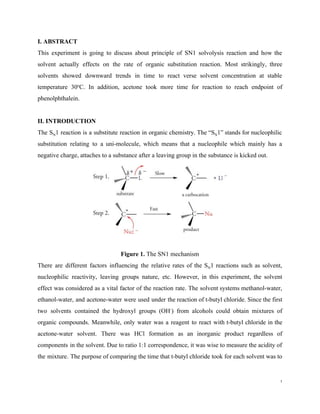
The S​N​1 reaction is a substitute reaction in organic chemistry. The “S​N​1” stands for nucleophilic
substitution relating to a uni-molecule, which means that a nucleophile which mainly has a
negative charge, attaches to a substance after a leaving group in the substance is kicked out.
Figure 1.​ The SN1 mechanism
There are different factors influencing the relative rates of the S​N​1 reactions such as solvent,
nucleophilic reactivity, leaving groups nature, etc. However, in this experiment, the solvent
effect was considered as a vital factor of the reaction rate. The solvent systems methanol-water,
ethanol-water, and acetone-water were used under the reaction of t-butyl chloride. Since the first
two solvents contained the hydroxyl groups (OH​-​
) from alcohols could obtain mixtures of
organic compounds. Meanwhile, only water was a reagent to react with t-butyl chloride in the
acetone-water solvent. There was HCl formation as an inorganic product regardless of
components in the solvent. Due to ratio 1:1 correspondence, it was wise to measure the acidity of
the mixture. The purpose of comparing the time that t-butyl chloride took for each solvent was to
1
reach the same percentage of completion. The way of realizing the same point was to add a
specific amount of NaOH which would neutralize the HCl molecules. Then, the mixture turned
into acidic when leftover HCl was generated. By adding some drops of indicator
phenolphthalein, the color from pink (basic condition) changed to colorless (acidic condition).
Plotting a diagram of the percent water in each solvent system versus the required time to turn
the solution to the colorless was comparable between the influences of different solvent upon the
S​N​1 rate reaction.
III. MATERIALS & METHOD
1. Material:
The equipment used in this experiment included: micropipet, dropper or disposable pipet, 15 test
tubes, 13 x 100 mm, tin foil and water bath.
The chemicals used were acetone 6-10 mL, t-butyl chloride (less than 5 mL), 95% ethanol (6-10
mL), methanol (6-10 mL), phenolphthalein indicator, sodium bicarbonate, a few drops 0.5 M
sodium hydroxide (less than 5 mL).
2. Procedure:
Part 1: Preparing test tubes
15 test tubes including each of three solvents (acetone, ethanol and methanol) and water in
certain ratios according to the table in the lab manual were prepared by micropipet. To save time,
water in all test tubes were taken first thanks to the micropipet. Then, three mentioned solvents
were also added to the test tubes orderly. All test tubes were covered by tin foil after finishing
adding solvent in order to prevent evaporation.
​ Part 2: Recording time for the reaction happen
Next, prepared test tubes were placed in water bath, which maintained the temperature at 30 C.
Adding about 3 drops of 0.5N sodium hydroxide solution and 1-2 drops of phenolphthalein
indicator to each test tube in the water bath. The time was recorded as soon as adding 3 drops of
t-butyl chloride to the test tube. The mix and shaking were kept until the solution in the test tube
2
became colorless, recording the time when the change in color happened. This procedure was
repeated continuously until all 15 mixtures were measured.
IV. RESULTS
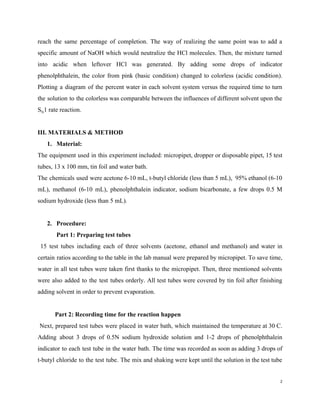
Figure 2. ​The pink of a solvent mixture were placed at water bath after adding NaOH and
phenolphthalein
Observation: ​After adding 3 drops of 0.5N NaOH solution and 1-2 drops of phenolphthalein
into solvent mixture at 30​o​
C water bath, the mixture change from colorless to pink. Then 3 drops
of t-butyl chloride were added, the test tube was shook until the pink color disappeared.
Table 1. ​The elapsed time for reaction in each solvent system recorded (seconds)
3
Composition
percent by
volume
Solvent:Water
The elapsed time for reaction in each solvent system (seconds)
50:50 55:45 60:40 65:35 70:30
Figure 3.​ The relationship between percent water versus elapsed time for reaction in three
different solvent systems
V. DISCUSSION
While performing the experiment, 3-5 test tubes are run in the same time to ensure the droppers
and NaOH solution used​[1]​
. The tert-butyl chloride is composed of an electronegative chlorine
attached to a 3° carbon, which causes significant polarity in the molecule​[2]​
. After the ionization
4
Ethanol:Water 275 520 704 1189 1593
Methanol:Wate
r
178 216 220 303 513
Acetone:Water 83 540 921 1338 1711
of the tert-butyl chloride, other polar molecules, like water, will be electrostatically attracted to
the positive and negative surfaces of tert-butyl chloride molecules. This sets up the possibility of
the chlorine leaving (as Cl​-​
) and being replaced with an oxygen. Since the rate of ionization
determines the overall rate of the reaction, the rate of HCl production is relative to the rate of
ionization of the tert-butyl chloride reactant.
The relative rates of the solvolysis of t-butyl chloride in three different solvent systems
(methanol-water, ethanol-water, and acetone-water) are determined and compared. The
temperature, the nature of solvent, and concentrations of reactant can all affect rates.
Temperature control is crucial to the success of any kinetics experiment. The experiment was
carried out in a constant-temperature (30​o​
C) water bath due to the fact that the solvolysis is a
weak endothermic reaction which absorbs heat in the reaction and generate more HCl. In
addition, a polar protic solvent increases the reactivity of the leaving group in an S​N​1 reaction by
helping to stabilize the products of the ionization step​[3]​
. Besides, carbocation is positively
charged which is very electron poor. Hence, the polar protic solvent can effectively solvate
anions, which donates electron density to the center of electron poverty will help to stabilize
carbocation intermediate. Finally, increasing the concentration of reactant (tert-butyl chloride)
increases the rate of reaction.
As can be seen from the graph (figure 3) , the figures for time requirement of reactions in three
solvent systems saw downward trends with increasing percentage of water. It is due to the fact
that the polarity of water makes it much more effective in solvating the cation–anion pair
produced in the first step of the SN1 reaction which is rate-determining than ethanol, methanol,
or acetone. The more stable the carbocation in the intermediate stage, the lower the activation
energy and the faster the reaction proceeds ​[4]​
. When all three solvent systems had the same high
50% of water, the elapsed time for each reaction was approximately equal because the overall
rate was majorly affected by water. However, when the proportion of water in each solvent was
decreased, the other components (ethanol, methanol, acetone) gradually played the main role.
Acetone does not contain any OH group to participate in H bonding; therefore, it does not
engage in the solvolysis reaction like ethanol or methanol. It is then lead to the fact that the
5
reactions in solvent system acetone:water (with more acetone than water) requires the most time
to reach the phenolphthalein end-point. Additionally, methanol is polar than ethanol because
ethanol has one more methyl group that donates electron to the hydroxyl group. It lowers the
partial positive charge of the carbon that attaches to the hydroxyl group which lowers the the
polarity. Hence, the elapsed time for reactions in the solvent system methanol:water is generally
the least.
VI. CONCLUSION
In conclusion, the different polarity in protic solvents is the crucial thing affecting rates of an S​N​1
solvolysis reaction. The more polar solvent will contribute to the more stability of carbocation
intermediate, which influences on the reaction rates. In this experiment, ​the elapsed time for
reactions in the solvent system methanol:water is the least of three solvent mixtures.
VII. REFERENCES
[1] “Experiment 9: Solvent Effects in an SN1 Solvolysis Reaction, A Kinetics Study” Organic
Chemistry Lab Manual. International University HCMC-VNU, 2017.
[2] ​SOLVOLYSIS OF tert-BUTYL CHLORIDE: TESTING A MECHANISM​. Linfield University
(n.d.). Retrieved from https://www.linfield.edu/assets/files/chem/Courses/CHEM
321/2015_Week11_SN1_Testing_a_mechanism_6040.pdf.
[3] ​Walker, M. (n.d.). “Factors affecting rate of nucleophilic substitution reactions”. Retrieved
from
https://courses.lumenlearning.com/suny-potsdam-organicchemistry/chapter/8-3-factors-affecting
-rate-of-nucleophilic-substitution-reactions/
[4]​ Characteristics of the S 1 Reaction. (Feb 2019). Retrieved from
https://chem.libretexts.org/Courses/Sacramento_City_College/SCC%3A_Chem_420_-_Organic_
6
Chemistry_I/Text/07%3A_Alkyl_Halides%3A_Nucleophilic_Substitution_and_Elimination/7.0
9%3A_Characteristics_of_the_S%E2%82%991_Reaction
7

Report 9

  • 1.
    International University, VietnamNational University - HCMC ORGANIC CHEMISTRY LABORATORY REPORT EXPERIMENT #9: Group: 4 Section: 9 Date: XX July, 2020 Group members: Trương Phú Lễ BTBCIU15061 Đặng Nguyễn Quỳnh Phương BTBCIU17047 Huyên Nhật Vy BTBCIU18084 Đào Thanh Trúc BTBCIU18096 Võ Đỗ Minh Trang BTBCIU18074 Instructors: Dr. Hoàng Lê Sơn Nguyễn Thanh Phong
  • 2.
    I. ABSTRACT This experimentis going to discuss about principle of SN1 solvolysis reaction and how the solvent actually effects on the rate of organic substitution reaction. Most strikingly, three solvents showed downward trends in time to react verse solvent concentration at stable temperature 30​o​ C. In addition, acetone took more time for reaction to reach endpoint of phenolphthalein. II. INTRODUCTION The S​N​1 reaction is a substitute reaction in organic chemistry. The “S​N​1” stands for nucleophilic substitution relating to a uni-molecule, which means that a nucleophile which mainly has a negative charge, attaches to a substance after a leaving group in the substance is kicked out. Figure 1.​ The SN1 mechanism There are different factors influencing the relative rates of the S​N​1 reactions such as solvent, nucleophilic reactivity, leaving groups nature, etc. However, in this experiment, the solvent effect was considered as a vital factor of the reaction rate. The solvent systems methanol-water, ethanol-water, and acetone-water were used under the reaction of t-butyl chloride. Since the first two solvents contained the hydroxyl groups (OH​-​ ) from alcohols could obtain mixtures of organic compounds. Meanwhile, only water was a reagent to react with t-butyl chloride in the acetone-water solvent. There was HCl formation as an inorganic product regardless of components in the solvent. Due to ratio 1:1 correspondence, it was wise to measure the acidity of the mixture. The purpose of comparing the time that t-butyl chloride took for each solvent was to 1
  • 3.
    reach the samepercentage of completion. The way of realizing the same point was to add a specific amount of NaOH which would neutralize the HCl molecules. Then, the mixture turned into acidic when leftover HCl was generated. By adding some drops of indicator phenolphthalein, the color from pink (basic condition) changed to colorless (acidic condition). Plotting a diagram of the percent water in each solvent system versus the required time to turn the solution to the colorless was comparable between the influences of different solvent upon the S​N​1 rate reaction. III. MATERIALS & METHOD 1. Material: The equipment used in this experiment included: micropipet, dropper or disposable pipet, 15 test tubes, 13 x 100 mm, tin foil and water bath. The chemicals used were acetone 6-10 mL, t-butyl chloride (less than 5 mL), 95% ethanol (6-10 mL), methanol (6-10 mL), phenolphthalein indicator, sodium bicarbonate, a few drops 0.5 M sodium hydroxide (less than 5 mL). 2. Procedure: Part 1: Preparing test tubes 15 test tubes including each of three solvents (acetone, ethanol and methanol) and water in certain ratios according to the table in the lab manual were prepared by micropipet. To save time, water in all test tubes were taken first thanks to the micropipet. Then, three mentioned solvents were also added to the test tubes orderly. All test tubes were covered by tin foil after finishing adding solvent in order to prevent evaporation. ​ Part 2: Recording time for the reaction happen Next, prepared test tubes were placed in water bath, which maintained the temperature at 30 C. Adding about 3 drops of 0.5N sodium hydroxide solution and 1-2 drops of phenolphthalein indicator to each test tube in the water bath. The time was recorded as soon as adding 3 drops of t-butyl chloride to the test tube. The mix and shaking were kept until the solution in the test tube 2
  • 4.
    became colorless, recordingthe time when the change in color happened. This procedure was repeated continuously until all 15 mixtures were measured. IV. RESULTS Figure 2. ​The pink of a solvent mixture were placed at water bath after adding NaOH and phenolphthalein Observation: ​After adding 3 drops of 0.5N NaOH solution and 1-2 drops of phenolphthalein into solvent mixture at 30​o​ C water bath, the mixture change from colorless to pink. Then 3 drops of t-butyl chloride were added, the test tube was shook until the pink color disappeared. Table 1. ​The elapsed time for reaction in each solvent system recorded (seconds) 3 Composition percent by volume Solvent:Water The elapsed time for reaction in each solvent system (seconds) 50:50 55:45 60:40 65:35 70:30
  • 5.
    Figure 3.​ Therelationship between percent water versus elapsed time for reaction in three different solvent systems V. DISCUSSION While performing the experiment, 3-5 test tubes are run in the same time to ensure the droppers and NaOH solution used​[1]​ . The tert-butyl chloride is composed of an electronegative chlorine attached to a 3° carbon, which causes significant polarity in the molecule​[2]​ . After the ionization 4 Ethanol:Water 275 520 704 1189 1593 Methanol:Wate r 178 216 220 303 513 Acetone:Water 83 540 921 1338 1711
  • 6.
    of the tert-butylchloride, other polar molecules, like water, will be electrostatically attracted to the positive and negative surfaces of tert-butyl chloride molecules. This sets up the possibility of the chlorine leaving (as Cl​-​ ) and being replaced with an oxygen. Since the rate of ionization determines the overall rate of the reaction, the rate of HCl production is relative to the rate of ionization of the tert-butyl chloride reactant. The relative rates of the solvolysis of t-butyl chloride in three different solvent systems (methanol-water, ethanol-water, and acetone-water) are determined and compared. The temperature, the nature of solvent, and concentrations of reactant can all affect rates. Temperature control is crucial to the success of any kinetics experiment. The experiment was carried out in a constant-temperature (30​o​ C) water bath due to the fact that the solvolysis is a weak endothermic reaction which absorbs heat in the reaction and generate more HCl. In addition, a polar protic solvent increases the reactivity of the leaving group in an S​N​1 reaction by helping to stabilize the products of the ionization step​[3]​ . Besides, carbocation is positively charged which is very electron poor. Hence, the polar protic solvent can effectively solvate anions, which donates electron density to the center of electron poverty will help to stabilize carbocation intermediate. Finally, increasing the concentration of reactant (tert-butyl chloride) increases the rate of reaction. As can be seen from the graph (figure 3) , the figures for time requirement of reactions in three solvent systems saw downward trends with increasing percentage of water. It is due to the fact that the polarity of water makes it much more effective in solvating the cation–anion pair produced in the first step of the SN1 reaction which is rate-determining than ethanol, methanol, or acetone. The more stable the carbocation in the intermediate stage, the lower the activation energy and the faster the reaction proceeds ​[4]​ . When all three solvent systems had the same high 50% of water, the elapsed time for each reaction was approximately equal because the overall rate was majorly affected by water. However, when the proportion of water in each solvent was decreased, the other components (ethanol, methanol, acetone) gradually played the main role. Acetone does not contain any OH group to participate in H bonding; therefore, it does not engage in the solvolysis reaction like ethanol or methanol. It is then lead to the fact that the 5
  • 7.
    reactions in solventsystem acetone:water (with more acetone than water) requires the most time to reach the phenolphthalein end-point. Additionally, methanol is polar than ethanol because ethanol has one more methyl group that donates electron to the hydroxyl group. It lowers the partial positive charge of the carbon that attaches to the hydroxyl group which lowers the the polarity. Hence, the elapsed time for reactions in the solvent system methanol:water is generally the least. VI. CONCLUSION In conclusion, the different polarity in protic solvents is the crucial thing affecting rates of an S​N​1 solvolysis reaction. The more polar solvent will contribute to the more stability of carbocation intermediate, which influences on the reaction rates. In this experiment, ​the elapsed time for reactions in the solvent system methanol:water is the least of three solvent mixtures. VII. REFERENCES [1] “Experiment 9: Solvent Effects in an SN1 Solvolysis Reaction, A Kinetics Study” Organic Chemistry Lab Manual. International University HCMC-VNU, 2017. [2] ​SOLVOLYSIS OF tert-BUTYL CHLORIDE: TESTING A MECHANISM​. Linfield University (n.d.). Retrieved from https://www.linfield.edu/assets/files/chem/Courses/CHEM 321/2015_Week11_SN1_Testing_a_mechanism_6040.pdf. [3] ​Walker, M. (n.d.). “Factors affecting rate of nucleophilic substitution reactions”. Retrieved from https://courses.lumenlearning.com/suny-potsdam-organicchemistry/chapter/8-3-factors-affecting -rate-of-nucleophilic-substitution-reactions/ [4]​ Characteristics of the S 1 Reaction. (Feb 2019). Retrieved from https://chem.libretexts.org/Courses/Sacramento_City_College/SCC%3A_Chem_420_-_Organic_ 6
  • 8.