Download to read offline
![186 Micro and Nanosystems, 2012, 4, 186-191
1876-4037/12 $58.00+.00 © 2012 Bentham Science Publishers
Synthesis and Optimisation of IrO2 Electrocatalysts by Adams Fusion
Method for Solid Polymer Electrolyte Electrolysers
C. Felix, T. Maiyalagan#
, S. Pasupathi*
, B. Bladergroen and V. Linkov
South African Institute for Advanced Materials Chemistry (SAIAMC), University of the Western Cape, Modderdam
Road, Bellville 7535, Cape Town, South Africa
Abstract: IrO2 as an anodic electrocatalyst for the oxygen evolution reaction (OER) in solid polymer electrolyte (SPE)
electrolysers was synthesised by adapting the Adams fusion method. Optimisation of the IrO2 electrocatalyst was achieved
by varying the synthesis duration (0.5 – 4 hours) and temperature (250 - 500°C). The physical properties of the
electrocatalysts were characterised by scanning electron microscopy (SEM), transmission electron microscopy (TEM) and
x-ray diffraction (XRD). Electrochemical characterisation of the electrocatalysts toward the OER was evaluated by
chronoamperometry (CA). CA analysis revealed the best electrocatalytic activity towards the OER for IrO2 synthesised
for 2 hours at 350o
C which displayed a better electrocatalytic activity than the commercial IrO2 electrocatalyst used in this
study. XRD and TEM analyses revealed an increase in crystallinity and average particle size with increasing synthesis
duration and temperature which accounted for the decreasing electrocatalytic activity. At 250°C the formation of an active
IrO2 electrocatalyst was not favoured.
Keywords: Adams fusion method, Anodic electrocatalyst, Oxygen evolution reaction, Solid polymer electrolyte, Water
electrolysis.
1. INTRODUCTION
Hydrogen used as a fuel has benefits over the
hydrocarbon rich fuels such as having a higher specific
energy density by mass and it does not present the problem
of the emission of pollutants or greenhouse gases, such as
CO2 [1]. However challenges related to the production of
hydrogen has delayed the realisation of the hydrogen
economy [2]. Solid polymer electrolyte (SPE) or commonly
known as proton exchange membrane (PEM) electrolysers
have in recent years received considerable interest as a
production method for carbon free hydrogen [3, 4]. SPE
electrolysers are well suited for water electrolysis using
intermittent power sources and have been identified by the
European Commission as a key technology to transform
renewable electricity into hydrogen and oxygen [5]. The
main drawback at present is the high cost associated with the
SPE electrolyser components such as the expensive precious
metal electrocatalysts and the proton conducting membrane
[6, 7]. One way to reduce the cost of the SPE electrolyser is
by improving the specific performance and durability of the
noble metal electrocatalysts. The oxygen evolution electrode
(anode) is the greatest source of overpotential at typical
operating current density [3, 7] and is associated with a
substantial energy loss. The anodic electrocatalyst therefore
needs to be highly stable and active under the operating
conditions [8]. IrO2 is commonly employed as the anodic
electrocatalyst as it exhibits a high corrosion resistance to the
oxygen evolution reaction (OER) in a strong acidic
environment [8, 9]. IrO2 offers a lower anodic overpotential
*Address correspondence to this author at the South African Institute for
Advanced Materials Chemistry (SAIAMC), University of the Western Cape,
Modderdam Road, Bellville 7535, Cape Town, South Africa;
Tel: +27-21-9599318; Fax: +27-21-9591583; E-mail: spasupathi@uwc.ac.za
#Both authors contribute equally
(100 mV at 1 A cm-2
) than metallic Pt and a long term
stability of at least two years. IrO2 also show less efficiency
loss due to corrosion or poisoning [10]. However, IrO2 is
scarce and very expensive [11], adding significantly to the
cost of the SPE electrolyser system. IrO2 has a service life of
about 20 times longer than RuO2, but has a slightly lower
electrocatalytic activity towards the OER [12]. Therefore it
becomes important to improve the electrocatalytic activity of
the IrO2 electrocatalyst. The electrolytic evolution of oxygen
is influenced by several factors: crystal field stabilisation
energy, mixed and doped oxides, dispersion, crystallinity and
particle size [13] therefore it becomes important to develop
an electrocatalyst that possess an optimum combination of
these attributes. Methods for preparing the noble metal
oxides include the Sol – Gel method, a modified polyol
method, the Adams fusion method, a sputtering technique
and a sulphite complex based preparation method [14]. In
this study IrO2 was synthesised and optimised as an anodic
electrocatalyst for the SPE electrolyser by adapting the
Adams fusion method. The Adams fusion method is a simple
and easy method and is known to directly produce nanosize
metal oxides [15]. Physical properties of the electrocatalysts
were characterised by scanning electron microscopy (SEM),
transmission electron microscopy (TEM) and x-ray
diffraction (XRD). Electrochemical characterisation of the
electrocatalysts towards the OER was evaluated by
chronoamperometry (CA).
2. MATERIALS AND METHODS
2.1. Synthesis and Optimisation of IrO2
The Adams fusion method, first described by R. Adams
and R.L. Shriner [16], entails the fusion of the metal chloride
precursor with NaNO3 in air at elevated temperature. The
method has since been used to prepare various noble metal
oxides [17-19]. In this study a predetermined quantity of the](https://image.slidesharecdn.com/synthesis-and-optimisation-of-iro-2-electrocatalysts-by-adams-fusion-method-for-solid-polymer-electr-150719044724-lva1-app6891/75/Synthesis-and-optimisation-of-ir-o-2-electrocatalysts-by-adams-fusion-method-for-solid-polymer-electrolyte-electrolysers-1-2048.jpg)
![Synthesis and Optimisation of IrO2 Electrocatalysts Micro and Nanosystems, 2012, Vol. 4, No. 3 187
H2IrCl6 (SA Precious Metals, South Africa) was dissolved in
10 ml isopropanol (Alfa Aesar, Johnson Matthey) until a
metal concentration of 3.5 x 10⁻²
M was achieved and
magnetically stirred for 90 minutes. Five grams of finely
ground NaNO3 (Holpro Fine Chemicals, South Africa) was
added to the solution, which was then further stirred for 30
minutes. The mixture was then placed in a preheated oven (at
80°C) for 30 minutes to evaporate the isopropanol. The dried
catalyst precursor/salt mixture was then reacted in a preheated
furnace. The obtained metal oxide was then cooled and
washed with ultrapure water to remove the excess NaNO3.
The final step was to dry the metal oxide in an oven at 100°C.
In order to achieve the most active IrO2 electrocatalyst, the
synthesis duration (0.5 – 4 hours) and synthesis temperature
(250 - 500°C) was varied. First, the temperature of 500°C was
chosen (based on the literature) and the synthesis duration was
varied from 0.5 to 4 hours. The best synthesis duration
obtained was then kept constant while varying the synthesis
temperature from 250 to 500°C. No additional annealing step
followed to limit the sintering of the nanosize particles. A
commercial IrO2 electrocatalyst was procured from Alfa Aesar
(Johnson Matthey) and used as received as a comparison to
the best performing synthesised IrO2 electrocatalyst.
2.2. Preparation of the Working Electrode
A glassy carbon working electrode (area = 0.196 cm2
)
was used for all electrochemical measurements. Catalyst inks
were prepared by mixing together the IrO2, ultrapure (UP)
water and 5 wt % Nafion solution (Aldrich) in a ratio of
1:2:6. The mixture was then ultrasonically dispersed for 15
minutes. A measured drop of the catalyst ink was deposited
using a micropipette onto the thoroughly cleaned glassy
carbon surface followed by drying in an oven at 80°C. The
IrO2 loading equated to 0.45 mg cm-2
.
2.3. Characterisation
Physical phases and structures of the electrocatalysts
were characterised by X-ray diffraction (XRD) employing
the Bruker AXS D8 Advance diffractometer using Cu K
radiation ( = 1.5406 Å) operating at 40 kV and 40 mA.
Scanning electron micrographs were obtained with the
Hitachi X-650 SEM using GENESIS software, working at
25 keV. Transmission electron micrographs were obtained
using a Tecnai G2
F20 X-Twin Mat200 kV Field Emission
TEM, operating at 200 kV.
2.4. Electrochemical Measurements
CA analysis was performed in a standard three-electrode
cell at 25°C and atmospheric pressure. A glassy carbon
working electrode (as described in section 2.2), a 3M
Ag/AgCl reference electrode, a platinum mesh counter
electrode and a 0.5M H2SO4 electrolyte solution was used.
Autolab potentiostat PGSTAT20 (Eco-Chemie) was used for
CA analysis to evaluate the electrocatalytic activity of the
synthesised IrO2 electrocatalysts towards the OER. The
electrolyte solution was purged with N2 for 30 minutes
before performing electrochemical measurements. CA was
performed by stepping the potentials from 1.2 – 1.6 V and
measuring the current (mA) response as a function of time.
Each potential step was performed for 30 minutes. All
potentials are reported versus the 3M Ag/AgCl electrode.
3. RESULTS AND DISCUSSION
3.1. Physico-Chemical Characterisations
The XRD analysis of synthesised IrO2 (500°C, 0.5 – 4
hours) is shown in Fig. (1). XRD analysis revealed the
presence of a rutile oxide phase, showing the preferential
(110) and (101) orientations of IrO2, which are both close-
packed planes for the Ir atom [20]. An increase in
crystallinity and particle size was observed as the synthesis
duration was increased which is known to contribute to the
decrease in active surface area of the electrocatalysts [21].
The particle size may also affect the electronic conductivity,
catalyst utilisation and gas/water transport when the
electrocatalyst is used as part of a MEA [18]. Calculated
using the Scherrer equation, the average particle size was
estimated to increase from 4.5 nm (0.5 hour) – 10 nm (4
hour). The XRD analysis of synthesised IrO2 (2 hours, 250 –
500°C) is shown in Fig. (2). XRD analysis revealed an
increasing trend towards crystallisation and larger particle
sizes as the temperature was increased. IrO2 prepared at
250°C and 350°C showed broader peaks, depicting lower
crystallinity, or an amorphous nature. Broader peaks are
known to be indicative of smaller particle sizes. Rasten et al.
[22] also found that IrO2 prepared at 340°C via the Adams
fusion method consisted of nanosize particles with low
crystallinity. The 110 phase which is known to be a stable
surface of IrO2, was not observed for IrO2 (2 hours, 250°C)
Fig. (1). XRD analysis of synthesised IrO2 (500°C, 0.5 - 4 hours).
Fig. (2). XRD analysis of synthesised IrO2 (2 hours, 250-500°C).](https://image.slidesharecdn.com/synthesis-and-optimisation-of-iro-2-electrocatalysts-by-adams-fusion-method-for-solid-polymer-electr-150719044724-lva1-app6891/75/Synthesis-and-optimisation-of-ir-o-2-electrocatalysts-by-adams-fusion-method-for-solid-polymer-electrolyte-electrolysers-2-2048.jpg)
![188 Micro and Nanosystems, 2012, Vol. 4, No. 3 Felix et al.
but became more prevalent as the synthesis temperature was
increased from 350 – 500°C. Calculated using the Scherrer
formula, the average particle sizes for synthesised IrO2 (2
hours, 250 – 500°C) were estimated to increase from 1.5 nm
(250 o
C) to 5.5 (500°C). No metallic Ir was observed for all
of the synthesised IrO2 electrocatalysts. The XRD analysis of
the best synthesised IrO2 (2 hours, 350°C) and the
commercial IrO2 electrocatalyst is shown in Fig. (3). The
XRD analysis revealed both broad amorphous and sharp
crystalline peaks for commercial IrO2. The presence of
metallic Ir was observed for the commercial IrO2
electrocatalyst. Metallic Ir is not known to be beneficial for
the OER since the reaction always takes place at an oxide
surface [17]. Rutile type oxides of Ir are known to be
considerably better as oxygen evolving electrodes than the
metallic Ir. Oxygen evolution on metal surfaces can only take
place when there is high oxygen coverage and at high
oxidation potentials, the metal might form a metal oxide [23].
SEM analysis of synthesised IrO2 (500°C, 0.5 – 4 hours)
and commercial IrO2 is shown in Fig. (4). Particle formation
and size could not be defined from the SEM images as
agglomerates of micrometer scale are visible. A change in
morphology was observed for the synthesised IrO2 as the
synthesis duration increased which was probably due to
particle agglomeration. The most notable change was
observed for IrO2 synthesised at 500°C for 2 hours which
had morphology more similar to the commercial IrO2
electrocatalyst. SEM analysis of synthesised IrO2 (2 hours,
250 – 500°C) is shown in Fig. (5). Particle formation and
size could not be defined from the images. A change in
morphology was observed as the synthesis temperature was
increased which was probably due to particle agglomeration
or sintering due to the increasing temperature.
TEM analysis of synthesised IrO2 (500°C, 0.5 – 4 hours)
and commercial IrO2 is shown in Fig (6). TEM analysis of
the synthesised IrO2 electrocatalyts was consistent with the
XRD analysis, i.e. as the synthesis duration was increased,
the average particle size increased. TEM also confirmed that
the synthesised IrO2 electrocatalysts consisted of nanosize
particles with the following average sizes; 4 nm (0.5 hour),
5.5 nm (1 hour), 6.5 nm (2 hours), 8 nm (3 hours) and 10.5
Fig. (3). XRD analysis of the best synthesised IrO2 and commercial
IrO2.
Fig. (4). SEM images of synthesised IrO2 (500°C, 0.5-4 hours) and
commercial IrO2 (a) 0.5 hour (b) 1 hour (c) 2 hour (d) 3 hour (e) 4
hour (f) commercial.
Fig. (5). SEM images of synthesised IrO2 (2 hours, 250-500°C) (a)
250°C (b) 350°C (c) 450°C (d) 500°C.](https://image.slidesharecdn.com/synthesis-and-optimisation-of-iro-2-electrocatalysts-by-adams-fusion-method-for-solid-polymer-electr-150719044724-lva1-app6891/75/Synthesis-and-optimisation-of-ir-o-2-electrocatalysts-by-adams-fusion-method-for-solid-polymer-electrolyte-electrolysers-3-2048.jpg)
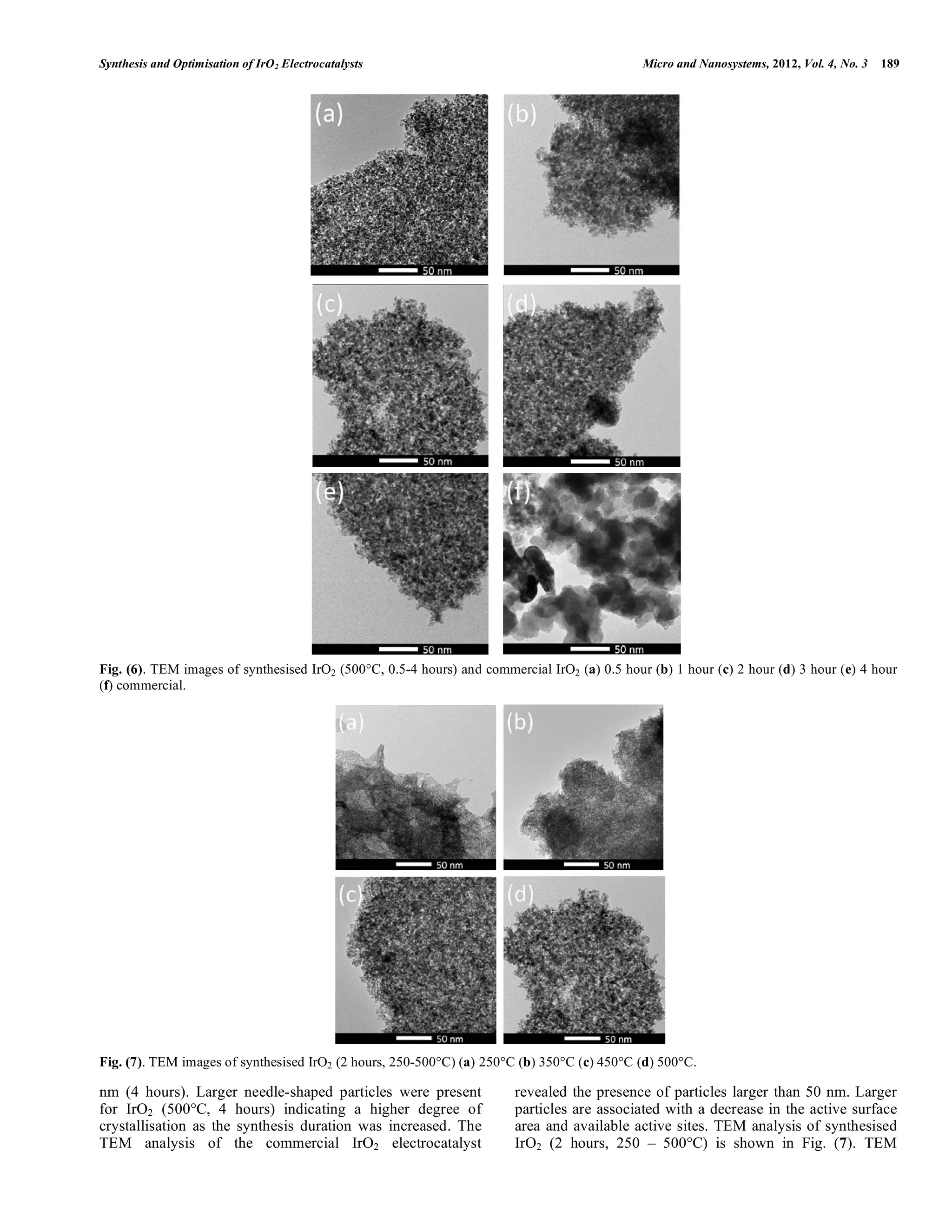
![190 Micro and Nanosystems, 2012, Vol. 4, No. 3 Felix et al.
analysis revealed an increasing particle size with increasing
synthesis temperature which is consistent with the XRD
analysis. TEM revealed nanosize particles with the following
average sizes: 2.5 nm (250°C), 4.5 nm (350°C), 6 nm
(450°C) and 6.5 nm (500°C).
3.2. Electrochemical Characterisation
The CA analysis for synthesised IrO2 (500°C, 0.5 – 4
hours) performed at 1.6V for 30 minutes is shown in Fig. (8).
CA analysis revealed the best electrocatalytic activity
towards the OER for the IrO2 electrocatalyst synthesised at
500°C for 2 hours. As the synthesis duration was increased
from 0.5 – 2 hours, the IrO2 electrocatalyst became more
active towards the OER which was followed by a decrease in
activity as the synthesis duration was kept longer than 2
hours. The high temperature resulted in a higher degree of
crystallisation and larger particle sizes as revealed by XRD
and TEM which probably caused a decrease in the active
surface area and a decrease in available active sites [21]. The
CA analysis for synthesised IrO2 (2 hours, 250 – 500°C) and
commercial IrO2 performed at 1.6V for 30 minutes is shown
in Fig. (9). CA analysis revealed the best electrocatalytic
activity towards the OER for the IrO2 electrocatalyst
synthesised at 350°C for 2 hours. IrO2 (2 hours, 250°C)
showed very low electrocatalytic activity towards the OER.
XRD analysis revealed the absence of the stable 110 phase
which may be the reason for low electrocatalytic activity and
the large decrease in current density. Cruz et al. [24],
although using a different synthesis method, observed a
phase transition from an amorphous to a crystalline phase
between 240 - 480ºC. They found their 200 and 300ºC
samples to show an amorphous phase whereas the 400 and
500ºC samples showed a crystalline phase. Therefore the
decrease in electrocatalytic activity of IrO2 synthesised at
temperatures above 350°C is due to an increase in
crystallinity and particle size as was revealed by TEM and
XRD. A similar observation was made by Rasten et al. [22]
when they annealed the catalyst between 440 and 540°C.
The best synthesised IrO2 electrocatalyst was found to be
almost twice as active towards the OER as the commercial
IrO2 electrocatalyst. The lower electrocatalytic activity of the
commercial IrO2 electrocatalyst can be attributed to the
larger particle sizes (> 50nm) and the presence of metallic Ir
as revealed by TEM and XRD. At 1.6V, a decrease in
current density was observed for the synthesised and
commercial IrO2 electrocatalysts which was not evident at
lower voltages (1.2 – 1.5V). At 1.6V, significant amounts of
O2 bubbles due to the OER were formed which remained
adsorbed onto the electrocatalyst surface due to the use of a
stationary electrode. The O2 bubbles on the electrocatalyst
surface are known to cause an ohmic drop which could
explain the oscillations in the measured current [11].
CONCLUSION
IrO2 was successfully synthesised and optimised by
adapting the Adams fusion method. TEM and XRD were
useful in relating the physical structure of the electrocatalysts
to the electrochemical performance. XRD and TEM analyses
revealed increasing crystallinity and particle size as both
synthesis duration and temperature was increased. CA
revealed the best electrocatalytic performance for IrO2
synthesised for 2 hours at 350°C. At 250°C the formation of
an active IrO2 electrocatalyst was not favoured. CA revealed
that the best synthesised IrO2 electrocatalyst were almost
twice as active towards the OER as the commercial IrO2.
CONFLICT OF INTEREST
The author(s) confirm that this article content has no
conflicts of interest.
ACKNOWLEDGEMENTS
This work was supported by the South African
Department of Science and Technology through the
Technology Implementation Agency (TIA) project number
T70600 (SPE Electrolyser).
REFERENCES
[1] Ganley, J.C. High temperature and pressure alkaline electrolysis.
Int. J. Hydrogen Energy, 2009, 34, 3604-3611.
[2] Balat, M. Potential importance of hydrogen as a future solution to
environmental and transportation problems. Int. J. Hydrogen
Energy, 2008, 33, 4013-4029.
[3] Marshall, A.T.; Sunde, S.; Tsypkin, M.; Tunold, R. Performance of
a PEM water electrolysis cell using IrxRuyTazO2 electrocatalysts for
Fig. (8). Chronoamperometry analysis of synthesised IrO2 (500°C,
0.5-4 hours).
Fig. (9). Chronoamperometry analysis of synthesised IrO2 (2 hours,
250-500°C) and commercial IrO2.](https://image.slidesharecdn.com/synthesis-and-optimisation-of-iro-2-electrocatalysts-by-adams-fusion-method-for-solid-polymer-electr-150719044724-lva1-app6891/75/Synthesis-and-optimisation-of-ir-o-2-electrocatalysts-by-adams-fusion-method-for-solid-polymer-electrolyte-electrolysers-5-2048.jpg)
![Synthesis and Optimisation of IrO2 Electrocatalysts Micro and Nanosystems, 2012, Vol. 4, No. 3 191
the oxygen evolution electrode. Int. J. Hydrogen Energy, 2007, 32,
2320-2324.
[4] Xu, W.; Tayal, J.; Basu, S.; Scott, K. Nano-crystalline RuxSn1-xO2
powder catalysts for oxygen evolution reaction in proton exchange
membrane water electrolysers. Int. J. Hydrogen Energy, 2011, 36,
14796-14804.
[5] Xu, C.; Ma, L.; Li, J.; Zhao, W.; Gan, Z. Synthesis and
characterisation of novel high performance composite
electrocatalysts for the oxygen evolution in solid polymer
electrolyte (SPE) water electrolysis. Int. J. Hydrogen Energy, 2011.
[6] Cheng, J.; Zhang, H.; Ma, H.; Zhong, H.; Zou, Y. Electrochim.
Acta, 2010, 55, 1855-1861.
[7] Song, S.; Zhang, H.; Ma, X.; Shao, Z.; Baker, R.T.; B. Yi. Int. J.
Hydrogen Energy, 2008, 33, 4955-4961.
[8] Siracusano, S.; Baglio, V.; Stassi, A.; Ornelas, R.; Antonucci, V.;
Arico, A.S. Investigation of IrO2 electrocatalysts prepared by a
sulfite-complex route for the O2 evolution reaction in solid polymer
electrolyte electrolysers. Int. J. Hydrogen Energy, 2011, 36, 7822-
7831.
[9] Cheng, J.; Zhang, H.; Chen, G.; Zhang, Y. Study of IrxRu1-xO2
oxides as anodic electrocatalysts for solid polymer electrolyte water
electrolysis. Electrochim. Acta, 2009, 54, 6250-6256.
[10] Ma, L.; Sui, S.; Zhai, Y. Preparation and characterisation of Ir/TiC
catalyst for oxygen evolution. J. Power Sources, 2008, 177, 470-
477.
[11] Mayousse, E.; Maillard, F.; Fouda-Onana, F.; Sicardy, O.; Guillet,
N. Synthesis and characterisation of electrocatalysts for the oxygen
evolution in PEM water electrolysis. Int. J. Hydrogen Energy,
2011, 36, 10474-10481.
[12] Ardizzone, S.; Bianchi, C.L.; Borgese, L.; Capelletti, G.; Locatelli,
C.; Minguzzi, A.; Rondinini, S.; Vertova, A.; Ricci, P.C.; Cannas,
C.; Musinu, A. Physico-chemical characterisation of IrO2-SnO2 sol-
gel nanopowders for electrochemical applications. J. Appl.
Electrochem., 2009, 39, 2093-2105.
[13] Di Blasi, A.; D’Urso, C.; Baglio, V.; Antonucci, V.; Arico’, A.S.;
Ornelas, R.; Matteucci, F.; Orozco, G.; Beltran, D.; Meas, Y.;
Arriaga, L.G. Preparation and evaluation of RuO2-IrO2, IrO2-Pt and
IrO2-Ta2O5 catalysts for the oxygen evolution reaction in SPE
electrolyser. J. Appl. Electrochem., 2009, 39, 191-196.
[14] Xu, J.; Liu, G.; Li, J.; Wang, X. The electrocatalytic properties of
an IrO2/SnO2 catalyst using SnO2 as a support and an assisting
reagent for the oxygen evolution reaction. Electrochim. Acta, 2012,
59, 105-112.
[15] Zhang, Y.; Wang, C.; Mao, Z.; Wang, N. Preparation of nano-
meter sized SnO2 by the fusion method. Mater. Lett., 2007, 61,
1205-1209.
[16] Adams, R.; Shriner, R.L. Platinum oxides as a catalyst in the
reduction of organic compounds. III, Preparation and properties of
the oxide of platinum obtained by the fusion of chloroplatinic acid
with sodium nitrate, J. Am. Chem. Soc., 1923, 45, 2171-2179.
[17] Rasten, E. Electrocatalysis in water electrolysis with solid polymer
electrolyte, PhD. Thesis, Norwegian University of Science and
technology, October 2001.
[18] Marshall, A.; Børresen, B.; Hagen, G.; Tsypkin, M.; Tunold, R.
Hydrogen production by advanced proton exchange membrane
(PEM) electrolysers – Reduced energy consumption by improved
electrocatalysis. Energy, 2007, 32, 431-436.
[19] Shriner, R.L.; Adams, R. The preparation of palladous oxide and its
use as a catalyst in the reduction of organic compounds, VI. J. Am.
Chem. Soc., 1924, 46, 1683-1693.
[20] Hu, J.M.; Meng, H.M.; Zhang, J.Q.; Cao, C.N. Degradation
mechanism of long service life Ti/IrO2-Ta2O5 oxide anodes in
sulphuric acid. Corrosion Sci., 2002, 44, 1655-1668.
[21] Marshall, A.; Borresen, B.; Hagen, G.; Tsypkin, M.; Tunold, R.
Electrochemical characterisation of IrxSnx-1O2 powders as oxygen
evolution electrocatalysts, Electrochim. Acta, 2006, 51, 3161-3167.
[22] Rasten, E.; Hagen, G.; Tunold, R. Electrocatalysis in water
electrolysis with solid polymer electrolyte. Electrochim. Acta,
2003, 48, 3945+3952.
[23] Rossmeisl, J.; Qu, Z.-W.; Zhu, H.; Kroes, G.-J.; Nørskov, J.K.
Electrolysis of water on oxide surfaces. J. Electroanal. Chem.,
2007, 607, 83-89.
[24] Cruz, J.C.; Baglio, V.; Siracusano, S.; Ornelas, R.; Ortiz-Frade, L.;
Arriaga, L.G.; Antonucci, V.; Aricò, A.S. Nanosized IrO2
electrocatalysts for oxygen evolution reaction in SPE electrolyser.
J. Nanopart. Res., 2011, 13, 1639-1646.
Received: March 09, 2012 Revised: March 16, 2012 Accepted: May 14, 2012](https://image.slidesharecdn.com/synthesis-and-optimisation-of-iro-2-electrocatalysts-by-adams-fusion-method-for-solid-polymer-electr-150719044724-lva1-app6891/75/Synthesis-and-optimisation-of-ir-o-2-electrocatalysts-by-adams-fusion-method-for-solid-polymer-electrolyte-electrolysers-6-2048.jpg)

The study investigates the synthesis and optimization of IrO2 electrocatalysts using the Adams fusion method for solid polymer electrolyte electrolysers, revealing that the optimal conditions are a synthesis duration of 2 hours at 350°C. Characterization techniques such as SEM, TEM, and XRD demonstrate that increasing temperature and duration enhance crystallinity and particle size, affecting electrocatalytic performance. The best performing IrO2 shows improved activity compared to commercial IrO2, highlighting the potential for cost-effective hydrogen production through optimized electrocatalysts.


