Thinking in OODA
Loops
Venkatesh Rao
With monotonous regularity, apparently competent men have laid down the
law about what is technically possible or impossible — and have been
proved utterly wrong, sometimes while the ink was scarcely dry from their
pens. On careful analysis, it appears that these debacles fall into two
classes, which I will call “failures of nerve” and “failures of imagination.”
The failure of nerve seems to be the more common; it occurs when even
given all the relevant facts the would-be prophet cannot see that they point to
an inescapable conclusion. Some of these failures are so ludicrous as to be
almost unbelievable, and would form an interesting subject for psychological
analysis.
— From Hazards of Prophecy by Arthur C. Clarke, in Profiles of the Future: An
Inquiry into the Limits of the Possible 
2
“an organizational climate for operational success”
{
{
Blitzkrieg Model OODA loop
3
Thinking in OODA loops is about getting the right mix of
nerve and imagination for a winning strategy.
Today’s session!
4
Trust (Einheit)

Capabilities (Fingerspitzengefühl)

Contracts (Auftragstaktik)

Goal (Schwerpunkt)
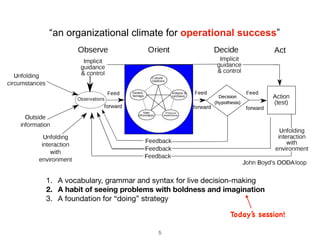
“an organizational climate for operational success”
1. A vocabulary, grammar and syntax for thinking about organizations

2. A style of diagnosing and intervening in organizations

3. A foundation for building a winning culture
5
1. A vocabulary, grammar and syntax for live decision-making

2. A habit of seeing problems with boldness and imagination
3. A foundation for “doing” strategy
“an organizational climate for operational success”
Today’s session!
6
Core of OODA thinking
Operate inside another agent’s decision-
cycle, collapsing it from within
7
WARNING #1: OODA is a not a process diagram. Treat it as a
mindful meditation catalyst, not a blueprint
WARNING #2: OODA is NOT a cyclic sequence. All 4 behaviors
evolve in parallel flowing into each other.
WARNING #3: Orientation is a context-sensitive gestalt state,
not a behavior. Re-orientation is an unscripted state reset that is
the result of imaginative re-perception and re-situation in the
environment, accompanied by active creative destruction. It is not a
predictable “meta” process.

WARNING #4: OODA is not about “iterating faster” than the
competition.
8
How to “do” OODA-based strategy
1. Operate in real-time: if you need time to think you
must create it

2. See in functionally unfixed ways: things are not
their functions

3. Mind the matrix: perceptions are not realities

4. Workshop through sparring: if it’s not being free-
play tested, it isn’t thinking

5. Develop deep memory: historical amnesia equals
bad strategy
9
If you don’t create time
1. Time pressure builds

2. You make mistakes

3. Imagination starts to fail

4. Your luck turns bad

5. Appetite for risk starts to collapse

6. Fear forces an unsafe retreat

7. Your OODA loop “collapses”

8. Feeling of certain doom

This is ZEMBLANITY
If you do create time
1. Time advantage accumulates

2. You make inspired moves

3. Imagination starts to compound

4. Your luck turns good

5. Appetite for risk starts to increase

6. Confidence fuels a bold advance

7. You “seize the initiative”

8. Feeling of unstoppable power

This is SERENDIPITY
“Create time” = “operate inside the adversary’s decision cycle”
10
The goal of OODA operations is to operate inside the adversary’s
decision cycle, to seize and retain the initiative, in order to control the
conflict, to make yourself surprisingly lucky and your adversary
unsurprisingly unlucky

Prototype: War
Pure Conflict OODA (Zero/Negative-Sum)
11
“No bastard ever won a war by dying for his country. He won
it by making the other poor dumb bastard die for his
country.” 

— General George S. Patton
12
The goal of OODA operations is to operate inside the market’s
decision cycle, to seize and retain the initiative, in order to control
the market, to make yourself surprisingly lucky, and your customer
predictably delighted

Prototype: Caring for an infant
Pure Cooperation OODA (Positive-Sum)
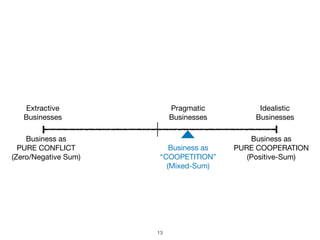
13
Business as 

PURE CONFLICT

(Zero/Negative Sum)
Business as 

PURE COOPERATION

(Positive-Sum)
Business as 

“COOPETITION”

(Mixed-Sum)
Idealistic

Businesses
Extractive

Businesses
Pragmatic

Businesses
14
Jim Keller 2x2:™ 4 possible OODA loop regimes
15
Unsafe Safe
Advance
Retreat
CONTRACTION
“Collapsing” OODA loop

Sense of certain doom
DISCOVERY
SERENDIPITY
(surprisingly lucky)
ZEMBLANITY
(unsurprisingly unlucky)
“Certain to Win” OODA loop

Sense of unstoppable power
Graceful Degradation

OODA loop
New environment

OODA loop
arrogance
loss of nerve
and imagination
resurrection
confidence complacency
humiliation
Silicon Valley

paranoia set-point
16
Wherever you are on the spectrum…
…There is no permanent strategic advantage
17
Covid Response in 4 regimes
Unsafe Safe
Advance
Retreat
18
12 Examples
1. Lanchester attrition

2. Turnicate (sea squirt)

3. Leuchordium (a worm)
4. Throwing a ball

5. Infinite walking

6. Asymmetric chess 

7. HITEN mission salvage

8. Robot soccer

9. Traffic enforcement

10. Southwest Airlines

11. Nakatomi Spaces

12. The Van Riper Affair
Lanchester’s Law (1916): The relative loss rates of
opposed forces in combat is inversely proportionate
to the ratio of the squares of their strengths
1.
Problem: Attrition conflict creates a doomsday stalemate
between equally matched sides. How do you break out?
20
OODA solution: Start maneuvering!
21
https://github.com/vgururao/MatlabFun/tree/master/lanchester
22
Lesson 1: maneuvering creates the
equivalent of a resource advantage
23
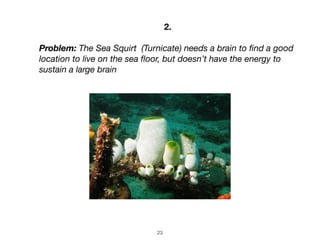
2.
Problem: The Sea Squirt (Turnicate) needs a brain to find a good
location to live on the sea floor, but doesn’t have the energy to
sustain a large brain
24
OODA solution: Eat your brain when you’re done!
25
Lesson 2: You don’t need much of a brain
to run an OODA loop, only a reality signal
26
3.
Problem: The Leuchordium worm needs
to get around, but has weak mobility
27
OODA solution: Hijack a snail to
hitch a ride in a bird’s gut
28
Lesson 3: Containment does not equal control. Just
because you run the OODA loop, doesn’t mean you
own the OODA loop
29
4.
Problem: You’re throwing a ball but a mad scientist
has messed with your vision by putting wedge prism
glasses on you, so you keep missing
30
OODA solution: Your cerebellum has you covered!
31
Purkinje cells: the cerebellum re-orientation hardware
32
Lesson 4: The older parts of your brain are
already wired for OODA. It’s the newer parts that
have some learning to do.
33
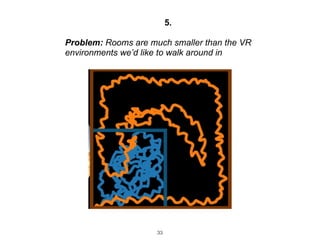
5.
Problem: Rooms are much smaller than the VR
environments we’d like to walk around in
34
OODA solution: hack the saccades!
35
Lesson 5: You normally drive on the map, not on the
territory. This fact can, and generally will, be used against
you
36
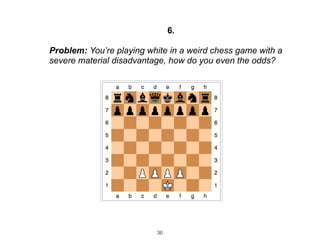
6.
Problem: You’re playing white in a weird chess game with a
severe material disadvantage, how do you even the odds?
37
OODA solution: Move twice as fast!
38
Lesson 6: a tempo advantage can make up for
a surprisingly heavy material or positional
disadvantage… for a while.
39
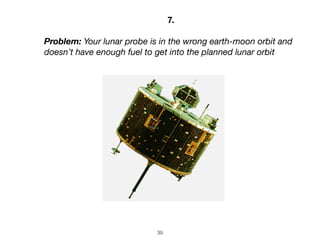
7.
Problem: Your lunar probe is in the wrong earth-moon orbit and
doesn’t have enough fuel to get into the planned lunar orbit
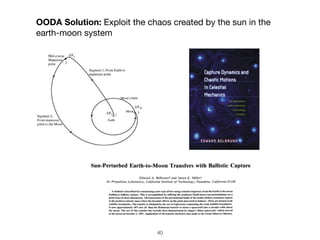
40
OODA Solution: Exploit the chaos created by the sun in the
earth-moon system
41
Lesson 7: the map is not the territory

Lesson 8: The right boundary is the one that “carves
reality at the joints”

Lesson 9: Chaos favors the superior orientation
42
8.
Problem: You need to move to a new position and kick the
ball towards the goal before the competition does
43
Move
Kick
Move 1
Rot 1
Move 2
Rot 2
Kick
Cornell omnidirectional drive with
optimal-control maneuvering
Unidirectional drive with
Manhattan grid maneuvering
OODA solution: Invent better moves than the competition
44
Lesson 10: Richer moves beats more moves

Lesson 11: Higher tempo with an inferior
orientation loses to lower tempo with superior
orientation
45
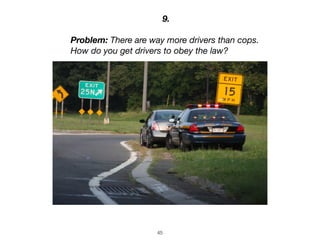
9.
Problem: There are way more drivers than cops.
How do you get drivers to obey the law?
46
OODA solution: Loom menacingly so you look bigger than you are
47
Lesson 12: People respond to perceptions, not realities,
and having the initiative allows you to shape perceptions
48
1. Single aircraft type or heterogeneous fleets?

2. Short-hop or hub-spoke?

3. Peanuts or fancy full-service meals?

4. Many classes or a single class?

5. Assigned or non-assigned seating?

6. Fast or slow gate-turnaround time?

7. Customer experience first or employee experience first?

8. Stingy or generous baggage allowance?

9. Premium or budget pricing?
10.
Problem: It’s 1967 and you’re entering a supposedly “Golden Age”
crony industry where everybody sucks, which of the gazillion parts of
the playbook should you rewrite?
49
OODA solution: Compete with buses and cars, not other airlines!
1. Single aircraft type or heterogeneous fleets?

2. Short-hop or hub-spoke?

3. Peanuts or fancy full-service meals?

4. Many classes or a single class?

5. Assigned or non-assigned seating?

6. Fast or slow gate-turnaround time?

7. Customer experience first or employee experience first?

8. Stingy or generous baggage allowance?

9. Premium or budget pricing?
50
Lesson 13: Superior orientation leads to superior
goals, which makes all other decisions easy
51
11.
Problem: Hans Gruber has taken over your building and
controls all exits, entries, and passageways
52
OODA solution: Move through the ventilation ducts
(Nakatomi Space!)
53
http://www.bldgblog.com/2010/01/nakatomi-space/
54
Lesson 14: Just because it was designed for a
purpose doesn’t mean you must ONLY use it for that
purpose
55
12.
Problem: Your adversary has is dominant on all technological fronts
and has perfect hive-mind situation awareness
Millennium War Games to test Network-Centric Warfare
56
OODA solution: Fight low-tech
Lt .General Paul Van Riper
Red Team strategy: Radio silence, motorcycle
couriers, swarm attack by fishing boats
57
Lesson 15: Don’t attack where the adversary is
already massively over-prepared
58
BONUS! 13
Problem: What happens when you put the following together?
Boyd’s problem
Handlebars from a bicycle
Outboard motor from a boat
Caterpillar treads from a child’s toy tank
A pair of skis
59
OODA solution: Snowmobile!
Boyd’s Snowmobile
60
Lesson 16: Objects are not the same as their
functions or behaviors
61
1. Maneuvering creates the equivalent of a resource advantage
2. You don’t need much of a brain to run an OODA loop, only a reality signal
3. Just because you run the OODA loop, doesn’t mean you own the OODA loop
4. The older parts of your brain are already wired for OODA. It’s the newer parts
that have some learning to do.
5. You normally drive on the map, not on the territory. This fact can, and generally
will, be used against you
6. A tempo advantage can make up for a surprisingly heavy material or positional
disadvantage… for a while
7. The map is not the territory
8. The right boundary is the one that “carves reality at the joints”
9. Chaos favors the superior orientation
10.Richer moves beats more moves
11.Higher tempo with an inferior orientation loses to lower tempo with superior
orientation
12.People respond to perceptions, not realities, and having the initiative allows you
to shape perceptions
13.Superior orientation leads to superior goals, which makes all other decisions
easy
14.Just because it was designed for a purpose doesn’t mean you must ONLY use
it for that purpose
15.Don’t attack where the adversary is already massively over prepared
16.Objects are not the same as their functions or behaviors
62
63
History of trade
relations with China
Doctrinal beliefs (eg.
Moore’s Law)
Case studies of energy
transitions
Starlink brings
connectivity to isolated
areas
Example: Detroit
history in automotive
64
Territory orientation

Map orientation

Explicit orientation

Implicit orientation

Null orientation
“Head in the game”
Deepening, more fluid orientation, 

faster transients, higher tempo
Unpacking “Orientation”
65
Null orientation: wearing a “kick me sign”
66
Implicit orientation: Noticing deviations from “normalcy”
67
Explicit orientation: Having models that can at least be wrong
68
Map orientation: Knowing how models are situated in
environments
69
Territory awareness: Knowing when maps are going wrong
“an organizational climate for operational success”
{
{
Blitzkrieg Model OODA loop
70
Thinking in OODA loops is about getting the right mix of
nerve and imagination for a winning strategy.
Today’s session!
71
WARNING #1: OODA is a not a process diagram. Treat it as a
mindful meditation catalyst, not a blueprint
WARNING #2: OODA is NOT a cyclic sequence. All 4 behaviors
evolve in parallel flowing into each other.
WARNING #3: Orientation is a context-sensitive gestalt state,
not a behavior. Re-orientation is an unscripted state reset that is
the result of imaginative re-perception and re-situation in the
environment, accompanied by active creative destruction. It is not a
predictable “meta” process.

WARNING #4: OODA is not about “iterating faster” than the
competition.
72
How to “do” OODA-based strategy
1. Operate in real-time: if you need time to think you
must create it

2. See in functionally unfixed ways: things are not
their functions

3. Mind the matrix: perceptions are not realities

4. Workshop through sparring: if it’s not being free-
play tested, it isn’t thinking

5. Develop deep memory: historical amnesia equals
bad strategy

Thinking in OODA Loops

  • 1.
  • 2.
    With monotonous regularity,apparently competent men have laid down the law about what is technically possible or impossible — and have been proved utterly wrong, sometimes while the ink was scarcely dry from their pens. On careful analysis, it appears that these debacles fall into two classes, which I will call “failures of nerve” and “failures of imagination.” The failure of nerve seems to be the more common; it occurs when even given all the relevant facts the would-be prophet cannot see that they point to an inescapable conclusion. Some of these failures are so ludicrous as to be almost unbelievable, and would form an interesting subject for psychological analysis. — From Hazards of Prophecy by Arthur C. Clarke, in Profiles of the Future: An Inquiry into the Limits of the Possible  2
  • 3.
    “an organizational climatefor operational success” { { Blitzkrieg Model OODA loop 3 Thinking in OODA loops is about getting the right mix of nerve and imagination for a winning strategy. Today’s session!
  • 4.
    4 Trust (Einheit) Capabilities (Fingerspitzengefühl) Contracts(Auftragstaktik) Goal (Schwerpunkt) “an organizational climate for operational success” 1. A vocabulary, grammar and syntax for thinking about organizations 2. A style of diagnosing and intervening in organizations 3. A foundation for building a winning culture
  • 5.
    5 1. A vocabulary,grammar and syntax for live decision-making 2. A habit of seeing problems with boldness and imagination 3. A foundation for “doing” strategy “an organizational climate for operational success” Today’s session!
  • 6.
    6 Core of OODAthinking Operate inside another agent’s decision- cycle, collapsing it from within
  • 7.
    7 WARNING #1: OODAis a not a process diagram. Treat it as a mindful meditation catalyst, not a blueprint WARNING #2: OODA is NOT a cyclic sequence. All 4 behaviors evolve in parallel flowing into each other. WARNING #3: Orientation is a context-sensitive gestalt state, not a behavior. Re-orientation is an unscripted state reset that is the result of imaginative re-perception and re-situation in the environment, accompanied by active creative destruction. It is not a predictable “meta” process. WARNING #4: OODA is not about “iterating faster” than the competition.
  • 8.
    8 How to “do”OODA-based strategy 1. Operate in real-time: if you need time to think you must create it 2. See in functionally unfixed ways: things are not their functions 3. Mind the matrix: perceptions are not realities 4. Workshop through sparring: if it’s not being free- play tested, it isn’t thinking 5. Develop deep memory: historical amnesia equals bad strategy
  • 9.
    9 If you don’tcreate time 1. Time pressure builds 2. You make mistakes 3. Imagination starts to fail 4. Your luck turns bad 5. Appetite for risk starts to collapse 6. Fear forces an unsafe retreat 7. Your OODA loop “collapses” 8. Feeling of certain doom This is ZEMBLANITY If you do create time 1. Time advantage accumulates 2. You make inspired moves 3. Imagination starts to compound 4. Your luck turns good 5. Appetite for risk starts to increase 6. Confidence fuels a bold advance 7. You “seize the initiative” 8. Feeling of unstoppable power This is SERENDIPITY “Create time” = “operate inside the adversary’s decision cycle”
  • 10.
    10 The goal ofOODA operations is to operate inside the adversary’s decision cycle, to seize and retain the initiative, in order to control the conflict, to make yourself surprisingly lucky and your adversary unsurprisingly unlucky Prototype: War Pure Conflict OODA (Zero/Negative-Sum)
  • 11.
    11 “No bastard everwon a war by dying for his country. He won it by making the other poor dumb bastard die for his country.” — General George S. Patton
  • 12.
    12 The goal ofOODA operations is to operate inside the market’s decision cycle, to seize and retain the initiative, in order to control the market, to make yourself surprisingly lucky, and your customer predictably delighted Prototype: Caring for an infant Pure Cooperation OODA (Positive-Sum)
  • 13.
    13 Business as PURECONFLICT (Zero/Negative Sum) Business as PURE COOPERATION (Positive-Sum) Business as “COOPETITION” (Mixed-Sum) Idealistic Businesses Extractive Businesses Pragmatic Businesses
  • 14.
    14 Jim Keller 2x2:™4 possible OODA loop regimes
  • 15.
    15 Unsafe Safe Advance Retreat CONTRACTION “Collapsing” OODAloop Sense of certain doom DISCOVERY SERENDIPITY (surprisingly lucky) ZEMBLANITY (unsurprisingly unlucky) “Certain to Win” OODA loop Sense of unstoppable power Graceful Degradation OODA loop New environment OODA loop arrogance loss of nerve and imagination resurrection confidence complacency humiliation Silicon Valley paranoia set-point
  • 16.
    16 Wherever you areon the spectrum… …There is no permanent strategic advantage
  • 17.
    17 Covid Response in4 regimes Unsafe Safe Advance Retreat
  • 18.
    18 12 Examples 1. Lanchesterattrition 2. Turnicate (sea squirt) 3. Leuchordium (a worm) 4. Throwing a ball 5. Infinite walking 6. Asymmetric chess 7. HITEN mission salvage 8. Robot soccer 9. Traffic enforcement 10. Southwest Airlines 11. Nakatomi Spaces 12. The Van Riper Affair
  • 19.
    Lanchester’s Law (1916):The relative loss rates of opposed forces in combat is inversely proportionate to the ratio of the squares of their strengths 1. Problem: Attrition conflict creates a doomsday stalemate between equally matched sides. How do you break out?
  • 20.
  • 21.
  • 22.
    22 Lesson 1: maneuveringcreates the equivalent of a resource advantage
  • 23.
    23 2. Problem: The SeaSquirt (Turnicate) needs a brain to find a good location to live on the sea floor, but doesn’t have the energy to sustain a large brain
  • 24.
    24 OODA solution: Eatyour brain when you’re done!
  • 25.
    25 Lesson 2: Youdon’t need much of a brain to run an OODA loop, only a reality signal
  • 26.
    26 3. Problem: The Leuchordiumworm needs to get around, but has weak mobility
  • 27.
    27 OODA solution: Hijacka snail to hitch a ride in a bird’s gut
  • 28.
    28 Lesson 3: Containmentdoes not equal control. Just because you run the OODA loop, doesn’t mean you own the OODA loop
  • 29.
    29 4. Problem: You’re throwinga ball but a mad scientist has messed with your vision by putting wedge prism glasses on you, so you keep missing
  • 30.
    30 OODA solution: Yourcerebellum has you covered!
  • 31.
    31 Purkinje cells: thecerebellum re-orientation hardware
  • 32.
    32 Lesson 4: Theolder parts of your brain are already wired for OODA. It’s the newer parts that have some learning to do.
  • 33.
    33 5. Problem: Rooms aremuch smaller than the VR environments we’d like to walk around in
  • 34.
  • 35.
    35 Lesson 5: Younormally drive on the map, not on the territory. This fact can, and generally will, be used against you
  • 36.
    36 6. Problem: You’re playingwhite in a weird chess game with a severe material disadvantage, how do you even the odds?
  • 37.
    37 OODA solution: Movetwice as fast!
  • 38.
    38 Lesson 6: atempo advantage can make up for a surprisingly heavy material or positional disadvantage… for a while.
  • 39.
    39 7. Problem: Your lunarprobe is in the wrong earth-moon orbit and doesn’t have enough fuel to get into the planned lunar orbit
  • 40.
    40 OODA Solution: Exploitthe chaos created by the sun in the earth-moon system
  • 41.
    41 Lesson 7: themap is not the territory Lesson 8: The right boundary is the one that “carves reality at the joints” Lesson 9: Chaos favors the superior orientation
  • 42.
    42 8. Problem: You needto move to a new position and kick the ball towards the goal before the competition does
  • 43.
    43 Move Kick Move 1 Rot 1 Move2 Rot 2 Kick Cornell omnidirectional drive with optimal-control maneuvering Unidirectional drive with Manhattan grid maneuvering OODA solution: Invent better moves than the competition
  • 44.
    44 Lesson 10: Richermoves beats more moves Lesson 11: Higher tempo with an inferior orientation loses to lower tempo with superior orientation
  • 45.
    45 9. Problem: There areway more drivers than cops. How do you get drivers to obey the law?
  • 46.
    46 OODA solution: Loommenacingly so you look bigger than you are
  • 47.
    47 Lesson 12: Peoplerespond to perceptions, not realities, and having the initiative allows you to shape perceptions
  • 48.
    48 1. Single aircrafttype or heterogeneous fleets? 2. Short-hop or hub-spoke? 3. Peanuts or fancy full-service meals? 4. Many classes or a single class? 5. Assigned or non-assigned seating? 6. Fast or slow gate-turnaround time? 7. Customer experience first or employee experience first? 8. Stingy or generous baggage allowance? 9. Premium or budget pricing? 10. Problem: It’s 1967 and you’re entering a supposedly “Golden Age” crony industry where everybody sucks, which of the gazillion parts of the playbook should you rewrite?
  • 49.
    49 OODA solution: Competewith buses and cars, not other airlines! 1. Single aircraft type or heterogeneous fleets? 2. Short-hop or hub-spoke? 3. Peanuts or fancy full-service meals? 4. Many classes or a single class? 5. Assigned or non-assigned seating? 6. Fast or slow gate-turnaround time? 7. Customer experience first or employee experience first? 8. Stingy or generous baggage allowance? 9. Premium or budget pricing?
  • 50.
    50 Lesson 13: Superiororientation leads to superior goals, which makes all other decisions easy
  • 51.
    51 11. Problem: Hans Gruberhas taken over your building and controls all exits, entries, and passageways
  • 52.
    52 OODA solution: Movethrough the ventilation ducts (Nakatomi Space!)
  • 53.
  • 54.
    54 Lesson 14: Justbecause it was designed for a purpose doesn’t mean you must ONLY use it for that purpose
  • 55.
    55 12. Problem: Your adversaryhas is dominant on all technological fronts and has perfect hive-mind situation awareness Millennium War Games to test Network-Centric Warfare
  • 56.
    56 OODA solution: Fightlow-tech Lt .General Paul Van Riper Red Team strategy: Radio silence, motorcycle couriers, swarm attack by fishing boats
  • 57.
    57 Lesson 15: Don’tattack where the adversary is already massively over-prepared
  • 58.
    58 BONUS! 13 Problem: Whathappens when you put the following together? Boyd’s problem Handlebars from a bicycle Outboard motor from a boat Caterpillar treads from a child’s toy tank A pair of skis
  • 59.
  • 60.
    60 Lesson 16: Objectsare not the same as their functions or behaviors
  • 61.
    61 1. Maneuvering createsthe equivalent of a resource advantage 2. You don’t need much of a brain to run an OODA loop, only a reality signal 3. Just because you run the OODA loop, doesn’t mean you own the OODA loop 4. The older parts of your brain are already wired for OODA. It’s the newer parts that have some learning to do. 5. You normally drive on the map, not on the territory. This fact can, and generally will, be used against you 6. A tempo advantage can make up for a surprisingly heavy material or positional disadvantage… for a while 7. The map is not the territory 8. The right boundary is the one that “carves reality at the joints” 9. Chaos favors the superior orientation 10.Richer moves beats more moves 11.Higher tempo with an inferior orientation loses to lower tempo with superior orientation 12.People respond to perceptions, not realities, and having the initiative allows you to shape perceptions 13.Superior orientation leads to superior goals, which makes all other decisions easy 14.Just because it was designed for a purpose doesn’t mean you must ONLY use it for that purpose 15.Don’t attack where the adversary is already massively over prepared 16.Objects are not the same as their functions or behaviors
  • 62.
  • 63.
    63 History of trade relationswith China Doctrinal beliefs (eg. Moore’s Law) Case studies of energy transitions Starlink brings connectivity to isolated areas Example: Detroit history in automotive
  • 64.
    64 Territory orientation Map orientation Explicitorientation Implicit orientation Null orientation “Head in the game” Deepening, more fluid orientation, faster transients, higher tempo Unpacking “Orientation”
  • 65.
    65 Null orientation: wearinga “kick me sign”
  • 66.
    66 Implicit orientation: Noticingdeviations from “normalcy”
  • 67.
    67 Explicit orientation: Havingmodels that can at least be wrong
  • 68.
    68 Map orientation: Knowinghow models are situated in environments
  • 69.
    69 Territory awareness: Knowingwhen maps are going wrong
  • 70.
    “an organizational climatefor operational success” { { Blitzkrieg Model OODA loop 70 Thinking in OODA loops is about getting the right mix of nerve and imagination for a winning strategy. Today’s session!
  • 71.
    71 WARNING #1: OODAis a not a process diagram. Treat it as a mindful meditation catalyst, not a blueprint WARNING #2: OODA is NOT a cyclic sequence. All 4 behaviors evolve in parallel flowing into each other. WARNING #3: Orientation is a context-sensitive gestalt state, not a behavior. Re-orientation is an unscripted state reset that is the result of imaginative re-perception and re-situation in the environment, accompanied by active creative destruction. It is not a predictable “meta” process. WARNING #4: OODA is not about “iterating faster” than the competition.
  • 72.
    72 How to “do”OODA-based strategy 1. Operate in real-time: if you need time to think you must create it 2. See in functionally unfixed ways: things are not their functions 3. Mind the matrix: perceptions are not realities 4. Workshop through sparring: if it’s not being free- play tested, it isn’t thinking 5. Develop deep memory: historical amnesia equals bad strategy