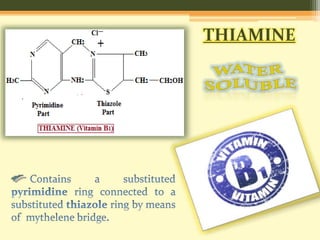
THIAMINE
Occurrence 
• Thiamine occurs in the outer 
coats (Aluerone) of the seeds 
of many plants including the 
cereal grains- 
Whole wheat flour 
Unpolished hand pound 
rice 
• Yeast is also a very good 
source 
• In animal tissues it occurs 
primarily as the coenzyme 
thiamine pyrophosphate or 
cocarboxylase.
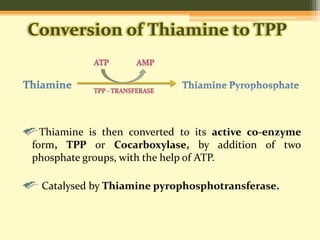
Conversion of Thiamine to TPP 
Thiamine is then converted to its active co-enzyme 
form, TPP or Cocarboxylase, by addition of two 
phosphate groups, with the help of ATP. 
Catalysed by Thiamine pyrophosphotransferase.
Absorption & Metabolism 
• Most absorption of thiamine occurs in jejunum and 
ileum of the small intestine. 
• If consumed in small quantity- thiamine absorbed by 
sodium dependent active transport mechanism. 
• If consumed in large quantity- absorption carried out by 
passive diffusion. 
• TPP within food must be dephosphorylated to thiamine 
before it can be absorbed by humans. Except in RBCs, 
where TPP can cross its cell membrane.
• About 80% of thiamine in the body is in the form of TPP. 
• Half of the body’s thiamine is in the muscle tissues. 
• The body contains no specific storage site for thiamine. 
• Thiamine is excreted from the body in the form of 
thiamine acetic acid and as various other metabolites 
produced by its degradation.
Biochemical Role of TPP 
• TPP is needed for the oxidative decarboxylation of 
pyruvate (pyruvic acid) to form the acetyl coenzyme A 
that enters the TCA cycle. 
• It is also used for the decarboxylation of α – 
ketogluterate to succinyl coA and CO2 within the TCA 
cycle. 
(Pyruvic acid and α – ketogluterate accumulate in 
those with thiamine deficiency)
• It is a co-enzyme of the enzyme transketolase which is 
required for the metabolism of glucose via the hexose 
monophosphate shunt (HMP) pathway. 
(HMP pathway is the only way by which the body can 
produce the ribose and deoxy ribose sugars needed for the 
synthesis of ribonucleic acid and deoxy ribonucleic acid)
• Thiamine is involved in the transmission of high 
frequency impulses across nerve synapses, the junctions 
between neighboring nerve cells, across which the signals 
are carried by chemical neurotransmitters. 
• Thiamine is also known to be involved in the conversion 
of the amino acid tryptophan to the vitamin Niacin and 
in the metabolism of the branched- chain amino acids 
leucine, isoleucin and valine.
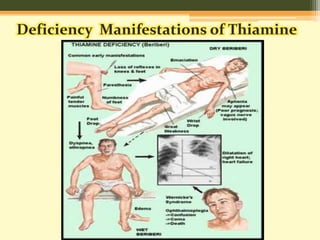
Glucose is incompletely metabolised & 
pyruvic and lactic acids accumulates in 
the tissues and body fluids. 
Inability to use glucose efficiently. 
Dilates peripheral blood vessels. If 
vasodilatation is extreme, fluid leaks out 
of the capillaries, producing edema. 
High cardiac output- myocardium over 
worked. 
Edema of legs, trunk and face are themain 
features. Palpitation, breathlessness and 
distended neck is also observed.
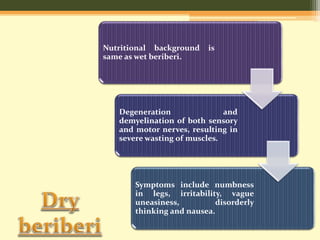
Nutritional background is 
same as wet beriberi. 
Degeneration and 
demyelination of both sensory 
and motor nerves, resulting in 
severewasting of muscles. 
Symptoms include numbness 
in legs, irritability, vague 
uneasiness, disorderly 
thinking and nausea.
It often presents acutely 
in alcoholics. But 
sometimes seen in 
people with persistent 
vomiting. 
The patient seems quite 
confused. The most valuable 
signs are- bilateral, 
symmetrical opthalmoplegia-paralysis 
of eye muscles, jerky 
repetition movement of eye 
balls. 
If left untreated, psychosis is 
observed. May also lead to 
death.
Occurs in infants between 2 
and 5 months of age. 
Beriberi occurs more often in 
breast fed because a lactating 
mother’s intake of thiamine 
may be too low. 
The affected baby develops 
cyanosis, accumulation of 
CO2 or lack of O2 in the blood 
vessels - skin turns blue, 
tachycardia is observed.
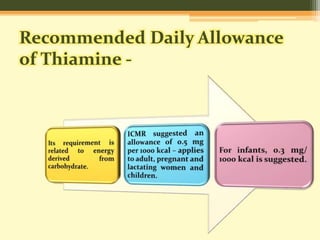
Recommended Daily Allowance 
of Thiamine -
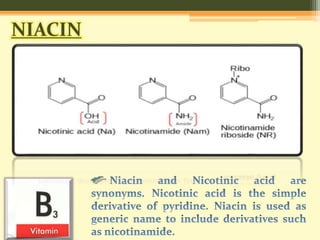
NIACIN
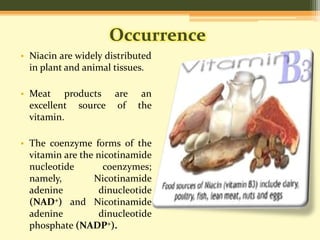
Occurrence 
• Niacin are widely distributed 
in plant and animal tissues. 
• Meat products are an 
excellent source of the 
vitamin. 
• The coenzyme forms of the 
vitamin are the nicotinamide 
nucleotide coenzymes; 
namely, Nicotinamide 
adenine dinucleotide 
(NAD+) and Nicotinamide 
adenine dinucleotide 
phosphate (NADP+).
Absorption & Metabolism 
• Niacin is readily absorbed from the stomach and the 
small intestine. 
• It is converted into the coenzymes NAD and NADP within 
the cells and limited stores of these coenzymes are held in 
the kidney, liver and brain. 
• Any excess niacin is excreted in urine in the forms of 
methyl nicotinamide and methyl carboxamido – 
pyridone.
Niacin & Tryptophan interrelationship 
• About 97% molecules of tryptophan are metabolised in 
the major pathway. About 3% molecules are diverted at the 
level of 3- hydroxy anthranilic acid, to form NAD+ . 
• The enzyme, Quinolinate phosphoribosyl transferase 
(QPRT) is the rate- limiting step. 
• About 60 mg of tryptophan will be equivalent to 1 mg of 
nicotinic acid.
Biochemical role of Niacin 
• Its major biochemical role is to form part of the 
coenzymes NAD and NADP. 
• These coenzymes are required by many of the key 
pathways of metabolism with NAD being primarily 
involved in catabolic reactions and NADP functions 
mainly in anabolic reactions. 
• NAD and NADP act in a large number of reversible 
oxidation reduction reactions. 
• NAD and NADP participate in more than 200 enzyme 
reactions.
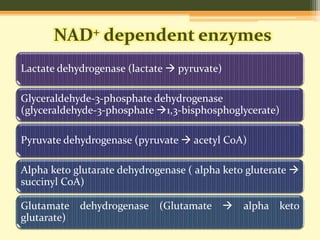
NAD+ dependent enzymes 
Lactate dehydrogenase (lactate  pyruvate) 
Glyceraldehyde-3-phosphate dehydrogenase 
(glyceraldehyde-3-phosphate 1,3-bisphosphoglycerate) 
Pyruvate dehydrogenase (pyruvate  acetyl CoA) 
Alpha keto glutarate dehydrogenase ( alpha keto gluterate  
succinyl CoA) 
Glutamate dehydrogenase (Glutamate  alpha keto 
glutarate)
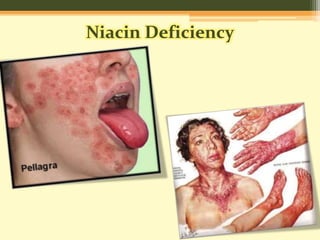
Niacin Deficiency
It is an Italian word, meaning “rough skin”. 
The symptoms are- 
Dermatitis: in early stages, bright red 
erythema occurs, especially in the feet, 
ankles and face. Increased pigmentation 
around neck is known as Casal’s necklace. 
Diarrhea: It may be mild or severe with 
blood and mucus. This may lead to weight 
loss. Nausea and vomiting may also be 
present. 
Dementia: It is frequently seen in chronic 
cases. Irritability, inability to concentrate 
and poor memory are more common in mild 
cases.
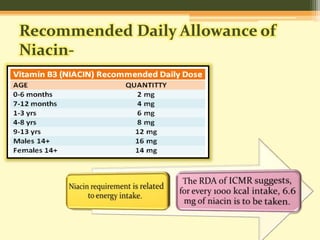
Recommended Daily Allowance of 
Niacin-
References 
• Nutrition Science (fourth revised edition) 
▫ B. Srilakshmi 
• Textbook of Biochemistry for Medical Students 
▫ D.M. Vasudevan 
▫ Srikumari S. 
• Outlines of biochemistry (5th edition) 
▫ Eric E. Conn 
▫ Paul k. Stumpf 
▫ G. Bruening 
▫ Roy H. Doi

Thiamine & Niacin

  • 2.
  • 3.
    Occurrence • Thiamineoccurs in the outer coats (Aluerone) of the seeds of many plants including the cereal grains- Whole wheat flour Unpolished hand pound rice • Yeast is also a very good source • In animal tissues it occurs primarily as the coenzyme thiamine pyrophosphate or cocarboxylase.
  • 4.
    Conversion of Thiamineto TPP Thiamine is then converted to its active co-enzyme form, TPP or Cocarboxylase, by addition of two phosphate groups, with the help of ATP. Catalysed by Thiamine pyrophosphotransferase.
  • 5.
    Absorption & Metabolism • Most absorption of thiamine occurs in jejunum and ileum of the small intestine. • If consumed in small quantity- thiamine absorbed by sodium dependent active transport mechanism. • If consumed in large quantity- absorption carried out by passive diffusion. • TPP within food must be dephosphorylated to thiamine before it can be absorbed by humans. Except in RBCs, where TPP can cross its cell membrane.
  • 6.
    • About 80%of thiamine in the body is in the form of TPP. • Half of the body’s thiamine is in the muscle tissues. • The body contains no specific storage site for thiamine. • Thiamine is excreted from the body in the form of thiamine acetic acid and as various other metabolites produced by its degradation.
  • 7.
    Biochemical Role ofTPP • TPP is needed for the oxidative decarboxylation of pyruvate (pyruvic acid) to form the acetyl coenzyme A that enters the TCA cycle. • It is also used for the decarboxylation of α – ketogluterate to succinyl coA and CO2 within the TCA cycle. (Pyruvic acid and α – ketogluterate accumulate in those with thiamine deficiency)
  • 8.
    • It isa co-enzyme of the enzyme transketolase which is required for the metabolism of glucose via the hexose monophosphate shunt (HMP) pathway. (HMP pathway is the only way by which the body can produce the ribose and deoxy ribose sugars needed for the synthesis of ribonucleic acid and deoxy ribonucleic acid)
  • 9.
    • Thiamine isinvolved in the transmission of high frequency impulses across nerve synapses, the junctions between neighboring nerve cells, across which the signals are carried by chemical neurotransmitters. • Thiamine is also known to be involved in the conversion of the amino acid tryptophan to the vitamin Niacin and in the metabolism of the branched- chain amino acids leucine, isoleucin and valine.
  • 11.
    Glucose is incompletelymetabolised & pyruvic and lactic acids accumulates in the tissues and body fluids. Inability to use glucose efficiently. Dilates peripheral blood vessels. If vasodilatation is extreme, fluid leaks out of the capillaries, producing edema. High cardiac output- myocardium over worked. Edema of legs, trunk and face are themain features. Palpitation, breathlessness and distended neck is also observed.
  • 12.
    Nutritional background is same as wet beriberi. Degeneration and demyelination of both sensory and motor nerves, resulting in severewasting of muscles. Symptoms include numbness in legs, irritability, vague uneasiness, disorderly thinking and nausea.
  • 13.
    It often presentsacutely in alcoholics. But sometimes seen in people with persistent vomiting. The patient seems quite confused. The most valuable signs are- bilateral, symmetrical opthalmoplegia-paralysis of eye muscles, jerky repetition movement of eye balls. If left untreated, psychosis is observed. May also lead to death.
  • 14.
    Occurs in infantsbetween 2 and 5 months of age. Beriberi occurs more often in breast fed because a lactating mother’s intake of thiamine may be too low. The affected baby develops cyanosis, accumulation of CO2 or lack of O2 in the blood vessels - skin turns blue, tachycardia is observed.
  • 15.
  • 16.
  • 17.
    Occurrence • Niacinare widely distributed in plant and animal tissues. • Meat products are an excellent source of the vitamin. • The coenzyme forms of the vitamin are the nicotinamide nucleotide coenzymes; namely, Nicotinamide adenine dinucleotide (NAD+) and Nicotinamide adenine dinucleotide phosphate (NADP+).
  • 18.
    Absorption & Metabolism • Niacin is readily absorbed from the stomach and the small intestine. • It is converted into the coenzymes NAD and NADP within the cells and limited stores of these coenzymes are held in the kidney, liver and brain. • Any excess niacin is excreted in urine in the forms of methyl nicotinamide and methyl carboxamido – pyridone.
  • 19.
    Niacin & Tryptophaninterrelationship • About 97% molecules of tryptophan are metabolised in the major pathway. About 3% molecules are diverted at the level of 3- hydroxy anthranilic acid, to form NAD+ . • The enzyme, Quinolinate phosphoribosyl transferase (QPRT) is the rate- limiting step. • About 60 mg of tryptophan will be equivalent to 1 mg of nicotinic acid.
  • 21.
    Biochemical role ofNiacin • Its major biochemical role is to form part of the coenzymes NAD and NADP. • These coenzymes are required by many of the key pathways of metabolism with NAD being primarily involved in catabolic reactions and NADP functions mainly in anabolic reactions. • NAD and NADP act in a large number of reversible oxidation reduction reactions. • NAD and NADP participate in more than 200 enzyme reactions.
  • 22.
    NAD+ dependent enzymes Lactate dehydrogenase (lactate  pyruvate) Glyceraldehyde-3-phosphate dehydrogenase (glyceraldehyde-3-phosphate 1,3-bisphosphoglycerate) Pyruvate dehydrogenase (pyruvate  acetyl CoA) Alpha keto glutarate dehydrogenase ( alpha keto gluterate  succinyl CoA) Glutamate dehydrogenase (Glutamate  alpha keto glutarate)
  • 23.
  • 24.
    It is anItalian word, meaning “rough skin”. The symptoms are- Dermatitis: in early stages, bright red erythema occurs, especially in the feet, ankles and face. Increased pigmentation around neck is known as Casal’s necklace. Diarrhea: It may be mild or severe with blood and mucus. This may lead to weight loss. Nausea and vomiting may also be present. Dementia: It is frequently seen in chronic cases. Irritability, inability to concentrate and poor memory are more common in mild cases.
  • 25.
  • 26.
    References • NutritionScience (fourth revised edition) ▫ B. Srilakshmi • Textbook of Biochemistry for Medical Students ▫ D.M. Vasudevan ▫ Srikumari S. • Outlines of biochemistry (5th edition) ▫ Eric E. Conn ▫ Paul k. Stumpf ▫ G. Bruening ▫ Roy H. Doi