Stabilizing and balancing of
Linear and Rotary Inverted Pendulum system.
Presented by-
Nowab Md. Aminul Haq
Student ID. -1010130
Ashik-E-Rasul
Student ID. 1010132
Department of Mechanical Engineering
Bangladesh University of Engineering and Technology (BUET)
1
Supervised by-
Dr. Md. Zahurul Haq
Professor & Head.
Department of Mechanical Engineering, BUET.
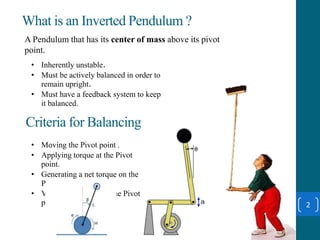
What is an Inverted Pendulum ?
2
A Pendulum that has its center of mass above its pivot
point.
• Inherently unstable.
• Must be actively balanced in order to
remain upright.
• Must have a feedback system to keep
it balanced.
Criteria for Balancing
• Moving the Pivot point .
• Applying torque at the Pivot
point.
• Generating a net torque on the
Pendulum.
• Vertically Oscillating the Pivot
point.
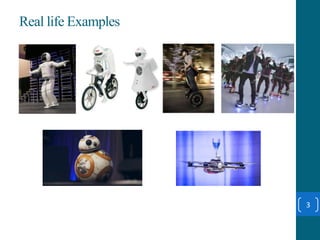
Real life Examples
3
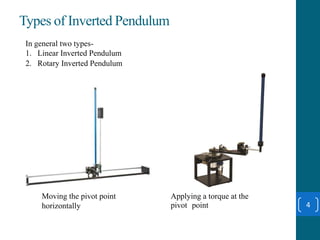
Types of Inverted Pendulum
4
In general two types-
1. Linear Inverted Pendulum
2. Rotary Inverted Pendulum
Moving the pivot point
horizontally
Applying a torque at the
pivot point
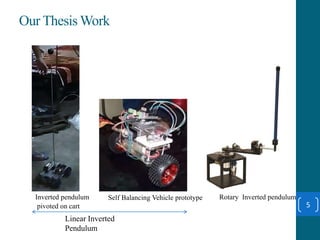
Our Thesis Work
5
Inverted pendulum
pivoted on cart
Rotary Inverted pendulumSelf Balancing Vehicle prototype
Linear Inverted
Pendulum
Linear Inverted Pendulum
6
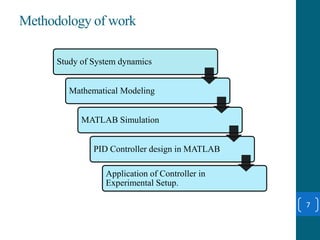
Methodology of work
7
Study of System dynamics
Mathematical Modeling
MATLAB Simulation
PID Controller design in MATLAB
Application of Controller in
Experimental Setup.
System Dynamics and Mathematical Modeling
8
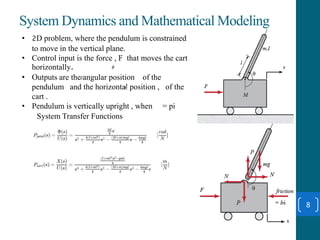
• 2D problem, where the pendulum is constrained
to move in the vertical plane.
• Control input is the force , F that moves the cart
horizontally.
• Outputs are the angular position of the
pendulum and the horizontal position , of the
cart .
• Pendulum is vertically upright , when = pi
System Transfer Functions
MATLAB Simulation of the System.
9
Time
phi
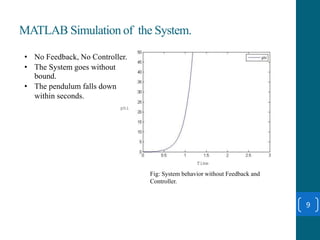
• No Feedback, No Controller.
• The System goes without
bound.
• The pendulum falls down
within seconds.
Fig: System behavior without Feedback and
Controller.
PID Controller Design
10
Angle
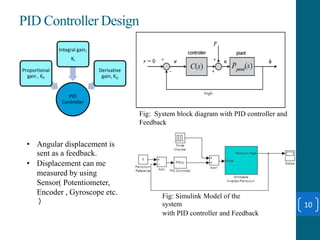
Fig: Simulink Model of the
system
with PID controller and Feedback
Fig: System block diagram with PID controller and
Feedback
PID
Controller
Proportional
gain , KP
Integral gain,
KI
Derivative
gain, KD
• Angular displacement is
sent as a feedback.
• Displacement can me
measured by using
Sensor( Potentiometer,
Encoder , Gyroscope etc.
)
PID Controller design in MATLAB
11
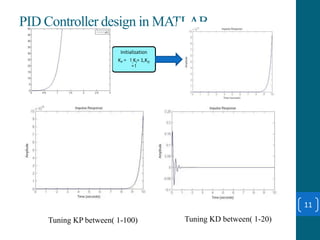
Initialization
KP = 1,KI= 1,KD
=1
Tuning KP between( 1-100) Tuning KD between( 1-20)
12
PID Controller design in MATLAB
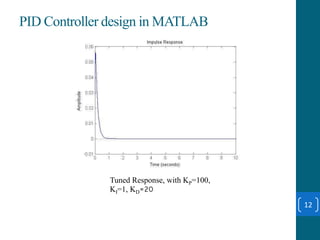
Tuned Response, with KP=100,
KI=1, KD=20
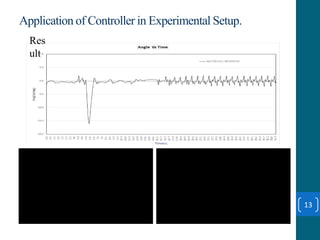
Application of Controller in Experimental Setup.
13
Res
ult
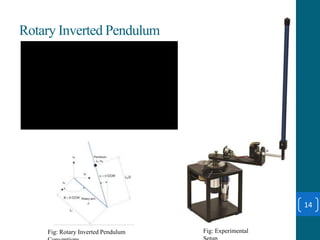
Rotary Inverted Pendulum
14
Fig: ExperimentalFig: Rotary Inverted Pendulum
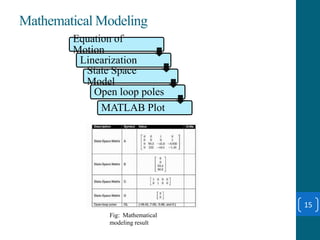
Mathematical Modeling
15
Equation of
Motion
Linearization
State Space
Model
Open loop poles
MATLAB Plot
Fig: Mathematical
modeling result
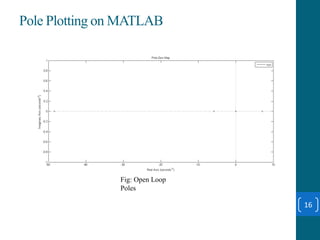
Pole Plotting on MATLAB
16
Fig: Open Loop
Poles
Controller Design(Pole Placement Method)
17
Controll
ability
Desired
Poles
• ζ = 0.7.
• ωn = 4 rad/s
• |α| < 15 deg.
•
Gain
Calculat
ion
• To move the poles to desired location
Simulati
on
• Simulate The result
To
Model
• Apply on the system
2
. . . ]
( )
[ n
Ran
T B
k
AB A B A B
T n


3 430, 40p p   
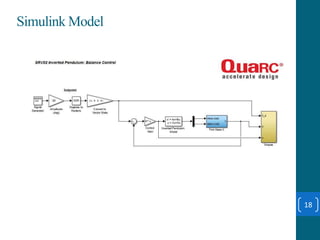
Simulink Model
18
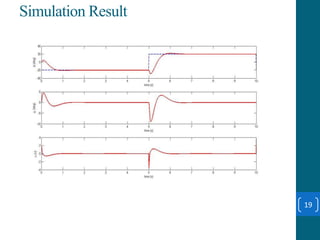
Simulation Result
19
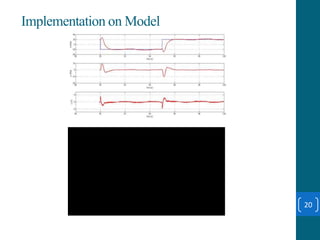
Implementation on Model
20
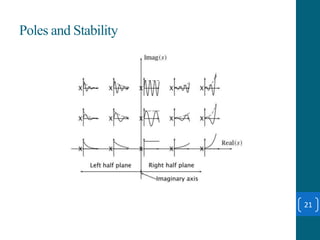
Poles and Stability
21
Designing an optimal controller
22
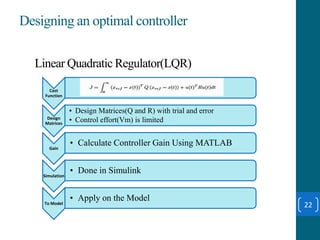
Linear Quadratic Regulator(LQR)
Cost
Function
Design
Matrices
• Design Matrices(Q and R) with trial and error
• Control effort(Vm) is limited
Gain
• Calculate Controller Gain Using MATLAB
Simulation
• Done in Simulink
To Model
• Apply on the Model
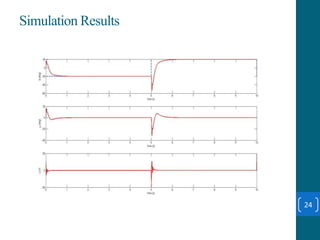
Simulation Results
23
24
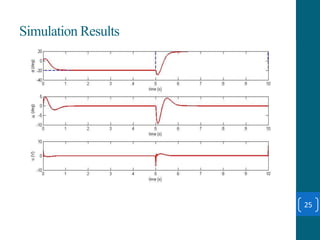
Simulation Results
25
Simulation Results
26
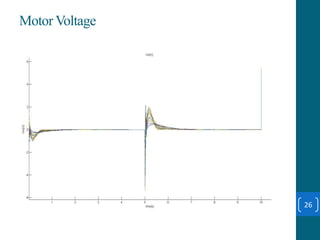
Motor Voltage
27
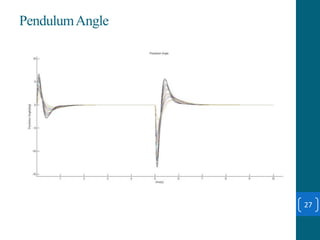
PendulumAngle
28
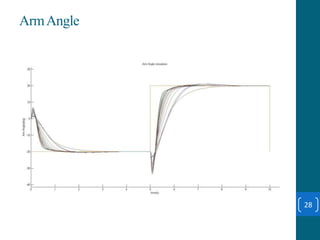
ArmAngle
29
Concluding Remarks
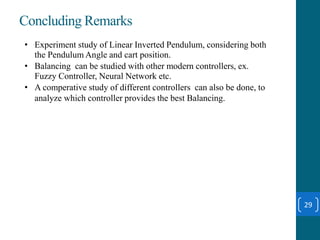
• Experiment study of Linear Inverted Pendulum, considering both
the Pendulum Angle and cart position.
• Balancing can be studied with other modern controllers, ex.
Fuzzy Controller, Neural Network etc.
• A comperative study of different controllers can also be done, to
analyze which controller provides the best Balancing.
Thank you!!
30

Thesis presentation on inverted pendulum

  • 1.
    Stabilizing and balancingof Linear and Rotary Inverted Pendulum system. Presented by- Nowab Md. Aminul Haq Student ID. -1010130 Ashik-E-Rasul Student ID. 1010132 Department of Mechanical Engineering Bangladesh University of Engineering and Technology (BUET) 1 Supervised by- Dr. Md. Zahurul Haq Professor & Head. Department of Mechanical Engineering, BUET.
  • 2.
    What is anInverted Pendulum ? 2 A Pendulum that has its center of mass above its pivot point. • Inherently unstable. • Must be actively balanced in order to remain upright. • Must have a feedback system to keep it balanced. Criteria for Balancing • Moving the Pivot point . • Applying torque at the Pivot point. • Generating a net torque on the Pendulum. • Vertically Oscillating the Pivot point.
  • 3.
  • 4.
    Types of InvertedPendulum 4 In general two types- 1. Linear Inverted Pendulum 2. Rotary Inverted Pendulum Moving the pivot point horizontally Applying a torque at the pivot point
  • 5.
    Our Thesis Work 5 Invertedpendulum pivoted on cart Rotary Inverted pendulumSelf Balancing Vehicle prototype Linear Inverted Pendulum
  • 6.
  • 7.
    Methodology of work 7 Studyof System dynamics Mathematical Modeling MATLAB Simulation PID Controller design in MATLAB Application of Controller in Experimental Setup.
  • 8.
    System Dynamics andMathematical Modeling 8 • 2D problem, where the pendulum is constrained to move in the vertical plane. • Control input is the force , F that moves the cart horizontally. • Outputs are the angular position of the pendulum and the horizontal position , of the cart . • Pendulum is vertically upright , when = pi System Transfer Functions
  • 9.
    MATLAB Simulation ofthe System. 9 Time phi • No Feedback, No Controller. • The System goes without bound. • The pendulum falls down within seconds. Fig: System behavior without Feedback and Controller.
  • 10.
    PID Controller Design 10 Angle Fig:Simulink Model of the system with PID controller and Feedback Fig: System block diagram with PID controller and Feedback PID Controller Proportional gain , KP Integral gain, KI Derivative gain, KD • Angular displacement is sent as a feedback. • Displacement can me measured by using Sensor( Potentiometer, Encoder , Gyroscope etc. )
  • 11.
    PID Controller designin MATLAB 11 Initialization KP = 1,KI= 1,KD =1 Tuning KP between( 1-100) Tuning KD between( 1-20)
  • 12.
    12 PID Controller designin MATLAB Tuned Response, with KP=100, KI=1, KD=20
  • 13.
    Application of Controllerin Experimental Setup. 13 Res ult
  • 14.
    Rotary Inverted Pendulum 14 Fig:ExperimentalFig: Rotary Inverted Pendulum
  • 15.
    Mathematical Modeling 15 Equation of Motion Linearization StateSpace Model Open loop poles MATLAB Plot Fig: Mathematical modeling result
  • 16.
    Pole Plotting onMATLAB 16 Fig: Open Loop Poles
  • 17.
    Controller Design(Pole PlacementMethod) 17 Controll ability Desired Poles • ζ = 0.7. • ωn = 4 rad/s • |α| < 15 deg. • Gain Calculat ion • To move the poles to desired location Simulati on • Simulate The result To Model • Apply on the system 2 . . . ] ( ) [ n Ran T B k AB A B A B T n   3 430, 40p p   
  • 18.
  • 19.
  • 20.
  • 21.
  • 22.
    Designing an optimalcontroller 22 Linear Quadratic Regulator(LQR) Cost Function Design Matrices • Design Matrices(Q and R) with trial and error • Control effort(Vm) is limited Gain • Calculate Controller Gain Using MATLAB Simulation • Done in Simulink To Model • Apply on the Model
  • 23.
  • 24.
  • 25.
  • 26.
  • 27.
  • 28.
  • 29.
    29 Concluding Remarks • Experimentstudy of Linear Inverted Pendulum, considering both the Pendulum Angle and cart position. • Balancing can be studied with other modern controllers, ex. Fuzzy Controller, Neural Network etc. • A comperative study of different controllers can also be done, to analyze which controller provides the best Balancing.
  • 30.