
PIVOT ALGORITHM
Vineet Kumar Doshi
11010759
CL 622
What Is Pivot Algorithm?
• The Pivot algorithm is a very efficient ‘dynamic’ algorithm for
generating d-dimensional canonical ensemble.[1][2][3]
• It drastically modifies the chain dimension.
How It Works?
The pivot algorithm uses pivot moves as the transitions in
Markov chain which proceeds as follows.
• Choose the pivot point.
• Transform the coordinates of either side by rotating about the
pivot point.
• If the resulting walk is self-avoiding the move is accepted,
otherwise the move is rejected and the original walk is
retained.
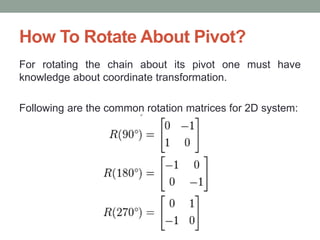
How To Rotate About Pivot?
For rotating the chain about its pivot one must have
knowledge about coordinate transformation.
Following are the common rotation matrices for 2D system:
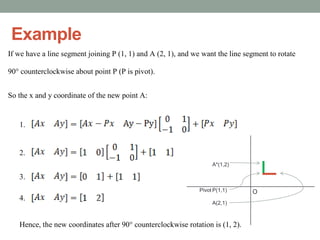
Example
A*(1,2)
Pivot P(1,1) O
A(2,1)
If we have a line segment joining P (1, 1) and A (2, 1), and we want the line segment to rotate
90° counterclockwise about point P (P is pivot).
So the x and y coordinate of the new point A:
1.
2.
3.
4.
Hence, the new coordinates after 90° counterclockwise rotation is (1, 2).
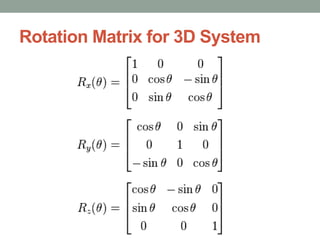
Rotation Matrix for 3D System
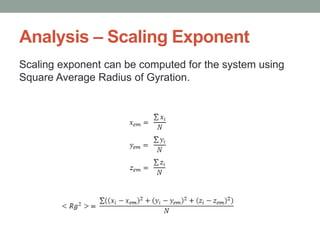
Analysis – Scaling Exponent
Scaling exponent can be computed for the system using
Square Average Radius of Gyration.
Analysis – Scaling Exponent (contd.)
< Rg2
> ∝ (N) 2ν
For 2D system: ν = 0.75
For 3D system: ν = 0.588
References
• [1] M. Kroger, Introduction to Computational Physics,
Lecture Notes; ETH Zurich (2008).
• [2] Joachim P. Wittmer et. al., Monte Carlo Simulation of
Polymers, NIC Series 23, 83-140 (2001).
• [3] Nathan Clisby, Efficient Implementation of pivot
algorithm for self-avoiding walks, ARC, (2010).

Pivot Algorithm

  • 1.
    PIVOT ALGORITHM Vineet KumarDoshi 11010759 CL 622
  • 2.
    What Is PivotAlgorithm? • The Pivot algorithm is a very efficient ‘dynamic’ algorithm for generating d-dimensional canonical ensemble.[1][2][3] • It drastically modifies the chain dimension.
  • 3.
    How It Works? Thepivot algorithm uses pivot moves as the transitions in Markov chain which proceeds as follows. • Choose the pivot point. • Transform the coordinates of either side by rotating about the pivot point. • If the resulting walk is self-avoiding the move is accepted, otherwise the move is rejected and the original walk is retained.
  • 4.
    How To RotateAbout Pivot? For rotating the chain about its pivot one must have knowledge about coordinate transformation. Following are the common rotation matrices for 2D system:
  • 5.
    Example A*(1,2) Pivot P(1,1) O A(2,1) Ifwe have a line segment joining P (1, 1) and A (2, 1), and we want the line segment to rotate 90° counterclockwise about point P (P is pivot). So the x and y coordinate of the new point A: 1. 2. 3. 4. Hence, the new coordinates after 90° counterclockwise rotation is (1, 2).
  • 6.
  • 7.
    Analysis – ScalingExponent Scaling exponent can be computed for the system using Square Average Radius of Gyration.
  • 8.
    Analysis – ScalingExponent (contd.) < Rg2 > ∝ (N) 2ν For 2D system: ν = 0.75 For 3D system: ν = 0.588
  • 9.
    References • [1] M.Kroger, Introduction to Computational Physics, Lecture Notes; ETH Zurich (2008). • [2] Joachim P. Wittmer et. al., Monte Carlo Simulation of Polymers, NIC Series 23, 83-140 (2001). • [3] Nathan Clisby, Efficient Implementation of pivot algorithm for self-avoiding walks, ARC, (2010).