ARBAMICH UNIVERSITY
SCHOOL OF POST GRADUATE STUDIES
Thesis Presentation
On
Design, Modeling and Analysis of Hybrid Biomass-
Photovoltaic system
for Condominium Developments
A case study of Koye Feche condominium site
On
By:- Fasil Ayele Advisor: Prof. Sudesh Parkash Sabberwa
∗ To the professors and AMU community
∗ To my Advisor
∗ My Friends
∗ My wife
Acknowledgement
∗ My wife
∗ My parents
∗ Residents of Semit condominium who took part in the
work
∗ Semit waste collection micro enterprise (Abu, yade
and Adinew)
MSc. Thesis Presentation By:- Fasil Ayele Advisor: Prof. Sudesh Parkash Sabberwa Arbaminch University School Of Post Graduates
1. Introduction
2. Load profile
3. Renewable Resources
4. Design & Model
5. Simulation and Results
Presentation outline
5. Simulation and Results
6. Conclusion
7. Recommendation
8. References
MSc. Thesis Presentation By:- Fasil Ayele Advisor: Prof. Sudesh Parkash Sabberwa Arbaminch University School Of Post Graduates
∗ Motivation
∗ Aim of work
∗ Scope of study
∗ Case study site
Introduction
∗ Case study site
∗ Significance of the study
MSc. Thesis Presentation By:- Fasil Ayele Advisor: Prof. Sudesh Parkash Sabberwa Arbaminch University School Of Post Graduates
∗ Supplying Electricity to condominium developments is a
big challenge to the Government
∗ Bringing new culture of distributed generation to the
Ethiopian Power Industry
∗ Diversifying Hydro dominated power sector
Motivation
∗ Diversifying Hydro dominated power sector
∗ Making most out of our resources
MSc. Thesis Presentation By:- Fasil Ayele Advisor: Prof. Sudesh Parkash Sabberwa Arbaminch University School Of Post Graduates
∗ Develop a load profile for condominium
developments
∗ Study available resources and their potential energy
capacity
Aim of work
capacity
∗ Design, model and analyze possible Biomass-PV
hybrid system for condominium developments
∗ Indicate available alternative to the problem
MSc. Thesis Presentation By:- Fasil Ayele Advisor: Prof. Sudesh Parkash Sabberwa Arbaminch University School Of Post Graduates
∗ Statistical study of the load profile from populated
condominium developments
∗ Statistical study of the waste generation
∗ Rooftop PV generation potential simulation using
PVWatts
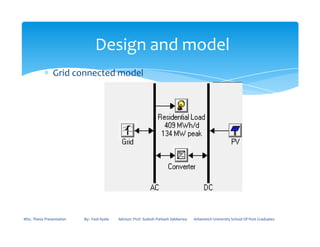
Scope of study
PVWatts
∗ Simulate the optimum model using Homer
MSc. Thesis Presentation By:- Fasil Ayele Advisor: Prof. Sudesh Parkash Sabberwa Arbaminch University School Of Post Graduates
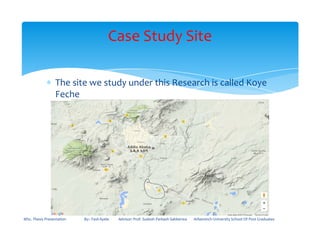
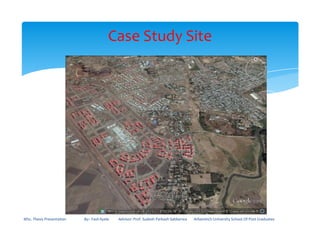
∗ The site we study under this Research is called Koye
Feche
Case Study Site
MSc. Thesis Presentation By:- Fasil Ayele Advisor: Prof. Sudesh Parkash Sabberwa Arbaminch University School Of Post Graduates
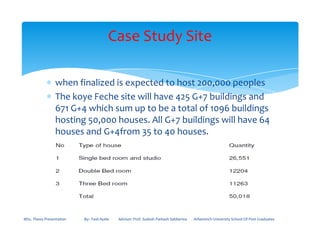
∗ when finalized is expected to host 200,000 peoples
∗ The koye Feche site will have 425 G+7 buildings and
671 G+4 which sum up to be a total of 1096 buildings
hosting 50,000 houses. All G+7 buildings will have 64
Case Study Site
hosting 50,000 houses. All G+7 buildings will have 64
houses and G+4from 35 to 40 houses.
MSc. Thesis Presentation By:- Fasil Ayele Advisor: Prof. Sudesh Parkash Sabberwa Arbaminch University School Of Post Graduates
∗ It is the biggest site and is expected to host around
200000 peoples whose demand for electric power will be a
real challenge
∗ It is construction is being started and necessary changes in
the construction can be made to implement the suggested
Case Study Site
Why Koye Feche?
the construction can be made to implement the suggested
project
∗ It is a big load and can attract the interest of power
producing investors
∗ The site has enough land in the surrounding for efficient
biomass bi-producing businesses
MSc. Thesis Presentation By:- Fasil Ayele Advisor: Prof. Sudesh Parkash Sabberwa Arbaminch University School Of Post Graduates
Case Study Site
MSc. Thesis Presentation By:- Fasil Ayele Advisor: Prof. Sudesh Parkash Sabberwa Arbaminch University School Of Post Graduates
∗ Indicate an alternative (help)
∗ Attract power producing Investors
Significance of the study
MSc. Thesis Presentation By:- Fasil Ayele Advisor: Prof. Sudesh Parkash Sabberwa Arbaminch University School Of Post Graduates
∗ Literature Review
∗ Methodology and procedure
∗ Load Profile curves
Load Profile
MSc. Thesis Presentation By:- Fasil Ayele Advisor: Prof. Sudesh Parkash Sabberwa Arbaminch University School Of Post Graduates
∗ There are two general categories of techniques
available to model residential load demand:
∗ top-down
∗ use estimates of total residential sector energy consumption, together with other pertinent macro variables,
to attribute energy consumption to characteristics of the housing sector
∗ bottom up models
Load profiling
∗ bottom up models
∗ identify the contribution of each end-use towards the aggregate energy consumption of the residential
sector
∗ Standard vs real load profile
∗ Because of a more realistic result with bottom up
approaches, load profiling in this work make use of
same
MSc. Thesis Presentation By:- Fasil Ayele Advisor: Prof. Sudesh Parkash Sabberwa Arbaminch University School Of Post Graduates
∗ models calculate the energy consumption of an individual
or group of households and extrapolate the results to a
region or nation
∗ aggregate result is generally accomplished by using a
weight for each modeled house or group of houses based
on its representation of the sector
Load profiling
Bottom up Approach
on its representation of the sector
∗ Do not rely on historical Data
∗ Common input data to bottom-up models include dwelling
characteristics (e.g., size and layout, building materials,
and appliances’ characteristics), weather conditions,
household occupant behavior and related use of
appliances, lighting use, and characteristics of heating,
ventilation, and air conditioning (HVAC) systems.
MSc. Thesis Presentation By:- Fasil Ayele Advisor: Prof. Sudesh Parkash Sabberwa Arbaminch University School Of Post Graduates
∗ Bottom up models
∗ In 1994 Capasso et al. propose a model forevaluating the
impact of demand side management on residential customers
∗ Monte Carlo method is used to capture the relationship
between residential demand and the psychological and
behavioral factors typical of the household occupants
∗ Richardson et al. introduce a Markov-chain technique to
generate synthetic active occupancy patterns, based upon
Load profiling
Bottom up Approach
∗ Richardson et al. introduce a Markov-chain technique to
generate synthetic active occupancy patterns, based upon
survey data of people’s time-use in the United Kingdom.
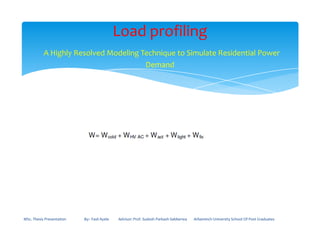
∗ The model selected for this work is “A Highly Resolved
Modeling Technique to Simulate Residential Power
Demand” this model is selected because the inputs to the
model can be made available with statistical load survey
studies than the above models which use synthesized
constants from prior studies.
MSc. Thesis Presentation By:- Fasil Ayele Advisor: Prof. Sudesh Parkash Sabberwa Arbaminch University School Of Post Graduates
Load profiling
A Highly Resolved Modeling Technique to Simulate Residential Power
Demand
MSc. Thesis Presentation By:- Fasil Ayele Advisor: Prof. Sudesh Parkash Sabberwa Arbaminch University School Of Post Graduates
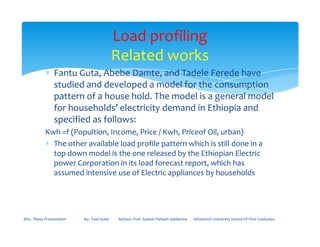
∗ Fantu Guta, Abebe Damte, and Tadele Ferede have
studied and developed a model for the consumption
pattern of a house hold. The model is a general model
for households’ electricity demand in Ethiopia and
specified as follows:
Load profiling
Related works
specified as follows:
Kwh =f (Popultion, Income, Price / Kwh, Priceof Oil, urban)
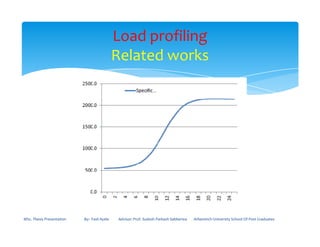
∗ The other available load profile pattern which is still done in a
top down model is the one released by the Ethiopian Electric
power Corporation in its load forecast report, which has
assumed intensive use of Electric appliances by households
MSc. Thesis Presentation By:- Fasil Ayele Advisor: Prof. Sudesh Parkash Sabberwa Arbaminch University School Of Post Graduates
Load profiling
Related works
MSc. Thesis Presentation By:- Fasil Ayele Advisor: Prof. Sudesh Parkash Sabberwa Arbaminch University School Of Post Graduates
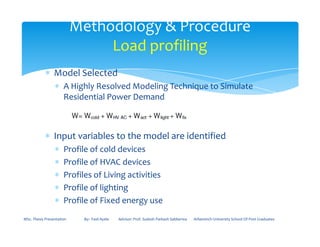
∗ Model Selected
∗ A Highly Resolved Modeling Technique to Simulate
Residential Power Demand
Methodology & Procedure
Load profiling
∗ Input variables to the model are identified
∗ Profile of cold devices
∗ Profile of HVAC devices
∗ Profiles of Living activities
∗ Profile of lighting
∗ Profile of Fixed energy use
MSc. Thesis Presentation By:- Fasil Ayele Advisor: Prof. Sudesh Parkash Sabberwa Arbaminch University School Of Post Graduates
∗ Data collection is made
∗ Stage one- Building Energy survey
∗ Electrical Appliance ownership data
∗ Average Electrical rating of devices determined
∗ Sample size selection –creative survey systems sample size calculator with
95% confidence level and 15% confidence Interval
∗ Sample size =40
∗ Questionnaire Used
Methodology & Procedure
Load profiling
∗ Questionnaire Used
∗ Stage two- Activity pattern Survey
∗ Activities which are identified to represent the electrical Energy
consumption of the residents
∗ Cooking
∗ Enjera Baking
∗ Automatic washing
∗ Leisure
∗ Sample selection
∗ Size 9 households (3 of Each category)
∗ Questionnaire used
MSc. Thesis Presentation By:- Fasil Ayele Advisor: Prof. Sudesh Parkash Sabberwa Arbaminch University School Of Post Graduates
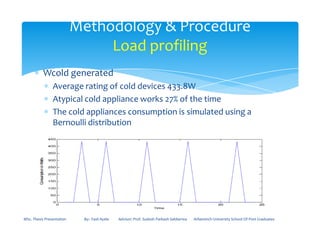
∗ Wcold generated
∗ Average rating of cold devices 433.8W
∗ Atypical cold appliance works 27% of the time
∗ The cold appliances consumption is simulated using a
Bernoulli distribution
Methodology & Procedure
Load profiling
Bernoulli distribution
MSc. Thesis Presentation By:- Fasil Ayele Advisor: Prof. Sudesh Parkash Sabberwa Arbaminch University School Of Post Graduates
∗ WHVAC generated=0
Methodology & Procedure
Load profiling
∗ W generated=0
MSc. Thesis Presentation By:- Fasil Ayele Advisor: Prof. Sudesh Parkash Sabberwa Arbaminch University School Of Post Graduates
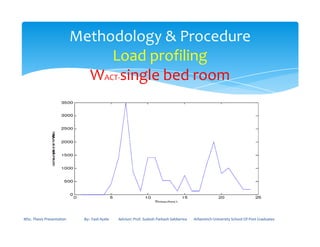
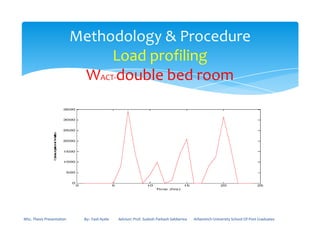
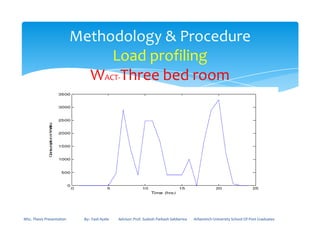
∗ Wact generated
∗ activity pattern for each household member is generated
from the activity pattern of a household collected from the
site and then this pattern is converted into Wact by using
power conversion factors associated with each activity. In
this work a least-squares linear regression model is used to
Methodology & Procedure
Load profiling
this work a least-squares linear regression model is used to
estimate these parameters. The coefficients are coined to
fit a measured pattern
∗ Cooking-1225 W
∗ Enjera Baking-1200W
∗ Automatic washing-3825W
∗ Leisure-200W
MSc. Thesis Presentation By:- Fasil Ayele Advisor: Prof. Sudesh Parkash Sabberwa Arbaminch University School Of Post Graduates
Methodology & Procedure
Load profiling
WACT-single bed room
MSc. Thesis Presentation By:- Fasil Ayele Advisor: Prof. Sudesh Parkash Sabberwa Arbaminch University School Of Post Graduates
Methodology & Procedure
Load profiling
WACT-double bed room
MSc. Thesis Presentation By:- Fasil Ayele Advisor: Prof. Sudesh Parkash Sabberwa Arbaminch University School Of Post Graduates
Methodology & Procedure
Load profiling
WACT-Three bed room
MSc. Thesis Presentation By:- Fasil Ayele Advisor: Prof. Sudesh Parkash Sabberwa Arbaminch University School Of Post Graduates
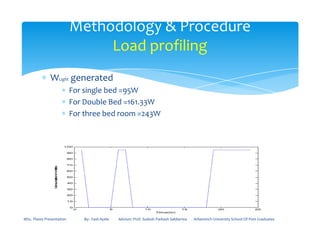
∗ WLight generated
∗ For single bed =95W
∗ For Double Bed =161.33W
∗ For three bed room =243W
Methodology & Procedure
Load profiling
MSc. Thesis Presentation By:- Fasil Ayele Advisor: Prof. Sudesh Parkash Sabberwa Arbaminch University School Of Post Graduates
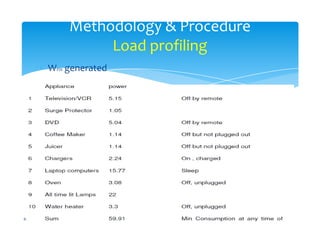
∗ WFIX generated
Methodology & Procedure
Load profiling
MSc. Thesis Presentation By:- Fasil Ayele Advisor: Prof. Sudesh Parkash Sabberwa Arbaminch University School Of Post Graduates
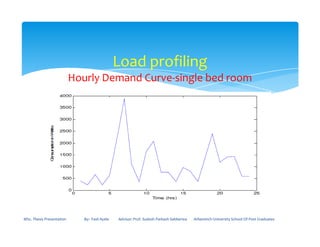
Load profiling
Hourly Demand Curve-single bed room
MSc. Thesis Presentation By:- Fasil Ayele Advisor: Prof. Sudesh Parkash Sabberwa Arbaminch University School Of Post Graduates
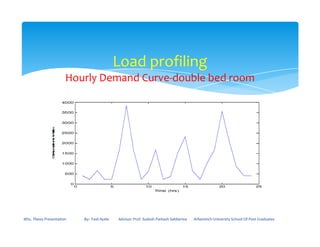
Load profiling
Hourly Demand Curve-double bed room
MSc. Thesis Presentation By:- Fasil Ayele Advisor: Prof. Sudesh Parkash Sabberwa Arbaminch University School Of Post Graduates
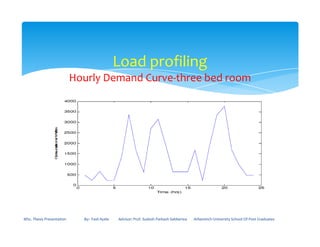
Load profiling
Hourly Demand Curve-three bed room
MSc. Thesis Presentation By:- Fasil Ayele Advisor: Prof. Sudesh Parkash Sabberwa Arbaminch University School Of Post Graduates
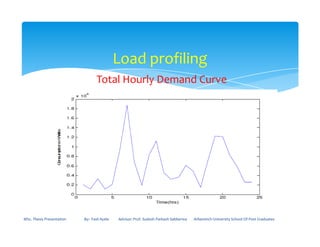
Load profiling
Total Hourly Demand Curve
MSc. Thesis Presentation By:- Fasil Ayele Advisor: Prof. Sudesh Parkash Sabberwa Arbaminch University School Of Post Graduates
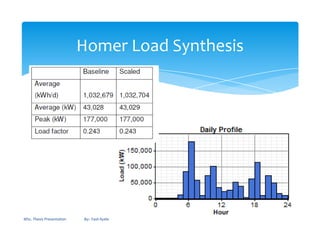
Homer Load Synthesis
MSc. Thesis Presentation By:- Fasil Ayele Advisor: Prof. Sudesh Parkash Sabberwa Arbaminch University School Of Post Graduates
∗ Literature Review
∗ Methodology and procedure
∗ Energy potential
Renewable Resource Study
MSc. Thesis Presentation By:- Fasil Ayele Advisor: Prof. Sudesh Parkash Sabberwa Arbaminch University School Of Post Graduates
∗ Literature Review
∗ Methodology and procedure
∗ Energy potential
Resource Study
Biomass
MSc. Thesis Presentation By:- Fasil Ayele Advisor: Prof. Sudesh Parkash Sabberwa Arbaminch University School Of Post Graduates
∗ Local Biomass Resource-waste
∗ Manucipal solid waste
∗ Human waste
∗ Waste in Addis Ababa-Related works
∗ The contribution to the total generation of waste by
Resource Study
Biomass
Literature Review
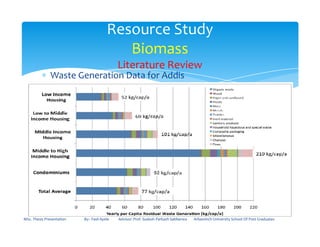
∗ The contribution to the total generation of waste by
the different sources is estimated to be
∗ 76% for households,
∗ 18% for commercial, institutional and industrial sources,
and
∗ 6% from streets and public areas.
∗ With 80%collection potential of municipality 550t/day
of MSW is collected in Addis
MSc. Thesis Presentation By:- Fasil Ayele Advisor: Prof. Sudesh Parkash Sabberwa Arbaminch University School Of Post Graduates
∗ Waste Generation Data for Addis
Resource Study
Biomass
Literature Review
MSc. Thesis Presentation By:- Fasil Ayele Advisor: Prof. Sudesh Parkash Sabberwa Arbaminch University School Of Post Graduates
∗ Statistical survey is carried out for Semit condominium block
sector 290-296
∗ The waste collecting Association collects the waste twice a
week every Tuesday and Thursday. We have sorted and
measured the waste collected from the condominium six
blocks for a month or eight times in June and July.
Resource Study
Biomass
Biomass Statistical survey
blocks for a month or eight times in June and July.
∗ The six blocks have two types of buildings. The first is the one
with 30 homes while the second type has 20 homes. Each
type has three buildings among the six. And the site hosts 150
peoples according to our survey door to door. Age difference
and sex are not given special attention in the survey. Every
member of the family is counted despite age and sex as an
identical element
MSc. Thesis Presentation By:- Fasil Ayele Advisor: Prof. Sudesh Parkash Sabberwa Arbaminch University School Of Post Graduates
Resource Study
Biomass
Biomass Statistical survey
MSc. Thesis Presentation By:- Fasil Ayele Advisor: Prof. Sudesh Parkash Sabberwa Arbaminch University School Of Post Graduates
Resource Study
Biomass
Biomass Statistical survey
Vegetable
Paper
Rubber/
Plastic
Wood
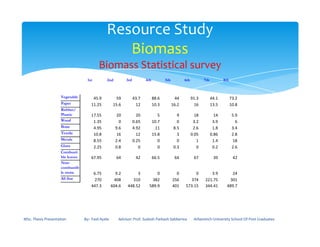
45.9 59 43.7 88.6 44 91.3 44.1 73.2
11.25 15.6 12 10.3 16.2 16 13.5 10.8
17.55 20 20 5 9 18 14 5.9
1.35 0 0.65 10.7 0 3.2 3.9 6
1st 2nd 3rd 4th 5th 6th 7th 8th
MSc. Thesis Presentation By:- Fasil Ayele Advisor: Prof. Sudesh Parkash Sabberwa Arbaminch University School Of Post Graduates
Bone
Textile
Metals
Glass
Combusti
ble leaves
Non-
combustib
le stone
All fine
1.35 0 0.65 10.7 0 3.2 3.9 6
4.95 9.6 4.92 11 8.5 2.6 1.8 3.4
10.8 16 12 15.8 3 0.05 0.86 2.8
8.55 2.4 0.25 0 0 1 1.4 18
2.25 0.8 0 0 0.3 0 0.2 2.6
67.95 64 42 66.5 64 67 39 42
6.75 9.2 3 0 0 0 3.9 24
270 408 310 382 256 374 221.75 301
447.3 604.6 448.52 589.9 401 573.15 344.41 489.7
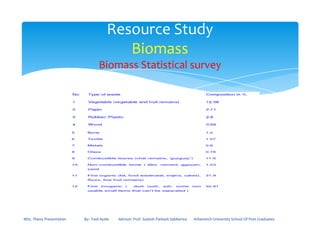
∗ The per capita solid waste generation is according to
this survey is 0.217kg/cap/day. We have selected this
value to calculate the solid waste generation potential
of the project site Koye Feche. This per capita waste
generation is taken because it’s found to be in the range
Resource Study
Biomass
Biomass Statistical survey
generation is taken because it’s found to be in the range
of prior studies which is in the range 0.17-
0.24kg/cap/day.
∗ Therefore the site is going to generate a daily total solid
waste of 200,000cap * 0.217kg/cap/day =43,400kg/day
=43.4 ton/day.
MSc. Thesis Presentation By:- Fasil Ayele Advisor: Prof. Sudesh Parkash Sabberwa Arbaminch University School Of Post Graduates
∗ In this research we did not take any data to understand
the per capita generation of human waste. This is
because culturally it’s unacceptable for the society to
participate in such a study. Therefore we believe the
data can from literature can be extended to estimate
Resource Study
Biomass
Human waste
data can from literature can be extended to estimate
the human waste generation of the site under research.
∗ healthy man generates a human waste equivalent to
0.35kg/cap/day. Therefore the Koye Feche site has a
potential of generating human waste equivalent to
70,000kg/day=70tons/day
MSc. Thesis Presentation By:- Fasil Ayele Advisor: Prof. Sudesh Parkash Sabberwa Arbaminch University School Of Post Graduates
∗ In order to understand the variability associated with
PV potential, a number of simulation tools have been
created.
∗ Some of these specifically complement the solar
Resource Study
Rooftop PV
Literature Review
∗ Some of these specifically complement the solar
energy GIS models, others use interpolated solar
radiation surface datasets
∗ The GIS model is the best model available to calculate
the net usable area of the roof top and uses elevation
data for calculating abstractions tools with respective
models that can be mentioned for reference are
ArcGIS, r.SUN . But these models need DEM which
needs remote sensing data
MSc. Thesis Presentation By:- Fasil Ayele Advisor: Prof. Sudesh Parkash Sabberwa Arbaminch University School Of Post Graduates
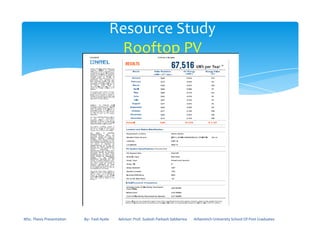
∗ The best available tool that can be used here is PVWatts
which used surface solar dataset collected at ground
station in the Bole airport in 10Km range from the site of
study.
∗ NREL's PVWatts® Calculator is a web application
Resource Study
Rooftop PV
Literature Review
∗ NREL's PVWatts® Calculator is a web application
developed by the National Renewable Energy Laboratory
(NREL) that estimates the electricity production of a grid-
connected roof- or ground-mounted photovoltaic system
based on a few simple inputs. To use the calculator, you
provide information about the system's location, basic
design parameters, and system economics. PVWatts®
calculates estimated values for the system's annual and
monthly electricity production, and for the monetary value
of the electricity.
MSc. Thesis Presentation By:- Fasil Ayele Advisor: Prof. Sudesh Parkash Sabberwa Arbaminch University School Of Post Graduates
Resource Study
Rooftop PV
MSc. Thesis Presentation By:- Fasil Ayele Advisor: Prof. Sudesh Parkash Sabberwa Arbaminch University School Of Post Graduates
∗ We know the housing development project has 425
G+7 buildings which imply that we have a net roof top
area available for mounting the PV panels equal to
404,285.5m2.
Resource Study
Rooftop PV
404,285.5m2.
∗ Sattelite analysis of PVWatts area calculator tool
revealed that given different shapes of G+4 buildings
their Average area is calculated to be 341m2. There
are 671 G+4 buildings on the site. Therefore we have a
net usable area of 228811 m2. Total roof top area
measured in a horizontal projection is therefore
found to be 633,096 m2.
MSc. Thesis Presentation By:- Fasil Ayele Advisor: Prof. Sudesh Parkash Sabberwa Arbaminch University School Of Post Graduates
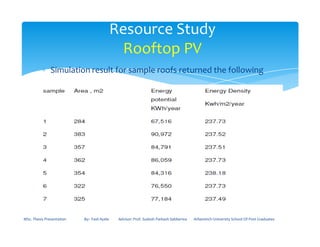
∗ Simulation result for sample roofs returned the following
Resource Study
Rooftop PV
MSc. Thesis Presentation By:- Fasil Ayele Advisor: Prof. Sudesh Parkash Sabberwa Arbaminch University School Of Post Graduates
∗ Therefore, the Potential Energy that can be
generated installing a PV system in the site of study
can be calculated on average Values of the sample
simulation using PVWatts.
Resource Study
Rooftop PV
simulation using PVWatts.
∗ The total PV Energy potential thus is
Total PV Energy = Net roof top area * average energy
density =633096m2*237.7
KWh/m2/year=15,048,6919.2KWh/year
∗ The average value of the per day Energy potential of
the area is 483,488.85 KWh/day
MSc. Thesis Presentation By:- Fasil Ayele Advisor: Prof. Sudesh Parkash Sabberwa Arbaminch University School Of Post Graduates
∗ Biomass Plant
∗ PV plant
Design & Model
MSc. Thesis Presentation By:- Fasil Ayele Advisor: Prof. Sudesh Parkash Sabberwa Arbaminch University School Of Post Graduates
∗ Design Basis
∗ The load profile studied above is constant throughout week days and
months of the year.
∗ The average load which is considered as base load is to be supplied
by biomass plant.
∗ The PV system is designed to meet the extra load which we
considered as peak load here.
Design And model
considered as peak load here.
∗ We cannot implement highly expensive storage system so the system
designed considers grid connection.
∗ The PV facility will be installed on the rooftops of the residential
buildings.
∗ Considering the consumption record of the biomass fueled power
plants the local resource may fall far below the requirement. Other
biomass supply chains will be available as an alternative.
MSc. Thesis Presentation By:- Fasil Ayele Advisor: Prof. Sudesh Parkash Sabberwa Arbaminch University School Of Post Graduates
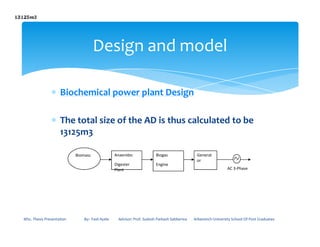
∗ Biochemical power plant Design
∗ The total size of the AD is thus calculated to be
Design and model
∗ The total size of the AD is thus calculated to be
13125m3
MSc. Thesis Presentation By:- Fasil Ayele Advisor: Prof. Sudesh Parkash Sabberwa Arbaminch University School Of Post Graduates
Biomass Anaerobic
Digester
Plant
Biogas
Engine
Generat
or
AC 3-Phase
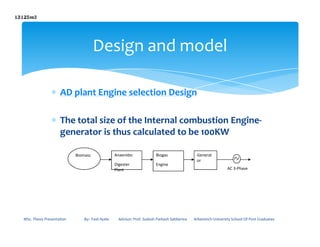
∗ AD plant Engine selection Design
∗ The total size of the Internal combustion Engine-
Design and model
∗ The total size of the Internal combustion Engine-
generator is thus calculated to be 100KW
MSc. Thesis Presentation By:- Fasil Ayele Advisor: Prof. Sudesh Parkash Sabberwa Arbaminch University School Of Post Graduates
Biomass Anaerobic
Digester
Plant
Biogas
Engine
Generat
or
AC 3-Phase
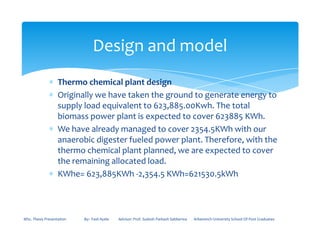
∗ Thermo chemical plant design
∗ Originally we have taken the ground to generate energy to
supply load equivalent to 623,885.00Kwh. The total
biomass power plant is expected to cover 623885 KWh.
∗ We have already managed to cover 2354.5KWh with our
Design and model
∗ We have already managed to cover 2354.5KWh with our
anaerobic digester fueled power plant. Therefore, with the
thermo chemical plant planned, we are expected to cover
the remaining allocated load.
∗ KWhe= 623,885KWh -2,354.5 KWh=621530.5kWh
MSc. Thesis Presentation By:- Fasil Ayele Advisor: Prof. Sudesh Parkash Sabberwa Arbaminch University School Of Post Graduates
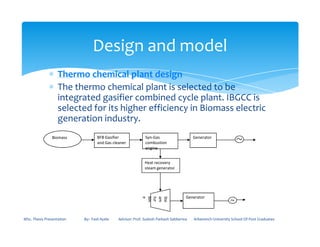
∗ Thermo chemical plant design
∗ The thermo chemical plant is selected to be
integrated gasifier combined cycle plant. IBGCC is
selected for its higher efficiency in Biomass electric
generation industry.
Design and model
generation industry.
MSc. Thesis Presentation By:- Fasil Ayele Advisor: Prof. Sudesh Parkash Sabberwa Arbaminch University School Of Post Graduates
Heat recovery
steam generator
Ste
am
tur
bin
e
Generator
Biomass BFB Gasifier
and Gas cleaner
Syn-Gas
combustion
engine
Generator
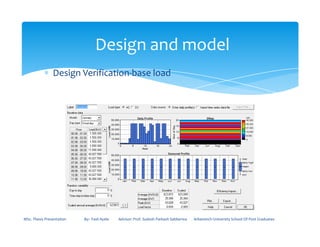
∗ Design Verification-base load
Design and model
MSc. Thesis Presentation By:- Fasil Ayele Advisor: Prof. Sudesh Parkash Sabberwa Arbaminch University School Of Post Graduates
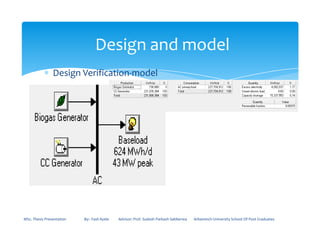
∗ Design Verification-model
Design and model
MSc. Thesis Presentation By:- Fasil Ayele Advisor: Prof. Sudesh Parkash Sabberwa Arbaminch University School Of Post Graduates
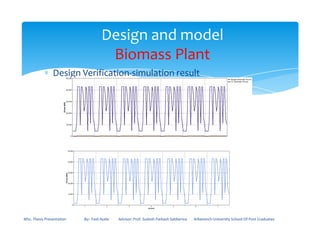
∗ Design Verification-simulation result
Design and model
Biomass Plant
MSc. Thesis Presentation By:- Fasil Ayele Advisor: Prof. Sudesh Parkash Sabberwa Arbaminch University School Of Post Graduates
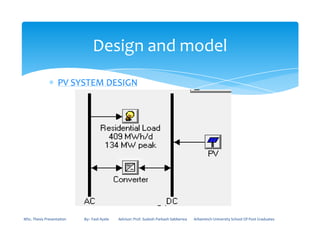
∗ PV SYSTEM DESIGN
Design and model
MSc. Thesis Presentation By:- Fasil Ayele Advisor: Prof. Sudesh Parkash Sabberwa Arbaminch University School Of Post Graduates
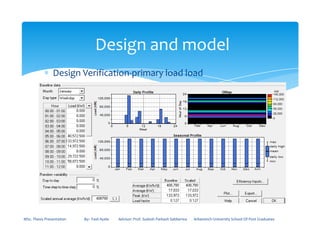
∗ Design Verification-primary load load
Design and model
MSc. Thesis Presentation By:- Fasil Ayele Advisor: Prof. Sudesh Parkash Sabberwa Arbaminch University School Of Post Graduates
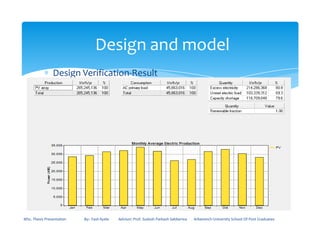
∗ Design Verification-Result
Design and model
MSc. Thesis Presentation By:- Fasil Ayele Advisor: Prof. Sudesh Parkash Sabberwa Arbaminch University School Of Post Graduates
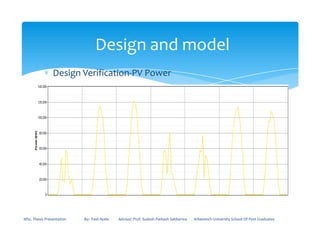
∗ Design Verification-PV Power
Design and model
MSc. Thesis Presentation By:- Fasil Ayele Advisor: Prof. Sudesh Parkash Sabberwa Arbaminch University School Of Post Graduates
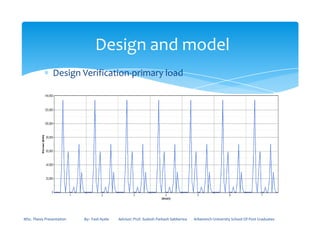
∗ Design Verification-primary load
Design and model
MSc. Thesis Presentation By:- Fasil Ayele Advisor: Prof. Sudesh Parkash Sabberwa Arbaminch University School Of Post Graduates
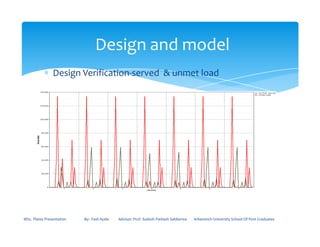
∗ Design Verification-served & unmet load
Design and model
MSc. Thesis Presentation By:- Fasil Ayele Advisor: Prof. Sudesh Parkash Sabberwa Arbaminch University School Of Post Graduates
∗ Design Discussion
∗ Stand alone design with out storage will leave 69% of the
load unsupported.
∗ We have 81% of the PV power wasted
∗ What if Storage is included?
Design and model
∗ What if PPA exists which buys what ever is produced and
available for sale and sells whenever is needed?
MSc. Thesis Presentation By:- Fasil Ayele Advisor: Prof. Sudesh Parkash Sabberwa Arbaminch University School Of Post Graduates
∗ Grid connected model
Design and model
MSc. Thesis Presentation By:- Fasil Ayele Advisor: Prof. Sudesh Parkash Sabberwa Arbaminch University School Of Post Graduates
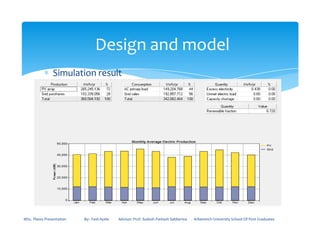
∗ Simulation result
Design and model
MSc. Thesis Presentation By:- Fasil Ayele Advisor: Prof. Sudesh Parkash Sabberwa Arbaminch University School Of Post Graduates
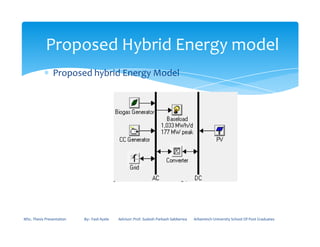
∗ Proposed hybrid Energy Model
Proposed Hybrid Energy model
MSc. Thesis Presentation By:- Fasil Ayele Advisor: Prof. Sudesh Parkash Sabberwa Arbaminch University School Of Post Graduates
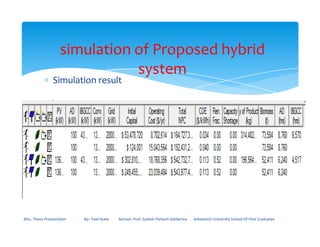
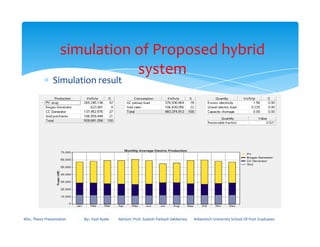
∗ Simulation result
simulation of Proposed hybrid
system
MSc. Thesis Presentation By:- Fasil Ayele Advisor: Prof. Sudesh Parkash Sabberwa Arbaminch University School Of Post Graduates
∗ Simulation result
simulation of Proposed hybrid
system
MSc. Thesis Presentation By:- Fasil Ayele Advisor: Prof. Sudesh Parkash Sabberwa Arbaminch University School Of Post Graduates
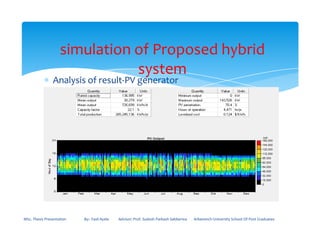
∗ Analysis of result-PV generator
simulation of Proposed hybrid
system
MSc. Thesis Presentation By:- Fasil Ayele Advisor: Prof. Sudesh Parkash Sabberwa Arbaminch University School Of Post Graduates
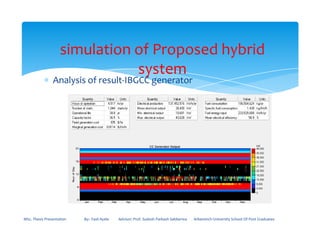
∗ Analysis of result-IBGCC generator
simulation of Proposed hybrid
system
MSc. Thesis Presentation By:- Fasil Ayele Advisor: Prof. Sudesh Parkash Sabberwa Arbaminch University School Of Post Graduates
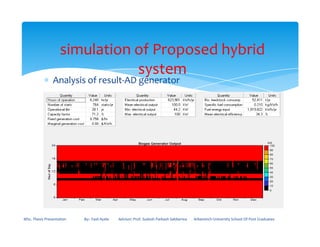
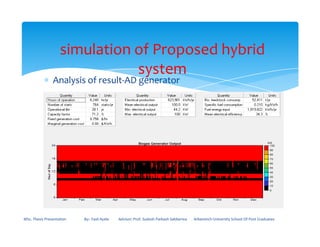
∗ Analysis of result-AD generator
simulation of Proposed hybrid
system
MSc. Thesis Presentation By:- Fasil Ayele Advisor: Prof. Sudesh Parkash Sabberwa Arbaminch University School Of Post Graduates
∗ Analysis of result-AD generator
simulation of Proposed hybrid
system
MSc. Thesis Presentation By:- Fasil Ayele Advisor: Prof. Sudesh Parkash Sabberwa Arbaminch University School Of Post Graduates
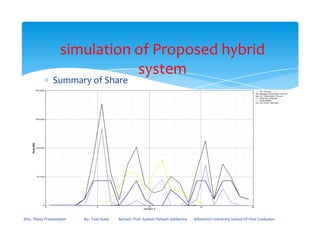
∗ Summary of Share
simulation of Proposed hybrid
system
MSc. Thesis Presentation By:- Fasil Ayele Advisor: Prof. Sudesh Parkash Sabberwa Arbaminch University School Of Post Graduates
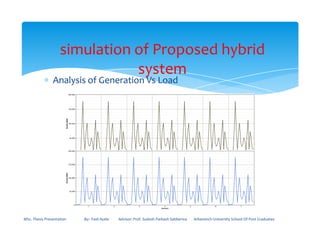
∗ Analysis of Generation Vs Load
simulation of Proposed hybrid
system
MSc. Thesis Presentation By:- Fasil Ayele Advisor: Prof. Sudesh Parkash Sabberwa Arbaminch University School Of Post Graduates
∗ The MSW needed per day for the IBCC plant is
538.53tons/day. The locally generated MSW from the
developed site is 43.4tons/day. The total collectable SMW
in Addis is 550ton/day therefore a supply chain from the
nearby cities like Nazret, Debrezeit and collection of wood
Discussion of resource
nearby cities like Nazret, Debrezeit and collection of wood
and paper factories by product is required.
∗ The total Rooftop area calculated in the design is
641903.67m2. The PVwatts estimated available area is
633096m2. We can include rooftops of common purpose
buildings to fill the Gap. Therefore the PV plant can be
erected without a problem
MSc. Thesis Presentation By:- Fasil Ayele Advisor: Prof. Sudesh Parkash Sabberwa Arbaminch University School Of Post Graduates
Conclusion
•It is all proved that using storage less system it is not feasible to supply
the load demand with a standalone system. But it is shown that a grid-
connected Biomass-PV hybrid system with zero net energy purchase from
the grid can be developed
•The resource, the solar radiation and the area of the roof tops is found to
be sufficient for supporting the PV installation but the MSW generated
locally (on the development site) falls very short of what is needed.
MSc. Thesis Presentation By:- Fasil Ayele Advisor: Prof. Sudesh Parkash Sabberwa Arbaminch University School Of Post Graduates
locally (on the development site) falls very short of what is needed.
Therefore Biomass supply chains are necessary.
•The Energy cost of the modeled hybrid system is 0.113USD which is
actually in the international acceptable range. But cost of energy
compared to the energy sale rate of Ethiopian electric Utility shows 182 %
increase.
•Finally, it can be concluded that Hybrid renewable energy systems could
be planned and developed and can solve the problems regarding
powering the housing development projects the country is engaged with.
∗ Rooftop LiDar data study could provide better estimate of the
rooftops available for solar installations and better Photovoltaic
energy generation potential calculations could be made.
∗ A laboratory heating value measurements should be made for the
components of the wastes so that the energy potential can be well
calculated.
Recommendation
∗ A long term load study will provide us better understanding of
variation in the load profile.
∗ A study of energy efficiency practices that can be adopted to the
residents, either in terms of the habit of equipment use, the practice of
energy utilization or pattern of use is believed to cut the demand and
the feedstock to a significant amount.
MSc. Thesis Presentation By:- Fasil Ayele Advisor: Prof. Sudesh Parkash Sabberwa Arbaminch University School Of Post Graduates
∗ References
∗ Thank you for sharing me the words, the figures, the
knowledge
References
knowledge
MSc. Thesis Presentation By:- Fasil Ayele Advisor: Prof. Sudesh Parkash Sabberwa Arbaminch University School Of Post Graduates
Questions?
Suggestions?Suggestions?
MSc. Thesis Presentation By:- Fasil Ayele Advisor: Prof. Sudesh Parkash Sabberwa Arbaminch University School Of Post Graduates
I Thank you
MSc. Thesis Presentation By:- Fasil Ayele Advisor: Prof. Sudesh Parkash Sabberwa Arbaminch University School Of Post Graduates

Thesis on Hybrid renewable energy system for condo developments

  • 1.
    ARBAMICH UNIVERSITY SCHOOL OFPOST GRADUATE STUDIES Thesis Presentation On Design, Modeling and Analysis of Hybrid Biomass- Photovoltaic system for Condominium Developments A case study of Koye Feche condominium site On By:- Fasil Ayele Advisor: Prof. Sudesh Parkash Sabberwa
  • 2.
    ∗ To theprofessors and AMU community ∗ To my Advisor ∗ My Friends ∗ My wife Acknowledgement ∗ My wife ∗ My parents ∗ Residents of Semit condominium who took part in the work ∗ Semit waste collection micro enterprise (Abu, yade and Adinew) MSc. Thesis Presentation By:- Fasil Ayele Advisor: Prof. Sudesh Parkash Sabberwa Arbaminch University School Of Post Graduates
  • 3.
    1. Introduction 2. Loadprofile 3. Renewable Resources 4. Design & Model 5. Simulation and Results Presentation outline 5. Simulation and Results 6. Conclusion 7. Recommendation 8. References MSc. Thesis Presentation By:- Fasil Ayele Advisor: Prof. Sudesh Parkash Sabberwa Arbaminch University School Of Post Graduates
  • 4.
    ∗ Motivation ∗ Aimof work ∗ Scope of study ∗ Case study site Introduction ∗ Case study site ∗ Significance of the study MSc. Thesis Presentation By:- Fasil Ayele Advisor: Prof. Sudesh Parkash Sabberwa Arbaminch University School Of Post Graduates
  • 5.
    ∗ Supplying Electricityto condominium developments is a big challenge to the Government ∗ Bringing new culture of distributed generation to the Ethiopian Power Industry ∗ Diversifying Hydro dominated power sector Motivation ∗ Diversifying Hydro dominated power sector ∗ Making most out of our resources MSc. Thesis Presentation By:- Fasil Ayele Advisor: Prof. Sudesh Parkash Sabberwa Arbaminch University School Of Post Graduates
  • 6.
    ∗ Develop aload profile for condominium developments ∗ Study available resources and their potential energy capacity Aim of work capacity ∗ Design, model and analyze possible Biomass-PV hybrid system for condominium developments ∗ Indicate available alternative to the problem MSc. Thesis Presentation By:- Fasil Ayele Advisor: Prof. Sudesh Parkash Sabberwa Arbaminch University School Of Post Graduates
  • 7.
    ∗ Statistical studyof the load profile from populated condominium developments ∗ Statistical study of the waste generation ∗ Rooftop PV generation potential simulation using PVWatts Scope of study PVWatts ∗ Simulate the optimum model using Homer MSc. Thesis Presentation By:- Fasil Ayele Advisor: Prof. Sudesh Parkash Sabberwa Arbaminch University School Of Post Graduates
  • 8.
    ∗ The sitewe study under this Research is called Koye Feche Case Study Site MSc. Thesis Presentation By:- Fasil Ayele Advisor: Prof. Sudesh Parkash Sabberwa Arbaminch University School Of Post Graduates
  • 9.
    ∗ when finalizedis expected to host 200,000 peoples ∗ The koye Feche site will have 425 G+7 buildings and 671 G+4 which sum up to be a total of 1096 buildings hosting 50,000 houses. All G+7 buildings will have 64 Case Study Site hosting 50,000 houses. All G+7 buildings will have 64 houses and G+4from 35 to 40 houses. MSc. Thesis Presentation By:- Fasil Ayele Advisor: Prof. Sudesh Parkash Sabberwa Arbaminch University School Of Post Graduates
  • 10.
    ∗ It isthe biggest site and is expected to host around 200000 peoples whose demand for electric power will be a real challenge ∗ It is construction is being started and necessary changes in the construction can be made to implement the suggested Case Study Site Why Koye Feche? the construction can be made to implement the suggested project ∗ It is a big load and can attract the interest of power producing investors ∗ The site has enough land in the surrounding for efficient biomass bi-producing businesses MSc. Thesis Presentation By:- Fasil Ayele Advisor: Prof. Sudesh Parkash Sabberwa Arbaminch University School Of Post Graduates
  • 11.
    Case Study Site MSc.Thesis Presentation By:- Fasil Ayele Advisor: Prof. Sudesh Parkash Sabberwa Arbaminch University School Of Post Graduates
  • 12.
    ∗ Indicate analternative (help) ∗ Attract power producing Investors Significance of the study MSc. Thesis Presentation By:- Fasil Ayele Advisor: Prof. Sudesh Parkash Sabberwa Arbaminch University School Of Post Graduates
  • 13.
    ∗ Literature Review ∗Methodology and procedure ∗ Load Profile curves Load Profile MSc. Thesis Presentation By:- Fasil Ayele Advisor: Prof. Sudesh Parkash Sabberwa Arbaminch University School Of Post Graduates
  • 14.
    ∗ There aretwo general categories of techniques available to model residential load demand: ∗ top-down ∗ use estimates of total residential sector energy consumption, together with other pertinent macro variables, to attribute energy consumption to characteristics of the housing sector ∗ bottom up models Load profiling ∗ bottom up models ∗ identify the contribution of each end-use towards the aggregate energy consumption of the residential sector ∗ Standard vs real load profile ∗ Because of a more realistic result with bottom up approaches, load profiling in this work make use of same MSc. Thesis Presentation By:- Fasil Ayele Advisor: Prof. Sudesh Parkash Sabberwa Arbaminch University School Of Post Graduates
  • 15.
    ∗ models calculatethe energy consumption of an individual or group of households and extrapolate the results to a region or nation ∗ aggregate result is generally accomplished by using a weight for each modeled house or group of houses based on its representation of the sector Load profiling Bottom up Approach on its representation of the sector ∗ Do not rely on historical Data ∗ Common input data to bottom-up models include dwelling characteristics (e.g., size and layout, building materials, and appliances’ characteristics), weather conditions, household occupant behavior and related use of appliances, lighting use, and characteristics of heating, ventilation, and air conditioning (HVAC) systems. MSc. Thesis Presentation By:- Fasil Ayele Advisor: Prof. Sudesh Parkash Sabberwa Arbaminch University School Of Post Graduates
  • 16.
    ∗ Bottom upmodels ∗ In 1994 Capasso et al. propose a model forevaluating the impact of demand side management on residential customers ∗ Monte Carlo method is used to capture the relationship between residential demand and the psychological and behavioral factors typical of the household occupants ∗ Richardson et al. introduce a Markov-chain technique to generate synthetic active occupancy patterns, based upon Load profiling Bottom up Approach ∗ Richardson et al. introduce a Markov-chain technique to generate synthetic active occupancy patterns, based upon survey data of people’s time-use in the United Kingdom. ∗ The model selected for this work is “A Highly Resolved Modeling Technique to Simulate Residential Power Demand” this model is selected because the inputs to the model can be made available with statistical load survey studies than the above models which use synthesized constants from prior studies. MSc. Thesis Presentation By:- Fasil Ayele Advisor: Prof. Sudesh Parkash Sabberwa Arbaminch University School Of Post Graduates
  • 17.
    Load profiling A HighlyResolved Modeling Technique to Simulate Residential Power Demand MSc. Thesis Presentation By:- Fasil Ayele Advisor: Prof. Sudesh Parkash Sabberwa Arbaminch University School Of Post Graduates
  • 18.
    ∗ Fantu Guta,Abebe Damte, and Tadele Ferede have studied and developed a model for the consumption pattern of a house hold. The model is a general model for households’ electricity demand in Ethiopia and specified as follows: Load profiling Related works specified as follows: Kwh =f (Popultion, Income, Price / Kwh, Priceof Oil, urban) ∗ The other available load profile pattern which is still done in a top down model is the one released by the Ethiopian Electric power Corporation in its load forecast report, which has assumed intensive use of Electric appliances by households MSc. Thesis Presentation By:- Fasil Ayele Advisor: Prof. Sudesh Parkash Sabberwa Arbaminch University School Of Post Graduates
  • 19.
    Load profiling Related works MSc.Thesis Presentation By:- Fasil Ayele Advisor: Prof. Sudesh Parkash Sabberwa Arbaminch University School Of Post Graduates
  • 20.
    ∗ Model Selected ∗A Highly Resolved Modeling Technique to Simulate Residential Power Demand Methodology & Procedure Load profiling ∗ Input variables to the model are identified ∗ Profile of cold devices ∗ Profile of HVAC devices ∗ Profiles of Living activities ∗ Profile of lighting ∗ Profile of Fixed energy use MSc. Thesis Presentation By:- Fasil Ayele Advisor: Prof. Sudesh Parkash Sabberwa Arbaminch University School Of Post Graduates
  • 21.
    ∗ Data collectionis made ∗ Stage one- Building Energy survey ∗ Electrical Appliance ownership data ∗ Average Electrical rating of devices determined ∗ Sample size selection –creative survey systems sample size calculator with 95% confidence level and 15% confidence Interval ∗ Sample size =40 ∗ Questionnaire Used Methodology & Procedure Load profiling ∗ Questionnaire Used ∗ Stage two- Activity pattern Survey ∗ Activities which are identified to represent the electrical Energy consumption of the residents ∗ Cooking ∗ Enjera Baking ∗ Automatic washing ∗ Leisure ∗ Sample selection ∗ Size 9 households (3 of Each category) ∗ Questionnaire used MSc. Thesis Presentation By:- Fasil Ayele Advisor: Prof. Sudesh Parkash Sabberwa Arbaminch University School Of Post Graduates
  • 22.
    ∗ Wcold generated ∗Average rating of cold devices 433.8W ∗ Atypical cold appliance works 27% of the time ∗ The cold appliances consumption is simulated using a Bernoulli distribution Methodology & Procedure Load profiling Bernoulli distribution MSc. Thesis Presentation By:- Fasil Ayele Advisor: Prof. Sudesh Parkash Sabberwa Arbaminch University School Of Post Graduates
  • 23.
    ∗ WHVAC generated=0 Methodology& Procedure Load profiling ∗ W generated=0 MSc. Thesis Presentation By:- Fasil Ayele Advisor: Prof. Sudesh Parkash Sabberwa Arbaminch University School Of Post Graduates
  • 24.
    ∗ Wact generated ∗activity pattern for each household member is generated from the activity pattern of a household collected from the site and then this pattern is converted into Wact by using power conversion factors associated with each activity. In this work a least-squares linear regression model is used to Methodology & Procedure Load profiling this work a least-squares linear regression model is used to estimate these parameters. The coefficients are coined to fit a measured pattern ∗ Cooking-1225 W ∗ Enjera Baking-1200W ∗ Automatic washing-3825W ∗ Leisure-200W MSc. Thesis Presentation By:- Fasil Ayele Advisor: Prof. Sudesh Parkash Sabberwa Arbaminch University School Of Post Graduates
  • 25.
    Methodology & Procedure Loadprofiling WACT-single bed room MSc. Thesis Presentation By:- Fasil Ayele Advisor: Prof. Sudesh Parkash Sabberwa Arbaminch University School Of Post Graduates
  • 26.
    Methodology & Procedure Loadprofiling WACT-double bed room MSc. Thesis Presentation By:- Fasil Ayele Advisor: Prof. Sudesh Parkash Sabberwa Arbaminch University School Of Post Graduates
  • 27.
    Methodology & Procedure Loadprofiling WACT-Three bed room MSc. Thesis Presentation By:- Fasil Ayele Advisor: Prof. Sudesh Parkash Sabberwa Arbaminch University School Of Post Graduates
  • 28.
    ∗ WLight generated ∗For single bed =95W ∗ For Double Bed =161.33W ∗ For three bed room =243W Methodology & Procedure Load profiling MSc. Thesis Presentation By:- Fasil Ayele Advisor: Prof. Sudesh Parkash Sabberwa Arbaminch University School Of Post Graduates
  • 29.
    ∗ WFIX generated Methodology& Procedure Load profiling MSc. Thesis Presentation By:- Fasil Ayele Advisor: Prof. Sudesh Parkash Sabberwa Arbaminch University School Of Post Graduates
  • 30.
    Load profiling Hourly DemandCurve-single bed room MSc. Thesis Presentation By:- Fasil Ayele Advisor: Prof. Sudesh Parkash Sabberwa Arbaminch University School Of Post Graduates
  • 31.
    Load profiling Hourly DemandCurve-double bed room MSc. Thesis Presentation By:- Fasil Ayele Advisor: Prof. Sudesh Parkash Sabberwa Arbaminch University School Of Post Graduates
  • 32.
    Load profiling Hourly DemandCurve-three bed room MSc. Thesis Presentation By:- Fasil Ayele Advisor: Prof. Sudesh Parkash Sabberwa Arbaminch University School Of Post Graduates
  • 33.
    Load profiling Total HourlyDemand Curve MSc. Thesis Presentation By:- Fasil Ayele Advisor: Prof. Sudesh Parkash Sabberwa Arbaminch University School Of Post Graduates
  • 34.
    Homer Load Synthesis MSc.Thesis Presentation By:- Fasil Ayele Advisor: Prof. Sudesh Parkash Sabberwa Arbaminch University School Of Post Graduates
  • 35.
    ∗ Literature Review ∗Methodology and procedure ∗ Energy potential Renewable Resource Study MSc. Thesis Presentation By:- Fasil Ayele Advisor: Prof. Sudesh Parkash Sabberwa Arbaminch University School Of Post Graduates
  • 36.
    ∗ Literature Review ∗Methodology and procedure ∗ Energy potential Resource Study Biomass MSc. Thesis Presentation By:- Fasil Ayele Advisor: Prof. Sudesh Parkash Sabberwa Arbaminch University School Of Post Graduates
  • 37.
    ∗ Local BiomassResource-waste ∗ Manucipal solid waste ∗ Human waste ∗ Waste in Addis Ababa-Related works ∗ The contribution to the total generation of waste by Resource Study Biomass Literature Review ∗ The contribution to the total generation of waste by the different sources is estimated to be ∗ 76% for households, ∗ 18% for commercial, institutional and industrial sources, and ∗ 6% from streets and public areas. ∗ With 80%collection potential of municipality 550t/day of MSW is collected in Addis MSc. Thesis Presentation By:- Fasil Ayele Advisor: Prof. Sudesh Parkash Sabberwa Arbaminch University School Of Post Graduates
  • 38.
    ∗ Waste GenerationData for Addis Resource Study Biomass Literature Review MSc. Thesis Presentation By:- Fasil Ayele Advisor: Prof. Sudesh Parkash Sabberwa Arbaminch University School Of Post Graduates
  • 39.
    ∗ Statistical surveyis carried out for Semit condominium block sector 290-296 ∗ The waste collecting Association collects the waste twice a week every Tuesday and Thursday. We have sorted and measured the waste collected from the condominium six blocks for a month or eight times in June and July. Resource Study Biomass Biomass Statistical survey blocks for a month or eight times in June and July. ∗ The six blocks have two types of buildings. The first is the one with 30 homes while the second type has 20 homes. Each type has three buildings among the six. And the site hosts 150 peoples according to our survey door to door. Age difference and sex are not given special attention in the survey. Every member of the family is counted despite age and sex as an identical element MSc. Thesis Presentation By:- Fasil Ayele Advisor: Prof. Sudesh Parkash Sabberwa Arbaminch University School Of Post Graduates
  • 40.
    Resource Study Biomass Biomass Statisticalsurvey MSc. Thesis Presentation By:- Fasil Ayele Advisor: Prof. Sudesh Parkash Sabberwa Arbaminch University School Of Post Graduates
  • 41.
    Resource Study Biomass Biomass Statisticalsurvey Vegetable Paper Rubber/ Plastic Wood 45.9 59 43.7 88.6 44 91.3 44.1 73.2 11.25 15.6 12 10.3 16.2 16 13.5 10.8 17.55 20 20 5 9 18 14 5.9 1.35 0 0.65 10.7 0 3.2 3.9 6 1st 2nd 3rd 4th 5th 6th 7th 8th MSc. Thesis Presentation By:- Fasil Ayele Advisor: Prof. Sudesh Parkash Sabberwa Arbaminch University School Of Post Graduates Bone Textile Metals Glass Combusti ble leaves Non- combustib le stone All fine 1.35 0 0.65 10.7 0 3.2 3.9 6 4.95 9.6 4.92 11 8.5 2.6 1.8 3.4 10.8 16 12 15.8 3 0.05 0.86 2.8 8.55 2.4 0.25 0 0 1 1.4 18 2.25 0.8 0 0 0.3 0 0.2 2.6 67.95 64 42 66.5 64 67 39 42 6.75 9.2 3 0 0 0 3.9 24 270 408 310 382 256 374 221.75 301 447.3 604.6 448.52 589.9 401 573.15 344.41 489.7
  • 42.
    ∗ The percapita solid waste generation is according to this survey is 0.217kg/cap/day. We have selected this value to calculate the solid waste generation potential of the project site Koye Feche. This per capita waste generation is taken because it’s found to be in the range Resource Study Biomass Biomass Statistical survey generation is taken because it’s found to be in the range of prior studies which is in the range 0.17- 0.24kg/cap/day. ∗ Therefore the site is going to generate a daily total solid waste of 200,000cap * 0.217kg/cap/day =43,400kg/day =43.4 ton/day. MSc. Thesis Presentation By:- Fasil Ayele Advisor: Prof. Sudesh Parkash Sabberwa Arbaminch University School Of Post Graduates
  • 43.
    ∗ In thisresearch we did not take any data to understand the per capita generation of human waste. This is because culturally it’s unacceptable for the society to participate in such a study. Therefore we believe the data can from literature can be extended to estimate Resource Study Biomass Human waste data can from literature can be extended to estimate the human waste generation of the site under research. ∗ healthy man generates a human waste equivalent to 0.35kg/cap/day. Therefore the Koye Feche site has a potential of generating human waste equivalent to 70,000kg/day=70tons/day MSc. Thesis Presentation By:- Fasil Ayele Advisor: Prof. Sudesh Parkash Sabberwa Arbaminch University School Of Post Graduates
  • 44.
    ∗ In orderto understand the variability associated with PV potential, a number of simulation tools have been created. ∗ Some of these specifically complement the solar Resource Study Rooftop PV Literature Review ∗ Some of these specifically complement the solar energy GIS models, others use interpolated solar radiation surface datasets ∗ The GIS model is the best model available to calculate the net usable area of the roof top and uses elevation data for calculating abstractions tools with respective models that can be mentioned for reference are ArcGIS, r.SUN . But these models need DEM which needs remote sensing data MSc. Thesis Presentation By:- Fasil Ayele Advisor: Prof. Sudesh Parkash Sabberwa Arbaminch University School Of Post Graduates
  • 45.
    ∗ The bestavailable tool that can be used here is PVWatts which used surface solar dataset collected at ground station in the Bole airport in 10Km range from the site of study. ∗ NREL's PVWatts® Calculator is a web application Resource Study Rooftop PV Literature Review ∗ NREL's PVWatts® Calculator is a web application developed by the National Renewable Energy Laboratory (NREL) that estimates the electricity production of a grid- connected roof- or ground-mounted photovoltaic system based on a few simple inputs. To use the calculator, you provide information about the system's location, basic design parameters, and system economics. PVWatts® calculates estimated values for the system's annual and monthly electricity production, and for the monetary value of the electricity. MSc. Thesis Presentation By:- Fasil Ayele Advisor: Prof. Sudesh Parkash Sabberwa Arbaminch University School Of Post Graduates
  • 46.
    Resource Study Rooftop PV MSc.Thesis Presentation By:- Fasil Ayele Advisor: Prof. Sudesh Parkash Sabberwa Arbaminch University School Of Post Graduates
  • 47.
    ∗ We knowthe housing development project has 425 G+7 buildings which imply that we have a net roof top area available for mounting the PV panels equal to 404,285.5m2. Resource Study Rooftop PV 404,285.5m2. ∗ Sattelite analysis of PVWatts area calculator tool revealed that given different shapes of G+4 buildings their Average area is calculated to be 341m2. There are 671 G+4 buildings on the site. Therefore we have a net usable area of 228811 m2. Total roof top area measured in a horizontal projection is therefore found to be 633,096 m2. MSc. Thesis Presentation By:- Fasil Ayele Advisor: Prof. Sudesh Parkash Sabberwa Arbaminch University School Of Post Graduates
  • 48.
    ∗ Simulation resultfor sample roofs returned the following Resource Study Rooftop PV MSc. Thesis Presentation By:- Fasil Ayele Advisor: Prof. Sudesh Parkash Sabberwa Arbaminch University School Of Post Graduates
  • 49.
    ∗ Therefore, thePotential Energy that can be generated installing a PV system in the site of study can be calculated on average Values of the sample simulation using PVWatts. Resource Study Rooftop PV simulation using PVWatts. ∗ The total PV Energy potential thus is Total PV Energy = Net roof top area * average energy density =633096m2*237.7 KWh/m2/year=15,048,6919.2KWh/year ∗ The average value of the per day Energy potential of the area is 483,488.85 KWh/day MSc. Thesis Presentation By:- Fasil Ayele Advisor: Prof. Sudesh Parkash Sabberwa Arbaminch University School Of Post Graduates
  • 50.
    ∗ Biomass Plant ∗PV plant Design & Model MSc. Thesis Presentation By:- Fasil Ayele Advisor: Prof. Sudesh Parkash Sabberwa Arbaminch University School Of Post Graduates
  • 51.
    ∗ Design Basis ∗The load profile studied above is constant throughout week days and months of the year. ∗ The average load which is considered as base load is to be supplied by biomass plant. ∗ The PV system is designed to meet the extra load which we considered as peak load here. Design And model considered as peak load here. ∗ We cannot implement highly expensive storage system so the system designed considers grid connection. ∗ The PV facility will be installed on the rooftops of the residential buildings. ∗ Considering the consumption record of the biomass fueled power plants the local resource may fall far below the requirement. Other biomass supply chains will be available as an alternative. MSc. Thesis Presentation By:- Fasil Ayele Advisor: Prof. Sudesh Parkash Sabberwa Arbaminch University School Of Post Graduates
  • 52.
    ∗ Biochemical powerplant Design ∗ The total size of the AD is thus calculated to be Design and model ∗ The total size of the AD is thus calculated to be 13125m3 MSc. Thesis Presentation By:- Fasil Ayele Advisor: Prof. Sudesh Parkash Sabberwa Arbaminch University School Of Post Graduates Biomass Anaerobic Digester Plant Biogas Engine Generat or AC 3-Phase
  • 53.
    ∗ AD plantEngine selection Design ∗ The total size of the Internal combustion Engine- Design and model ∗ The total size of the Internal combustion Engine- generator is thus calculated to be 100KW MSc. Thesis Presentation By:- Fasil Ayele Advisor: Prof. Sudesh Parkash Sabberwa Arbaminch University School Of Post Graduates Biomass Anaerobic Digester Plant Biogas Engine Generat or AC 3-Phase
  • 54.
    ∗ Thermo chemicalplant design ∗ Originally we have taken the ground to generate energy to supply load equivalent to 623,885.00Kwh. The total biomass power plant is expected to cover 623885 KWh. ∗ We have already managed to cover 2354.5KWh with our Design and model ∗ We have already managed to cover 2354.5KWh with our anaerobic digester fueled power plant. Therefore, with the thermo chemical plant planned, we are expected to cover the remaining allocated load. ∗ KWhe= 623,885KWh -2,354.5 KWh=621530.5kWh MSc. Thesis Presentation By:- Fasil Ayele Advisor: Prof. Sudesh Parkash Sabberwa Arbaminch University School Of Post Graduates
  • 55.
    ∗ Thermo chemicalplant design ∗ The thermo chemical plant is selected to be integrated gasifier combined cycle plant. IBGCC is selected for its higher efficiency in Biomass electric generation industry. Design and model generation industry. MSc. Thesis Presentation By:- Fasil Ayele Advisor: Prof. Sudesh Parkash Sabberwa Arbaminch University School Of Post Graduates Heat recovery steam generator Ste am tur bin e Generator Biomass BFB Gasifier and Gas cleaner Syn-Gas combustion engine Generator
  • 56.
    ∗ Design Verification-baseload Design and model MSc. Thesis Presentation By:- Fasil Ayele Advisor: Prof. Sudesh Parkash Sabberwa Arbaminch University School Of Post Graduates
  • 57.
    ∗ Design Verification-model Designand model MSc. Thesis Presentation By:- Fasil Ayele Advisor: Prof. Sudesh Parkash Sabberwa Arbaminch University School Of Post Graduates
  • 58.
    ∗ Design Verification-simulationresult Design and model Biomass Plant MSc. Thesis Presentation By:- Fasil Ayele Advisor: Prof. Sudesh Parkash Sabberwa Arbaminch University School Of Post Graduates
  • 59.
    ∗ PV SYSTEMDESIGN Design and model MSc. Thesis Presentation By:- Fasil Ayele Advisor: Prof. Sudesh Parkash Sabberwa Arbaminch University School Of Post Graduates
  • 60.
    ∗ Design Verification-primaryload load Design and model MSc. Thesis Presentation By:- Fasil Ayele Advisor: Prof. Sudesh Parkash Sabberwa Arbaminch University School Of Post Graduates
  • 61.
    ∗ Design Verification-Result Designand model MSc. Thesis Presentation By:- Fasil Ayele Advisor: Prof. Sudesh Parkash Sabberwa Arbaminch University School Of Post Graduates
  • 62.
    ∗ Design Verification-PVPower Design and model MSc. Thesis Presentation By:- Fasil Ayele Advisor: Prof. Sudesh Parkash Sabberwa Arbaminch University School Of Post Graduates
  • 63.
    ∗ Design Verification-primaryload Design and model MSc. Thesis Presentation By:- Fasil Ayele Advisor: Prof. Sudesh Parkash Sabberwa Arbaminch University School Of Post Graduates
  • 64.
    ∗ Design Verification-served& unmet load Design and model MSc. Thesis Presentation By:- Fasil Ayele Advisor: Prof. Sudesh Parkash Sabberwa Arbaminch University School Of Post Graduates
  • 65.
    ∗ Design Discussion ∗Stand alone design with out storage will leave 69% of the load unsupported. ∗ We have 81% of the PV power wasted ∗ What if Storage is included? Design and model ∗ What if PPA exists which buys what ever is produced and available for sale and sells whenever is needed? MSc. Thesis Presentation By:- Fasil Ayele Advisor: Prof. Sudesh Parkash Sabberwa Arbaminch University School Of Post Graduates
  • 66.
    ∗ Grid connectedmodel Design and model MSc. Thesis Presentation By:- Fasil Ayele Advisor: Prof. Sudesh Parkash Sabberwa Arbaminch University School Of Post Graduates
  • 67.
    ∗ Simulation result Designand model MSc. Thesis Presentation By:- Fasil Ayele Advisor: Prof. Sudesh Parkash Sabberwa Arbaminch University School Of Post Graduates
  • 68.
    ∗ Proposed hybridEnergy Model Proposed Hybrid Energy model MSc. Thesis Presentation By:- Fasil Ayele Advisor: Prof. Sudesh Parkash Sabberwa Arbaminch University School Of Post Graduates
  • 69.
    ∗ Simulation result simulationof Proposed hybrid system MSc. Thesis Presentation By:- Fasil Ayele Advisor: Prof. Sudesh Parkash Sabberwa Arbaminch University School Of Post Graduates
  • 70.
    ∗ Simulation result simulationof Proposed hybrid system MSc. Thesis Presentation By:- Fasil Ayele Advisor: Prof. Sudesh Parkash Sabberwa Arbaminch University School Of Post Graduates
  • 71.
    ∗ Analysis ofresult-PV generator simulation of Proposed hybrid system MSc. Thesis Presentation By:- Fasil Ayele Advisor: Prof. Sudesh Parkash Sabberwa Arbaminch University School Of Post Graduates
  • 72.
    ∗ Analysis ofresult-IBGCC generator simulation of Proposed hybrid system MSc. Thesis Presentation By:- Fasil Ayele Advisor: Prof. Sudesh Parkash Sabberwa Arbaminch University School Of Post Graduates
  • 73.
    ∗ Analysis ofresult-AD generator simulation of Proposed hybrid system MSc. Thesis Presentation By:- Fasil Ayele Advisor: Prof. Sudesh Parkash Sabberwa Arbaminch University School Of Post Graduates
  • 74.
    ∗ Analysis ofresult-AD generator simulation of Proposed hybrid system MSc. Thesis Presentation By:- Fasil Ayele Advisor: Prof. Sudesh Parkash Sabberwa Arbaminch University School Of Post Graduates
  • 75.
    ∗ Summary ofShare simulation of Proposed hybrid system MSc. Thesis Presentation By:- Fasil Ayele Advisor: Prof. Sudesh Parkash Sabberwa Arbaminch University School Of Post Graduates
  • 76.
    ∗ Analysis ofGeneration Vs Load simulation of Proposed hybrid system MSc. Thesis Presentation By:- Fasil Ayele Advisor: Prof. Sudesh Parkash Sabberwa Arbaminch University School Of Post Graduates
  • 77.
    ∗ The MSWneeded per day for the IBCC plant is 538.53tons/day. The locally generated MSW from the developed site is 43.4tons/day. The total collectable SMW in Addis is 550ton/day therefore a supply chain from the nearby cities like Nazret, Debrezeit and collection of wood Discussion of resource nearby cities like Nazret, Debrezeit and collection of wood and paper factories by product is required. ∗ The total Rooftop area calculated in the design is 641903.67m2. The PVwatts estimated available area is 633096m2. We can include rooftops of common purpose buildings to fill the Gap. Therefore the PV plant can be erected without a problem MSc. Thesis Presentation By:- Fasil Ayele Advisor: Prof. Sudesh Parkash Sabberwa Arbaminch University School Of Post Graduates
  • 78.
    Conclusion •It is allproved that using storage less system it is not feasible to supply the load demand with a standalone system. But it is shown that a grid- connected Biomass-PV hybrid system with zero net energy purchase from the grid can be developed •The resource, the solar radiation and the area of the roof tops is found to be sufficient for supporting the PV installation but the MSW generated locally (on the development site) falls very short of what is needed. MSc. Thesis Presentation By:- Fasil Ayele Advisor: Prof. Sudesh Parkash Sabberwa Arbaminch University School Of Post Graduates locally (on the development site) falls very short of what is needed. Therefore Biomass supply chains are necessary. •The Energy cost of the modeled hybrid system is 0.113USD which is actually in the international acceptable range. But cost of energy compared to the energy sale rate of Ethiopian electric Utility shows 182 % increase. •Finally, it can be concluded that Hybrid renewable energy systems could be planned and developed and can solve the problems regarding powering the housing development projects the country is engaged with.
  • 79.
    ∗ Rooftop LiDardata study could provide better estimate of the rooftops available for solar installations and better Photovoltaic energy generation potential calculations could be made. ∗ A laboratory heating value measurements should be made for the components of the wastes so that the energy potential can be well calculated. Recommendation ∗ A long term load study will provide us better understanding of variation in the load profile. ∗ A study of energy efficiency practices that can be adopted to the residents, either in terms of the habit of equipment use, the practice of energy utilization or pattern of use is believed to cut the demand and the feedstock to a significant amount. MSc. Thesis Presentation By:- Fasil Ayele Advisor: Prof. Sudesh Parkash Sabberwa Arbaminch University School Of Post Graduates
  • 80.
    ∗ References ∗ Thankyou for sharing me the words, the figures, the knowledge References knowledge MSc. Thesis Presentation By:- Fasil Ayele Advisor: Prof. Sudesh Parkash Sabberwa Arbaminch University School Of Post Graduates
  • 81.
    Questions? Suggestions?Suggestions? MSc. Thesis PresentationBy:- Fasil Ayele Advisor: Prof. Sudesh Parkash Sabberwa Arbaminch University School Of Post Graduates
  • 82.
    I Thank you MSc.Thesis Presentation By:- Fasil Ayele Advisor: Prof. Sudesh Parkash Sabberwa Arbaminch University School Of Post Graduates