CELAL BAYAR UNIVERSITY
MECHANICAL ENGINEERING
Turgut Selman TÜMER
120304073
Assignment topic : Thermoelectric Cooler
INTRODUCTION
Thermoelectric refrigerator sometimes called a thermoelectric cooler module or Peltier
cooler is a semi conductor based electric component that functions as a small heat pump. By
applying a low voltage direct current (DC) power source to a thermoelectric cooler module,
heat will be moved through the module from one side to the other. One module face,
therefore, will be cooled while the opposite face simultaneously is heated. Both thermoelectric
refrigerators and mechanical refrigerators are governed by the same fundamental laws of
thermodynamics and both refrigeration systems; although considerably different in form,
function in accordance with the same principles. In a mechanical refrigeration unit, a
compressor raises the pressure of a refrigerant and circulates the refrigerant through the
system. In the refrigerated chamber, the refrigerant boils and in the process of changing to a
vapor, the refrigerant absorbs heat causing the chamber to become cold. The heat absorbed in
the chamber is moved to the condenser where it is transferred to the environment from the
condensing refrigerant. In a thermoelectric cooling system, a doped semi-conductor material
essentially takes the place of the refrigerant, the condenser is replaced by a finned heat sink,
and the compressor is replaced by a Direct Current (DC) power source. The application of Direct
Current (DC) power to the thermoelectric cooler modules causes electrons to move through the
semi-conductor material. At the cold end of the semi-conductor material, heat is absorbed by
the electron movement, moved through the material, and expelled at the hot end. Since the
hot end of the material is physically attached to a heat sink, the heat is passed from the
material to the heat sink and then in turn, transferred to the environment.
The physical principles upon which modern thermoelectric coolers are based actually
date back to the early 1800‟s, although commercial thermoelectric cooler modules were not
available until almost 1960. The first important discovery relating to thermoelectricity occurred
in 1821 when a German Scientist, Thomas Seebeck, found that an electric current would flow
continuously in a closed circuit made up of two dissimilar metals maintained at two different
temperatures. Seebeck did not actually comprehend the scientific basis for his discovery,
however, and falsely assumed that flowing heat produced the same effect as flowing electric
current. In 1834, a French watchmaker and part time physicist, Jean Peltier, while investigating
the “Seebeck Effect”, found that there was an opposite phenomenon whereby thermal energy
could be absorbed at one dissimilar metal junction and discharged at the other junction when
an electric current flowed within the closed circuit. Twenty years later, William Thomson later
Lord Kelvin issued a compressible explanation of the Seebeck and Peltier effects and described
their interrelationship. At the time however, these phenomenon were still considered to be
more laboratory curiosities and were without practical application. In the 1930‟s, Russian
scientists began studying some of the earlier thermoelectric work in an effort to construct
power generators for use at remote locations throughout the country. This Russian interest in
thermoelectricity eventually caught the attention of the rest of the world and inspired the
development of practical thermoelectric modules. Today‟s thermoelectric refrigerators make
use of modern semi-conductor technology whereby doped semi-conductor material takes the
place of dissimilar metals used in early thermoelectric experiments. [Ref.1]
In 1821, Thomas Seebeck discovered that a continuously flowing current is created when two
wires of different materials are joined together and heated at one end.This idea is known as the
Seebeck Effect. The Seebeck effect has two main applications including temperature
measurement and power generation. Thirteen years later Jean Charles Athanase reversed the
flow of electrons in Seebeck.s circuit to create refrigeration. This effect is known as the Peltier
Effect. This idea forms the basis for the Thermoelectric refrigerator.Scottish scientist
WilliamThomson (later Lord Kelvin) discovered in 1854 that if a temperature difference exists
between any two points of a current carrying conductor, heat is either evolved or absorbed
depending upon the material.6 If such a circuit absorbs heat, thenheat may be evolved if the
direction of the current or of the temperature gradient is reversed[1]. The Peltier effect is a
temperature difference created by applying a voltage between two electrodes connected to a
sample of semiconductor material. This phenomenon can be useful when it is necessary to
transfer heat from one medium to another on a small scale. The Peltier effect is one of three
types of thermoelectric effect; the other two are theSeebeck effect and the Thomson effect. In
a Peltier-effect device, the electrodes are typically made of a metal with excellent electrical
conductivity. The semiconductor material between the electrodes creates two junctions
between dissimilar materials, which, in turn, creates a pair of thermocouple voltage is applied
to the electrodes to force electrical current through the semiconductor, thermal energy flows in
the direction of the charge carriers.[2]. In its simplest form, this may be done with a single
semiconductor 'pellet' which is soldered to electrically-conductive material on each end (usually
plated copper). In this 'stripped-down' configuration, the second dissimilar material required
for the Peltier effect, is actually the copper connection paths to the power supply. It is
important to note that the heat will be moved (or 'pumped') in the direction of charge carrier
flow throughout the circuit— actually, it is the charge carriers that transfer the heat.[3].But in
order to pump appreciable amount of heat, we need to interconnect such semiconductor
electrically and thermally parallel. Moreover it needs costly power supply arrangement to
supply high current requirement for parallel arrangement of semiconductor. So semiconductor
can be arranged electrically in series but thermally parallel which further increases the
possibility of short circuiting and reduces the reliability of system. The best optimized way to
connect the semiconductor is in the form of pn junctions which overcome the above
mentioned problems .[Ref.2]
There are 5 thermoelectric effects and these are observed when a current is passed
through a thermocouple whose junctions are at different temperatures. These phenomenon
are the Seeback effect, the Peltier effect, the Joulean effect, the conduction effect, and the
Thomson effect. Thermoelectric cooling, also called "Peltier Effect", is a solid-state method of
heat transfer through dissimilar semiconductor materials. It is based on the thermoelectric
effect known as ‘Peltier Effect‘ according to which if current is passed through a thermocouple,
then the heat is absorbed at one junction of the thermocouple and liberated at the other
junction. So by using the cold junction of the thermocouple as the evaporator, a heat sink as
the condenser and a DC power source as the compressor of the refrigerator, cooling effect can
be provided.
Theory of Operation
The semiconductor materials are N and P type, and are so named because either they have
more electrons than necessary to complete a perfect molecular lattice structure (N-type) or not
enough electrons to complete a lattice structure (P-type). The extra electrons in the N-type
material and the holes left in the P-type material are called "carriers" and they are the agents
that move the heat energy from the cold to the hot junction.
Heat absorbed at the cold junction is pumped to the hot junction at a rate proportional to
carrier current passing through the circuit and the number of couples. Good thermo-electric
semiconductor materials such as bismuth telluride greatly impede conventional heat
conduction from hot to cold areas, yet provide an easy flow for the carriers. in addition, these
materials have carriers with a capacity for carrying more heat.
SEEBECK EFFECT
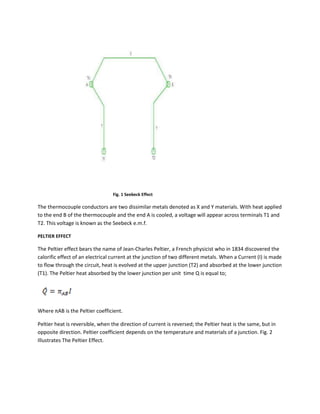
Fig. 1 Seebeck Effect
The thermocouple conductors are two dissimilar metals denoted as X and Y materials. With heat applied
to the end B of the thermocouple and the end A is cooled, a voltage will appear across terminals T1 and
T2. This voltage is known as the Seebeck e.m.f.
PELTIER EFFECT
The Peltier effect bears the name of Jean-Charles Peltier, a French physicist who in 1834 discovered the
calorific effect of an electrical current at the junction of two different metals. When a Current (I) is made
to flow through the circuit, heat is evolved at the upper junction (T2) and absorbed at the lower junction
(T1). The Peltier heat absorbed by the lower junction per unit time Q is equal to;
Where πAB is the Peltier coefficient.
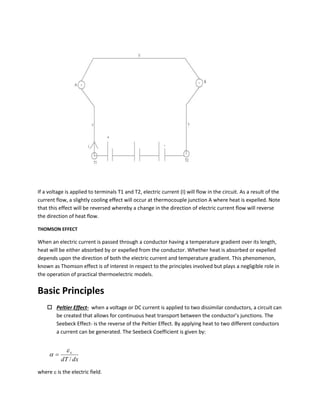
Peltier heat is reversible, when the direction of current is reversed; the Peltier heat is the same, but in
opposite direction. Peltier coefficient depends on the temperature and materials of a junction. Fig. 2
Illustrates The Peltier Effect.
If a voltage is applied to terminals T1 and T2, electric current (I) will flow in the circuit. As a result of the
current flow, a slightly cooling effect will occur at thermocouple junction A where heat is expelled. Note
that this effect will be reversed whereby a change in the direction of electric current flow will reverse
the direction of heat flow.
THOMSON EFFECT
When an electric current is passed through a conductor having a temperature gradient over its length,
heat will be either absorbed by or expelled from the conductor. Whether heat is absorbed or expelled
depends upon the direction of both the electric current and temperature gradient. This phenomenon,
known as Thomson effect is of interest in respect to the principles involved but plays a negligible role in
the operation of practical thermoelectric models.
Basic Principles
 Peltier Effect- when a voltage or DC current is applied to two dissimilar conductors, a circuit can
be created that allows for continuous heat transport between the conductor’s junctions. The
Seebeck Effect- is the reverse of the Peltier Effect. By applying heat to two different conductors
a current can be generated. The Seebeck Coefficient is given by:
where  is the electric field.
dxdT
x
/

 
 The current is transported through charge carriers (opposite the hole flow or with electron
flow).
 Heat transfer occurs in the direction of charge carrier movement.
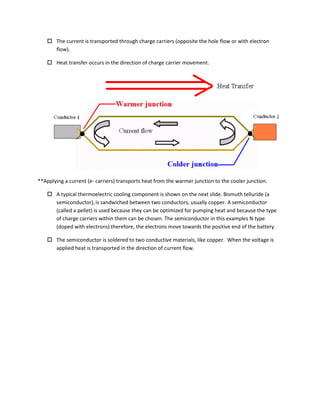
**Applying a current (e- carriers) transports heat from the warmer junction to the cooler junction.
 A typical thermoelectric cooling component is shown on the next slide. Bismuth telluride (a
semiconductor),is sandwiched between two conductors, usually copper. A semiconductor
(called a pellet) is used because they can be optimized for pumping heat and because the type
of charge carriers within them can be chosen. The semiconductor in this examples N type
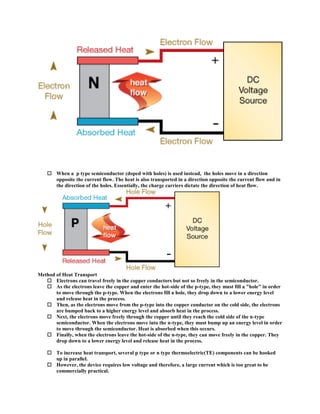
(doped with electrons) therefore, the electrons move towards the positive end of the battery.
 The semiconductor is soldered to two conductive materials, like copper. When the voltage is
applied heat is transported in the direction of current flow.
 When a p type semiconductor (doped with holes) is used instead, the holes move in a direction
opposite the current flow. The heat is also transported in a direction opposite the current flow and in
the direction of the holes. Essentially, the charge carriers dictate the direction of heat flow.
Method of Heat Transport
 Electrons can travel freely in the copper conductors but not so freely in the semiconductor.
 As the electrons leave the copper and enter the hot-side of the p-type, they must fill a "hole" in order
to move through the p-type. When the electrons fill a hole, they drop down to a lower energy level
and release heat in the process.
 Then, as the electrons move from the p-type into the copper conductor on the cold side, the electrons
are bumped back to a higher energy level and absorb heat in the process.
 Next, the electrons move freely through the copper until they reach the cold side of the n-type
semiconductor. When the electrons move into the n-type, they must bump up an energy level in order
to move through the semiconductor. Heat is absorbed when this occurs.
 Finally, when the electrons leave the hot-side of the n-type, they can move freely in the copper. They
drop down to a lower energy level and release heat in the process.
 To increase heat transport, several p type or n type thermoelectric(TE) components can be hooked
up in parallel.
 However, the device requires low voltage and therefore, a large current which is too great to be
commercially practical.
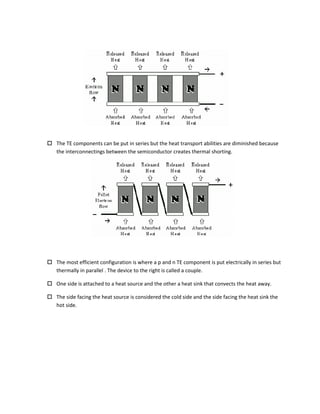
 The TE components can be put in series but the heat transport abilities are diminished because
the interconnectings between the semiconductor creates thermal shorting.
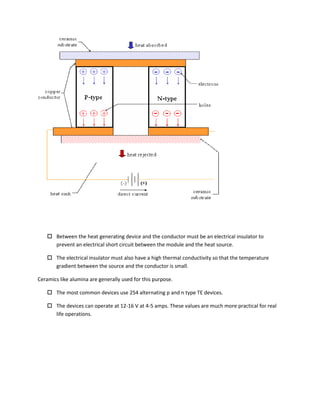
 The most efficient configuration is where a p and n TE component is put electrically in series but
thermally in parallel . The device to the right is called a couple.
 One side is attached to a heat source and the other a heat sink that convects the heat away.
 The side facing the heat source is considered the cold side and the side facing the heat sink the
hot side.
 Between the heat generating device and the conductor must be an electrical insulator to
prevent an electrical short circuit between the module and the heat source.
 The electrical insulator must also have a high thermal conductivity so that the temperature
gradient between the source and the conductor is small.
Ceramics like alumina are generally used for this purpose.
 The most common devices use 254 alternating p and n type TE devices.
 The devices can operate at 12-16 V at 4-5 amps. These values are much more practical for real
life operations.
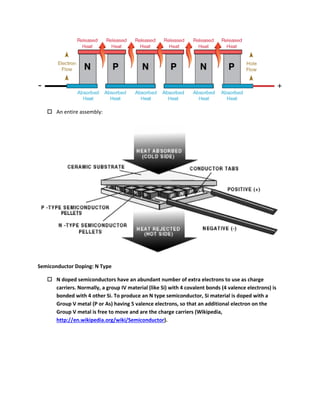
 An entire assembly:
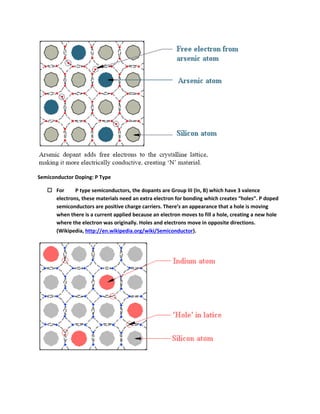
Semiconductor Doping: N Type
 N doped semiconductors have an abundant number of extra electrons to use as charge
carriers. Normally, a group IV material (like Si) with 4 covalent bonds (4 valence electrons) is
bonded with 4 other Si. To produce an N type semiconductor, Si material is doped with a
Group V metal (P or As) having 5 valence electrons, so that an additional electron on the
Group V metal is free to move and are the charge carriers (Wikipedia,
http://en.wikipedia.org/wiki/Semiconductor).
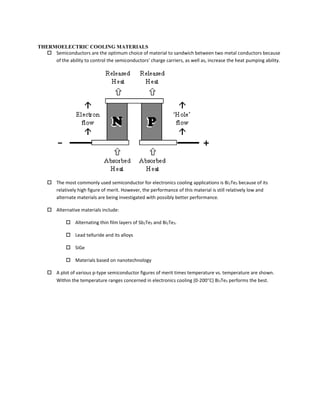
Semiconductor Doping: P Type
 For P type semiconductors, the dopants are Group III (In, B) which have 3 valence
electrons, these materials need an extra electron for bonding which creates “holes”. P doped
semiconductors are positive charge carriers. There’s an appearance that a hole is moving
when there is a current applied because an electron moves to fill a hole, creating a new hole
where the electron was originally. Holes and electrons move in opposite directions.
(Wikipedia, http://en.wikipedia.org/wiki/Semiconductor).
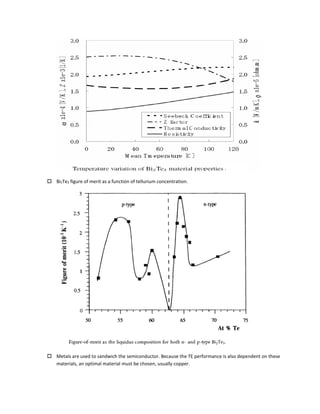
THERMOELECTRIC COOLING MATERIALS
 Semiconductors are the optimum choice of material to sandwich between two metal conductors because
of the ability to control the semiconductors’ charge carriers, as well as, increase the heat pumping ability.
 The most commonly used semiconductor for electronics cooling applications is Bi2Te3 because of its
relatively high figure of merit. However, the performance of this material is still relatively low and
alternate materials are being investigated with possibly better performance.
 Alternative materials include:
 Alternating thin film layers of Sb2Te3 and Bi2Te3.
 Lead telluride and its alloys
 SiGe
 Materials based on nanotechnology
 A plot of various p-type semiconductor figures of merit times temperature vs. temperature are shown.
Within the temperature ranges concerned in electronics cooling (0-200C) Bi2Te3 performs the best.
zT for p-type thermoelectric materials [ref3]
 Similar results are shown for n-type semiconductors
Bi2Te3 Properties
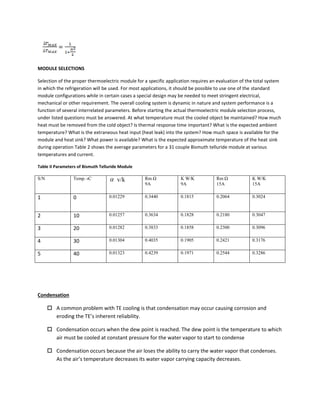
 Below is a plot of the figure of merit (Z), Seebeck coefficient, electrical resistivity, and thermal
conductivity, as a function of temperature for Bi2Te3. Carrier concentration will alter the values below.
 Bi2Te3 figure of merit as a function of tellurium concentration.
 Metals are used to sandwich the semiconductor. Because the TE performance is also dependent on these
materials, an optimal material must be chosen, usually copper.
Although the principle of thermoelectricity dates back to the discovery of the Peltier effect, there was
little practical application of the phenomenon until the middle 1950‟s. Prior to then, the poor thermoelectric
properties of known materials made them unsuitable for use in a practical refrigerating device. According to Nolas
et al [3], from the middle 1950s to the present the major thermoelectric material design approach was that
introduced by A.V. Ioffe, leading to semi-conducting compounds such as Bi2Te3, which is currently used in
thermoelectric refrigerators. In recent years there has been increased interest in the application of thermoelectric
to electronic cooling, accompanied by efforts to improve their performance through the development of new bulk
materials and thin film micro coolers [3]. The usefulness of thermoelectric materials for refrigeration is often
characterized by the dimensionless product, ZT, of the thermoelectric figure of merit Z and temperature T. The
expression for the thermoelectric figure of merit is given by:
Where ρ is the electrical resistivity, k is the thermal conductivity, and  is the Seebeck Coefficient.
Note: low electrical resistivity and thermal conductivity are required for high high figure of merit. These
values are temperature dependent therefore, the figure of merit is temperature dependent. P and N
type material have different figures of merit and are averaged to determine a materials overall quality.
Fluerial et al [4] reported that in 1991 JPL started abroad search to identify and develop advanced
materials. Among the materials considered, Skutterudite and Zn4Sb3 based materials appeared
particularly promising and several of these materials are being developed. ZT values equal to or greater
than one have been obtained for these materials over different ranges of temperature varying from 375
to 975K. However, to be particularly useful for electronic cooling applications, improvements in ZT are
needed over the temperature range of 300 to 325K or below. Another strategy for enhancing ZT being
pursued by researchers at MIT, Harvard and UCLA focuses on reduced dimensionality as occurs in
quantum wells (2D) or quantum wires.
Table I Figure of Merit for Different Materials
Material Figure of merit
Pb – Te 1.2 x 10⁻³
Pb – Se 1.2 x 10⁻³
k
Z



Pb2 – Te3 1.2 x 10⁻³
Bi2 – Te3 1.3 x 10⁻³
(BiSb)2 – Te3 3.3 x 10⁻³
THERMOELECTRIC REFRIGERATORS COMPENENTS
The thermoelectric refrigerator consists of the following components:
A. The Thermoelectric Module
The thermoelectric module consists of pairs of P-type and N-type semi-conductor thermo element forming
thermocouple which are connected electrically in series and thermally in parallel. The modules are considered to
be highly reliable components due to their solid state construction. For most application they will provide long,
trouble free service. In cooling application, an electrical current is supplied to the module, heat is pumped from
one side to the other, and the result is that one side of the module becomes cold and the other side hot.
B. Heat Sink
The heat sink usually made of aluminum, is in contact with the hot side of a thermoelectric module. When the
positive and negative module leads are connected to the respective positive and negative terminals of a Direct
Current (D.C) power source, heat will be rejected by the module‟s hot side, the heat sink expedites the removal of
heat. Heat sink typically is intermediates stages in the heat removal process whereby heat flows into a heat sink
and then is transferred to an external medium. Common heat sinks include free convection, forced convection and
fluid cooled, depending on the size of the refrigerator.
C. Cold Side
The cold side also made of aluminum is in contact with the cold side of a thermoelectric module, when the positive
and negative module leads are connected to the respective positive and negative terminals of a direct current
(D.C) power source, heat will be absorbed by the module‟s cold side. The hot side of a thermoelectric module is
normally placed in contact with the object being cold.
D. Spacer Block
The spacer block though optional in water chillers is used to ensure sufficient air gap between the heat sink and
the object being cooled.
E. Power Source
Thermoelectric module is a Direct Current (D.C) device. Specified thermoelectric module performance is valid if a
Direct Current (D.C) power supply is used. Actual D.C power supply has a rippled output. This D. C. component is
detrimental [7]. Degradation of thermoelectric module performance due to the ripple can be approximated by:
MODULE SELECTIONS
Selection of the proper thermoelectric module for a specific application requires an evaluation of the total system
in which the refrigeration will be used. For most applications, it should be possible to use one of the standard
module configurations while in certain cases a special design may be needed to meet stringent electrical,
mechanical or other requirement. The overall cooling system is dynamic in nature and system performance is a
function of several interrelated parameters. Before starting the actual thermoelectric module selection process,
under listed questions must be answered. At what temperature must the cooled object be maintained? How much
heat must be removed from the cold object? Is thermal response time important? What is the expected ambient
temperature? What is the extraneous heat input (heat leak) into the system? How much space is available for the
module and heat sink? What power is available? What is the expected approximate temperature of the heat sink
during operation Table 2 shows the average parameters for a 31 couple Bismuth telluride module at various
temperatures and current.
Table II Parameters of Bismuth Telluride Module
S/N Temp. 0C  v/k Rm Ω
9A
K W/K
9A
Rm Ω
15A
K W/K
15A
1 0 0.01229 0.3440 0.1815 0.2064 0.3024
2 10 0.01257 0.3634 0.1828 0.2180 0.3047
3 20 0.01282 0.3833 0.1858 0.2300 0.3096
4 30 0.01304 0.4035 0.1905 0.2421 0.3176
5 40 0.01323 0.4239 0.1971 0.2544 0.3286
Condensation
 A common problem with TE cooling is that condensation may occur causing corrosion and
eroding the TE’s inherent reliability.
 Condensation occurs when the dew point is reached. The dew point is the temperature to which
air must be cooled at constant pressure for the water vapor to start to condense
 Condensation occurs because the air loses the ability to carry the water vapor that condenses.
As the air’s temperature decreases its water vapor carrying capacity decreases.
 Since TE coolers can cool to low and even below ambient temperatures, condensation is a
problem.
 The most common sealant employed is silicon rubber (Nagy, 1997).
 Research has been performed to determine the most effective sealing agent used to protect the
chip from water.
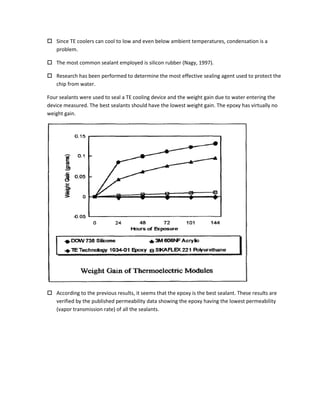
Four sealants were used to seal a TE cooling device and the weight gain due to water entering the
device measured. The best sealants should have the lowest weight gain. The epoxy has virtually no
weight gain.
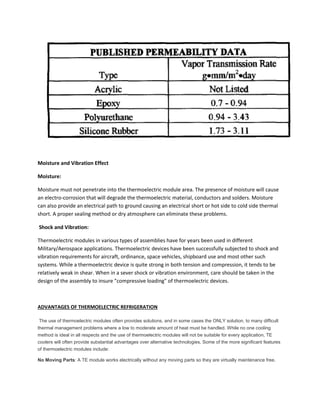
 According to the previous results, it seems that the epoxy is the best sealant. These results are
verified by the published permeability data showing the epoxy having the lowest permeability
(vapor transmission rate) of all the sealants.
Moisture and Vibration Effect
Moisture:
Moisture must not penetrate into the thermoelectric module area. The presence of moisture will cause
an electro-corrosion that will degrade the thermoelectric material, conductors and solders. Moisture
can also provide an electrical path to ground causing an electrical short or hot side to cold side thermal
short. A proper sealing method or dry atmosphere can eliminate these problems.
Shock and Vibration:
Thermoelectric modules in various types of assemblies have for years been used in different
Military/Aerospace applications. Thermoelectric devices have been successfully subjected to shock and
vibration requirements for aircraft, ordinance, space vehicles, shipboard use and most other such
systems. While a thermoelectric device is quite strong in both tension and compression, it tends to be
relatively weak in shear. When in a sever shock or vibration environment, care should be taken in the
design of the assembly to insure "compressive loading" of thermoelectric devices.
ADVANTAGES OF THERMOELECTRIC REFRIGERATION
The use of thermoelectric modules often provides solutions, and in some cases the ONLY solution, to many difficult
thermal management problems where a low to moderate amount of heat must be handled. While no one cooling
method is ideal in all respects and the use of thermoelectric modules will not be suitable for every application, TE
coolers will often provide substantial advantages over alternative technologies. Some of the more significant features
of thermoelectric modules include:
No Moving Parts: A TE module works electrically without any moving parts so they are virtually maintenance free.
Small Size and Weight: The overall thermoelectric cooling system is much smaller and lighter than a comparable
mechanical system. In addition, a variety of standard and special sizes and configurations are available to meet strict
application requirements.
Ability to Cool Below Ambient: Unlike a conventional heat sink whose temperature necessarily must rise above
ambient, a TE cooler attached to that same heat sink has the ability to reduce the temperature below the ambient
value.
Ability to Heat and Cool With the Same module: Thermoelectric coolers will either heat or cool depending upon
the polarity of the applied DC power. This feature eliminates the necessity of providing separate heating and cooling
functions within a given system.
Precise Temperature Control: With an appropriate closed-loop temperature control circuit, TE coolers can control
temperatures to better than +/- 0.1°C.
High Reliability: Thermoelectric modules exhibit very high reliability due to their solid state construction. Although
reliability is somewhat application dependent, the life of typical TE coolers is greater than 200,000 hours.
Electrically "Quiet" Operation: Unlike a mechanical refrigeration system, TE modules generate virtually no
electrical noise and can be used in conjunction with sensitive electronic sensors. They are also acoustically silent.
Operation in any Orientation: TEs can be used in any orientation and in zero gravity environments. Thus they are
popular in many aerospace applications.
Convenient Power Supply: TE modules operate directly from a DC power source. Modules having a wide range of
input voltages and currents are available. Pulse Width Modulation (PWM) may be used in many applications
Spot Cooling: With a TE cooler it is possible to cool one specific component or area only, thereby often making it
unnecessary to cool an entire package or enclosure.
Ability to Generate Electrical Power: When used "in reverse" by applying a temperature differential across the
faces of a TE cooler, it is possible to generate a small amount of DC power.
Environmentally Friendly: Conventional refrigeration systems can not be fabricated without using
chlorofluorocarbons or other chemicals that may be harmful to the environment. Thermoelectric devices do not use or
generate gases of any kind
EASY SERVICE: Most parts are easily replaced by the end-user with a screw driver.
RELIABILITY: Thermoelectrics have a 40 year proven track record in military, aerospace, laboratory, and
now consumer applications.
 Excellent cooling alternative to vapor compression coolers for systems that are sensitive to mechanical
vibration.
 Compact size make them useful for applications where size or weight is a constraint.
.
https://www.ferrotec.com/Technology/Thermoelectric/Thermalref04
ADVANTAGES OF THERMOELECTRIC REFRIGERATION
(i) Efficiency of thermo-electric cooling is less.
(ii) 5–10% efficiency as compared with that of ideal reversed Carnot Cycle
(iii) 40–60% COP as compared to conventional compression refrigeration cycle
(iv) COP is low and further decreases with increase in (Th - Tc)
(v) Suitable only for small capacity units
(vi) Costly because of high cost of semi-conductors.
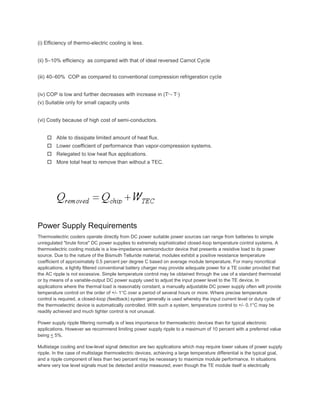
 Able to dissipate limited amount of heat flux.
 Lower coefficient of performance than vapor-compression systems.
 Relegated to low heat flux applications.
 More total heat to remove than without a TEC.
Power Supply Requirements
Thermoelectric coolers operate directly from DC power suitable power sources can range from batteries to simple
unregulated "brute force" DC power supplies to extremely sophisticated closed-loop temperature control systems. A
thermoelectric cooling module is a low-impedance semiconductor device that presents a resistive load to its power
source. Due to the nature of the Bismuth Telluride material, modules exhibit a positive resistance temperature
coefficient of approximately 0.5 percent per degree C based on average module temperature. For many noncritical
applications, a lightly filtered conventional battery charger may provide adequate power for a TE cooler provided that
the AC ripple is not excessive. Simple temperature control may be obtained through the use of a standard thermostat
or by means of a variable-output DC power supply used to adjust the input power level to the TE device. In
applications where the thermal load is reasonably constant, a manually adjustable DC power supply often will provide
temperature control on the order of +/- 1°C over a period of several hours or more. Where precise temperature
control is required, a closed-loop (feedback) system generally is used whereby the input current level or duty cycle of
the thermoelectric device is automatically controlled. With such a system, temperature control to +/- 0.1°C may be
readily achieved and much tighter control is not unusual.
Power supply ripple filtering normally is of less importance for thermoelectric devices than for typical electronic
applications. However we recommend limiting power supply ripple to a maximum of 10 percent with a preferred value
being < 5%.
Multistage cooling and low-level signal detection are two applications which may require lower values of power supply
ripple. In the case of multistage thermoelectric devices, achieving a large temperature differential is the typical goal,
and a ripple component of less than two percent may be necessary to maximize module performance. In situations
where very low level signals must be detected and/or measured, even though the TE module itself is electrically
quiet, the presence of an AC ripple signal within the module and wire leads may be unsatisfactory. The acceptable
level of power supply ripple for such applications will have to be determined on a case-by-case basis.
Thermoelectric Performance
 TE performance depends on the following factors:
 The temperature of the cold and hot sides.
 Thermal and electrical conductivities of the device’s materials.
 Contact resistance between the TE device and heat source/heat sink.
Thermal resistance of the heat sink.
 The current yielding the maximum COP is given by:
 The maximum COP is:
Where Tm= (TH+TC)/2
 The COP corresponding to the maximum heat pumping capacity is:
 The current corresponding to the maximum heat pumping capacity is:
]1)1[(
))((
2/1



m
chnp
ZTR
TT
I


]1)1)[((
]/)1[(
2/1
12
12
2/1
1
max



m
m
in
c
ZTTT
TTZTT
W
Q

cH
cHc
q
TZT
TTZT )(2/1
2


R
T
I
cnp
q
)(  

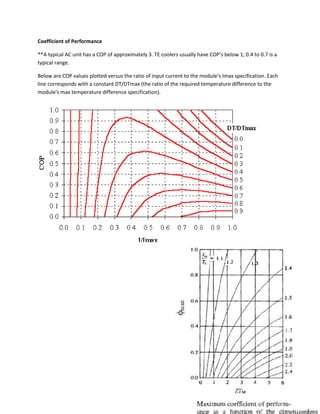
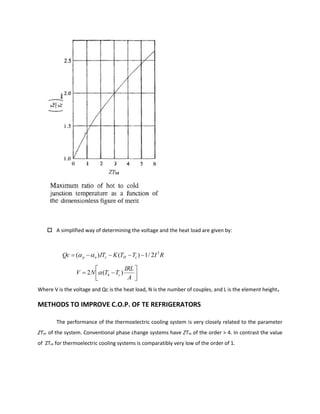
Coefficient of Performance
**A typical AC unit has a COP of approximately 3. TE coolers usually have COP’s below 1; 0.4 to 0.7 is a
typical range.
Below are COP values plotted versus the ratio of input current to the module’s Imax specification. Each
line corresponds with a constant DT/DTmax (the ratio of the required temperature difference to the
module's max temperature difference specification).
 A simplified way of determining the voltage and the heat load are given by:
Where V is the voltage and Qc is the heat load, N is the number of couples, and L is the element height.
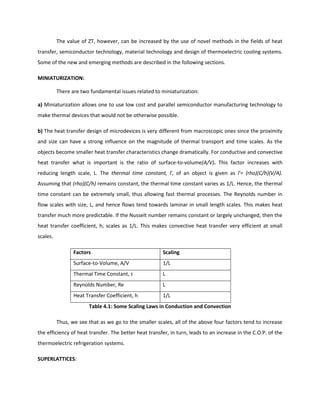
METHODS TO IMPROVE C.O.P. OF TE REFRIGERATORS
The performance of the thermoelectric cooling system is very closely related to the parameter
ZTm of the system. Conventional phase change systems have ZTm of the order > 4. In contrast the value
of ZTm for thermoelectric cooling systems is comparatibly very low of the order of 1.
RITTKITQc cHcnp
2
2/1)()(  





A
IRL
TTNV ch )(2 
The value of ZT, however, can be increased by the use of novel methods in the fields of heat
transfer, semiconductor technology, material technology and design of thermoelectric cooling systems.
Some of the new and emerging methods are described in the following sections.
MINIATURIZATION:
There are two fundamental issues related to miniaturization:
a) Miniaturization allows one to use low cost and parallel semiconductor manufacturing technology to
make thermal devices that would not be otherwise possible.
b) The heat transfer design of microdevices is very different from macroscopic ones since the proximity
and size can have a strong influence on the magnitude of thermal transport and time scales. As the
objects become smaller heat transfer characteristics change dramatically. For conductive and convective
heat transfer what is important is the ratio of surface-to-volume(A/V). This factor increases with
reducing length scale, L. The thermal time constant, Γ, of an object is given as Γ= (rho)(C/h)(V/A).
Assuming that (rho)(C/h) remains constant, the thermal time constant varies as 1/L. Hence, the thermal
time constant can be extremely small, thus allowing fast thermal processes. The Reynolds number in
flow scales with size, L, and hence flows tend towards laminar in small length scales. This makes heat
transfer much more predictable. If the Nusselt number remains constant or largely unchanged, then the
heat transfer coefficient, h, scales as 1/L. This makes convective heat transfer very efficient at small
scales.
Factors Scaling
Surface-to-Volume, A/V 1/L
Thermal Time Constant, τ L
Reynolds Number, Re L
Heat Transfer Coefficient, h 1/L
Table 4.1: Some Scaling Laws in Conduction and Convection
Thus, we see that as we go to the smaller scales, all of the above four factors tend to increase
the efficiency of heat transfer. The better heat transfer, in turn, leads to an increase in the C.O.P. of the
thermoelectric refrigeration systems.
SUPERLATTICES:
A new approach to increase ZT is to use superlattice structures to reduce k. [5]
In heat conduction, a quantum of vibrational energy is called a phonon, and heat conduction can
be studied as a transport of phonons. To increase ZT, strategies to reduce k and ρ simultaneously have
been very difficult. For example, by making amorphous materials, one can reduce k by introducing many
scattering sites for phonons and thereby reducing l. However, they also scatter electrons and thereby
reduce ρ. Because at the fundamental level, heat conduction by phonons is a wave transport problem,
wave effects are being used to alter heat conduction. One such approach is to fabricate a multi-layer
structure containing extremely thin films of two alternating materials. Such a superlattice should have a
period of 1-10 nm since the wavelength of phonons that dominate in heat conduction fall in this regime.
Phonon wave interference effects in superlattices reduce the propagation speed of phonons and
thereby reduce the effective thermal conductivity. Therefore, as the superlattice period thickness
decreases, thermal resistance increases and the thermal conductivity goes on reducing with increasing
number of such interfaces.
e.g. Using PbTe quantum wells and electron confinement to quantum wells with thickness ranging from
1.7 to 5.5 nm, a factor of 5 increase was found in Z relative to bulk PbTe of the same volume.
Thermal conductivity reduction in this manner is being used in thermoelectric devices to
produce high-performance refrigerators.
Methods like miniaturization and superlattices allow us to manipulate the thermal properties of
materials which can have a strong influence on the performance of thermoelectric refrigeration devices.
Use of PCMs, new materials with unusual electronic and thermal properties and other novel heat
transfer designs significantly increase the C.O.P. of TE devices and thus need to be developed more
vigorously
.
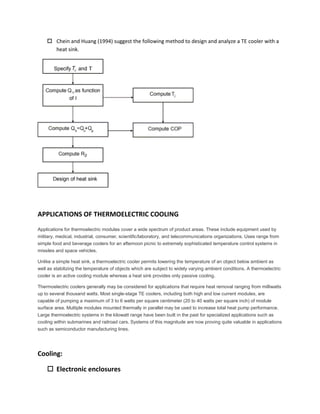
Design Methodology
 Chein and Huang (1994) suggest the following method to design and analyze a TE cooler with a
heat sink.
APPLICATIONS OF THERMOELECTRIC COOLING
Applications for thermoelectric modules cover a wide spectrum of product areas. These include equipment used by
military, medical, industrial, consumer, scientific/laboratory, and telecommunications organizations. Uses range from
simple food and beverage coolers for an afternoon picnic to extremely sophisticated temperature control systems in
missiles and space vehicles.
Unlike a simple heat sink, a thermoelectric cooler permits lowering the temperature of an object below ambient as
well as stabilizing the temperature of objects which are subject to widely varying ambient conditions. A thermoelectric
cooler is an active cooling module whereas a heat sink provides only passive cooling.
Thermoelectric coolers generally may be considered for applications that require heat removal ranging from milliwatts
up to several thousand watts. Most single-stage TE coolers, including both high and low current modules, are
capable of pumping a maximum of 3 to 6 watts per square centimeter (20 to 40 watts per square inch) of module
surface area. Multiple modules mounted thermally in parallel may be used to increase total heat pump performance.
Large thermoelectric systems in the kilowatt range have been built in the past for specialized applications such as
cooling within submarines and railroad cars. Systems of this magnitude are now proving quite valuable in applications
such as semiconductor manufacturing lines.
Cooling:
 Electronic enclosures
 Laser diodes
 Laboratory instruments
 Temperature baths
 Refrigerators
 Telecommunications equipment
 Temperature control in missiles and space systems
 Heat transport ranges vary from a few milliwatts to several thousand
watts, however, since the efficiency of TE devices are low, smaller heat
transfer applications are more practical.
Commercial devices based on thermoelectric materials have come up in a big way recently. In
addition to the benefits thermoelectrics offer over the conventional devices, commercial factors like
decrease in production costs and significant opening of consumer markets have helped it in a big way
and the use of T.E. devices is increasing day by day.
 Thermoelectric cooling is used in medical and pharmaceutical equipment, spectroscopy systems,
various types of detectors, electronic equipment, portable refrigerators, chilled food and
beverage dispensers, and drinking water coolers.
 Requiring cooling devices with high reliability that fit into small spaces, powerful integrated
circuits in today's personal computers also employ thermoelectric coolers.
 Using solid state heat pumps that utilize the Peltier effect, thermoelectric cooling devices are
also under scrutiny for larger spaces such as passenger compartments of idling aircraft parked at
the gate.
Some of the other potential and current uses of thermoelectric cooling are: [8]
Military/Aerospace
 Inertial Guidance Systems, Night Vision Equipment, Electronic Equipment Cooling, Cooled
Personal Garments, Portable Refrigerators.
Consumer Products
 Recreational Vehicle Refrigerators, Mobile Home Refrigerators, Portable Picnic Coolers, Wine
and Beer Keg Coolers, Residential Water Coolers/Purifiers.
Laboratory and Scientific Equipment
 Infrared Detectors, Integrated Circuit Coolers, Laboratory Cold Plates, Cold Chambers, Ice Point
Reference Baths, Dewpoint Hygrometers, Constant Temperature Baths, Thermostat Calibrating
Baths, Laser Collimators.
Industrial Equipments
 C Computer Microprocessors, Microprocessors and PC's in Numerical Control and Robotics,
Medical Instruments, Hypothermia Blankets, Pharmaceutical Refrigerators - Portable and
Stationary, Blood Analyzers, Tissue Preparation and Storage, Restaurant Equipment, Cream and
Butter Dispensers.
Miscellaneous
 Hotel Room Refrigerators, Automobile Mini – Refrigerators, Automobile Seat Cooler, Aircraft
Drinking Water Coolers.
COMMERCIAL THERMOELECTRIC COOLING PRODUCTS:
A varied variety of products based on thermoelectric cooling are now currently available in the
market. These are important because they can be bought off the shelf as per the requirements. Some of
the important listings are as follows:
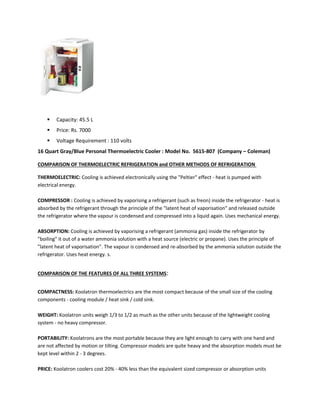
PowerChill™ Plus 40-qt Vertical/Horizontal Thermoelectric Cooler (Gray/White) : Model No. 5642A807
( Company - Coleman)
 Capacity: 45.5 L
 Price: Rs. 7000
 Voltage Requirement : 110 volts
16 Quart Gray/Blue Personal Thermoelectric Cooler : Model No. 5615-807 (Company – Coleman)
COMPARISON OF THERMOELECTRIC REFRIGERATION and OTHER METHODS OF REFRIGERATION
THERMOELECTRIC: Cooling is achieved electronically using the "Peltier" effect - heat is pumped with
electrical energy.
COMPRESSOR : Cooling is achieved by vaporising a refrigerant (such as freon) inside the refrigerator - heat is
absorbed by the refrigerant through the principle of the "latent heat of vaporisation" and released outside
the refrigerator where the vapour is condensed and compressed into a liquid again. Uses mechanical energy.
ABSORPTION: Cooling is achieved by vaporising a refrigerant (ammonia gas) inside the refrigerator by
"boiling" it out of a water ammonia solution with a heat source (electric or propane). Uses the principle of
"latent heat of vaporisation". The vapour is condensed and re-absorbed by the ammonia solution outside the
refrigerator. Uses heat energy. s.
COMPARISON OF THE FEATURES OF ALL THREE SYSTEMS:
COMPACTNESS: Koolatron thermoelectrics are the most compact because of the small size of the cooling
components - cooling module / heat sink / cold sink.
WEIGHT: Koolatron units weigh 1/3 to 1/2 as much as the other units because of the lightweight cooling
system - no heavy compressor.
PORTABILITY: Koolatrons are the most portable because they are light enough to carry with one hand and
are not affected by motion or tilting. Compressor models are quite heavy and the absorption models must be
kept level within 2 - 3 degrees.
PRICE: Koolatron coolers cost 20% - 40% less than the equivalent sized compressor or absorption units
available for recreational use.
BATTERY DRAIN: Koolatron coolers have a maximum current drain on 12 volts of 4.5 amps. Compressor
portables draw slightly more current when running but may average slightly less depending on thermostatic
control settings. Absorption portables draw 6.5 to 7.5 amps when running and may average about 5 amps
draw.
BATTERY PROTECTION: Consider the "Battery Saver" option as discussed in the previous section.
COOLING PERFORMANCE: Compressor systems are potentially the most efficient in hot weather. Some
models will perform as a portable freezer and will refrigerate in ambient temperatures of up to 110 degrees
F. Koolatron units will refrigerate in sustained ambient temperatures of up to 95 degrees F. If they are kept
full, they will refrigerate satisfactorily even if peak daytime temperatures reach 110 degrees F because the
contents temperature will lag behind the ambient. The food will be just starting to warm up when the air
cools off in the evening which will bring the food temperature back down to normal. Absorption type
refrigerators provide almost the same cooling performance as Koolatron portables but are less efficient at
high ambients.
FREEZING ICE CUBES: Compressor systems will usually make a quantity of small ice cubes except in very hot
weather. Gas absorption systems can do the same except in hot weather. Koolatron thermoelectric units do
not make ice cubes but can preserve them in a plastic container for 2 - 3 days which is often adequate for
most applications.
SAFETY: Koolatron systems are completely safe because they use no gases or open flames and run on just 12
volts. Compressor systems can leak freon which can be extremely dangerous especially if heated. Absorption
systems may use propane which can be extremely dangerous in the event of a leak.
RELIABILITY: Koolatrons thermoelectric modules do not wear out or deteriorate with use. They have been
used for military and aerospace applications for years because of their reliability and other unique features.
Compressors and their motors are both subject to wear and freon-filled coils are subject to leakage and
costly repairs. Absorption units are somewhat temperamental and may require expert servicing from time to
time, especially if jarred when travelling.
EASE OF SERVICING AND MAINTENANCE: Koolatron units have only one moving part, a small fan (and 12 volt
motor) which can easily be replaced with only a screw driver. Most parts are easily replaced by the end-user.
Compressor and absorption units both require trained (expensive) mechanics and special service equipment
to service them.
Since thermoelectric cooling systems are most often compared to conventional systems,
perhaps the best way to show the differences in the two refrigeration methods is to describe the
systems themselves.[1] A conventional cooling system contains three fundamental parts - the
evaporator, compressor and condenser. The evaporator or cold section is the part where the
refrigerant is allowed to boil and evaporate. During this change of state from liquid to gas,
energy (heat) is absorbed. The compressor acts as the refrigerant pump and recompresses the gas.
The condenser expels the heat absorbed at the evaporator plus the heat produced during
compression, into the environment or ambient.
A thermoelectric refrigerator has analogous parts. At the cold junction, energy is
absorbed by electrons as they pass from a low energy level in the p-type semiconductor element,
to a higher energy level in the n-type semiconductor element. The power supply provides the
energy to move the electrons through the system. At the hot junction, energy is expelled to a heat
sink as electrons move from a high energy level element (n-type) to a lower energy level element
(p-type). As the electrons move from the p-type material to the n-type material through an
electrical connector, the electrons jump to a higher energy state absorbing thermal energy (cold
side). Continuing through the lattice of material, the electrons flow from the n-type material to
the p-type material through an electrical connector, dropping to a lower energy state and
releasing energy as heat to the heat sink (hot side). A TE module thus uses a pair of fixed
junctions into which electrical energy is applied causing one junction to become cold while the
other becomes hot.
Because thermoelectric cooling is a form of solid-state refrigeration, it has the advantage of
being compact and durable. A thermoelectric cooler uses no moving parts (except for some fans),
and employs no fluids, eliminating the need for bulky piping and mechanical compressors used
in vapor-cycle cooling systems. Such sturdiness allows thermoelectric cooling to be used where
conventional refrigeration would fail. In a current application, a thermoelectric cold plate cools
radio equipment mounted in a fighter jet wingtip. The exacting size and weight requirements, as
well as the extreme g forces in this unusual environment, rule out the use of conventional
refrigeration. Thermoelectric devices also have the advantage of being able to maintain a much
narrower temperature range than conventional refrigeration. They can maintain a target
temperature to within ±1° or better, while conventional refrigeration varies over several degrees.
Unfortunately, modules tend to be expensive, limiting their use in applications that call for more
than 1 kW/h of cooling power. Owing to their small size, if nothing else, there are also limits to
the maximum temperature differential that can be achieved between one side of a thermoelectric
module and the other. However, in applications requiring a higher ∆T, modules can be cascaded
by stacking one module on top of another. When one module's cold side is another's hot side,
some unusually cold temperatures can be achieved.
Why Use Thermoelectrics Instead of Traditional Refrigerant-Based
Systems
 Solid state design
 No moving parts
 Integrated chip design
 No hazardous gases
 Silent operation
 Compact and lightweight
 Low profile
 Sizes to match your component footprint
 No bulky compressor units
 Perfect for benchtop applications
 High reliability
 100,000 hours + MTBF
 Precise temperature stability
 Tolerances of better than +/- 0.1°C
 Accurate and reproducible ramp and dwell times
 Cooling/heating mode options
 Fully reversible with switch in polarity
 Supports rapid temperature cycling
 Localized Cooling
 Spot cooling for components or medical applications
 Perfect for temperature calibration in precision detection systems
 Rapid response times
 Instantaneous temperature change
 Reduced power consumption
 Low DC voltage designs
 Dehumidification
 Efficient condensation of atmospheric water vapor
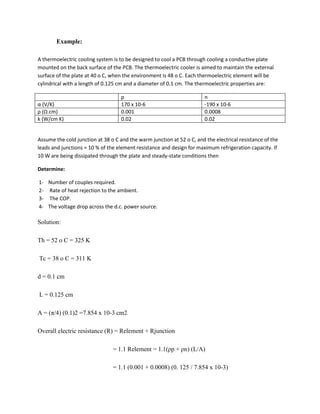
Example:
A thermoelectric cooling system is to be designed to cool a PCB through cooling a conductive plate
mounted on the back surface of the PCB. The thermoelectric cooler is aimed to maintain the external
surface of the plate at 40 o C, when the environment is 48 o C. Each thermoelectric element will be
cylindrical with a length of 0.125 cm and a diameter of 0.1 cm. The thermoelectric properties are:
p n
α (V/K) 170 x 10-6 -190 x 10-6
ρ (Ω.cm) 0.001 0.0008
k (W/cm K) 0.02 0.02
Assume the cold junction at 38 o C and the warm junction at 52 o C, and the electrical resistance of the
leads and junctions = 10 % of the element resistance and design for maximum refrigeration capacity. If
10 W are being dissipated through the plate and steady-state conditions then
Determine:
1- Number of couples required.
2- Rate of heat rejection to the ambient.
3- The COP.
4- The voltage drop across the d.c. power source.
Solution:
Th = 52 o C = 325 K
Tc = 38 o C = 311 K
d = 0.1 cm
L = 0.125 cm
A = (π/4) (0.1)2 =7.854 x 10⁻³ cm2
Overall electric resistance (R) = Relement + Rjunction
= 1.1 Relement = 1.1(ρp + ρn) (L/A)
= 1.1 (0.001 + 0.0008) (0. 125 / 7.854 x 10⁻³)
= 0.0315 Ω
Conduction coefficient (C) = (kp + kn) (A/L)
= (0.02 + 0.02) (7.854 x 10⁻³ /0.125)
= 2.513 x 10⁻³ W/K
Figure of merit (Z) = (αp - αn) 2/ RC
= (360 x 10-6) 2 / (0.0315 x 2.513 x 10-3)
= 1.636 x 10⁻³ K-1
1- Number of couples required.
QC = QC (max) = N C [(Z Tc 2 )/2 – (Th – Tc)] 10
= N (2.513 x 10⁻³) [0.5 (1.636 x 10-3 x (311)2 ) – (14)]
N ≈ 62 couples
2- Rate of heat rejection to the ambient (Qh).
Iopt. = (αp - αn) Tc /R
= (360 x 10-6) x 311/ 0.0315
= 3.55 A
Then
Qh = N [(αp - αn) Th x Iopt – C (Th – Tc) + I2 opt R/2]
= 62 [(360 x 10-6) 325 x 3.55 - 2.513 x 10⁻³ (14) + (3.55)2 0.0315/2]
= 35.8 W
3- The COP.
COP = QC / Pin
Pin (Power input by power source to the thermoelectric) = Qh - QC
= 35.8 – 10 = 25.8 W
COP = 10 / 25.8 = 0.386
4- The voltage drop across the d.c. power source.
The voltage drop (∆V) = Pin / I
= 25.8 / 3.55
= 7.27 volt
CURRENT THERMO-ELECTRIC TECHNOLOGY
The simplest system involves air cooling on both the hot and cold sides; more advanced systems have
water cooling on either the hot or cold sides or else on both faces. The air-air system can be used for
air-conditioning where indoor air to be cooled is blown directly onto the cold face of the Peltier module
while heat is released directly to outdoor air. A commercial cooling system involving air-cooling on the
hot side and heat transfer to a coolant or test fluid on the cold-side is marketed by several companies. A
system using heat transfer to water on both the cold and hot faces of the module was developed for use
in a refrigerator.
The main advantage of air-cooling is simplicity since only fins and a fan are required but the major
disadvantage is reduced thermal efficiency. It is found that the poor thermal conductivity of air causes a
high temperature to develop on the hot face and conversely a very low temperature on the cold face for
even a moderate level of heat transfer. For example, if the difference in temperature between the
interior of refrigerator and the external atmosphere is 20 degrees Kelvin, then the thermo-electric
module would have to operate at approximately 40 degrees Kelvin temperature difference in order for
sufficient heat transport to balance the heat leakage into the cabinet. Each face of the module would
need approximately 10 degrees Kelvin temperature difference relative to either the refrigerated cabinet
or the external air before there is sufficient heat transfer by convection in air. This larger temperature
difference causes the coefficient of performance to decline from approximately 1 to 0.5 or less because
of reverse thermal conduction in the module.
A liquid-liquid heat transfer system for the Peltier module usually involves a liquid coolant which
transfers heat from the module to the air by a radiator. It is also possible to cool a process fluid directly
without using a radiator. This is a more efficient process but may involve problems of corrosion or
blockage inside the heat exchange tubes. A pump is required to circulate the coolant and the radiator
will probably require a fan, thus raising the level of mechanical complexity of the system when
compared to direct air cooling. In most cases, water is used as the coolant because it is readily available,
non-corrosive and an efficient medium for heat transfer. Brine is also used on the cold side of the
module in order to prevent blockage by freezing of the coolant.
The main advantage of using water-based cooling systems is that the Peltier module can work at a
temperature difference that is far closer to the nominal temperature difference of the system. This is
because the convective heat transfer coefficient between water and a solid interface is much higher
than air for comparable flow conditions. The Peltier module is then able to work at close to its optimum
thermodynamic efficiency thus reducing electricity consumption to practicable levels. Refrigeration is a
major source of electricity consumption and there is little purpose to mitigate ozone destruction if in
return, the greenhouse effect is intensified by an increase in electricity demand. European Union (EU)
legislation has imposed limits on the amount of electricity that can be consumed annually by an
individual refrigerator inside EU countries. This legislation necessitates either a high coefficient of
performance from the refrigerating system or very efficient thermal insulation on the refrigerator
cabinet.
The maximum temperature difference between hot and cold side for practical functioning by Peltier
modules is approximately 70 degrees Celsius. Larger temperature differences can be obtained by
stacking the Peltier modules where the waste heat from the coldest module is conducted to the cold
side of the warmer module. The disadvantage of this method is the low COP so that it is mostly used for
specialized instrumentation applications.
A valuable feature of thermo-electric refrigeration is the ease at which fractional power settings (for
example, half-power) can be maintained. The full power of the thermo-electric system is reserved for
cooling the cabinets from ambient temperature to set temperature while the fractional power setting at
steady state is optimized for maximum COP. A thermo-electric refrigeration system can be set at a
power level sufficient to maintain the set temperature indefinitely instead of hunting around a set point,
as is the case with a compressor refrigerator. Typically a compressor driven refrigerator is controlled by
a thermostat which only starts up the compressor when the temperature is approximately 3 degrees
Kelvin higher than the set-point. It is possible to reduce this temperature bandwidth but then the
compressor must function at reduced efficiency because of frequent operations for short periods of
time when the compressor is still warm. Thermo-electric refrigeration enables food to be held within a
narrow temperature range without being exposed to periods of unsuitably high or low temperatures.
This control of temperature minimises low temperature damage (chilling injury) to fruits and vegetables,
while suppressing the growth of pathogenic organisms such as salmonella, in stored meats. Bacterial
growth rates have an exponential relationship with temperature, which means that even brief
excursions of temperature above the set-point generate a disproportionately large amount of bacterial
growth. Bacteria can degrade the nutrients within the food and release toxins, which may cause illness
for the consumer of the food.
DEVELOPMENT OF MATERIALS
Since the beginning of the industrial revolution, humanity has demanded an ever-increasing supply of
energy.
TE devices are currently used in automotive seat coolers/heaters (over 500,000/yr), in portable
refrigerators that plug into an automobile’s cigarette lighter, and in chemical and nuclear generators in
arctic regions and space probes. Increasing the efficiency of TE materials has been the primary goal of
research in the field, and may allow penetration of the economical and environmentally friendly
technology. Thermo-electric might then be coupled to any number of heat sources to extract electricity
from heat that would otherwise have been dissipated into the environment as waste. Examples of
potentially useful heat sources include fuel cells, the steam generator systems inherent in all large
power plants, solar collectors, the shaded sides of solar cells, and automotive exhaust. A Japanese
collaboration has predicted that gas mileage would be improved by several miles per gallon if the
alternator were replaced by an array of TE generators. Generators could also be attached to wood
stoves to electrify remote areas. Proposed uses of efficient TE refrigerators include the cooling of high-
temperature superconductor cables that could be used to distribute electric power without loss and the
cooling of microchips to enable faster computing and more sensitive detectors. The military is
considering the use of thermoelectric in wireless IR detectors, temperature stabilization of optics,
cooling of microprocessors and CCDs, controlling heat signatures, individual man portable micro-climate
systems, remote power sources, and air conditioning and waste heat recovery for ships, submarines,
land vehicles, and aircraft.
TE materials naturally generate a temperature gradient in the presence of an electromotive force (emf)
and they produce an emf in a temperature gradient. While all materials except superconductors possess
some TE character, only a few systems are efficient enough to generate interest. These include the lead,
bismuth, and antimony chalcogenides, skutterudites such as cobalt triantimonide, bismuth antimony,
silicon germanium, boron carbides, and more complex compounds and alloys based on these systems. A
TE refrigerator connects two or more pieces of TE material to of voltage source. A generator can be
made from the same device is the voltage source is replaced by a load (e.g. a battery charger). Nearly all
devices use two different types of materials, one "n-type" and the other "p-type." These pieces must be
connected so that they are electrically in series, but thermally in parallel. This situation is illustrated in
the figures below.
The figure above is a simplified schematic of a TE cooler. The voltage source moves electrons and holes
(think of them as bubbles in a sea of electrons) to the right in the n- and p-type materials, respectively.
These charge carriers also carry heat as they travel, picking it up on the left and dumping it on the right.
Simultaneously, phonons (vibrations in the atoms of a solid) carry some heat back, detracting from the
performance of the device.
Earlier Bismuth and Antimony were used in thermo-electric refrigerator. Latter on various
semiconductor materials developed. In today’s status materials like BiTe3/Sb2Te3/Bi2Se3 alloy are being
used in Peltier refrigeration. Further investigations suggest compounds made from elements found in
the lower right corner of the periodic table group IIIB to VIB.
Some materials and their figure of merits are as shown in chart.
FUTURE DEVELOPMENTS:
The two main issues in thermo-electric refrigeration are the development of new materials with
stronger Peltier effects and the application of these materials to real engineering problems such as
refrigeration and control of process heat. The former issue is primarily the domain of physicists and
materials scientists who test a large number of materials looking for crystalline structures which
combine high electrical conductivity with low thermal conductivity as well as a strong thermo-electric
characteristic. The latter issue is of greatest concern to mechanical engineering where problems such as
heat transfer between the module and cheap manufacture of modules are of concern. For refrigeration,
unlike air-conditioning, the power consumption is relatively small, typically 50 Watts which means that
the number of modules and their cost is also small. This means that the main issue for refrigeration is
heat transfer between the module and its external environment. The level of interest in these
engineering problems is intensifying as the efforts of physicists and materials scientists produce thermo-
electric materials with usefully high levels of performance.
There has been steady progress in raising the performance of the materials and construction of thermo-
electric modules since the first application of bismuth telluride in the 1950’s. A purified form of bismuth
telluride now enables the manufacture of thermo-electric modules with a Coefficient of Performance
approximately equal to unity for temperature differences of 29 degrees Kelvin. The standard test
temperature difference for a refrigerator cabinet is 29 degrees Kelvin where the cabinet interior is set at
3 degrees Celsius and the exterior at 32 degrees Celsius. The thermo-electric module would operate at
a higher temperature difference than this because of conduction and convection losses in the thermo-
electric refrigerating system. A high efficiency of the Peltier module is obtained when these secondary
temperature losses are reduced to very small values compared to the temperature difference across the
Peltier module.
Enhancement of the heat transfer between the hot and cold faces of
a Peltier module and the working fluid is still however a major topic of research since the relative power
consumption of a Peltier when used in a refrigeration system remains high. The key factor to improve
energy efficiency is efficient heat transfer. A major problem is the small size of the Peltier modules
compared to their heat output which means that a generous heat transfer coefficient is needed to
prevent a large temperature difference between the module and the working fluid. It is fortunate that
water is an effective heat transfer since the choice of fluids is greatly limited by considerations of non-
toxicity and non-corrosiveness for a domestic refrigerator. The sensitivity of Peltier module efficiency to
temperature difference between hot and cold face means that even a saving of 1 degree in temperature
losses can generate a significant increase in the overall Coefficient of Performance. A fundamental
problem is that the same pumps and fans which generate vigorous convective heat transfer and thereby
raise the coefficient of performance of the Peltier module, also consume power to lower the overall
system efficiency. The efficiency of the pumps and manifolds should be as high as possible with a
balanced distribution of electrical power to the various sub-systems within the refrigerator.
CONCLUSIONS
Thermoelectrics and thermoelectric cooling are being studied exhaustively for the past several
years and various conclusions have been conceived regarding the efficient functioning of thermoelectric
refrigerators.
Thermoelectric refrigerators are greatly needed, particularly for developing countries, where
long life, low maintenance and clean environment are needed. In this aspect thermoelectrics cannot be
challenged in spite of the fact that it has some disadvantages like low coefficient of performance and
high cost. These contentious issues are the frontal factors hampering the large scale commercialization
of thermoelectric cooling devices.
The solution to above problems can only be resolved with the development of new techniques.
There is a lot of scope for developing materials specefically suited for TE cooling purpose and these can
greatly improve the C.O.P. of these devices. Development of new methods to improve efficiency
catering to changes in the basic design of the thermoelectric set up like better heat transfer,
miniaturization etc. can give very effective enhancement in the overall performance of thermoelectric
refrigerators. Finally, there is a general need for more studies that combine several techniques,
exploiting the best of each and using these practically.
From the all above discussion we can predict that the thermo-electric refrigeration is in
experimental stage. Though it is so, today it is being used in surgery for cooling the instrument used for
extracting the crystalline lens out of the eye.
There is problem from testing of thermo-electric refrigerator that by using the heat pipe, we can
achieve heat transfer rate 500 times more than the conventional heat removal aids like fins etc.by
evaporating the heat pipe reverse heat transfer which occurs after the shutoff power supply can be
solved So it has been noticed that use of heat pipe will lead to improve the performance of the thermo-
electric module and ulmatly the refrigerator.
Thermo-electric refrigeration is likely to become a significant form of domestic refrigeration within the
medium term because of the need to avoid refrigerating fluids that are hostile to the environment.
Precise control of temperature for better food preservation, low noise and a reduced number of moving
parts are also significant benefits of thermo-electric refrigeration.
The energy consumption of thermo-electric refrigeration can be reduced to moderate levels with further
improvements in the heat transfer between the various stages of the refrigerating system.
Last but not least, I feel that though thermo-electric refrigeration system is at experimental
stage and have less application today, in future it can become popular, convenient, reliable eco-friendly
alternative refrigeration system.
1http://www.ijeit.com/vol%202/Issue%207/IJEIT1412201301_03.pdf
2 http://www.academia.edu/5263544/THERMOELECTRIC_REFRIGERATOR
3http://www.its.caltech.edu/~jsnyder/thermoelectrics/science_page.htm
http://mechanicalgarage.blogspot.com.tr/2013/08/thermoelectric-refrigeration.html
http://www.koolatron.com/test/images/thermoelectric.html
http://www.pathways.cu.edu.eg/ec/text-pdf/part%20c-17.pdf
https://thermal.ferrotec.com/technology/thermoelectric/thermalRef07
http://www.electronics-cooling.com/2000/05/application-of-thermoelectric-coolers-for-module-
cooling-enhancement/
http://kryothermtec.com/tem-advantages.html
http://www.academia.edu/5263544/THERMOELECTRIC_REFRIGERATOR
http://en.wikipedia.org/wiki/Thermoelectric_cooling
http://www.ijeit.com/vol%202/Issue%207/IJEIT1412201301_03.pdf

Thermoelectric cooler

  • 1.
    CELAL BAYAR UNIVERSITY MECHANICALENGINEERING Turgut Selman TÜMER 120304073 Assignment topic : Thermoelectric Cooler
  • 2.
    INTRODUCTION Thermoelectric refrigerator sometimescalled a thermoelectric cooler module or Peltier cooler is a semi conductor based electric component that functions as a small heat pump. By applying a low voltage direct current (DC) power source to a thermoelectric cooler module, heat will be moved through the module from one side to the other. One module face, therefore, will be cooled while the opposite face simultaneously is heated. Both thermoelectric refrigerators and mechanical refrigerators are governed by the same fundamental laws of thermodynamics and both refrigeration systems; although considerably different in form, function in accordance with the same principles. In a mechanical refrigeration unit, a compressor raises the pressure of a refrigerant and circulates the refrigerant through the system. In the refrigerated chamber, the refrigerant boils and in the process of changing to a vapor, the refrigerant absorbs heat causing the chamber to become cold. The heat absorbed in the chamber is moved to the condenser where it is transferred to the environment from the condensing refrigerant. In a thermoelectric cooling system, a doped semi-conductor material essentially takes the place of the refrigerant, the condenser is replaced by a finned heat sink, and the compressor is replaced by a Direct Current (DC) power source. The application of Direct Current (DC) power to the thermoelectric cooler modules causes electrons to move through the semi-conductor material. At the cold end of the semi-conductor material, heat is absorbed by the electron movement, moved through the material, and expelled at the hot end. Since the hot end of the material is physically attached to a heat sink, the heat is passed from the material to the heat sink and then in turn, transferred to the environment. The physical principles upon which modern thermoelectric coolers are based actually date back to the early 1800‟s, although commercial thermoelectric cooler modules were not available until almost 1960. The first important discovery relating to thermoelectricity occurred in 1821 when a German Scientist, Thomas Seebeck, found that an electric current would flow continuously in a closed circuit made up of two dissimilar metals maintained at two different temperatures. Seebeck did not actually comprehend the scientific basis for his discovery, however, and falsely assumed that flowing heat produced the same effect as flowing electric current. In 1834, a French watchmaker and part time physicist, Jean Peltier, while investigating the “Seebeck Effect”, found that there was an opposite phenomenon whereby thermal energy could be absorbed at one dissimilar metal junction and discharged at the other junction when an electric current flowed within the closed circuit. Twenty years later, William Thomson later Lord Kelvin issued a compressible explanation of the Seebeck and Peltier effects and described their interrelationship. At the time however, these phenomenon were still considered to be more laboratory curiosities and were without practical application. In the 1930‟s, Russian
  • 3.
    scientists began studyingsome of the earlier thermoelectric work in an effort to construct power generators for use at remote locations throughout the country. This Russian interest in thermoelectricity eventually caught the attention of the rest of the world and inspired the development of practical thermoelectric modules. Today‟s thermoelectric refrigerators make use of modern semi-conductor technology whereby doped semi-conductor material takes the place of dissimilar metals used in early thermoelectric experiments. [Ref.1] In 1821, Thomas Seebeck discovered that a continuously flowing current is created when two wires of different materials are joined together and heated at one end.This idea is known as the Seebeck Effect. The Seebeck effect has two main applications including temperature measurement and power generation. Thirteen years later Jean Charles Athanase reversed the flow of electrons in Seebeck.s circuit to create refrigeration. This effect is known as the Peltier Effect. This idea forms the basis for the Thermoelectric refrigerator.Scottish scientist WilliamThomson (later Lord Kelvin) discovered in 1854 that if a temperature difference exists between any two points of a current carrying conductor, heat is either evolved or absorbed depending upon the material.6 If such a circuit absorbs heat, thenheat may be evolved if the direction of the current or of the temperature gradient is reversed[1]. The Peltier effect is a temperature difference created by applying a voltage between two electrodes connected to a sample of semiconductor material. This phenomenon can be useful when it is necessary to transfer heat from one medium to another on a small scale. The Peltier effect is one of three types of thermoelectric effect; the other two are theSeebeck effect and the Thomson effect. In a Peltier-effect device, the electrodes are typically made of a metal with excellent electrical conductivity. The semiconductor material between the electrodes creates two junctions between dissimilar materials, which, in turn, creates a pair of thermocouple voltage is applied to the electrodes to force electrical current through the semiconductor, thermal energy flows in the direction of the charge carriers.[2]. In its simplest form, this may be done with a single semiconductor 'pellet' which is soldered to electrically-conductive material on each end (usually plated copper). In this 'stripped-down' configuration, the second dissimilar material required for the Peltier effect, is actually the copper connection paths to the power supply. It is important to note that the heat will be moved (or 'pumped') in the direction of charge carrier flow throughout the circuit— actually, it is the charge carriers that transfer the heat.[3].But in order to pump appreciable amount of heat, we need to interconnect such semiconductor electrically and thermally parallel. Moreover it needs costly power supply arrangement to supply high current requirement for parallel arrangement of semiconductor. So semiconductor can be arranged electrically in series but thermally parallel which further increases the possibility of short circuiting and reduces the reliability of system. The best optimized way to connect the semiconductor is in the form of pn junctions which overcome the above mentioned problems .[Ref.2]
  • 4.
    There are 5thermoelectric effects and these are observed when a current is passed through a thermocouple whose junctions are at different temperatures. These phenomenon are the Seeback effect, the Peltier effect, the Joulean effect, the conduction effect, and the Thomson effect. Thermoelectric cooling, also called "Peltier Effect", is a solid-state method of heat transfer through dissimilar semiconductor materials. It is based on the thermoelectric effect known as ‘Peltier Effect‘ according to which if current is passed through a thermocouple, then the heat is absorbed at one junction of the thermocouple and liberated at the other junction. So by using the cold junction of the thermocouple as the evaporator, a heat sink as the condenser and a DC power source as the compressor of the refrigerator, cooling effect can be provided. Theory of Operation The semiconductor materials are N and P type, and are so named because either they have more electrons than necessary to complete a perfect molecular lattice structure (N-type) or not enough electrons to complete a lattice structure (P-type). The extra electrons in the N-type material and the holes left in the P-type material are called "carriers" and they are the agents that move the heat energy from the cold to the hot junction. Heat absorbed at the cold junction is pumped to the hot junction at a rate proportional to carrier current passing through the circuit and the number of couples. Good thermo-electric semiconductor materials such as bismuth telluride greatly impede conventional heat conduction from hot to cold areas, yet provide an easy flow for the carriers. in addition, these materials have carriers with a capacity for carrying more heat. SEEBECK EFFECT
  • 5.
    Fig. 1 SeebeckEffect The thermocouple conductors are two dissimilar metals denoted as X and Y materials. With heat applied to the end B of the thermocouple and the end A is cooled, a voltage will appear across terminals T1 and T2. This voltage is known as the Seebeck e.m.f. PELTIER EFFECT The Peltier effect bears the name of Jean-Charles Peltier, a French physicist who in 1834 discovered the calorific effect of an electrical current at the junction of two different metals. When a Current (I) is made to flow through the circuit, heat is evolved at the upper junction (T2) and absorbed at the lower junction (T1). The Peltier heat absorbed by the lower junction per unit time Q is equal to; Where πAB is the Peltier coefficient. Peltier heat is reversible, when the direction of current is reversed; the Peltier heat is the same, but in opposite direction. Peltier coefficient depends on the temperature and materials of a junction. Fig. 2 Illustrates The Peltier Effect.
  • 6.
    If a voltageis applied to terminals T1 and T2, electric current (I) will flow in the circuit. As a result of the current flow, a slightly cooling effect will occur at thermocouple junction A where heat is expelled. Note that this effect will be reversed whereby a change in the direction of electric current flow will reverse the direction of heat flow. THOMSON EFFECT When an electric current is passed through a conductor having a temperature gradient over its length, heat will be either absorbed by or expelled from the conductor. Whether heat is absorbed or expelled depends upon the direction of both the electric current and temperature gradient. This phenomenon, known as Thomson effect is of interest in respect to the principles involved but plays a negligible role in the operation of practical thermoelectric models. Basic Principles  Peltier Effect- when a voltage or DC current is applied to two dissimilar conductors, a circuit can be created that allows for continuous heat transport between the conductor’s junctions. The Seebeck Effect- is the reverse of the Peltier Effect. By applying heat to two different conductors a current can be generated. The Seebeck Coefficient is given by: where  is the electric field. dxdT x /   
  • 7.
     The currentis transported through charge carriers (opposite the hole flow or with electron flow).  Heat transfer occurs in the direction of charge carrier movement. **Applying a current (e- carriers) transports heat from the warmer junction to the cooler junction.  A typical thermoelectric cooling component is shown on the next slide. Bismuth telluride (a semiconductor),is sandwiched between two conductors, usually copper. A semiconductor (called a pellet) is used because they can be optimized for pumping heat and because the type of charge carriers within them can be chosen. The semiconductor in this examples N type (doped with electrons) therefore, the electrons move towards the positive end of the battery.  The semiconductor is soldered to two conductive materials, like copper. When the voltage is applied heat is transported in the direction of current flow.
  • 8.
     When ap type semiconductor (doped with holes) is used instead, the holes move in a direction opposite the current flow. The heat is also transported in a direction opposite the current flow and in the direction of the holes. Essentially, the charge carriers dictate the direction of heat flow. Method of Heat Transport  Electrons can travel freely in the copper conductors but not so freely in the semiconductor.  As the electrons leave the copper and enter the hot-side of the p-type, they must fill a "hole" in order to move through the p-type. When the electrons fill a hole, they drop down to a lower energy level and release heat in the process.  Then, as the electrons move from the p-type into the copper conductor on the cold side, the electrons are bumped back to a higher energy level and absorb heat in the process.  Next, the electrons move freely through the copper until they reach the cold side of the n-type semiconductor. When the electrons move into the n-type, they must bump up an energy level in order to move through the semiconductor. Heat is absorbed when this occurs.  Finally, when the electrons leave the hot-side of the n-type, they can move freely in the copper. They drop down to a lower energy level and release heat in the process.  To increase heat transport, several p type or n type thermoelectric(TE) components can be hooked up in parallel.  However, the device requires low voltage and therefore, a large current which is too great to be commercially practical.
  • 9.
     The TEcomponents can be put in series but the heat transport abilities are diminished because the interconnectings between the semiconductor creates thermal shorting.  The most efficient configuration is where a p and n TE component is put electrically in series but thermally in parallel . The device to the right is called a couple.  One side is attached to a heat source and the other a heat sink that convects the heat away.  The side facing the heat source is considered the cold side and the side facing the heat sink the hot side.
  • 10.
     Between theheat generating device and the conductor must be an electrical insulator to prevent an electrical short circuit between the module and the heat source.  The electrical insulator must also have a high thermal conductivity so that the temperature gradient between the source and the conductor is small. Ceramics like alumina are generally used for this purpose.  The most common devices use 254 alternating p and n type TE devices.  The devices can operate at 12-16 V at 4-5 amps. These values are much more practical for real life operations.
  • 11.
     An entireassembly: Semiconductor Doping: N Type  N doped semiconductors have an abundant number of extra electrons to use as charge carriers. Normally, a group IV material (like Si) with 4 covalent bonds (4 valence electrons) is bonded with 4 other Si. To produce an N type semiconductor, Si material is doped with a Group V metal (P or As) having 5 valence electrons, so that an additional electron on the Group V metal is free to move and are the charge carriers (Wikipedia, http://en.wikipedia.org/wiki/Semiconductor).
  • 12.
    Semiconductor Doping: PType  For P type semiconductors, the dopants are Group III (In, B) which have 3 valence electrons, these materials need an extra electron for bonding which creates “holes”. P doped semiconductors are positive charge carriers. There’s an appearance that a hole is moving when there is a current applied because an electron moves to fill a hole, creating a new hole where the electron was originally. Holes and electrons move in opposite directions. (Wikipedia, http://en.wikipedia.org/wiki/Semiconductor).
  • 13.
    THERMOELECTRIC COOLING MATERIALS Semiconductors are the optimum choice of material to sandwich between two metal conductors because of the ability to control the semiconductors’ charge carriers, as well as, increase the heat pumping ability.  The most commonly used semiconductor for electronics cooling applications is Bi2Te3 because of its relatively high figure of merit. However, the performance of this material is still relatively low and alternate materials are being investigated with possibly better performance.  Alternative materials include:  Alternating thin film layers of Sb2Te3 and Bi2Te3.  Lead telluride and its alloys  SiGe  Materials based on nanotechnology  A plot of various p-type semiconductor figures of merit times temperature vs. temperature are shown. Within the temperature ranges concerned in electronics cooling (0-200C) Bi2Te3 performs the best.
  • 14.
    zT for p-typethermoelectric materials [ref3]  Similar results are shown for n-type semiconductors Bi2Te3 Properties  Below is a plot of the figure of merit (Z), Seebeck coefficient, electrical resistivity, and thermal conductivity, as a function of temperature for Bi2Te3. Carrier concentration will alter the values below.
  • 15.
     Bi2Te3 figureof merit as a function of tellurium concentration.  Metals are used to sandwich the semiconductor. Because the TE performance is also dependent on these materials, an optimal material must be chosen, usually copper.
  • 16.
    Although the principleof thermoelectricity dates back to the discovery of the Peltier effect, there was little practical application of the phenomenon until the middle 1950‟s. Prior to then, the poor thermoelectric properties of known materials made them unsuitable for use in a practical refrigerating device. According to Nolas et al [3], from the middle 1950s to the present the major thermoelectric material design approach was that introduced by A.V. Ioffe, leading to semi-conducting compounds such as Bi2Te3, which is currently used in thermoelectric refrigerators. In recent years there has been increased interest in the application of thermoelectric to electronic cooling, accompanied by efforts to improve their performance through the development of new bulk materials and thin film micro coolers [3]. The usefulness of thermoelectric materials for refrigeration is often characterized by the dimensionless product, ZT, of the thermoelectric figure of merit Z and temperature T. The expression for the thermoelectric figure of merit is given by: Where ρ is the electrical resistivity, k is the thermal conductivity, and  is the Seebeck Coefficient. Note: low electrical resistivity and thermal conductivity are required for high high figure of merit. These values are temperature dependent therefore, the figure of merit is temperature dependent. P and N type material have different figures of merit and are averaged to determine a materials overall quality. Fluerial et al [4] reported that in 1991 JPL started abroad search to identify and develop advanced materials. Among the materials considered, Skutterudite and Zn4Sb3 based materials appeared particularly promising and several of these materials are being developed. ZT values equal to or greater than one have been obtained for these materials over different ranges of temperature varying from 375 to 975K. However, to be particularly useful for electronic cooling applications, improvements in ZT are needed over the temperature range of 300 to 325K or below. Another strategy for enhancing ZT being pursued by researchers at MIT, Harvard and UCLA focuses on reduced dimensionality as occurs in quantum wells (2D) or quantum wires. Table I Figure of Merit for Different Materials Material Figure of merit Pb – Te 1.2 x 10⁻³ Pb – Se 1.2 x 10⁻³ k Z   
  • 17.
    Pb2 – Te31.2 x 10-3 Bi2 – Te3 1.3 x 10⁻³ (BiSb)2 – Te3 3.3 x 10⁻³ THERMOELECTRIC REFRIGERATORS COMPENENTS The thermoelectric refrigerator consists of the following components: A. The Thermoelectric Module The thermoelectric module consists of pairs of P-type and N-type semi-conductor thermo element forming thermocouple which are connected electrically in series and thermally in parallel. The modules are considered to be highly reliable components due to their solid state construction. For most application they will provide long, trouble free service. In cooling application, an electrical current is supplied to the module, heat is pumped from one side to the other, and the result is that one side of the module becomes cold and the other side hot. B. Heat Sink The heat sink usually made of aluminum, is in contact with the hot side of a thermoelectric module. When the positive and negative module leads are connected to the respective positive and negative terminals of a Direct Current (D.C) power source, heat will be rejected by the module‟s hot side, the heat sink expedites the removal of heat. Heat sink typically is intermediates stages in the heat removal process whereby heat flows into a heat sink and then is transferred to an external medium. Common heat sinks include free convection, forced convection and fluid cooled, depending on the size of the refrigerator. C. Cold Side The cold side also made of aluminum is in contact with the cold side of a thermoelectric module, when the positive and negative module leads are connected to the respective positive and negative terminals of a direct current (D.C) power source, heat will be absorbed by the module‟s cold side. The hot side of a thermoelectric module is normally placed in contact with the object being cold. D. Spacer Block The spacer block though optional in water chillers is used to ensure sufficient air gap between the heat sink and the object being cooled. E. Power Source Thermoelectric module is a Direct Current (D.C) device. Specified thermoelectric module performance is valid if a Direct Current (D.C) power supply is used. Actual D.C power supply has a rippled output. This D. C. component is detrimental [7]. Degradation of thermoelectric module performance due to the ripple can be approximated by:
  • 18.
    MODULE SELECTIONS Selection ofthe proper thermoelectric module for a specific application requires an evaluation of the total system in which the refrigeration will be used. For most applications, it should be possible to use one of the standard module configurations while in certain cases a special design may be needed to meet stringent electrical, mechanical or other requirement. The overall cooling system is dynamic in nature and system performance is a function of several interrelated parameters. Before starting the actual thermoelectric module selection process, under listed questions must be answered. At what temperature must the cooled object be maintained? How much heat must be removed from the cold object? Is thermal response time important? What is the expected ambient temperature? What is the extraneous heat input (heat leak) into the system? How much space is available for the module and heat sink? What power is available? What is the expected approximate temperature of the heat sink during operation Table 2 shows the average parameters for a 31 couple Bismuth telluride module at various temperatures and current. Table II Parameters of Bismuth Telluride Module S/N Temp. 0C  v/k Rm Ω 9A K W/K 9A Rm Ω 15A K W/K 15A 1 0 0.01229 0.3440 0.1815 0.2064 0.3024 2 10 0.01257 0.3634 0.1828 0.2180 0.3047 3 20 0.01282 0.3833 0.1858 0.2300 0.3096 4 30 0.01304 0.4035 0.1905 0.2421 0.3176 5 40 0.01323 0.4239 0.1971 0.2544 0.3286 Condensation  A common problem with TE cooling is that condensation may occur causing corrosion and eroding the TE’s inherent reliability.  Condensation occurs when the dew point is reached. The dew point is the temperature to which air must be cooled at constant pressure for the water vapor to start to condense  Condensation occurs because the air loses the ability to carry the water vapor that condenses. As the air’s temperature decreases its water vapor carrying capacity decreases.
  • 19.
     Since TEcoolers can cool to low and even below ambient temperatures, condensation is a problem.  The most common sealant employed is silicon rubber (Nagy, 1997).  Research has been performed to determine the most effective sealing agent used to protect the chip from water. Four sealants were used to seal a TE cooling device and the weight gain due to water entering the device measured. The best sealants should have the lowest weight gain. The epoxy has virtually no weight gain.  According to the previous results, it seems that the epoxy is the best sealant. These results are verified by the published permeability data showing the epoxy having the lowest permeability (vapor transmission rate) of all the sealants.
  • 20.
    Moisture and VibrationEffect Moisture: Moisture must not penetrate into the thermoelectric module area. The presence of moisture will cause an electro-corrosion that will degrade the thermoelectric material, conductors and solders. Moisture can also provide an electrical path to ground causing an electrical short or hot side to cold side thermal short. A proper sealing method or dry atmosphere can eliminate these problems. Shock and Vibration: Thermoelectric modules in various types of assemblies have for years been used in different Military/Aerospace applications. Thermoelectric devices have been successfully subjected to shock and vibration requirements for aircraft, ordinance, space vehicles, shipboard use and most other such systems. While a thermoelectric device is quite strong in both tension and compression, it tends to be relatively weak in shear. When in a sever shock or vibration environment, care should be taken in the design of the assembly to insure "compressive loading" of thermoelectric devices. ADVANTAGES OF THERMOELECTRIC REFRIGERATION The use of thermoelectric modules often provides solutions, and in some cases the ONLY solution, to many difficult thermal management problems where a low to moderate amount of heat must be handled. While no one cooling method is ideal in all respects and the use of thermoelectric modules will not be suitable for every application, TE coolers will often provide substantial advantages over alternative technologies. Some of the more significant features of thermoelectric modules include: No Moving Parts: A TE module works electrically without any moving parts so they are virtually maintenance free.
  • 21.
    Small Size andWeight: The overall thermoelectric cooling system is much smaller and lighter than a comparable mechanical system. In addition, a variety of standard and special sizes and configurations are available to meet strict application requirements. Ability to Cool Below Ambient: Unlike a conventional heat sink whose temperature necessarily must rise above ambient, a TE cooler attached to that same heat sink has the ability to reduce the temperature below the ambient value. Ability to Heat and Cool With the Same module: Thermoelectric coolers will either heat or cool depending upon the polarity of the applied DC power. This feature eliminates the necessity of providing separate heating and cooling functions within a given system. Precise Temperature Control: With an appropriate closed-loop temperature control circuit, TE coolers can control temperatures to better than +/- 0.1°C. High Reliability: Thermoelectric modules exhibit very high reliability due to their solid state construction. Although reliability is somewhat application dependent, the life of typical TE coolers is greater than 200,000 hours. Electrically "Quiet" Operation: Unlike a mechanical refrigeration system, TE modules generate virtually no electrical noise and can be used in conjunction with sensitive electronic sensors. They are also acoustically silent. Operation in any Orientation: TEs can be used in any orientation and in zero gravity environments. Thus they are popular in many aerospace applications. Convenient Power Supply: TE modules operate directly from a DC power source. Modules having a wide range of input voltages and currents are available. Pulse Width Modulation (PWM) may be used in many applications Spot Cooling: With a TE cooler it is possible to cool one specific component or area only, thereby often making it unnecessary to cool an entire package or enclosure. Ability to Generate Electrical Power: When used "in reverse" by applying a temperature differential across the faces of a TE cooler, it is possible to generate a small amount of DC power. Environmentally Friendly: Conventional refrigeration systems can not be fabricated without using chlorofluorocarbons or other chemicals that may be harmful to the environment. Thermoelectric devices do not use or generate gases of any kind EASY SERVICE: Most parts are easily replaced by the end-user with a screw driver. RELIABILITY: Thermoelectrics have a 40 year proven track record in military, aerospace, laboratory, and now consumer applications.  Excellent cooling alternative to vapor compression coolers for systems that are sensitive to mechanical vibration.  Compact size make them useful for applications where size or weight is a constraint. . https://www.ferrotec.com/Technology/Thermoelectric/Thermalref04 ADVANTAGES OF THERMOELECTRIC REFRIGERATION
  • 22.
    (i) Efficiency ofthermo-electric cooling is less. (ii) 5–10% efficiency as compared with that of ideal reversed Carnot Cycle (iii) 40–60% COP as compared to conventional compression refrigeration cycle (iv) COP is low and further decreases with increase in (Th - Tc) (v) Suitable only for small capacity units (vi) Costly because of high cost of semi-conductors.  Able to dissipate limited amount of heat flux.  Lower coefficient of performance than vapor-compression systems.  Relegated to low heat flux applications.  More total heat to remove than without a TEC. Power Supply Requirements Thermoelectric coolers operate directly from DC power suitable power sources can range from batteries to simple unregulated "brute force" DC power supplies to extremely sophisticated closed-loop temperature control systems. A thermoelectric cooling module is a low-impedance semiconductor device that presents a resistive load to its power source. Due to the nature of the Bismuth Telluride material, modules exhibit a positive resistance temperature coefficient of approximately 0.5 percent per degree C based on average module temperature. For many noncritical applications, a lightly filtered conventional battery charger may provide adequate power for a TE cooler provided that the AC ripple is not excessive. Simple temperature control may be obtained through the use of a standard thermostat or by means of a variable-output DC power supply used to adjust the input power level to the TE device. In applications where the thermal load is reasonably constant, a manually adjustable DC power supply often will provide temperature control on the order of +/- 1°C over a period of several hours or more. Where precise temperature control is required, a closed-loop (feedback) system generally is used whereby the input current level or duty cycle of the thermoelectric device is automatically controlled. With such a system, temperature control to +/- 0.1°C may be readily achieved and much tighter control is not unusual. Power supply ripple filtering normally is of less importance for thermoelectric devices than for typical electronic applications. However we recommend limiting power supply ripple to a maximum of 10 percent with a preferred value being < 5%. Multistage cooling and low-level signal detection are two applications which may require lower values of power supply ripple. In the case of multistage thermoelectric devices, achieving a large temperature differential is the typical goal, and a ripple component of less than two percent may be necessary to maximize module performance. In situations where very low level signals must be detected and/or measured, even though the TE module itself is electrically
  • 23.
    quiet, the presenceof an AC ripple signal within the module and wire leads may be unsatisfactory. The acceptable level of power supply ripple for such applications will have to be determined on a case-by-case basis. Thermoelectric Performance  TE performance depends on the following factors:  The temperature of the cold and hot sides.  Thermal and electrical conductivities of the device’s materials.  Contact resistance between the TE device and heat source/heat sink. Thermal resistance of the heat sink.  The current yielding the maximum COP is given by:  The maximum COP is: Where Tm= (TH+TC)/2  The COP corresponding to the maximum heat pumping capacity is:  The current corresponding to the maximum heat pumping capacity is: ]1)1[( ))(( 2/1    m chnp ZTR TT I   ]1)1)[(( ]/)1[( 2/1 12 12 2/1 1 max    m m in c ZTTT TTZTT W Q  cH cHc q TZT TTZT )(2/1 2   R T I cnp q )(   
  • 24.
    Coefficient of Performance **Atypical AC unit has a COP of approximately 3. TE coolers usually have COP’s below 1; 0.4 to 0.7 is a typical range. Below are COP values plotted versus the ratio of input current to the module’s Imax specification. Each line corresponds with a constant DT/DTmax (the ratio of the required temperature difference to the module's max temperature difference specification).
  • 25.
     A simplifiedway of determining the voltage and the heat load are given by: Where V is the voltage and Qc is the heat load, N is the number of couples, and L is the element height. METHODS TO IMPROVE C.O.P. OF TE REFRIGERATORS The performance of the thermoelectric cooling system is very closely related to the parameter ZTm of the system. Conventional phase change systems have ZTm of the order > 4. In contrast the value of ZTm for thermoelectric cooling systems is comparatibly very low of the order of 1. RITTKITQc cHcnp 2 2/1)()(        A IRL TTNV ch )(2 
  • 26.
    The value ofZT, however, can be increased by the use of novel methods in the fields of heat transfer, semiconductor technology, material technology and design of thermoelectric cooling systems. Some of the new and emerging methods are described in the following sections. MINIATURIZATION: There are two fundamental issues related to miniaturization: a) Miniaturization allows one to use low cost and parallel semiconductor manufacturing technology to make thermal devices that would not be otherwise possible. b) The heat transfer design of microdevices is very different from macroscopic ones since the proximity and size can have a strong influence on the magnitude of thermal transport and time scales. As the objects become smaller heat transfer characteristics change dramatically. For conductive and convective heat transfer what is important is the ratio of surface-to-volume(A/V). This factor increases with reducing length scale, L. The thermal time constant, Γ, of an object is given as Γ= (rho)(C/h)(V/A). Assuming that (rho)(C/h) remains constant, the thermal time constant varies as 1/L. Hence, the thermal time constant can be extremely small, thus allowing fast thermal processes. The Reynolds number in flow scales with size, L, and hence flows tend towards laminar in small length scales. This makes heat transfer much more predictable. If the Nusselt number remains constant or largely unchanged, then the heat transfer coefficient, h, scales as 1/L. This makes convective heat transfer very efficient at small scales. Factors Scaling Surface-to-Volume, A/V 1/L Thermal Time Constant, τ L Reynolds Number, Re L Heat Transfer Coefficient, h 1/L Table 4.1: Some Scaling Laws in Conduction and Convection Thus, we see that as we go to the smaller scales, all of the above four factors tend to increase the efficiency of heat transfer. The better heat transfer, in turn, leads to an increase in the C.O.P. of the thermoelectric refrigeration systems. SUPERLATTICES:
  • 27.
    A new approachto increase ZT is to use superlattice structures to reduce k. [5] In heat conduction, a quantum of vibrational energy is called a phonon, and heat conduction can be studied as a transport of phonons. To increase ZT, strategies to reduce k and ρ simultaneously have been very difficult. For example, by making amorphous materials, one can reduce k by introducing many scattering sites for phonons and thereby reducing l. However, they also scatter electrons and thereby reduce ρ. Because at the fundamental level, heat conduction by phonons is a wave transport problem, wave effects are being used to alter heat conduction. One such approach is to fabricate a multi-layer structure containing extremely thin films of two alternating materials. Such a superlattice should have a period of 1-10 nm since the wavelength of phonons that dominate in heat conduction fall in this regime. Phonon wave interference effects in superlattices reduce the propagation speed of phonons and thereby reduce the effective thermal conductivity. Therefore, as the superlattice period thickness decreases, thermal resistance increases and the thermal conductivity goes on reducing with increasing number of such interfaces. e.g. Using PbTe quantum wells and electron confinement to quantum wells with thickness ranging from 1.7 to 5.5 nm, a factor of 5 increase was found in Z relative to bulk PbTe of the same volume. Thermal conductivity reduction in this manner is being used in thermoelectric devices to produce high-performance refrigerators. Methods like miniaturization and superlattices allow us to manipulate the thermal properties of materials which can have a strong influence on the performance of thermoelectric refrigeration devices. Use of PCMs, new materials with unusual electronic and thermal properties and other novel heat transfer designs significantly increase the C.O.P. of TE devices and thus need to be developed more vigorously . Design Methodology
  • 28.
     Chein andHuang (1994) suggest the following method to design and analyze a TE cooler with a heat sink. APPLICATIONS OF THERMOELECTRIC COOLING Applications for thermoelectric modules cover a wide spectrum of product areas. These include equipment used by military, medical, industrial, consumer, scientific/laboratory, and telecommunications organizations. Uses range from simple food and beverage coolers for an afternoon picnic to extremely sophisticated temperature control systems in missiles and space vehicles. Unlike a simple heat sink, a thermoelectric cooler permits lowering the temperature of an object below ambient as well as stabilizing the temperature of objects which are subject to widely varying ambient conditions. A thermoelectric cooler is an active cooling module whereas a heat sink provides only passive cooling. Thermoelectric coolers generally may be considered for applications that require heat removal ranging from milliwatts up to several thousand watts. Most single-stage TE coolers, including both high and low current modules, are capable of pumping a maximum of 3 to 6 watts per square centimeter (20 to 40 watts per square inch) of module surface area. Multiple modules mounted thermally in parallel may be used to increase total heat pump performance. Large thermoelectric systems in the kilowatt range have been built in the past for specialized applications such as cooling within submarines and railroad cars. Systems of this magnitude are now proving quite valuable in applications such as semiconductor manufacturing lines. Cooling:  Electronic enclosures
  • 29.
     Laser diodes Laboratory instruments  Temperature baths  Refrigerators  Telecommunications equipment  Temperature control in missiles and space systems  Heat transport ranges vary from a few milliwatts to several thousand watts, however, since the efficiency of TE devices are low, smaller heat transfer applications are more practical. Commercial devices based on thermoelectric materials have come up in a big way recently. In addition to the benefits thermoelectrics offer over the conventional devices, commercial factors like decrease in production costs and significant opening of consumer markets have helped it in a big way and the use of T.E. devices is increasing day by day.  Thermoelectric cooling is used in medical and pharmaceutical equipment, spectroscopy systems, various types of detectors, electronic equipment, portable refrigerators, chilled food and beverage dispensers, and drinking water coolers.  Requiring cooling devices with high reliability that fit into small spaces, powerful integrated circuits in today's personal computers also employ thermoelectric coolers.  Using solid state heat pumps that utilize the Peltier effect, thermoelectric cooling devices are also under scrutiny for larger spaces such as passenger compartments of idling aircraft parked at the gate. Some of the other potential and current uses of thermoelectric cooling are: [8] Military/Aerospace
  • 30.
     Inertial GuidanceSystems, Night Vision Equipment, Electronic Equipment Cooling, Cooled Personal Garments, Portable Refrigerators. Consumer Products  Recreational Vehicle Refrigerators, Mobile Home Refrigerators, Portable Picnic Coolers, Wine and Beer Keg Coolers, Residential Water Coolers/Purifiers. Laboratory and Scientific Equipment  Infrared Detectors, Integrated Circuit Coolers, Laboratory Cold Plates, Cold Chambers, Ice Point Reference Baths, Dewpoint Hygrometers, Constant Temperature Baths, Thermostat Calibrating Baths, Laser Collimators. Industrial Equipments  C Computer Microprocessors, Microprocessors and PC's in Numerical Control and Robotics, Medical Instruments, Hypothermia Blankets, Pharmaceutical Refrigerators - Portable and Stationary, Blood Analyzers, Tissue Preparation and Storage, Restaurant Equipment, Cream and Butter Dispensers. Miscellaneous  Hotel Room Refrigerators, Automobile Mini – Refrigerators, Automobile Seat Cooler, Aircraft Drinking Water Coolers. COMMERCIAL THERMOELECTRIC COOLING PRODUCTS: A varied variety of products based on thermoelectric cooling are now currently available in the market. These are important because they can be bought off the shelf as per the requirements. Some of the important listings are as follows: PowerChill™ Plus 40-qt Vertical/Horizontal Thermoelectric Cooler (Gray/White) : Model No. 5642A807 ( Company - Coleman)
  • 31.
     Capacity: 45.5L  Price: Rs. 7000  Voltage Requirement : 110 volts 16 Quart Gray/Blue Personal Thermoelectric Cooler : Model No. 5615-807 (Company – Coleman) COMPARISON OF THERMOELECTRIC REFRIGERATION and OTHER METHODS OF REFRIGERATION THERMOELECTRIC: Cooling is achieved electronically using the "Peltier" effect - heat is pumped with electrical energy. COMPRESSOR : Cooling is achieved by vaporising a refrigerant (such as freon) inside the refrigerator - heat is absorbed by the refrigerant through the principle of the "latent heat of vaporisation" and released outside the refrigerator where the vapour is condensed and compressed into a liquid again. Uses mechanical energy. ABSORPTION: Cooling is achieved by vaporising a refrigerant (ammonia gas) inside the refrigerator by "boiling" it out of a water ammonia solution with a heat source (electric or propane). Uses the principle of "latent heat of vaporisation". The vapour is condensed and re-absorbed by the ammonia solution outside the refrigerator. Uses heat energy. s. COMPARISON OF THE FEATURES OF ALL THREE SYSTEMS: COMPACTNESS: Koolatron thermoelectrics are the most compact because of the small size of the cooling components - cooling module / heat sink / cold sink. WEIGHT: Koolatron units weigh 1/3 to 1/2 as much as the other units because of the lightweight cooling system - no heavy compressor. PORTABILITY: Koolatrons are the most portable because they are light enough to carry with one hand and are not affected by motion or tilting. Compressor models are quite heavy and the absorption models must be kept level within 2 - 3 degrees. PRICE: Koolatron coolers cost 20% - 40% less than the equivalent sized compressor or absorption units
  • 32.
    available for recreationaluse. BATTERY DRAIN: Koolatron coolers have a maximum current drain on 12 volts of 4.5 amps. Compressor portables draw slightly more current when running but may average slightly less depending on thermostatic control settings. Absorption portables draw 6.5 to 7.5 amps when running and may average about 5 amps draw. BATTERY PROTECTION: Consider the "Battery Saver" option as discussed in the previous section. COOLING PERFORMANCE: Compressor systems are potentially the most efficient in hot weather. Some models will perform as a portable freezer and will refrigerate in ambient temperatures of up to 110 degrees F. Koolatron units will refrigerate in sustained ambient temperatures of up to 95 degrees F. If they are kept full, they will refrigerate satisfactorily even if peak daytime temperatures reach 110 degrees F because the contents temperature will lag behind the ambient. The food will be just starting to warm up when the air cools off in the evening which will bring the food temperature back down to normal. Absorption type refrigerators provide almost the same cooling performance as Koolatron portables but are less efficient at high ambients. FREEZING ICE CUBES: Compressor systems will usually make a quantity of small ice cubes except in very hot weather. Gas absorption systems can do the same except in hot weather. Koolatron thermoelectric units do not make ice cubes but can preserve them in a plastic container for 2 - 3 days which is often adequate for most applications. SAFETY: Koolatron systems are completely safe because they use no gases or open flames and run on just 12 volts. Compressor systems can leak freon which can be extremely dangerous especially if heated. Absorption systems may use propane which can be extremely dangerous in the event of a leak. RELIABILITY: Koolatrons thermoelectric modules do not wear out or deteriorate with use. They have been used for military and aerospace applications for years because of their reliability and other unique features. Compressors and their motors are both subject to wear and freon-filled coils are subject to leakage and costly repairs. Absorption units are somewhat temperamental and may require expert servicing from time to time, especially if jarred when travelling. EASE OF SERVICING AND MAINTENANCE: Koolatron units have only one moving part, a small fan (and 12 volt motor) which can easily be replaced with only a screw driver. Most parts are easily replaced by the end-user. Compressor and absorption units both require trained (expensive) mechanics and special service equipment to service them. Since thermoelectric cooling systems are most often compared to conventional systems, perhaps the best way to show the differences in the two refrigeration methods is to describe the systems themselves.[1] A conventional cooling system contains three fundamental parts - the evaporator, compressor and condenser. The evaporator or cold section is the part where the
  • 33.
    refrigerant is allowedto boil and evaporate. During this change of state from liquid to gas, energy (heat) is absorbed. The compressor acts as the refrigerant pump and recompresses the gas. The condenser expels the heat absorbed at the evaporator plus the heat produced during compression, into the environment or ambient. A thermoelectric refrigerator has analogous parts. At the cold junction, energy is absorbed by electrons as they pass from a low energy level in the p-type semiconductor element, to a higher energy level in the n-type semiconductor element. The power supply provides the energy to move the electrons through the system. At the hot junction, energy is expelled to a heat sink as electrons move from a high energy level element (n-type) to a lower energy level element (p-type). As the electrons move from the p-type material to the n-type material through an electrical connector, the electrons jump to a higher energy state absorbing thermal energy (cold side). Continuing through the lattice of material, the electrons flow from the n-type material to the p-type material through an electrical connector, dropping to a lower energy state and releasing energy as heat to the heat sink (hot side). A TE module thus uses a pair of fixed junctions into which electrical energy is applied causing one junction to become cold while the other becomes hot. Because thermoelectric cooling is a form of solid-state refrigeration, it has the advantage of being compact and durable. A thermoelectric cooler uses no moving parts (except for some fans), and employs no fluids, eliminating the need for bulky piping and mechanical compressors used in vapor-cycle cooling systems. Such sturdiness allows thermoelectric cooling to be used where conventional refrigeration would fail. In a current application, a thermoelectric cold plate cools radio equipment mounted in a fighter jet wingtip. The exacting size and weight requirements, as well as the extreme g forces in this unusual environment, rule out the use of conventional refrigeration. Thermoelectric devices also have the advantage of being able to maintain a much narrower temperature range than conventional refrigeration. They can maintain a target temperature to within ±1° or better, while conventional refrigeration varies over several degrees. Unfortunately, modules tend to be expensive, limiting their use in applications that call for more than 1 kW/h of cooling power. Owing to their small size, if nothing else, there are also limits to the maximum temperature differential that can be achieved between one side of a thermoelectric module and the other. However, in applications requiring a higher ∆T, modules can be cascaded
  • 34.
    by stacking onemodule on top of another. When one module's cold side is another's hot side, some unusually cold temperatures can be achieved. Why Use Thermoelectrics Instead of Traditional Refrigerant-Based Systems  Solid state design  No moving parts  Integrated chip design  No hazardous gases  Silent operation  Compact and lightweight  Low profile  Sizes to match your component footprint  No bulky compressor units  Perfect for benchtop applications  High reliability  100,000 hours + MTBF  Precise temperature stability  Tolerances of better than +/- 0.1°C  Accurate and reproducible ramp and dwell times  Cooling/heating mode options  Fully reversible with switch in polarity  Supports rapid temperature cycling  Localized Cooling  Spot cooling for components or medical applications  Perfect for temperature calibration in precision detection systems  Rapid response times  Instantaneous temperature change  Reduced power consumption  Low DC voltage designs  Dehumidification  Efficient condensation of atmospheric water vapor
  • 35.
    Example: A thermoelectric coolingsystem is to be designed to cool a PCB through cooling a conductive plate mounted on the back surface of the PCB. The thermoelectric cooler is aimed to maintain the external surface of the plate at 40 o C, when the environment is 48 o C. Each thermoelectric element will be cylindrical with a length of 0.125 cm and a diameter of 0.1 cm. The thermoelectric properties are: p n α (V/K) 170 x 10-6 -190 x 10-6 ρ (Ω.cm) 0.001 0.0008 k (W/cm K) 0.02 0.02 Assume the cold junction at 38 o C and the warm junction at 52 o C, and the electrical resistance of the leads and junctions = 10 % of the element resistance and design for maximum refrigeration capacity. If 10 W are being dissipated through the plate and steady-state conditions then Determine: 1- Number of couples required. 2- Rate of heat rejection to the ambient. 3- The COP. 4- The voltage drop across the d.c. power source. Solution: Th = 52 o C = 325 K Tc = 38 o C = 311 K d = 0.1 cm L = 0.125 cm A = (π/4) (0.1)2 =7.854 x 10⁻³ cm2 Overall electric resistance (R) = Relement + Rjunction = 1.1 Relement = 1.1(ρp + ρn) (L/A) = 1.1 (0.001 + 0.0008) (0. 125 / 7.854 x 10⁻³)
  • 36.
    = 0.0315 Ω Conductioncoefficient (C) = (kp + kn) (A/L) = (0.02 + 0.02) (7.854 x 10⁻³ /0.125) = 2.513 x 10⁻³ W/K Figure of merit (Z) = (αp - αn) 2/ RC = (360 x 10-6) 2 / (0.0315 x 2.513 x 10-3) = 1.636 x 10⁻³ K-1 1- Number of couples required. QC = QC (max) = N C [(Z Tc 2 )/2 – (Th – Tc)] 10 = N (2.513 x 10⁻³) [0.5 (1.636 x 10-3 x (311)2 ) – (14)] N ≈ 62 couples 2- Rate of heat rejection to the ambient (Qh). Iopt. = (αp - αn) Tc /R = (360 x 10-6) x 311/ 0.0315 = 3.55 A Then Qh = N [(αp - αn) Th x Iopt – C (Th – Tc) + I2 opt R/2] = 62 [(360 x 10-6) 325 x 3.55 - 2.513 x 10⁻³ (14) + (3.55)2 0.0315/2] = 35.8 W
  • 37.
    3- The COP. COP= QC / Pin Pin (Power input by power source to the thermoelectric) = Qh - QC = 35.8 – 10 = 25.8 W COP = 10 / 25.8 = 0.386 4- The voltage drop across the d.c. power source. The voltage drop (∆V) = Pin / I = 25.8 / 3.55 = 7.27 volt CURRENT THERMO-ELECTRIC TECHNOLOGY The simplest system involves air cooling on both the hot and cold sides; more advanced systems have water cooling on either the hot or cold sides or else on both faces. The air-air system can be used for air-conditioning where indoor air to be cooled is blown directly onto the cold face of the Peltier module while heat is released directly to outdoor air. A commercial cooling system involving air-cooling on the hot side and heat transfer to a coolant or test fluid on the cold-side is marketed by several companies. A system using heat transfer to water on both the cold and hot faces of the module was developed for use in a refrigerator. The main advantage of air-cooling is simplicity since only fins and a fan are required but the major disadvantage is reduced thermal efficiency. It is found that the poor thermal conductivity of air causes a high temperature to develop on the hot face and conversely a very low temperature on the cold face for even a moderate level of heat transfer. For example, if the difference in temperature between the interior of refrigerator and the external atmosphere is 20 degrees Kelvin, then the thermo-electric module would have to operate at approximately 40 degrees Kelvin temperature difference in order for
  • 38.
    sufficient heat transportto balance the heat leakage into the cabinet. Each face of the module would need approximately 10 degrees Kelvin temperature difference relative to either the refrigerated cabinet or the external air before there is sufficient heat transfer by convection in air. This larger temperature difference causes the coefficient of performance to decline from approximately 1 to 0.5 or less because of reverse thermal conduction in the module. A liquid-liquid heat transfer system for the Peltier module usually involves a liquid coolant which transfers heat from the module to the air by a radiator. It is also possible to cool a process fluid directly without using a radiator. This is a more efficient process but may involve problems of corrosion or blockage inside the heat exchange tubes. A pump is required to circulate the coolant and the radiator will probably require a fan, thus raising the level of mechanical complexity of the system when compared to direct air cooling. In most cases, water is used as the coolant because it is readily available, non-corrosive and an efficient medium for heat transfer. Brine is also used on the cold side of the module in order to prevent blockage by freezing of the coolant. The main advantage of using water-based cooling systems is that the Peltier module can work at a temperature difference that is far closer to the nominal temperature difference of the system. This is because the convective heat transfer coefficient between water and a solid interface is much higher than air for comparable flow conditions. The Peltier module is then able to work at close to its optimum thermodynamic efficiency thus reducing electricity consumption to practicable levels. Refrigeration is a major source of electricity consumption and there is little purpose to mitigate ozone destruction if in return, the greenhouse effect is intensified by an increase in electricity demand. European Union (EU) legislation has imposed limits on the amount of electricity that can be consumed annually by an individual refrigerator inside EU countries. This legislation necessitates either a high coefficient of performance from the refrigerating system or very efficient thermal insulation on the refrigerator cabinet. The maximum temperature difference between hot and cold side for practical functioning by Peltier modules is approximately 70 degrees Celsius. Larger temperature differences can be obtained by stacking the Peltier modules where the waste heat from the coldest module is conducted to the cold side of the warmer module. The disadvantage of this method is the low COP so that it is mostly used for specialized instrumentation applications. A valuable feature of thermo-electric refrigeration is the ease at which fractional power settings (for example, half-power) can be maintained. The full power of the thermo-electric system is reserved for cooling the cabinets from ambient temperature to set temperature while the fractional power setting at steady state is optimized for maximum COP. A thermo-electric refrigeration system can be set at a power level sufficient to maintain the set temperature indefinitely instead of hunting around a set point, as is the case with a compressor refrigerator. Typically a compressor driven refrigerator is controlled by a thermostat which only starts up the compressor when the temperature is approximately 3 degrees Kelvin higher than the set-point. It is possible to reduce this temperature bandwidth but then the compressor must function at reduced efficiency because of frequent operations for short periods of time when the compressor is still warm. Thermo-electric refrigeration enables food to be held within a
  • 39.
    narrow temperature rangewithout being exposed to periods of unsuitably high or low temperatures. This control of temperature minimises low temperature damage (chilling injury) to fruits and vegetables, while suppressing the growth of pathogenic organisms such as salmonella, in stored meats. Bacterial growth rates have an exponential relationship with temperature, which means that even brief excursions of temperature above the set-point generate a disproportionately large amount of bacterial growth. Bacteria can degrade the nutrients within the food and release toxins, which may cause illness for the consumer of the food. DEVELOPMENT OF MATERIALS Since the beginning of the industrial revolution, humanity has demanded an ever-increasing supply of energy. TE devices are currently used in automotive seat coolers/heaters (over 500,000/yr), in portable refrigerators that plug into an automobile’s cigarette lighter, and in chemical and nuclear generators in arctic regions and space probes. Increasing the efficiency of TE materials has been the primary goal of research in the field, and may allow penetration of the economical and environmentally friendly technology. Thermo-electric might then be coupled to any number of heat sources to extract electricity from heat that would otherwise have been dissipated into the environment as waste. Examples of potentially useful heat sources include fuel cells, the steam generator systems inherent in all large power plants, solar collectors, the shaded sides of solar cells, and automotive exhaust. A Japanese collaboration has predicted that gas mileage would be improved by several miles per gallon if the alternator were replaced by an array of TE generators. Generators could also be attached to wood stoves to electrify remote areas. Proposed uses of efficient TE refrigerators include the cooling of high- temperature superconductor cables that could be used to distribute electric power without loss and the cooling of microchips to enable faster computing and more sensitive detectors. The military is considering the use of thermoelectric in wireless IR detectors, temperature stabilization of optics, cooling of microprocessors and CCDs, controlling heat signatures, individual man portable micro-climate systems, remote power sources, and air conditioning and waste heat recovery for ships, submarines, land vehicles, and aircraft. TE materials naturally generate a temperature gradient in the presence of an electromotive force (emf) and they produce an emf in a temperature gradient. While all materials except superconductors possess some TE character, only a few systems are efficient enough to generate interest. These include the lead, bismuth, and antimony chalcogenides, skutterudites such as cobalt triantimonide, bismuth antimony, silicon germanium, boron carbides, and more complex compounds and alloys based on these systems. A TE refrigerator connects two or more pieces of TE material to of voltage source. A generator can be made from the same device is the voltage source is replaced by a load (e.g. a battery charger). Nearly all devices use two different types of materials, one "n-type" and the other "p-type." These pieces must be connected so that they are electrically in series, but thermally in parallel. This situation is illustrated in the figures below.
  • 40.
    The figure aboveis a simplified schematic of a TE cooler. The voltage source moves electrons and holes (think of them as bubbles in a sea of electrons) to the right in the n- and p-type materials, respectively. These charge carriers also carry heat as they travel, picking it up on the left and dumping it on the right. Simultaneously, phonons (vibrations in the atoms of a solid) carry some heat back, detracting from the performance of the device. Earlier Bismuth and Antimony were used in thermo-electric refrigerator. Latter on various semiconductor materials developed. In today’s status materials like BiTe3/Sb2Te3/Bi2Se3 alloy are being used in Peltier refrigeration. Further investigations suggest compounds made from elements found in the lower right corner of the periodic table group IIIB to VIB. Some materials and their figure of merits are as shown in chart. FUTURE DEVELOPMENTS: The two main issues in thermo-electric refrigeration are the development of new materials with stronger Peltier effects and the application of these materials to real engineering problems such as refrigeration and control of process heat. The former issue is primarily the domain of physicists and materials scientists who test a large number of materials looking for crystalline structures which combine high electrical conductivity with low thermal conductivity as well as a strong thermo-electric characteristic. The latter issue is of greatest concern to mechanical engineering where problems such as heat transfer between the module and cheap manufacture of modules are of concern. For refrigeration, unlike air-conditioning, the power consumption is relatively small, typically 50 Watts which means that the number of modules and their cost is also small. This means that the main issue for refrigeration is heat transfer between the module and its external environment. The level of interest in these engineering problems is intensifying as the efforts of physicists and materials scientists produce thermo- electric materials with usefully high levels of performance. There has been steady progress in raising the performance of the materials and construction of thermo- electric modules since the first application of bismuth telluride in the 1950’s. A purified form of bismuth telluride now enables the manufacture of thermo-electric modules with a Coefficient of Performance approximately equal to unity for temperature differences of 29 degrees Kelvin. The standard test temperature difference for a refrigerator cabinet is 29 degrees Kelvin where the cabinet interior is set at 3 degrees Celsius and the exterior at 32 degrees Celsius. The thermo-electric module would operate at a higher temperature difference than this because of conduction and convection losses in the thermo- electric refrigerating system. A high efficiency of the Peltier module is obtained when these secondary temperature losses are reduced to very small values compared to the temperature difference across the Peltier module. Enhancement of the heat transfer between the hot and cold faces of
  • 41.
    a Peltier moduleand the working fluid is still however a major topic of research since the relative power consumption of a Peltier when used in a refrigeration system remains high. The key factor to improve energy efficiency is efficient heat transfer. A major problem is the small size of the Peltier modules compared to their heat output which means that a generous heat transfer coefficient is needed to prevent a large temperature difference between the module and the working fluid. It is fortunate that water is an effective heat transfer since the choice of fluids is greatly limited by considerations of non- toxicity and non-corrosiveness for a domestic refrigerator. The sensitivity of Peltier module efficiency to temperature difference between hot and cold face means that even a saving of 1 degree in temperature losses can generate a significant increase in the overall Coefficient of Performance. A fundamental problem is that the same pumps and fans which generate vigorous convective heat transfer and thereby raise the coefficient of performance of the Peltier module, also consume power to lower the overall system efficiency. The efficiency of the pumps and manifolds should be as high as possible with a balanced distribution of electrical power to the various sub-systems within the refrigerator. CONCLUSIONS Thermoelectrics and thermoelectric cooling are being studied exhaustively for the past several years and various conclusions have been conceived regarding the efficient functioning of thermoelectric refrigerators. Thermoelectric refrigerators are greatly needed, particularly for developing countries, where long life, low maintenance and clean environment are needed. In this aspect thermoelectrics cannot be challenged in spite of the fact that it has some disadvantages like low coefficient of performance and high cost. These contentious issues are the frontal factors hampering the large scale commercialization of thermoelectric cooling devices. The solution to above problems can only be resolved with the development of new techniques. There is a lot of scope for developing materials specefically suited for TE cooling purpose and these can greatly improve the C.O.P. of these devices. Development of new methods to improve efficiency catering to changes in the basic design of the thermoelectric set up like better heat transfer, miniaturization etc. can give very effective enhancement in the overall performance of thermoelectric refrigerators. Finally, there is a general need for more studies that combine several techniques, exploiting the best of each and using these practically. From the all above discussion we can predict that the thermo-electric refrigeration is in experimental stage. Though it is so, today it is being used in surgery for cooling the instrument used for extracting the crystalline lens out of the eye.
  • 42.
    There is problemfrom testing of thermo-electric refrigerator that by using the heat pipe, we can achieve heat transfer rate 500 times more than the conventional heat removal aids like fins etc.by evaporating the heat pipe reverse heat transfer which occurs after the shutoff power supply can be solved So it has been noticed that use of heat pipe will lead to improve the performance of the thermo- electric module and ulmatly the refrigerator. Thermo-electric refrigeration is likely to become a significant form of domestic refrigeration within the medium term because of the need to avoid refrigerating fluids that are hostile to the environment. Precise control of temperature for better food preservation, low noise and a reduced number of moving parts are also significant benefits of thermo-electric refrigeration. The energy consumption of thermo-electric refrigeration can be reduced to moderate levels with further improvements in the heat transfer between the various stages of the refrigerating system. Last but not least, I feel that though thermo-electric refrigeration system is at experimental stage and have less application today, in future it can become popular, convenient, reliable eco-friendly alternative refrigeration system. 1http://www.ijeit.com/vol%202/Issue%207/IJEIT1412201301_03.pdf 2 http://www.academia.edu/5263544/THERMOELECTRIC_REFRIGERATOR 3http://www.its.caltech.edu/~jsnyder/thermoelectrics/science_page.htm http://mechanicalgarage.blogspot.com.tr/2013/08/thermoelectric-refrigeration.html http://www.koolatron.com/test/images/thermoelectric.html http://www.pathways.cu.edu.eg/ec/text-pdf/part%20c-17.pdf https://thermal.ferrotec.com/technology/thermoelectric/thermalRef07 http://www.electronics-cooling.com/2000/05/application-of-thermoelectric-coolers-for-module- cooling-enhancement/ http://kryothermtec.com/tem-advantages.html http://www.academia.edu/5263544/THERMOELECTRIC_REFRIGERATOR
  • 43.