Unit-2 Direct Energy Conversion Principles and Types
Thermo Electric Generators
• Seeback effect
• Peltier effect
• Thomson effect
• Thermoelectric convertors
• Brief description of the construction of thermoelectric generator
Introduction
• The pioneer in thermoelectrics was a German scientist Thomas Johann Seebeck
(1770-1831)
• Thermoelectricity refers to a class of phenomena in which a temperature difference
creates an electric potential or an electric potential creates a temperature
difference.
• Thermoelectric power generator is a device that converts the heat energy into
electrical energy based on the principles of Seebeck effect
• Later, In 1834, French scientist, Peltier and in 1851, Thomson (later Lord Kelvin)
described the thermal effects on conductors
Thermo electric Generator
• The pioneer in thermoelectrics was a German scientist Thomas Johann Seebeck
(1770-1831)
• Thermoelectricity refers to a class of phenomena in which a temperature difference
creates an electric potential or an electric potential creates a temperature
difference.
• Thermoelectric power generator is a device that converts the heat energy into
electrical energy based on the principles of Seebeck effect
• Later, In 1834, French scientist, Peltier and in 1851, Thomson (later Lord Kelvin)
described the thermal effects on conductors
Seebeck Effect
Concept of Contact Potential
6
Seebeck Effect Application : Thermocouples
7
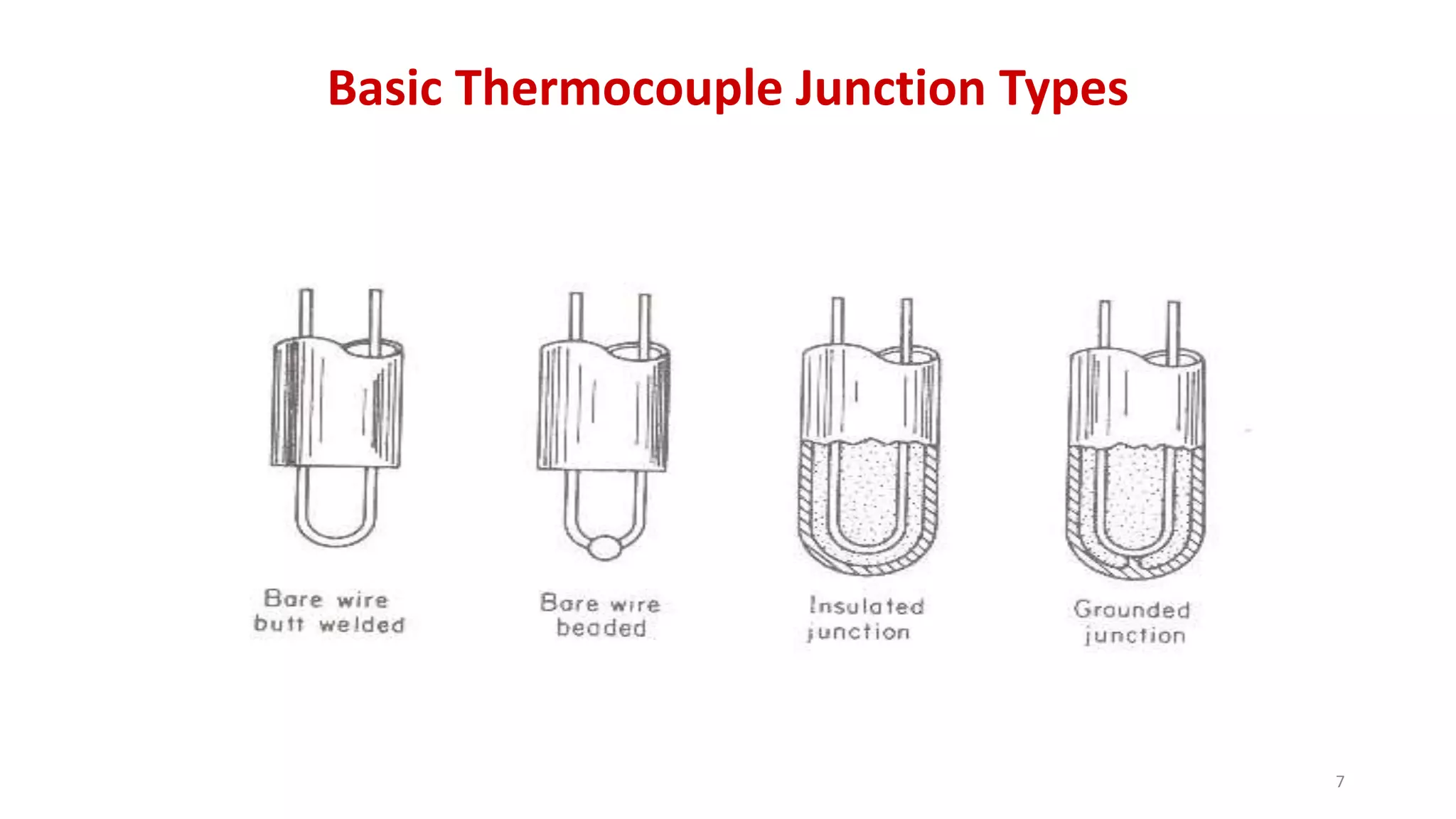
Basic Thermocouple Junction Types
8
Thermocouple configuration
Thermocouple Types
10
Thermocouple Laws
11
12
13
14
15
Thermo Electric Generator
(Simple Arrangement)
Thermocouple connected in series to
increase voltage
General Schematic of Thermoelectric Converter
Peltier Effect
• When an electric current flows across an isothermal junction of two
dissimilar materials, there is evolution or absorption of heat at the
junction
• Its a reversible effect
• If heat is evolved when the current flows in on direction, the same amount of
heat is absorbed at the junction if the current is also reversed
Peltier Effect
• α1-2 : Peltier coefficient
• Defined as: Heat evolved or absorbed at the junction per unit curret flow,
per unit time
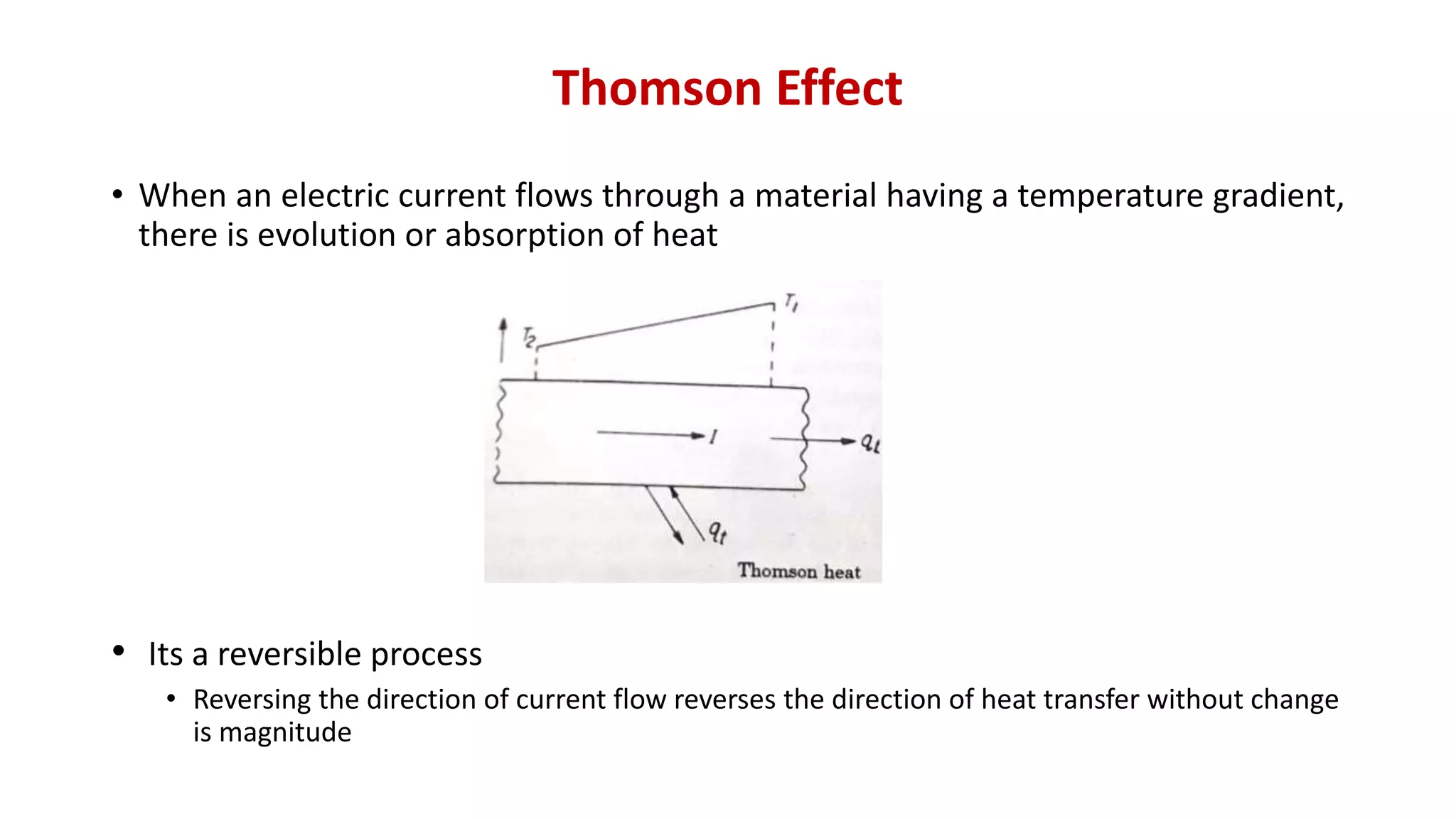
Thomson Effect
• When an electric current flows through a material having a temperature gradient,
there is evolution or absorption of heat
• Its a reversible process
• Reversing the direction of current flow reverses the direction of heat transfer without change
is magnitude
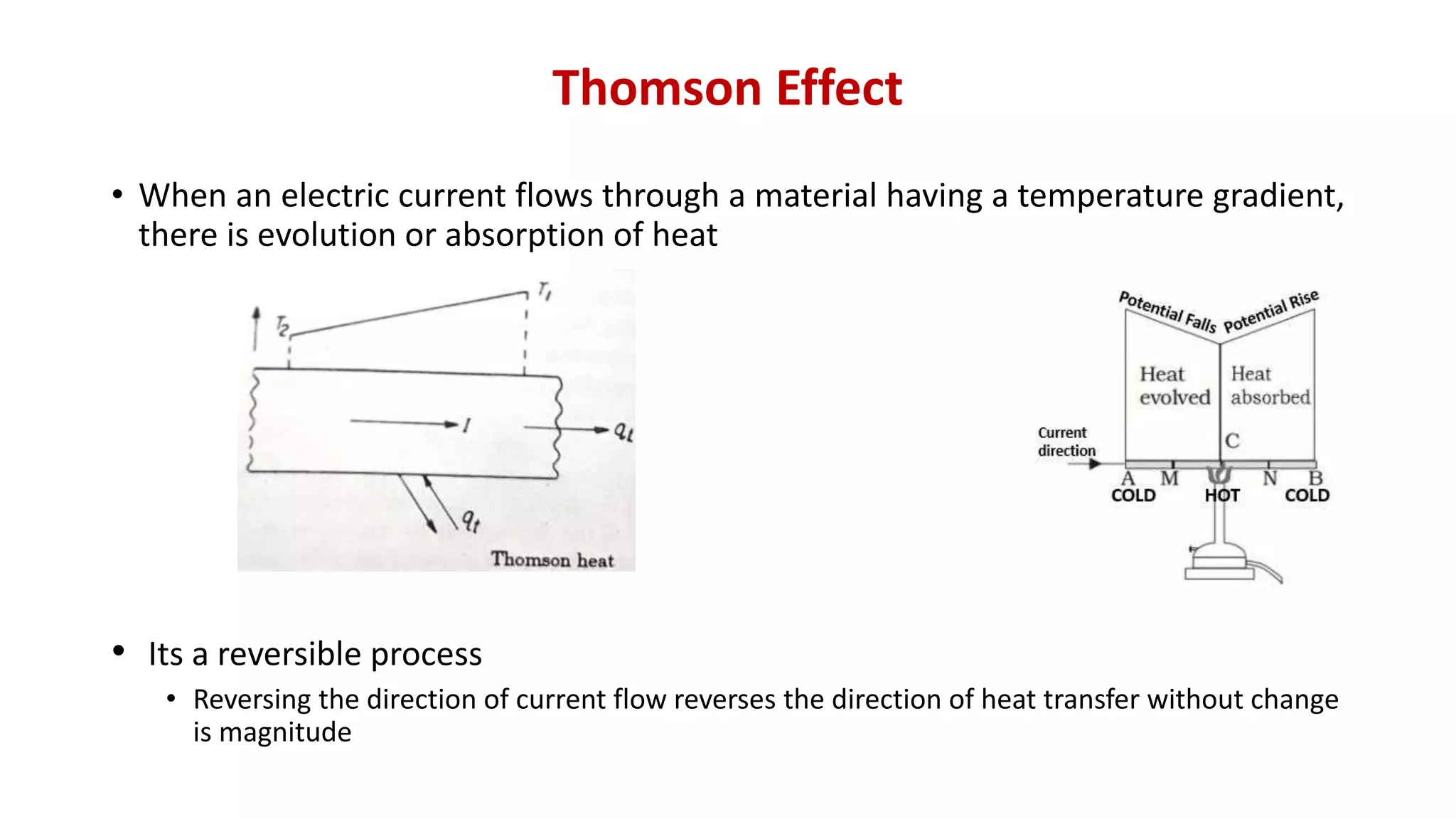
Thomson Effect
• When an electric current flows through a material having a temperature gradient,
there is evolution or absorption of heat
• Its a reversible process
• Reversing the direction of current flow reverses the direction of heat transfer without change
is magnitude
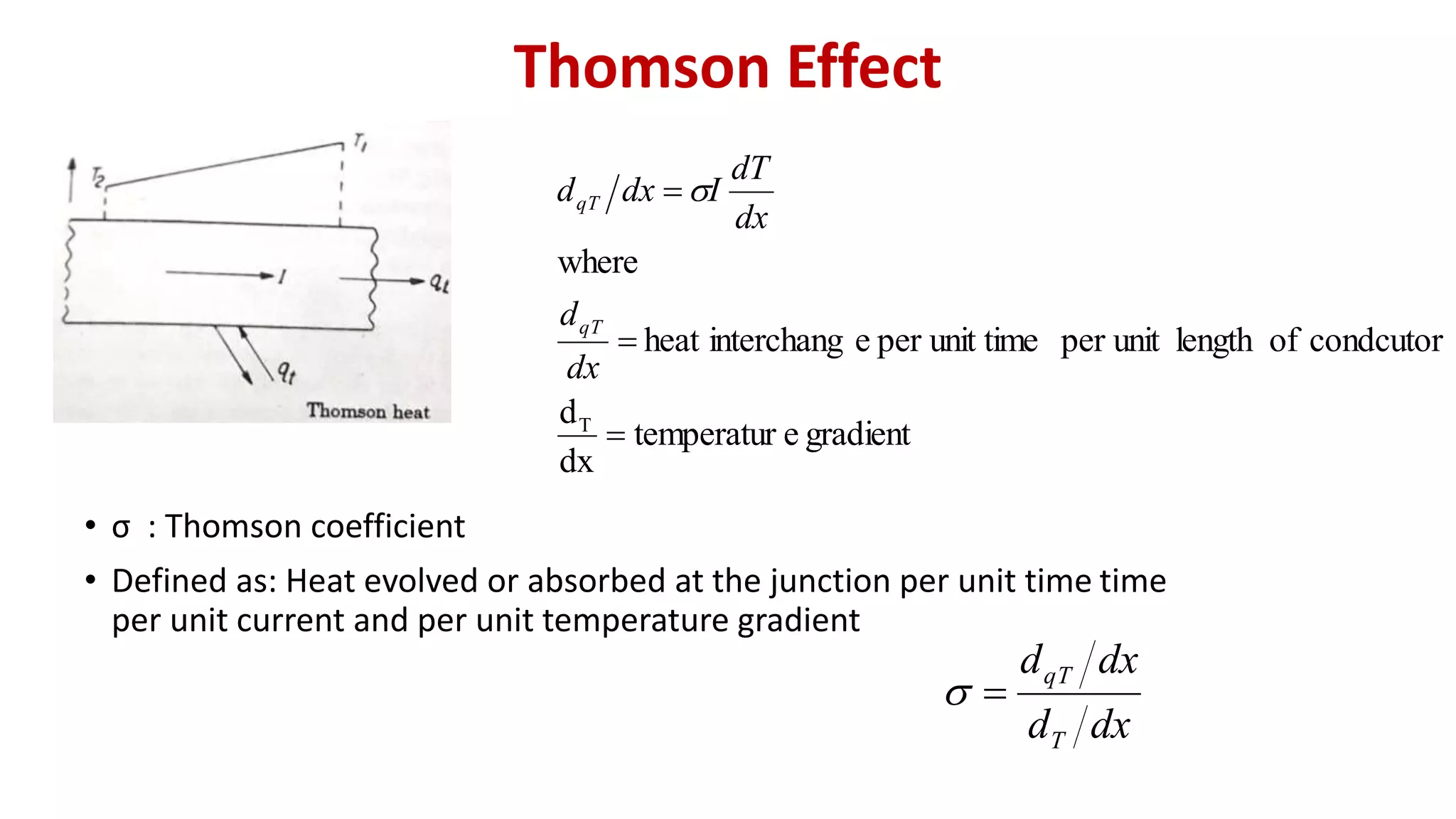
Thomson Effect
• σ : Thomson coefficient
• Defined as: Heat evolved or absorbed at the junction per unit time time
per unit current and per unit temperature gradient
dx
d
dx
d
T
qT


gradient
e
temperatur
dx
d
condcutor
of
length
unit
per
unit time
per
e
interchang
heat
where
T



dx
d
dx
dT
I
dx
d
qT
qT 
Summary
dx
dT
I
dx
dqT 

General Schematic of Thermoelectric Converter
Unit 2_Thermoelectric effect.pptx

Unit 2_Thermoelectric effect.pptx

  • 1.
    Unit-2 Direct EnergyConversion Principles and Types Thermo Electric Generators • Seeback effect • Peltier effect • Thomson effect • Thermoelectric convertors • Brief description of the construction of thermoelectric generator
  • 2.
    Introduction • The pioneerin thermoelectrics was a German scientist Thomas Johann Seebeck (1770-1831) • Thermoelectricity refers to a class of phenomena in which a temperature difference creates an electric potential or an electric potential creates a temperature difference. • Thermoelectric power generator is a device that converts the heat energy into electrical energy based on the principles of Seebeck effect • Later, In 1834, French scientist, Peltier and in 1851, Thomson (later Lord Kelvin) described the thermal effects on conductors
  • 3.
    Thermo electric Generator •The pioneer in thermoelectrics was a German scientist Thomas Johann Seebeck (1770-1831) • Thermoelectricity refers to a class of phenomena in which a temperature difference creates an electric potential or an electric potential creates a temperature difference. • Thermoelectric power generator is a device that converts the heat energy into electrical energy based on the principles of Seebeck effect • Later, In 1834, French scientist, Peltier and in 1851, Thomson (later Lord Kelvin) described the thermal effects on conductors
  • 4.
  • 5.
  • 6.
  • 7.
  • 8.
  • 9.
  • 10.
  • 11.
  • 12.
  • 13.
  • 14.
  • 15.
  • 16.
  • 17.
    Thermocouple connected inseries to increase voltage
  • 18.
    General Schematic ofThermoelectric Converter
  • 19.
    Peltier Effect • Whenan electric current flows across an isothermal junction of two dissimilar materials, there is evolution or absorption of heat at the junction • Its a reversible effect • If heat is evolved when the current flows in on direction, the same amount of heat is absorbed at the junction if the current is also reversed
  • 20.
    Peltier Effect • α1-2: Peltier coefficient • Defined as: Heat evolved or absorbed at the junction per unit curret flow, per unit time
  • 21.
    Thomson Effect • Whenan electric current flows through a material having a temperature gradient, there is evolution or absorption of heat • Its a reversible process • Reversing the direction of current flow reverses the direction of heat transfer without change is magnitude
  • 22.
    Thomson Effect • Whenan electric current flows through a material having a temperature gradient, there is evolution or absorption of heat • Its a reversible process • Reversing the direction of current flow reverses the direction of heat transfer without change is magnitude
  • 23.
    Thomson Effect • σ: Thomson coefficient • Defined as: Heat evolved or absorbed at the junction per unit time time per unit current and per unit temperature gradient dx d dx d T qT   gradient e temperatur dx d condcutor of length unit per unit time per e interchang heat where T    dx d dx dT I dx d qT qT 
  • 24.
  • 25.
    General Schematic ofThermoelectric Converter