PRESENTATION ON THERMODYNAMICS
PRESENTED TO
NARGIS ARA
ASSOCIATE PROFESSOR
DEPARTMENT OF PHARMACY
UNIVERSITY OF DEVELOPMENT ALTERNATIVE
Group Members
Name ID
1. Farzana Akter Jami 032182014
2. Srijita Dafadar 032182010
3. Mst Rammi Khatun 032182012
4. Shamima Nasrin Bithi 032182011
5. Rakibul Hasan 032182015
INTRODUCTORY
 The word thermodynamics was
coined in 1840 from Greek word
therme meaning heat and dynamis
meaning power.
 It is the science of the relationship
between heat, work, temperature and
energy.
 It deals with the transfer of energy
from one place to another and from
one form to another.
BASIC CONCEPTS AND
THERMODYNAMIC TERMS
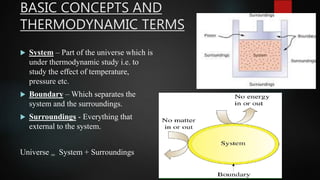
 System – Part of the universe which is
under thermodynamic study i.e. to
study the effect of temperature,
pressure etc.
 Boundary – Which separates the
system and the surroundings.
 Surroundings - Everything that
external to the system.
Universe = System + Surroundings
THERMODYNAMIC TERMS
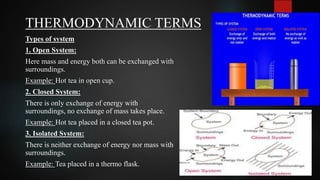
Types of system
1. Open System:
Here mass and energy both can be exchanged with
surroundings.
Example: Hot tea in open cup.
2. Closed System:
There is only exchange of energy with
surroundings, no exchange of mass takes place.
Example: Hot tea placed in a closed tea pot.
3. Isolated System:
There is neither exchange of energy nor mass with
surroundings.
Example: Tea placed in a thermo flask.
CLASSIFICATION OF SYSTEM ON THE BASIS OF
NATURE OF CONSTITUENTS
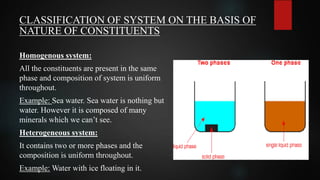
Homogenous system:
All the constituents are present in the same
phase and composition of system is uniform
throughout.
Example: Sea water. Sea water is nothing but
water. However it is composed of many
minerals which we can’t see.
Heterogeneous system:
It contains two or more phases and the
composition is uniform throughout.
Example: Water with ice floating in it.
INTENSIVE AND EXTENSIVE
PROPERTIES
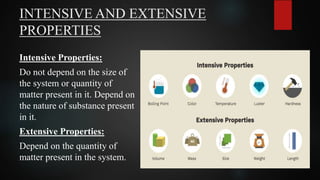
Intensive Properties:
Do not depend on the size of
the system or quantity of
matter present in it. Depend on
the nature of substance present
in it.
Extensive Properties:
Depend on the quantity of
matter present in the system.
PROCESS
When state of system changes then process is
said to occur. The first and last state of process
are called initial and final state respectively.
There are certain processes in which particular
state variable is kept constant.
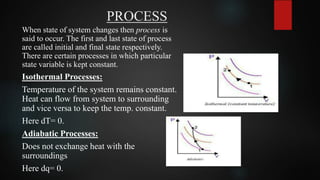
Isothermal Processes:
Temperature of the system remains constant.
Heat can flow from system to surrounding
and vice versa to keep the temp. constant.
Here dT= 0.
Adiabatic Processes:
Does not exchange heat with the
surroundings
Here dq= 0.
TYPES OF PROSSESES
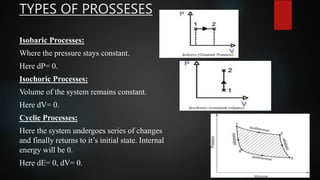
Isobaric Processes:
Where the pressure stays constant.
Here dP= 0.
Isochoric Processes:
Volume of the system remains constant.
Here dV= 0.
Cyclic Processes:
Here the system undergoes series of changes
and finally returns to it’s initial state. Internal
energy will be 0.
Here dE= 0, dV= 0.
1st LAW OF THERMODYNAMICS
Law of Conservation of Energy
 Energy can neither be created nor destroyed although it may
be converted from one form to other.
 The total energy of an isolated system remains constant though
it may change from one form to another.
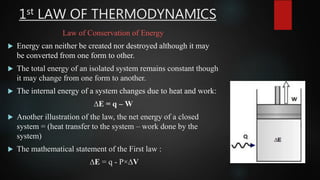
 The internal energy of a system changes due to heat and work:
∆E = q – W
 Another illustration of the law, the net energy of a closed
system = (heat transfer to the system – work done by the
system)
 The mathematical statement of the First law :
∆E = q - P×∆V
SOME SPECIAL FORMS OF 1ST LAW OF
THERMODYNAMICS
1. For a Cyclic process,
∆E = 0, q = w
2. For an adiabatic process,
dq = 0, ∆E = - w
3. For an Isochoric Process,
dV = 0, ∆E = q
4. For an Isobaric Process,
dP = 0, ∆E = q
SPONTANEOUS PROCESS AND NON
SPONTANEOUS PROCESS
Spontaneous Process:
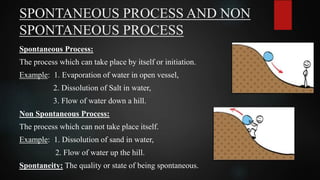
The process which can take place by itself or initiation.
Example: 1. Evaporation of water in open vessel,
2. Dissolution of Salt in water,
3. Flow of water down a hill.
Non Spontaneous Process:
The process which can not take place itself.
Example: 1. Dissolution of sand in water,
2. Flow of water up the hill.
Spontaneity: The quality or state of being spontaneous.
REVERSIBLE AND IRREVERSIBLE PROCESS
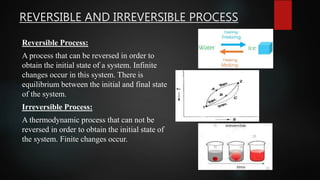
Reversible Process:
A process that can be reversed in order to
obtain the initial state of a system. Infinite
changes occur in this system. There is
equilibrium between the initial and final state
of the system.
Irreversible Process:
A thermodynamic process that can not be
reversed in order to obtain the initial state of
the system. Finite changes occur.
ENTROPY
 Entropy is a thermodynamic state
quantity that is measure of the
randomness or disorder of the
molecules of the system.
 The symbol of Entropy is S.
 It is a state function: its path
independent
S Final −Sinitial = ∆S
∆S=
𝑞
𝑇
2nd LAW OF THERMODYNAMICS
 Whenever a spontaneous process takes place, it is accompanied by
an increase in the total energy of the universe(system+surrounding).
 Another form – All natural or spontaneous process are
thermonamically irreversible in character.
3rd LAW OF THERMODYNAMICS
At absolute zero the entropy of a pure crystal is also zero.
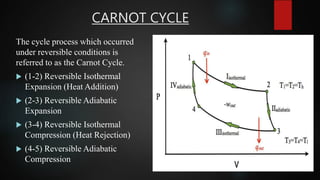
CARNOT CYCLE
The cycle process which occurred
under reversible conditions is
referred to as the Carnot Cycle.
 (1-2) Reversible Isothermal
Expansion (Heat Addition)
 (2-3) Reversible Adiabatic
Expansion
 (3-4) Reversible Isothermal
Compression (Heat Rejection)
 (4-5) Reversible Adiabatic
Compression
THANK YOU FOR BEING WITH US

Thermodynamics (bithi)

  • 1.
    PRESENTATION ON THERMODYNAMICS PRESENTEDTO NARGIS ARA ASSOCIATE PROFESSOR DEPARTMENT OF PHARMACY UNIVERSITY OF DEVELOPMENT ALTERNATIVE
  • 2.
    Group Members Name ID 1.Farzana Akter Jami 032182014 2. Srijita Dafadar 032182010 3. Mst Rammi Khatun 032182012 4. Shamima Nasrin Bithi 032182011 5. Rakibul Hasan 032182015
  • 3.
    INTRODUCTORY  The wordthermodynamics was coined in 1840 from Greek word therme meaning heat and dynamis meaning power.  It is the science of the relationship between heat, work, temperature and energy.  It deals with the transfer of energy from one place to another and from one form to another.
  • 4.
    BASIC CONCEPTS AND THERMODYNAMICTERMS  System – Part of the universe which is under thermodynamic study i.e. to study the effect of temperature, pressure etc.  Boundary – Which separates the system and the surroundings.  Surroundings - Everything that external to the system. Universe = System + Surroundings
  • 5.
    THERMODYNAMIC TERMS Types ofsystem 1. Open System: Here mass and energy both can be exchanged with surroundings. Example: Hot tea in open cup. 2. Closed System: There is only exchange of energy with surroundings, no exchange of mass takes place. Example: Hot tea placed in a closed tea pot. 3. Isolated System: There is neither exchange of energy nor mass with surroundings. Example: Tea placed in a thermo flask.
  • 6.
    CLASSIFICATION OF SYSTEMON THE BASIS OF NATURE OF CONSTITUENTS Homogenous system: All the constituents are present in the same phase and composition of system is uniform throughout. Example: Sea water. Sea water is nothing but water. However it is composed of many minerals which we can’t see. Heterogeneous system: It contains two or more phases and the composition is uniform throughout. Example: Water with ice floating in it.
  • 7.
    INTENSIVE AND EXTENSIVE PROPERTIES IntensiveProperties: Do not depend on the size of the system or quantity of matter present in it. Depend on the nature of substance present in it. Extensive Properties: Depend on the quantity of matter present in the system.
  • 8.
    PROCESS When state ofsystem changes then process is said to occur. The first and last state of process are called initial and final state respectively. There are certain processes in which particular state variable is kept constant. Isothermal Processes: Temperature of the system remains constant. Heat can flow from system to surrounding and vice versa to keep the temp. constant. Here dT= 0. Adiabatic Processes: Does not exchange heat with the surroundings Here dq= 0.
  • 9.
    TYPES OF PROSSESES IsobaricProcesses: Where the pressure stays constant. Here dP= 0. Isochoric Processes: Volume of the system remains constant. Here dV= 0. Cyclic Processes: Here the system undergoes series of changes and finally returns to it’s initial state. Internal energy will be 0. Here dE= 0, dV= 0.
  • 10.
    1st LAW OFTHERMODYNAMICS Law of Conservation of Energy  Energy can neither be created nor destroyed although it may be converted from one form to other.  The total energy of an isolated system remains constant though it may change from one form to another.  The internal energy of a system changes due to heat and work: ∆E = q – W  Another illustration of the law, the net energy of a closed system = (heat transfer to the system – work done by the system)  The mathematical statement of the First law : ∆E = q - P×∆V
  • 11.
    SOME SPECIAL FORMSOF 1ST LAW OF THERMODYNAMICS 1. For a Cyclic process, ∆E = 0, q = w 2. For an adiabatic process, dq = 0, ∆E = - w 3. For an Isochoric Process, dV = 0, ∆E = q 4. For an Isobaric Process, dP = 0, ∆E = q
  • 12.
    SPONTANEOUS PROCESS ANDNON SPONTANEOUS PROCESS Spontaneous Process: The process which can take place by itself or initiation. Example: 1. Evaporation of water in open vessel, 2. Dissolution of Salt in water, 3. Flow of water down a hill. Non Spontaneous Process: The process which can not take place itself. Example: 1. Dissolution of sand in water, 2. Flow of water up the hill. Spontaneity: The quality or state of being spontaneous.
  • 13.
    REVERSIBLE AND IRREVERSIBLEPROCESS Reversible Process: A process that can be reversed in order to obtain the initial state of a system. Infinite changes occur in this system. There is equilibrium between the initial and final state of the system. Irreversible Process: A thermodynamic process that can not be reversed in order to obtain the initial state of the system. Finite changes occur.
  • 14.
    ENTROPY  Entropy isa thermodynamic state quantity that is measure of the randomness or disorder of the molecules of the system.  The symbol of Entropy is S.  It is a state function: its path independent S Final −Sinitial = ∆S ∆S= 𝑞 𝑇
  • 15.
    2nd LAW OFTHERMODYNAMICS  Whenever a spontaneous process takes place, it is accompanied by an increase in the total energy of the universe(system+surrounding).  Another form – All natural or spontaneous process are thermonamically irreversible in character. 3rd LAW OF THERMODYNAMICS At absolute zero the entropy of a pure crystal is also zero.
  • 16.
    CARNOT CYCLE The cycleprocess which occurred under reversible conditions is referred to as the Carnot Cycle.  (1-2) Reversible Isothermal Expansion (Heat Addition)  (2-3) Reversible Adiabatic Expansion  (3-4) Reversible Isothermal Compression (Heat Rejection)  (4-5) Reversible Adiabatic Compression
  • 17.
    THANK YOU FORBEING WITH US