Chemical
Thermodynamics
JAWAHAR NAVODAYA VIDYALAYA
PAPROLA DISTT KANGRA[H.P]
UNIT-6
THERMODYNAMICS
WELCOME
LESSON BY :
RANJAN KUMAR
PGT CHEMISTRY
CLASS XI
SCIENCE
Chemical
Thermodynamics
2
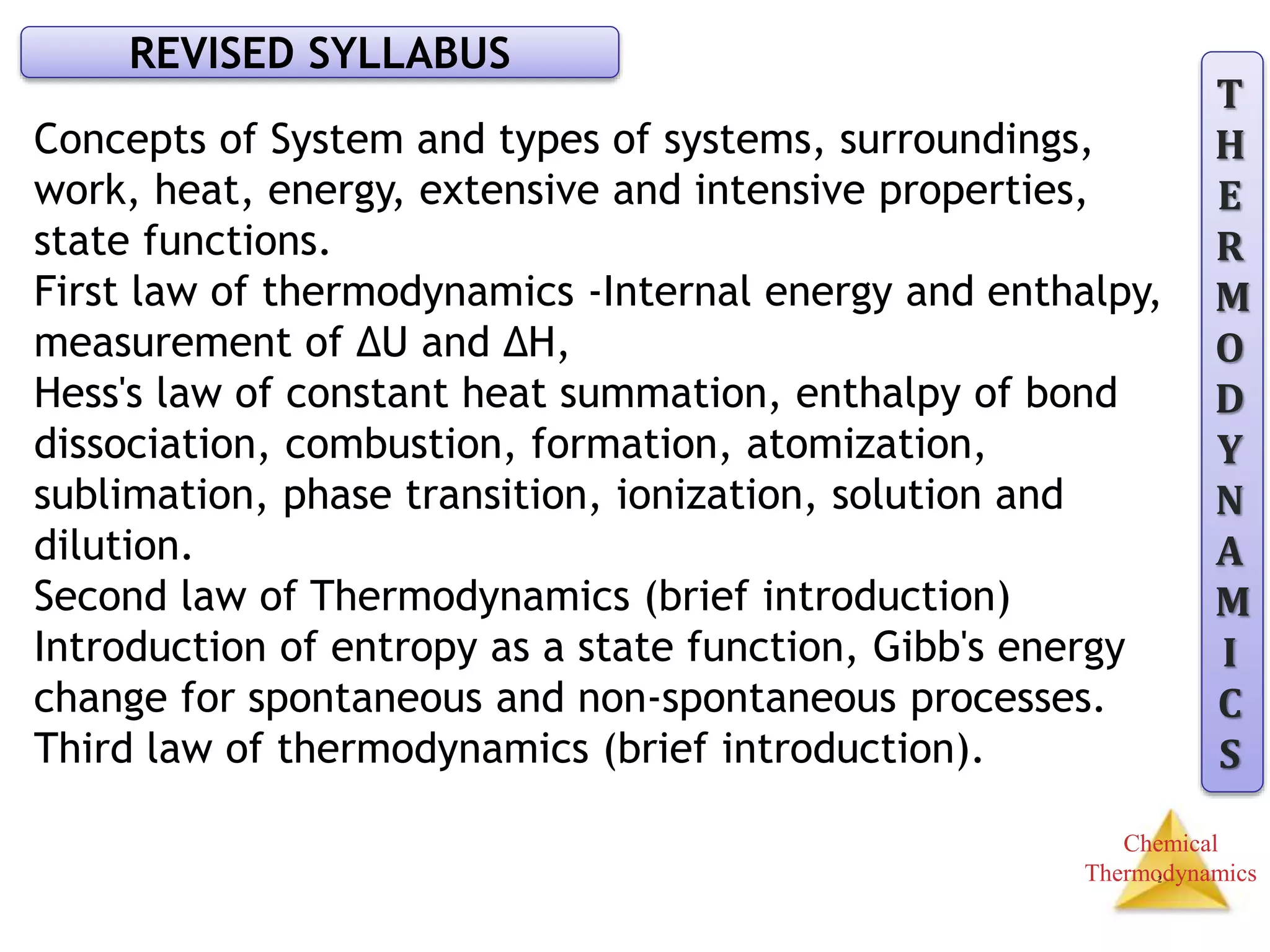
Concepts of System and types of systems, surroundings,
work, heat, energy, extensive and intensive properties,
state functions.
First law of thermodynamics ‐Internal energy and enthalpy,
measurement of ΔU and ΔH,
Hess's law of constant heat summation, enthalpy of bond
dissociation, combustion, formation, atomization,
sublimation, phase transition, ionization, solution and
dilution.
Second law of Thermodynamics (brief introduction)
Introduction of entropy as a state function, Gibb's energy
change for spontaneous and non‐spontaneous processes.
Third law of thermodynamics (brief introduction).
REVISED SYLLABUS
T
H
E
R
M
O
D
Y
N
A
M
I
C
S
Chemical
Thermodynamics
Rub your hands together for few seconds.
Are your hands warm?
Thermal energy
Chemical
Thermodynamics
Thermodynamics
The study of the effects of work, heat
flow, and energy on a system
Movement of thermal energy
SYSTEM
SURROUNDINGS
BOUNDARY
Chemical
Thermodynamics
OBJECTIVES
• To predict flexibility of a process under
a given set of conditions
• To predict whether a reaction is
spontaneous or not.
• It is a state function and not a path
function.i.e; it depends on initial and
final states
Chemical
Thermodynamics
INTRODUCTION
• Thermodynamics is the branch of science
that deals with the study of inter conversion
of heat with other forms of energy during
physical and chemical processes.
• It mainly deals with transformation of
energy.
• All physical and chemical processes are
accompanied by the absorption liberation
and conversion or redistribution of energy.
Chemical
Thermodynamics
Certain Terms
• System-is a specified portion of universe which is
under thermodynamic study and is separated from
the universe with a definite boundary. Eg- the earth
is a system .
• Surroundings- is the portion of the universe
excluding the system which is capable of
exchanging energy and matter with the system eg:-
the entire universe excluding the earth forms the
earth`s surrounding .
Boundary- the real or imaginary surface that
separates the system from the surrounding . Eg:-
the atmosphere can be considered as earth`s
boundary from the universe.
Chemical
Thermodynamics
TYPES OF SYSTEMS
• There are three types of systems
1.Open System
2. Closed System
3. Isolated system
Chemical
Thermodynamics
OPEN SYSTEM
An open system is a system which can
exchange both matter and energy with
the surrounding. Eg:-water in an open
beaker is an open system as it can
exchange both energy and matter with
the surrounding
Chemical
Thermodynamics
OPEN SYSTEM
Chemical
Thermodynamics
CLOSED SYSTEM
• A closed system is one which can
exchange energy but not matter with the
surroundings. Eg:- Hot water in contact
with its vapour in a closed container.
Chemical
Thermodynamics
CLOSED SYSTEM
Chemical
Thermodynamics
ISOLATED SYSTEM
• An isolated system is a system which
can neither exchange matter nor energy
with the surroundings. Eg:- Water in
contact with its vapour in a closed
insulated vessel is an isolated system.
Chemical
Thermodynamics
ISOLATED SYSTEM
Chemical
Thermodynamics
THERMODYNAMIC PROCESSES
• A process is an operation which
brings about changes in the state of
a system. It is accompanied by the
changes in energy and mass .
Standard state :- The state of a
system at 298K and 101.3 kPa
pressure is known as standard
state of a system .
Chemical
Thermodynamics
TYPES OF PROCESSES
1. Isothermal process
2. Adiabatic process
3. Isobaric process
4. Isochoric process
5. Reversible process
6. Irreversible process
7. Cyclic process
Chemical
Thermodynamics
ISOTHERMAL PROCESS
• Isothermal process is a process
during which the temperature of a
system is constant . It is a process
carried out in a closed vessel . For
an isothermal process , dT=0 . Eg
:- the melting and solidification of
wax at the same temperature is an
isothermal process .
Chemical
Thermodynamics
ADIABATIC PROCESS
• Adiabatic process is a process
during which no heat is exchanged
between the surrounding and the
system . Adiabatic process is
carried out in an isolated vessel .
For an a adiabatic process , dq=0 .
Eg :- Bursting of a high pressure
tyre tube is close enough to an
adiabatic process
Chemical
Thermodynamics
ISOBARIC PROCESS
• It is a process during which the
pressure remains constant .
They are carried out in an open
process .
• For an isobaric process , dP=0 .
Eg :- A chemical reaction carried
out in a test tube .
Chemical
Thermodynamics
ISOCHORIC PROCESS
• It is a process where
volume remains constant .
It is carried out in a closed
vessel .
• For an isochoric process ,
dV=0
Chemical
Thermodynamics
REVERSIBLE PROCESSES
In a reversible process the
system changes in such a
way that the system and
surroundings can be put
back in their original states
by exactly reversing the
process.
Changes are infinitesimally
small in a reversible
process.
Chemical
Thermodynamics
IRREVERSIBLE PROCESSES
• Irreversible processes cannot be undone by
exactly reversing the change to the system.
• All Spontaneous processes are irreversible.
• All Real processes are irreversible.
Chemical
Thermodynamics
CYCLIC PROCESS
• A process during which the
system undergoes a series of
changes and returns to its initial
state . Eg :- Water cycle ,
Carbon dioxide cycle .
Chemical
Thermodynamics
PROPERTIES OF THE SYSTEM
• INTENSIVE PROPERTY of a system is a
property of a system which does not depend
on the quantity of substance present in the
system. For example : density , viscocity ,
surface tension , pressure, temperature and
many more…..
• EXTENSIVE PROPERTY of a system is a
system which depends upon the quantity of
substance present in the system .for
example mass , volume , energy ,enthalpy
and many more……..
Chemical
Thermodynamics
THERMODYNAMIC PARAMETER
• INTERNAL ENERGY
It is the energy possessed by the system due
to its nature chemical composition and
thermodynamic state . Its value depends on
the mass of the system and its state . It is
made up of a number of energies like kinetic ,
nuclear , translational and many more . It is an
extensive property. Its definite vale cannot be
determined but change in internal energy can .
It is directly proportional to the temperature of
the system
Chemical
Thermodynamics
Chemical
Thermodynamics
Chemical
Thermodynamics
Heat is also transferred between system and
surrounding in two ways –
reversible and irreversible.
Reverssible heating means heating an object
from Ti to Tf using infinite heat reservoirs.
Irreverssible heat transfer means heat transfer
across temp difference T.
Heating an object from 100 K to 1000 K by
using heat reservoir of temperature 1000 K is
an example of irreverssible heating.
While heating an object from 100 to 1000 K
using reservoir of temp 100 + dT, 100 + 2dT,
......... 1000 – dT, 1000 K is an example of
reversible heating.
You can clearly see reversible heating is
hypothetical concept.
Work can be of many types : The following
table show different kinds of work.
Chemical
Thermodynamics
All natural processes are example of irreversible process.
Reversible process VS Irreversible process
Driving force is infinitesimally small.
(1)Driving force is large and finite.
(2)PV work is done across pressure difference
(3)PV work is done across pressure difference d P P
(4)A reversible heat transfer take place across
(5) Irrerversible heat transfer take place across temperature difference dT temperature
difference T
(6)It is an ideal process. (4) It is a real process.
(7)It takes infinite time for completion of process. (5) It takes finite time for completion
of process..
(8)It is an imaginary process and can not be (6) It is a natural process
and occurs in realised in actual practice. particular direction under given set of
conditions.
The system is far removed from state of infinitesimally closer to state of equilibrium and
exact path of process is and exact path of process can be drawn indeterminate.
Chemical
Thermodynamics
LAWS OF THERMODYNAMICS
• There are four laws of
thermodynamics namely :
• First law of thermodynamics
• Second law of thermodynamics
• Third law of thermodynamics
• Zeroth law of thermodynamics
Chemical
Thermodynamics
FIRST LAW OF THERMODYNAMICS
• Energy cannot be created nor destroyed.
• Therefore, the total energy of the
universe is a constant.
• Energy can, however, be converted from
one form to another or transferred from a
system to the surroundings or vice versa.
Chemical
Thermodynamics
FIRST LAW OF THERMODYNAMICS
• Mathematical form of the law is
 ∆U= q + W
where ∆ U is change in internal
energy , q is heat energy and W is
work done on the system .
Chemical
Thermodynamics
1st Law of Thermodynamics
Example: Using a bicycle pump
Pumping the handle results in what?
Applying mechanical energy into the
system
Mechanical energy is converted into
thermal energy through friction (the pump
becomes hot)
The total increase in internal energy of
the system is equal to what?
The applied mechanical energy ©iStockphoto.com
Chemical
Thermodynamics
PRESSURE VOLUME WORK
• PV-WORK
• Consider a clylinder fitted with a frictionless piston, which
enclosed n mole of an ideal gas.
• Let an external force F pushes the piston inside producing
displacement in piston.
• Let distance of piston from a fixed point is x and distance of
bottom of piston at the same fixed point is l . This means the
volume of cylinder = ( l – x)A where A is area of cross section of
piston.
• dw = F.dx
• For a small displacement dx due to force F ,
• work done on the system.
Chemical
Thermodynamics
CONTINUE
• Also P =F.A
• F = PA
• dW = PA.dx
• V = (l– x) A
• dV = – A . dx
• dW = – Pext. dV
During expansion dV is +ive and hence
sign of w is -ive
since work is done by the system and -
ive sign representing decrese in energy
content of system.
During compression, the sign of dV is -
ive which gives +ive value of w
representing the increase in energy
content of system during compression.
Chemical
Thermodynamics
SIGN CONVENTION
• The following are the sign convention
used according to IUPAC
1.Heat absorbed by system , q is +ve
2.Heat evolved by the system ,q is –ve
3.Work done on the system , w is +ve
4.Work done by the system , w is -ve
Chemical
Thermodynamics
WORK DONE IN AN
ISOTHERMAL PROCESS
• When an ideal gas undergoes compression or
rarefaction , temperature of system is constant
therefore internal energy is zero
• dU = q+W 0=q+w w=-q
• Hence the mechanical work done during isothermal
change is equal to the quantity of heat absorbed or
evolved by the system.
• Mechanical work done in an isothermal process for an
ideal gas is given by
• W=-2.303 nRT log V2/V1(or P1/P2)for n moles of gas
.
Chemical
Thermodynamics
NUMERICAL PROBLEMS
• In a certain process, 600 J of work is done on the
system which gives off 250 J of heat. What is the
change in internal energy for the process?
• Solution:
?
Chemical
Thermodynamics
NUMERICAL PROBLEMS
• In a certain process, 6000 J of heat is
added to a system while the system does
work equivalent to 9000 J by expanding
against the surrounding atmosphere. What
is the change in internal energy for the
system?
• SOLUTION:
?
Chemical
Thermodynamics
NUMERICAL PROBLEMS
• In a certain process, 675 J of heat is
absorbed by a system while 290 J of work is
done on the system. What is the change in
internal energy for the process?
• SOLUTION:
?
Chemical
Thermodynamics
CAN YOU SOLVE IT?
• Calculate q, w, ∆U and ∆H for the reversible isothermal
expansion of one mole of an ideal gas at 37oC from a
volume of 20dm3 to a volume of 30 dm3
SOLUTION:
Temperature T = 37oC = 37 + 273 = 310 K
Since the process is Isothermal,
Therefore, ∆U=0 and ∆H = 0 (as for an isothermal expansion of
an ideal gas ∆U=0 and ∆H = 0)
As work done in reversible isothermal expansion is given by:
w= -nRT 2.303log (V2/ V1)
= – (1 mol) (8.314 J K-1 mol-1) (310 K) 2.303log (30 dm3 / 20dm3)
= – 1045.02 J
From first law, ∆U= q + w
Since ∆U=0, q = – w = 1045.02 J
Chemical
Thermodynamics
Its for you to solve!
• Calculate q, w, ∆U and ∆H for the reversible isothermal
expansion of one mole of an ideal gas at 27oC from a
volume of 50dm3 to a volume of 70 dm3
SOLUTION:
Temperature T = 27oC = 27 + 273 = 290 K
Since the process is Isothermal,
Therefore, ∆U=0 and ∆H = 0 (as for an isothermal expansion of
an ideal gas ∆U=0 and ∆H = 0)
As work done in reversible isothermal expansion is given by:
w= -nRT 2.303log (V2/ V1)
= – (1 mol) (8.314 J K-1 mol-1) (290 K) 2.303log (70 dm3 / 50dm3)
= ?
From first law, ∆U= q + w
Since ∆U=0, q = – w = ? J
Chemical
Thermodynamics
RECAPITULATION
• Isothermal process : dT=0 or ∆T = 0
• Adiabatic process : dq=0 or ∆q = 0
• Isobaric process : dP=0 or ∆P = 0
• Isochoric process : dV=0 or ∆V = 0
• First law of thermodynamics
∆U = q+W
Chemical
Thermodynamics
RECAPITULATION
• SIGN CONVENTION
• Heat absorbed by system , q is +ve
• Heat evolved by the system ,q is –ve
• Work done on the system , w is +ve
• Work done by the system , w is -ve
• Work done in an isothermal process
• W=-2.303 nRT log V2/V1(or P1/P2)
• for n moles of gas
Chemical
Thermodynamics
HOME ASSIGNMENT
• QUESTION 1:
In a certain process, 3000 J of heat is added to
a system while the system does work
equivalent to 5000 J by expanding against the
surrounding atmosphere. What is the change
in internal energy for the system?
• QUESTION 2:
Calculate q, w, ∆U and ∆H for the reversible
isothermal expansion of one mole of an ideal
gas at 50oC from a volume of 40dm3 to a
volume of 80 dm3?
Chemical
Thermodynamics
ENTHALPY H = U+PV
Chemical reactions are generally carried out at constant
pressure (atmospheric pressure) so it has been found
useful to define a new state function Enthalpy (H) as :
H = U + PV (By definition)
Chemical
Thermodynamics
CHANGE IN ENTHALPY
• H =U + (PV)
• ∆ H =∆ U+ ∆(P V) (at constant pressure)
• ∆ H =∆ U + P ∆ V
• P V = nRT
• P ∆ V = ∆ (nRT)
• P ∆ V = ∆ ng (RT)
• ∆ H = ∆ U + ∆ ng (RT)
• Under what conditions ∆ H = ∆ U
THINK
Chemical
Thermodynamics
HESS'S LAW OF CONSTANT HEAT
SUMMATION (OR JUST HESS'S LAW)
• states that regardless of the multiple stages or
steps of a reaction, the total enthalpy change for
the reaction is the sum of all changes.
• This law is a manifestation that enthalpy is
a state function.
The heat of any reaction ΔHf° for a specific reaction is equal
to the sum of the heats of reaction for any set of reactions
which in sum are equivalent to the overall reaction
Chemical
Thermodynamics
HESS'S LAW OF CONSTANT HEAT
SUMMATION (OR JUST HESS'S LAW)
Chemical
Thermodynamics
HESS'S LAW OF CONSTANT HEAT
SUMMATION (OR JUST HESS'S LAW)
Chemical
Thermodynamics
The enthalpy of a reaction does not depend on the elementary steps, but on the
final state of the products and initial state of the reactants. Enthalpy is an
extensive property and hence changes when the size of the sample changes. This
means that the enthalpy of the reaction scales proportionally to the moles used in
the reaction. For instance, in the following reaction, one can see that doubling the
molar amounts simply doubles the enthalpy of the reaction.
• H2 (g) + 1/2O2 (g) → H2O (g) ΔH° = -572 kJ
• 2H2 (g) + O2 (g) → 2H2O (g) ΔH° = -1144kJ
The sign of the reaction enthalpy changes when a process is reversed.
• H2 (g) + 1/2O2 (g) → H2O (g) ΔH° = -572 kJ
• When switched:
• H2O (g) → H2 (g) + 1/2O2 (g) ΔH° = +572 kJ
• Since enthalpy is a state function, it is path independent. Therefore, it
does not matter what reactions one uses to obtain the final reaction.
Chemical
Thermodynamics
ENTHALPY OF BOND DISSOCIATION
Enthalpy of bond dissociation is defined as the enthalpy
change when one mole of covalent bonds of a gaseous
covalent compound is broken to form products in the gaseous
phase.
Generally, enthalpy of bond dissociation values differ from
bond enthalpy values which is the average of some of all the
bond dissociation energy in a molecule except, in case
of diatomic molecules.
For example:
Cl2(g)→2Cl(g) ∆Cl–ClH0 = 242kJmol−1
Chemical
Thermodynamics
ENTHALPY OF COMBUSTION
Standard enthalpy of combustion is defined as the enthalpy
change when one mole of a compound is completely burnt in
oxygen with all the reactants and products in their standard
state under standard conditions (298K and 1 bar pressure).
For example:
∆CH0 = -286 kJmol−1
H2(g)+1/2O2(g)→H2O(l)
C4H10(g)+13/2O2(g)→4CO2(g)+5H2O(l) ∆CH0 = -2658 kJmol−1
Chemical
Thermodynamics
ENTHALPY OF FORMATION
Standard enthalpy of formation is defined as the enthalpy
change when one mole of a compound is formed from its
elements in their most stable state of aggregation (stable state
of aggregation at temperature: 298.15k, pressure: 1 atm).
For example formation of methane from carbon and hydrogen:
∆fH0 = -74.81 kJmol−1
C(graphite,s)+2H2(g)→CH4(g) ;
Enthalpy of formation is basically a special case of standard
enthalpy of reaction where two or more reactants combine to
form one mole of the product. Let us take an example of
formation of hydrogen bromide from hydrogen and bromine.
H2(g)+Br2(l)→2HBr(g) ; ∆rH0 = -72.81 kJmol−1
∆rH0 = 2∆fH0 ∆rH0 = Enthalpy of reaction
∆fH0 = Enthalpy of formation
Chemical
Thermodynamics
ENTHALPY OF ATOMIZATION
Enthalpy of atomization, ΔaH0, is the change in enthalpy when
one mole of bonds is completely broken to obtain atoms in the
gas phase.
For example: atomization of methane molecule
∆aH0 = 1665 kJmol−1
CH4 (g) → C (g) + 4H (g)
For diatomic molecules, enthalpy of atomization is equal to the
enthalpy of bond dissociation. For example: atomization of
dihydrogen molecule
H2 (g) → 2H (g) ∆aH0 = 435 kJmol−1
Chemical
Thermodynamics
ENTHALPY OF SOLUTION
Enthalpy of solution, ΔsolH0 is the enthalpy change when one
mol of a substance is completely dissolved in a solvent.
For example:
enthalpy of dissolution of ionic compound in water.
CuSO4 (s) + 5H2O(l)→ CuSO4 .5H2O(aq)
NaCl (s) + H2O(l)→ NaCl(aq)
Chemical
Thermodynamics
ENTHALPY OF BOND DISSOCIATION
ENTHALPY OF COMBUSTION
ENTHALPY OF FORMATION
ENTHALPY OF ATOMIZATION
ENTHALPY OF SOLUTION AND DILUTION.
Enthalpy of bond dissociation is defined as the enthalpy change when one mole of covalent
bonds of a gaseous covalent compound is broken to form products in the gaseous phase.
Standard enthalpy of combustion is defined as the enthalpy change when one mole of a
compound is completely burnt in oxygen with all the reactants and products in their
standard state under standard conditions (298K and 1 bar pressure).
Standard enthalpy of formation is defined as the enthalpy change when one mole of a compound is
formed from its elements in their most stable state of aggregation (stable state of aggregation at
temperature: 298.15k, pressure: 1 atm)
Enthalpy of atomization, ΔaH0, is the change in enthalpy when one mole
of bonds is completely broken to obtain atoms in the gas phase.
Enthalpy of solution, ΔsolH0 is the enthalpy change when one mol of a
substance is completely dissolved in a solvent. For example:enthalpy of
dissolution of ionic compound in water.
Chemical
Thermodynamics
PHASE
TRANSITION
ENTHALPY OF FUSION
ENTHALPY OF
VAPOURISATION
ENTHALPY OF
SUBLIMATION
The amount of heat change when one mole
of solid is converted into its liquid state at
its melting point is called ------
The amount of heat change when one mole of
liquid is converted into its gaseous state at its
boiling point is called ----
The amount of heat change when one mole
of solid is directly converted into its gaseous
state without changing to its liquid state
below its melting point is called ----
Chemical
Thermodynamics
SECOND LAW OF THERMODYNAMICS
(BRIEF INTRODUCTION)
The second law of thermodynamics says that when energy changes from one
form to another form, or matter moves freely, entropy (disorder) in a
closed system increases.
It is impossible to construct a device that produces no other effect than
transfer of heat from lower temperature body to higher temperature body
The second law of thermodynamics states that the total entropy of an
isolated system can never decrease over time, and is constant if and only if
all processes are reversible. Isolated systems spontaneously evolve towards
thermodynamic equilibrium, the state with maximum entropy.
The Second Law of Thermodynamics states that the state of entropy of the
entire universe, as an isolated system, will always increase over time. The
second law also states that the changes in the entropy in the universe can
never be negative.
Chemical
Thermodynamics
ENTROPY entropy means disorder or chaos.
the degree of disorder or uncertainty
in a system
UNIT
JK-1MOL-1
Entropy refers to the number of ways in which a system can be arranged.
Moreover, the higher the entropy the more disordered the system will
become.
Furthermore, we can understand it more easily with the help of an
example.
Suppose you sprayed perfume in one corner of the room.
So, what will happen next?
We all know that the smell will spread in the entire room and the
perfume molecule will eventually fill the room.
Entropy is the measure of disorders or randomness of the particular system. Since it
depends on the initial and final state of the system, the absolute value of entropy cannot be
determined. You need to consider the difference between the initial and final state to
determine the change in entropy.
Chemical
Thermodynamics
The change in Entropy Formula is expressed as
According to the thermodynamic definition, entropy is based on
change in entropy (ds) during physical or chemical changes and
expressed as
For change to be measurable between initial and final state, the
integrated expression is
Chemical
Thermodynamics
PHASE
TRANSITION
ENTROPY OF FUSION
ENTROPY OF
VAPOURISATION
ENTROPY OF
SUBLIMATION
The amount of ENTROPY change when one
mole of solid is converted into its liquid
state at its melting point is called ------
The amount of ENTROPY change when one
mole of liquid is converted into its gaseous
state at its boiling point is called ----
The amount of ENTROPY change when one
mole of solid is directly converted into its
gaseous state without changing to its liquid
state below its melting point is called ----
Chemical
Thermodynamics
Gibbs Free Energy G=H-TS
A B
GA=HA-TSA GB=HB-TSB
∆G=GB-GA
∆G=(HB-TSB )– (HA-TSA)
∆G=(HB-HA )– (TSB-TSA)
∆G=(∆H )– T(∆S)
Chemical
Thermodynamics
Gibbs Free Energy
The formula for the entropy change in the surroundings is ΔSsurr=ΔHsys/T .
If this equation is replaced in the previous formula, and the equation is then
multiplied by T and by -1 it results in the following formula.
If the left side of the equation is replaced by G , which is know as Gibbs energy or
free energy, the equation becomes
Now it is much simpler to conclude whether a system is spontaneous, non-
spontaneous, or at equilibrium.
ΔH refers to the heat change for a reaction. A positive ΔH means that heat is taken
from the environment (endothermic). A negative ΔH means that heat is emitted or
given the environment (exothermic).
ΔG is a measure for the change of a system's free energy in which a reaction takes
place at constant pressure ( P ) and temperature ( T ).
Chemical
Thermodynamics
DERIVATION AND EXPLANATION
To understand why entropy increases and decreases, it is important to recognize that
two changes in entropy have to considered at all times.
The entropy change of the surroundings and the entropy change of the system itself.
Given the entropy change of the universe is equivalent to the sums of the changes in
entropy of the system and surroundings:
Since the heat absorbed by the system is the amount lost by the
surroundings,
qsys=−qsurr
Therefore, for a truly reversible process, the entropy change is
If the process is irreversible however, the entropy change is
Chemical
Thermodynamics
SPONTANEOUS AND FEASIBILITY
According to the equation, when the entropy decreases and enthalpy increases the
free energy change, ΔG , is positive and not spontaneous, and it does not matter
what the temperature of the system is. Temperature comes into play when the
entropy and enthalpy both increase or both decrease. The reaction is not
spontaneous when both entropy and enthalpy are positive and at low
temperatures, and the reaction is spontaneous when both entropy and enthalpy
are positive and at high temperatures. The reactions are spontaneous when the
entropy and enthalpy are negative at low temperatures, and the reaction is not
spontaneous when the entropy and enthalpy are negative at high temperatures.
Because all spontaneous reactions increase entropy, one can determine if the
entropy changes according to the spontaneous nature of the reaction
Chemical
Thermodynamics
THANXS

THERMODYNAMICS GOOD PPT.pptx

  • 1.
    Chemical Thermodynamics JAWAHAR NAVODAYA VIDYALAYA PAPROLADISTT KANGRA[H.P] UNIT-6 THERMODYNAMICS WELCOME LESSON BY : RANJAN KUMAR PGT CHEMISTRY CLASS XI SCIENCE
  • 2.
    Chemical Thermodynamics 2 Concepts of Systemand types of systems, surroundings, work, heat, energy, extensive and intensive properties, state functions. First law of thermodynamics ‐Internal energy and enthalpy, measurement of ΔU and ΔH, Hess's law of constant heat summation, enthalpy of bond dissociation, combustion, formation, atomization, sublimation, phase transition, ionization, solution and dilution. Second law of Thermodynamics (brief introduction) Introduction of entropy as a state function, Gibb's energy change for spontaneous and non‐spontaneous processes. Third law of thermodynamics (brief introduction). REVISED SYLLABUS T H E R M O D Y N A M I C S
  • 3.
    Chemical Thermodynamics Rub your handstogether for few seconds. Are your hands warm? Thermal energy
  • 4.
    Chemical Thermodynamics Thermodynamics The study ofthe effects of work, heat flow, and energy on a system Movement of thermal energy SYSTEM SURROUNDINGS BOUNDARY
  • 5.
    Chemical Thermodynamics OBJECTIVES • To predictflexibility of a process under a given set of conditions • To predict whether a reaction is spontaneous or not. • It is a state function and not a path function.i.e; it depends on initial and final states
  • 6.
    Chemical Thermodynamics INTRODUCTION • Thermodynamics isthe branch of science that deals with the study of inter conversion of heat with other forms of energy during physical and chemical processes. • It mainly deals with transformation of energy. • All physical and chemical processes are accompanied by the absorption liberation and conversion or redistribution of energy.
  • 7.
    Chemical Thermodynamics Certain Terms • System-isa specified portion of universe which is under thermodynamic study and is separated from the universe with a definite boundary. Eg- the earth is a system . • Surroundings- is the portion of the universe excluding the system which is capable of exchanging energy and matter with the system eg:- the entire universe excluding the earth forms the earth`s surrounding . Boundary- the real or imaginary surface that separates the system from the surrounding . Eg:- the atmosphere can be considered as earth`s boundary from the universe.
  • 8.
    Chemical Thermodynamics TYPES OF SYSTEMS •There are three types of systems 1.Open System 2. Closed System 3. Isolated system
  • 9.
    Chemical Thermodynamics OPEN SYSTEM An opensystem is a system which can exchange both matter and energy with the surrounding. Eg:-water in an open beaker is an open system as it can exchange both energy and matter with the surrounding
  • 10.
  • 11.
    Chemical Thermodynamics CLOSED SYSTEM • Aclosed system is one which can exchange energy but not matter with the surroundings. Eg:- Hot water in contact with its vapour in a closed container.
  • 12.
  • 13.
    Chemical Thermodynamics ISOLATED SYSTEM • Anisolated system is a system which can neither exchange matter nor energy with the surroundings. Eg:- Water in contact with its vapour in a closed insulated vessel is an isolated system.
  • 14.
  • 15.
    Chemical Thermodynamics THERMODYNAMIC PROCESSES • Aprocess is an operation which brings about changes in the state of a system. It is accompanied by the changes in energy and mass . Standard state :- The state of a system at 298K and 101.3 kPa pressure is known as standard state of a system .
  • 16.
    Chemical Thermodynamics TYPES OF PROCESSES 1.Isothermal process 2. Adiabatic process 3. Isobaric process 4. Isochoric process 5. Reversible process 6. Irreversible process 7. Cyclic process
  • 17.
    Chemical Thermodynamics ISOTHERMAL PROCESS • Isothermalprocess is a process during which the temperature of a system is constant . It is a process carried out in a closed vessel . For an isothermal process , dT=0 . Eg :- the melting and solidification of wax at the same temperature is an isothermal process .
  • 18.
    Chemical Thermodynamics ADIABATIC PROCESS • Adiabaticprocess is a process during which no heat is exchanged between the surrounding and the system . Adiabatic process is carried out in an isolated vessel . For an a adiabatic process , dq=0 . Eg :- Bursting of a high pressure tyre tube is close enough to an adiabatic process
  • 19.
    Chemical Thermodynamics ISOBARIC PROCESS • Itis a process during which the pressure remains constant . They are carried out in an open process . • For an isobaric process , dP=0 . Eg :- A chemical reaction carried out in a test tube .
  • 20.
    Chemical Thermodynamics ISOCHORIC PROCESS • Itis a process where volume remains constant . It is carried out in a closed vessel . • For an isochoric process , dV=0
  • 21.
    Chemical Thermodynamics REVERSIBLE PROCESSES In areversible process the system changes in such a way that the system and surroundings can be put back in their original states by exactly reversing the process. Changes are infinitesimally small in a reversible process.
  • 22.
    Chemical Thermodynamics IRREVERSIBLE PROCESSES • Irreversibleprocesses cannot be undone by exactly reversing the change to the system. • All Spontaneous processes are irreversible. • All Real processes are irreversible.
  • 23.
    Chemical Thermodynamics CYCLIC PROCESS • Aprocess during which the system undergoes a series of changes and returns to its initial state . Eg :- Water cycle , Carbon dioxide cycle .
  • 24.
    Chemical Thermodynamics PROPERTIES OF THESYSTEM • INTENSIVE PROPERTY of a system is a property of a system which does not depend on the quantity of substance present in the system. For example : density , viscocity , surface tension , pressure, temperature and many more….. • EXTENSIVE PROPERTY of a system is a system which depends upon the quantity of substance present in the system .for example mass , volume , energy ,enthalpy and many more……..
  • 25.
    Chemical Thermodynamics THERMODYNAMIC PARAMETER • INTERNALENERGY It is the energy possessed by the system due to its nature chemical composition and thermodynamic state . Its value depends on the mass of the system and its state . It is made up of a number of energies like kinetic , nuclear , translational and many more . It is an extensive property. Its definite vale cannot be determined but change in internal energy can . It is directly proportional to the temperature of the system
  • 26.
  • 27.
  • 28.
    Chemical Thermodynamics Heat is alsotransferred between system and surrounding in two ways – reversible and irreversible. Reverssible heating means heating an object from Ti to Tf using infinite heat reservoirs. Irreverssible heat transfer means heat transfer across temp difference T. Heating an object from 100 K to 1000 K by using heat reservoir of temperature 1000 K is an example of irreverssible heating. While heating an object from 100 to 1000 K using reservoir of temp 100 + dT, 100 + 2dT, ......... 1000 – dT, 1000 K is an example of reversible heating. You can clearly see reversible heating is hypothetical concept. Work can be of many types : The following table show different kinds of work.
  • 29.
    Chemical Thermodynamics All natural processesare example of irreversible process. Reversible process VS Irreversible process Driving force is infinitesimally small. (1)Driving force is large and finite. (2)PV work is done across pressure difference (3)PV work is done across pressure difference d P P (4)A reversible heat transfer take place across (5) Irrerversible heat transfer take place across temperature difference dT temperature difference T (6)It is an ideal process. (4) It is a real process. (7)It takes infinite time for completion of process. (5) It takes finite time for completion of process.. (8)It is an imaginary process and can not be (6) It is a natural process and occurs in realised in actual practice. particular direction under given set of conditions. The system is far removed from state of infinitesimally closer to state of equilibrium and exact path of process is and exact path of process can be drawn indeterminate.
  • 30.
    Chemical Thermodynamics LAWS OF THERMODYNAMICS •There are four laws of thermodynamics namely : • First law of thermodynamics • Second law of thermodynamics • Third law of thermodynamics • Zeroth law of thermodynamics
  • 31.
    Chemical Thermodynamics FIRST LAW OFTHERMODYNAMICS • Energy cannot be created nor destroyed. • Therefore, the total energy of the universe is a constant. • Energy can, however, be converted from one form to another or transferred from a system to the surroundings or vice versa.
  • 32.
    Chemical Thermodynamics FIRST LAW OFTHERMODYNAMICS • Mathematical form of the law is  ∆U= q + W where ∆ U is change in internal energy , q is heat energy and W is work done on the system .
  • 33.
    Chemical Thermodynamics 1st Law ofThermodynamics Example: Using a bicycle pump Pumping the handle results in what? Applying mechanical energy into the system Mechanical energy is converted into thermal energy through friction (the pump becomes hot) The total increase in internal energy of the system is equal to what? The applied mechanical energy ©iStockphoto.com
  • 34.
    Chemical Thermodynamics PRESSURE VOLUME WORK •PV-WORK • Consider a clylinder fitted with a frictionless piston, which enclosed n mole of an ideal gas. • Let an external force F pushes the piston inside producing displacement in piston. • Let distance of piston from a fixed point is x and distance of bottom of piston at the same fixed point is l . This means the volume of cylinder = ( l – x)A where A is area of cross section of piston. • dw = F.dx • For a small displacement dx due to force F , • work done on the system.
  • 35.
    Chemical Thermodynamics CONTINUE • Also P=F.A • F = PA • dW = PA.dx • V = (l– x) A • dV = – A . dx • dW = – Pext. dV During expansion dV is +ive and hence sign of w is -ive since work is done by the system and - ive sign representing decrese in energy content of system. During compression, the sign of dV is - ive which gives +ive value of w representing the increase in energy content of system during compression.
  • 36.
    Chemical Thermodynamics SIGN CONVENTION • Thefollowing are the sign convention used according to IUPAC 1.Heat absorbed by system , q is +ve 2.Heat evolved by the system ,q is –ve 3.Work done on the system , w is +ve 4.Work done by the system , w is -ve
  • 37.
    Chemical Thermodynamics WORK DONE INAN ISOTHERMAL PROCESS • When an ideal gas undergoes compression or rarefaction , temperature of system is constant therefore internal energy is zero • dU = q+W 0=q+w w=-q • Hence the mechanical work done during isothermal change is equal to the quantity of heat absorbed or evolved by the system. • Mechanical work done in an isothermal process for an ideal gas is given by • W=-2.303 nRT log V2/V1(or P1/P2)for n moles of gas .
  • 38.
    Chemical Thermodynamics NUMERICAL PROBLEMS • Ina certain process, 600 J of work is done on the system which gives off 250 J of heat. What is the change in internal energy for the process? • Solution: ?
  • 39.
    Chemical Thermodynamics NUMERICAL PROBLEMS • Ina certain process, 6000 J of heat is added to a system while the system does work equivalent to 9000 J by expanding against the surrounding atmosphere. What is the change in internal energy for the system? • SOLUTION: ?
  • 40.
    Chemical Thermodynamics NUMERICAL PROBLEMS • Ina certain process, 675 J of heat is absorbed by a system while 290 J of work is done on the system. What is the change in internal energy for the process? • SOLUTION: ?
  • 41.
    Chemical Thermodynamics CAN YOU SOLVEIT? • Calculate q, w, ∆U and ∆H for the reversible isothermal expansion of one mole of an ideal gas at 37oC from a volume of 20dm3 to a volume of 30 dm3 SOLUTION: Temperature T = 37oC = 37 + 273 = 310 K Since the process is Isothermal, Therefore, ∆U=0 and ∆H = 0 (as for an isothermal expansion of an ideal gas ∆U=0 and ∆H = 0) As work done in reversible isothermal expansion is given by: w= -nRT 2.303log (V2/ V1) = – (1 mol) (8.314 J K-1 mol-1) (310 K) 2.303log (30 dm3 / 20dm3) = – 1045.02 J From first law, ∆U= q + w Since ∆U=0, q = – w = 1045.02 J
  • 42.
    Chemical Thermodynamics Its for youto solve! • Calculate q, w, ∆U and ∆H for the reversible isothermal expansion of one mole of an ideal gas at 27oC from a volume of 50dm3 to a volume of 70 dm3 SOLUTION: Temperature T = 27oC = 27 + 273 = 290 K Since the process is Isothermal, Therefore, ∆U=0 and ∆H = 0 (as for an isothermal expansion of an ideal gas ∆U=0 and ∆H = 0) As work done in reversible isothermal expansion is given by: w= -nRT 2.303log (V2/ V1) = – (1 mol) (8.314 J K-1 mol-1) (290 K) 2.303log (70 dm3 / 50dm3) = ? From first law, ∆U= q + w Since ∆U=0, q = – w = ? J
  • 43.
    Chemical Thermodynamics RECAPITULATION • Isothermal process: dT=0 or ∆T = 0 • Adiabatic process : dq=0 or ∆q = 0 • Isobaric process : dP=0 or ∆P = 0 • Isochoric process : dV=0 or ∆V = 0 • First law of thermodynamics ∆U = q+W
  • 44.
    Chemical Thermodynamics RECAPITULATION • SIGN CONVENTION •Heat absorbed by system , q is +ve • Heat evolved by the system ,q is –ve • Work done on the system , w is +ve • Work done by the system , w is -ve • Work done in an isothermal process • W=-2.303 nRT log V2/V1(or P1/P2) • for n moles of gas
  • 45.
    Chemical Thermodynamics HOME ASSIGNMENT • QUESTION1: In a certain process, 3000 J of heat is added to a system while the system does work equivalent to 5000 J by expanding against the surrounding atmosphere. What is the change in internal energy for the system? • QUESTION 2: Calculate q, w, ∆U and ∆H for the reversible isothermal expansion of one mole of an ideal gas at 50oC from a volume of 40dm3 to a volume of 80 dm3?
  • 46.
    Chemical Thermodynamics ENTHALPY H =U+PV Chemical reactions are generally carried out at constant pressure (atmospheric pressure) so it has been found useful to define a new state function Enthalpy (H) as : H = U + PV (By definition)
  • 47.
    Chemical Thermodynamics CHANGE IN ENTHALPY •H =U + (PV) • ∆ H =∆ U+ ∆(P V) (at constant pressure) • ∆ H =∆ U + P ∆ V • P V = nRT • P ∆ V = ∆ (nRT) • P ∆ V = ∆ ng (RT) • ∆ H = ∆ U + ∆ ng (RT) • Under what conditions ∆ H = ∆ U THINK
  • 48.
    Chemical Thermodynamics HESS'S LAW OFCONSTANT HEAT SUMMATION (OR JUST HESS'S LAW) • states that regardless of the multiple stages or steps of a reaction, the total enthalpy change for the reaction is the sum of all changes. • This law is a manifestation that enthalpy is a state function. The heat of any reaction ΔHf° for a specific reaction is equal to the sum of the heats of reaction for any set of reactions which in sum are equivalent to the overall reaction
  • 49.
    Chemical Thermodynamics HESS'S LAW OFCONSTANT HEAT SUMMATION (OR JUST HESS'S LAW)
  • 50.
    Chemical Thermodynamics HESS'S LAW OFCONSTANT HEAT SUMMATION (OR JUST HESS'S LAW)
  • 51.
    Chemical Thermodynamics The enthalpy ofa reaction does not depend on the elementary steps, but on the final state of the products and initial state of the reactants. Enthalpy is an extensive property and hence changes when the size of the sample changes. This means that the enthalpy of the reaction scales proportionally to the moles used in the reaction. For instance, in the following reaction, one can see that doubling the molar amounts simply doubles the enthalpy of the reaction. • H2 (g) + 1/2O2 (g) → H2O (g) ΔH° = -572 kJ • 2H2 (g) + O2 (g) → 2H2O (g) ΔH° = -1144kJ The sign of the reaction enthalpy changes when a process is reversed. • H2 (g) + 1/2O2 (g) → H2O (g) ΔH° = -572 kJ • When switched: • H2O (g) → H2 (g) + 1/2O2 (g) ΔH° = +572 kJ • Since enthalpy is a state function, it is path independent. Therefore, it does not matter what reactions one uses to obtain the final reaction.
  • 52.
    Chemical Thermodynamics ENTHALPY OF BONDDISSOCIATION Enthalpy of bond dissociation is defined as the enthalpy change when one mole of covalent bonds of a gaseous covalent compound is broken to form products in the gaseous phase. Generally, enthalpy of bond dissociation values differ from bond enthalpy values which is the average of some of all the bond dissociation energy in a molecule except, in case of diatomic molecules. For example: Cl2(g)→2Cl(g) ∆Cl–ClH0 = 242kJmol−1
  • 53.
    Chemical Thermodynamics ENTHALPY OF COMBUSTION Standardenthalpy of combustion is defined as the enthalpy change when one mole of a compound is completely burnt in oxygen with all the reactants and products in their standard state under standard conditions (298K and 1 bar pressure). For example: ∆CH0 = -286 kJmol−1 H2(g)+1/2O2(g)→H2O(l) C4H10(g)+13/2O2(g)→4CO2(g)+5H2O(l) ∆CH0 = -2658 kJmol−1
  • 54.
    Chemical Thermodynamics ENTHALPY OF FORMATION Standardenthalpy of formation is defined as the enthalpy change when one mole of a compound is formed from its elements in their most stable state of aggregation (stable state of aggregation at temperature: 298.15k, pressure: 1 atm). For example formation of methane from carbon and hydrogen: ∆fH0 = -74.81 kJmol−1 C(graphite,s)+2H2(g)→CH4(g) ; Enthalpy of formation is basically a special case of standard enthalpy of reaction where two or more reactants combine to form one mole of the product. Let us take an example of formation of hydrogen bromide from hydrogen and bromine. H2(g)+Br2(l)→2HBr(g) ; ∆rH0 = -72.81 kJmol−1 ∆rH0 = 2∆fH0 ∆rH0 = Enthalpy of reaction ∆fH0 = Enthalpy of formation
  • 55.
    Chemical Thermodynamics ENTHALPY OF ATOMIZATION Enthalpyof atomization, ΔaH0, is the change in enthalpy when one mole of bonds is completely broken to obtain atoms in the gas phase. For example: atomization of methane molecule ∆aH0 = 1665 kJmol−1 CH4 (g) → C (g) + 4H (g) For diatomic molecules, enthalpy of atomization is equal to the enthalpy of bond dissociation. For example: atomization of dihydrogen molecule H2 (g) → 2H (g) ∆aH0 = 435 kJmol−1
  • 56.
    Chemical Thermodynamics ENTHALPY OF SOLUTION Enthalpyof solution, ΔsolH0 is the enthalpy change when one mol of a substance is completely dissolved in a solvent. For example: enthalpy of dissolution of ionic compound in water. CuSO4 (s) + 5H2O(l)→ CuSO4 .5H2O(aq) NaCl (s) + H2O(l)→ NaCl(aq)
  • 57.
    Chemical Thermodynamics ENTHALPY OF BONDDISSOCIATION ENTHALPY OF COMBUSTION ENTHALPY OF FORMATION ENTHALPY OF ATOMIZATION ENTHALPY OF SOLUTION AND DILUTION. Enthalpy of bond dissociation is defined as the enthalpy change when one mole of covalent bonds of a gaseous covalent compound is broken to form products in the gaseous phase. Standard enthalpy of combustion is defined as the enthalpy change when one mole of a compound is completely burnt in oxygen with all the reactants and products in their standard state under standard conditions (298K and 1 bar pressure). Standard enthalpy of formation is defined as the enthalpy change when one mole of a compound is formed from its elements in their most stable state of aggregation (stable state of aggregation at temperature: 298.15k, pressure: 1 atm) Enthalpy of atomization, ΔaH0, is the change in enthalpy when one mole of bonds is completely broken to obtain atoms in the gas phase. Enthalpy of solution, ΔsolH0 is the enthalpy change when one mol of a substance is completely dissolved in a solvent. For example:enthalpy of dissolution of ionic compound in water.
  • 58.
    Chemical Thermodynamics PHASE TRANSITION ENTHALPY OF FUSION ENTHALPYOF VAPOURISATION ENTHALPY OF SUBLIMATION The amount of heat change when one mole of solid is converted into its liquid state at its melting point is called ------ The amount of heat change when one mole of liquid is converted into its gaseous state at its boiling point is called ---- The amount of heat change when one mole of solid is directly converted into its gaseous state without changing to its liquid state below its melting point is called ----
  • 59.
    Chemical Thermodynamics SECOND LAW OFTHERMODYNAMICS (BRIEF INTRODUCTION) The second law of thermodynamics says that when energy changes from one form to another form, or matter moves freely, entropy (disorder) in a closed system increases. It is impossible to construct a device that produces no other effect than transfer of heat from lower temperature body to higher temperature body The second law of thermodynamics states that the total entropy of an isolated system can never decrease over time, and is constant if and only if all processes are reversible. Isolated systems spontaneously evolve towards thermodynamic equilibrium, the state with maximum entropy. The Second Law of Thermodynamics states that the state of entropy of the entire universe, as an isolated system, will always increase over time. The second law also states that the changes in the entropy in the universe can never be negative.
  • 60.
    Chemical Thermodynamics ENTROPY entropy meansdisorder or chaos. the degree of disorder or uncertainty in a system UNIT JK-1MOL-1 Entropy refers to the number of ways in which a system can be arranged. Moreover, the higher the entropy the more disordered the system will become. Furthermore, we can understand it more easily with the help of an example. Suppose you sprayed perfume in one corner of the room. So, what will happen next? We all know that the smell will spread in the entire room and the perfume molecule will eventually fill the room. Entropy is the measure of disorders or randomness of the particular system. Since it depends on the initial and final state of the system, the absolute value of entropy cannot be determined. You need to consider the difference between the initial and final state to determine the change in entropy.
  • 61.
    Chemical Thermodynamics The change inEntropy Formula is expressed as According to the thermodynamic definition, entropy is based on change in entropy (ds) during physical or chemical changes and expressed as For change to be measurable between initial and final state, the integrated expression is
  • 62.
    Chemical Thermodynamics PHASE TRANSITION ENTROPY OF FUSION ENTROPYOF VAPOURISATION ENTROPY OF SUBLIMATION The amount of ENTROPY change when one mole of solid is converted into its liquid state at its melting point is called ------ The amount of ENTROPY change when one mole of liquid is converted into its gaseous state at its boiling point is called ---- The amount of ENTROPY change when one mole of solid is directly converted into its gaseous state without changing to its liquid state below its melting point is called ----
  • 63.
    Chemical Thermodynamics Gibbs Free EnergyG=H-TS A B GA=HA-TSA GB=HB-TSB ∆G=GB-GA ∆G=(HB-TSB )– (HA-TSA) ∆G=(HB-HA )– (TSB-TSA) ∆G=(∆H )– T(∆S)
  • 64.
    Chemical Thermodynamics Gibbs Free Energy Theformula for the entropy change in the surroundings is ΔSsurr=ΔHsys/T . If this equation is replaced in the previous formula, and the equation is then multiplied by T and by -1 it results in the following formula. If the left side of the equation is replaced by G , which is know as Gibbs energy or free energy, the equation becomes Now it is much simpler to conclude whether a system is spontaneous, non- spontaneous, or at equilibrium. ΔH refers to the heat change for a reaction. A positive ΔH means that heat is taken from the environment (endothermic). A negative ΔH means that heat is emitted or given the environment (exothermic). ΔG is a measure for the change of a system's free energy in which a reaction takes place at constant pressure ( P ) and temperature ( T ).
  • 65.
    Chemical Thermodynamics DERIVATION AND EXPLANATION Tounderstand why entropy increases and decreases, it is important to recognize that two changes in entropy have to considered at all times. The entropy change of the surroundings and the entropy change of the system itself. Given the entropy change of the universe is equivalent to the sums of the changes in entropy of the system and surroundings: Since the heat absorbed by the system is the amount lost by the surroundings, qsys=−qsurr Therefore, for a truly reversible process, the entropy change is If the process is irreversible however, the entropy change is
  • 66.
    Chemical Thermodynamics SPONTANEOUS AND FEASIBILITY Accordingto the equation, when the entropy decreases and enthalpy increases the free energy change, ΔG , is positive and not spontaneous, and it does not matter what the temperature of the system is. Temperature comes into play when the entropy and enthalpy both increase or both decrease. The reaction is not spontaneous when both entropy and enthalpy are positive and at low temperatures, and the reaction is spontaneous when both entropy and enthalpy are positive and at high temperatures. The reactions are spontaneous when the entropy and enthalpy are negative at low temperatures, and the reaction is not spontaneous when the entropy and enthalpy are negative at high temperatures. Because all spontaneous reactions increase entropy, one can determine if the entropy changes according to the spontaneous nature of the reaction
  • 67.

Editor's Notes

  • #5 Principles Of EngineeringTM Unit 1 – Lesson 1.2 Energy Forms