THERMAL:
MEANS
“HEAT.”
Conductivity:
Means
“ABILITY TO CONVEY”.
DEFINITION:
It is the property of a material that
indicates its ability to conduct heat.
 It is represented by k and is
measured in watts per kelvin per metre
(W·K−1·m−1).
The reciprocal of thermal conductivity
is thermal resistivity.
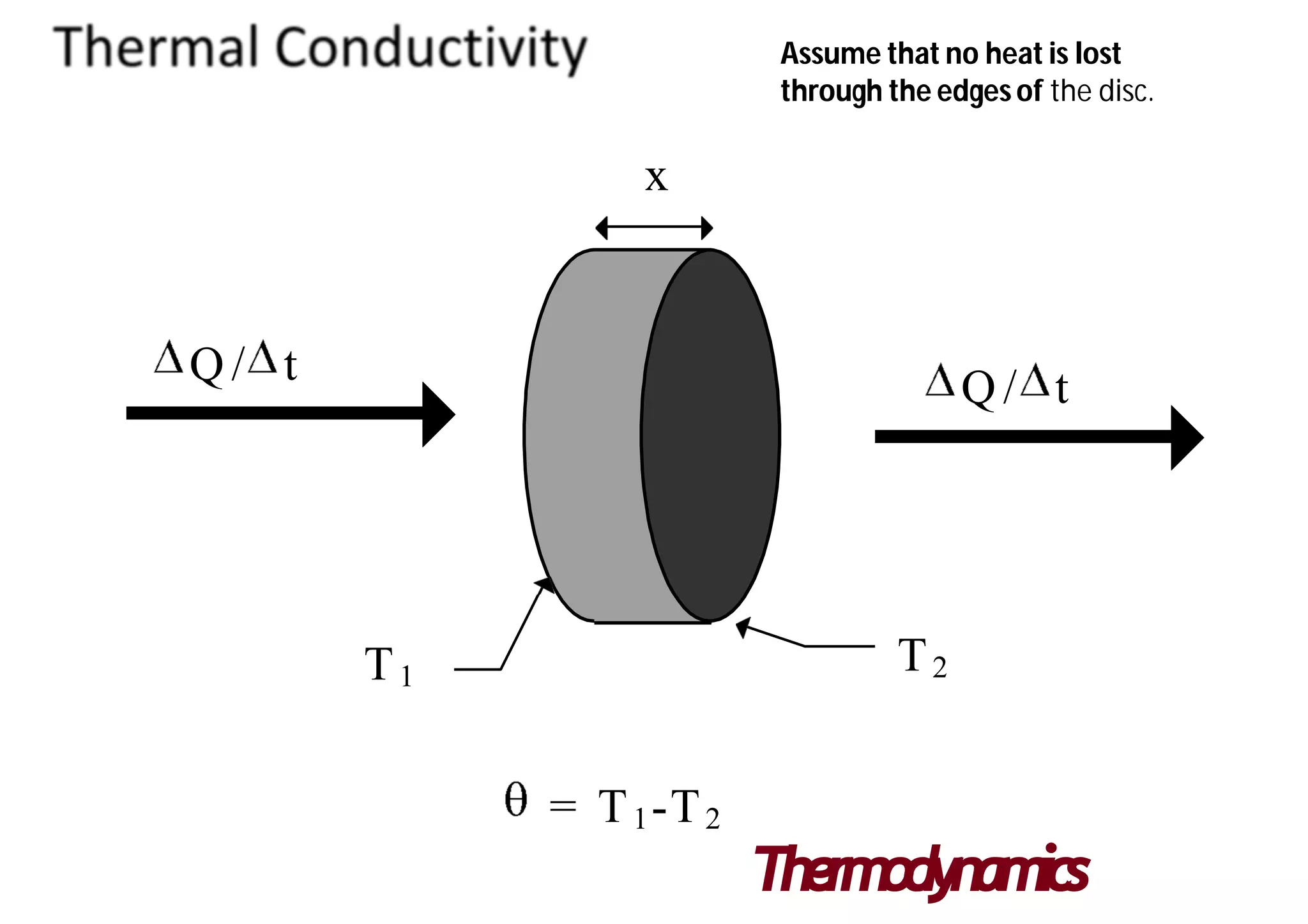
x
Q / t Q / t
T1
T2
= T1-T2
Thermodynamics
Assume that no heat is lost
through the edges of the disc.
Thermodynami
c
s
x
Q/ t Q/ t
T1 T2
= T1-T2
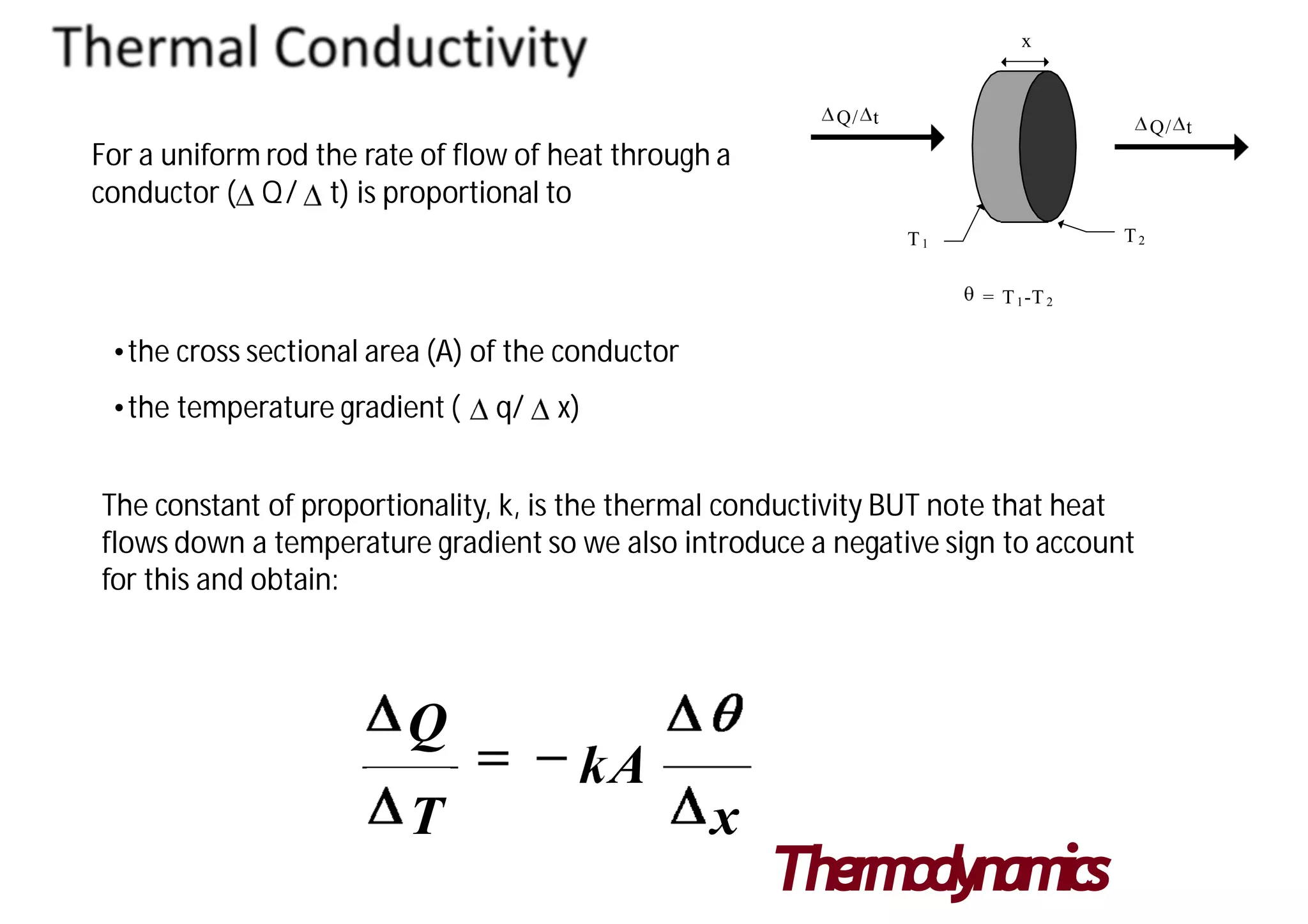
For a uniform rod the rate of flow of heat through a
conductor ( Q/ t) is proportional to
•the cross sectional area (A) of the conductor
•the temperature gradient ( q/ x)
The constant of proportionality, k, is the thermal conductivity BUT note that heat
flows down a temperature gradient so we also introduce a negative sign to account
for this and obtain:
Q
T
kA
x
Thermodynami
c
s
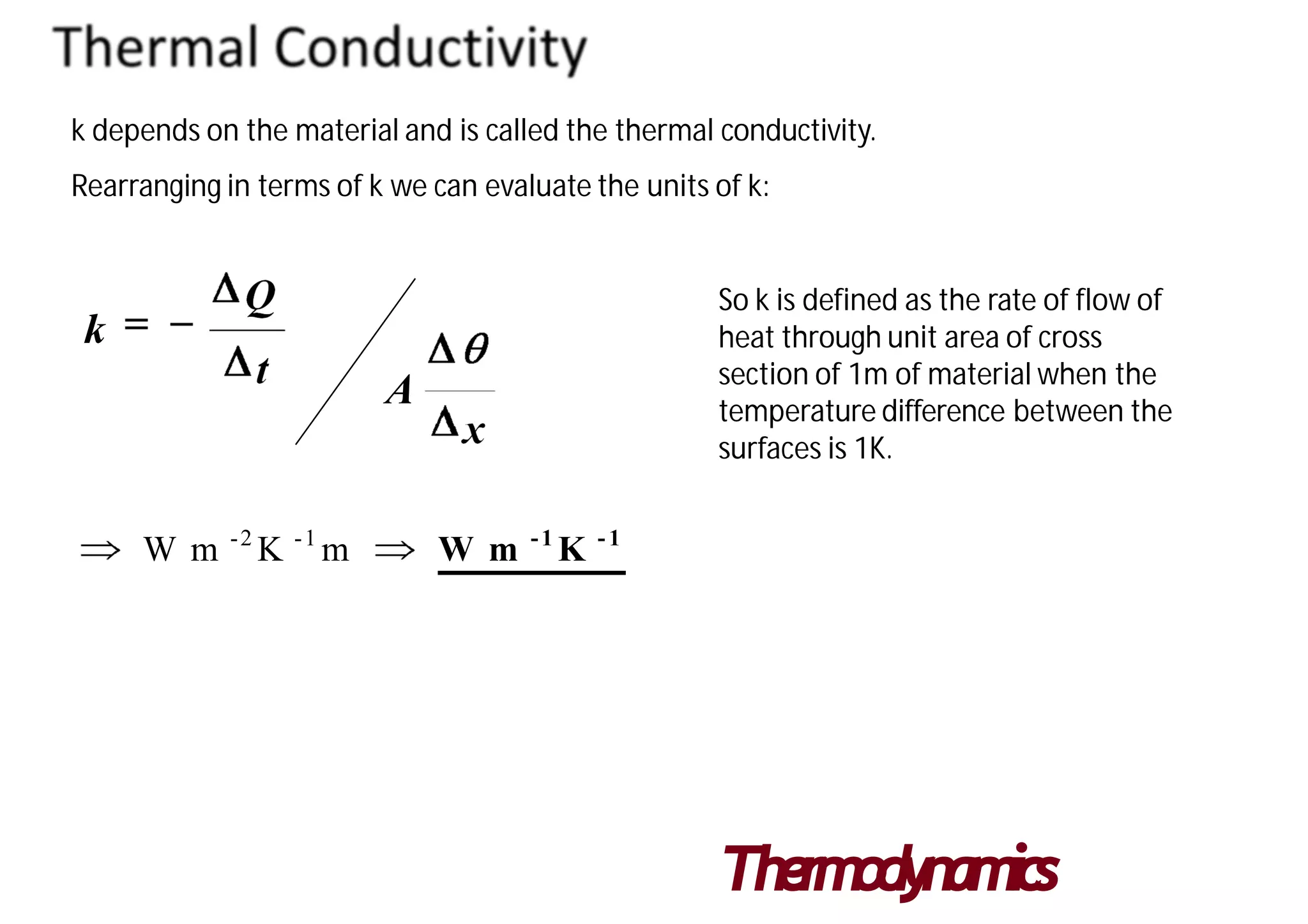
k depends on the material and is called the thermal conductivity.
Rearranging in terms of k we can evaluate the units of k:
k
Q
t A
x
W m -2
K -1
m W m -1
K - 1
So k is defined as the rate of flow of
heat through unit area of cross
section of 1m of material when the
temperature difference between the
surfaces is 1K.
Methods to measure thermal conductivity.
• Main methods:
1.STEADY STATE METHODS.
2.TRANSIENT STATE
METHODS
STEADY STATE METHODS.
Definition:
• These methods are used when the materials are in
equilibrium state( means when temperature of the
materials is constant).
• Advantage :
• Accurate readings can be taken.
• It steady state implies constant
signals.
• Disadvantage:
As material take to long time to reach
equilibrium state so it is slow method.
TRANSIENT STATE METHOD:
Definition:
• These methods are used during
the heating of material.
Advantage:
• Non-steady-state methods to measure the
thermal conductivity do not require the
signal to obtain a constant value.
• Readings can be taken during heating of
material.
Disadvantage:
• Readings are not accurate
• Mathematical analysis of the data is in
general more difficult.
THERMAL CONDUCTIVITY OF MATERIALS
Material  (W K-1 m-1)
Silver 422
Copper 391
Gold 295
Aluminum 205
Stainless Steel 10–25
Glass, Concrete,Wood 0.5–3
Many Plastics ~0.4
G-10 fiberglass 0.29
Stagnant Air 0.024
Styrofoam 0.01–0.03
Thermal Conductivity.pdf

Thermal Conductivity.pdf

  • 2.
  • 3.
    DEFINITION: It is theproperty of a material that indicates its ability to conduct heat.  It is represented by k and is measured in watts per kelvin per metre (W·K−1·m−1). The reciprocal of thermal conductivity is thermal resistivity.
  • 6.
    x Q / tQ / t T1 T2 = T1-T2 Thermodynamics Assume that no heat is lost through the edges of the disc.
  • 7.
    Thermodynami c s x Q/ t Q/t T1 T2 = T1-T2 For a uniform rod the rate of flow of heat through a conductor ( Q/ t) is proportional to •the cross sectional area (A) of the conductor •the temperature gradient ( q/ x) The constant of proportionality, k, is the thermal conductivity BUT note that heat flows down a temperature gradient so we also introduce a negative sign to account for this and obtain: Q T kA x
  • 8.
    Thermodynami c s k depends onthe material and is called the thermal conductivity. Rearranging in terms of k we can evaluate the units of k: k Q t A x W m -2 K -1 m W m -1 K - 1 So k is defined as the rate of flow of heat through unit area of cross section of 1m of material when the temperature difference between the surfaces is 1K.
  • 9.
    Methods to measurethermal conductivity. • Main methods: 1.STEADY STATE METHODS. 2.TRANSIENT STATE METHODS
  • 10.
    STEADY STATE METHODS. Definition: •These methods are used when the materials are in equilibrium state( means when temperature of the materials is constant). • Advantage : • Accurate readings can be taken. • It steady state implies constant signals. • Disadvantage: As material take to long time to reach equilibrium state so it is slow method.
  • 11.
    TRANSIENT STATE METHOD: Definition: •These methods are used during the heating of material. Advantage: • Non-steady-state methods to measure the thermal conductivity do not require the signal to obtain a constant value. • Readings can be taken during heating of material. Disadvantage: • Readings are not accurate • Mathematical analysis of the data is in general more difficult.
  • 12.
    THERMAL CONDUCTIVITY OFMATERIALS Material  (W K-1 m-1) Silver 422 Copper 391 Gold 295 Aluminum 205 Stainless Steel 10–25 Glass, Concrete,Wood 0.5–3 Many Plastics ~0.4 G-10 fiberglass 0.29 Stagnant Air 0.024 Styrofoam 0.01–0.03