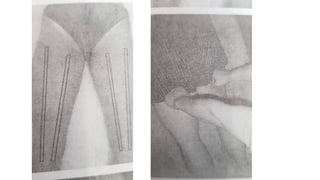
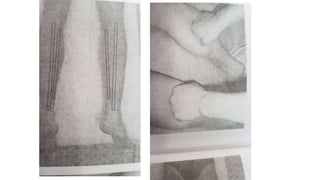
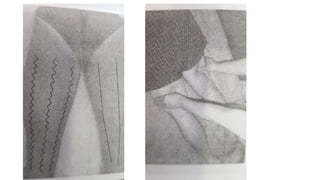
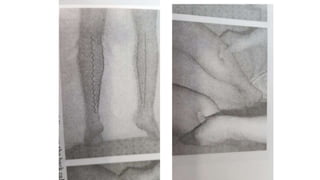
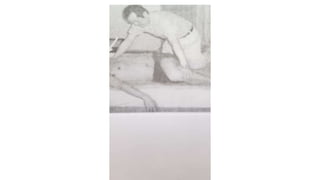
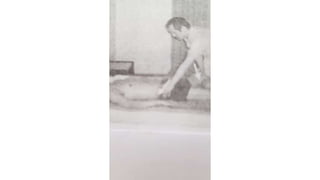
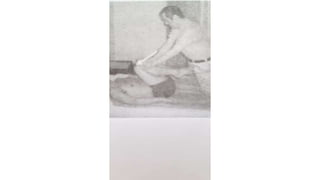
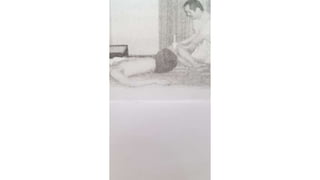
Massage course
Teacher of the massage course - Abdyrakunova Gulbara Turdubaevna, Candidate
of Medical Sciences
Massage is a dosed mechanical effect on various
parts of the human body produced by the hands of a
massage therapist or special
devices. The word "massage" most likely comes from the
Greek. masso that means to squeeze, knead, knead,
stroke.
Using the labor of many scientists and doctors
massage has become an effective method of treatment,
recovery today
ability to work, relieve fatigue, used to stop and
prevention of diseases, healing of the body.
Physiological
effectofmassage
Improving blood circulation and lymph circulation, increasing body
temperature locally by 0.50
, stimulation of growth, increased elasticity of ligaments
apparatus, enhanced and increased muscle contractility,
improvement of skin elasticity and tightness, in general,
improvement - trophic
fabrics.
Massage can be general when mechanical consumption
cover the entire surface of the body, and placed (locally, separately),
with
which is massaged by a certain area of ​​the body. Massage
replenishment
can be divided into manual and hardware. Applying Manual Views
massage in the office with hardware offers options
combined massage.
Depending onthe
tasksand
purpose, massage
isdivided intothe
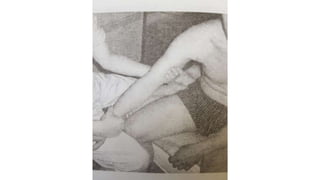
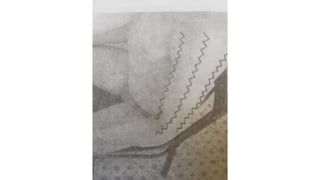
following types:
 medical,
 hygienic,
 cosmetic,
 sports,
 self-massage
Basicmassage
techniquesare:
 stroking,
 rubbing,
 kneading and
 vibration. Apart from
 basic techniques, there are various options for them.
Theeffectof
massageonthe
body
is based on a complex process,
due to neuro-reflex, humoral and mechanical
impact. The essence of the neuro-reflex mechanism is
that during massage, numerous and
four
a variety of nerve endings embedded in the skin, tendons, ligaments,
muscles, blood vessels and internal organs. The flow of impulses
that occurs when
this, reaches the central nervous system, modifies its activity,
manifested in
changes in the functional state of various body systems, its
reactivity and resistance to adverse environmental factors.
Theeffectof
massage onthe
body
2
Under the influence of massage in the tissues split
metabolic products. Being in the skin in a bound,
inactive state, they are under the influence of massage go
into a free
condition, absorbed into the blood and excreted from the
body.
Theeffectof
massage onthe
body
3
Massage also has a direct mechanical effect on
skin, muscles and other tissues, stimulates the movement of liquid
media in them,
changes their mechanical properties, nutrition and tone, functional
activity of tissues and organs. mechanical effect on the sympathetic
nerve fibers leads to the activation of the adaptive-trophic function
sympathetic nervous system, restoration of hormone excretion
adrenal glands, thyroid gland and ovaries. The latter stimulates
metabolic processes in the body, increases resistance and
activates it
immunogenesis
general
methodological
rulesofmassage.
(P1)
1. Massage should be carried out in a bright, spacious, clean and well
ventilated room with air temperature in the range of 22-24 ° C and relative
humidity not higher than 60%.
2. Cleanliness of the skin is the main hygienic requirement for carrying out
massage. It is desirable to do it after a hygienic shower. shower extremely
necessary in the summer, when sweating intensifies on the skin a lot of dust
and germs settle. With abundant hairline massage it is recommended to do
through sterile linen or sheet
3. The patient during the massage should be naked or in a clean
thin linen, preferably in silk. An indispensable condition for correct
massage - the maximum exposure of the massaged area.
4.To achieve the greatest effect, massage should be carried out.
with maximum muscle relaxation. Contributing to its achievement
average physiological position of the limbs during massage.
The comfortable position of the massaged part of the body is also
important..
general
methodological
rulesofmassage.
5. All massage techniques are performed along the lymphatic
pathways,
towards the near lymph nodes. Lymph nodes are not
massaged. Hands are massaged from the hand to the elbow joint,
and from it to the armpit; legs – from the foot to the knee joint, and
from the knee joint to the inguinal nodes; chest is massaged from
the middle to the sides to the armpits; back – from the spine to the
sides, lower back and sacral area are massaged to the inguinal
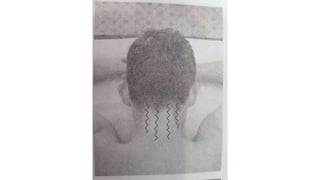
nodes; neck from the hairline down to the subclavian nodes
general
methodological
rulesofmassage.
6. In order to protect the skin during massage from excessive
irritation and enhance the massage effect, various
powders and lubricants are used. Of the powders, talc,
rice powder, baby powder are the most convenient.
Vegetable oils are used as lubricants, as well as special masking
creams. For herapeutic and sports massage
, rubbing agents and medicinal ointments are often used.
general
methodological
rulesof
massage.7
The massage procedure consists of introductory, main and
final sections. In the introductory section, the
massaged person is prepared for the main part of the
procedure with gentle techniques for 1-3 minutes. In
the main section, differentiated massage is carried out
according to its
purpose and the condition of the massaged. In the final part,
the
intensity of massage techniques is reduced for 1-3 minutes,
ending the procedure
by stroking the entire massaged area.
general
methodological
rulesofmassage.
8. Massage should not cause pain; after the massage there
should be a pleasant feeling of warmth in the massaged
area, improvement of well-being,
there may be a desire to sleep. The skin turns red, but it is
impossible to allow the appearance of spots, petechiae.
9. Massage is best done 1-2 hours after a non-abundant
meal. Before the procedure, the bladder and intestines
should be released.
10. After the massage, it is advisable to take a shower and
rest for 15 -30 minutes.
Musclesarethe
mainobjectof
massage
 The movement processes in the human
body are provided by the musculoskeletal
system
Itconsist
Passive part
1. Bones
2. Ligaments
3. joints
Active part
1. Muscles
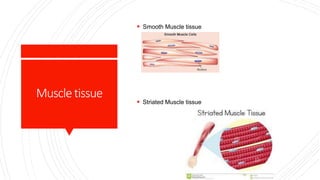
Muscletissue
 Smooth Muscle tissue
 Striated Muscle tissue
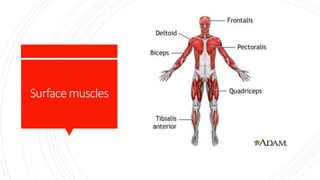
Surfacemuscles
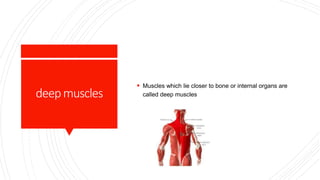
deepmuscles
 Muscles which lie closer to bone or internal organs are
called deep muscles
Whatdo
musclesdo?
 Muscles play a role in nearly every system and function of
the body. Different kinds of muscles help with:
 Breathing, speaking and swallowing.
 Digesting food and getting rid of waste.
 Moving, sitting still and standing up straight.
 Pumping blood through the heart and blood vessels.
 Pushing a baby through the birth canal as muscles in the
uterus contract and relax.
 Seeing and hearing.
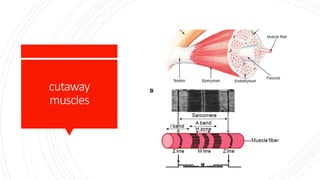
cutaway
muscles
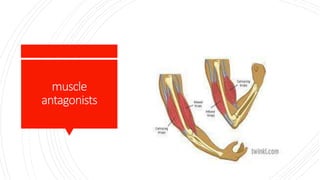
muscle
antagonists
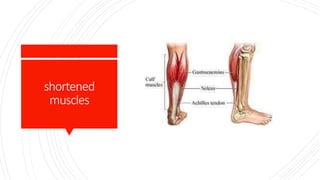
shortened
muscles
Indicationsfor
Massage
 Pain
 Edema
 Muscle Spasm
 Trigger Points
 Insufficiencies of Circulation
 Contracted Tissues
 Specific or general Relaxation
Painful
Musculoskeletal
 Back pain
 General orthopedic conditions
 Post-operative conditions
 Fibromyalgia
 Degenerative joint conditions
Typesof Edema
 Local - Edema is confined to an area (ex. ligament sprain)
 Systemic Edema - Occurs throughout the body (ex.
Congestive Heart Failure)
 Lymphedema - Edema resulting from compromise of
lymphatic system, tends to be regional. (ex. Removal of
cancerous lymph nodes
MuscleSpasms
 Involuntary contraction due to inflammation, irritation
 Often are tissues that are gaurding other injured tissues
MuscleSpasm
Massage
Purpose
 Used to relax muscle spasms
 Help local blood flow.
 reduce pain associated with spasm
 Helps break the pain - spasm - pain cycle
 Techniques such as cupping, dry needling, and trigger
point massage have been found to be effective in
reducing plastic pain
Benefitsof
Massageand
Relaxation
 Relaxation is a nice side effect which can enable us to
carry out other treatments
Contraindicatio
ns
 When increased circulation is not desired
 Severe Distress (severe pain, febrile state)
 Contagious skin condition
 Over foreign bodies or sharp bony prominences
 Massage Too soon: Acute conditions
 Areas of decreased sensation
 Over Recent surgery
 Systemic Edema
 Areas of Active Bone growth
 Tuberculosis
 Pregnancy (over abdomen
Conditions where
increased
Circulation isnot
Desired
 Systemic Edeman - Occurs throughout the body (ex
Congestive Heart failure. If you push back too much fluid
it overwhelms the heart leading to more damage)
 Primary Lymphedema - Edema resulting from
compromise ot the lymphatic system
 Infections - May be spread by blood or by lymph (ex.
Osteomyelitis, Septic arthritis, dermatitis, cellulitis,
myositis
 Blood Clots - DVT mechanical stimulation can break
down clot and release to freely roam
Contraindication
forSevereDistress
 Do not perform massage on patient that has severe
distress or is in a febrile condition.
 Physically ill or Nauseated
 Is in severe pain
 Has a fever or a systemic process occuring
Theerector
spinae
muscles
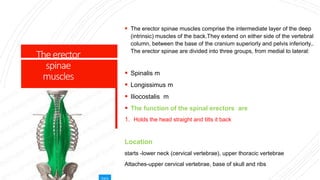
 The erector spinae muscles comprise the intermediate layer of the deep
(intrinsic) muscles of the back.They extend on either side of the vertebral
column, between the base of the cranium superiorly and pelvis inferiorly..
The erector spinae are divided into three groups, from medial to lateral:
 Spinalis m
 Longissimus m
 Iliocostalis m
 The function of the spinal erectors are
1. Holds the head straight and tilts it back
Location
starts -lower neck (cervical vertebrae), upper thoracic vertebrae
Attaches-upper cervical vertebrae, base of skull and ribs
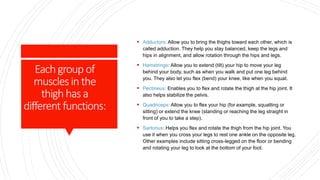
Eachgroup of
musclesinthe
thighhasa
different functions:
 Adductors: Allow you to bring the thighs toward each other, which is
called adduction. They help you stay balanced, keep the legs and
hips in alignment, and allow rotation through the hips and legs.
 Hamstrings: Allow you to extend (tilt) your hip to move your leg
behind your body, such as when you walk and put one leg behind
you. They also let you flex (bend) your knee, like when you squat.
 Pectineus: Enables you to flex and rotate the thigh at the hip joint. It
also helps stabilize the pelvis.
 Quadriceps: Allow you to flex your hip (for example, squatting or
sitting) or extend the knee (standing or reaching the leg straight in
front of you to take a step).
 Sartorius: Helps you flex and rotate the thigh from the hip joint. You
use it when you cross your legs to rest one ankle on the opposite leg.
Other examples include sitting cross-legged on the floor or bending
and rotating your leg to look at the bottom of your foot.
Location
 Adductors include five muscles: gracilis, obturator externus,
adductor brevis, adductor longus and adductor magnus.
They are on the inside of the thigh, starting at the pelvis and
extending to the femur (thigh bone).
 Hamstrings are a group of three muscles: semitendinosus,
semimembranosus and biceps femoris. They run down the
back of the thigh, from the hip to just below the knee.
 Pectineus is a flat muscle that extends from the front of the
pelvis to the top of the femur.
 Quadriceps include four large muscles located in the front of
the thigh: vastus lateralis, vastus medialis, vastus
intermedius, and rectus femoris. They start at the pelvis (hip
bone) and femur (thigh bone) and extend down to the patella
(kneecap) and tibia (shin bone).
 Sartorius muscle is a long, thin muscle — the longest in the
human body. It starts by the hip and wraps across the front of
the thigh, then downward toward the knee
psoasmajor.
iliacus
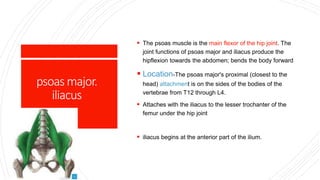
 The psoas muscle is the main flexor of the hip joint. The
joint functions of psoas major and iliacus produce the
hipflexion towards the abdomen; bends the body forward
 Location-The psoas major's proximal (closest to the
head) attachment is on the sides of the bodies of the
vertebrae from T12 through L4.
 Attaches with the iliacus to the lesser trochanter of the
femur under the hip joint
 iliacus begins at the anterior part of the ilium.
hamstrings: biceps
femoris,
semitendinosus,
semimembranosus
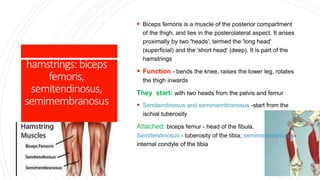
 Biceps femoris is a muscle of the posterior compartment
of the thigh, and lies in the posterolateral aspect. It arises
proximally by two 'heads', termed the 'long head'
(superficial) and the 'short head' (deep). It is part of the
hamstrings
 Function - bends the knee, raises the lower leg, rotates
the thigh inwards
They start: with two heads from the pelvis and femur
 Semitendinosus and semimembranosus -start from the
ischial tuberosity
Attached: biceps femur - head of the fibula.
Semitendinosus - tuberosity of the tibia; semimembranosus-
internal condyle of the tibia
calfmuscle
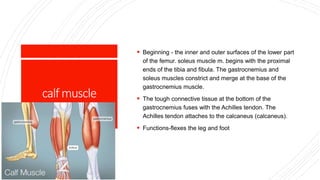
 Beginning - the inner and outer surfaces of the lower part
of the femur. soleus muscle m. begins with the proximal
ends of the tibia and fibula. The gastrocnemius and
soleus muscles constrict and merge at the base of the
gastrocnemius muscle.
 The tough connective tissue at the bottom of the
gastrocnemius fuses with the Achilles tendon. The
Achilles tendon attaches to the calcaneus (calcaneus).
 Functions-flexes the leg and foot
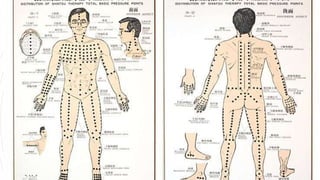
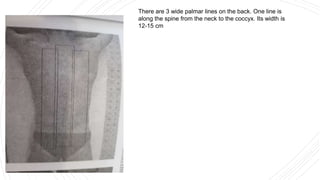
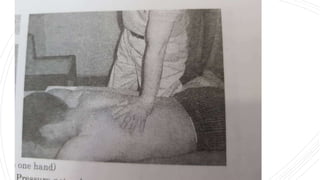
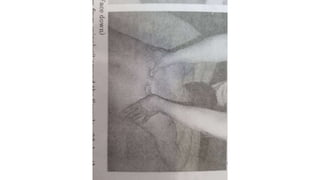
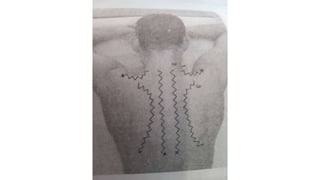
There are 3 wide palmar lines on the back. One line is
along the spine from the neck to the coccyx. Its width is
12-15 cm
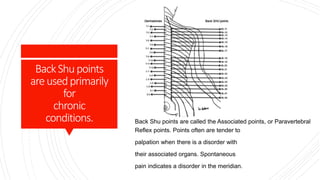
BackShupoints
areusedprimarily
for
chronic
conditions. Back Shu points are called the Associated points, or Paravertebral
Reflex points. Points often are tender to
palpation when there is a disorder with
their associated organs. Spontaneous
pain indicates a disorder in the meridian.
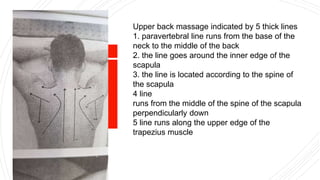
Upper back massage indicated by 5 thick lines
1. paravertebral line runs from the base of the
neck to the middle of the back
2. the line goes around the inner edge of the
scapula
3. the line is located according to the spine of
the scapula
4 line
runs from the middle of the spine of the scapula
perpendicularly down
5 line runs along the upper edge of the
trapezius muscle
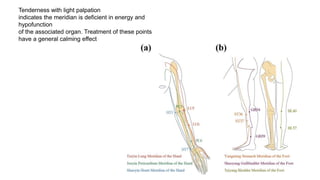
Tenderness with light palpation
indicates the meridian is deficient in energy and
hypofunction
of the associated organ. Treatment of these points
have a general calming effect
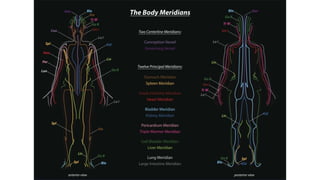
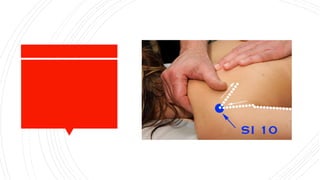
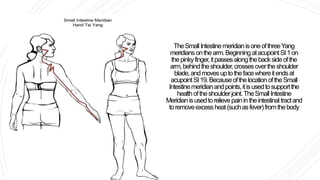
TheSmallIntestinemeridianisoneofthreeYang
meridiansonthearm.Beginning atacupointSI1on
thepinkyfinger,itpassesalongthebacksideofthe
arm,behindtheshoulder,crossesovertheshoulder
blade,andmovesuptothefacewhereitendsat
acupointSI19.BecauseofthelocationoftheSmall
Intestinemeridianandpoints,itisusedtosupportthe
healthoftheshoulderjoint.TheSmallIntestine
Meridianisusedtorelievepainintheintestinaltractand
toremoveexcessheat(suchasfever)fromthebody
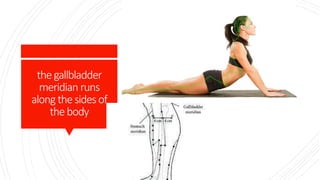
thegallbladder
meridian runs
along thesidesof
thebody
General
techniques
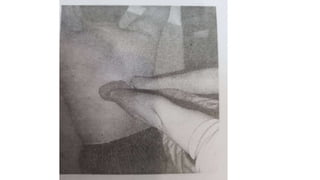
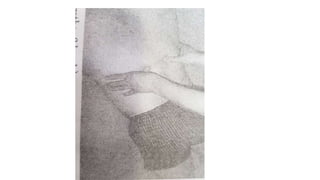
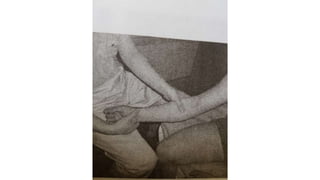
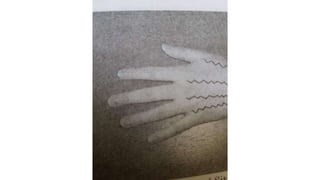
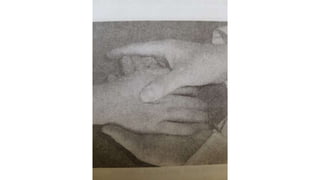
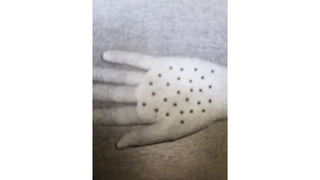
 1 Thumb pressure
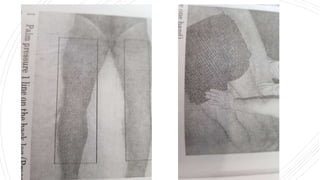
 2Palm pressure
 fist pressure
 3Kneading with one finger
 Pinching
 4 Pat
 Light touches on the head
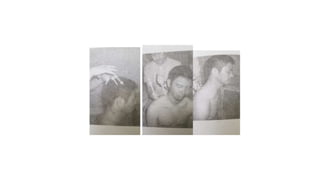
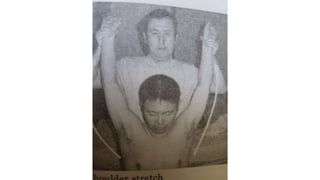
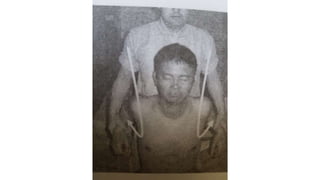
 5 Stretch
Shiatsu
massagerules:
 1 The room must be at a comfortable temperature
 2 Shiata can be done on the floor or on a couch
 3. The clothes of the massage therapist should be loose
and made of natural fibers.
 4. Massage should be carried out no earlier than 2 hours
after eating
 5Movements should be smooth and slow.
 6 The impact should be at a right angle. this does not
cause pain to the muscles
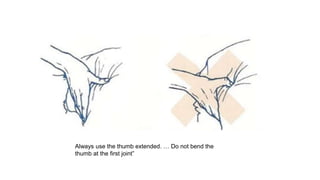
Always use the thumb extended. … Do not bend the
thumb at the first joint”
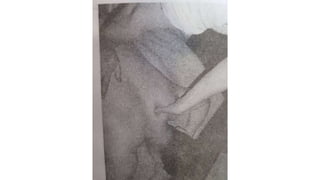
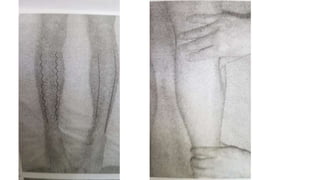
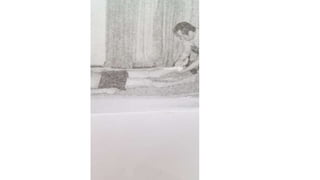
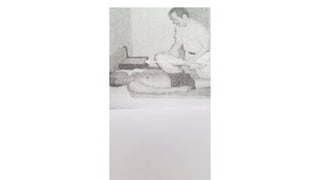
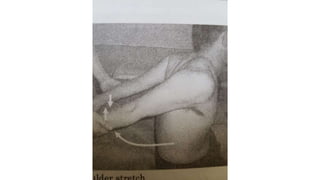
Leg stretch
Massage course ppt 3 about massage course

Massage course ppt 3 about massage course

  • 1.
    Massage course Teacher ofthe massage course - Abdyrakunova Gulbara Turdubaevna, Candidate of Medical Sciences
  • 2.
    Massage is adosed mechanical effect on various parts of the human body produced by the hands of a massage therapist or special devices. The word "massage" most likely comes from the Greek. masso that means to squeeze, knead, knead, stroke. Using the labor of many scientists and doctors massage has become an effective method of treatment, recovery today ability to work, relieve fatigue, used to stop and prevention of diseases, healing of the body.
  • 3.
    Physiological effectofmassage Improving blood circulationand lymph circulation, increasing body temperature locally by 0.50 , stimulation of growth, increased elasticity of ligaments apparatus, enhanced and increased muscle contractility, improvement of skin elasticity and tightness, in general, improvement - trophic fabrics. Massage can be general when mechanical consumption cover the entire surface of the body, and placed (locally, separately), with which is massaged by a certain area of ​​the body. Massage replenishment can be divided into manual and hardware. Applying Manual Views massage in the office with hardware offers options combined massage.
  • 4.
    Depending onthe tasksand purpose, massage isdividedintothe following types:  medical,  hygienic,  cosmetic,  sports,  self-massage
  • 5.
    Basicmassage techniquesare:  stroking,  rubbing, kneading and  vibration. Apart from  basic techniques, there are various options for them.
  • 6.
    Theeffectof massageonthe body is based ona complex process, due to neuro-reflex, humoral and mechanical impact. The essence of the neuro-reflex mechanism is that during massage, numerous and four a variety of nerve endings embedded in the skin, tendons, ligaments, muscles, blood vessels and internal organs. The flow of impulses that occurs when this, reaches the central nervous system, modifies its activity, manifested in changes in the functional state of various body systems, its reactivity and resistance to adverse environmental factors.
  • 7.
    Theeffectof massage onthe body 2 Under theinfluence of massage in the tissues split metabolic products. Being in the skin in a bound, inactive state, they are under the influence of massage go into a free condition, absorbed into the blood and excreted from the body.
  • 8.
    Theeffectof massage onthe body 3 Massage alsohas a direct mechanical effect on skin, muscles and other tissues, stimulates the movement of liquid media in them, changes their mechanical properties, nutrition and tone, functional activity of tissues and organs. mechanical effect on the sympathetic nerve fibers leads to the activation of the adaptive-trophic function sympathetic nervous system, restoration of hormone excretion adrenal glands, thyroid gland and ovaries. The latter stimulates metabolic processes in the body, increases resistance and activates it immunogenesis
  • 9.
    general methodological rulesofmassage. (P1) 1. Massage shouldbe carried out in a bright, spacious, clean and well ventilated room with air temperature in the range of 22-24 ° C and relative humidity not higher than 60%. 2. Cleanliness of the skin is the main hygienic requirement for carrying out massage. It is desirable to do it after a hygienic shower. shower extremely necessary in the summer, when sweating intensifies on the skin a lot of dust and germs settle. With abundant hairline massage it is recommended to do through sterile linen or sheet 3. The patient during the massage should be naked or in a clean thin linen, preferably in silk. An indispensable condition for correct massage - the maximum exposure of the massaged area. 4.To achieve the greatest effect, massage should be carried out. with maximum muscle relaxation. Contributing to its achievement average physiological position of the limbs during massage. The comfortable position of the massaged part of the body is also important..
  • 10.
    general methodological rulesofmassage. 5. All massagetechniques are performed along the lymphatic pathways, towards the near lymph nodes. Lymph nodes are not massaged. Hands are massaged from the hand to the elbow joint, and from it to the armpit; legs – from the foot to the knee joint, and from the knee joint to the inguinal nodes; chest is massaged from the middle to the sides to the armpits; back – from the spine to the sides, lower back and sacral area are massaged to the inguinal nodes; neck from the hairline down to the subclavian nodes
  • 11.
    general methodological rulesofmassage. 6. In orderto protect the skin during massage from excessive irritation and enhance the massage effect, various powders and lubricants are used. Of the powders, talc, rice powder, baby powder are the most convenient. Vegetable oils are used as lubricants, as well as special masking creams. For herapeutic and sports massage , rubbing agents and medicinal ointments are often used.
  • 12.
    general methodological rulesof massage.7 The massage procedureconsists of introductory, main and final sections. In the introductory section, the massaged person is prepared for the main part of the procedure with gentle techniques for 1-3 minutes. In the main section, differentiated massage is carried out according to its purpose and the condition of the massaged. In the final part, the intensity of massage techniques is reduced for 1-3 minutes, ending the procedure by stroking the entire massaged area.
  • 13.
    general methodological rulesofmassage. 8. Massage shouldnot cause pain; after the massage there should be a pleasant feeling of warmth in the massaged area, improvement of well-being, there may be a desire to sleep. The skin turns red, but it is impossible to allow the appearance of spots, petechiae. 9. Massage is best done 1-2 hours after a non-abundant meal. Before the procedure, the bladder and intestines should be released. 10. After the massage, it is advisable to take a shower and rest for 15 -30 minutes.
  • 14.
    Musclesarethe mainobjectof massage  The movementprocesses in the human body are provided by the musculoskeletal system
  • 15.
    Itconsist Passive part 1. Bones 2.Ligaments 3. joints Active part 1. Muscles
  • 16.
    Muscletissue  Smooth Muscletissue  Striated Muscle tissue
  • 17.
  • 18.
    deepmuscles  Muscles whichlie closer to bone or internal organs are called deep muscles
  • 19.
    Whatdo musclesdo?  Muscles playa role in nearly every system and function of the body. Different kinds of muscles help with:  Breathing, speaking and swallowing.  Digesting food and getting rid of waste.  Moving, sitting still and standing up straight.  Pumping blood through the heart and blood vessels.  Pushing a baby through the birth canal as muscles in the uterus contract and relax.  Seeing and hearing.
  • 20.
  • 21.
  • 22.
  • 23.
    Indicationsfor Massage  Pain  Edema Muscle Spasm  Trigger Points  Insufficiencies of Circulation  Contracted Tissues  Specific or general Relaxation
  • 24.
    Painful Musculoskeletal  Back pain General orthopedic conditions  Post-operative conditions  Fibromyalgia  Degenerative joint conditions
  • 25.
    Typesof Edema  Local- Edema is confined to an area (ex. ligament sprain)  Systemic Edema - Occurs throughout the body (ex. Congestive Heart Failure)  Lymphedema - Edema resulting from compromise of lymphatic system, tends to be regional. (ex. Removal of cancerous lymph nodes
  • 26.
    MuscleSpasms  Involuntary contractiondue to inflammation, irritation  Often are tissues that are gaurding other injured tissues
  • 27.
    MuscleSpasm Massage Purpose  Used torelax muscle spasms  Help local blood flow.  reduce pain associated with spasm  Helps break the pain - spasm - pain cycle
  • 28.
     Techniques suchas cupping, dry needling, and trigger point massage have been found to be effective in reducing plastic pain
  • 29.
    Benefitsof Massageand Relaxation  Relaxation isa nice side effect which can enable us to carry out other treatments
  • 30.
    Contraindicatio ns  When increasedcirculation is not desired  Severe Distress (severe pain, febrile state)  Contagious skin condition  Over foreign bodies or sharp bony prominences  Massage Too soon: Acute conditions  Areas of decreased sensation  Over Recent surgery  Systemic Edema  Areas of Active Bone growth  Tuberculosis  Pregnancy (over abdomen
  • 31.
    Conditions where increased Circulation isnot Desired Systemic Edeman - Occurs throughout the body (ex Congestive Heart failure. If you push back too much fluid it overwhelms the heart leading to more damage)  Primary Lymphedema - Edema resulting from compromise ot the lymphatic system  Infections - May be spread by blood or by lymph (ex. Osteomyelitis, Septic arthritis, dermatitis, cellulitis, myositis  Blood Clots - DVT mechanical stimulation can break down clot and release to freely roam
  • 32.
    Contraindication forSevereDistress  Do notperform massage on patient that has severe distress or is in a febrile condition.  Physically ill or Nauseated  Is in severe pain  Has a fever or a systemic process occuring
  • 33.
    Theerector spinae muscles  The erectorspinae muscles comprise the intermediate layer of the deep (intrinsic) muscles of the back.They extend on either side of the vertebral column, between the base of the cranium superiorly and pelvis inferiorly.. The erector spinae are divided into three groups, from medial to lateral:  Spinalis m  Longissimus m  Iliocostalis m  The function of the spinal erectors are 1. Holds the head straight and tilts it back Location starts -lower neck (cervical vertebrae), upper thoracic vertebrae Attaches-upper cervical vertebrae, base of skull and ribs
  • 34.
    Eachgroup of musclesinthe thighhasa different functions: Adductors: Allow you to bring the thighs toward each other, which is called adduction. They help you stay balanced, keep the legs and hips in alignment, and allow rotation through the hips and legs.  Hamstrings: Allow you to extend (tilt) your hip to move your leg behind your body, such as when you walk and put one leg behind you. They also let you flex (bend) your knee, like when you squat.  Pectineus: Enables you to flex and rotate the thigh at the hip joint. It also helps stabilize the pelvis.  Quadriceps: Allow you to flex your hip (for example, squatting or sitting) or extend the knee (standing or reaching the leg straight in front of you to take a step).  Sartorius: Helps you flex and rotate the thigh from the hip joint. You use it when you cross your legs to rest one ankle on the opposite leg. Other examples include sitting cross-legged on the floor or bending and rotating your leg to look at the bottom of your foot.
  • 35.
    Location  Adductors includefive muscles: gracilis, obturator externus, adductor brevis, adductor longus and adductor magnus. They are on the inside of the thigh, starting at the pelvis and extending to the femur (thigh bone).  Hamstrings are a group of three muscles: semitendinosus, semimembranosus and biceps femoris. They run down the back of the thigh, from the hip to just below the knee.  Pectineus is a flat muscle that extends from the front of the pelvis to the top of the femur.  Quadriceps include four large muscles located in the front of the thigh: vastus lateralis, vastus medialis, vastus intermedius, and rectus femoris. They start at the pelvis (hip bone) and femur (thigh bone) and extend down to the patella (kneecap) and tibia (shin bone).  Sartorius muscle is a long, thin muscle — the longest in the human body. It starts by the hip and wraps across the front of the thigh, then downward toward the knee
  • 36.
    psoasmajor. iliacus  The psoasmuscle is the main flexor of the hip joint. The joint functions of psoas major and iliacus produce the hipflexion towards the abdomen; bends the body forward  Location-The psoas major's proximal (closest to the head) attachment is on the sides of the bodies of the vertebrae from T12 through L4.  Attaches with the iliacus to the lesser trochanter of the femur under the hip joint  iliacus begins at the anterior part of the ilium.
  • 37.
    hamstrings: biceps femoris, semitendinosus, semimembranosus  Bicepsfemoris is a muscle of the posterior compartment of the thigh, and lies in the posterolateral aspect. It arises proximally by two 'heads', termed the 'long head' (superficial) and the 'short head' (deep). It is part of the hamstrings  Function - bends the knee, raises the lower leg, rotates the thigh inwards They start: with two heads from the pelvis and femur  Semitendinosus and semimembranosus -start from the ischial tuberosity Attached: biceps femur - head of the fibula. Semitendinosus - tuberosity of the tibia; semimembranosus- internal condyle of the tibia
  • 38.
    calfmuscle  Beginning -the inner and outer surfaces of the lower part of the femur. soleus muscle m. begins with the proximal ends of the tibia and fibula. The gastrocnemius and soleus muscles constrict and merge at the base of the gastrocnemius muscle.  The tough connective tissue at the bottom of the gastrocnemius fuses with the Achilles tendon. The Achilles tendon attaches to the calcaneus (calcaneus).  Functions-flexes the leg and foot
  • 42.
    There are 3wide palmar lines on the back. One line is along the spine from the neck to the coccyx. Its width is 12-15 cm
  • 43.
    BackShupoints areusedprimarily for chronic conditions. Back Shupoints are called the Associated points, or Paravertebral Reflex points. Points often are tender to palpation when there is a disorder with their associated organs. Spontaneous pain indicates a disorder in the meridian.
  • 44.
    Upper back massageindicated by 5 thick lines 1. paravertebral line runs from the base of the neck to the middle of the back 2. the line goes around the inner edge of the scapula 3. the line is located according to the spine of the scapula 4 line runs from the middle of the spine of the scapula perpendicularly down 5 line runs along the upper edge of the trapezius muscle
  • 45.
    Tenderness with lightpalpation indicates the meridian is deficient in energy and hypofunction of the associated organ. Treatment of these points have a general calming effect
  • 47.
  • 49.
  • 50.
    General techniques  1 Thumbpressure  2Palm pressure  fist pressure  3Kneading with one finger  Pinching  4 Pat  Light touches on the head  5 Stretch
  • 51.
    Shiatsu massagerules:  1 Theroom must be at a comfortable temperature  2 Shiata can be done on the floor or on a couch  3. The clothes of the massage therapist should be loose and made of natural fibers.  4. Massage should be carried out no earlier than 2 hours after eating  5Movements should be smooth and slow.  6 The impact should be at a right angle. this does not cause pain to the muscles
  • 52.
    Always use thethumb extended. … Do not bend the thumb at the first joint”
  • 82.