Lecture 7
Laws of Returns
Laws of Returns
• There are three laws of returns known to
  economists:

  – Law of Diminishing Returns

  – Law of Increasing Returns

  – Law of Constant Returns
Law of Diminishing Returns
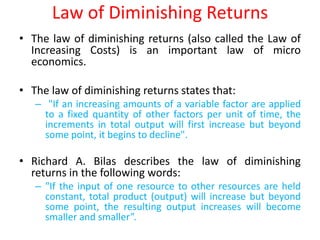
• The law of diminishing returns (also called the Law of
  Increasing Costs) is an important law of micro
  economics.

• The law of diminishing returns states that:
   – "If an increasing amounts of a variable factor are applied
     to a fixed quantity of other factors per unit of time, the
     increments in total output will first increase but beyond
     some point, it begins to decline".

• Richard A. Bilas describes the law of diminishing
  returns in the following words:
   – "If the input of one resource to other resources are held
     constant, total product (output) will increase but beyond
     some point, the resulting output increases will become
     smaller and smaller”.
Operation of Law of Diminishing Returns in Agriculture

• The classical economists were of the opinion that
   – the law of diminishing returns applies only to agriculture
     and to some extractive industries, such as mining, fisheries
     urban land, etc.

• The law was first stated by a Scottish farmer as such.
   – It is the practical experience of every farmer that if he
     wishes to raise a large quantity of food or other raw
     material requirements of the world from a particular piece
     of land, he cannot do so.
   – He knows it fully that the producing capacity of the soil is
     limited and is subject to exhaustation.
   – As he applies more and more units of labor to a given
     piece of land, the total produce no doubt increases but it
     increases at a diminishing rate.
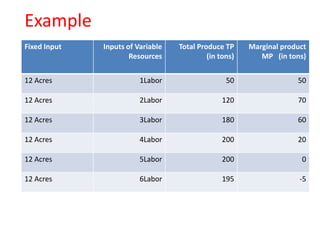
Example
Fixed Input   Inputs of Variable   Total Produce TP     Marginal product
                      Resources             (in tons)      MP (in tons)


12 Acres                 1Labor                   50                 50

12 Acres                 2Labor                  120                 70

12 Acres                 3Labor                  180                 60

12 Acres                 4Labor                  200                 20

12 Acres                 5Labor                  200                  0

12 Acres                 6Labor                  195                  -5
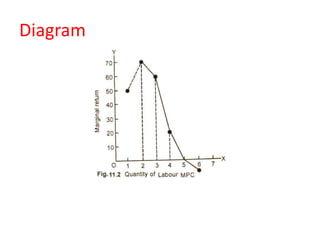
Diagram
Laws of Variable Proportions
• Law of Diminishing Returns is a misnomer (wrongly applied
  name)

• It is only the third stage of one of the basic law i.e. Law of
  variable proportions

• This law is also called Law of Proportionality

• This law tells us how the total output or marginal output is
  affected by a change in the proportion of the factors used

• Since, the return to the variable factor does not change at
  the same rate in all stages, it is also called the Law of Non-
  proportional Returns
Explanation of Law of VP
• In production process, after a stage, the marginal
  return begins to diminish
   – It is due to the technological facts underlying the
     production of the product in question
   – Every industry has its own peculiar set of technical facts.
     For example
      • Agriculture is dominated by the nature of land
          – In agriculture, the MR starts diminishing early
      • Manufacturing industry by capital
          – In industry, it starts diminishing very late
          – Which a wise entrepreneur can altogether avoid
• The Law of Variable Proportion occupies a very
  important place in economic theory
   – It describes the production function with one variable
     factor while the quantities of other factors of production
     are fixed
Law of VP in words of Economists
• In the word of Stigler
   – As equal increments of one input are added, the inputs of other
     productive services being held constant, beyond a certain point
     the result in increment of product will decrease i.e. the MP will
     diminish

• Prof. Samuelson states
   – An increase in some inputs relative to other fixed inputs will, in
     a given state of technology, cause output to increase; but after a
     point the extra output resulting from the same additions of
     extra inputs will become less and less

• Prof. Benham also states
   – As the proportion of one factor in a combination of factors is
     increased, after a point, first the marginal and then the average
     product of that factor will diminish
Assumptions of the Law of VP
• State of Technology remains unaltered
   – It is obvious that improvements in technology are
     bound to raise the MP and AP and they will not
     diminish

• Some inputs are kept constant
   – This law does not apply in case all inputs are variable

• Does not apply in the case of factors used in fixed
  proportions
Limitations of Law of DR
• Improved methods of Cultivation
   – Scientific rotation of crops, improved seeds, better
     irrigation facilities are bound to give increasing return

• New Soil
   – Virgin soil gives more yield. Later the return will
     diminish

• Insufficient Capital
   – If less capital in the beginning then first yeild will
     increase
   – Beginning part is exception to the law
Why Law Applies to Agriculture?
• The agricultural operations are spread out
  over a wide area
  – Supervision cannot be effective

• Scope of use of specialized machinery is
  limited
  – Economies of large scale cannot be reaped

• Seasonal nature of the industry
  – Interrupted by rain and climatic changes
Why this law operates?
• Wrong combination
   – In the initial stages, the fixed factor is not fully used
     since the units of variable factor are too few
      • Hence, increase in variable factor is productive
   – Then optimum combination
   – Further, increase counter productive

• Scarcity of Factors
   – The expansion of an industry, provided that additional
     supplies of some agent in production, which is
     essential cannot be obtained

• Imperfect Substitutes
   – Factor of production are imperfect substitutes
Law of Increasing Returns
• An industry is subject to the law of increasing
  returns if
  – extra investment in the industry is followed by
    more than proportionate returns e.g if the
    marginal product increases

• These two laws of increasing and diminishing
  returns can also be explained in terms of
  optimum business unit
  – Increasing returns when moving towards optimum
  – Diminishing returns when moving beyond
    optimum
Why Law of Increasing Returns
              Operates?
• No scarcity of factors
   – Law of diminishing returns operate when there is scarcity
     of some factor. If there is no such scarcity then law of
     increasing returns will operate

• Right Combination
   – Law of diminishing returns operate when there is wrong
     combination of factors of production when there is right
     combination of the factors law of increasing returns will
     apply

• Full use of Indivisible Factors
   – Plant may be setup to meet the higher demand so
     increasing returns when more utilization
Law of Constant Returns
• There can be a situation where neither law of
  diminishing operates and nor law of increasing
  rates operate
  – Over there law of constant returns will operate

• An industry is subject to the law of constant
  returns when,
  – Whatever the output or scale of production, the
    cost per unit remains unaltered, or
  – increased investment of labour and capital results
    in a proportionate increase in the output.
Returns to Scale
• Returns of scale is meant
  – the behaviour of production or returns
  – when all the productive factors are increased or
    decreased simultanously
  – in the same ratio

• The returns to scale of production may clearly be
  distinguished from the law of variable
  proportions
  – In the law of variable proportions
     • Some factors are variable atleast one is constant
  – In returns to scale
     • All the necessary factors of production are increased or
       decreased to the same extent
     • So that whatever the scale of production, the proportion
       among the factors remains the same
Three Phases of Returns to Scale
• First Phase
  – With increase in scale of production returns increase
    more than increase in scale of production

• Second Phase
  – Increase in returns proportionally increase with the
    increase in scale of production

• Third Phase
  – Increase in return is, proportionally, less than increase
    in scale of production

Lecture 7

  • 1.
  • 2.
    Laws of Returns •There are three laws of returns known to economists: – Law of Diminishing Returns – Law of Increasing Returns – Law of Constant Returns
  • 3.
    Law of DiminishingReturns • The law of diminishing returns (also called the Law of Increasing Costs) is an important law of micro economics. • The law of diminishing returns states that: – "If an increasing amounts of a variable factor are applied to a fixed quantity of other factors per unit of time, the increments in total output will first increase but beyond some point, it begins to decline". • Richard A. Bilas describes the law of diminishing returns in the following words: – "If the input of one resource to other resources are held constant, total product (output) will increase but beyond some point, the resulting output increases will become smaller and smaller”.
  • 4.
    Operation of Lawof Diminishing Returns in Agriculture • The classical economists were of the opinion that – the law of diminishing returns applies only to agriculture and to some extractive industries, such as mining, fisheries urban land, etc. • The law was first stated by a Scottish farmer as such. – It is the practical experience of every farmer that if he wishes to raise a large quantity of food or other raw material requirements of the world from a particular piece of land, he cannot do so. – He knows it fully that the producing capacity of the soil is limited and is subject to exhaustation. – As he applies more and more units of labor to a given piece of land, the total produce no doubt increases but it increases at a diminishing rate.
  • 5.
    Example Fixed Input Inputs of Variable Total Produce TP Marginal product Resources (in tons) MP (in tons) 12 Acres 1Labor 50 50 12 Acres 2Labor 120 70 12 Acres 3Labor 180 60 12 Acres 4Labor 200 20 12 Acres 5Labor 200 0 12 Acres 6Labor 195 -5
  • 6.
  • 7.
    Laws of VariableProportions • Law of Diminishing Returns is a misnomer (wrongly applied name) • It is only the third stage of one of the basic law i.e. Law of variable proportions • This law is also called Law of Proportionality • This law tells us how the total output or marginal output is affected by a change in the proportion of the factors used • Since, the return to the variable factor does not change at the same rate in all stages, it is also called the Law of Non- proportional Returns
  • 8.
    Explanation of Lawof VP • In production process, after a stage, the marginal return begins to diminish – It is due to the technological facts underlying the production of the product in question – Every industry has its own peculiar set of technical facts. For example • Agriculture is dominated by the nature of land – In agriculture, the MR starts diminishing early • Manufacturing industry by capital – In industry, it starts diminishing very late – Which a wise entrepreneur can altogether avoid • The Law of Variable Proportion occupies a very important place in economic theory – It describes the production function with one variable factor while the quantities of other factors of production are fixed
  • 9.
    Law of VPin words of Economists • In the word of Stigler – As equal increments of one input are added, the inputs of other productive services being held constant, beyond a certain point the result in increment of product will decrease i.e. the MP will diminish • Prof. Samuelson states – An increase in some inputs relative to other fixed inputs will, in a given state of technology, cause output to increase; but after a point the extra output resulting from the same additions of extra inputs will become less and less • Prof. Benham also states – As the proportion of one factor in a combination of factors is increased, after a point, first the marginal and then the average product of that factor will diminish
  • 10.
    Assumptions of theLaw of VP • State of Technology remains unaltered – It is obvious that improvements in technology are bound to raise the MP and AP and they will not diminish • Some inputs are kept constant – This law does not apply in case all inputs are variable • Does not apply in the case of factors used in fixed proportions
  • 11.
    Limitations of Lawof DR • Improved methods of Cultivation – Scientific rotation of crops, improved seeds, better irrigation facilities are bound to give increasing return • New Soil – Virgin soil gives more yield. Later the return will diminish • Insufficient Capital – If less capital in the beginning then first yeild will increase – Beginning part is exception to the law
  • 12.
    Why Law Appliesto Agriculture? • The agricultural operations are spread out over a wide area – Supervision cannot be effective • Scope of use of specialized machinery is limited – Economies of large scale cannot be reaped • Seasonal nature of the industry – Interrupted by rain and climatic changes
  • 13.
    Why this lawoperates? • Wrong combination – In the initial stages, the fixed factor is not fully used since the units of variable factor are too few • Hence, increase in variable factor is productive – Then optimum combination – Further, increase counter productive • Scarcity of Factors – The expansion of an industry, provided that additional supplies of some agent in production, which is essential cannot be obtained • Imperfect Substitutes – Factor of production are imperfect substitutes
  • 14.
    Law of IncreasingReturns • An industry is subject to the law of increasing returns if – extra investment in the industry is followed by more than proportionate returns e.g if the marginal product increases • These two laws of increasing and diminishing returns can also be explained in terms of optimum business unit – Increasing returns when moving towards optimum – Diminishing returns when moving beyond optimum
  • 15.
    Why Law ofIncreasing Returns Operates? • No scarcity of factors – Law of diminishing returns operate when there is scarcity of some factor. If there is no such scarcity then law of increasing returns will operate • Right Combination – Law of diminishing returns operate when there is wrong combination of factors of production when there is right combination of the factors law of increasing returns will apply • Full use of Indivisible Factors – Plant may be setup to meet the higher demand so increasing returns when more utilization
  • 16.
    Law of ConstantReturns • There can be a situation where neither law of diminishing operates and nor law of increasing rates operate – Over there law of constant returns will operate • An industry is subject to the law of constant returns when, – Whatever the output or scale of production, the cost per unit remains unaltered, or – increased investment of labour and capital results in a proportionate increase in the output.
  • 17.
    Returns to Scale •Returns of scale is meant – the behaviour of production or returns – when all the productive factors are increased or decreased simultanously – in the same ratio • The returns to scale of production may clearly be distinguished from the law of variable proportions – In the law of variable proportions • Some factors are variable atleast one is constant – In returns to scale • All the necessary factors of production are increased or decreased to the same extent • So that whatever the scale of production, the proportion among the factors remains the same
  • 18.
    Three Phases ofReturns to Scale • First Phase – With increase in scale of production returns increase more than increase in scale of production • Second Phase – Increase in returns proportionally increase with the increase in scale of production • Third Phase – Increase in return is, proportionally, less than increase in scale of production