Costing methods
UNIT 9 MANAGEMENT ACCOUNTING
Learning Outcome

Use different costing
methods
Topics

Review of Last session
Group Reporting

Different Costing

Methods
Review of Last Session
TYPES OF COST
SEATWORKS
What are Costs?
THE TOTAL MONEY, TIME
AND RESOURCES ASSOCIATED
WITH A PURCHASE OR
ACTIVITY.
Costing System
AN ACCOUNTING SYSTEM
ESTABLISHED TO MONITOR A
COMPANY„S COSTS, PROVIDING
MANAGEMENT WITH
INFORMATION ON OPERATIONS
AND PERFORMANCE
Widely used Costing Systems
job costing;
process costing;
batch costing;
contract costing;
service costing
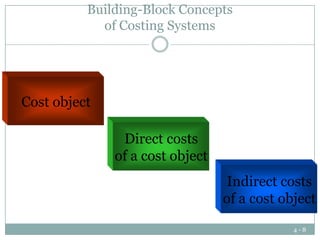
Building-Block Concepts
of Costing Systems

Cost object

Direct costs
of a cost object
Indirect costs
of a cost object
4-8
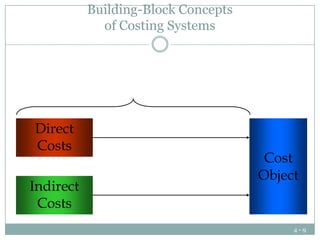
Building-Block Concepts
of Costing Systems

Cost Assignment
Direct
Costs
Indirect
Costs

Cost Tracing

Cost Allocation

Cost
Object

4-9
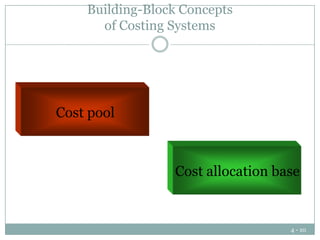
Building-Block Concepts
of Costing Systems

Cost pool

Cost allocation base

4 - 10
JOB COSTING
Job Costing
Job

order costing system is
generally used by companies
that manufacture a number of
different products. It is a widely
used
costing
system
in
manufacturing
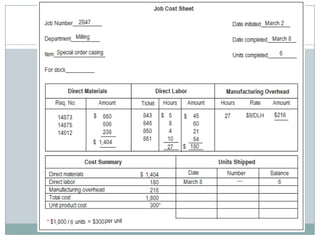
Job cost sheet
 document used to record manufacturing costs to compute







and allocate costs to products and services.
A separate job cost sheet is prepared for each individual job.
Includes job number, product name, starting date, completing
date, number of units completed etc.
materials requisition number, cost of direct materials
issued, time tickets, direct labor hours, direct labor rate per
hour and total cost, manufacturing overhead rate per direct
labor or machine hour and total cost etc.
Job cost sheet is not only used to charge cost to jobs but is
also a part of the company‟s accounting record. It is used as a
subsidiary ledger to the work in process account because it
contains all details about the job in process.
;
Pre Determined Overhead Rate (machine hours)
 Predetermined overhead rate is computed at the

beginning of the year using projected expenses over
projected hours
 Predetermined rate = total projected cost / projected

hours
 Manufacturing overhead applied to production =

Actual machine hours × Predetermined overhead
rate
Manufacturing Overhead
 Manufacturing overhead is applied or added to each job







while it is in process.
There are three kinds of overhead costs consider:
Estimated overhead cost - used only in the predetermined overhead rate calculation
Actual overhead cost which is incurred periodically
throughout the year and debited to the manufacturing
overhead account
Applied overhead cost which is added to jobs in the
work-in-process inventory account throughout the year
and credited to the manufacturing overhead account
Manufacturing Overhead
 Actual overhead costs flow into the account as they are







incurred
Applied overhead costs flow out of the account as the
jobs flow through the production process.
The account balance may be either underapplied or
overapplied.
Underapplied overhead represents an expense which
must be transferred to cost of goods sold.
Overapplied overhead represents a reduction of expense
charged to jobs which must be transferred to cost of
goods sold.
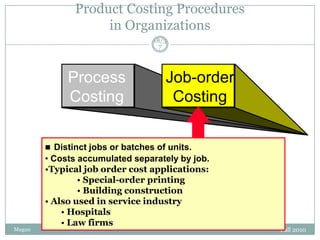
Product Costing Procedures
in Organizations
18/3
7

Process
Costing

Job-order
Costing

 Distinct jobs or batches of units.

Mugan

• Costs accumulated separately by job.
•Typical job order cost applications:
• Special-order printing
• Building construction
• Also used in service industry
• Hospitals
• Law firms

Fall 2010
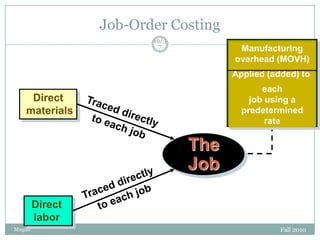
Job-Order Costing
19/3
7

Manufacturing
overhead (MOVH)
Applied (added) to

each
job using a
predetermined
rate

Direct
materials

The
Job
Direct
labor
Mugan

Fall 2010
Job-Order Costing
20/
37

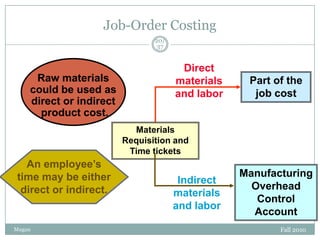
Raw materials
could be used as
direct or indirect
product cost.

Direct
materials
and labor

Part of the
job cost

Materials
Requisition and
Time tickets

An employee’s
time may be either
direct or indirect.

Mugan

Indirect
materials
and labor

Manufacturing
Overhead
Control
Account
Fall 2010
Job-Order Costing
21/3
7

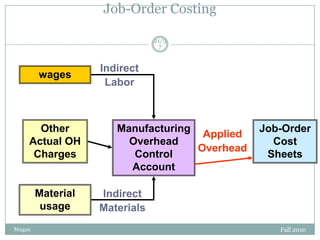
wages

Other
Actual OH
Charges

Material
usage
Mugan

Indirect
Labor

Manufacturing
Applied
Overhead
Overhead
Control
Account

Job-Order
Cost
Sheets

Indirect
Materials
Fall 2010
Job-Order Cost Sheet
22/
37

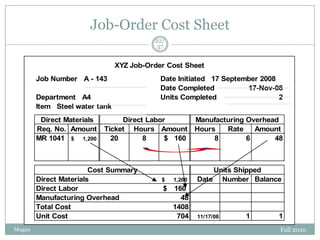
XYZ Job-Order Cost Sheet
Job Number A - 143
Department A4
Item Steel water tank
Direct Materials
Req. No. Amount
MR 1041 $ 1,200

Direct Labor
Manufacturing Overhead
Ticket Hours Amount Hours
Rate
Amount
20
8
$ 160
8
6
48

Cost Summary
Direct Materials
Direct Labor
Manufacturing Overhead
Total Cost
Unit Cost
Mugan

Date Initiated 17 September 2008
Date Completed
17-Nov-08
Units Completed
2

$

1,200

Units Shipped
Date Number Balance

$

160
48
1408
704

11/17/08

1

1
Fall 2010
Job-Order System Cost Flows
23/
37

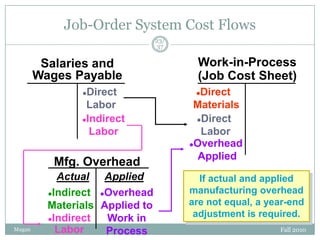
Salaries and
Wages Payable
Direct
Labor
Indirect
Labor


Mfg. Overhead

Mugan

Actual Applied
Indirect
Overhead
Materials Applied to
Indirect
Work in
Labor
Process

Work-in-Process
(Job Cost Sheet)
Direct
Materials
Direct
Labor
Overhead
Applied


If actual and applied
manufacturing overhead
are not equal, a year-end
adjustment is required.
Fall 2010
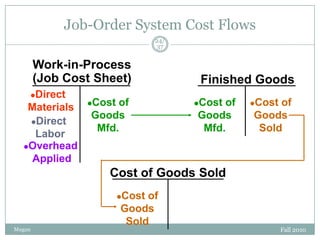
Job-Order System Cost Flows
24/
37

Work-in-Process
(Job Cost Sheet)
Direct
Materials
Direct
Labor
Overhead
Applied


Cost of
Goods
Mfd.



Finished Goods
Cost of
Goods
Mfd.



Cost of
Goods
Sold



Cost of Goods Sold
Cost of
Goods
Sold



Mugan

Fall 2010
Sample Problem
 The RC manufacturing company uses job order costing

system. The company uses machine hours to apply
overhead cost to jobs. At the beginning of Y1, the
company estimated that 150,000 machine hours would
be worked and $900,000 overhead cost would be
incurred during Y1.
 Materials were requisitioned for use in
production, $760,000 ($720,000 direct materials and
$40,000 indirect materials).
 Direct labor, $150,000; indirect labor, $220,000;
 RC manufacturing company worked 160,000 machine
hours. Manufacturing overhead was applied to
production.
 Sales commission, $180,000; and administrative











salaries, $400,000.
Sales travel costs were $34,000.
Utility costs incurred in the factory, $86,000.
Advertising expenses were $360,000.
Depreciation for the year was $700,000 ($560,000
relates to factory and $140,000 relates to selling and
administrative activities).
Insurance expired during the year, $20,000 ($14,000
relates to factory operations and $6,000 relates to selling
and administrative activities).
Goods costing $1,800,000 were completed during the
year.
The goods costing $1,740,000 were sold to customers for
$3,000,000.
Required
 Prepare a Job Order Sheet
Process Costing
Process Costing
 one method for

collecting and
assigning manufacturing costs to
the units produced. Processing cost
is used when nearly identical units
are mass produced.
Processing Departments
 an organizational unit where work is

performed on a product and where
materials, labor, or overhead costs are
added to the product.
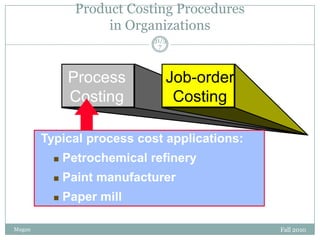
Product Costing Procedures
in Organizations
31/3
7

Process
Costing

Job-order
Costing

Typical process cost applications:




Paint manufacturer



Mugan

Petrochemical refinery
Paper mill
Fall 2010
Process Costing
32/
37

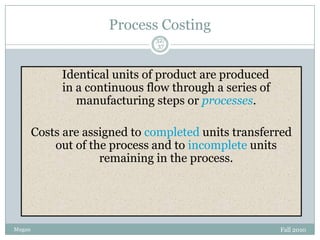
Identical units of product are produced
in a continuous flow through a series of
manufacturing steps or processes.
Costs are assigned to completed units transferred
out of the process and to incomplete units
remaining in the process.

Mugan

Fall 2010
Process Costing
33/
37

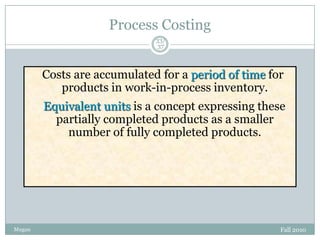
Costs are accumulated for a period of time for
products in work-in-process inventory.
Equivalent units is a concept expressing these
partially completed products as a smaller
number of fully completed products.

Mugan

Fall 2010
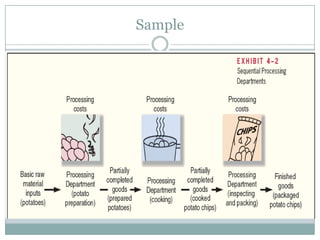
Sample
Equivalent Units
35/
37

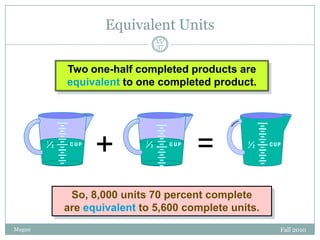
Two one-half completed products are
equivalent to one completed product.

+

=

So, 8,000 units 70 percent complete
are equivalent to 5,600 complete units.
Mugan

Fall 2010
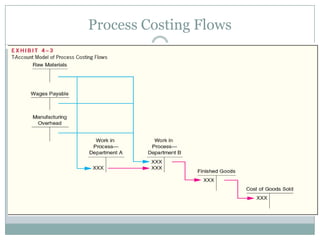
Process Costing Flows
Equivalent Units Question
37/
37

For the current period, Ames started 15,000
units and completed 10,000 units, leaving
5,000 units in process 30 percent complete.
How many equivalent units of production did
Ames have for the period?
a. 10,000
b. 11,500
c. 13,500
d. 15,000
Mugan

Fall 2010
Equivalent Units Question
38/
37

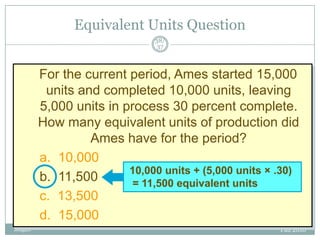
For the current period, Ames started 15,000
units and completed 10,000 units, leaving
5,000 units in process 30 percent complete.
How many equivalent units of production did
Ames have for the period?
a. 10,000
10,000 units + (5,000 units × .30)
b. 11,500
= 11,500 equivalent units
c. 13,500
d. 15,000
Mugan

Fall 2010
Similarities between Job-Order and
Process Costing
 Both systems have the same basic purposes—to

assign material, labor, and manufacturing overhead
costs to products and to provide a mechanism for
computing unit product costs.

 Both systems use the same basic manufacturing

accounts, including Manufacturing Overhead, Raw
Materials, Work in Process, and Finished Goods.

 The flow of costs through the manufacturing

accounts is basically the same in both systems.
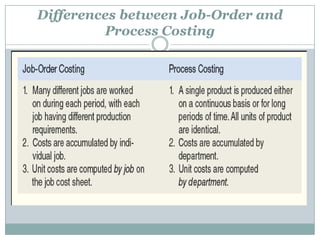
Differences between Job-Order and
Process Costing
Batch Costing
Batch Costing
 The identification and assignment of

costs
related
to
producing
a
set amount of goods. This includes all
fixed and variable costs for producing
the batch. The unit cost of a batch of
goods can be calculated by dividing the
batch cost by the number of units
produced.
Batch Costing
 In Batch Costing, a lot of similar units which

comprise the batch may be used as a cost unit for
ascertainment of cost.
 Separate Cost Sheet is maintained for each batch by
assigning a batch number.
 Cost per unit of product is determined by dividing
the total cost of a batch by the number of units of
that batch.
 Batch costing is used in number drug
industries, ready made garment
industries, electronic componentsmanufacture, TV
sets, radio etc.
Batch Costing
 “the form of specific order costing which applies

where similar articles are manufactured in batches
either for sale or for use within the company”-ICMA
 This system to be utilized when a firm manufacture
products in readily identifiable batches or definite
lots.
 “A batch is a cost unit which consist of a group of
similar articles, which maintain its identity
throughout one or more stages of production”
Features
 Variant of job costing
 Job costing is tailored to meet the customers‟

specifications whereas batch costing produced
inventory for future sale to customers.
 Furniture making, Small tool making, clothing &
toys and food processing undertakings.
Contract Costing
Contract Costing
A way of providing a cost for

especially large and long term
projects that will usually be
performed over a number of
accounting periods.
Contract Costing
 Variant of job costing,
 Applies to construction works,
 Individual cost unit (individual jobs)& cost centre

(department or process),
Service Costing
Service Costing

The

cost associated with
having an entity perform a
valuable task for which
specialized expertise may
be required.
Service Cost Perspective

Out-sourcing of Services
The Organization as the

Service Company
 With service-based

costing, organizations calculate the full
cost of their products and services.
 They propose a budget that includes
not just the expected "keep the lights
on" services, but also the many things
clients have requested.
Full Service Cost
 Direct costs (labor and vendor costs specific to

that project or service) are straightforward to assign
to services.
 Indirect Costs:
Unbillable time
 External indirect costs
 Internal indirect costs
 Overhead

Group Work
Which method for assigning costs to products would
be more appropriate in each of the following cases?
 a) Cruise ship builder
 b) Cornflakes factory
 c) Law firm
 d) Dentists office
 e) Beverage bottling company
Group Work
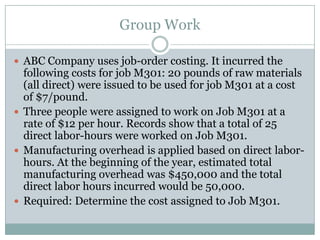
 ABC Company uses job-order costing. It incurred the

following costs for job M301: 20 pounds of raw materials
(all direct) were issued to be used for job M301 at a cost
of $7/pound.
 Three people were assigned to work on Job M301 at a
rate of $12 per hour. Records show that a total of 25
direct labor-hours were worked on Job M301.
 Manufacturing overhead is applied based on direct laborhours. At the beginning of the year, estimated total
manufacturing overhead was $450,000 and the total
direct labor hours incurred would be 50,000.
 Required: Determine the cost assigned to Job M301.
Group Work
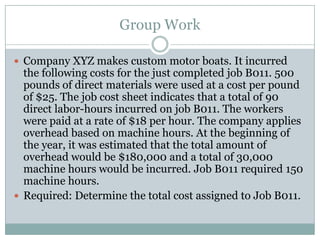
 Company XYZ makes custom motor boats. It incurred

the following costs for the just completed job B011. 500
pounds of direct materials were used at a cost per pound
of $25. The job cost sheet indicates that a total of 90
direct labor-hours incurred on job B011. The workers
were paid at a rate of $18 per hour. The company applies
overhead based on machine hours. At the beginning of
the year, it was estimated that the total amount of
overhead would be $180,000 and a total of 30,000
machine hours would be incurred. Job B011 required 150
machine hours.
 Required: Determine the total cost assigned to Job B011.
Home Assignment
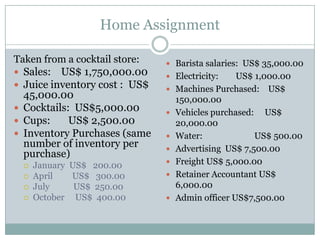
Taken from a cocktail store:
 Sales: US$ 1,750,000.00
 Juice inventory cost : US$
45,000.00
 Cocktails: US$5,000.00
 Cups:
US$ 2,500.00
 Inventory Purchases (same
number of inventory per
purchase)





January US$ 200.00
April
US$ 300.00
July
US$ 250.00
October US$ 400.00

 Barista salaries: US$ 35,000.00
 Electricity:









US$ 1,000.00
Machines Purchased: US$
150,000.00
Vehicles purchased: US$
20,000.00
Water:
US$ 500.00
Advertising US$ 7,500.00
Freight US$ 5,000.00
Retainer Accountant US$
6,000.00
Admin officer US$7,500.00
Required
 Classify the different type of costs given in the case
 Recommend and explain at least 2 different costing

methods applicable to the company
Topics for Research
Cost measurement:
o absorption and marginal costing;
o traditional overhead absorption
o activity-based costing;
o stock valuation methods
(FIFO, LIFO, AVCO, standard
costing)
Go Top
Required
Calculate costs using
appropriate techniques

Go Top
End of Session

Unit 9 costing methods

  • 1.
    Costing methods UNIT 9MANAGEMENT ACCOUNTING
  • 2.
  • 3.
    Topics Review of Lastsession Group Reporting Different Costing Methods
  • 4.
    Review of LastSession TYPES OF COST SEATWORKS
  • 5.
    What are Costs? THETOTAL MONEY, TIME AND RESOURCES ASSOCIATED WITH A PURCHASE OR ACTIVITY.
  • 6.
    Costing System AN ACCOUNTINGSYSTEM ESTABLISHED TO MONITOR A COMPANY„S COSTS, PROVIDING MANAGEMENT WITH INFORMATION ON OPERATIONS AND PERFORMANCE
  • 7.
    Widely used CostingSystems job costing; process costing; batch costing; contract costing; service costing
  • 8.
    Building-Block Concepts of CostingSystems Cost object Direct costs of a cost object Indirect costs of a cost object 4-8
  • 9.
    Building-Block Concepts of CostingSystems Cost Assignment Direct Costs Indirect Costs Cost Tracing Cost Allocation Cost Object 4-9
  • 10.
    Building-Block Concepts of CostingSystems Cost pool Cost allocation base 4 - 10
  • 11.
  • 12.
    Job Costing Job order costingsystem is generally used by companies that manufacture a number of different products. It is a widely used costing system in manufacturing
  • 13.
    Job cost sheet document used to record manufacturing costs to compute     and allocate costs to products and services. A separate job cost sheet is prepared for each individual job. Includes job number, product name, starting date, completing date, number of units completed etc. materials requisition number, cost of direct materials issued, time tickets, direct labor hours, direct labor rate per hour and total cost, manufacturing overhead rate per direct labor or machine hour and total cost etc. Job cost sheet is not only used to charge cost to jobs but is also a part of the company‟s accounting record. It is used as a subsidiary ledger to the work in process account because it contains all details about the job in process.
  • 14.
  • 15.
    Pre Determined OverheadRate (machine hours)  Predetermined overhead rate is computed at the beginning of the year using projected expenses over projected hours  Predetermined rate = total projected cost / projected hours  Manufacturing overhead applied to production = Actual machine hours × Predetermined overhead rate
  • 16.
    Manufacturing Overhead  Manufacturingoverhead is applied or added to each job     while it is in process. There are three kinds of overhead costs consider: Estimated overhead cost - used only in the predetermined overhead rate calculation Actual overhead cost which is incurred periodically throughout the year and debited to the manufacturing overhead account Applied overhead cost which is added to jobs in the work-in-process inventory account throughout the year and credited to the manufacturing overhead account
  • 17.
    Manufacturing Overhead  Actualoverhead costs flow into the account as they are     incurred Applied overhead costs flow out of the account as the jobs flow through the production process. The account balance may be either underapplied or overapplied. Underapplied overhead represents an expense which must be transferred to cost of goods sold. Overapplied overhead represents a reduction of expense charged to jobs which must be transferred to cost of goods sold.
  • 18.
    Product Costing Procedures inOrganizations 18/3 7 Process Costing Job-order Costing  Distinct jobs or batches of units. Mugan • Costs accumulated separately by job. •Typical job order cost applications: • Special-order printing • Building construction • Also used in service industry • Hospitals • Law firms Fall 2010
  • 19.
    Job-Order Costing 19/3 7 Manufacturing overhead (MOVH) Applied(added) to each job using a predetermined rate Direct materials The Job Direct labor Mugan Fall 2010
  • 20.
    Job-Order Costing 20/ 37 Raw materials couldbe used as direct or indirect product cost. Direct materials and labor Part of the job cost Materials Requisition and Time tickets An employee’s time may be either direct or indirect. Mugan Indirect materials and labor Manufacturing Overhead Control Account Fall 2010
  • 21.
  • 22.
    Job-Order Cost Sheet 22/ 37 XYZJob-Order Cost Sheet Job Number A - 143 Department A4 Item Steel water tank Direct Materials Req. No. Amount MR 1041 $ 1,200 Direct Labor Manufacturing Overhead Ticket Hours Amount Hours Rate Amount 20 8 $ 160 8 6 48 Cost Summary Direct Materials Direct Labor Manufacturing Overhead Total Cost Unit Cost Mugan Date Initiated 17 September 2008 Date Completed 17-Nov-08 Units Completed 2 $ 1,200 Units Shipped Date Number Balance $ 160 48 1408 704 11/17/08 1 1 Fall 2010
  • 23.
    Job-Order System CostFlows 23/ 37 Salaries and Wages Payable Direct Labor Indirect Labor  Mfg. Overhead Mugan Actual Applied Indirect Overhead Materials Applied to Indirect Work in Labor Process Work-in-Process (Job Cost Sheet) Direct Materials Direct Labor Overhead Applied  If actual and applied manufacturing overhead are not equal, a year-end adjustment is required. Fall 2010
  • 24.
    Job-Order System CostFlows 24/ 37 Work-in-Process (Job Cost Sheet) Direct Materials Direct Labor Overhead Applied  Cost of Goods Mfd.  Finished Goods Cost of Goods Mfd.  Cost of Goods Sold  Cost of Goods Sold Cost of Goods Sold  Mugan Fall 2010
  • 25.
    Sample Problem  TheRC manufacturing company uses job order costing system. The company uses machine hours to apply overhead cost to jobs. At the beginning of Y1, the company estimated that 150,000 machine hours would be worked and $900,000 overhead cost would be incurred during Y1.  Materials were requisitioned for use in production, $760,000 ($720,000 direct materials and $40,000 indirect materials).  Direct labor, $150,000; indirect labor, $220,000;  RC manufacturing company worked 160,000 machine hours. Manufacturing overhead was applied to production.
  • 26.
     Sales commission,$180,000; and administrative        salaries, $400,000. Sales travel costs were $34,000. Utility costs incurred in the factory, $86,000. Advertising expenses were $360,000. Depreciation for the year was $700,000 ($560,000 relates to factory and $140,000 relates to selling and administrative activities). Insurance expired during the year, $20,000 ($14,000 relates to factory operations and $6,000 relates to selling and administrative activities). Goods costing $1,800,000 were completed during the year. The goods costing $1,740,000 were sold to customers for $3,000,000.
  • 27.
    Required  Prepare aJob Order Sheet
  • 28.
  • 29.
    Process Costing  onemethod for collecting and assigning manufacturing costs to the units produced. Processing cost is used when nearly identical units are mass produced.
  • 30.
    Processing Departments  anorganizational unit where work is performed on a product and where materials, labor, or overhead costs are added to the product.
  • 31.
    Product Costing Procedures inOrganizations 31/3 7 Process Costing Job-order Costing Typical process cost applications:   Paint manufacturer  Mugan Petrochemical refinery Paper mill Fall 2010
  • 32.
    Process Costing 32/ 37 Identical unitsof product are produced in a continuous flow through a series of manufacturing steps or processes. Costs are assigned to completed units transferred out of the process and to incomplete units remaining in the process. Mugan Fall 2010
  • 33.
    Process Costing 33/ 37 Costs areaccumulated for a period of time for products in work-in-process inventory. Equivalent units is a concept expressing these partially completed products as a smaller number of fully completed products. Mugan Fall 2010
  • 34.
  • 35.
    Equivalent Units 35/ 37 Two one-halfcompleted products are equivalent to one completed product. + = So, 8,000 units 70 percent complete are equivalent to 5,600 complete units. Mugan Fall 2010
  • 36.
  • 37.
    Equivalent Units Question 37/ 37 Forthe current period, Ames started 15,000 units and completed 10,000 units, leaving 5,000 units in process 30 percent complete. How many equivalent units of production did Ames have for the period? a. 10,000 b. 11,500 c. 13,500 d. 15,000 Mugan Fall 2010
  • 38.
    Equivalent Units Question 38/ 37 Forthe current period, Ames started 15,000 units and completed 10,000 units, leaving 5,000 units in process 30 percent complete. How many equivalent units of production did Ames have for the period? a. 10,000 10,000 units + (5,000 units × .30) b. 11,500 = 11,500 equivalent units c. 13,500 d. 15,000 Mugan Fall 2010
  • 39.
    Similarities between Job-Orderand Process Costing  Both systems have the same basic purposes—to assign material, labor, and manufacturing overhead costs to products and to provide a mechanism for computing unit product costs.  Both systems use the same basic manufacturing accounts, including Manufacturing Overhead, Raw Materials, Work in Process, and Finished Goods.  The flow of costs through the manufacturing accounts is basically the same in both systems.
  • 40.
    Differences between Job-Orderand Process Costing
  • 41.
  • 42.
    Batch Costing  Theidentification and assignment of costs related to producing a set amount of goods. This includes all fixed and variable costs for producing the batch. The unit cost of a batch of goods can be calculated by dividing the batch cost by the number of units produced.
  • 43.
    Batch Costing  InBatch Costing, a lot of similar units which comprise the batch may be used as a cost unit for ascertainment of cost.  Separate Cost Sheet is maintained for each batch by assigning a batch number.  Cost per unit of product is determined by dividing the total cost of a batch by the number of units of that batch.  Batch costing is used in number drug industries, ready made garment industries, electronic componentsmanufacture, TV sets, radio etc.
  • 44.
    Batch Costing  “theform of specific order costing which applies where similar articles are manufactured in batches either for sale or for use within the company”-ICMA  This system to be utilized when a firm manufacture products in readily identifiable batches or definite lots.  “A batch is a cost unit which consist of a group of similar articles, which maintain its identity throughout one or more stages of production”
  • 45.
    Features  Variant ofjob costing  Job costing is tailored to meet the customers‟ specifications whereas batch costing produced inventory for future sale to customers.  Furniture making, Small tool making, clothing & toys and food processing undertakings.
  • 46.
  • 47.
    Contract Costing A wayof providing a cost for especially large and long term projects that will usually be performed over a number of accounting periods.
  • 48.
    Contract Costing  Variantof job costing,  Applies to construction works,  Individual cost unit (individual jobs)& cost centre (department or process),
  • 49.
  • 50.
    Service Costing The cost associatedwith having an entity perform a valuable task for which specialized expertise may be required.
  • 51.
    Service Cost Perspective Out-sourcingof Services The Organization as the Service Company
  • 52.
     With service-based costing,organizations calculate the full cost of their products and services.  They propose a budget that includes not just the expected "keep the lights on" services, but also the many things clients have requested.
  • 53.
    Full Service Cost Direct costs (labor and vendor costs specific to that project or service) are straightforward to assign to services.  Indirect Costs: Unbillable time  External indirect costs  Internal indirect costs  Overhead 
  • 54.
    Group Work Which methodfor assigning costs to products would be more appropriate in each of the following cases?  a) Cruise ship builder  b) Cornflakes factory  c) Law firm  d) Dentists office  e) Beverage bottling company
  • 55.
    Group Work  ABCCompany uses job-order costing. It incurred the following costs for job M301: 20 pounds of raw materials (all direct) were issued to be used for job M301 at a cost of $7/pound.  Three people were assigned to work on Job M301 at a rate of $12 per hour. Records show that a total of 25 direct labor-hours were worked on Job M301.  Manufacturing overhead is applied based on direct laborhours. At the beginning of the year, estimated total manufacturing overhead was $450,000 and the total direct labor hours incurred would be 50,000.  Required: Determine the cost assigned to Job M301.
  • 56.
    Group Work  CompanyXYZ makes custom motor boats. It incurred the following costs for the just completed job B011. 500 pounds of direct materials were used at a cost per pound of $25. The job cost sheet indicates that a total of 90 direct labor-hours incurred on job B011. The workers were paid at a rate of $18 per hour. The company applies overhead based on machine hours. At the beginning of the year, it was estimated that the total amount of overhead would be $180,000 and a total of 30,000 machine hours would be incurred. Job B011 required 150 machine hours.  Required: Determine the total cost assigned to Job B011.
  • 57.
    Home Assignment Taken froma cocktail store:  Sales: US$ 1,750,000.00  Juice inventory cost : US$ 45,000.00  Cocktails: US$5,000.00  Cups: US$ 2,500.00  Inventory Purchases (same number of inventory per purchase)     January US$ 200.00 April US$ 300.00 July US$ 250.00 October US$ 400.00  Barista salaries: US$ 35,000.00  Electricity:        US$ 1,000.00 Machines Purchased: US$ 150,000.00 Vehicles purchased: US$ 20,000.00 Water: US$ 500.00 Advertising US$ 7,500.00 Freight US$ 5,000.00 Retainer Accountant US$ 6,000.00 Admin officer US$7,500.00
  • 58.
    Required  Classify thedifferent type of costs given in the case  Recommend and explain at least 2 different costing methods applicable to the company
  • 59.
    Topics for Research Costmeasurement: o absorption and marginal costing; o traditional overhead absorption o activity-based costing; o stock valuation methods (FIFO, LIFO, AVCO, standard costing) Go Top
  • 60.
  • 61.