Theory of change
Alessandro Valenza holds a Master Degree in Political Science.
He is the founder and partner of t33 (www.t33.it ). He has more
than 15 years of professional experience in public policy analysis
and evaluation research working for different European
Institutions. He lectures in several Italian universities.
There is nothing wrong with change,
if it is in the right direction.
(W. Churchill)
Contents of the following Skill Pill
!  The casual pathway
!  TOC and Logic framework
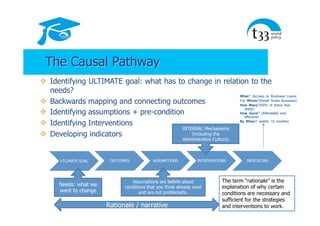
The Causal Pathway
!  Identifying ULTIMATE goal: what has to change in relation to the
needs?
!  Backwards mapping and connecting outcomes
!  Identifying assumptions + pre-condition
!  Identifying Interventions
!  Developing indicators
UTLIMATE GOAL OUTCOMES ASSUMPTIONS INTERVENTIONS INDICATORS
INTERNAL Mechanisms
(including the
Administrative Culture)
Needs: what we
want to change
Assumptions are beliefs about
conditions that you think already exist
and are not problematic.
Rationale / narrative
The term “rationale” is the
explanation of why certain
conditions are necessary and
sufficient for the strategies
and interventions to work.
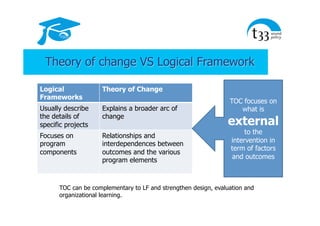
Theory of change VS Logical Framework
Logical
Frameworks
Theory of Change
Usually describe
the details of
specific projects
Explains a broader arc of
change
Focuses on
program
components
Relationships and
interdependences between
outcomes and the various
program elements
TOC focuses on
what is
external
to the
intervention in
term of factors
and outcomes
TOC can be complementary to LF and strengthen design, evaluation and
organizational learning.

Theory of change

  • 1.
    Theory of change AlessandroValenza holds a Master Degree in Political Science. He is the founder and partner of t33 (www.t33.it ). He has more than 15 years of professional experience in public policy analysis and evaluation research working for different European Institutions. He lectures in several Italian universities. There is nothing wrong with change, if it is in the right direction. (W. Churchill)
  • 2.
    Contents of thefollowing Skill Pill !  The casual pathway !  TOC and Logic framework
  • 3.
    The Causal Pathway ! Identifying ULTIMATE goal: what has to change in relation to the needs? !  Backwards mapping and connecting outcomes !  Identifying assumptions + pre-condition !  Identifying Interventions !  Developing indicators UTLIMATE GOAL OUTCOMES ASSUMPTIONS INTERVENTIONS INDICATORS INTERNAL Mechanisms (including the Administrative Culture) Needs: what we want to change Assumptions are beliefs about conditions that you think already exist and are not problematic. Rationale / narrative The term “rationale” is the explanation of why certain conditions are necessary and sufficient for the strategies and interventions to work.
  • 4.
    Theory of changeVS Logical Framework Logical Frameworks Theory of Change Usually describe the details of specific projects Explains a broader arc of change Focuses on program components Relationships and interdependences between outcomes and the various program elements TOC focuses on what is external to the intervention in term of factors and outcomes TOC can be complementary to LF and strengthen design, evaluation and organizational learning.