THEORY OF CHANGE
VS LOGIC MODEL
GUELPH EVALUATION CAFÉ
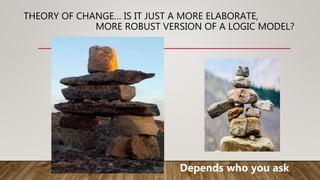
THEORY OF CHANGE… IS IT JUST A MORE ELABORATE,
MORE ROBUST VERSION OF A LOGIC MODEL?
Depends who you ask
THEORY OF CHANGE VS LOGIC MODEL…
WHY THE CONFUSION?
• “Theory of change” and “logic model” terms are often used
interchangeably and there are many hybrid or blended approaches
• Models of change
• Pathways mapping
• Causal pathway
• Outcomes chain
• Others
THEORY OF CHANGE VS LOGIC MODEL…
• They share some similarities…
• both represent a critical thinking approach to program design,
monitoring, and evaluation
• both typically identify outcomes and present a causal pathway
• both should be reviewed / refined regularly to reflect emerging
conditions and new knowledge
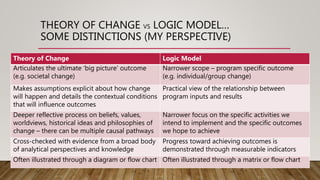
THEORY OF CHANGE VS LOGIC MODEL…
SOME DISTINCTIONS (MY PERSPECTIVE)
Theory of Change Logic Model
Articulates the ultimate ‘big picture’ outcome
(e.g. societal change)
Narrower scope – program specific outcome
(e.g. individual/group change)
Makes assumptions explicit about how change
will happen and details the contextual conditions
that will influence outcomes
Practical view of the relationship between
program inputs and results
Deeper reflective process on beliefs, values,
worldviews, historical ideas and philosophies of
change – there can be multiple causal pathways
Narrower focus on the specific activities we
intend to implement and the specific outcomes
we hope to achieve
Cross-checked with evidence from a broad body
of analytical perspectives and knowledge
Progress toward achieving outcomes is
demonstrated through measurable indicators
Often illustrated through a diagram or flow chart Often illustrated through a matrix or flow chart
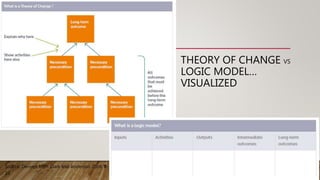
THEORY OF CHANGE VS
LOGIC MODEL…
VISUALIZED
Source: Derived from Clark and Anderson 2004: 8–
10
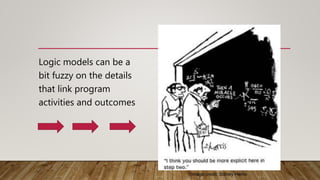
Logic models can be a
bit fuzzy on the details
that link program
activities and outcomes
Image credit: Sidney Harris
BRIDGING THE ‘MISSING MIDDLE’
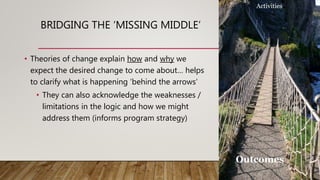
• Theories of change explain how and why we
expect the desired change to come about… helps
to clarify what is happening ‘behind the arrows’
• They can also acknowledge the weaknesses /
limitations in the logic and how we might
address them (informs program strategy)
Activities
Outcomes
CASE IN POINT…
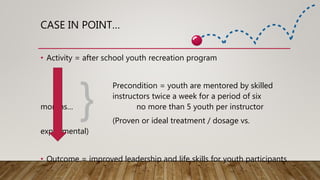
• Activity = after school youth recreation program
Precondition = youth are mentored by skilled
instructors twice a week for a period of six
months… no more than 5 youth per instructor
(Proven or ideal treatment / dosage vs.
experimental)
• Outcome = improved leadership and life skills for youth participants
}
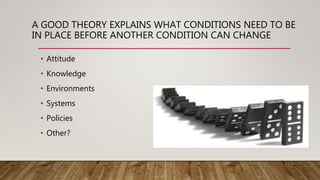
A GOOD THEORY EXPLAINS WHAT CONDITIONS NEED TO BE
IN PLACE BEFORE ANOTHER CONDITION CAN CHANGE
• Attitude
• Knowledge
• Environments
• Systems
• Policies
• Other?
TOC IS HELPFUL FOR PROGRAM PLANNING…
• Because it looks at the ‘bigger picture’ of factors that can influence change, TOC
can assist in identifying…
• what the organization can reasonably influence / leverage with its own
resources and activities
• where responsibilities need to be shared with other organizations
• actions that other organizations need to take full responsibility for
• TOC helps to think through and question our assumptions… it can contribute to
the development of a more realistic, doable, and testable program
TOC IS HELPFUL FOR PROGRAM EVALUATION…
• With an understanding of the type of change that we can and cannot
realistically influence, we can decide on the outcomes that…
• our organization wants (is willing) to be accountable for (e.g. set targets,
monitor, measure)
• our organization along with our partner organizations want to be collectively
accountable for
• TOC helps to think through and scope the evaluation… defining the things we
want to be responsible for monitoring and measuring
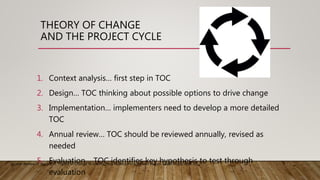
THEORY OF CHANGE
AND THE PROJECT CYCLE
1. Context analysis… first step in TOC
2. Design… TOC thinking about possible options to drive change
3. Implementation… implementers need to develop a more detailed
TOC
4. Annual review… TOC should be reviewed annually, revised as
needed
5. Evaluation… TOC identifies key hypothesis to test through
evaluation
Source: Review of the use of ‘Theory of Change’ in international development. Review Report. Isabel Vogel, April 2012
THEORY OF CHANGE
PITFALLS
• They can be challenging and time consuming to
prepare
• Requires realistic and transparent strategic
thinking… challenge assumptions, explore and
understand power relations
• They can be messy and confusing
• They can be difficult to interpret – especially if
language is too technical and concepts are too
abstract
THEORY OF CHANGE
THINKING
‘The main purpose of the process and the diagram is not to map
reality, but to surface perspectives on reality and worldviews, so that
these can be explored, debated and enriched. Theory of change is
about generating better assumptions, better hypotheses of change to
strengthen our work, learn from what happens and improve it.’
Alfredo Ortiz, Researcher
Institute of Development Studies
THEORY OF CHANGE
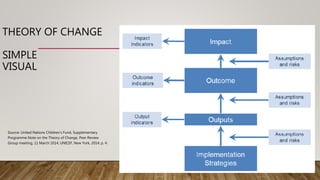
SIMPLE
VISUAL
Source: United Nations Children’s Fund, Supplementary
Programme Note on the Theory of Change, Peer Review
Group meeting, 11 March 2014, UNICEF, New York, 2014, p. 4.
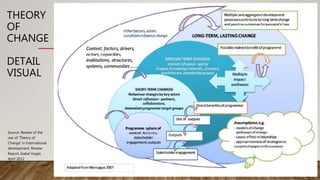
Source: Review of the
use of ‘Theory of
Change’ in International
development. Review
Report. Isabel Vogel,
April 2012
THEORY
OF
CHANGE
DETAIL
VISUAL
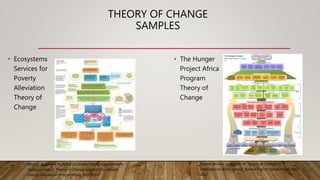
THEORY OF CHANGE
SAMPLES
• Ecosystems
Services for
Poverty
Alleviation
Theory of
Change
Source: Guidance for M&E of climate change interventions.
Guidance note 3: Theory of Change approach to climate
change adaptation programming. Feb. 2014
• The Hunger
Project Africa
Program
Theory of
Change
Source: Review of the use of ‘Theory of Change’ in
international development. Review Report. Isabel Vogel, April
2012
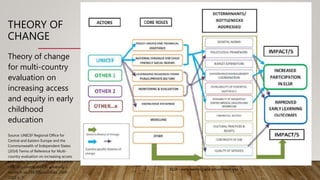
Theory of change
for multi-country
evaluation on
increasing access
and equity in early
childhood
education
Source: UNICEF Regional Office for
Central and Eastern Europe and the
Commonwealth of Independent States
(2014) Terms of Reference for Multi-
country evaluation on increasing access
and equity in early childhood education:
UNICEF’s contribution to achieving
results in six CEE-CIS countries, 2005–
2012, p. 7.
ELSR - early learning and school readiness
THEORY OF
CHANGE
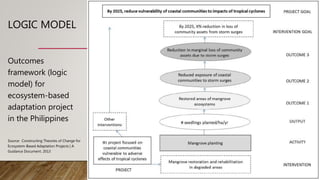
LOGIC MODEL
Outcomes
framework (logic
model) for
ecosystem-based
adaptation project
in the Philippines
Source: Constructing Theories of Change for
Ecosystem-Based Adaptation Projects | A
Guidance Document. 2013
DISCUSSION

Theory of Change vs. Program Logic Model

  • 1.
    THEORY OF CHANGE VSLOGIC MODEL GUELPH EVALUATION CAFÉ
  • 2.
    THEORY OF CHANGE…IS IT JUST A MORE ELABORATE, MORE ROBUST VERSION OF A LOGIC MODEL? Depends who you ask
  • 3.
    THEORY OF CHANGEVS LOGIC MODEL… WHY THE CONFUSION? • “Theory of change” and “logic model” terms are often used interchangeably and there are many hybrid or blended approaches • Models of change • Pathways mapping • Causal pathway • Outcomes chain • Others
  • 4.
    THEORY OF CHANGEVS LOGIC MODEL… • They share some similarities… • both represent a critical thinking approach to program design, monitoring, and evaluation • both typically identify outcomes and present a causal pathway • both should be reviewed / refined regularly to reflect emerging conditions and new knowledge
  • 5.
    THEORY OF CHANGEVS LOGIC MODEL… SOME DISTINCTIONS (MY PERSPECTIVE) Theory of Change Logic Model Articulates the ultimate ‘big picture’ outcome (e.g. societal change) Narrower scope – program specific outcome (e.g. individual/group change) Makes assumptions explicit about how change will happen and details the contextual conditions that will influence outcomes Practical view of the relationship between program inputs and results Deeper reflective process on beliefs, values, worldviews, historical ideas and philosophies of change – there can be multiple causal pathways Narrower focus on the specific activities we intend to implement and the specific outcomes we hope to achieve Cross-checked with evidence from a broad body of analytical perspectives and knowledge Progress toward achieving outcomes is demonstrated through measurable indicators Often illustrated through a diagram or flow chart Often illustrated through a matrix or flow chart
  • 6.
    THEORY OF CHANGEVS LOGIC MODEL… VISUALIZED Source: Derived from Clark and Anderson 2004: 8– 10
  • 7.
    Logic models canbe a bit fuzzy on the details that link program activities and outcomes Image credit: Sidney Harris
  • 8.
    BRIDGING THE ‘MISSINGMIDDLE’ • Theories of change explain how and why we expect the desired change to come about… helps to clarify what is happening ‘behind the arrows’ • They can also acknowledge the weaknesses / limitations in the logic and how we might address them (informs program strategy) Activities Outcomes
  • 9.
    CASE IN POINT… •Activity = after school youth recreation program Precondition = youth are mentored by skilled instructors twice a week for a period of six months… no more than 5 youth per instructor (Proven or ideal treatment / dosage vs. experimental) • Outcome = improved leadership and life skills for youth participants }
  • 10.
    A GOOD THEORYEXPLAINS WHAT CONDITIONS NEED TO BE IN PLACE BEFORE ANOTHER CONDITION CAN CHANGE • Attitude • Knowledge • Environments • Systems • Policies • Other?
  • 11.
    TOC IS HELPFULFOR PROGRAM PLANNING… • Because it looks at the ‘bigger picture’ of factors that can influence change, TOC can assist in identifying… • what the organization can reasonably influence / leverage with its own resources and activities • where responsibilities need to be shared with other organizations • actions that other organizations need to take full responsibility for • TOC helps to think through and question our assumptions… it can contribute to the development of a more realistic, doable, and testable program
  • 12.
    TOC IS HELPFULFOR PROGRAM EVALUATION… • With an understanding of the type of change that we can and cannot realistically influence, we can decide on the outcomes that… • our organization wants (is willing) to be accountable for (e.g. set targets, monitor, measure) • our organization along with our partner organizations want to be collectively accountable for • TOC helps to think through and scope the evaluation… defining the things we want to be responsible for monitoring and measuring
  • 13.
    THEORY OF CHANGE ANDTHE PROJECT CYCLE 1. Context analysis… first step in TOC 2. Design… TOC thinking about possible options to drive change 3. Implementation… implementers need to develop a more detailed TOC 4. Annual review… TOC should be reviewed annually, revised as needed 5. Evaluation… TOC identifies key hypothesis to test through evaluation Source: Review of the use of ‘Theory of Change’ in international development. Review Report. Isabel Vogel, April 2012
  • 14.
    THEORY OF CHANGE PITFALLS •They can be challenging and time consuming to prepare • Requires realistic and transparent strategic thinking… challenge assumptions, explore and understand power relations • They can be messy and confusing • They can be difficult to interpret – especially if language is too technical and concepts are too abstract
  • 15.
    THEORY OF CHANGE THINKING ‘Themain purpose of the process and the diagram is not to map reality, but to surface perspectives on reality and worldviews, so that these can be explored, debated and enriched. Theory of change is about generating better assumptions, better hypotheses of change to strengthen our work, learn from what happens and improve it.’ Alfredo Ortiz, Researcher Institute of Development Studies
  • 16.
    THEORY OF CHANGE SIMPLE VISUAL Source:United Nations Children’s Fund, Supplementary Programme Note on the Theory of Change, Peer Review Group meeting, 11 March 2014, UNICEF, New York, 2014, p. 4.
  • 17.
    Source: Review ofthe use of ‘Theory of Change’ in International development. Review Report. Isabel Vogel, April 2012 THEORY OF CHANGE DETAIL VISUAL
  • 18.
    THEORY OF CHANGE SAMPLES •Ecosystems Services for Poverty Alleviation Theory of Change Source: Guidance for M&E of climate change interventions. Guidance note 3: Theory of Change approach to climate change adaptation programming. Feb. 2014 • The Hunger Project Africa Program Theory of Change Source: Review of the use of ‘Theory of Change’ in international development. Review Report. Isabel Vogel, April 2012
  • 19.
    Theory of change formulti-country evaluation on increasing access and equity in early childhood education Source: UNICEF Regional Office for Central and Eastern Europe and the Commonwealth of Independent States (2014) Terms of Reference for Multi- country evaluation on increasing access and equity in early childhood education: UNICEF’s contribution to achieving results in six CEE-CIS countries, 2005– 2012, p. 7. ELSR - early learning and school readiness THEORY OF CHANGE
  • 20.
    LOGIC MODEL Outcomes framework (logic model)for ecosystem-based adaptation project in the Philippines Source: Constructing Theories of Change for Ecosystem-Based Adaptation Projects | A Guidance Document. 2013
  • 21.