Why Do We Forget?
Encoding Failure: Many memory failures result not from “forgetting” information that we once knew well, but from failure to encoding the information into long-term memory in the first place. At other times, we may notice information but fails to encode it deeply because we turn our attention to something else.
Why Do We Forget Everyone once in awhile feels that a piece of information has just vanished from memory.  Or you that it’s there but you just can’t seem to find it.  Research has proposed several explanations for normal memory loss, emphasizing difficulties in encoding, storage and retrieval.  Why Do We Forget
Motivated Forgetting: Sometimes, we may actively work to forget memories, especially those of traumatic or disturbing events or experiences. The two basic forms of motivated forgetting are: suppression, a conscious form of forgetting, and repression, an unconscious form of forgetting. However, the concept of repressed memories is not universally accepted by all psychologists. One of the problems with repressed memories is that it is difficult, if not impossible, to scientifically study whether or not a memory has been repressed. Also note that mental activities such as rehearsal and remembering are important ways of strengthening a memory, and memories of painful or traumatic life events are far less likely to be remembered, discussed or rehearsed .
Decay Theory: Over time, these memory traces begin to fade and disappear. If information is not received and rehearsed, it will eventually be lost. However, research has demonstrated that even memories which have not been rehearsed or remembered are remarkably stable in long-term memory.
Interference : Another theory known as  interference theory  suggests that some memories compete and interfere with other memories. When information is very similar to other information that was previously stored in memory, interference is more likely to occur. There are two basic types of interference:  Proactive interference  is when an old memory makes it more difficult or impossible to remember a new memory.  Retroactive interference  occurs when new information interferes with your ability to remember previously learned information.
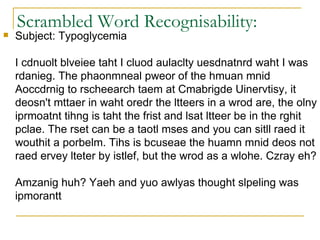
Scrambled Word Recognisability:  Subject: Typoglycemia I cdnuolt blveiee taht I cluod aulaclty uesdnatnrd waht I was rdanieg. The phaonmneal pweor of the hmuan mnid Aoccdrnig to rscheearch taem at Cmabrigde Uinervtisy, it deosn't mttaer in waht oredr the ltteers in a wrod are, the olny iprmoatnt tihng is taht the frist and lsat ltteer be in the rghit pclae. The rset can be a taotl mses and you can sitll raed it wouthit a porbelm. Tihs is bcuseae the huamn mnid deos not raed ervey lteter by istlef, but the wrod as a wlohe. Czray eh? Amzanig huh? Yaeh and yuo awlyas thought slpeling was ipmorantt

Why Do We Forget

  • 1.
    Why Do WeForget?
  • 2.
    Encoding Failure: Manymemory failures result not from “forgetting” information that we once knew well, but from failure to encoding the information into long-term memory in the first place. At other times, we may notice information but fails to encode it deeply because we turn our attention to something else.
  • 3.
    Why Do WeForget Everyone once in awhile feels that a piece of information has just vanished from memory. Or you that it’s there but you just can’t seem to find it. Research has proposed several explanations for normal memory loss, emphasizing difficulties in encoding, storage and retrieval. Why Do We Forget
  • 4.
    Motivated Forgetting: Sometimes,we may actively work to forget memories, especially those of traumatic or disturbing events or experiences. The two basic forms of motivated forgetting are: suppression, a conscious form of forgetting, and repression, an unconscious form of forgetting. However, the concept of repressed memories is not universally accepted by all psychologists. One of the problems with repressed memories is that it is difficult, if not impossible, to scientifically study whether or not a memory has been repressed. Also note that mental activities such as rehearsal and remembering are important ways of strengthening a memory, and memories of painful or traumatic life events are far less likely to be remembered, discussed or rehearsed .
  • 5.
    Decay Theory: Overtime, these memory traces begin to fade and disappear. If information is not received and rehearsed, it will eventually be lost. However, research has demonstrated that even memories which have not been rehearsed or remembered are remarkably stable in long-term memory.
  • 6.
    Interference : Anothertheory known as interference theory suggests that some memories compete and interfere with other memories. When information is very similar to other information that was previously stored in memory, interference is more likely to occur. There are two basic types of interference: Proactive interference is when an old memory makes it more difficult or impossible to remember a new memory. Retroactive interference occurs when new information interferes with your ability to remember previously learned information.
  • 7.
    Scrambled Word Recognisability: Subject: Typoglycemia I cdnuolt blveiee taht I cluod aulaclty uesdnatnrd waht I was rdanieg. The phaonmneal pweor of the hmuan mnid Aoccdrnig to rscheearch taem at Cmabrigde Uinervtisy, it deosn't mttaer in waht oredr the ltteers in a wrod are, the olny iprmoatnt tihng is taht the frist and lsat ltteer be in the rghit pclae. The rset can be a taotl mses and you can sitll raed it wouthit a porbelm. Tihs is bcuseae the huamn mnid deos not raed ervey lteter by istlef, but the wrod as a wlohe. Czray eh? Amzanig huh? Yaeh and yuo awlyas thought slpeling was ipmorantt