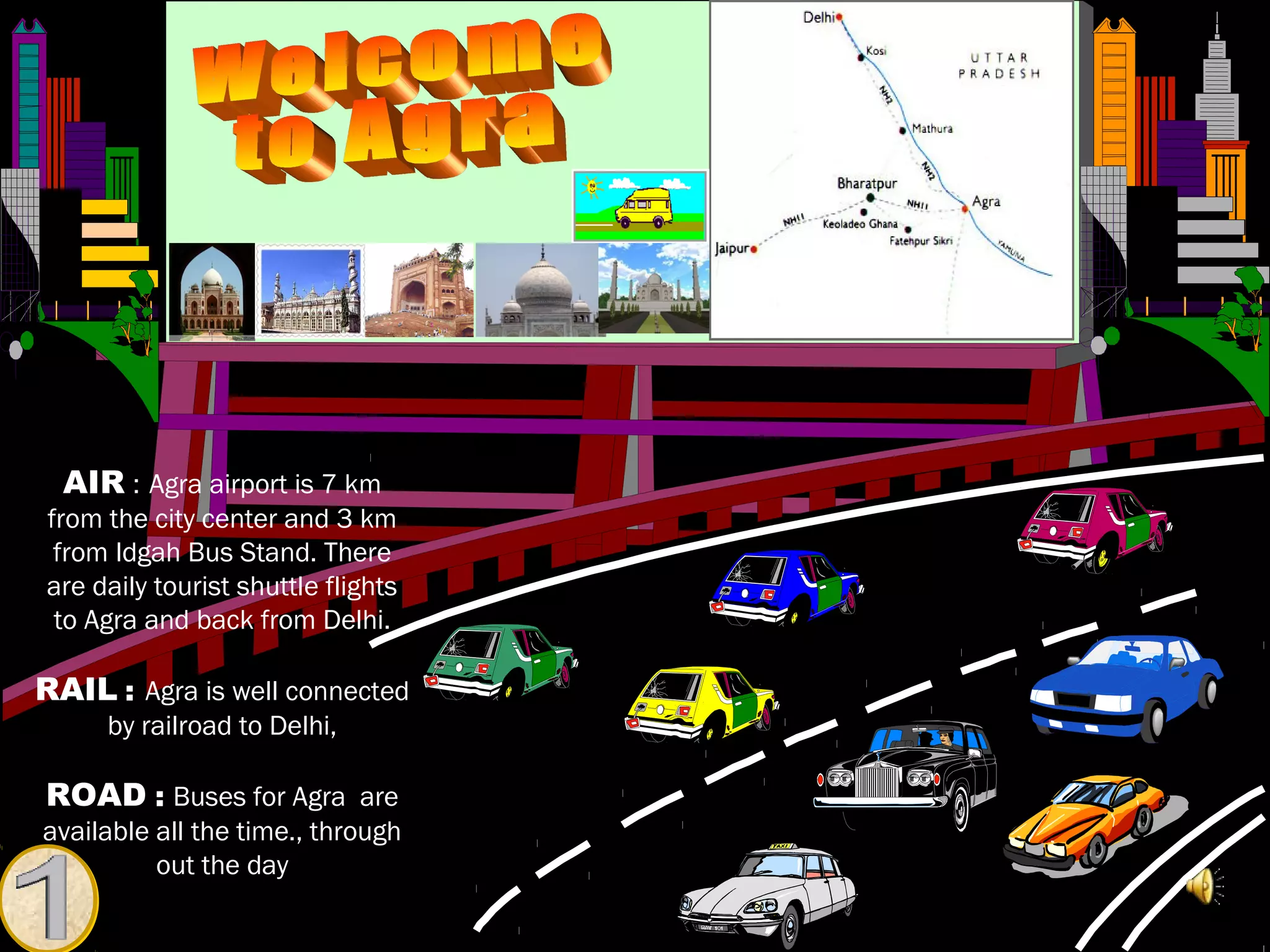
AIR : Agra airport is 7 km
from the city center and 3 km
 from Idgah Bus Stand. There
are daily tourist shuttle flights
 to Agra and back from Delhi.

RAIL : Agra is well connected
     by railroad to Delhi,

ROAD : Buses for Agra are
available all the time., through
          out the day
Indo-Islamic style is neither a local
variant of Islamic art, nor a modification
of Hindu art; it is an assimilation of both
the styles, though not always in an
equal degree. On the other hand, Islamic
art itself was a composite style, which
had various Muslims influences-Turkish,
Persian, and Arabic.
This amalgamation of exotic and
indigenous architectural styles was
possible due to a variety or factors-
Muslim rulers had to use, in most cases,
Indian craftsmen and sculptors who
were schooled in their own art
traditions.    Another     factor     that
inadvertently contributed to this fusion
of style was that during the early Muslim invasions, mosques were often
built out of materials from Hindu and Jain temples and sometimes
temples themselves were modified into mosques.
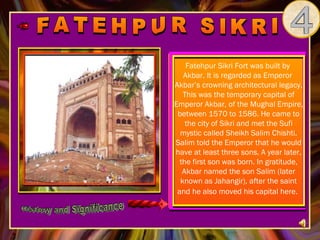
Fatehpur Sikri Fort was built by
   Akbar. It is regarded as Emperor
Akbar’s crowning architectural legacy.
   This was the temporary capital of
Emperor Akbar, of the Mughal Empire,
 between 1570 to 1586. He came to
    the city of Sikri and met the Sufi
  mystic called Sheikh Salim Chishti.
Salim told the Emperor that he would
have at least three sons. A year later,
  the first son was born. In gratitude,
   Akbar named the son Salim (later
  known as Jahangir), after the saint
 and he also moved his capital here.
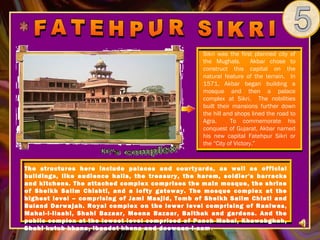
Sikri was the first planned city of
                                                   the Mughals.        Akbar chose to
                                                   construct this capital on the
                                                   natural feature of the terrain. In
                                                   1571, Akbar began building a
                                                   mosque and then a palace
                                                   complex at Sikri. The nobilities
                                                   built their mansions further down
                                                   the hill and shops lined the road to
                                                   Agra.      To commemorate his
                                                   conquest of Gujarat, Akbar named
                                                   his new capital Fatehpur Sikri or
                                                   the “City of Victory.”


The structures here include palaces and courtyards, as well as official
buildings, like audience halls, the treasury, the harem, soldier's barracks
and kitchens. The attached complex comprises the main mosque, the shrine
of Sheikh Salim Chishti, and a lofty gateway. The mosque complex at the
highest level – comprising of Jami Masjid, Tomb of Sheikh Salim Chisti and
Buland Darwajah. Royal complex on the lower level comprising of Raniwas,
Mahal-I-ilaahi, Shahi Bazaar, Meena Bazaar, Baithak and gardens. And the
public complex at the lowest level comprised of Panch Mahal, Khawabghah,
Shahi kutub khana, Ibaadat khana and deewaan-i-aam .
INSIDE FATEHPUR
                          SIKRI


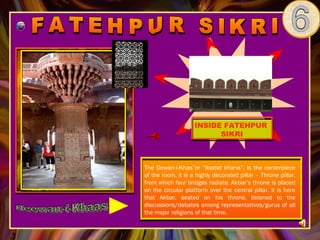
The Dewan-i-Khas”or “Ibadat khana”. Is the centerpiece
of the room, it is a highly decorated pillar – Throne pillar,
from which four bridges radiate. Akbar’s throne is placed
on the circular platform over the central pillar. It is here
that Akbar, seated on his throne, listened to the
discussions/debates among representatives/gurus of all
the major religions of that time.
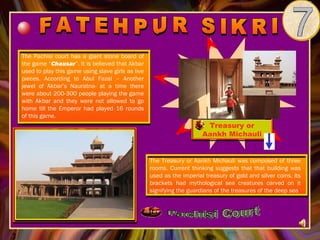
The Pachisi court has a giant stone board of
the game “Chausar”. It is believed that Akbar
used to play this game using slave girls as live
pieces. According to Abul Fazal – Another
jewel of Akbar’s Nauratna- at a time there
were about 200-300 people playing the game
with Akbar and they were not allowed to go
home till the Emperor had played 16 rounds
of this game.
                                                                        Treasury or
                                                                       Aankh Michauli


                                                   The Treasury or Aankh Michauli was composed of three
                                                   rooms. Current thinking suggests that that building was
                                                   used as the imperial treasury of gold and silver coins. Its
                                                   brackets had mythological sea creatures carved on it
                                                   signifying the guardians of the treasures of the deep sea
The Taj Mahal is a
mausoleum located in
Agra, India. The Mughal
Emperor     Shah     Jahan
commissioned it as a
mausoleum       for     his
favorite wife, Mumtaz
Mahal. Construction of
the Taj Mahal was begun
in   Agra    soon     after
Mumtaz's     death.     The
principal      mausoleum
was completed in 1648,
and    the    surrounding
buildings   and     garden
five    years    later.
Construction began in
1632 and was completed
in 1648.
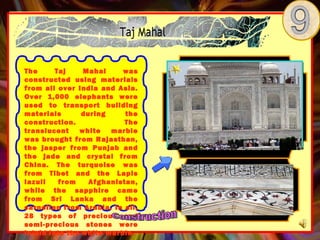
The      Taj    Mahal     was
constructed using materials
from all over India and Asia.
Over 1,000 elephants were
used to transport building
materials       during     the
construction.              The
translucent    white   marble
was brought from Rajasthan,
the jasper from Punjab and
the jade and crystal from
China. The turquoise was
from Tibet and the Lapis
lazuli    from    Afghanistan,
while the sapphire came
from Sri Lanka and the
carnelian from Arabia. In all,
28 types of precious and
semi-precious stones were
inlaid into the white marble.
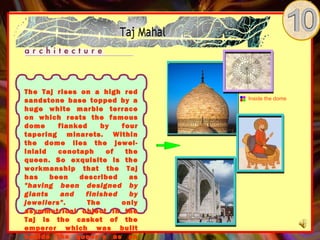
The Taj rises on a high red
sandstone base topped by a      Inside the dome

huge white marble terrace
on which rests the famous
dome     flanked     by  four
tapering minarets. Within
the dome lies the jewel-
inlaid   cenotaph     of  the
queen. So exquisite is the
workmanship that the Taj
has    been   described    as
"having been designed by
giants    and   finished   by
jewellers".      The     only
asymmetrical object in the
Taj is the casket of the
emperor which was built
beside the queen’s as an
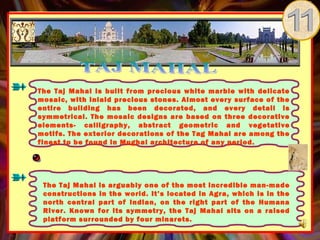
The Taj Mahal is built from precious white marble with delicate
mosaic, with inlaid precious stones. Almost every surface of the
entire building has been decorated, and every detail is
symmetrical. The mosaic designs are based on three decorative
elements- calligraphy, abstract geometric and vegetative
motifs. The exterior decorations of the Tag Mahal are among the
finest to be found in Mughal architecture of any period.


 The Taj Mahal is arguably one of the most incredible man-made
 constructions in the world. It’s located in Agra, which is in the
 north central part of Indian, on the right part of the Humana
 River. Known for its symmetry, the Taj Mahal sits on a raised
 platform surrounded by four minarets.
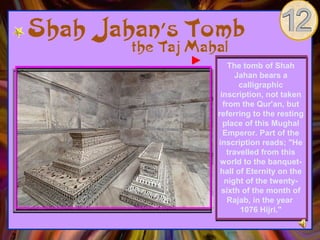
The tomb of Shah
       Jahan bears a
        calligraphic
 inscription, not taken
  from the Qur'an, but
referring to the resting
  place of this Mughal
  Emperor. Part of the
inscription reads; "He
    travelled from this
 world to the banquet-
 hall of Eternity on the
   night of the twenty-
 sixth of the month of
    Rajab, in the year
        1076 Hijri."
Shah Jehan deemed
      Shah Jehan deemed
    that one else should ever
    that one else should ever
    copy the masterpiece, so
    copy the masterpiece, so                       Many people believe,
                                                   Many people believe,
  he had the master craftsman
  he had the master craftsman                   Shah Jehan had planned to
                                                Shah Jehan had planned to
          Ustad Isa right
          Ustad Isa right                build another Taj Mahal in black marble,
                                         build another Taj Mahal in black marble,
           hand cut off.
           hand cut off.                  which was to be his own tomb on the
                                          which was to be his own tomb on the
                                         opposite bank of the River Yamuna and
                                         opposite bank of the River Yamuna and
                                               connect the two by a bridge.
                                                connect the two by a bridge.
                                             However, the construction never
                                             However, the construction never
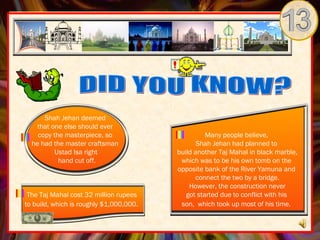
 The Taj Mahal cost 32 million rupees
 The Taj Mahal cost 32 million rupees       got started due to conflict with his
                                            got started due to conflict with his
to build, which is roughly $1,000,000.
to build, which is roughly $1,000,000.    son, which took up most of his time.
                                          son, which took up most of his time.
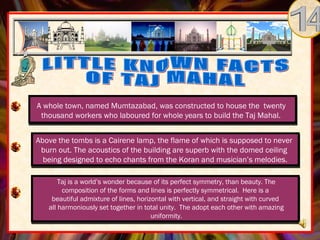
A whole town, named Mumtazabad, was constructed to house the twenty
  thousand workers who laboured for whole years to build the Taj Mahal.

Above the tombs isis a Cairene lamp, the flame of which is supposed to never
 Above the tombs a Cairene lamp, the flame of which is supposed to never
 burn out. The acoustics ofof the building are superb with the domed ceiling
   burn out. The acoustics the building are superb with the domed ceiling
  being designed toto echo chants from the Koran and musician’s melodies.
   being designed echo chants from the Koran and musician’s melodies.

         Taj is a world’s wonder because of its perfect symmetry, than beauty. The
          composition of the forms and lines is perfectly symmetrical. Here is a
      beautiful admixture of lines, horizontal with vertical, and straight with curved
     all harmoniously set together in total unity. The adopt each other with amazing
                                         uniformity.
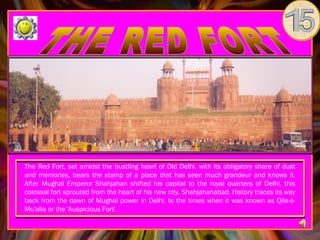
The Red Fort, set amidst the bustling heart of Old Delhi, with its obligatory share of dust
and memories, bears the stamp of a place that has seen much grandeur and knows it.
After Mughal Emperor Shahjahan shifted his capital to the royal quarters of Delhi, this
colossal fort sprouted from the heart of his new city, Shahjahanabad. History traces its way
back from the dawn of Mughal power in Delhi, to the times when it was known as Qila-e-
Mu'alla or the 'Auspicious Fort'.
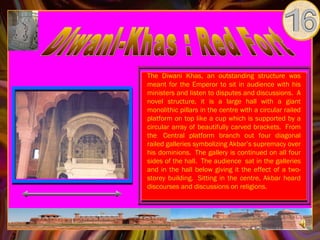
The Diwani Khas, an outstanding structure was
meant for the Emperor to sit in audience with his
ministers and listen to disputes and discussions.  A
novel structure, it is a large hall with a giant
monolithic pillars in the centre with a circular railed
platform on top like a cup which is supported by a
circular array of beautifully carved brackets.  From
the  Central platform branch out four diagonal
railed galleries symbolizing Akbar’s supremacy over
his dominions.  The gallery is continued on all four
sides of the hall.  The audience  sat in the galleries
and in the hall below giving it the effect of a two-
storey building.  Sitting in the centre, Akbar heard
discourses and discussions on religions.
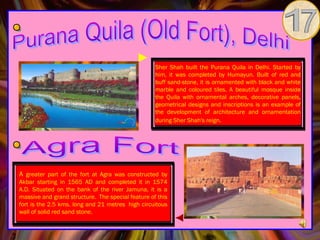
Sher Shah built the Purana Quila in Delhi. Started by
                                                    him, it was completed by Humayun. Built of red and
                                                    buff sand-stone, it is ornamented with black and white
                                                    marble and coloured tiles. A beautiful mosque inside
                                                    the Quila with ornamental arches, decorative panels,
                                                    geometrical designs and inscriptions is an example of
                                                    the development of architecture and ornamentation
                                                    during Sher Shah's reign.


A greater part of the fort at Agra was constructed by
Akbar starting in 1565 AD and completed it in 1574
A.D. Situated on the bank of the river Jamuna, it is a
massive and grand structure.  The special feature of this
fort is the 2.5 kms. long and 21 metres  high circuitous
wall of solid red sand stone.
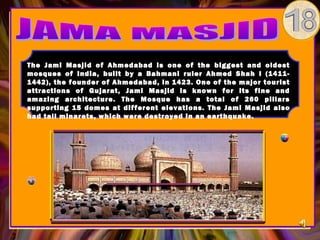
The Jami Masjid of Ahmedabad is one of the biggest and oldest
mosques of India, built by a Bahmani ruler Ahmed Shah I (1411-
1442), the founder of Ahmedabad, in 1423. One of the major tourist
attractions of Gujarat, Jami Masjid is known for its fine and
amazing architecture. The Mosque has a total of 260 pillars
supporting 15 domes at different elevations. The Jami Masjid also
had tall minarets, which were destroyed in an earthquake.
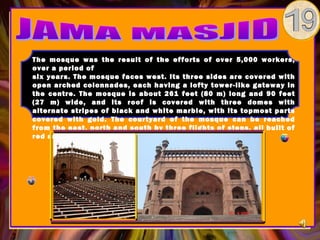
The mosque was the result of the efforts of over 5,000 workers,
over a period of
six years. The mosque faces west. Its three sides are covered with
open arched colonnades, each having a lofty tower-like gateway in
the centre. The mosque is about 261 feet (80 m) long and 90 feet
(27 m) wide, and its roof is covered with three domes with
alternate stripes of black and white marble, with its topmost parts
covered with gold. The courtyard of the mosque can be reached
from the east, north and south by three flights of steps, all built of
red sandstone.
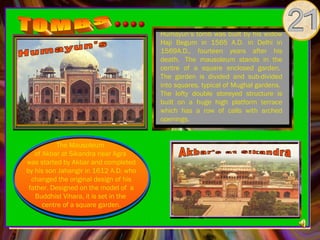
Humayun’s tomb was built by his widow
                                       Haji Begum in 1565 A.D. in Delhi in
                                       1569A.D., fourteen years after his
                                       death.  The mausoleum stands in the
                                       centre of a square enclosed garden. 
                                       The garden is divided and sub-divided
                                       into squares, typical of Mughal gardens. 
                                       The lofty double storeyed structure is
                                       built on a huge high platform terrace
                                       which has a row of calls with arched
                                       openings.


           The Mausoleum
   of Akbar at Sikandra near Agra
was started by Akbar and completed
by his son Jahangir in 1612 A.D. who
  changed the original design of his
 father. Designed on the model of  a
   Buddhist Vihara, it is set in the
      centre of a square garden.
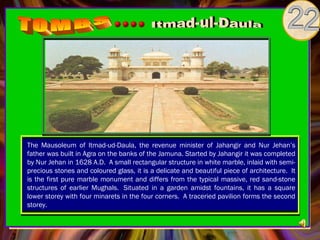
The Mausoleum of Itmad-ud-Daula, the revenue minister of Jahangir and Nur Jehan’s
father was built in Agra on the banks of the Jamuna. Started by Jahangir it was completed
by Nur Jehan in 1628 A.D.  A small rectangular structure in white marble, inlaid with semi-
precious stones and coloured glass, it is a delicate and beautiful piece of architecture.  It
is the first pure marble monument and differs from the typical massive, red sand-stone
structures of earlier Mughals.  Situated in a garden amidst fountains, it has a square
lower storey with four minarets in the four corners.  A traceried pavilion forms the second
storey. 
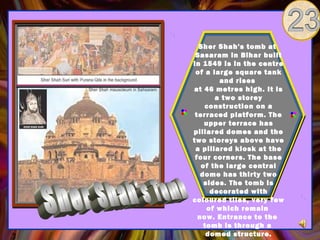
Sher Shah's tomb at
 Sasaram in Bihar built
in 1549 is in the centre
 of a large square tank
        and rises
at 46 metres high. It is
       a two storey
    construction on a
 terraced platform. The
    upper terrace has
pillared domes and the
two storeys above have
 a pillared kiosk at the
 four corners. The base
   of the large central
   dome has thirty two
    sides. The tomb is
      decorated with
coloured tiles, very few
     of which remain
  now. Entrance to the
    tomb is through a
     domed structure.
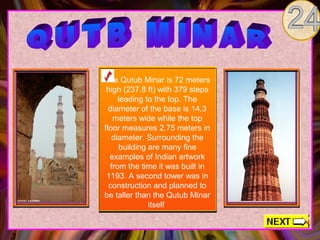
The Qutub Minar is 72 meters
 high (237.8 ft) with 379 steps
     leading to the top. The
  diameter of the base is 14.3
   meters wide while the top
floor measures 2.75 meters in
   diameter. Surrounding the
     building are many fine
  examples of Indian artwork
  from the time it was built in
 1193. A second tower was in
  construction and planned to
be taller than the Qutub Minar
              itself
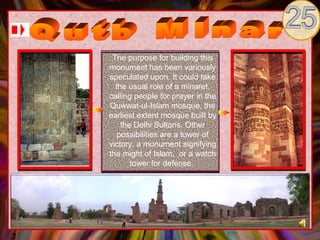
The purpose for building this
monument has been variously
speculated upon. It could take
  the usual role of a minaret,
calling people for prayer in the
Quwwat-ul-Islam mosque, the
earliest extent mosque built by
    the Delhi Sultans. Other
   possibilities are a tower of
victory, a monument signifying
the might of Islam, or a watch
       tower for defense.
The Taj Mahal is so      The Mughals made use of the
    proportionately       ancient Indian decorative technique
   constructed, one       of carving and sculpture and freely
 never imagines that      utilized glazed-tiling, painting, stucco,
  it is taller than the   mosaic and inlay arts. They liberally
    Qutb Minar, the       employed all types of motifs and
tallest minaret in the    designs which were in vogue in the
   world! The Taj is      Orient. The Mughal decorative art is
   243½ ft. in height     not an expression in isolation, it is a
while the Qutb Minar      link in the continuous growth of the
      is only 239 ft.     art of the people.
Let us continue
  to follow in
the footprints
of our ancestors
 by keeping our
Indian Traditions

Mughal architectural monuments

  • 1.
    AIR : Agraairport is 7 km from the city center and 3 km from Idgah Bus Stand. There are daily tourist shuttle flights to Agra and back from Delhi. RAIL : Agra is well connected by railroad to Delhi, ROAD : Buses for Agra are available all the time., through out the day
  • 3.
    Indo-Islamic style isneither a local variant of Islamic art, nor a modification of Hindu art; it is an assimilation of both the styles, though not always in an equal degree. On the other hand, Islamic art itself was a composite style, which had various Muslims influences-Turkish, Persian, and Arabic. This amalgamation of exotic and indigenous architectural styles was possible due to a variety or factors- Muslim rulers had to use, in most cases, Indian craftsmen and sculptors who were schooled in their own art traditions. Another factor that inadvertently contributed to this fusion of style was that during the early Muslim invasions, mosques were often built out of materials from Hindu and Jain temples and sometimes temples themselves were modified into mosques.
  • 4.
    Fatehpur Sikri Fortwas built by Akbar. It is regarded as Emperor Akbar’s crowning architectural legacy. This was the temporary capital of Emperor Akbar, of the Mughal Empire, between 1570 to 1586. He came to the city of Sikri and met the Sufi mystic called Sheikh Salim Chishti. Salim told the Emperor that he would have at least three sons. A year later, the first son was born. In gratitude, Akbar named the son Salim (later known as Jahangir), after the saint and he also moved his capital here.
  • 5.
    Sikri was thefirst planned city of the Mughals. Akbar chose to construct this capital on the natural feature of the terrain. In 1571, Akbar began building a mosque and then a palace complex at Sikri. The nobilities built their mansions further down the hill and shops lined the road to Agra. To commemorate his conquest of Gujarat, Akbar named his new capital Fatehpur Sikri or the “City of Victory.” The structures here include palaces and courtyards, as well as official buildings, like audience halls, the treasury, the harem, soldier's barracks and kitchens. The attached complex comprises the main mosque, the shrine of Sheikh Salim Chishti, and a lofty gateway. The mosque complex at the highest level – comprising of Jami Masjid, Tomb of Sheikh Salim Chisti and Buland Darwajah. Royal complex on the lower level comprising of Raniwas, Mahal-I-ilaahi, Shahi Bazaar, Meena Bazaar, Baithak and gardens. And the public complex at the lowest level comprised of Panch Mahal, Khawabghah, Shahi kutub khana, Ibaadat khana and deewaan-i-aam .
  • 6.
    INSIDE FATEHPUR SIKRI The Dewan-i-Khas”or “Ibadat khana”. Is the centerpiece of the room, it is a highly decorated pillar – Throne pillar, from which four bridges radiate. Akbar’s throne is placed on the circular platform over the central pillar. It is here that Akbar, seated on his throne, listened to the discussions/debates among representatives/gurus of all the major religions of that time.
  • 7.
    The Pachisi courthas a giant stone board of the game “Chausar”. It is believed that Akbar used to play this game using slave girls as live pieces. According to Abul Fazal – Another jewel of Akbar’s Nauratna- at a time there were about 200-300 people playing the game with Akbar and they were not allowed to go home till the Emperor had played 16 rounds of this game. Treasury or Aankh Michauli The Treasury or Aankh Michauli was composed of three rooms. Current thinking suggests that that building was used as the imperial treasury of gold and silver coins. Its brackets had mythological sea creatures carved on it signifying the guardians of the treasures of the deep sea
  • 8.
    The Taj Mahalis a mausoleum located in Agra, India. The Mughal Emperor Shah Jahan commissioned it as a mausoleum for his favorite wife, Mumtaz Mahal. Construction of the Taj Mahal was begun in Agra soon after Mumtaz's death. The principal mausoleum was completed in 1648, and the surrounding buildings and garden five years later. Construction began in 1632 and was completed in 1648.
  • 9.
    The Taj Mahal was constructed using materials from all over India and Asia. Over 1,000 elephants were used to transport building materials during the construction. The translucent white marble was brought from Rajasthan, the jasper from Punjab and the jade and crystal from China. The turquoise was from Tibet and the Lapis lazuli from Afghanistan, while the sapphire came from Sri Lanka and the carnelian from Arabia. In all, 28 types of precious and semi-precious stones were inlaid into the white marble.
  • 10.
    The Taj riseson a high red sandstone base topped by a Inside the dome huge white marble terrace on which rests the famous dome flanked by four tapering minarets. Within the dome lies the jewel- inlaid cenotaph of the queen. So exquisite is the workmanship that the Taj has been described as "having been designed by giants and finished by jewellers". The only asymmetrical object in the Taj is the casket of the emperor which was built beside the queen’s as an
  • 11.
    The Taj Mahalis built from precious white marble with delicate mosaic, with inlaid precious stones. Almost every surface of the entire building has been decorated, and every detail is symmetrical. The mosaic designs are based on three decorative elements- calligraphy, abstract geometric and vegetative motifs. The exterior decorations of the Tag Mahal are among the finest to be found in Mughal architecture of any period. The Taj Mahal is arguably one of the most incredible man-made constructions in the world. It’s located in Agra, which is in the north central part of Indian, on the right part of the Humana River. Known for its symmetry, the Taj Mahal sits on a raised platform surrounded by four minarets.
  • 12.
    The tomb ofShah Jahan bears a calligraphic inscription, not taken from the Qur'an, but referring to the resting place of this Mughal Emperor. Part of the inscription reads; "He travelled from this world to the banquet- hall of Eternity on the night of the twenty- sixth of the month of Rajab, in the year 1076 Hijri."
  • 13.
    Shah Jehan deemed Shah Jehan deemed that one else should ever that one else should ever copy the masterpiece, so copy the masterpiece, so Many people believe, Many people believe, he had the master craftsman he had the master craftsman Shah Jehan had planned to Shah Jehan had planned to Ustad Isa right Ustad Isa right build another Taj Mahal in black marble, build another Taj Mahal in black marble, hand cut off. hand cut off. which was to be his own tomb on the which was to be his own tomb on the opposite bank of the River Yamuna and opposite bank of the River Yamuna and connect the two by a bridge. connect the two by a bridge. However, the construction never However, the construction never The Taj Mahal cost 32 million rupees The Taj Mahal cost 32 million rupees got started due to conflict with his got started due to conflict with his to build, which is roughly $1,000,000. to build, which is roughly $1,000,000. son, which took up most of his time. son, which took up most of his time.
  • 14.
    A whole town,named Mumtazabad, was constructed to house the twenty thousand workers who laboured for whole years to build the Taj Mahal. Above the tombs isis a Cairene lamp, the flame of which is supposed to never Above the tombs a Cairene lamp, the flame of which is supposed to never burn out. The acoustics ofof the building are superb with the domed ceiling burn out. The acoustics the building are superb with the domed ceiling being designed toto echo chants from the Koran and musician’s melodies. being designed echo chants from the Koran and musician’s melodies. Taj is a world’s wonder because of its perfect symmetry, than beauty. The composition of the forms and lines is perfectly symmetrical. Here is a beautiful admixture of lines, horizontal with vertical, and straight with curved all harmoniously set together in total unity. The adopt each other with amazing uniformity.
  • 15.
    The Red Fort,set amidst the bustling heart of Old Delhi, with its obligatory share of dust and memories, bears the stamp of a place that has seen much grandeur and knows it. After Mughal Emperor Shahjahan shifted his capital to the royal quarters of Delhi, this colossal fort sprouted from the heart of his new city, Shahjahanabad. History traces its way back from the dawn of Mughal power in Delhi, to the times when it was known as Qila-e- Mu'alla or the 'Auspicious Fort'.
  • 16.
    The Diwani Khas,an outstanding structure was meant for the Emperor to sit in audience with his ministers and listen to disputes and discussions.  A novel structure, it is a large hall with a giant monolithic pillars in the centre with a circular railed platform on top like a cup which is supported by a circular array of beautifully carved brackets.  From the  Central platform branch out four diagonal railed galleries symbolizing Akbar’s supremacy over his dominions.  The gallery is continued on all four sides of the hall.  The audience  sat in the galleries and in the hall below giving it the effect of a two- storey building.  Sitting in the centre, Akbar heard discourses and discussions on religions.
  • 17.
    Sher Shah builtthe Purana Quila in Delhi. Started by him, it was completed by Humayun. Built of red and buff sand-stone, it is ornamented with black and white marble and coloured tiles. A beautiful mosque inside the Quila with ornamental arches, decorative panels, geometrical designs and inscriptions is an example of the development of architecture and ornamentation during Sher Shah's reign. A greater part of the fort at Agra was constructed by Akbar starting in 1565 AD and completed it in 1574 A.D. Situated on the bank of the river Jamuna, it is a massive and grand structure.  The special feature of this fort is the 2.5 kms. long and 21 metres  high circuitous wall of solid red sand stone.
  • 18.
    The Jami Masjidof Ahmedabad is one of the biggest and oldest mosques of India, built by a Bahmani ruler Ahmed Shah I (1411- 1442), the founder of Ahmedabad, in 1423. One of the major tourist attractions of Gujarat, Jami Masjid is known for its fine and amazing architecture. The Mosque has a total of 260 pillars supporting 15 domes at different elevations. The Jami Masjid also had tall minarets, which were destroyed in an earthquake.
  • 19.
    The mosque wasthe result of the efforts of over 5,000 workers, over a period of six years. The mosque faces west. Its three sides are covered with open arched colonnades, each having a lofty tower-like gateway in the centre. The mosque is about 261 feet (80 m) long and 90 feet (27 m) wide, and its roof is covered with three domes with alternate stripes of black and white marble, with its topmost parts covered with gold. The courtyard of the mosque can be reached from the east, north and south by three flights of steps, all built of red sandstone.
  • 21.
    Humayun’s tomb wasbuilt by his widow Haji Begum in 1565 A.D. in Delhi in 1569A.D., fourteen years after his death.  The mausoleum stands in the centre of a square enclosed garden.  The garden is divided and sub-divided into squares, typical of Mughal gardens.  The lofty double storeyed structure is built on a huge high platform terrace which has a row of calls with arched openings. The Mausoleum of Akbar at Sikandra near Agra was started by Akbar and completed by his son Jahangir in 1612 A.D. who changed the original design of his father. Designed on the model of  a Buddhist Vihara, it is set in the centre of a square garden.
  • 22.
    The Mausoleum ofItmad-ud-Daula, the revenue minister of Jahangir and Nur Jehan’s father was built in Agra on the banks of the Jamuna. Started by Jahangir it was completed by Nur Jehan in 1628 A.D.  A small rectangular structure in white marble, inlaid with semi- precious stones and coloured glass, it is a delicate and beautiful piece of architecture.  It is the first pure marble monument and differs from the typical massive, red sand-stone structures of earlier Mughals.  Situated in a garden amidst fountains, it has a square lower storey with four minarets in the four corners.  A traceried pavilion forms the second storey. 
  • 23.
    Sher Shah's tombat Sasaram in Bihar built in 1549 is in the centre of a large square tank and rises at 46 metres high. It is a two storey construction on a terraced platform. The upper terrace has pillared domes and the two storeys above have a pillared kiosk at the four corners. The base of the large central dome has thirty two sides. The tomb is decorated with coloured tiles, very few of which remain now. Entrance to the tomb is through a domed structure.
  • 24.
    The Qutub Minaris 72 meters high (237.8 ft) with 379 steps leading to the top. The diameter of the base is 14.3 meters wide while the top floor measures 2.75 meters in diameter. Surrounding the building are many fine examples of Indian artwork from the time it was built in 1193. A second tower was in construction and planned to be taller than the Qutub Minar itself
  • 25.
    The purpose forbuilding this monument has been variously speculated upon. It could take the usual role of a minaret, calling people for prayer in the Quwwat-ul-Islam mosque, the earliest extent mosque built by the Delhi Sultans. Other possibilities are a tower of victory, a monument signifying the might of Islam, or a watch tower for defense.
  • 26.
    The Taj Mahalis so The Mughals made use of the proportionately ancient Indian decorative technique constructed, one of carving and sculpture and freely never imagines that utilized glazed-tiling, painting, stucco, it is taller than the mosaic and inlay arts. They liberally Qutb Minar, the employed all types of motifs and tallest minaret in the designs which were in vogue in the world! The Taj is Orient. The Mughal decorative art is 243½ ft. in height not an expression in isolation, it is a while the Qutb Minar link in the continuous growth of the is only 239 ft. art of the people.
  • 27.
    Let us continue to follow in the footprints of our ancestors by keeping our Indian Traditions