MELC: Explain the occurrence of evolution
Ms. Jeraldel Encepto
Science 10 Teacher
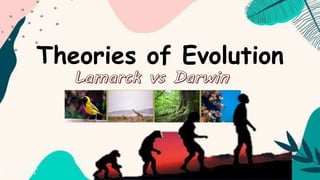
Theories of Evolution
MELC: Explain the occurrence of evolution
Theories of Evolution
A long time ago, a small flock of sparrow-like birds called
finches were
blown out to sea by a fierce storm. They lost their bearings but
flew on in search of the mainland, going further and further out
to sea. At the point of exhaustion, 600 miles from home, they
spotted a speck of land - an island in the middle of the sea. They
were saved and could rest, drink and feed before returning
home. But this island was perfect: it had abundant seeds and
other food, plenty of shelter, nesting sites and (amazingly) no
predators or other birds to compete with.
Life was much harder on the mainland. There was no
need for the birds to move on. Their numbers grew -
until they became just a bit too numerous for the little
island. Some found it hard to find enough food for
themselves or their offspring, and young birds were
driven away from areas where food was available. Some
birds were forced to fly across the sea to nearby islands.
There, they found new territories, also with no
predators or other birds to compete with.
As the plants and their seeds were just a little
different on each island, some birds were better than
others at finding and eating the new food sources. Birds
which could break open fruits and eat the seeds survived
well enough to produce lots of babies. Eventually, after
a very long time, all the islands became occupied by
these birds but the finches on each island were slightly
different.
1. Explain why it is questionable that more than one
flock of birds would find the islands in this way at
the same time.
2. Suggest two possible reasons why there were no
predators on the island.
3. Why were there no other birds to compete with?
(see Q1)
4. Why might some finches survive better than
others on the same food sources?
5. Why were the finches slightly different on each
island?
History of Evolutionary Thought
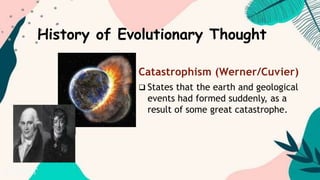
Catastrophism (Werner/Cuvier)
 States that the earth and geological
events had formed suddenly, as a
result of some great catastrophe.
History of Evolutionary Thought
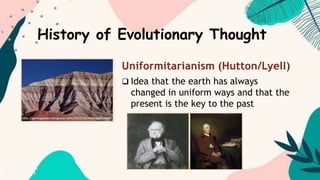
Uniformitarianism (Hutton/Lyell)
 Idea that the earth has always
changed in uniform ways and that the
present is the key to the past
Theories of Evolution
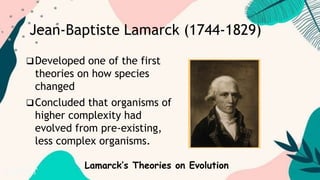
Jean-Baptiste Lamarck (1744-1829)
Developed one of the first
theories on how species
changed
Concluded that organisms of
higher complexity had
evolved from pre-existing,
less complex organisms.
Lamarck’s Theories on Evolution
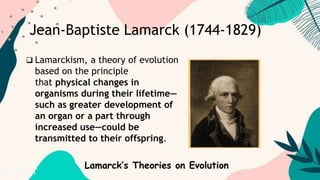
Jean-Baptiste Lamarck (1744-1829)
 Lamarckism, a theory of evolution
based on the principle
that physical changes in
organisms during their lifetime—
such as greater development of
an organ or a part through
increased use—could be
transmitted to their offspring.
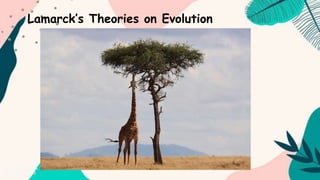
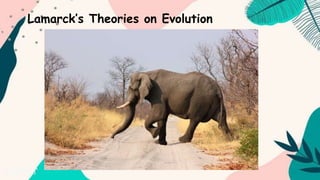
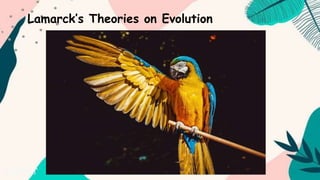
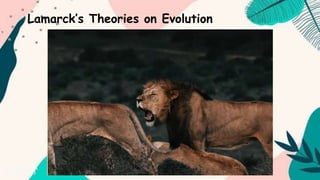
Lamarck’s Theories on Evolution
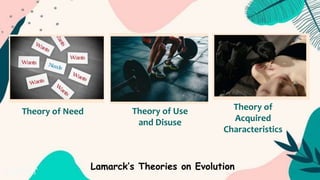
Theory of Need Theory of Use
and Disuse
Theory of
Acquired
Characteristics
Lamarck’s Theories on Evolution
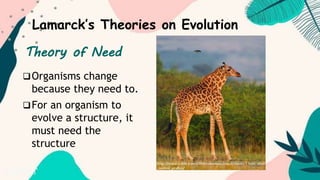
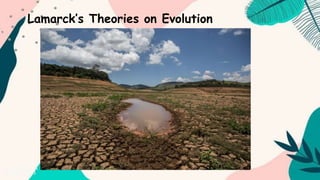
Organisms change
because they need to.
For an organism to
evolve a structure, it
must need the
structure
Theory of Need
Lamarck’s Theories on Evolution
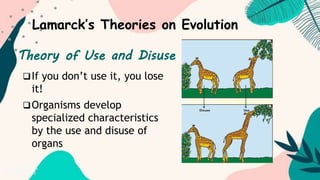
If you don’t use it, you lose
it!
Organisms develop
specialized characteristics
by the use and disuse of
organs
Theory of Use and Disuse
Lamarck’s Theories on Evolution
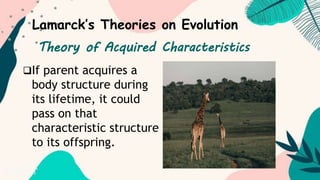
If parent acquires a
body structure during
its lifetime, it could
pass on that
characteristic structure
to its offspring.
Theory of Acquired Characteristics
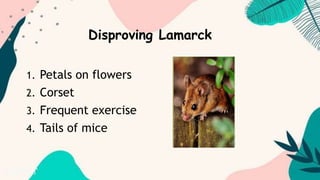
1. Petals on flowers
2. Corset
3. Frequent exercise
4. Tails of mice
Disproving Lamarck
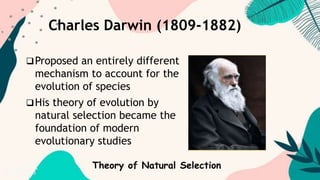
Charles Darwin (1809-1882)
Proposed an entirely different
mechanism to account for the
evolution of species
His theory of evolution by
natural selection became the
foundation of modern
evolutionary studies
Theory of Natural Selection
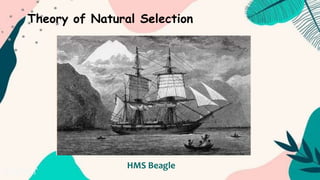
HMS Beagle
Theory of Natural Selection
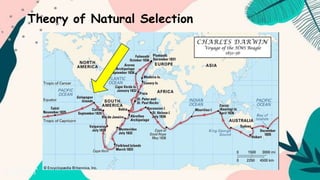
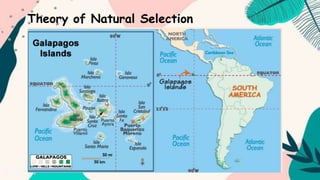
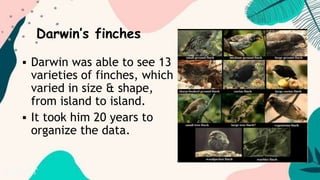
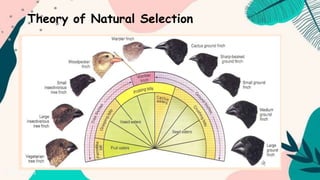
 Darwin was able to see 13
varieties of finches, which
varied in size & shape,
from island to island.
 It took him 20 years to
organize the data.
Darwin’s finches
Theory of Natural Selection
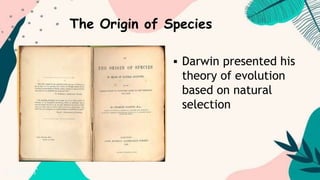
 Darwin presented his
theory of evolution
based on natural
selection
The Origin of Species
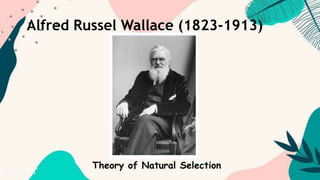
Alfred Russel Wallace (1823-1913)
Theory of Natural Selection
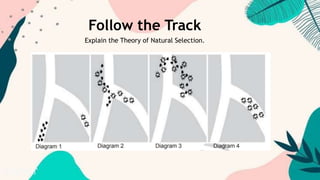
Follow the Track
Explain the Theory of Natural Selection.
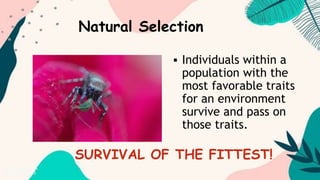
 Individuals within a
population with the
most favorable traits
for an environment
survive and pass on
those traits.
Natural Selection
SURVIVAL OF THE FITTEST!
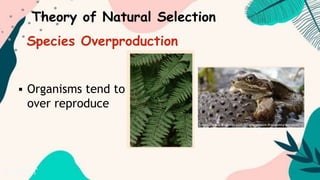
 Organisms tend to
over reproduce
Theory of Natural Selection
Species Overproduction
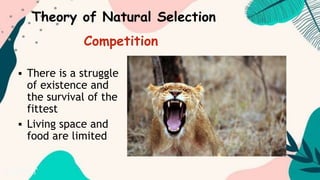
 There is a struggle
of existence and
the survival of the
fittest
 Living space and
food are limited
Theory of Natural Selection
Competition
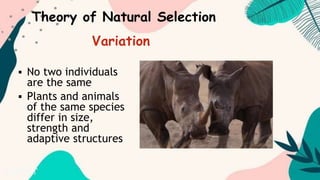
 No two individuals
are the same
 Plants and animals
of the same species
differ in size,
strength and
adaptive structures
Theory of Natural Selection
Variation
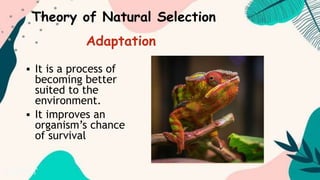
 It is a process of
becoming better
suited to the
environment.
 It improves an
organism’s chance
of survival
Theory of Natural Selection
Adaptation
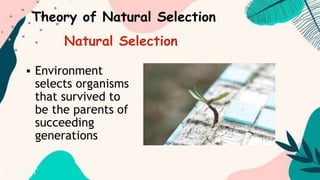
 Environment
selects organisms
that survived to
be the parents of
succeeding
generations
Theory of Natural Selection
Natural Selection
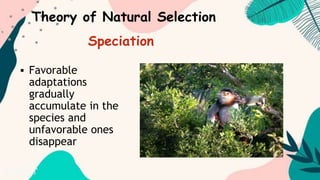
 Favorable
adaptations
gradually
accumulate in the
species and
unfavorable ones
disappear
Theory of Natural Selection
Speciation
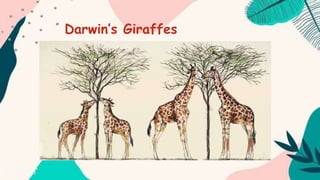
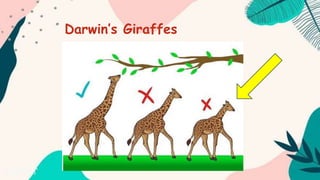
Darwin’s Giraffes
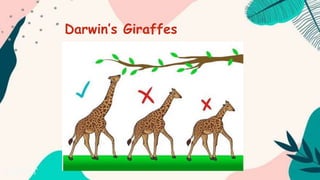
Darwin’s Giraffes
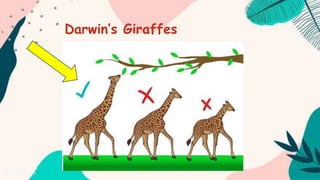
Darwin’s Giraffes
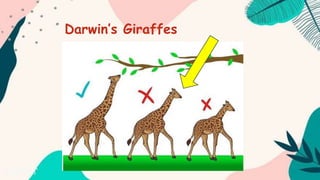
Darwin’s Giraffes
Darwin’s Giraffes
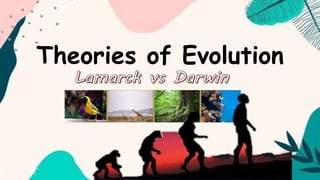
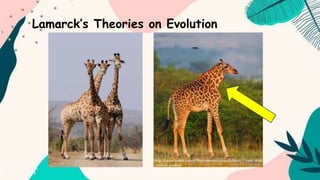
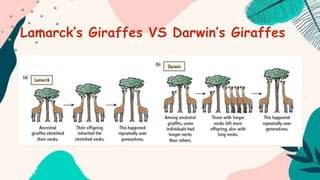
Lamarck’s Giraffes VS Darwin’s Giraffes
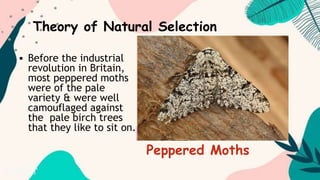
 Before the industrial
revolution in Britain,
most peppered moths
were of the pale
variety & were well
camouflaged against
the pale birch trees
that they like to sit on.
Theory of Natural Selection
Peppered Moths
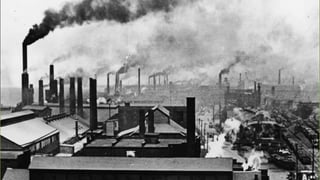
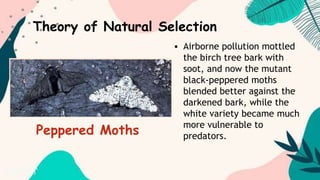
 Airborne pollution mottled
the birch tree bark with
soot, and now the mutant
black-peppered moths
blended better against the
darkened bark, while the
white variety became much
more vulnerable to
predators.
Theory of Natural Selection
Peppered Moths
Theories of Evolution

THEORIES of Evolution.pptx

  • 2.
    MELC: Explain theoccurrence of evolution Ms. Jeraldel Encepto Science 10 Teacher
  • 3.
    Theories of Evolution MELC:Explain the occurrence of evolution
  • 4.
  • 6.
    A long timeago, a small flock of sparrow-like birds called finches were blown out to sea by a fierce storm. They lost their bearings but flew on in search of the mainland, going further and further out to sea. At the point of exhaustion, 600 miles from home, they spotted a speck of land - an island in the middle of the sea. They were saved and could rest, drink and feed before returning home. But this island was perfect: it had abundant seeds and other food, plenty of shelter, nesting sites and (amazingly) no predators or other birds to compete with.
  • 7.
    Life was muchharder on the mainland. There was no need for the birds to move on. Their numbers grew - until they became just a bit too numerous for the little island. Some found it hard to find enough food for themselves or their offspring, and young birds were driven away from areas where food was available. Some birds were forced to fly across the sea to nearby islands. There, they found new territories, also with no predators or other birds to compete with.
  • 8.
    As the plantsand their seeds were just a little different on each island, some birds were better than others at finding and eating the new food sources. Birds which could break open fruits and eat the seeds survived well enough to produce lots of babies. Eventually, after a very long time, all the islands became occupied by these birds but the finches on each island were slightly different.
  • 9.
    1. Explain whyit is questionable that more than one flock of birds would find the islands in this way at the same time. 2. Suggest two possible reasons why there were no predators on the island. 3. Why were there no other birds to compete with? (see Q1) 4. Why might some finches survive better than others on the same food sources? 5. Why were the finches slightly different on each island?
  • 10.
    History of EvolutionaryThought Catastrophism (Werner/Cuvier)  States that the earth and geological events had formed suddenly, as a result of some great catastrophe.
  • 11.
    History of EvolutionaryThought Uniformitarianism (Hutton/Lyell)  Idea that the earth has always changed in uniform ways and that the present is the key to the past
  • 12.
  • 13.
    Jean-Baptiste Lamarck (1744-1829) Developedone of the first theories on how species changed Concluded that organisms of higher complexity had evolved from pre-existing, less complex organisms. Lamarck’s Theories on Evolution
  • 14.
    Jean-Baptiste Lamarck (1744-1829) Lamarckism, a theory of evolution based on the principle that physical changes in organisms during their lifetime— such as greater development of an organ or a part through increased use—could be transmitted to their offspring. Lamarck’s Theories on Evolution
  • 15.
    Lamarck’s Theories onEvolution Theory of Need Theory of Use and Disuse Theory of Acquired Characteristics
  • 16.
  • 17.
    Lamarck’s Theories onEvolution Organisms change because they need to. For an organism to evolve a structure, it must need the structure Theory of Need
  • 18.
  • 19.
  • 20.
  • 21.
  • 22.
  • 23.
    Lamarck’s Theories onEvolution If you don’t use it, you lose it! Organisms develop specialized characteristics by the use and disuse of organs Theory of Use and Disuse
  • 24.
  • 25.
    Lamarck’s Theories onEvolution If parent acquires a body structure during its lifetime, it could pass on that characteristic structure to its offspring. Theory of Acquired Characteristics
  • 26.
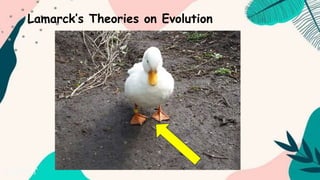
    1. Petals onflowers 2. Corset 3. Frequent exercise 4. Tails of mice Disproving Lamarck
  • 27.
    Charles Darwin (1809-1882) Proposedan entirely different mechanism to account for the evolution of species His theory of evolution by natural selection became the foundation of modern evolutionary studies Theory of Natural Selection
  • 28.
    Theory of NaturalSelection HMS Beagle
  • 29.
  • 30.
  • 31.
     Darwin wasable to see 13 varieties of finches, which varied in size & shape, from island to island.  It took him 20 years to organize the data. Darwin’s finches
  • 32.
  • 33.
     Darwin presentedhis theory of evolution based on natural selection The Origin of Species
  • 34.
    Alfred Russel Wallace(1823-1913) Theory of Natural Selection
  • 35.
    Follow the Track Explainthe Theory of Natural Selection.
  • 36.
     Individuals withina population with the most favorable traits for an environment survive and pass on those traits. Natural Selection SURVIVAL OF THE FITTEST!
  • 37.
     Organisms tendto over reproduce Theory of Natural Selection Species Overproduction
  • 38.
     There isa struggle of existence and the survival of the fittest  Living space and food are limited Theory of Natural Selection Competition
  • 39.
     No twoindividuals are the same  Plants and animals of the same species differ in size, strength and adaptive structures Theory of Natural Selection Variation
  • 40.
     It isa process of becoming better suited to the environment.  It improves an organism’s chance of survival Theory of Natural Selection Adaptation
  • 41.
     Environment selects organisms thatsurvived to be the parents of succeeding generations Theory of Natural Selection Natural Selection
  • 42.
     Favorable adaptations gradually accumulate inthe species and unfavorable ones disappear Theory of Natural Selection Speciation
  • 43.
  • 44.
  • 45.
  • 46.
  • 47.
  • 48.
    Lamarck’s Giraffes VSDarwin’s Giraffes
  • 49.
     Before theindustrial revolution in Britain, most peppered moths were of the pale variety & were well camouflaged against the pale birch trees that they like to sit on. Theory of Natural Selection Peppered Moths
  • 51.
     Airborne pollutionmottled the birch tree bark with soot, and now the mutant black-peppered moths blended better against the darkened bark, while the white variety became much more vulnerable to predators. Theory of Natural Selection Peppered Moths
  • 52.
  • 54.

Editor's Notes

  • #11 Catastrophism was a theory developed by Georges Cuvier based on paleontological evidence in the Paris Basin. Cuvier was there when he observed something peculiar about the fossil record. Instead of finding a continuous succession of fossils, Cuvier noticed several gaps where all evidence of life would disappear and then abruptly reappear again after a notable amount of time. Cuvier recognized these gaps in the fossil succession as mass extinction events. This led Cuvier to develop a theory called catastrophism. Catastrophism states that natural history has been punctuated by catastrophic events that altered that way life developed and rocks were deposited.
  • #36 Procedure: Observe the set of footprints in the diagram. Try to tell a story about the different events. Predict what can probably happen at the end of the diagram In Diagram 1, how many sets of footprints are there? Based on the size of footprints, describe the organisms. 2. In what directions are the footprints going? 3. Describe or predict what is happening in Diagram 3. In Diagram