“Everyone BecomesWhatThey DecideTo Be”
Group:WinnerzKlub
Year: 2019
 The methylxanthines (CNS stimulants)
(caffeine, theophylline and theobromine) are
mainly taken in beverages (coffee, tea, cocoa
and soft drinks) to increase alertness, and
administered in respiratory disorders.
 Is the prototype xanthine bronchodilator.
 A smooth muscle relaxant used for relief of
bronchospasm in certain respiratory
conditions:
 especially aminophylline a derivative of
theophylline used in asthma & COPD.
 Has a narrow therapeutic index.
 Unpredictable metabolism, propensity for drug
reactions & prominent side-effects.
 Has useful anti-inflammatory effects & may
increase responsiveness to corticosteroids in
pts. resistant to corticosteroids.
 Stimulant drug that may reduce sedative effects of
benzodiazepines
 An example of hydrophilic(water-soluble) drug that
may accumulate if body water decrease causing
adverse effects.
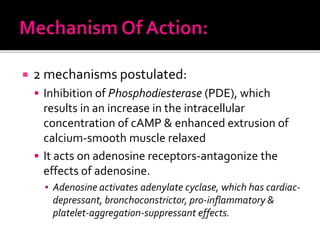
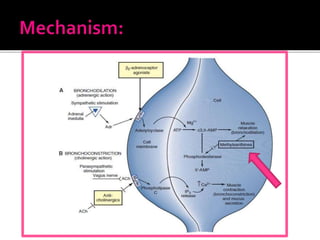
 2 mechanisms postulated:
 Inhibition of Phosphodiesterase (PDE), which
results in an increase in the intracellular
concentration of cAMP & enhanced extrusion of
calcium-smooth muscle relaxed
 It acts on adenosine receptors-antagonize the
effects of adenosine.
▪ Adenosine activates adenylate cyclase, which has cardiac-
depressant, bronchoconstrictor, pro-inflammatory &
platelet-aggregation-suppressant effects.
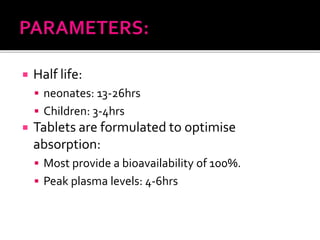
 Half life:
 neonates: 13-26hrs
 Children: 3-4hrs
 Tablets are formulated to optimise
absorption:
 Most provide a bioavailability of 100%.
 Peak plasma levels: 4-6hrs
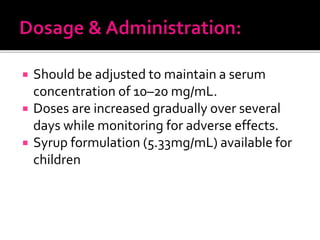
 Should be adjusted to maintain a serum
concentration of 10–20 mg/mL.
 Doses are increased gradually over several
days while monitoring for adverse effects.
 Syrup formulation (5.33mg/mL) available for
children
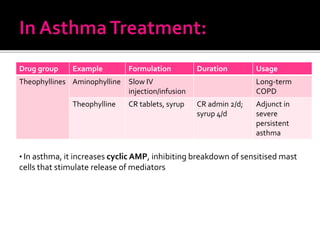
Drug group Example Formulation Duration Usage
Theophyllines Aminophylline Slow IV
injection/infusion
Long-term
COPD
Theophylline CR tablets, syrup CR admin 2/d;
syrup 4/d
Adjunct in
severe
persistent
asthma
• In asthma, it increases cyclic AMP, inhibiting breakdown of sensitised mast
cells that stimulate release of mediators
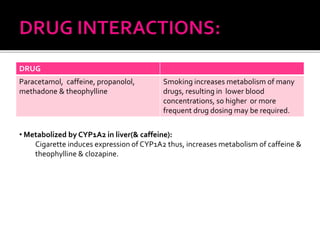
DRUG
Paracetamol, caffeine, propanolol,
methadone & theophylline
Smoking increases metabolism of many
drugs, resulting in lower blood
concentrations, so higher or more
frequent drug dosing may be required.
• Metabolized by CYP1A2 in liver(& caffeine):
Cigarette induces expression of CYP1A2 thus, increases metabolism of caffeine &
theophylline & clozapine.
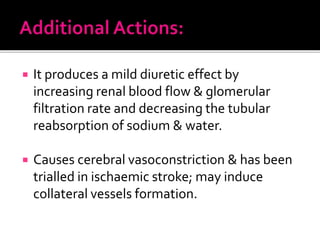
 It produces a mild diuretic effect by
increasing renal blood flow & glomerular
filtration rate and decreasing the tubular
reabsorption of sodium & water.
 Causes cerebral vasoconstriction & has been
trialled in ischaemic stroke; may induce
collateral vessels formation.
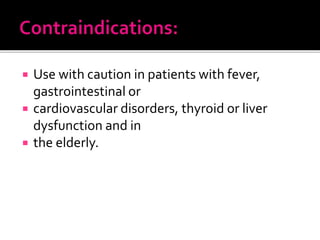
 Use with caution in patients with fever,
gastrointestinal or
 cardiovascular disorders, thyroid or liver
dysfunction and in
 the elderly.
 May promote calcium-stone formation.
 A cause of poisoning:
 Tremors & Convulsion(s)
 Hyperventilation
 Arrhythmias
 May cause profuse vomiting-hypotension.
 Nausea/Vomiting
 Abdominal pain
 Diarrhoea
 Hyperreflexia
 Headache
 Restlessness & irritability
 May induce insomnia(sleep disturbances)
 Sources:
 Clinical Medicine, 8th Ed., Kumar & Clarks.
 Pharmacology for Health Professionals, 4th Ed., B.
Bryant & K. Knights.
 Davidson’s Principles & Practice of Medicine, 22nd
Ed., B.Walker & I. Penman

Theophylline-CNS stimulant

  • 1.
    “Everyone BecomesWhatThey DecideToBe” Group:WinnerzKlub Year: 2019
  • 2.
     The methylxanthines(CNS stimulants) (caffeine, theophylline and theobromine) are mainly taken in beverages (coffee, tea, cocoa and soft drinks) to increase alertness, and administered in respiratory disorders.
  • 3.
     Is theprototype xanthine bronchodilator.  A smooth muscle relaxant used for relief of bronchospasm in certain respiratory conditions:  especially aminophylline a derivative of theophylline used in asthma & COPD.  Has a narrow therapeutic index.  Unpredictable metabolism, propensity for drug reactions & prominent side-effects.
  • 4.
     Has usefulanti-inflammatory effects & may increase responsiveness to corticosteroids in pts. resistant to corticosteroids.  Stimulant drug that may reduce sedative effects of benzodiazepines  An example of hydrophilic(water-soluble) drug that may accumulate if body water decrease causing adverse effects.
  • 5.
     2 mechanismspostulated:  Inhibition of Phosphodiesterase (PDE), which results in an increase in the intracellular concentration of cAMP & enhanced extrusion of calcium-smooth muscle relaxed  It acts on adenosine receptors-antagonize the effects of adenosine. ▪ Adenosine activates adenylate cyclase, which has cardiac- depressant, bronchoconstrictor, pro-inflammatory & platelet-aggregation-suppressant effects.
  • 7.
     Half life: neonates: 13-26hrs  Children: 3-4hrs  Tablets are formulated to optimise absorption:  Most provide a bioavailability of 100%.  Peak plasma levels: 4-6hrs
  • 8.
     Should beadjusted to maintain a serum concentration of 10–20 mg/mL.  Doses are increased gradually over several days while monitoring for adverse effects.  Syrup formulation (5.33mg/mL) available for children
  • 9.
    Drug group ExampleFormulation Duration Usage Theophyllines Aminophylline Slow IV injection/infusion Long-term COPD Theophylline CR tablets, syrup CR admin 2/d; syrup 4/d Adjunct in severe persistent asthma • In asthma, it increases cyclic AMP, inhibiting breakdown of sensitised mast cells that stimulate release of mediators
  • 10.
    DRUG Paracetamol, caffeine, propanolol, methadone& theophylline Smoking increases metabolism of many drugs, resulting in lower blood concentrations, so higher or more frequent drug dosing may be required. • Metabolized by CYP1A2 in liver(& caffeine): Cigarette induces expression of CYP1A2 thus, increases metabolism of caffeine & theophylline & clozapine.
  • 11.
     It producesa mild diuretic effect by increasing renal blood flow & glomerular filtration rate and decreasing the tubular reabsorption of sodium & water.  Causes cerebral vasoconstriction & has been trialled in ischaemic stroke; may induce collateral vessels formation.
  • 12.
     Use withcaution in patients with fever, gastrointestinal or  cardiovascular disorders, thyroid or liver dysfunction and in  the elderly.
  • 13.
     May promotecalcium-stone formation.  A cause of poisoning:  Tremors & Convulsion(s)  Hyperventilation  Arrhythmias  May cause profuse vomiting-hypotension.  Nausea/Vomiting  Abdominal pain  Diarrhoea  Hyperreflexia  Headache  Restlessness & irritability  May induce insomnia(sleep disturbances)
  • 14.
     Sources:  ClinicalMedicine, 8th Ed., Kumar & Clarks.  Pharmacology for Health Professionals, 4th Ed., B. Bryant & K. Knights.  Davidson’s Principles & Practice of Medicine, 22nd Ed., B.Walker & I. Penman