The case for COERCS
Theo Vermaelen
Professor of Finance
INSEAD
How should an Ideal Financial Security
look like?
• Tax efficient
• No negative information signal
• No costs of financial distress
• No agency costs
• No wealth transfers from shareholders to others
2
Equity
• Not tax efficient if company is profitable (-)
• Negative information signal as market expects timing (-)
• Low costs of financial distress (+)
• high agency costs (-)
• If shares undervalued, wealth transfer to new shareholders
(-)
3
Debt
• Tax efficient when company is profitable (+)
• No negative information signal (+)
• Costs of financial distress (-)
• Low agency costs (+)
• If shares undervalued, no wealth transfers to new
shareholders (+) 4
Choice between Debt and Equity
Imperfection Debt Equity
•Corporate taxes 1 2
•Expected COFD 2 1
•Agency costs 1 2
•Undervaluation 1 2
5
Government policies can correct tax disadvantage
• Example : Cooreman-De Clercq ( 1982)
• Companies that issued equity could deduct 13 % of the
amount issued from their taxable income for 10 years
• Personal tax advantages for individuals who invest in
common stock
• Result : More equity issued in 1982-1983 than during
previous 13 years
• Belgian stock market became “market of the year”
6
Cooreman-De Clercq and the stock market
Monthly cumulative return difference between KB-index and the “world”
index, from January 1981 until January 1984
7
However : how to elimate COFD ?
Imperfection Debt Equity
•Corporate taxes 1 2
•Expected COFD 2 1
•Agency costs 1 2
•Undervaluation 1 2
8
9
Coco bonds
• Contingent convertibles (CoCos) are bonds that mandatorily
convert to equity after a triggering event such as a decline
in the bank’s capital (Flannery (2005).
• Motivation: providing discipline of debt (tax deductions?) in
good times, avoiding COFD (bailouts!) in bad times.
• Since 2009 : 20 banks for $ 100 bn
• Although designed for banks potentially interesting for other
corporations ?
Cocobonds
• In good times: normal debt
• Bad times: mandatory conversion into equity
• Today mostly issued by banks
• Sometimes no conversion but total writedown
10
Problems with Cocos
• How to define “bad times”?
• If “bad times” are based on stock prices how to avoid
manipulation and undeserved conversions?
• How to make sure they are not very risky so it is very
likely you are going to get your money back ?
11
12
Solution: COERC
• Call Option Enhanced Reversed Convertible
• Trigger based on market values
• When the trigger is hit, bondholders are forced to
convert at huge discount from stock price, creating
large potential dilution
• However,shareholders get the pre-emptive right to buy
new shares at the conversion price and repay debt
• As a result Coco bond becomes nearly riskless
• COERC coerces shareholders to pay back debt holders
12
Example
Assets: 100 Equity 60
COERCS 40
5 million shares outstanding (stock price $12)
Coerc converts into equity when equity falls to 1/3 of firm value.
When this happens the conversion price is 25 % of the stock price.
13
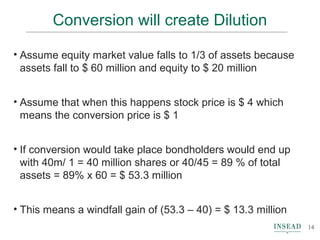
Conversion will create Dilution
• Assume equity market value falls to 1/3 of assets because
assets fall to $ 60 million and equity to $ 20 million
• Assume that when this happens stock price is $ 4 which
means the conversion price is $ 1
• If conversion would take place bondholders would end up
with 40m/ 1 = 40 million shares or 40/45 = 89 % of total
assets = 89% x 60 = $ 53.3 million
• This means a windfall gain of (53.3 – 40) = $ 13.3 million
14
Preventing Conversion
• In order to avoid this wealth transfer to bondholders,
equityholders have pre-emptive rights to buy the shares by
repaying the debt
• Rights issue is announced for 40 million shares at $1
• After completion of rights issue firm is all equity financed with 60
million assets divided by 45 million shares or $1.33
• Rights issue would be unsuccessful if during rights period assets
would fall below 45 million
• Insurance against this failure can be bought by buying an
underwriting contract ( put option). Otherwise bondholders will
ask credit spread to compensate for this risk.
15
How much would insurance cost ?
• Put option
• Maturity : 20 days
• Stock price : 1.33
• Exercise price 1
• Volatility : 70 %
• Jump process with 3 jumps per year jump size 50%
• P = 0.006 or 40 m x 0.006 = $ 0.24 m
• So you pay insurance fee of 0.6 %
• Ideally issuer should provide cash collateral for this fee.
16
• There are 5 million shares outstanding
• Each share has 1 right
• 40 million new shares, so with each share you can
buy 8 new shares if you pay $ 1 x 8 = $ 8
17
Payoffs to Investor
Wealth of the Investor with $ 8 in cash who owns
1 share worth $ 4
• If he exercises the right : 9 new shares at $ 1.33 = $ 12
• If he sells the right to buy new shares to someone else and
keeps his $ 8
cash $ 8
1 share $ 1.33
1 right = 8 x (1.33-1) $ 2.64
-------------------------- ---------
Total $ 12
18
After the dust has settled
Assets: 60 Equity 60
45 million shares outstanding (stock price $1.33)
You cleaned up your balance sheet without transferring
wealth to debt holders
Potential to re-lever
19
Implication for Bondholders
• The fear of dilution coerces equityholders into
repaying the debt as long as conversion price is
set at a significant discount from trigger price
• Debt is very likely to be repaid, rather than forced
to convert
• The only risk is that because of “jumps” the value
of the assets falls below $ 40 milion so that fully
diluted stock price falls below $ 1.
• In order to largely eliminate this risk issuers can
pay for firm commitment underwriting contract.
20
Implication for Shareholders
• Because you are able to make a credible
commitment that you will pay back debt holders in
periods of financial distress, credit spreads will be
very small
• ROE will go up, although WACC remains the same
• As debt has become large risk-free, no more costs
of financial distress, hence total firm value will
increase
• Death spirals because of manipulation and panic
can be prevented
• COERC issuance is not a signal of overvaluation ! 21
Choice between Debt, Equity and Coerc
Imperfection Debt Equity Coerc
•Corporate taxes 1 3 1
•Expected COFD 3 1 1
•Agency costs 1 2 1
•Undervaluation 1 2 1
22
Intuition
• “Normal“ debt is risky because equityholders have
limited liability
• The Coercive feature of the COERC forces
shareholders to bail out bondholders to avoid dilution
• Because financially constrained shareholders can sell
their rights to others these constraints don’t matter
• Of course, this assumes that rights can be sold at fair
value
23
Difference with other bonds
• Covered bond : collateral is put up front, illiquid?
> COERC: collateral is cash provided by Coercive rights
issue when needed
• Subordinated debt : credit spread charges for default risk
> COERC : no credit spread but firm commitment rights
underwriting fee when trigger is hit
24
A case study
• Bidder is considering making a $ 120 million bid for Target
• It does not want to pay with stock
• If it borrows to pay for it it will have to issue bonds below
investment grade
• Can COERC be the solution ?
25
26
Balance sheet of Bidder ( $ million)
Assets Liabilities
230 Debt 50
Equity 180
230 230
Stock price : $112 shares outstanding : 1.7 million
Debt/Assets = 22 %
27
Balance sheet of Target
Assets Liabilities
115 Debt 25
Equity (E) 90
115 115
28
Bidder after merger (assume $120 m purchase price for
target equity paid by issuing COERC; assume other debt)
Assets Liabilities
375 Debt 75
COERC 120
Equity 180
375 375
Debt/assets = 195/375 = 52 %
COERC converts when Debt/Asset = 65 % Discount of 50%
The trigger
• Based on market values of equity and book values of debt
• Because book values are normally calculated only quarterly,
company should update book values if it changes more than
1 %
• Note that this is not the same as a stock price trigger : you
can’t control the stock price but you can control leverage to
a large extent
29
What happens at conversion ?
• Debt/Assets = 65 % and Debt = 195
• Assets = 195/0.65 = 300
• Equity = 300 – 195 = 105
• This represents a fall in equity of (180-105)/180 = 42 %
• Current stock price is $ 112
• A 42 % decline means new stock price will be $ 65
• Then you announce a rights issue at a 50 % discount ($
32.5)
• This means new shares issued : 120 m/32.5 = 3.7 m
• Total number of shares outstanding is 3.7 m + 1.7 m =5.4 m
30
After the dust settles
• Total firm value is still 300
• Non-Coerc debt = 75
• Equity = 225
• Stock price (fully diluted) = 225/5.4 = $ 42
• Issue will fail if stock falls below $32.5 in 20 days
. Insurance : Underwriter firm commitment = put option
• Value of put ? Volatility = 70 % 3 Jumps per year of 50%
• Put = 0.226
• Total cost = 0.226 x 3.7 m = $ 0.836 m
• Total cost =0.7 % of 120 m raised
31
32
Bidder after merger + conversion
Assets Liabilities
300 Debt 75
Equity 225
300 300
Debt/assets = 25 %
Why issue COERCS ?
• You can borrow at (almost) the risk-free rate (A rating)
• You have however to commit to buy insurance by having the
rights issue underwritten.
• The underwriting fee only has to be paid when conversion is
triggered
• You may however put enough collateral aside to pay for the
underwriting fee
• Only if you are a true high credit risk you will pay the
insurance !
• This is better than issuing subordinated debt now with a
large credit spread to be paid every year
33
Why buy COERCS ?
• You have a corporate alternative to buying government
bonds (low risk, A rated)
• Because the company has committed to insure the proceeds
of a rights issue to repay you when conversion is triggered,
your risk is largely eliminated
• High risk-aversion ( Banks ?)
34
Why no COERC issued by Banks so far?
• Regulators insist on capital ratio triggers, not
market based triggers
• This in spite of proven failure of such triggers during
the financial crisis
• Regulators/bankers like capital ratio triggers for a
variety of reasons
• Corporate non-banking sector has freedom to
design contracts
35
Regulatory Capital versus Market Value Capital Triggers
36
Barclays partially Endorses COERC
37
37
The ideal issuer
• Company perceived as risky
• Management feels market undervalues cash flows/
overestimates risk
• Profitable and therefore taxable business
• Current large shareholders don’t want to issue equity now
38

Theo vermaelen presentation

  • 1.
    The case forCOERCS Theo Vermaelen Professor of Finance INSEAD
  • 2.
    How should anIdeal Financial Security look like? • Tax efficient • No negative information signal • No costs of financial distress • No agency costs • No wealth transfers from shareholders to others 2
  • 3.
    Equity • Not taxefficient if company is profitable (-) • Negative information signal as market expects timing (-) • Low costs of financial distress (+) • high agency costs (-) • If shares undervalued, wealth transfer to new shareholders (-) 3
  • 4.
    Debt • Tax efficientwhen company is profitable (+) • No negative information signal (+) • Costs of financial distress (-) • Low agency costs (+) • If shares undervalued, no wealth transfers to new shareholders (+) 4
  • 5.
    Choice between Debtand Equity Imperfection Debt Equity •Corporate taxes 1 2 •Expected COFD 2 1 •Agency costs 1 2 •Undervaluation 1 2 5
  • 6.
    Government policies cancorrect tax disadvantage • Example : Cooreman-De Clercq ( 1982) • Companies that issued equity could deduct 13 % of the amount issued from their taxable income for 10 years • Personal tax advantages for individuals who invest in common stock • Result : More equity issued in 1982-1983 than during previous 13 years • Belgian stock market became “market of the year” 6
  • 7.
    Cooreman-De Clercq andthe stock market Monthly cumulative return difference between KB-index and the “world” index, from January 1981 until January 1984 7
  • 8.
    However : howto elimate COFD ? Imperfection Debt Equity •Corporate taxes 1 2 •Expected COFD 2 1 •Agency costs 1 2 •Undervaluation 1 2 8
  • 9.
    9 Coco bonds • Contingentconvertibles (CoCos) are bonds that mandatorily convert to equity after a triggering event such as a decline in the bank’s capital (Flannery (2005). • Motivation: providing discipline of debt (tax deductions?) in good times, avoiding COFD (bailouts!) in bad times. • Since 2009 : 20 banks for $ 100 bn • Although designed for banks potentially interesting for other corporations ?
  • 10.
    Cocobonds • In goodtimes: normal debt • Bad times: mandatory conversion into equity • Today mostly issued by banks • Sometimes no conversion but total writedown 10
  • 11.
    Problems with Cocos •How to define “bad times”? • If “bad times” are based on stock prices how to avoid manipulation and undeserved conversions? • How to make sure they are not very risky so it is very likely you are going to get your money back ? 11
  • 12.
    12 Solution: COERC • CallOption Enhanced Reversed Convertible • Trigger based on market values • When the trigger is hit, bondholders are forced to convert at huge discount from stock price, creating large potential dilution • However,shareholders get the pre-emptive right to buy new shares at the conversion price and repay debt • As a result Coco bond becomes nearly riskless • COERC coerces shareholders to pay back debt holders 12
  • 13.
    Example Assets: 100 Equity60 COERCS 40 5 million shares outstanding (stock price $12) Coerc converts into equity when equity falls to 1/3 of firm value. When this happens the conversion price is 25 % of the stock price. 13
  • 14.
    Conversion will createDilution • Assume equity market value falls to 1/3 of assets because assets fall to $ 60 million and equity to $ 20 million • Assume that when this happens stock price is $ 4 which means the conversion price is $ 1 • If conversion would take place bondholders would end up with 40m/ 1 = 40 million shares or 40/45 = 89 % of total assets = 89% x 60 = $ 53.3 million • This means a windfall gain of (53.3 – 40) = $ 13.3 million 14
  • 15.
    Preventing Conversion • Inorder to avoid this wealth transfer to bondholders, equityholders have pre-emptive rights to buy the shares by repaying the debt • Rights issue is announced for 40 million shares at $1 • After completion of rights issue firm is all equity financed with 60 million assets divided by 45 million shares or $1.33 • Rights issue would be unsuccessful if during rights period assets would fall below 45 million • Insurance against this failure can be bought by buying an underwriting contract ( put option). Otherwise bondholders will ask credit spread to compensate for this risk. 15
  • 16.
    How much wouldinsurance cost ? • Put option • Maturity : 20 days • Stock price : 1.33 • Exercise price 1 • Volatility : 70 % • Jump process with 3 jumps per year jump size 50% • P = 0.006 or 40 m x 0.006 = $ 0.24 m • So you pay insurance fee of 0.6 % • Ideally issuer should provide cash collateral for this fee. 16
  • 17.
    • There are5 million shares outstanding • Each share has 1 right • 40 million new shares, so with each share you can buy 8 new shares if you pay $ 1 x 8 = $ 8 17 Payoffs to Investor
  • 18.
    Wealth of theInvestor with $ 8 in cash who owns 1 share worth $ 4 • If he exercises the right : 9 new shares at $ 1.33 = $ 12 • If he sells the right to buy new shares to someone else and keeps his $ 8 cash $ 8 1 share $ 1.33 1 right = 8 x (1.33-1) $ 2.64 -------------------------- --------- Total $ 12 18
  • 19.
    After the dusthas settled Assets: 60 Equity 60 45 million shares outstanding (stock price $1.33) You cleaned up your balance sheet without transferring wealth to debt holders Potential to re-lever 19
  • 20.
    Implication for Bondholders •The fear of dilution coerces equityholders into repaying the debt as long as conversion price is set at a significant discount from trigger price • Debt is very likely to be repaid, rather than forced to convert • The only risk is that because of “jumps” the value of the assets falls below $ 40 milion so that fully diluted stock price falls below $ 1. • In order to largely eliminate this risk issuers can pay for firm commitment underwriting contract. 20
  • 21.
    Implication for Shareholders •Because you are able to make a credible commitment that you will pay back debt holders in periods of financial distress, credit spreads will be very small • ROE will go up, although WACC remains the same • As debt has become large risk-free, no more costs of financial distress, hence total firm value will increase • Death spirals because of manipulation and panic can be prevented • COERC issuance is not a signal of overvaluation ! 21
  • 22.
    Choice between Debt,Equity and Coerc Imperfection Debt Equity Coerc •Corporate taxes 1 3 1 •Expected COFD 3 1 1 •Agency costs 1 2 1 •Undervaluation 1 2 1 22
  • 23.
    Intuition • “Normal“ debtis risky because equityholders have limited liability • The Coercive feature of the COERC forces shareholders to bail out bondholders to avoid dilution • Because financially constrained shareholders can sell their rights to others these constraints don’t matter • Of course, this assumes that rights can be sold at fair value 23
  • 24.
    Difference with otherbonds • Covered bond : collateral is put up front, illiquid? > COERC: collateral is cash provided by Coercive rights issue when needed • Subordinated debt : credit spread charges for default risk > COERC : no credit spread but firm commitment rights underwriting fee when trigger is hit 24
  • 25.
    A case study •Bidder is considering making a $ 120 million bid for Target • It does not want to pay with stock • If it borrows to pay for it it will have to issue bonds below investment grade • Can COERC be the solution ? 25
  • 26.
    26 Balance sheet ofBidder ( $ million) Assets Liabilities 230 Debt 50 Equity 180 230 230 Stock price : $112 shares outstanding : 1.7 million Debt/Assets = 22 %
  • 27.
    27 Balance sheet ofTarget Assets Liabilities 115 Debt 25 Equity (E) 90 115 115
  • 28.
    28 Bidder after merger(assume $120 m purchase price for target equity paid by issuing COERC; assume other debt) Assets Liabilities 375 Debt 75 COERC 120 Equity 180 375 375 Debt/assets = 195/375 = 52 % COERC converts when Debt/Asset = 65 % Discount of 50%
  • 29.
    The trigger • Basedon market values of equity and book values of debt • Because book values are normally calculated only quarterly, company should update book values if it changes more than 1 % • Note that this is not the same as a stock price trigger : you can’t control the stock price but you can control leverage to a large extent 29
  • 30.
    What happens atconversion ? • Debt/Assets = 65 % and Debt = 195 • Assets = 195/0.65 = 300 • Equity = 300 – 195 = 105 • This represents a fall in equity of (180-105)/180 = 42 % • Current stock price is $ 112 • A 42 % decline means new stock price will be $ 65 • Then you announce a rights issue at a 50 % discount ($ 32.5) • This means new shares issued : 120 m/32.5 = 3.7 m • Total number of shares outstanding is 3.7 m + 1.7 m =5.4 m 30
  • 31.
    After the dustsettles • Total firm value is still 300 • Non-Coerc debt = 75 • Equity = 225 • Stock price (fully diluted) = 225/5.4 = $ 42 • Issue will fail if stock falls below $32.5 in 20 days . Insurance : Underwriter firm commitment = put option • Value of put ? Volatility = 70 % 3 Jumps per year of 50% • Put = 0.226 • Total cost = 0.226 x 3.7 m = $ 0.836 m • Total cost =0.7 % of 120 m raised 31
  • 32.
    32 Bidder after merger+ conversion Assets Liabilities 300 Debt 75 Equity 225 300 300 Debt/assets = 25 %
  • 33.
    Why issue COERCS? • You can borrow at (almost) the risk-free rate (A rating) • You have however to commit to buy insurance by having the rights issue underwritten. • The underwriting fee only has to be paid when conversion is triggered • You may however put enough collateral aside to pay for the underwriting fee • Only if you are a true high credit risk you will pay the insurance ! • This is better than issuing subordinated debt now with a large credit spread to be paid every year 33
  • 34.
    Why buy COERCS? • You have a corporate alternative to buying government bonds (low risk, A rated) • Because the company has committed to insure the proceeds of a rights issue to repay you when conversion is triggered, your risk is largely eliminated • High risk-aversion ( Banks ?) 34
  • 35.
    Why no COERCissued by Banks so far? • Regulators insist on capital ratio triggers, not market based triggers • This in spite of proven failure of such triggers during the financial crisis • Regulators/bankers like capital ratio triggers for a variety of reasons • Corporate non-banking sector has freedom to design contracts 35
  • 36.
    Regulatory Capital versusMarket Value Capital Triggers 36
  • 37.
  • 38.
    The ideal issuer •Company perceived as risky • Management feels market undervalues cash flows/ overestimates risk • Profitable and therefore taxable business • Current large shareholders don’t want to issue equity now 38