On Financial Contracting: An
Analysis of Covenants
Paper by Clifford W Smith & Jerold B. Warner
Presentation by Michael-Paul James
1
Table of contents
2
Michael-Paul James
Introduction
Introduction and summary, sources of conflict, competing
hypothesis, evidence, overview
01
Analysis
A description and analysis of bond covenants, restrictions on
production/investment policy, dividends, financing policy,
payoffs, activities
02
Enforcement
The enforcement of bond covenants, legal liability, trust
indenture, default remedies
03
Conclusions
Role of bond covenants, implications of capital structure,
extensions
04
Introduction
01
Introduction and summary, sources of conflict, competing hypothesis,
evidence, overview
3
Michael-Paul James
Introduction and summary
4
Michael-Paul James
● Conflict of interest between bondholders and stockholders
○ Production plans can be constructed to maximize the wealth of
the bondholders or the stockholders
■ Equity call option [max(S(T)-Debt,0)]: Biases equity risk preference
○ Ideally, production plans should maximize firm value
● Bond covenant used to mitigate bondholder-stockholder conflict
○ Restricts the firm from engaging in specified actions after the
bonds are sold
● Provisions from the American Bar Foundation compendium
○ Commentaries on Indentures
Sources of bondholder-stockholder conflict
5
Michael-Paul James
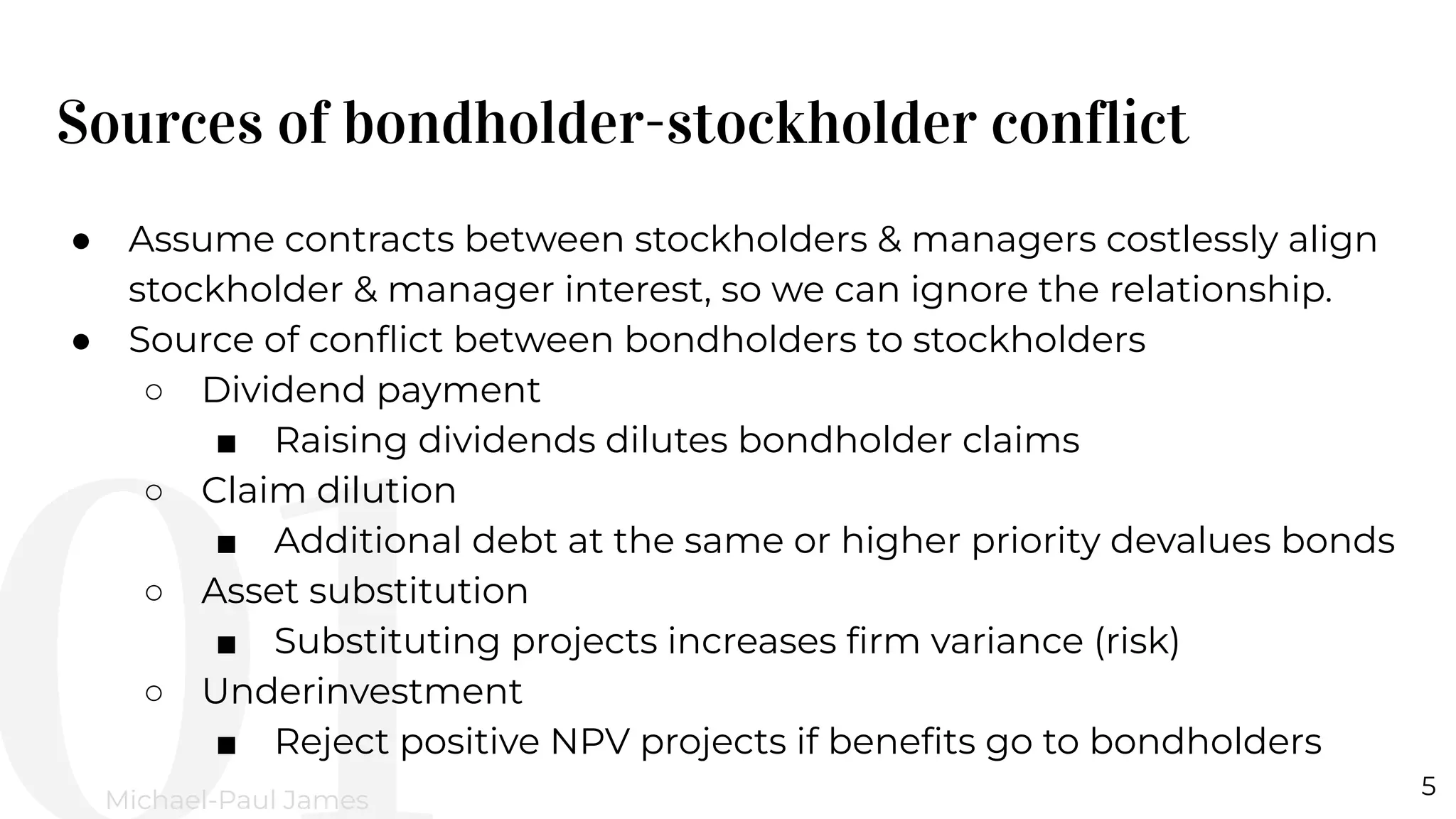
● Assume contracts between stockholders & managers costlessly align
stockholder & manager interest, so we can ignore the relationship.
● Source of conflict between bondholders to stockholders
○ Dividend payment
■ Raising dividends dilutes bondholder claims
○ Claim dilution
■ Additional debt at the same or higher priority devalues bonds
○ Asset substitution
■ Substituting projects increases firm variance (risk)
○ Underinvestment
■ Reject positive NPV projects if benefits go to bondholders
Control of the bondholder-stockholder conflict
The competing hypotheses
6
Michael-Paul James
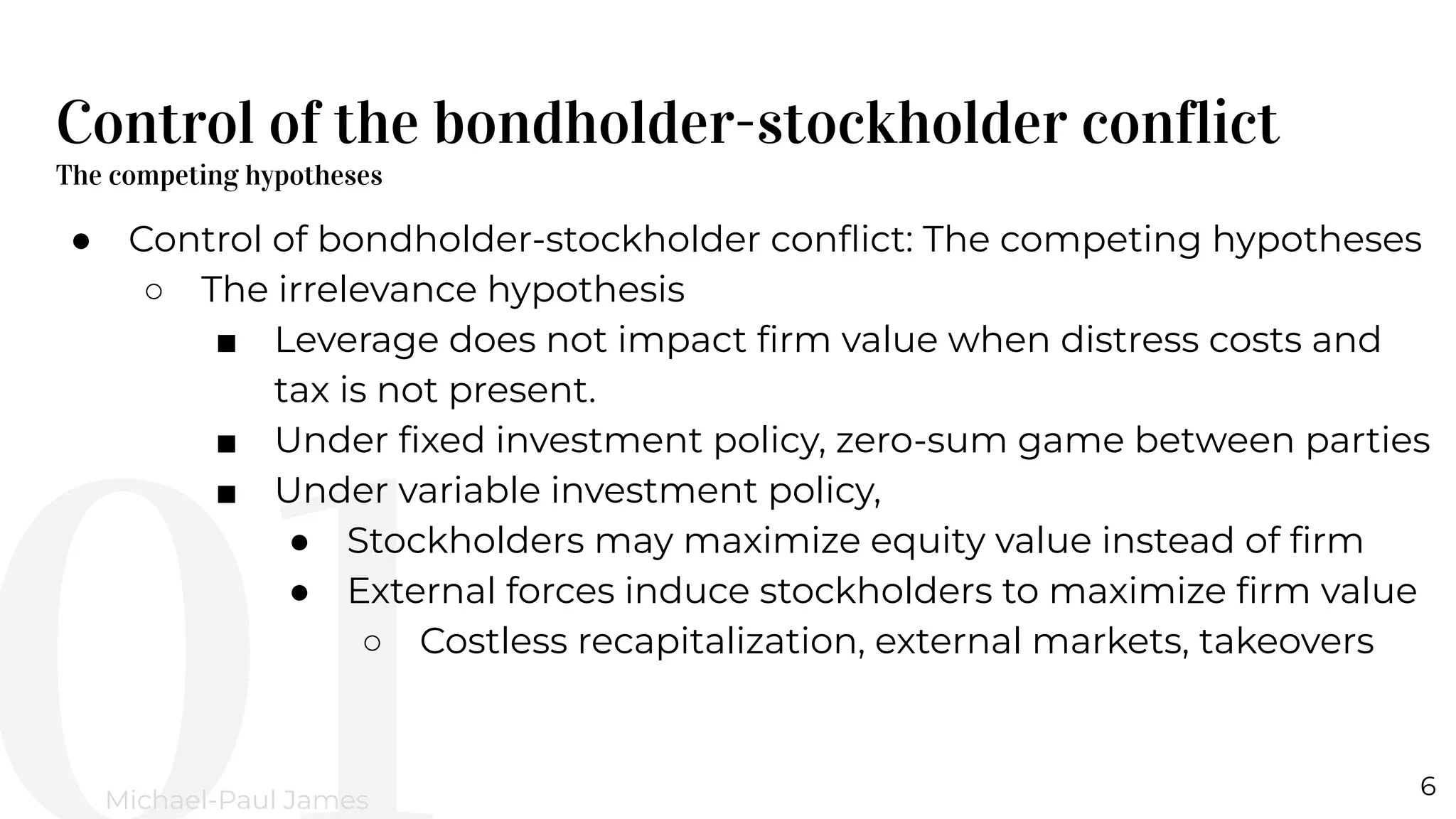
● Control of bondholder-stockholder conflict: The competing hypotheses
○ The irrelevance hypothesis
■ Leverage does not impact firm value when distress costs and
tax is not present.
■ Under fixed investment policy, zero-sum game between parties
■ Under variable investment policy,
● Stockholders may maximize equity value instead of firm
● External forces induce stockholders to maximize firm value
○ Costless recapitalization, external markets, takeovers
Control of the bondholder-stockholder conflict
The competing hypotheses
7
Michael-Paul James
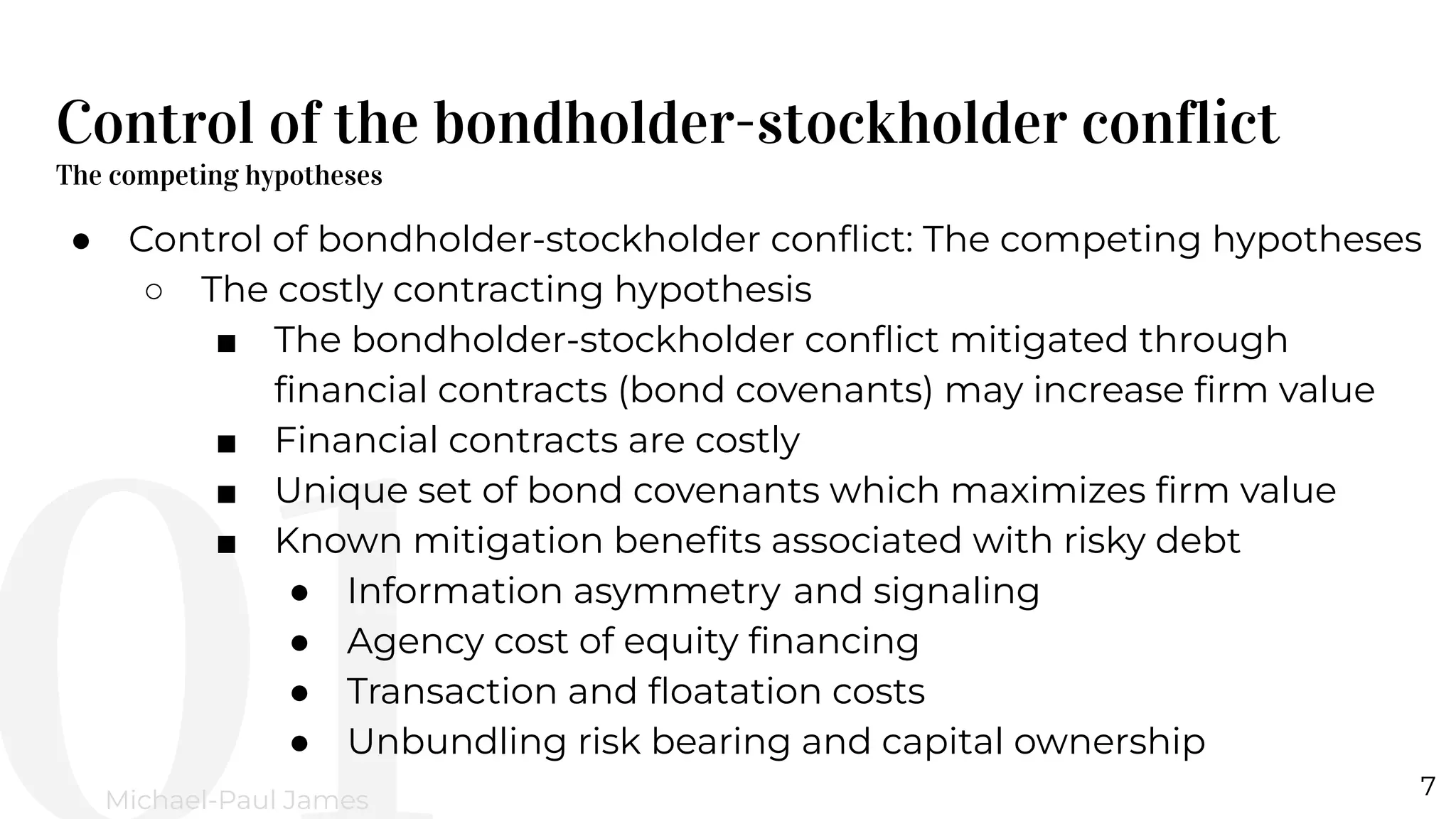
● Control of bondholder-stockholder conflict: The competing hypotheses
○ The costly contracting hypothesis
■ The bondholder-stockholder conflict mitigated through
financial contracts (bond covenants) may increase firm value
■ Financial contracts are costly
■ Unique set of bond covenants which maximizes firm value
■ Known mitigation benefits associated with risky debt
● Information asymmetry and signaling
● Agency cost of equity financing
● Transaction and floatation costs
● Unbundling risk bearing and capital ownership
Evidence by an examination of bond covenants
8
Michael-Paul James
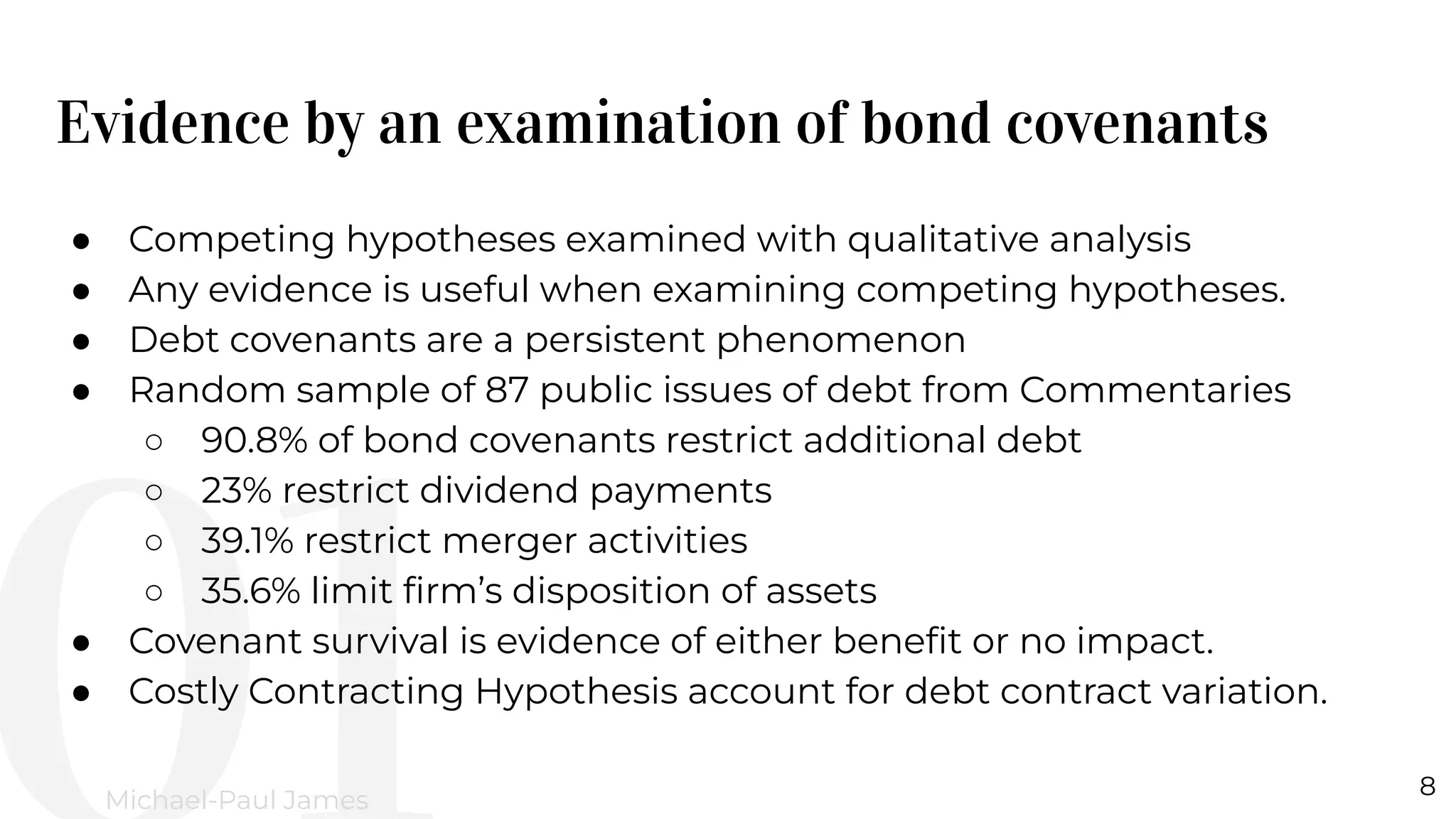
● Competing hypotheses examined with qualitative analysis
● Any evidence is useful when examining competing hypotheses.
● Debt covenants are a persistent phenomenon
● Random sample of 87 public issues of debt from Commentaries
○ 90.8% of bond covenants restrict additional debt
○ 23% restrict dividend payments
○ 39.1% restrict merger activities
○ 35.6% limit firm’s disposition of assets
● Covenant survival is evidence of either benefit or no impact.
● Costly Contracting Hypothesis account for debt contract variation.
Overview of the paper
9
Michael-Paul James
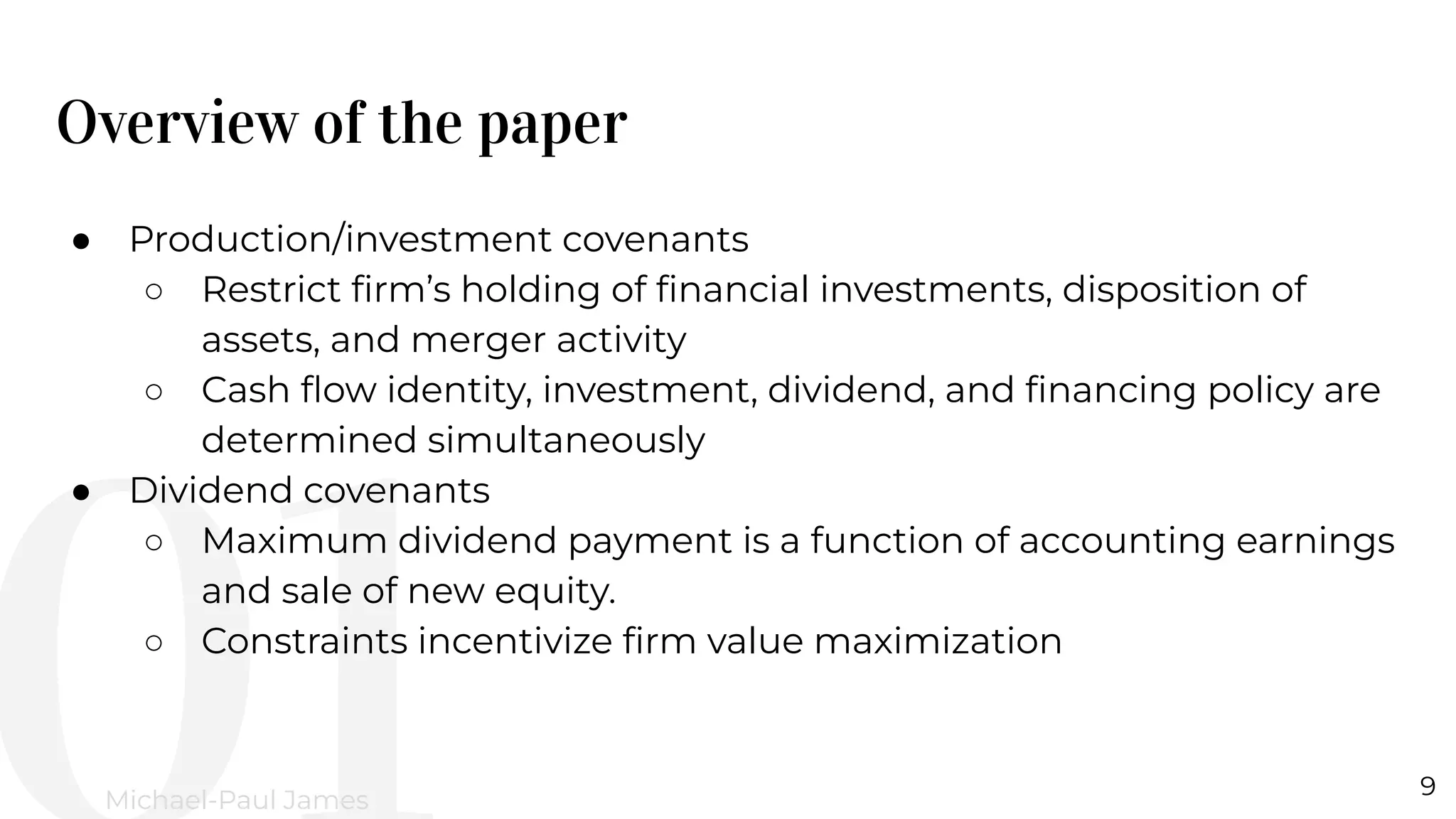
● Production/investment covenants
○ Restrict firm’s holding of financial investments, disposition of
assets, and merger activity
○ Cash flow identity, investment, dividend, and financing policy are
determined simultaneously
● Dividend covenants
○ Maximum dividend payment is a function of accounting earnings
and sale of new equity.
○ Constraints incentivize firm value maximization
Overview of the paper
10
Michael-Paul James
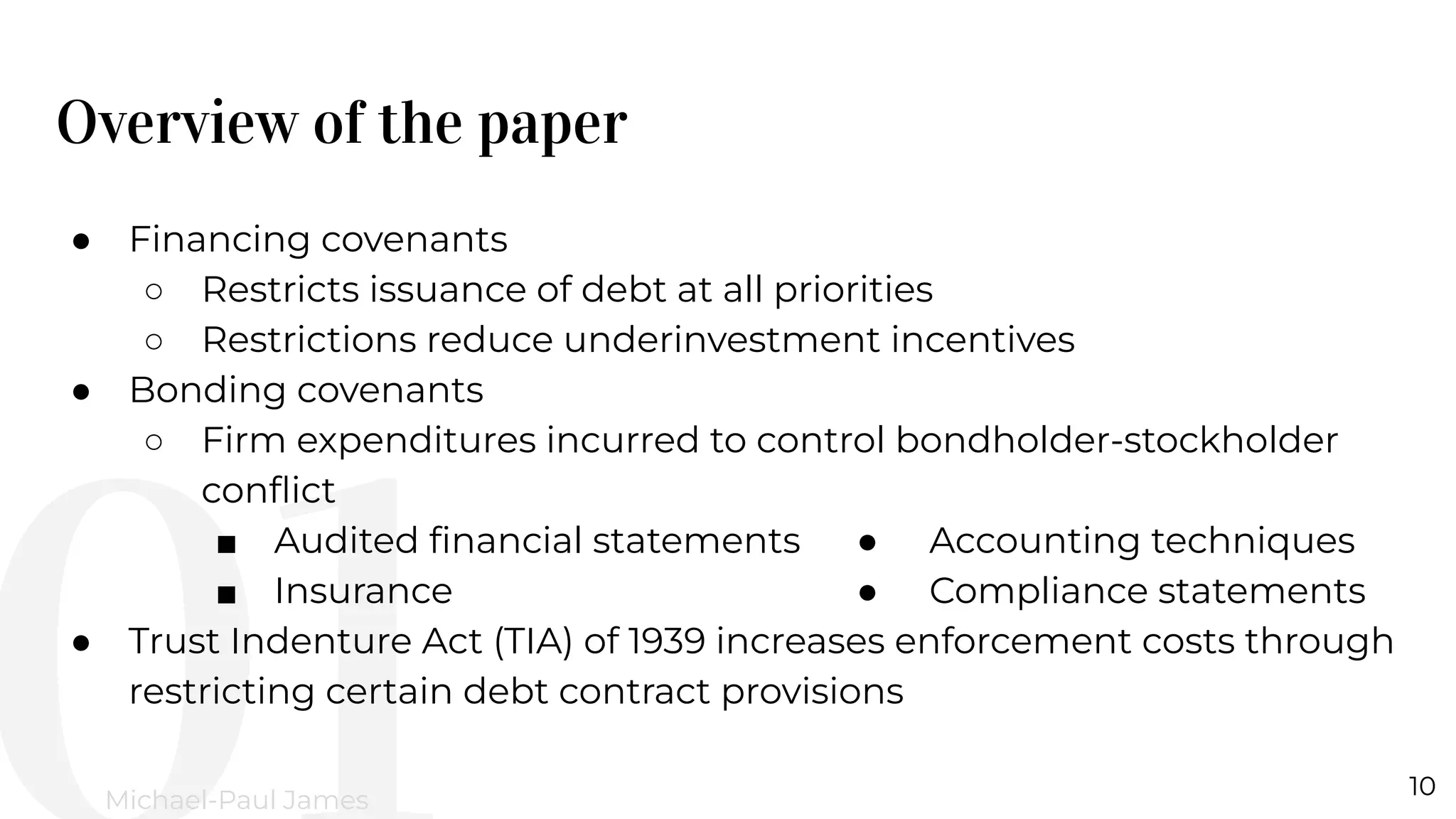
● Financing covenants
○ Restricts issuance of debt at all priorities
○ Restrictions reduce underinvestment incentives
● Bonding covenants
○ Firm expenditures incurred to control bondholder-stockholder
conflict
■ Audited financial statements ● Accounting techniques
■ Insurance ● Compliance statements
● Trust Indenture Act (TIA) of 1939 increases enforcement costs through
restricting certain debt contract provisions
Analysis
02
A description and analysis of bond covenants, restrictions on
production/investment policy, dividends, financing policy, payoffs, activities
11
Michael-Paul James
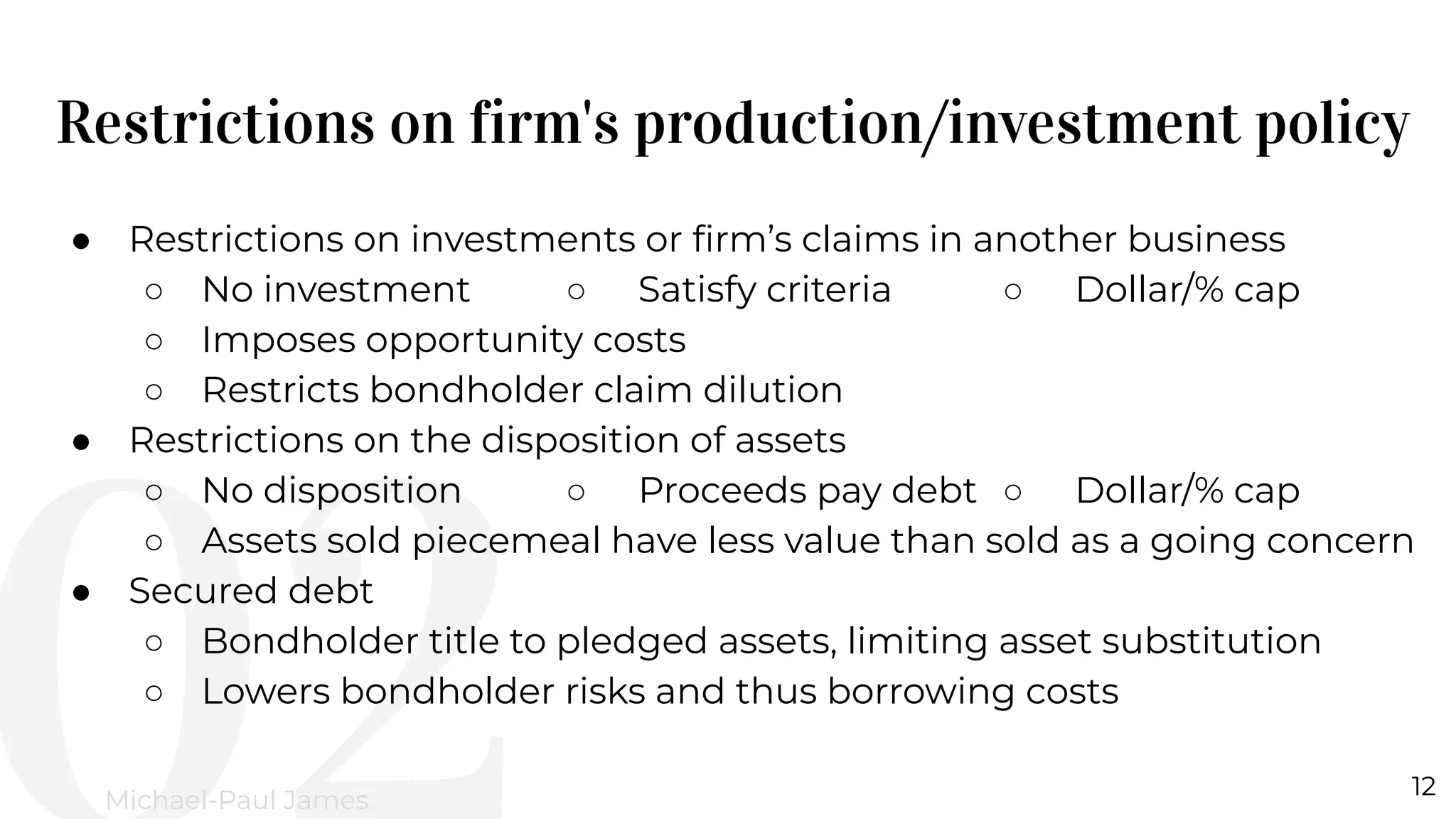
Restrictions on firm's production/investment policy
12
Michael-Paul James
● Restrictions on investments or firm’s claims in another business
○ No investment ○ Satisfy criteria ○ Dollar/% cap
○ Imposes opportunity costs
○ Restricts bondholder claim dilution
● Restrictions on the disposition of assets
○ No disposition ○ Proceeds pay debt ○ Dollar/% cap
○ Assets sold piecemeal have less value than sold as a going concern
● Secured debt
○ Bondholder title to pledged assets, limiting asset substitution
○ Lowers bondholder risks and thus borrowing costs
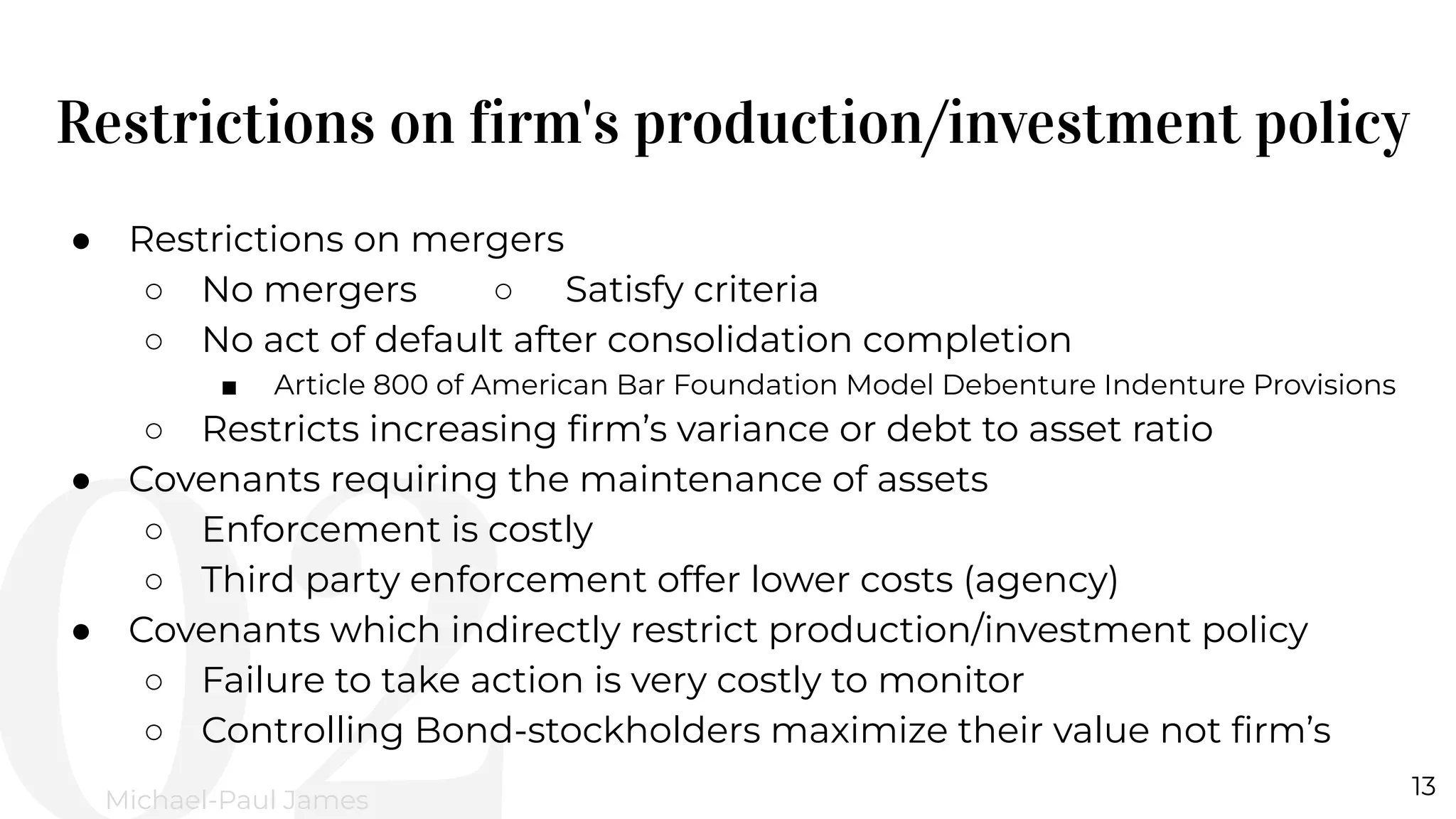
Restrictions on firm's production/investment policy
13
Michael-Paul James
● Restrictions on mergers
○ No mergers ○ Satisfy criteria
○ No act of default after consolidation completion
■ Article 800 of American Bar Foundation Model Debenture Indenture Provisions
○ Restricts increasing firm’s variance or debt to asset ratio
● Covenants requiring the maintenance of assets
○ Enforcement is costly
○ Third party enforcement offer lower costs (agency)
● Covenants which indirectly restrict production/investment policy
○ Failure to take action is very costly to monitor
○ Controlling Bond-stockholders maximize their value not firm’s
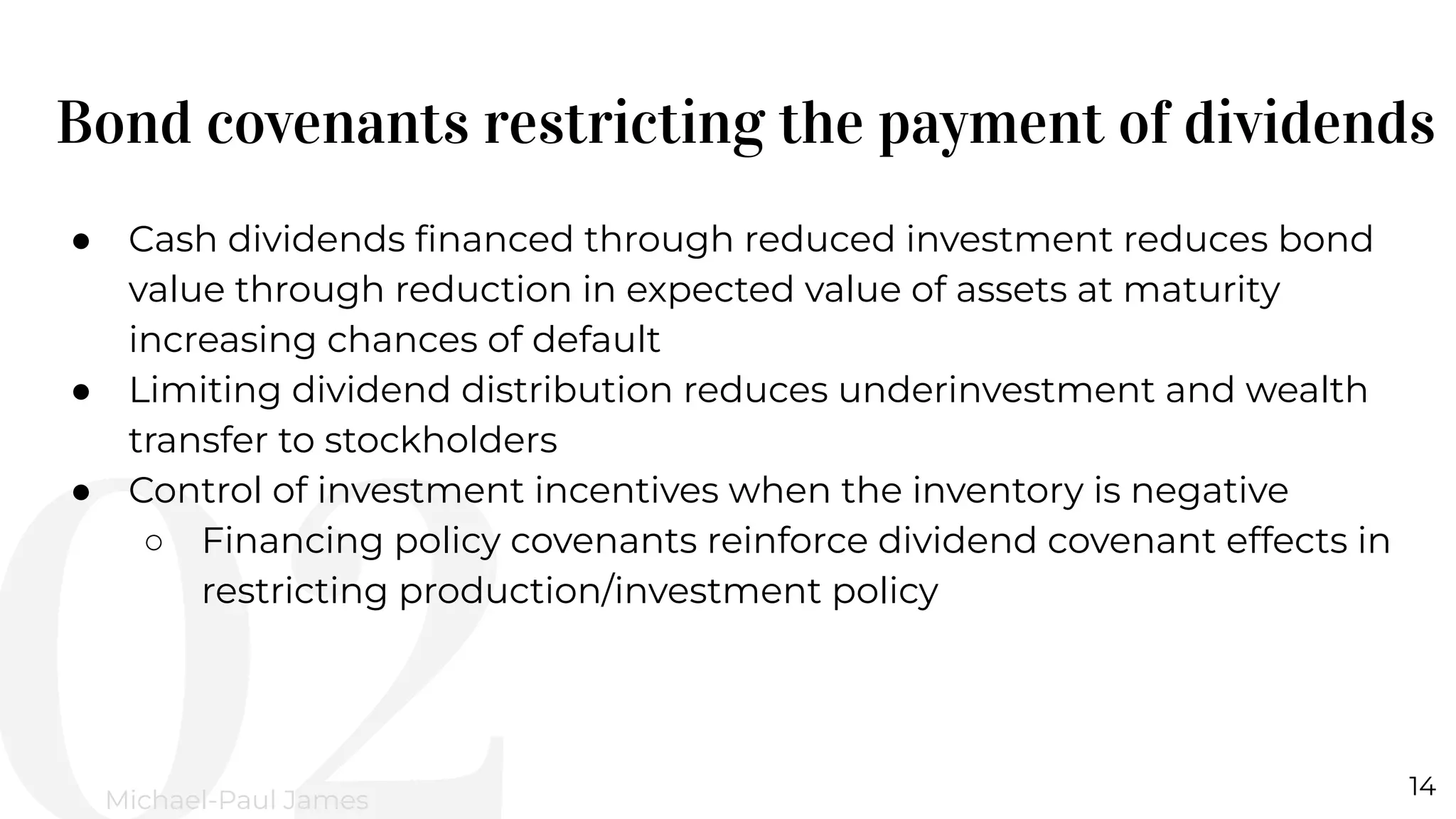
Bond covenants restricting the payment of dividends
14
Michael-Paul James
● Cash dividends financed through reduced investment reduces bond
value through reduction in expected value of assets at maturity
increasing chances of default
● Limiting dividend distribution reduces underinvestment and wealth
transfer to stockholders
● Control of investment incentives when the inventory is negative
○ Financing policy covenants reinforce dividend covenant effects in
restricting production/investment policy
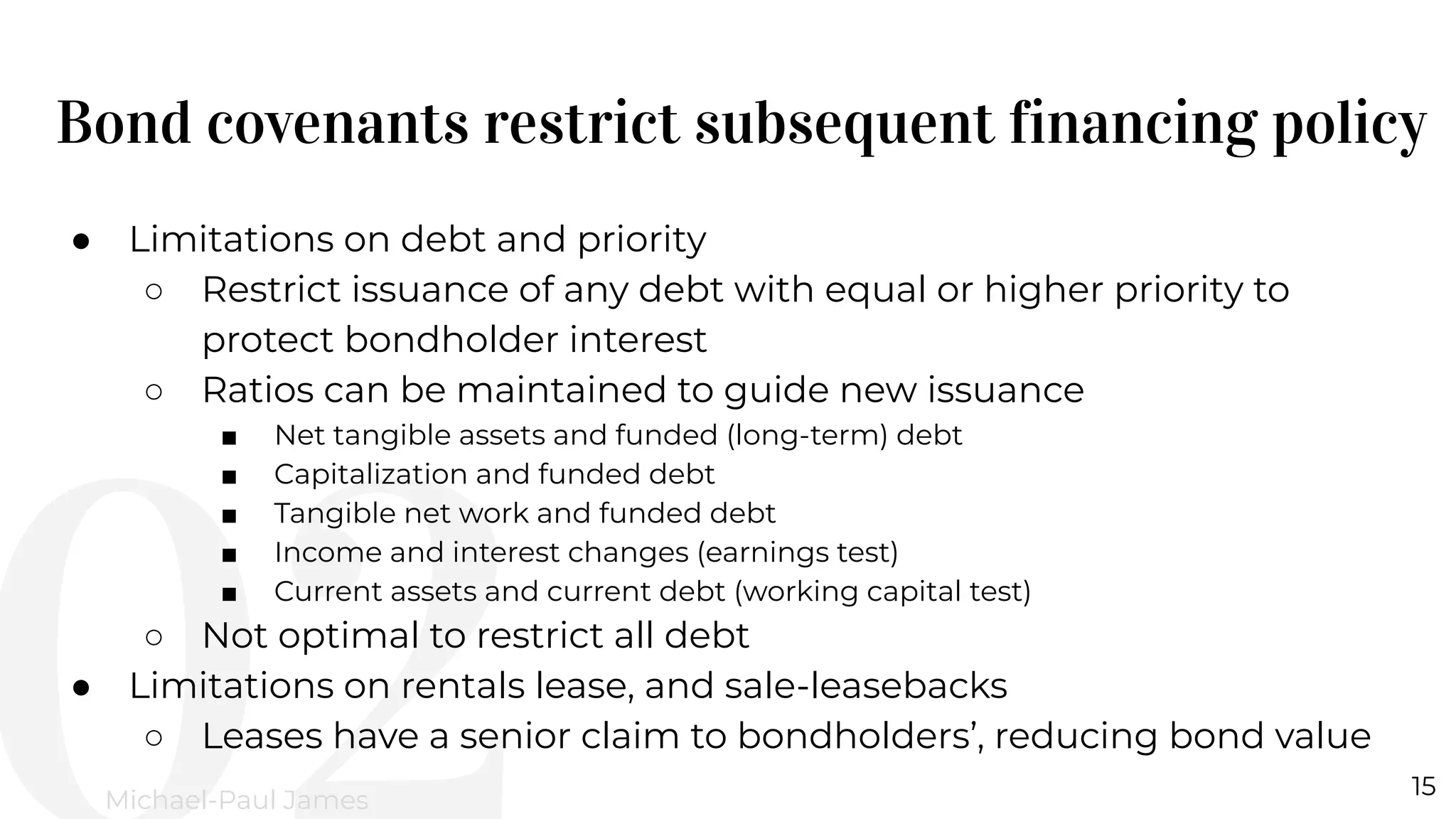
Bond covenants restrict subsequent financing policy
15
Michael-Paul James
● Limitations on debt and priority
○ Restrict issuance of any debt with equal or higher priority to
protect bondholder interest
○ Ratios can be maintained to guide new issuance
■ Net tangible assets and funded (long-term) debt
■ Capitalization and funded debt
■ Tangible net work and funded debt
■ Income and interest changes (earnings test)
■ Current assets and current debt (working capital test)
○ Not optimal to restrict all debt
● Limitations on rentals lease, and sale-leasebacks
○ Leases have a senior claim to bondholders’, reducing bond value
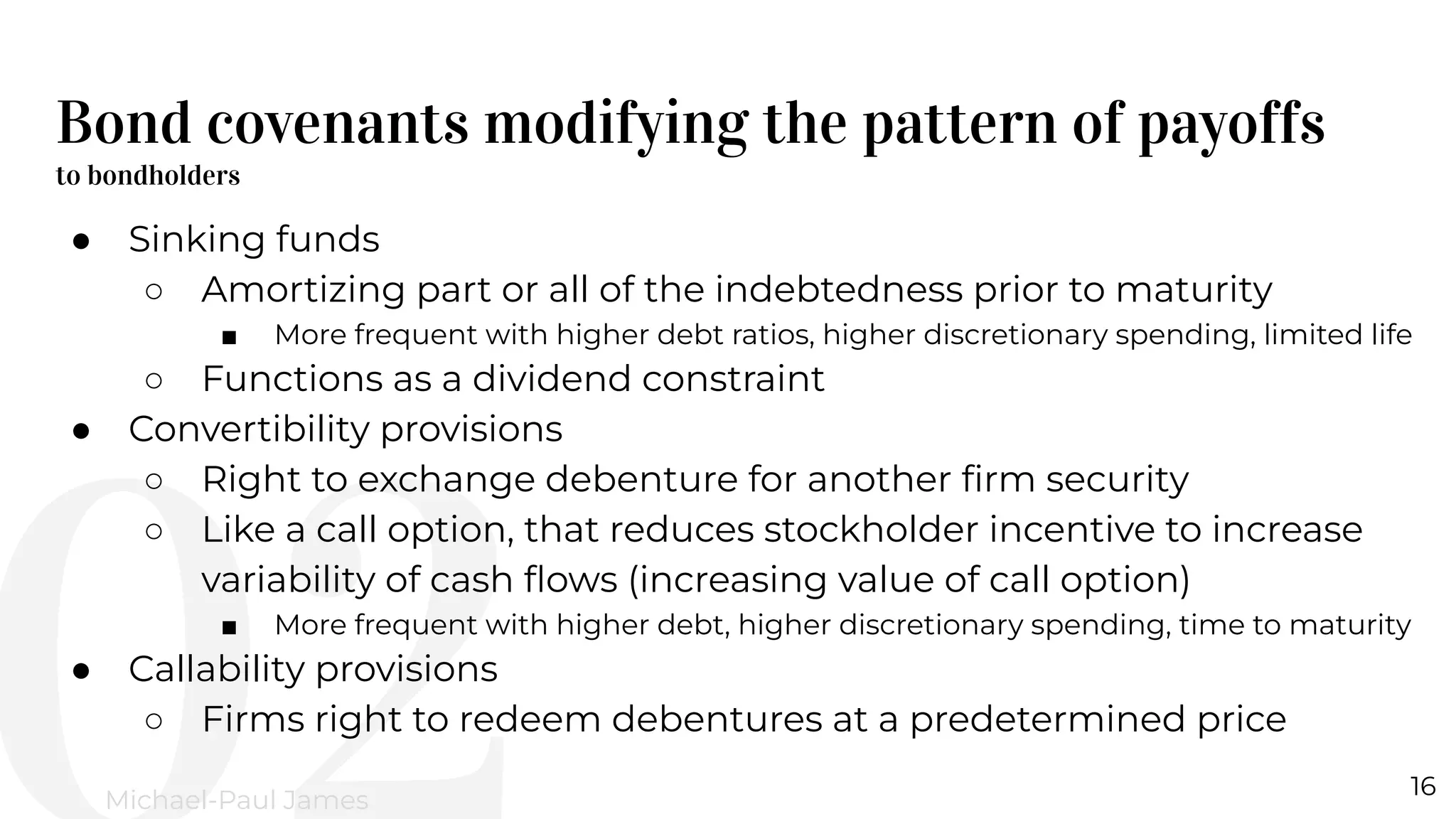
Bond covenants modifying the pattern of payoffs
to bondholders
16
Michael-Paul James
● Sinking funds
○ Amortizing part or all of the indebtedness prior to maturity
■ More frequent with higher debt ratios, higher discretionary spending, limited life
○ Functions as a dividend constraint
● Convertibility provisions
○ Right to exchange debenture for another firm security
○ Like a call option, that reduces stockholder incentive to increase
variability of cash flows (increasing value of call option)
■ More frequent with higher debt, higher discretionary spending, time to maturity
● Callability provisions
○ Firms right to redeem debentures at a predetermined price
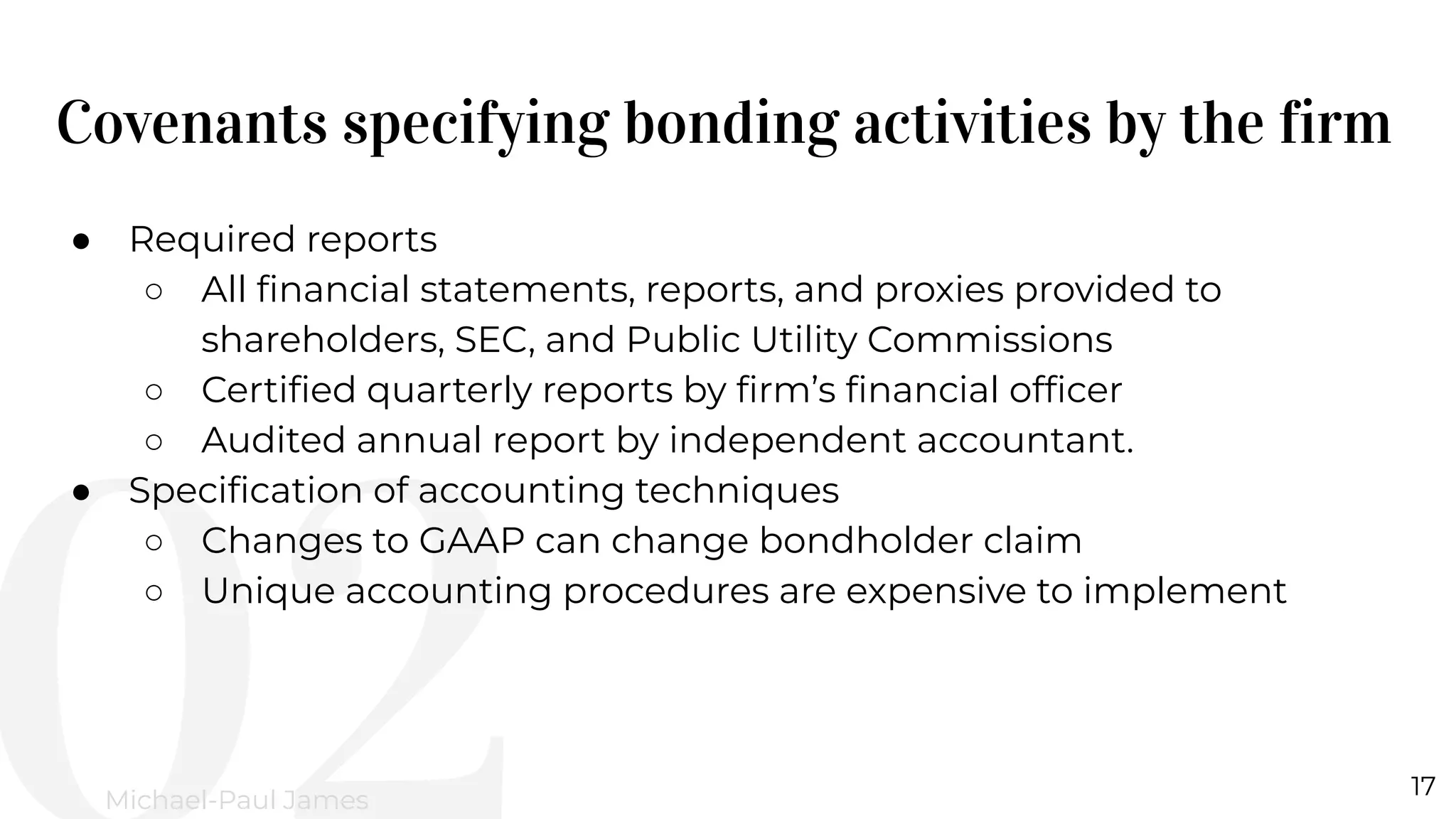
Covenants specifying bonding activities by the firm
17
Michael-Paul James
● Required reports
○ All financial statements, reports, and proxies provided to
shareholders, SEC, and Public Utility Commissions
○ Certified quarterly reports by firm’s financial officer
○ Audited annual report by independent accountant.
● Specification of accounting techniques
○ Changes to GAAP can change bondholder claim
○ Unique accounting procedures are expensive to implement
Covenants specifying bonding activities by the firm
18
Michael-Paul James
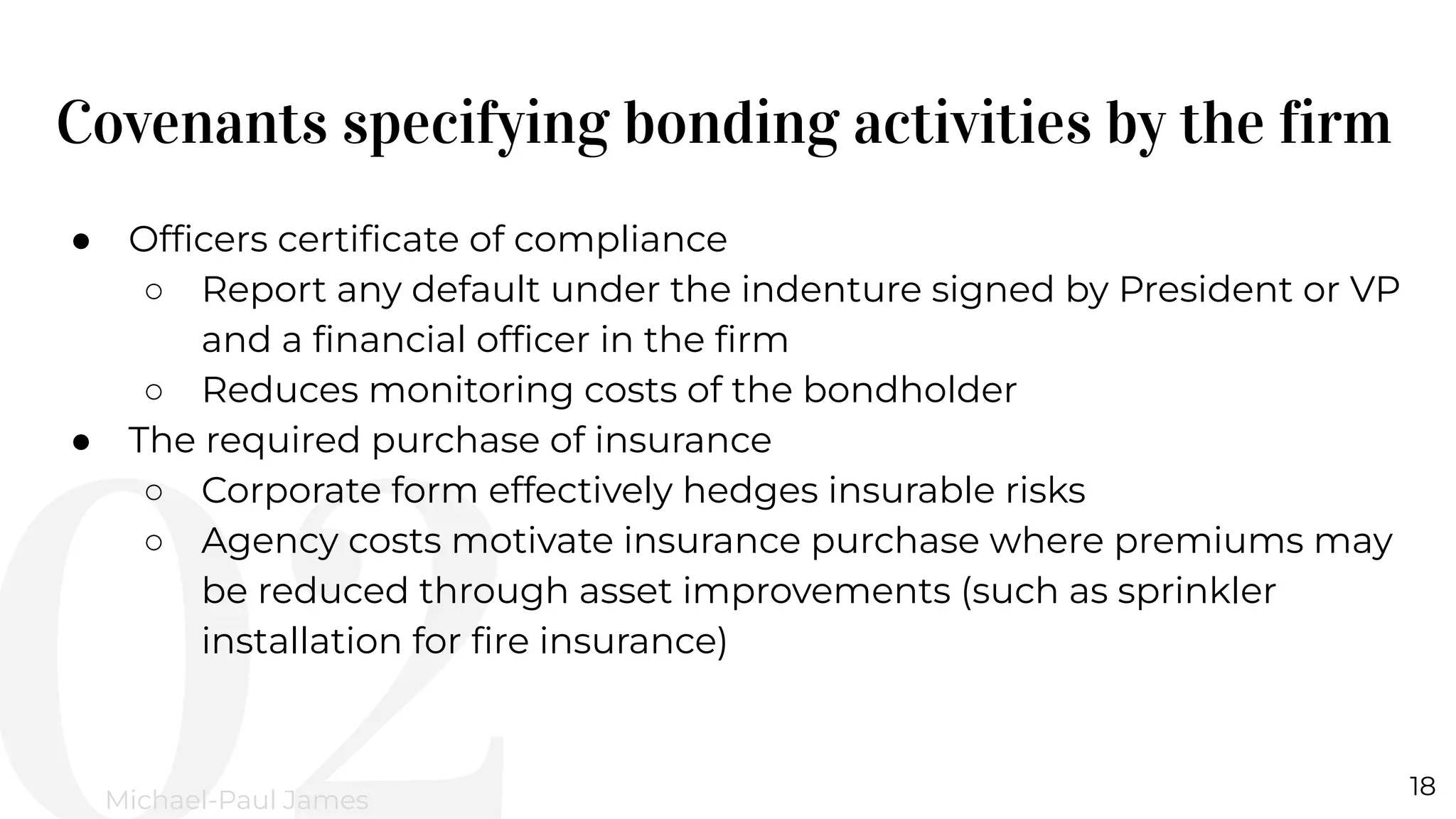
● Officers certificate of compliance
○ Report any default under the indenture signed by President or VP
and a financial officer in the firm
○ Reduces monitoring costs of the bondholder
● The required purchase of insurance
○ Corporate form effectively hedges insurable risks
○ Agency costs motivate insurance purchase where premiums may
be reduced through asset improvements (such as sprinkler
installation for fire insurance)
Enforcement
03
The enforcement of bond covenants, legal liability, trust indenture, default
remedies
19
Michael-Paul James
The legal liability of bondholders
20
Michael-Paul James
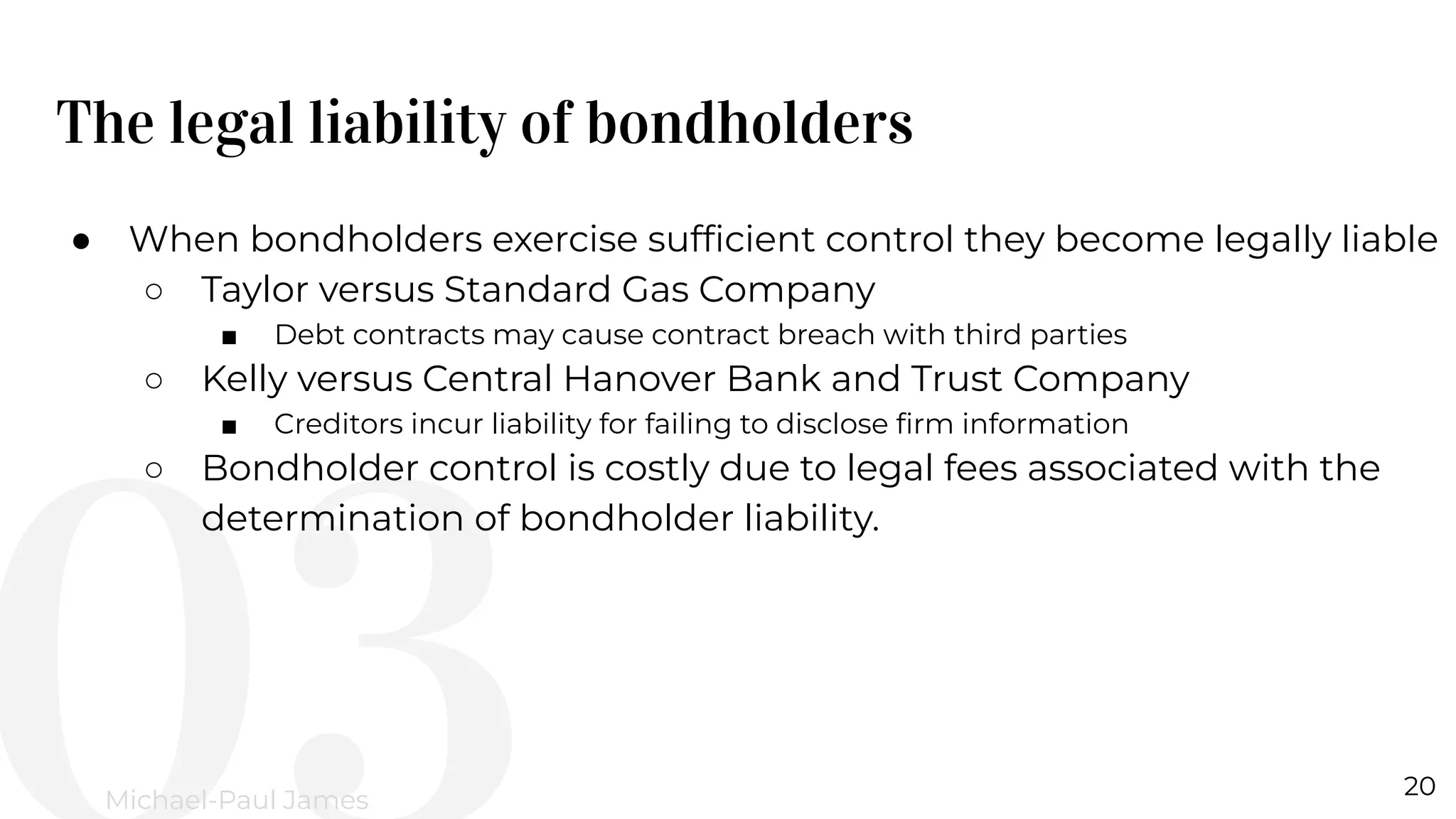
● When bondholders exercise sufficient control they become legally liable
○ Taylor versus Standard Gas Company
■ Debt contracts may cause contract breach with third parties
○ Kelly versus Central Hanover Bank and Trust Company
■ Creditors incur liability for failing to disclose firm information
○ Bondholder control is costly due to legal fees associated with the
determination of bondholder liability.
The role of the trust indenture and the trustee
21
Michael-Paul James
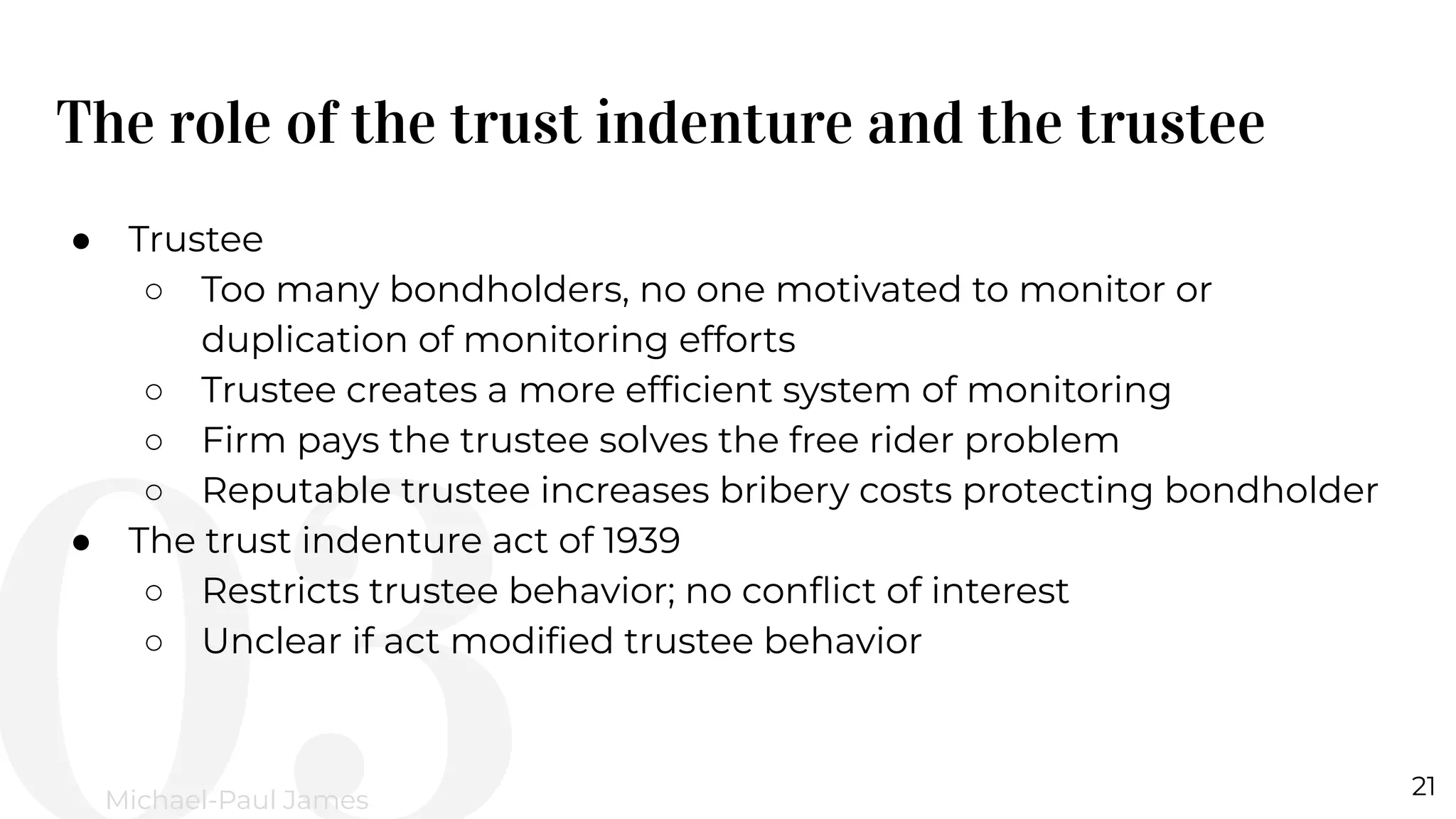
● Trustee
○ Too many bondholders, no one motivated to monitor or
duplication of monitoring efforts
○ Trustee creates a more efficient system of monitoring
○ Firm pays the trustee solves the free rider problem
○ Reputable trustee increases bribery costs protecting bondholder
● The trust indenture act of 1939
○ Restricts trustee behavior; no conflict of interest
○ Unclear if act modified trustee behavior
The role of the trust indenture and the trustee
22
Michael-Paul James
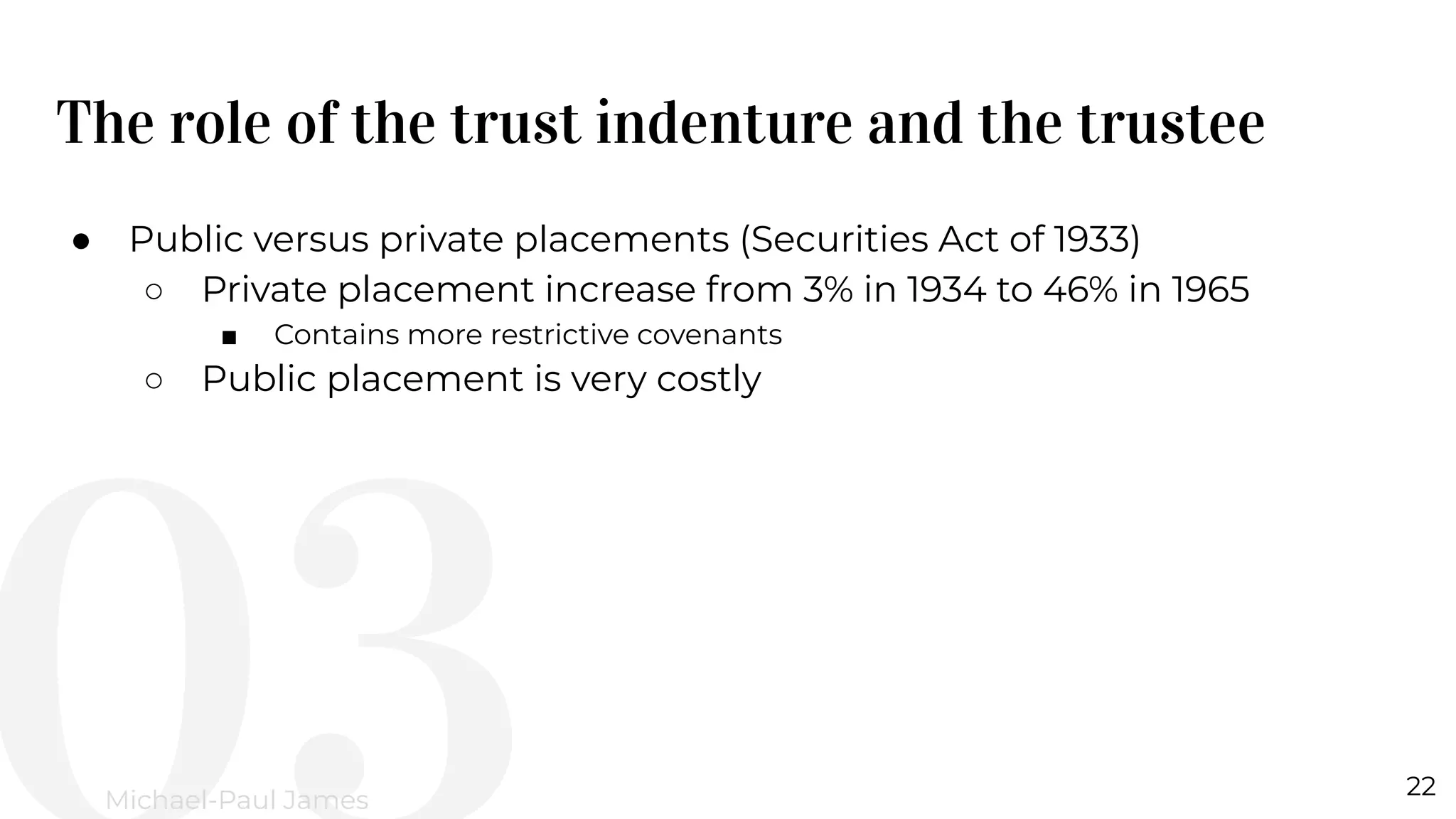
● Public versus private placements (Securities Act of 1933)
○ Private placement increase from 3% in 1934 to 46% in 1965
■ Contains more restrictive covenants
○ Public placement is very costly
Default remedies
23
Michael-Paul James
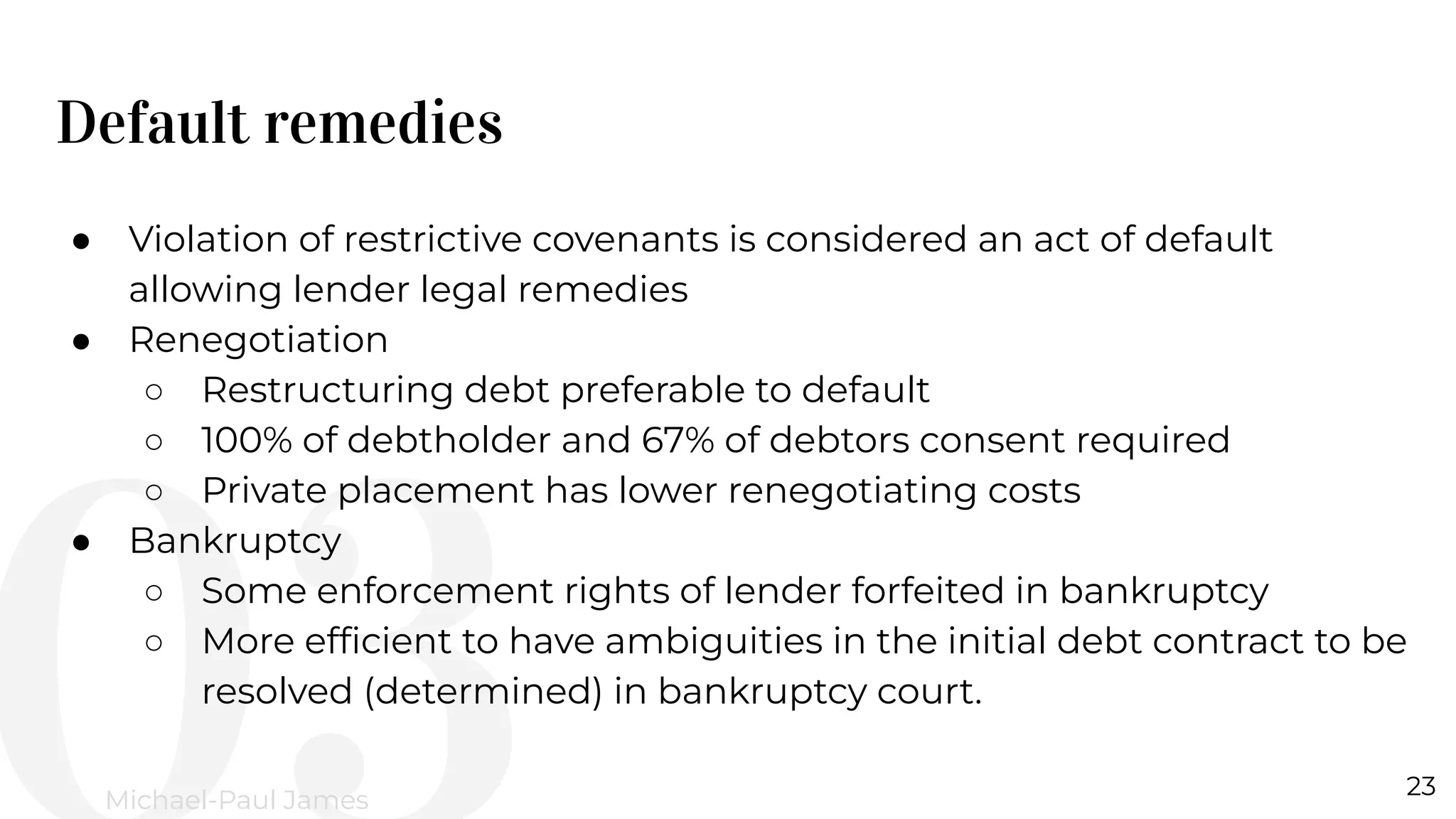
● Violation of restrictive covenants is considered an act of default
allowing lender legal remedies
● Renegotiation
○ Restructuring debt preferable to default
○ 100% of debtholder and 67% of debtors consent required
○ Private placement has lower renegotiating costs
● Bankruptcy
○ Some enforcement rights of lender forfeited in bankruptcy
○ More efficient to have ambiguities in the initial debt contract to be
resolved (determined) in bankruptcy court.
Conclusions
04
Role of bond covenants, implications of capital structure, extensions
24
Michael-Paul James
The role of bond covenants
25
Michael-Paul James
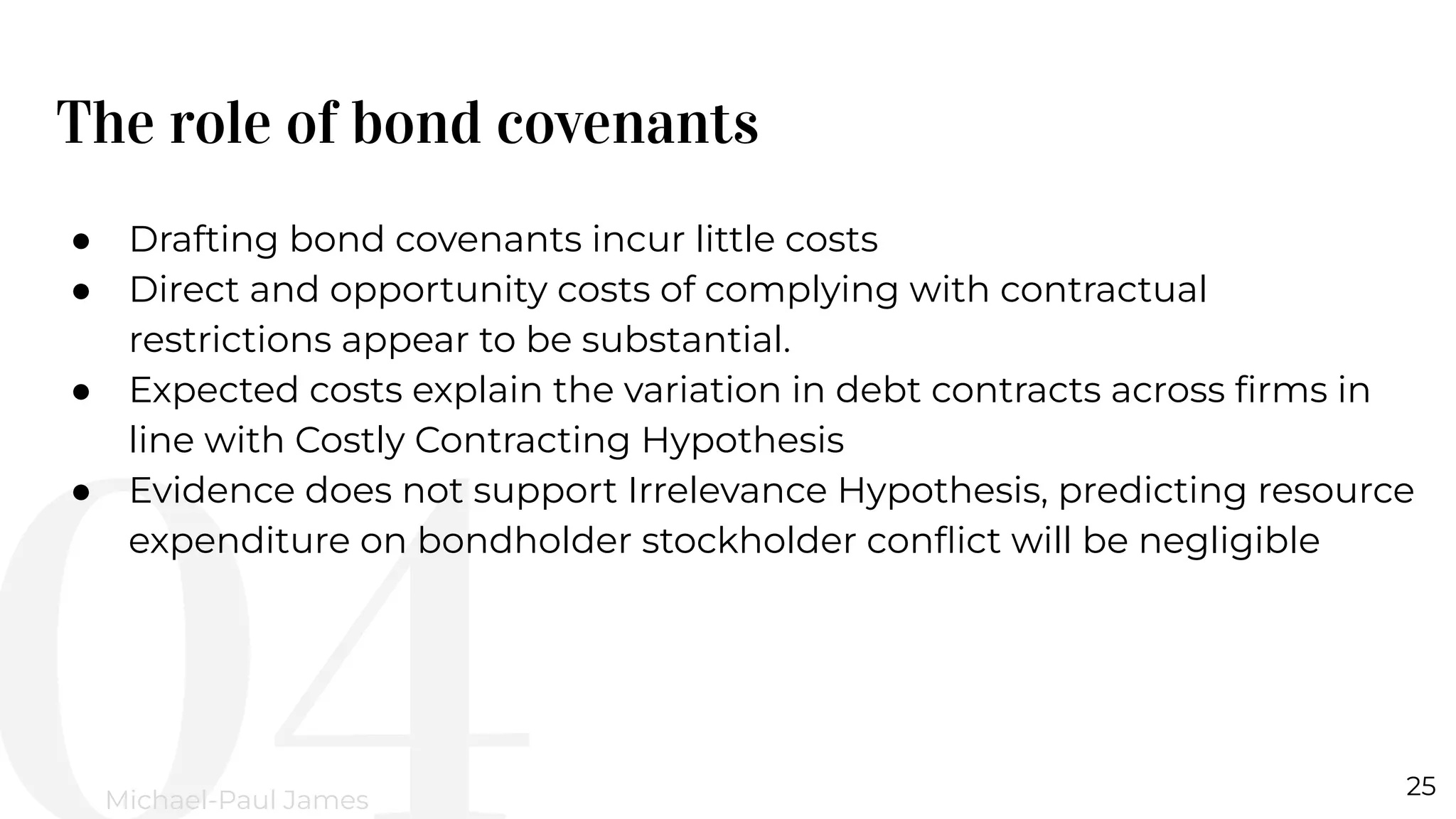
● Drafting bond covenants incur little costs
● Direct and opportunity costs of complying with contractual
restrictions appear to be substantial.
● Expected costs explain the variation in debt contracts across firms in
line with Costly Contracting Hypothesis
● Evidence does not support Irrelevance Hypothesis, predicting resource
expenditure on bondholder stockholder conflict will be negligible
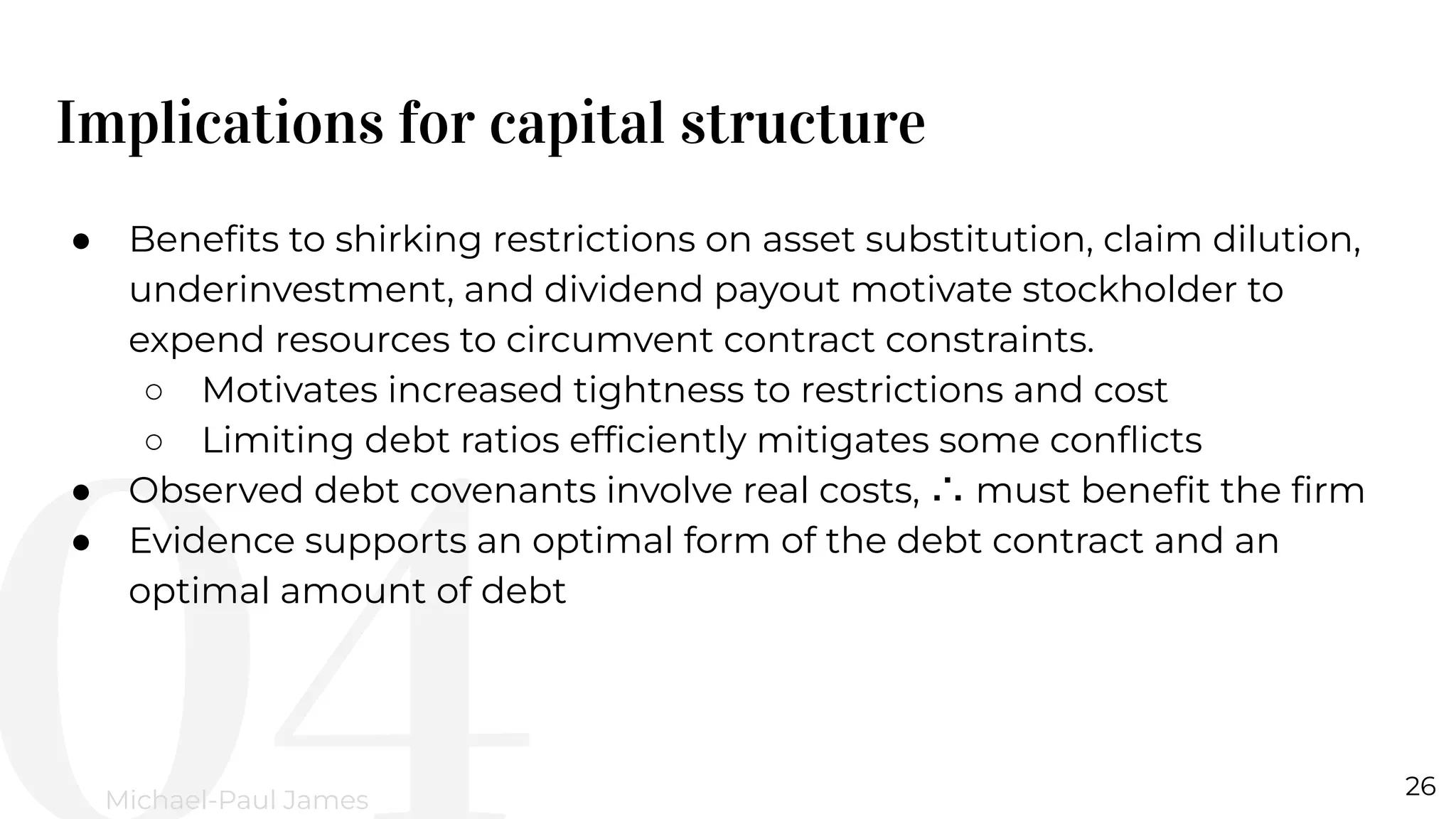
Implications for capital structure
26
Michael-Paul James
● Benefits to shirking restrictions on asset substitution, claim dilution,
underinvestment, and dividend payout motivate stockholder to
expend resources to circumvent contract constraints.
○ Motivates increased tightness to restrictions and cost
○ Limiting debt ratios efficiently mitigates some conflicts
● Observed debt covenants involve real costs, ∴ must benefit the firm
● Evidence supports an optimal form of the debt contract and an
optimal amount of debt
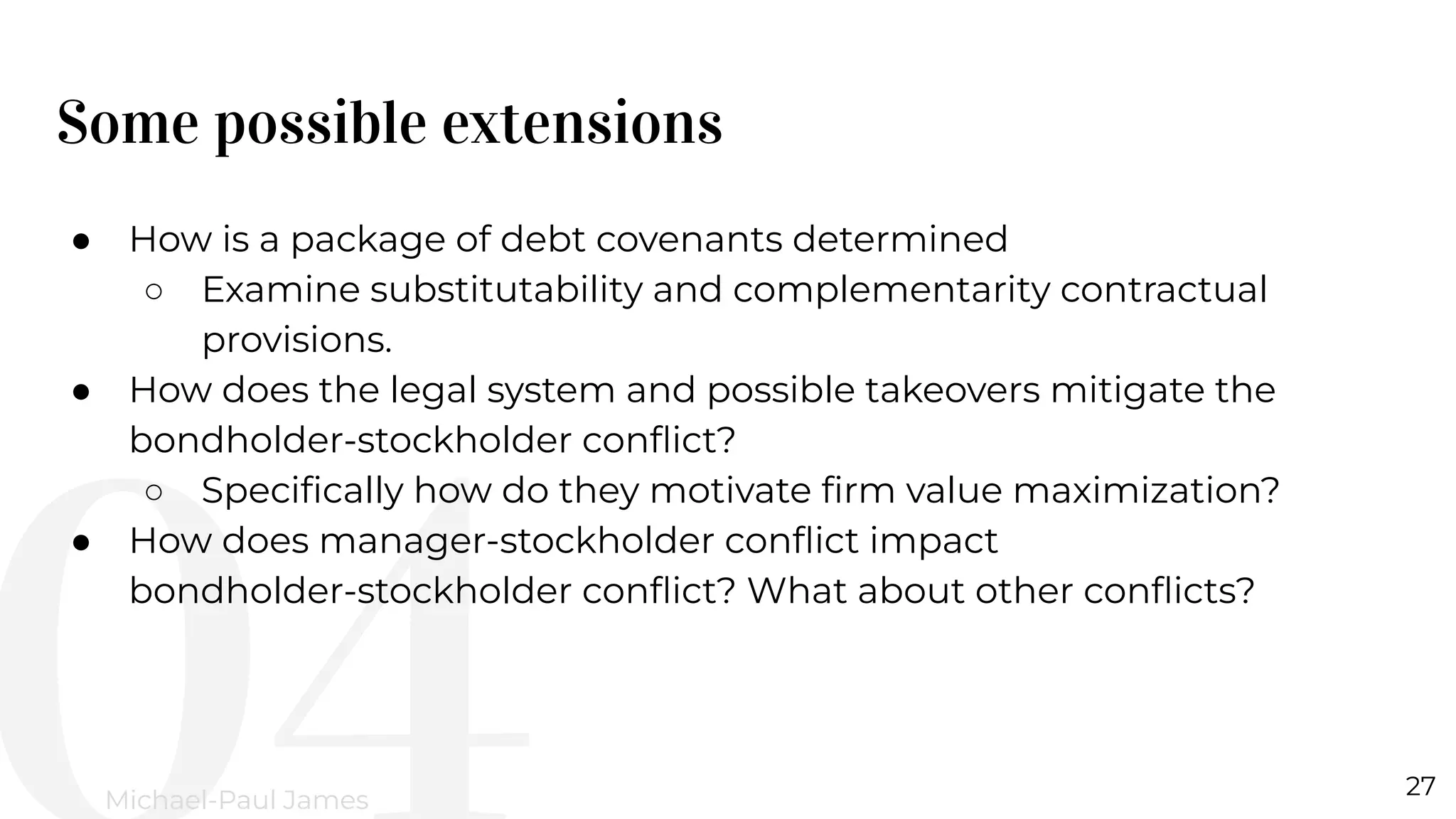
Some possible extensions
27
Michael-Paul James
● How is a package of debt covenants determined
○ Examine substitutability and complementarity contractual
provisions.
● How does the legal system and possible takeovers mitigate the
bondholder-stockholder conflict?
○ Specifically how do they motivate firm value maximization?
● How does manager-stockholder conflict impact
bondholder-stockholder conflict? What about other conflicts?
You are Amazing
Ask me all the questions you desire. I will do my best to answer honestly
and strive to grasp your intent and creativity.
28
Michael-Paul James

Presentation on On Financial Contracting: An Analysis of Covenants

  • 1.
    On Financial Contracting:An Analysis of Covenants Paper by Clifford W Smith & Jerold B. Warner Presentation by Michael-Paul James 1
  • 2.
    Table of contents 2 Michael-PaulJames Introduction Introduction and summary, sources of conflict, competing hypothesis, evidence, overview 01 Analysis A description and analysis of bond covenants, restrictions on production/investment policy, dividends, financing policy, payoffs, activities 02 Enforcement The enforcement of bond covenants, legal liability, trust indenture, default remedies 03 Conclusions Role of bond covenants, implications of capital structure, extensions 04
  • 3.
    Introduction 01 Introduction and summary,sources of conflict, competing hypothesis, evidence, overview 3 Michael-Paul James
  • 4.
    Introduction and summary 4 Michael-PaulJames ● Conflict of interest between bondholders and stockholders ○ Production plans can be constructed to maximize the wealth of the bondholders or the stockholders ■ Equity call option [max(S(T)-Debt,0)]: Biases equity risk preference ○ Ideally, production plans should maximize firm value ● Bond covenant used to mitigate bondholder-stockholder conflict ○ Restricts the firm from engaging in specified actions after the bonds are sold ● Provisions from the American Bar Foundation compendium ○ Commentaries on Indentures
  • 5.
    Sources of bondholder-stockholderconflict 5 Michael-Paul James ● Assume contracts between stockholders & managers costlessly align stockholder & manager interest, so we can ignore the relationship. ● Source of conflict between bondholders to stockholders ○ Dividend payment ■ Raising dividends dilutes bondholder claims ○ Claim dilution ■ Additional debt at the same or higher priority devalues bonds ○ Asset substitution ■ Substituting projects increases firm variance (risk) ○ Underinvestment ■ Reject positive NPV projects if benefits go to bondholders
  • 6.
    Control of thebondholder-stockholder conflict The competing hypotheses 6 Michael-Paul James ● Control of bondholder-stockholder conflict: The competing hypotheses ○ The irrelevance hypothesis ■ Leverage does not impact firm value when distress costs and tax is not present. ■ Under fixed investment policy, zero-sum game between parties ■ Under variable investment policy, ● Stockholders may maximize equity value instead of firm ● External forces induce stockholders to maximize firm value ○ Costless recapitalization, external markets, takeovers
  • 7.
    Control of thebondholder-stockholder conflict The competing hypotheses 7 Michael-Paul James ● Control of bondholder-stockholder conflict: The competing hypotheses ○ The costly contracting hypothesis ■ The bondholder-stockholder conflict mitigated through financial contracts (bond covenants) may increase firm value ■ Financial contracts are costly ■ Unique set of bond covenants which maximizes firm value ■ Known mitigation benefits associated with risky debt ● Information asymmetry and signaling ● Agency cost of equity financing ● Transaction and floatation costs ● Unbundling risk bearing and capital ownership
  • 8.
    Evidence by anexamination of bond covenants 8 Michael-Paul James ● Competing hypotheses examined with qualitative analysis ● Any evidence is useful when examining competing hypotheses. ● Debt covenants are a persistent phenomenon ● Random sample of 87 public issues of debt from Commentaries ○ 90.8% of bond covenants restrict additional debt ○ 23% restrict dividend payments ○ 39.1% restrict merger activities ○ 35.6% limit firm’s disposition of assets ● Covenant survival is evidence of either benefit or no impact. ● Costly Contracting Hypothesis account for debt contract variation.
  • 9.
    Overview of thepaper 9 Michael-Paul James ● Production/investment covenants ○ Restrict firm’s holding of financial investments, disposition of assets, and merger activity ○ Cash flow identity, investment, dividend, and financing policy are determined simultaneously ● Dividend covenants ○ Maximum dividend payment is a function of accounting earnings and sale of new equity. ○ Constraints incentivize firm value maximization
  • 10.
    Overview of thepaper 10 Michael-Paul James ● Financing covenants ○ Restricts issuance of debt at all priorities ○ Restrictions reduce underinvestment incentives ● Bonding covenants ○ Firm expenditures incurred to control bondholder-stockholder conflict ■ Audited financial statements ● Accounting techniques ■ Insurance ● Compliance statements ● Trust Indenture Act (TIA) of 1939 increases enforcement costs through restricting certain debt contract provisions
  • 11.
    Analysis 02 A description andanalysis of bond covenants, restrictions on production/investment policy, dividends, financing policy, payoffs, activities 11 Michael-Paul James
  • 12.
    Restrictions on firm'sproduction/investment policy 12 Michael-Paul James ● Restrictions on investments or firm’s claims in another business ○ No investment ○ Satisfy criteria ○ Dollar/% cap ○ Imposes opportunity costs ○ Restricts bondholder claim dilution ● Restrictions on the disposition of assets ○ No disposition ○ Proceeds pay debt ○ Dollar/% cap ○ Assets sold piecemeal have less value than sold as a going concern ● Secured debt ○ Bondholder title to pledged assets, limiting asset substitution ○ Lowers bondholder risks and thus borrowing costs
  • 13.
    Restrictions on firm'sproduction/investment policy 13 Michael-Paul James ● Restrictions on mergers ○ No mergers ○ Satisfy criteria ○ No act of default after consolidation completion ■ Article 800 of American Bar Foundation Model Debenture Indenture Provisions ○ Restricts increasing firm’s variance or debt to asset ratio ● Covenants requiring the maintenance of assets ○ Enforcement is costly ○ Third party enforcement offer lower costs (agency) ● Covenants which indirectly restrict production/investment policy ○ Failure to take action is very costly to monitor ○ Controlling Bond-stockholders maximize their value not firm’s
  • 14.
    Bond covenants restrictingthe payment of dividends 14 Michael-Paul James ● Cash dividends financed through reduced investment reduces bond value through reduction in expected value of assets at maturity increasing chances of default ● Limiting dividend distribution reduces underinvestment and wealth transfer to stockholders ● Control of investment incentives when the inventory is negative ○ Financing policy covenants reinforce dividend covenant effects in restricting production/investment policy
  • 15.
    Bond covenants restrictsubsequent financing policy 15 Michael-Paul James ● Limitations on debt and priority ○ Restrict issuance of any debt with equal or higher priority to protect bondholder interest ○ Ratios can be maintained to guide new issuance ■ Net tangible assets and funded (long-term) debt ■ Capitalization and funded debt ■ Tangible net work and funded debt ■ Income and interest changes (earnings test) ■ Current assets and current debt (working capital test) ○ Not optimal to restrict all debt ● Limitations on rentals lease, and sale-leasebacks ○ Leases have a senior claim to bondholders’, reducing bond value
  • 16.
    Bond covenants modifyingthe pattern of payoffs to bondholders 16 Michael-Paul James ● Sinking funds ○ Amortizing part or all of the indebtedness prior to maturity ■ More frequent with higher debt ratios, higher discretionary spending, limited life ○ Functions as a dividend constraint ● Convertibility provisions ○ Right to exchange debenture for another firm security ○ Like a call option, that reduces stockholder incentive to increase variability of cash flows (increasing value of call option) ■ More frequent with higher debt, higher discretionary spending, time to maturity ● Callability provisions ○ Firms right to redeem debentures at a predetermined price
  • 17.
    Covenants specifying bondingactivities by the firm 17 Michael-Paul James ● Required reports ○ All financial statements, reports, and proxies provided to shareholders, SEC, and Public Utility Commissions ○ Certified quarterly reports by firm’s financial officer ○ Audited annual report by independent accountant. ● Specification of accounting techniques ○ Changes to GAAP can change bondholder claim ○ Unique accounting procedures are expensive to implement
  • 18.
    Covenants specifying bondingactivities by the firm 18 Michael-Paul James ● Officers certificate of compliance ○ Report any default under the indenture signed by President or VP and a financial officer in the firm ○ Reduces monitoring costs of the bondholder ● The required purchase of insurance ○ Corporate form effectively hedges insurable risks ○ Agency costs motivate insurance purchase where premiums may be reduced through asset improvements (such as sprinkler installation for fire insurance)
  • 19.
    Enforcement 03 The enforcement ofbond covenants, legal liability, trust indenture, default remedies 19 Michael-Paul James
  • 20.
    The legal liabilityof bondholders 20 Michael-Paul James ● When bondholders exercise sufficient control they become legally liable ○ Taylor versus Standard Gas Company ■ Debt contracts may cause contract breach with third parties ○ Kelly versus Central Hanover Bank and Trust Company ■ Creditors incur liability for failing to disclose firm information ○ Bondholder control is costly due to legal fees associated with the determination of bondholder liability.
  • 21.
    The role ofthe trust indenture and the trustee 21 Michael-Paul James ● Trustee ○ Too many bondholders, no one motivated to monitor or duplication of monitoring efforts ○ Trustee creates a more efficient system of monitoring ○ Firm pays the trustee solves the free rider problem ○ Reputable trustee increases bribery costs protecting bondholder ● The trust indenture act of 1939 ○ Restricts trustee behavior; no conflict of interest ○ Unclear if act modified trustee behavior
  • 22.
    The role ofthe trust indenture and the trustee 22 Michael-Paul James ● Public versus private placements (Securities Act of 1933) ○ Private placement increase from 3% in 1934 to 46% in 1965 ■ Contains more restrictive covenants ○ Public placement is very costly
  • 23.
    Default remedies 23 Michael-Paul James ●Violation of restrictive covenants is considered an act of default allowing lender legal remedies ● Renegotiation ○ Restructuring debt preferable to default ○ 100% of debtholder and 67% of debtors consent required ○ Private placement has lower renegotiating costs ● Bankruptcy ○ Some enforcement rights of lender forfeited in bankruptcy ○ More efficient to have ambiguities in the initial debt contract to be resolved (determined) in bankruptcy court.
  • 24.
    Conclusions 04 Role of bondcovenants, implications of capital structure, extensions 24 Michael-Paul James
  • 25.
    The role ofbond covenants 25 Michael-Paul James ● Drafting bond covenants incur little costs ● Direct and opportunity costs of complying with contractual restrictions appear to be substantial. ● Expected costs explain the variation in debt contracts across firms in line with Costly Contracting Hypothesis ● Evidence does not support Irrelevance Hypothesis, predicting resource expenditure on bondholder stockholder conflict will be negligible
  • 26.
    Implications for capitalstructure 26 Michael-Paul James ● Benefits to shirking restrictions on asset substitution, claim dilution, underinvestment, and dividend payout motivate stockholder to expend resources to circumvent contract constraints. ○ Motivates increased tightness to restrictions and cost ○ Limiting debt ratios efficiently mitigates some conflicts ● Observed debt covenants involve real costs, ∴ must benefit the firm ● Evidence supports an optimal form of the debt contract and an optimal amount of debt
  • 27.
    Some possible extensions 27 Michael-PaulJames ● How is a package of debt covenants determined ○ Examine substitutability and complementarity contractual provisions. ● How does the legal system and possible takeovers mitigate the bondholder-stockholder conflict? ○ Specifically how do they motivate firm value maximization? ● How does manager-stockholder conflict impact bondholder-stockholder conflict? What about other conflicts?
  • 28.
    You are Amazing Askme all the questions you desire. I will do my best to answer honestly and strive to grasp your intent and creativity. 28 Michael-Paul James