Business borrowing and Leasing
Outline Domestic Bonds, Foreign Bonds and Euro Bonds The Bond Contract Security and Seniority Repayment Provisions Debt Covenants Convertible Bonds and Warrants Innovation in the Bond Market
Outline (cont.) Leases and Lease Types Accounting and Leasing Taxes, the IRS and Leases The Cash Flows from Leasing Lease or Buy? A Leasing Paradox Reasons for Leasing
Bond Terminology Foreign bonds - bonds that are sold to local investors in another country's bond market Yankee bond- a bond sold publicly by a foreign company in the United States Samurai - a bond sold by a foreign firm in Japan Eurobond market - when European and American multinationals are forced to tap into international markets for capital
Bond Terminology Indenture or trust deed - the bond agreement between the borrower and a trust company Registered bond - a bond in which the Company's records show ownership and interest and principal are paid directly to each owner Bearer bonds - the bond holder must send in coupons to claim interest and must send a certificate to claim the final payment of principal Accrued interest - the amount of accumulated interest since the last coupon payment
Bond Terminology Debentures - long-term unsecured issues on debt Mortgage bonds - long-term secured debt often containing a claim against a specific building or property Asset-backed securities - the sale of cash flows derived directly from a specific set of bundled assets
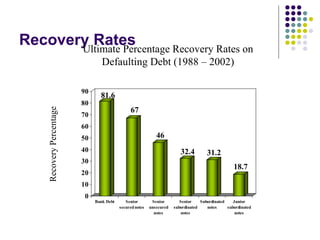
Recovery Rates Ultimate Percentage Recovery Rates on Defaulting Debt (1988 – 2002) Recovery Percentage
Bond Terminology Sinking fund - a fund established to retired debt before maturity Callable bond - a bond that may be repurchased by a the firm before maturity at a specified call price Defeasance - a method of retiring corporate debt involving the creation of a trust funded with treasury bonds
Bond Terminology Restrictive covenants  - Limitations set by bondholders on the actions of the Corporation Negative Pledge Clause - the processing of giving unsecured debentures equal protection and when assets are mortgaged Poison Put - a clause that obliges the borrower to repay the bond if a large quantity of stock is bought by single investor, which causes the firms bonds to beat down rated
Bond Terminology Pay in kind (PIK) - a bond that makes regular interest payments, but in the early years of the bonds life the issuer can choose to pay interest in the form of either cash or more bonds with an equivalent face value Puttable bond – A provision that allows the bondholder to demand immediate payment. This is the central feature in loan guarantees issued by the government.
Covenants Debt ratios: Senior debt limits senior borrowing Junior debt limits senior & junior borrowing Security: Negative pledge Dividends Event risk Positive covenants: Working capital Net worth
Event Risk: An Example October 1993 Marriott spun off its hotel management business worth 80% of its value. Before the spin-off, Marriott’s long-term book debt ratio was 2891/3644 = 79%.  Almost all the debt remained with the parent (renamed Host Marriott), whose debt ratio therefore rose to 93%. Marriott’s stock price rose 13.8% and its bond prices declined by up to 30%. Bondholders sued and Marriott modified its spin-off plan.
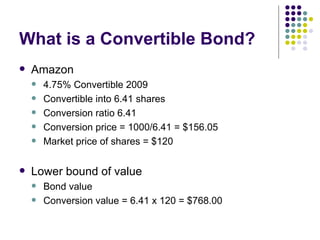
What is a Convertible Bond? Amazon 4.75% Convertible 2009 Convertible into 6.41 shares Conversion ratio 6.41 Conversion price = 1000/6.41 = $156.05 Market price of shares = $120 Lower bound of value  Bond value  Conversion value = 6.41 x 120 = $768.00
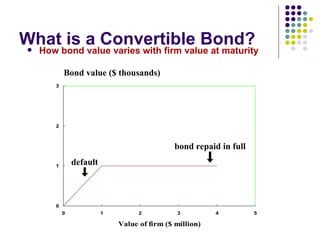
What is a Convertible Bond? How bond value varies with firm value at maturity default bond repaid in full Bond value ($ thousands)
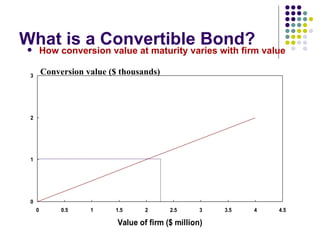
What is a Convertible Bond? How conversion value at maturity varies with firm value Conversion value ($ thousands)
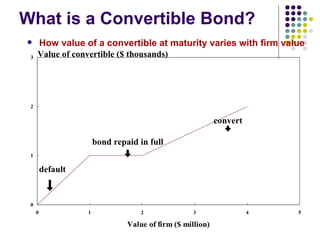
What is a Convertible Bond? How value of a convertible at maturity varies with firm value default bond repaid in full convert Value of convertible ($ thousands)
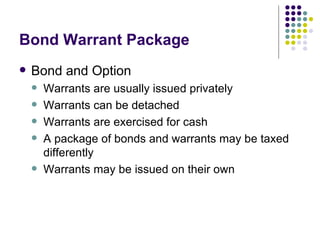
Bond Warrant Package Bond and Option Warrants are usually issued privately Warrants can be detached Warrants are exercised for cash A package of bonds and warrants may be taxed differently Warrants may be issued on their own
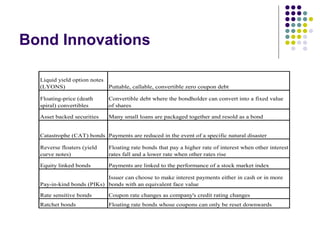
Bond Innovations
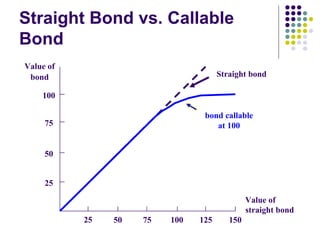
Straight Bond vs. Callable Bond Value of straight bond 25 50 75 100 125 150 25 50 75 100 bond Value of Straight bond bond callable at 100
Lease Terminology Lease – contractual agreement for use of an asset in return for a series of payments Lessee – user of an asset; makes payments Lessor – owner of the asset; receives payments Direct lease – lessor is the manufacturer Captive finance company – subsidiaries that lease products for the manufacturer
Types of Leases Operating lease Shorter-term lease Lessor is responsible for insurance, taxes and maintenance Often cancelable Financial lease (capital lease) Longer-term lease Lessee is responsible for insurance, taxes and maintenance Generally not cancelable Specific capital leases Tax-oriented Leveraged Sale and leaseback
Lease Accounting Leases are governed primarily by FASB 13 Financial leases are essentially treated as debt financing Present value of lease payments must be included on the balance sheet as a liability Same amount shown on the asset as the “capitalized value of leased assets” Operating leases are still “off-balance-sheet” and do not have any impact on the balance sheet itself
Criteria for a Capital Lease If one of the following criteria is met, then the lease is considered a capital lease and must be shown on the balance sheet Lease transfers ownership by the end of the lease term Lessee can purchase asset at below market price Lease term is for 75 percent or more of the life of the asset Present value of lease payments is at least 90 percent of the fair market value at the start of the lease
Taxes Lessee can deduct lease payments for income tax purposes Must be used for business purposes and not to avoid taxes Term of lease is less than 80 percent of the economic life of the asset Should not include an option to acquire the asset at the end of the lease at a below market price Lease payments should not start high and then drop dramatically Must survive a profits test – lessor should earn a fair return Renewal options must be reasonable and consider fair market value at the time of the renewal
Incremental Cash Flows Cash Flows from the Lessee’s point of view After-tax lease payment (outflow) Lease payment*(1 – T) Lost depreciation tax shield (outflow) Depreciation * tax rate for each year Initial cost of machine (inflow) Inflow because we save the cost of purchasing the asset now May have incremental maintenance, taxes or insurance
Example: Lease Cash Flows ABC, Inc. needs some new equipment. The equipment would cost $100,000 if purchased and would be depreciated straight-line over 5 years. No salvage is expected. Alternatively, the company can lease the equipment for $25,000 per year. The marginal tax rate is 40%. What are the incremental cash flows? After-tax lease payment = 25,000(1 - .4) = 15,000 (outflow years 1 - 5) Lost depreciation tax shield = (100,000/5)*.4 = 8,000 (outflow years 1 – 5) Cost of machine = 100,000 (inflow year 0)
Lease or Buy? The company needs to determine whether it is better off borrowing the money and buying the asset or leasing Compute the NPV of the incremental cash flows Appropriate discount rate is the after-tax cost of debt since a lease is essentially the same risk as a company’s debt
Net Advantage to Leasing The net advantage to leasing (NAL) is the same thing as the NPV of the incremental cash flows If NAL > 0, the firm should lease If NAL < 0, the firm should buy Consider the previous example. Assume the firm’s cost of debt is 10%. After-tax cost of debt = 10(1 - .4) = 6% NAL = 3,116 Should the firm buy or lease?
Example Do the calculations for a $30,000 car, 5-year loan at 7% with monthly payments and a $3000 down payment. The available lease is for 3 years and requires a $550 per month payment with a $1000 security deposit and $1000 other upfront costs.
Good Reasons for Leasing Taxes may be reduced May reduce some uncertainty May have lower transaction costs May require fewer restrictive covenants May encumber fewer assets than secured borrowing
Dubious Reasons for Leasing Balance sheet, especially leverage ratios, may look better if the lease does not have to be accounted for on the balance sheet 100% financing – except that leases normally do require either a down-payment or security deposit Low cost – some may try to compare the “implied” rate of interest to other market rates, but this is not directly comparable
Quick Quiz What is the difference between a lessee and a lessor? What is the difference between an operating lease and a capital lease? What are the requirements for a lease to be tax deductible? What are typical incremental cash flows and how do you determine the net advantage to leasing? What are some good reasons for leasing? What are some dubious reasons for leasing?

Topic 7 Business Borrowing And Leasing

  • 1.
  • 2.
    Outline Domestic Bonds,Foreign Bonds and Euro Bonds The Bond Contract Security and Seniority Repayment Provisions Debt Covenants Convertible Bonds and Warrants Innovation in the Bond Market
  • 3.
    Outline (cont.) Leasesand Lease Types Accounting and Leasing Taxes, the IRS and Leases The Cash Flows from Leasing Lease or Buy? A Leasing Paradox Reasons for Leasing
  • 4.
    Bond Terminology Foreignbonds - bonds that are sold to local investors in another country's bond market Yankee bond- a bond sold publicly by a foreign company in the United States Samurai - a bond sold by a foreign firm in Japan Eurobond market - when European and American multinationals are forced to tap into international markets for capital
  • 5.
    Bond Terminology Indentureor trust deed - the bond agreement between the borrower and a trust company Registered bond - a bond in which the Company's records show ownership and interest and principal are paid directly to each owner Bearer bonds - the bond holder must send in coupons to claim interest and must send a certificate to claim the final payment of principal Accrued interest - the amount of accumulated interest since the last coupon payment
  • 6.
    Bond Terminology Debentures- long-term unsecured issues on debt Mortgage bonds - long-term secured debt often containing a claim against a specific building or property Asset-backed securities - the sale of cash flows derived directly from a specific set of bundled assets
  • 7.
    Recovery Rates UltimatePercentage Recovery Rates on Defaulting Debt (1988 – 2002) Recovery Percentage
  • 8.
    Bond Terminology Sinkingfund - a fund established to retired debt before maturity Callable bond - a bond that may be repurchased by a the firm before maturity at a specified call price Defeasance - a method of retiring corporate debt involving the creation of a trust funded with treasury bonds
  • 9.
    Bond Terminology Restrictivecovenants - Limitations set by bondholders on the actions of the Corporation Negative Pledge Clause - the processing of giving unsecured debentures equal protection and when assets are mortgaged Poison Put - a clause that obliges the borrower to repay the bond if a large quantity of stock is bought by single investor, which causes the firms bonds to beat down rated
  • 10.
    Bond Terminology Payin kind (PIK) - a bond that makes regular interest payments, but in the early years of the bonds life the issuer can choose to pay interest in the form of either cash or more bonds with an equivalent face value Puttable bond – A provision that allows the bondholder to demand immediate payment. This is the central feature in loan guarantees issued by the government.
  • 11.
    Covenants Debt ratios:Senior debt limits senior borrowing Junior debt limits senior & junior borrowing Security: Negative pledge Dividends Event risk Positive covenants: Working capital Net worth
  • 12.
    Event Risk: AnExample October 1993 Marriott spun off its hotel management business worth 80% of its value. Before the spin-off, Marriott’s long-term book debt ratio was 2891/3644 = 79%. Almost all the debt remained with the parent (renamed Host Marriott), whose debt ratio therefore rose to 93%. Marriott’s stock price rose 13.8% and its bond prices declined by up to 30%. Bondholders sued and Marriott modified its spin-off plan.
  • 13.
    What is aConvertible Bond? Amazon 4.75% Convertible 2009 Convertible into 6.41 shares Conversion ratio 6.41 Conversion price = 1000/6.41 = $156.05 Market price of shares = $120 Lower bound of value Bond value Conversion value = 6.41 x 120 = $768.00
  • 14.
    What is aConvertible Bond? How bond value varies with firm value at maturity default bond repaid in full Bond value ($ thousands)
  • 15.
    What is aConvertible Bond? How conversion value at maturity varies with firm value Conversion value ($ thousands)
  • 16.
    What is aConvertible Bond? How value of a convertible at maturity varies with firm value default bond repaid in full convert Value of convertible ($ thousands)
  • 17.
    Bond Warrant PackageBond and Option Warrants are usually issued privately Warrants can be detached Warrants are exercised for cash A package of bonds and warrants may be taxed differently Warrants may be issued on their own
  • 18.
  • 19.
    Straight Bond vs.Callable Bond Value of straight bond 25 50 75 100 125 150 25 50 75 100 bond Value of Straight bond bond callable at 100
  • 20.
    Lease Terminology Lease– contractual agreement for use of an asset in return for a series of payments Lessee – user of an asset; makes payments Lessor – owner of the asset; receives payments Direct lease – lessor is the manufacturer Captive finance company – subsidiaries that lease products for the manufacturer
  • 21.
    Types of LeasesOperating lease Shorter-term lease Lessor is responsible for insurance, taxes and maintenance Often cancelable Financial lease (capital lease) Longer-term lease Lessee is responsible for insurance, taxes and maintenance Generally not cancelable Specific capital leases Tax-oriented Leveraged Sale and leaseback
  • 22.
    Lease Accounting Leasesare governed primarily by FASB 13 Financial leases are essentially treated as debt financing Present value of lease payments must be included on the balance sheet as a liability Same amount shown on the asset as the “capitalized value of leased assets” Operating leases are still “off-balance-sheet” and do not have any impact on the balance sheet itself
  • 23.
    Criteria for aCapital Lease If one of the following criteria is met, then the lease is considered a capital lease and must be shown on the balance sheet Lease transfers ownership by the end of the lease term Lessee can purchase asset at below market price Lease term is for 75 percent or more of the life of the asset Present value of lease payments is at least 90 percent of the fair market value at the start of the lease
  • 24.
    Taxes Lessee candeduct lease payments for income tax purposes Must be used for business purposes and not to avoid taxes Term of lease is less than 80 percent of the economic life of the asset Should not include an option to acquire the asset at the end of the lease at a below market price Lease payments should not start high and then drop dramatically Must survive a profits test – lessor should earn a fair return Renewal options must be reasonable and consider fair market value at the time of the renewal
  • 25.
    Incremental Cash FlowsCash Flows from the Lessee’s point of view After-tax lease payment (outflow) Lease payment*(1 – T) Lost depreciation tax shield (outflow) Depreciation * tax rate for each year Initial cost of machine (inflow) Inflow because we save the cost of purchasing the asset now May have incremental maintenance, taxes or insurance
  • 26.
    Example: Lease CashFlows ABC, Inc. needs some new equipment. The equipment would cost $100,000 if purchased and would be depreciated straight-line over 5 years. No salvage is expected. Alternatively, the company can lease the equipment for $25,000 per year. The marginal tax rate is 40%. What are the incremental cash flows? After-tax lease payment = 25,000(1 - .4) = 15,000 (outflow years 1 - 5) Lost depreciation tax shield = (100,000/5)*.4 = 8,000 (outflow years 1 – 5) Cost of machine = 100,000 (inflow year 0)
  • 27.
    Lease or Buy?The company needs to determine whether it is better off borrowing the money and buying the asset or leasing Compute the NPV of the incremental cash flows Appropriate discount rate is the after-tax cost of debt since a lease is essentially the same risk as a company’s debt
  • 28.
    Net Advantage toLeasing The net advantage to leasing (NAL) is the same thing as the NPV of the incremental cash flows If NAL > 0, the firm should lease If NAL < 0, the firm should buy Consider the previous example. Assume the firm’s cost of debt is 10%. After-tax cost of debt = 10(1 - .4) = 6% NAL = 3,116 Should the firm buy or lease?
  • 29.
    Example Do thecalculations for a $30,000 car, 5-year loan at 7% with monthly payments and a $3000 down payment. The available lease is for 3 years and requires a $550 per month payment with a $1000 security deposit and $1000 other upfront costs.
  • 30.
    Good Reasons forLeasing Taxes may be reduced May reduce some uncertainty May have lower transaction costs May require fewer restrictive covenants May encumber fewer assets than secured borrowing
  • 31.
    Dubious Reasons forLeasing Balance sheet, especially leverage ratios, may look better if the lease does not have to be accounted for on the balance sheet 100% financing – except that leases normally do require either a down-payment or security deposit Low cost – some may try to compare the “implied” rate of interest to other market rates, but this is not directly comparable
  • 32.
    Quick Quiz Whatis the difference between a lessee and a lessor? What is the difference between an operating lease and a capital lease? What are the requirements for a lease to be tax deductible? What are typical incremental cash flows and how do you determine the net advantage to leasing? What are some good reasons for leasing? What are some dubious reasons for leasing?