Networking Systems
in Libraries
By David Ofili
@ the 2018 LRCN National Workshop on Electronic Resource Management Systems in
Libraries, held at the University of Nigeria, Nsukka, Enugu State
Wednesday, August 9
Introduction
When you think of a network, what comes to your mind?
Two things basically:
● Computer network
● Communication/Resource Sharing/Social Network
If those are your thoughts about networking,
you’re very much in order.
However, let us consider the keywords individually
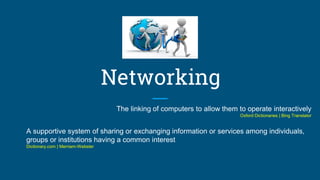
Networking
The linking of computers to allow them to operate interactively
Oxford Dictionaries | Bing Translator
A supportive system of sharing or exchanging information or services among individuals,
groups or institutions having a common interest
Dictionary.com | Merriam-Webster
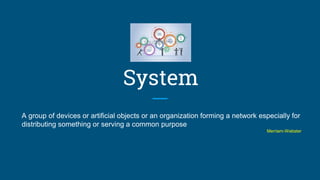
System
A group of devices or artificial objects or an organization forming a network especially for
distributing something or serving a common purpose
Merriam-Webster
Library
● A collection of sources of
information and similar
resources, made accessible to
a defined community for
reference or borrowing
Merriam-Webster
● However, in the context of our
training, we will look at a library
as an institution responsible
for the aboveSource: https://chroniclesofharriet.com/2014/10/02/reading-reduces-stress/
WHAT
THEN
is Library
NETWORKING?
Definition
When two or more libraries and/or other
organizations engage in a common pattern
of information exchange, through
communications, for some functional
purpose, a networking system is formed
National Commission on Libraries and Information Science (NCLIS),
USA
In other words, a network is formed when a
group of libraries and information centers
formally organize themselves following some
common pattern or design for information
exchange and communication with a view to
improve efficiency
Source: http://www.freestockphotos.biz/stockphoto/17341
Source: https://commons.wikimedia.org/wiki/File:Call_center_agent.jpg
Fundamentals of Library Networking
Basically
Library networking is
established when a library
makes a request to
another and it is honoured
Fundamentally
● Two libraries talk to each other
● A library provides service to
another
● Exchange in any form occurs
● One library trains staff of
another or are involved in a
collaborative capacity building
programme
● One library lends part of its
building to another for an event
Source:https://www.flickr.com/photos/usdagov/14195226791
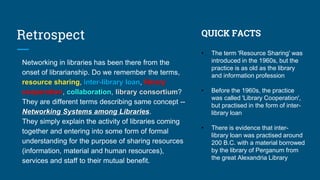
Retrospect
Networking in libraries has been there from the
onset of librarianship. Do we remember the terms,
resource sharing, inter-library loan, library
cooperation, collaboration, library consortium?
They are different terms describing same concept --
Networking Systems among Libraries.
They simply explain the activity of libraries coming
together and entering into some form of formal
understanding for the purpose of sharing resources
(information, material and human resources),
services and staff to their mutual benefit.
QUICK FACTS
• The term 'Resource Sharing' was
introduced in the 1960s, but the
practice is as old as the library
and information profession
• Before the 1960s, the practice
was called 'Library Cooperation',
but practised in the form of inter-
library loan
• There is evidence that inter-
library loan was practised around
200 B.C. with a material borrowed
by the library of Perganum from
the great Alexandria Library
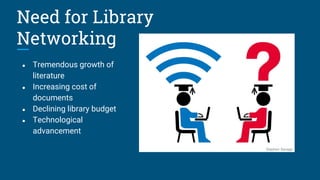
Need for Library
Networking
● Tremendous growth of
literature
● Increasing cost of
documents
● Declining library budget
● Technological
advancement
Stephen Savage
Aim
Basically, the aim of Library networking is optimum utilisation of available resources
in libraries through sharing, i.e. to achieve sharing of resources for the provision of
better services through exchange of data, information or other material/physical
resources.
https://commons.wikimedia.org/wiki/File:Harrows_Bristle_Board_Bullseye.JPG
Importance of Library Networking
1. To satisfy information
needs of users.
2. To increase the availability
and accessibility of
resources: clientele of each
participating library can
access the resources available
in all the other libraries.
Resources can be moved from
one library to another
manually or through modern
means. This provides an easy
access to and free flow of
information.
3. To diminish cost: resource sharing
helps in building specialized collection
and all participating libraries need not
duplicate the procurement of similar
materials.
4. To exploit resources: resource sharing
advocates that the reading material of
one library should be made available to
clients of other libraries, thus exposing
reading materials to a wider group of
users. Similarly, the services of a library
can be exploited by the users of other
libraries or a wider community.
5. To promote co-operative
activities like acquisition,
exchange, storage binding,
training, reference and
documentation services,
library loans, etc.
6. To eliminate record
duplication.
7. To promote the exchange
of information with other
co-operative networks.
Questions
PracticalDiscussion
● NgREN – Nigerian Research and
Education Network
● NULIB – Nigerian University
Libraries Consortium
● EBSCOhost
● JSTOR.org (Journal Storage)
● TEEAL (The Essential Electronic
Agricultural Library)
● LOAF (Library on a Flash)
● eGranary Digital Library
What they are | Membership/Subscription | Limitations | Other Challenges
?
References
● Ashikuzzaman, M. (2016, August 14). Library Networking. Retrieved from LIS
BD Network: http://www.lisbdnet.com/library-networking/
● Jha, P. K. (2001). Chapter 2: Library Networks. In P. K. Jha, Library Networks
and Network Based Information Services in India. New Delhi: India
National Scientific Documentation Center.
● Tandel, K. D. (2013). Chapter 4: Library Networking. In K. D. Tandel,
Development of cost effective network model for optimum utilisation of
resources in science and engineering college libraries in Gujarat a plan
(pp. 46-106). Gujarat: Sardar Patel University.

Networking Systems in Libraries

  • 1.
    Networking Systems in Libraries ByDavid Ofili @ the 2018 LRCN National Workshop on Electronic Resource Management Systems in Libraries, held at the University of Nigeria, Nsukka, Enugu State Wednesday, August 9
  • 2.
    Introduction When you thinkof a network, what comes to your mind? Two things basically: ● Computer network ● Communication/Resource Sharing/Social Network
  • 4.
    If those areyour thoughts about networking, you’re very much in order. However, let us consider the keywords individually
  • 5.
    Networking The linking ofcomputers to allow them to operate interactively Oxford Dictionaries | Bing Translator A supportive system of sharing or exchanging information or services among individuals, groups or institutions having a common interest Dictionary.com | Merriam-Webster
  • 6.
    System A group ofdevices or artificial objects or an organization forming a network especially for distributing something or serving a common purpose Merriam-Webster
  • 7.
    Library ● A collectionof sources of information and similar resources, made accessible to a defined community for reference or borrowing Merriam-Webster ● However, in the context of our training, we will look at a library as an institution responsible for the aboveSource: https://chroniclesofharriet.com/2014/10/02/reading-reduces-stress/
  • 8.
  • 9.
    Definition When two ormore libraries and/or other organizations engage in a common pattern of information exchange, through communications, for some functional purpose, a networking system is formed National Commission on Libraries and Information Science (NCLIS), USA In other words, a network is formed when a group of libraries and information centers formally organize themselves following some common pattern or design for information exchange and communication with a view to improve efficiency Source: http://www.freestockphotos.biz/stockphoto/17341 Source: https://commons.wikimedia.org/wiki/File:Call_center_agent.jpg
  • 10.
    Fundamentals of LibraryNetworking Basically Library networking is established when a library makes a request to another and it is honoured Fundamentally ● Two libraries talk to each other ● A library provides service to another ● Exchange in any form occurs ● One library trains staff of another or are involved in a collaborative capacity building programme ● One library lends part of its building to another for an event Source:https://www.flickr.com/photos/usdagov/14195226791
  • 11.
    Retrospect Networking in librarieshas been there from the onset of librarianship. Do we remember the terms, resource sharing, inter-library loan, library cooperation, collaboration, library consortium? They are different terms describing same concept -- Networking Systems among Libraries. They simply explain the activity of libraries coming together and entering into some form of formal understanding for the purpose of sharing resources (information, material and human resources), services and staff to their mutual benefit. QUICK FACTS • The term 'Resource Sharing' was introduced in the 1960s, but the practice is as old as the library and information profession • Before the 1960s, the practice was called 'Library Cooperation', but practised in the form of inter- library loan • There is evidence that inter- library loan was practised around 200 B.C. with a material borrowed by the library of Perganum from the great Alexandria Library
  • 12.
    Need for Library Networking ●Tremendous growth of literature ● Increasing cost of documents ● Declining library budget ● Technological advancement Stephen Savage
  • 13.
    Aim Basically, the aimof Library networking is optimum utilisation of available resources in libraries through sharing, i.e. to achieve sharing of resources for the provision of better services through exchange of data, information or other material/physical resources. https://commons.wikimedia.org/wiki/File:Harrows_Bristle_Board_Bullseye.JPG
  • 14.
    Importance of LibraryNetworking 1. To satisfy information needs of users. 2. To increase the availability and accessibility of resources: clientele of each participating library can access the resources available in all the other libraries. Resources can be moved from one library to another manually or through modern means. This provides an easy access to and free flow of information. 3. To diminish cost: resource sharing helps in building specialized collection and all participating libraries need not duplicate the procurement of similar materials. 4. To exploit resources: resource sharing advocates that the reading material of one library should be made available to clients of other libraries, thus exposing reading materials to a wider group of users. Similarly, the services of a library can be exploited by the users of other libraries or a wider community. 5. To promote co-operative activities like acquisition, exchange, storage binding, training, reference and documentation services, library loans, etc. 6. To eliminate record duplication. 7. To promote the exchange of information with other co-operative networks.
  • 15.
    Questions PracticalDiscussion ● NgREN –Nigerian Research and Education Network ● NULIB – Nigerian University Libraries Consortium ● EBSCOhost ● JSTOR.org (Journal Storage) ● TEEAL (The Essential Electronic Agricultural Library) ● LOAF (Library on a Flash) ● eGranary Digital Library What they are | Membership/Subscription | Limitations | Other Challenges ?
  • 16.
    References ● Ashikuzzaman, M.(2016, August 14). Library Networking. Retrieved from LIS BD Network: http://www.lisbdnet.com/library-networking/ ● Jha, P. K. (2001). Chapter 2: Library Networks. In P. K. Jha, Library Networks and Network Based Information Services in India. New Delhi: India National Scientific Documentation Center. ● Tandel, K. D. (2013). Chapter 4: Library Networking. In K. D. Tandel, Development of cost effective network model for optimum utilisation of resources in science and engineering college libraries in Gujarat a plan (pp. 46-106). Gujarat: Sardar Patel University.