






University of “Los Andes”“NucleoUniversitario Rafael Rangel”New Technologies in the classroom for English Teaching.Teacher: Dr. José R. PerníaAuthors:Zora RojasAndrés CómbitaThe Use of Blogs for English Teaching.
What is a blog?A blog is a type of website or part of a website. Blogs are usually maintained by an individual with regular entries of commentary, descriptions of events, or other material such as graphics or video. Entries are commonly displayed in reverse-chronological order.
Types of BlogsThere are many different types of blogs, differing not only in the type of content, but also in the way that content is delivered or written. Personal blogs
 Corporate and organizational blogs
By genre
By media typeHowtocreate a Blog?This is a very easy process; it’s the same thing than creating an account in any social network, once you get an account from a social network, then you lug into a website which you may create a blog and you start making yoursYou’ve got to follow the step acquired to create it. Then you select a type of blog, on that way you will have a specific thing to talk about and from there and on the roll on, you’ll develop different topics related to your blog.
Use of Blogs for English TeachingHow do we use a blog to teach English? There are lots of sites where you can set up a blog for free, but perhaps the best known and one of the most reliable and simple blogging tools to use with students is Blogger (http://blogger.com). It takes only fifteen minutes from setting up an account to publishing the first post using this valuable tool. The teacher sets up the tutor blog or a class blog. With a Class blog, students will need to be invited to participate by e-mail. Learner blog accounts can either be set up beforehand by the teacher, or done at the same time with a whole class in a computer room. The former gives the teacher more control of student accounts, but some advantages of the latter is that learners are given more choice (of username, design of the blog, etc) and a greater sense of 'ownership' of their new virtual writing space.
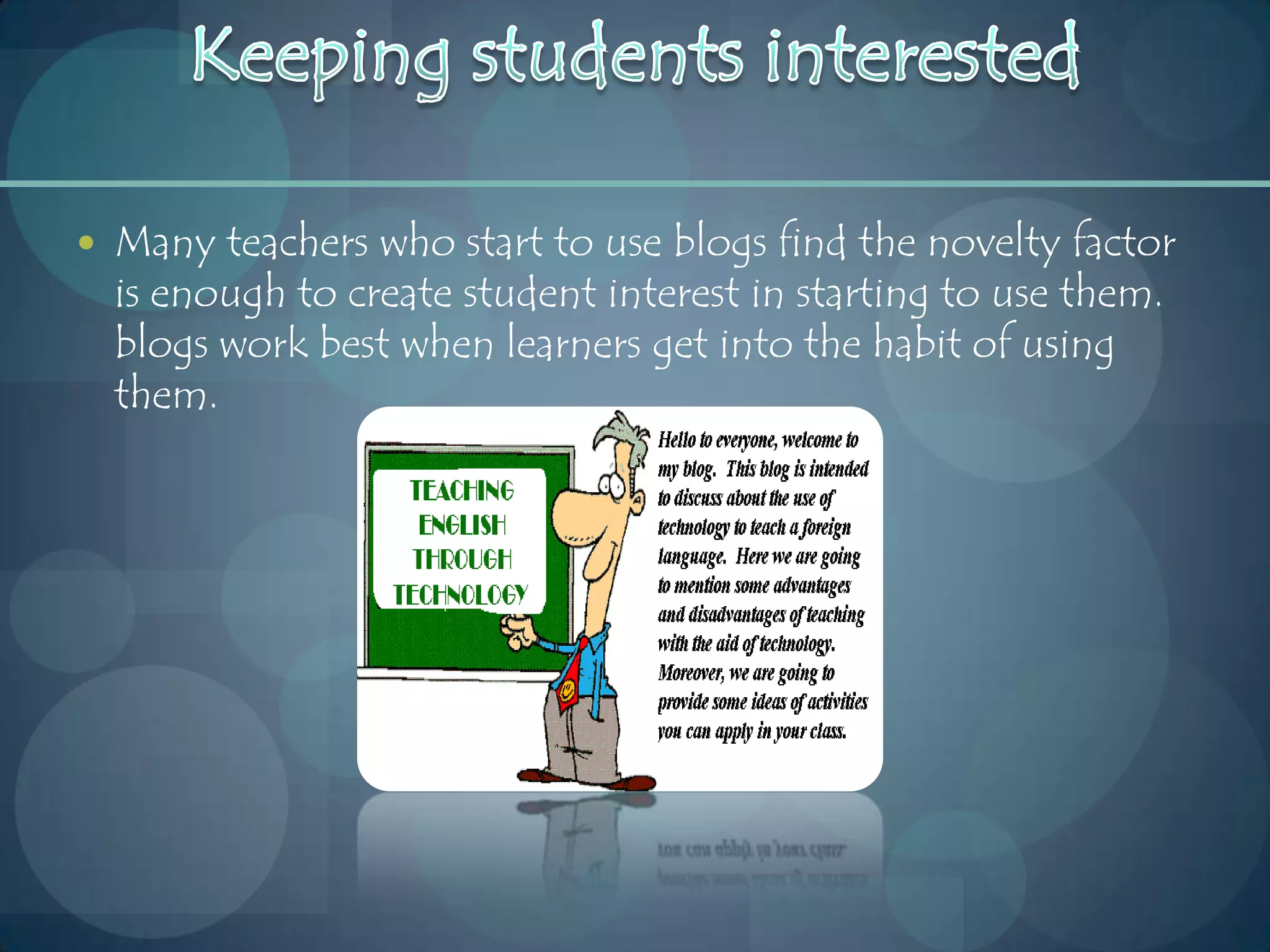
Keeping students interestedMany teachers who start to use blogs find the novelty factor is enough to create student interest in starting to use them. blogs work best when learners get into the habit of using them.
Tips for keeping your students commited. Respond to student posts quickly, writing a short comment related to the content. Ask questions about what the learner writes to create stimulus for writing.Students should be actively encouraged to read and respond (through the commenting feature of the blog) to their classmates.Writing to the blog could be required, and it may form part of the class assessment. Students should be encouraged to post their writing homework on the blog instead of only giving it to the teacher.
Why blog?So, why should you blog with your students? There are many reasons why you may choose to use weblogs with students. One of the best reasons is to provide a real audience for student writing. Usually, the teacher is the only person who reads student writing, and the focus of this reading is usually on form, not content. With weblogs, students can find themselves writing for a real audience that, apart from the teacher, may include their peers, students from other classes, or even other countries, their parents, and potentially anyone with access to the Internet.

The use of blogs for english teaching1

  • 1.
    University of “LosAndes”“NucleoUniversitario Rafael Rangel”New Technologies in the classroom for English Teaching.Teacher: Dr. José R. PerníaAuthors:Zora RojasAndrés CómbitaThe Use of Blogs for English Teaching.
  • 2.
    What is ablog?A blog is a type of website or part of a website. Blogs are usually maintained by an individual with regular entries of commentary, descriptions of events, or other material such as graphics or video. Entries are commonly displayed in reverse-chronological order.
  • 3.
    Types of BlogsThereare many different types of blogs, differing not only in the type of content, but also in the way that content is delivered or written. Personal blogs
  • 4.
    Corporate andorganizational blogs
  • 5.
  • 6.
    By media typeHowtocreatea Blog?This is a very easy process; it’s the same thing than creating an account in any social network, once you get an account from a social network, then you lug into a website which you may create a blog and you start making yoursYou’ve got to follow the step acquired to create it. Then you select a type of blog, on that way you will have a specific thing to talk about and from there and on the roll on, you’ll develop different topics related to your blog.
  • 7.
    Use of Blogsfor English TeachingHow do we use a blog to teach English? There are lots of sites where you can set up a blog for free, but perhaps the best known and one of the most reliable and simple blogging tools to use with students is Blogger (http://blogger.com). It takes only fifteen minutes from setting up an account to publishing the first post using this valuable tool. The teacher sets up the tutor blog or a class blog. With a Class blog, students will need to be invited to participate by e-mail. Learner blog accounts can either be set up beforehand by the teacher, or done at the same time with a whole class in a computer room. The former gives the teacher more control of student accounts, but some advantages of the latter is that learners are given more choice (of username, design of the blog, etc) and a greater sense of 'ownership' of their new virtual writing space.
  • 8.
    Keeping students interestedManyteachers who start to use blogs find the novelty factor is enough to create student interest in starting to use them. blogs work best when learners get into the habit of using them.
  • 9.
    Tips for keepingyour students commited. Respond to student posts quickly, writing a short comment related to the content. Ask questions about what the learner writes to create stimulus for writing.Students should be actively encouraged to read and respond (through the commenting feature of the blog) to their classmates.Writing to the blog could be required, and it may form part of the class assessment. Students should be encouraged to post their writing homework on the blog instead of only giving it to the teacher.
  • 10.
    Why blog?So, whyshould you blog with your students? There are many reasons why you may choose to use weblogs with students. One of the best reasons is to provide a real audience for student writing. Usually, the teacher is the only person who reads student writing, and the focus of this reading is usually on form, not content. With weblogs, students can find themselves writing for a real audience that, apart from the teacher, may include their peers, students from other classes, or even other countries, their parents, and potentially anyone with access to the Internet.
  • 11.
    Some Blogs inEducation you can visit:Blog - Wikipedia, la enciclopedia libreWikipedia http://miblogeducativo.wordpress.com/Mi Blog Educativo @ Inglés  http://ducacioningles.blogspot.com/2007/11/presentacin-del-blog.htmlEducación inglés http://maggiecastro.blogspot.com/ Recursos Educativos para el Aula http://eduticpampa.wordpress.com/tag/idioma-ingles-blog-profesor/Educación y TIC con mirada pampeana http://www.educacontic.es/Educ@contic
  • 12.