






The Blogging Phenomenon Its impact on Language Learning
overview What is a  blog Blogging  in learning : its roles Why  blogging ? Blogs  vs. Discussion Boards Using  blogs  in the classroom Types of  blogs Features Tips Planning your  blog Blogging  software
What is a  blog ...? A blog (a  portmanteau  made by  contracting  the phrase "web log") is a  website  in which items are posted on a regular basis and displayed in reverse chronological order. Like other  media , blogs often focus on a particular subject, such as food, politics, or local news. Some blogs function as  online  diaries . A typical blog combines text,  images , and links to other blogs, web pages, and other media related to its topic. Since its appearance in 1995, blogging has emerged as a popular means of communication, affecting public opinion and mass media around the world .
Weblogs can be seen as.... ways to improve our own writing just in time learning arenas places to share easy ways to create websites quickly ways to connect with others and make connections to learning perfect spots for quick writes places to visit daily, which provide elements of surprise places to collaborate
Why blogging...? we can place lessons, assignments, and announcements online. expand students’ access to relevant materials by incorporating links  enhance class interaction through online discussions and chats facilitate idea sharing motivate and prepare students for class maintain communication with absent students challenge students by placing quizzes and tests online get parents more involved by giving them access to their children’s assignments
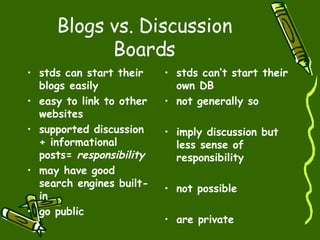
Blogs vs. Discussion Boards stds can start their blogs easily easy to link to other websites supported discussion + informational posts=  responsibility may have good search engines built-in go public stds can’t start their own DB not generally so imply discussion but less sense of responsibility not possible are private
advantages of using blogs They allow instant publishing to the Internet  They cost little or nothing They provide a comment feature that allows  interaction from others  They are  dynamic  and focus on content from the participants - listening, talking, collaborating, having a dialog, sharing They work for any subject They are empowering - they give everyone a voice  They make writing THE focus - send the message that writing matters  They promote ownership of work  They allow us to learn from our students They allow us to reflect on our teaching and our student’s learning They allow the interchange of thoughts and ideas  They are exciting - seeing others comment on your thoughts/anticipating comments and replies
Types of weblogs for use in EFL classrooms   The Tutor Blog The Learner Blog The Class Blog
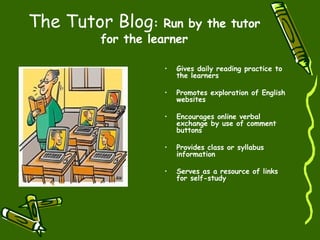
The Tutor Blog : Run by the tutor for the learner Gives daily reading practice to the learners Promotes exploration of English websites Encourages online verbal exchange by use of comment buttons Provides class or syllabus information Serves as a resource of links for self-study
The Learner Blog Individual/ in groups Best suited for reading and writing classes: Virtual composition books Searching the web for sites to link, on the topic. Individual journals: track progress Inspire self reflection Mega-blogs can be run by tutors
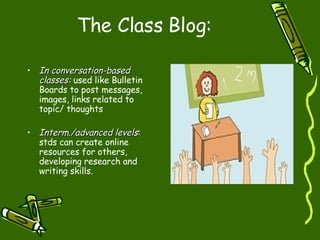
The Class Blog : In conversation-based classes :  used like Bulletin Boards to post messages, images, links related to topic/ thoughts  Interm./advanced levels : stds can create online resources for others, developing research and writing skills.
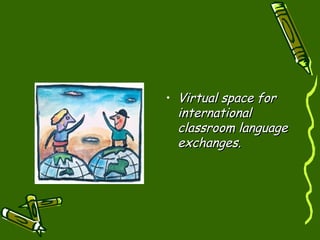
Virtual space for international classroom language exchanges.
Teachers could develop a classroom blog to.......... post short current events/ articles to invite students thoughts, reactions, and possible solutions  create a literature circle  post photos and ask students to create captions foster book discussions in the form of an online book club  encourage student writing to demonstrate learning  direct students to curriculum web sites and have them read and make responses  communicate with another classroom  stimulate entries about their learning and how this learning is relevant for them
invite one student a day to post a summary and reflections on the day's learning  observe the growth of plants or animals or keep records of science experiments  spot and record student kindnesses or good deeds  develop new vocabulary: students create sentences/ a brief paragraph using new vocabulary  enable students to post their ideas for the classroom/ school  let student write short reviews of books they are enjoying reading post quotes and have students write their interpretation and apply it to something in their life
Teachers could create an informational class blog to ...... post a daily/weekly synopsis of the curriculum taught  publish homework assignments   give a birdseye view of the class for parents  honour and celebrate class achievements  list class-related information such as calendars, events. show examples of good students’ work and the teacher's response to it  provide a day-by-day description of a specific teaching unit  take a moment out of the classroom day to share with family and friends
Teachers could create a reflective, journal type blog to..........   share ideas for teaching activities to use in the classroom  share classroom technology management techniques  make reflections on each teaching day  explore important teaching and learning issues  provide tips for beginning teachers  spot gems of wisdom from the students in their classroom on any number of ideas  produce how-to's on using specific technology programs in the curriculum  keep a record of a new teaching project with what worked and what didn't
You can have your students create their own weblogs to..........   complete class writing assignments  create an ongoing portfolio of samples of their writing  express their opinions on topics you are studying in class  write comments, opinions, or questions on daily news items or issues of interest  discuss activities they did in class and tell what they think about them  write about class curriculum topics, newly-learned vocabulary words and idioms  showcase their best writing pieces 
You can also ask your class to create a shared weblog to... complete project work in small groups, assigning each group a different task  showcase products of project-based learning  complete a webquest
Features Comment feature Archiving entries Linking Permalink Blogrolls RSS feeds Photos/images Audio/video Moblogging Ipodding
Tips Keep it simple at first Nothing “right” or “wrong” Use your creativeness to motivate stds Don’t linger on every posting Post regularly Commnet on your fellow classmates’ commnets When  quoting sources, give them credit Write sth about yourself Choose your links
Planning your blog What purpose will it serve? What name will you give it? What content will it include? How will you organize it? Type of info? Students’ postings? What audience will it address?
Weblog software without commercial advertising: http://pitas.com/ http://diaryland.com/ http://www.upsaid.com/ http://webcrimson.com/ http:// www.schoolblogs.com / commercial software http://www.blogger.com/
Sample Blogs   Michael Coghlan’s http://mikecogh.blogspot.com/2005/07/greetings-to-those-at-rosario-efl.html Teresa Almeida d’Eça’s http ://www.malhatlantica.pt/teresadeca/school/fwe5-feb05.htm Ishbel Galloway http://www.sfu.ca/~igallowa/blogging/ Diaryland http://diaryland.com/ Sus Nyrup’s http://mysteryguest.blogspot.com/ ESL + EFL  friendly   blogs   with   comments   http://www.eslgo.net/ Findory http://www.findory.com/ Dafne Gonzalez’s Student Vanessa’s http://vanessamartini.blogspot.com/ vBlog Central http://www.vblogcentral.com/ A Life in Wales http://alifeinwales.typepad.com/a_life_in_wales/ Red is an Apple http://www.schoolblogs.com/Val/ Our Class 2005 http://ourenglishclass2.blogspot.com/ CAE 2005 (my students’) http://cae2005.blogspot.com/ CALL SIG Rosario http://callsigrosario.blogspot.com/

Blogging

  • 1.
    The Blogging PhenomenonIts impact on Language Learning
  • 2.
    overview What isa blog Blogging in learning : its roles Why blogging ? Blogs vs. Discussion Boards Using blogs in the classroom Types of blogs Features Tips Planning your blog Blogging software
  • 3.
    What is a blog ...? A blog (a portmanteau made by contracting the phrase "web log") is a website in which items are posted on a regular basis and displayed in reverse chronological order. Like other media , blogs often focus on a particular subject, such as food, politics, or local news. Some blogs function as online diaries . A typical blog combines text, images , and links to other blogs, web pages, and other media related to its topic. Since its appearance in 1995, blogging has emerged as a popular means of communication, affecting public opinion and mass media around the world .
  • 4.
    Weblogs can beseen as.... ways to improve our own writing just in time learning arenas places to share easy ways to create websites quickly ways to connect with others and make connections to learning perfect spots for quick writes places to visit daily, which provide elements of surprise places to collaborate
  • 5.
    Why blogging...? wecan place lessons, assignments, and announcements online. expand students’ access to relevant materials by incorporating links enhance class interaction through online discussions and chats facilitate idea sharing motivate and prepare students for class maintain communication with absent students challenge students by placing quizzes and tests online get parents more involved by giving them access to their children’s assignments
  • 6.
    Blogs vs. DiscussionBoards stds can start their blogs easily easy to link to other websites supported discussion + informational posts= responsibility may have good search engines built-in go public stds can’t start their own DB not generally so imply discussion but less sense of responsibility not possible are private
  • 7.
    advantages of usingblogs They allow instant publishing to the Internet They cost little or nothing They provide a comment feature that allows interaction from others They are dynamic and focus on content from the participants - listening, talking, collaborating, having a dialog, sharing They work for any subject They are empowering - they give everyone a voice They make writing THE focus - send the message that writing matters They promote ownership of work They allow us to learn from our students They allow us to reflect on our teaching and our student’s learning They allow the interchange of thoughts and ideas They are exciting - seeing others comment on your thoughts/anticipating comments and replies
  • 8.
    Types of weblogsfor use in EFL classrooms The Tutor Blog The Learner Blog The Class Blog
  • 9.
    The Tutor Blog: Run by the tutor for the learner Gives daily reading practice to the learners Promotes exploration of English websites Encourages online verbal exchange by use of comment buttons Provides class or syllabus information Serves as a resource of links for self-study
  • 10.
    The Learner BlogIndividual/ in groups Best suited for reading and writing classes: Virtual composition books Searching the web for sites to link, on the topic. Individual journals: track progress Inspire self reflection Mega-blogs can be run by tutors
  • 11.
    The Class Blog: In conversation-based classes : used like Bulletin Boards to post messages, images, links related to topic/ thoughts Interm./advanced levels : stds can create online resources for others, developing research and writing skills.
  • 12.
    Virtual space forinternational classroom language exchanges.
  • 13.
    Teachers could developa classroom blog to.......... post short current events/ articles to invite students thoughts, reactions, and possible solutions create a literature circle post photos and ask students to create captions foster book discussions in the form of an online book club encourage student writing to demonstrate learning direct students to curriculum web sites and have them read and make responses communicate with another classroom stimulate entries about their learning and how this learning is relevant for them
  • 14.
    invite one studenta day to post a summary and reflections on the day's learning observe the growth of plants or animals or keep records of science experiments spot and record student kindnesses or good deeds develop new vocabulary: students create sentences/ a brief paragraph using new vocabulary enable students to post their ideas for the classroom/ school let student write short reviews of books they are enjoying reading post quotes and have students write their interpretation and apply it to something in their life
  • 15.
    Teachers could createan informational class blog to ...... post a daily/weekly synopsis of the curriculum taught publish homework assignments  give a birdseye view of the class for parents honour and celebrate class achievements list class-related information such as calendars, events. show examples of good students’ work and the teacher's response to it provide a day-by-day description of a specific teaching unit take a moment out of the classroom day to share with family and friends
  • 16.
    Teachers could createa reflective, journal type blog to.......... share ideas for teaching activities to use in the classroom share classroom technology management techniques make reflections on each teaching day explore important teaching and learning issues provide tips for beginning teachers spot gems of wisdom from the students in their classroom on any number of ideas produce how-to's on using specific technology programs in the curriculum keep a record of a new teaching project with what worked and what didn't
  • 17.
    You can haveyour students create their own weblogs to.......... complete class writing assignments create an ongoing portfolio of samples of their writing express their opinions on topics you are studying in class write comments, opinions, or questions on daily news items or issues of interest discuss activities they did in class and tell what they think about them write about class curriculum topics, newly-learned vocabulary words and idioms showcase their best writing pieces 
  • 18.
    You can alsoask your class to create a shared weblog to... complete project work in small groups, assigning each group a different task showcase products of project-based learning complete a webquest
  • 19.
    Features Comment featureArchiving entries Linking Permalink Blogrolls RSS feeds Photos/images Audio/video Moblogging Ipodding
  • 20.
    Tips Keep itsimple at first Nothing “right” or “wrong” Use your creativeness to motivate stds Don’t linger on every posting Post regularly Commnet on your fellow classmates’ commnets When quoting sources, give them credit Write sth about yourself Choose your links
  • 21.
    Planning your blogWhat purpose will it serve? What name will you give it? What content will it include? How will you organize it? Type of info? Students’ postings? What audience will it address?
  • 22.
    Weblog software withoutcommercial advertising: http://pitas.com/ http://diaryland.com/ http://www.upsaid.com/ http://webcrimson.com/ http:// www.schoolblogs.com / commercial software http://www.blogger.com/
  • 23.
    Sample Blogs Michael Coghlan’s http://mikecogh.blogspot.com/2005/07/greetings-to-those-at-rosario-efl.html Teresa Almeida d’Eça’s http ://www.malhatlantica.pt/teresadeca/school/fwe5-feb05.htm Ishbel Galloway http://www.sfu.ca/~igallowa/blogging/ Diaryland http://diaryland.com/ Sus Nyrup’s http://mysteryguest.blogspot.com/ ESL + EFL friendly blogs with comments http://www.eslgo.net/ Findory http://www.findory.com/ Dafne Gonzalez’s Student Vanessa’s http://vanessamartini.blogspot.com/ vBlog Central http://www.vblogcentral.com/ A Life in Wales http://alifeinwales.typepad.com/a_life_in_wales/ Red is an Apple http://www.schoolblogs.com/Val/ Our Class 2005 http://ourenglishclass2.blogspot.com/ CAE 2005 (my students’) http://cae2005.blogspot.com/ CALL SIG Rosario http://callsigrosario.blogspot.com/