CHAPTER 16
270
Stage 5: students re-write the text from Sour Sweet as if Chen really approves of his wife s
appearance,
Stage 6: students write physical descriptions of well-known figures. The class has to guess
who they are writing about.
Stage 7: students listen to a dialogue about a police line-up before role-playing police
officers taking witness statements based on descriptions of people they have supposedly seen
committing a crime.
The sequence, which would, of course, be inappropriate in certain cultural contexts, provides
both study and activation (see page 67). More importantly, from the point of view of this
discussion, it involves the students in reading, writing, speaking and listening. As a result,
students have been able to practise a wide range of language abilities.
A5 Top-down and bottom-up
A frequent distinction is made between top-down and bottom-up processing. In metaphorical
terms, this is the difference between looking at a forest, or, instead, studying the individual
trees within it.
It has been said that in top-down processing, the reader (or listener) gets a general view 01
the reading or listening passage by, in some way, absorbing the overall picture. This is greatly
helped if their schemata allow them to have appropriate expectations of what they are going
to come across. In bottom-up processing, on the other hand, the reader or listener focuses on
such things as individual words, phrases or cohesive devices and achieves understanding by
stringing these detailed elements together to build up a whole.
It is probably most useful to see acts of reading and listening (as well as speaking ana
writing) as interactions between top-down and bottom-up processing. Sometimes it is the
individual details that help us understand (or put together) the whole; sometimes it is our
overview that allows us to process the details. Without a good understanding of a reasonable
proportion of the details gained or proposed through some bottom-up processing, we may
find it difficult to come to a clear general picture of what a text is about, or about how to put
together a coherent stretch of discourse. But without some global understanding of the topic
that is written or spoken about, even an understanding of the details may not be enough.
B Receptive skills
Although there are significant differences between readingand listening, as we shall see in Chapters
17 and 18, nevertheless the basic classroom procedure we often use is the same for both.
B1 A basic methodological model for teaching receptive skills
A typical procedure for getting students to read a written text or listen to a recording involves
both Type 1 and Type 2 tasks. Type 1 tasks are those where we get students to read or listen for
some general understanding, rather than asking them to pick out details or get involved in a
refined search of the text. Type 2 tasks, on the other hand, are those where we get students to
look at the text in considerably more detail, maybe for specific information or for language
points. Moving from the general to the specific by starting with Type 1 tasks and going on to
Type 2 tasks works because it allows students to get a feel for what they are seeing or hearing
before they have to attack the text in detail, which is the more difficult thing to do.
LANGUAGE SKILLS
The procedure for teaching receptive skills generally starts with a lead in. This is where
we engage students with the topic of the reading and we try to activate their schema (plural
schemata), a term which was best described by Guy Cook as 'our pre-existent knowledge of
the world1
(Cook 1989: 69). This is the knowledge that allows many British, Australian, West
Indian, Pakistani and Indian people (for example) to make sense of headlines like England in
six-wicket collapse (a reference to the game of cricket), whereas many Canadians would instantly
understand what it means to be sent to the penalty box and why being sent there might give
another team a power play (both terms come from ice hockey, Canada's national sport).
All of us, at whatever age, but especially from late childhood onwards, have this pre-existent
knowledge which we bring with us to all encounters with topics and events. The job of the
receptive skills teacher, therefore, is to provoke students to get in touch with that knowledge or
schema. They can then predict what a text is likely to be about, and what they are going to see
or hear. We can provoke this kind of prediction by giving them various clues, such as pictures,
headlines or book jacket descriptions. We can give them a few words or phrases from the
text and ask them to predict what these might indicate about its content. We can encourage
a general discussion of the topic or ask students to make their own questions for what they
are going to read about. Whatever alternative we choose, the point is that prediction is vitally
important if we want students to engage fully with the text.
Once students are ready to read, we set some kind of a comprehension task so that they
will read or listen in a general way - trying to extract a mostly general understanding of what,
superficially, the audio or written text is all about.
The students read or listen to the text and then the teacher directs feedback. Here we may
suggest that students go through the answers in pairs or small groups. This is partly so that
they get more opportunities to work together, and partly so that when we go through the
answers with the class, individual students do not get exposed as having failed in a task.
Sometimes the teacher directs a text-related task immediately this Type 1 task has been
completed. A text-related task is any kind of follow-up activity and might be either a response
to the content of the text or a focus on aspects of language in the text. However, we will
usually get the students to look at the text again for a Type 2 task in which they are required to
examine it in more detail. The comprehension cycle is repeated and then the teacher involves
the students in text-related tasks (of course, it is possible that students might be involved in
more than one Type 2 task cycle).
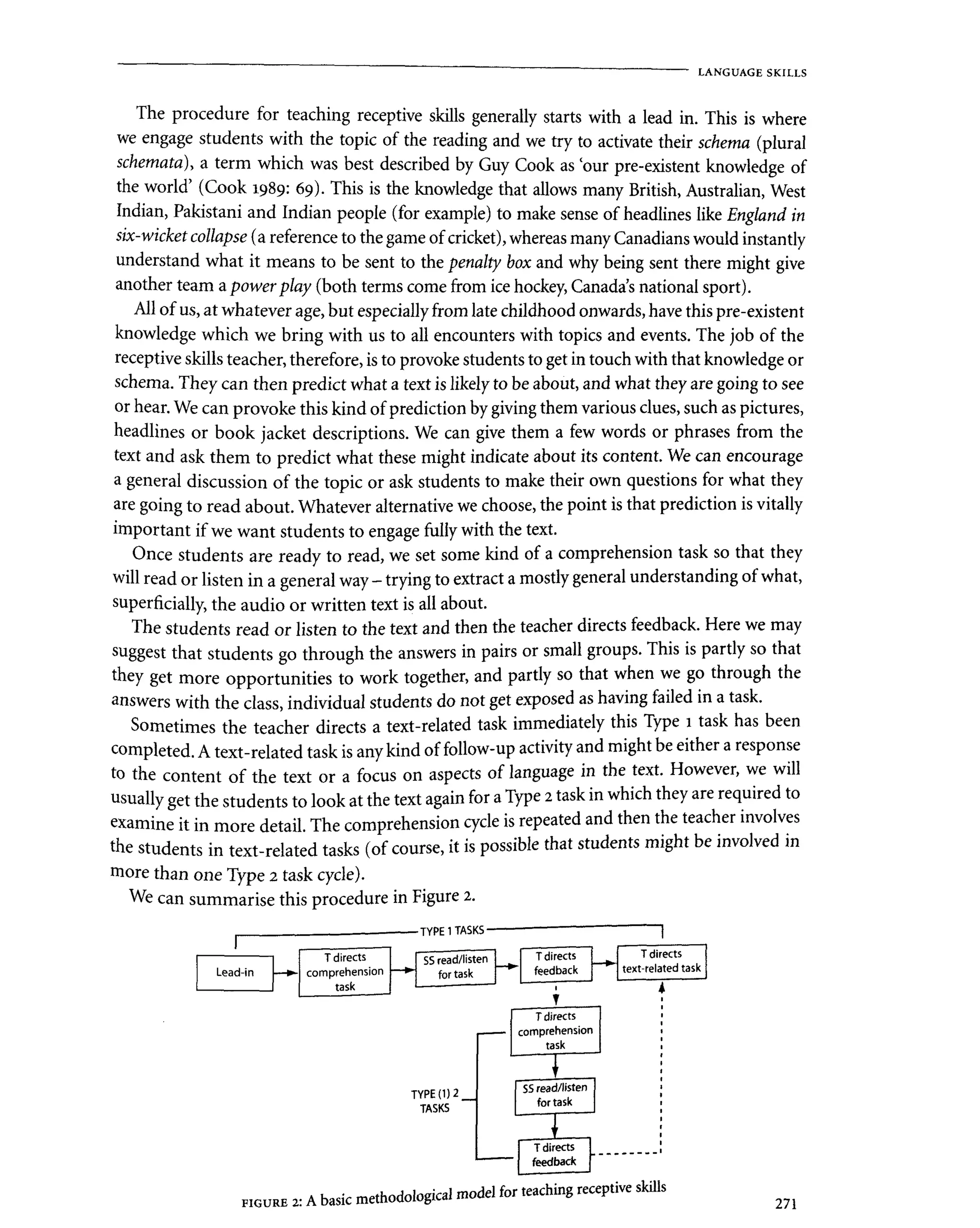
We can summarise this procedure in Figure 2.
1 -
Lead-in
T directs
comprehension
1 task
-TYPE 1 TASKS -
SS read/listen
for task
T directs
feedback
1
1 • 1
T directs
text-related task
i
t
TYPE (1) 2 __
TASKS
1 r i J i w
T
Tdirects
comprehension
task
*
SS read/listen
for task
1
1 T directs
feedback
F I G U HB , A basic methodological model for teaching receptive skills
271
CHAPTER 16 ~~
B2 The language issue
What is it that makes a text difficult? In the case of written text, some researchers look at word
and sentence length (Wallace 1992:77) on the premise that texts with longer sentences and longer
words will be more difficult to understand than those with shorter ones. Others, however, claim
that the critical issue is quite simply the number of unfamiliar words which a text contains.
If readers and listeners do not know half the words in a text, they will have great difficulty in
understanding the text as a whole. To be successful, they have to recognise a high proportion of
the vocabulary without consciously thinking about it (Paran 1996). Both sentence length and
the percentage of unknown words play their part in a text's comprehensibility.
When students who are engaged in listening encounter unknown lexis, it can be c
... like
a dropped barrier causing them to stop and think about the meaning of a word and thus
making them miss the next part of the speech' (Underwood 1989:17). Unlike reading, there
may be no opportunity to go back and listen to the lexis again. Comprehension is gradually
degraded, therefore, and unless the listeners are able to latch onto a new element to help them
back into the flow of what is being said, the danger is that they will lose heart and gradually
disengage from the receptive task since it is just too difficult.
If, as Stephen Krashen suggested, comprehensible input aids language acquisition (see
Chapter 3, Ai), then it follows that 'incomprehensible' input will not. We can try to get
students to read or listen to texts that are way beyond their comprehension level, but the only
effect this will probably have is to demotivate them.
It is obvious, however, that the more language we expose students to, the more they will
learn, so we need specific ways of addressing the problem of language difficulty. These
could include pre-teaching vocabulary, using extensive reading/listening, and considering
alternatives to authentic language.
• Pre-teachingvocabulary: one wayofhelping students is to pre-teach vocabularythat occurs
in the reading or listening text. This removes at least some of the barriers to understanding
which they are likely to encounter.
However, ifwe want to give students practice in what it is like to tackle authentic reading
and listening texts for general understanding, then getting past words they don't understand
is one of the skills they need to develop. By giving them some or all of those words, we deny
them that chance.
We need a common sense solution to this dilemma: where students are likelyto beheldback
unnecessarily because of three or four words, it makes sense to teach them first. Where they
should be able to comprehend the text despite some unknown words, we will explain to them
that they should try to understand the general meaning of the text, and that we will look at the
meaning of individual words once they have done their best to read in this general way.
One useful technique is to use some (possibly unknown) words from a reading or
listening text as part of our procedure to create interest and activate the students' schemata;
the words may suggest topic, genre or construction - or all three. The students can first
research the meanings of words and phrases and then predict what a text with such words
is likely to be about.
• Extensive reading and listening; most researchers like to make a difference between
extensive and intensive reading and listening. Whereas the former suggests reading or
272
LANGUAGE SKILLS
listening at length, often for pleasure and in a leisurely way intensive reading or listening
tends to be more concentrated, less relaxed, and often dedicated not so much to pleasure as
to the achievement of a study goal.
Extensive reading and listening frequently take place when students are on their own,
whereas intensive reading or listening is often done with the help and/or intervention of
the teacher.
Extensive reading - especially where students are reading material written specially
at their level - has a number of benefits for the development of a student's language (see
Chapter 17A). Colin Davis suggests that any classroom will be the poorer for the lack of
an extensive reading programme and will be'... unable to promote its pupils1
language
development in all aspects as effectively as if such a programme were present' (1995:335).
He also claims that such a programme will make students more positive about reading, will
improve their overall comprehension skills, and will give them a wider passive and active
vocabulary. Richard Day and Julian Bamford agree, citing as two of the many goals for
extensive reading 'enabling students to read without constantly stopping' and 'providing
an increased word recognition' (Day and Bamford 1998).
Whatthese commentators andothers are claimingis thatextensivereadingis thebestpossible
wayfor students to develop automaticity-that is the automatic recognition ofwordswhen they
see them. It is by far the best way to improve their English reading (and writing) overall.
The benefits of extensive reading are echoed bythe benefits for extensive listening: the more
students listen, the more language they acquire and the better they get at listening activities in
general. Whether they choose recordings of passagesfromtextbooks, recordings of simplified
readers, other listening material designed fortheirlevel or podcasts ofradio programmes which
theyare capable of following, the effect will be the same. Provided the input is comprehensible,
they will gradually acquire more words and greater schematic knowledge which will, in turn,
resolve many of the language difficulties they started out with.
Authenticity: because it is vital for students to get practice in dealing with written text and
speech where they miss quite a few words but are still able to extract the general meaning,
an argument can be made for using mainly authentic reading and listening texts in class.
After all, it is when students come into contact with 'real' language that they have to work
hardest to understand.
Authentic material is language where no concessions are made to foreign speakers. It is
normal, natural language used bynative or competent speakers of a language. This is what our
students encounter (orwill encounter) in real life iftheycome into contact with target-language
speakers, and, preciselybecause it is authentic, it is unlikely to be simplified or spoken slowly.
Authentic material which has been carelessly chosen can be extremely demotivating for
students since theywill not understand it. Instead ofencouraging failure, we should let students
read and listen to things they can understand. For beginners this may mean roughly-tuned
language from the teacher (see page 117), and specially designed reading and kstemng texts
from materials writers. However, itis essential that such listeningtexts approxunate to authentic
language use. The language may be simplified, but it must not be unnatural. As Ronald Carter
and his colleagues suggest, 'concocted, made-up language can be perfectly viable but it should
be modelled on naturalistic samples' (Carter etal 1998:86).
273
CHAPTER l 6
Authentic material can be used by students at fairly low levels, however, if the tasks that
go with it are well-designed and help students understand it better, rather than showing
them how little they know. A gently paced sequence of activities with small tasks leading to
bigger ones, for example, can enable students to watch television soap operas in English and
help them understand far more than they might have thought possible (Farrell 1998).
It is worth pointing out that deciding what is or is not authentic is not easy. A stage play
written for native speakers is a playwright's representation of spontaneous speech rather
than the real thing, so it is, in a sense, both authentic and inauthentic. A father talking to
his baby daughter may be employing 'baby talk' - rough-tuning the language so that it is
comprehensible - but there is nothing inauthentic about it. The language which students
are exposed to has just as strong a claim to authenticity as the play or the parent, provided
that it is not altered in such a way as to make it unrecognisable in style and construction
from the language which competent speakers encounter in many walks of life.
B3 Comprehension tasks
A key feature in the successful teaching of receptive skills concerns the choice of comprehension
tasks. Sometimes such tasks appear to be testing the students rather than helping them to
understand. But although reading and listening are perfectly proper mediums for language
and skill testing, nevertheless if we are trying to encourage students to improve their receptive
skills, testing them will not be an appropriate way of accomplishing this. Sometimes texts
and/or the tasks which accompany them are either far too easy or far too difficult.
In order to resolve these problems we need to use comprehension tasks which promote
understanding and we need to match text and task appropriately.
• Testing and teaching: the best kind of tasks are those which raise students5
expectations,
help them tease out meanings and provoke an examination of the reading or listening
passage. Unlike reading and listening tests, these tasks bring them to a greater understanding
of language and text construction. By having students perform activities such as looking up
information on the Internet, filling in forms on the basis of a recording or solving reading
puzzles, we are helping them become better readers and listeners.
Some tasks seem to fall halfway between testing and teaching, however, since, by
appearing to demand a right answer (e.g. Are these statements about the text true orfalse? or
questions abut the text with what, when, how many and how often), they could, in theory, be
used to assess student performance. Indeed, when they are done under test conditions, their
r _ . r „ _ „, ^..v^cu; LU ^A^iuic siuuem sirengtns and weaknesses. Yet sucn compreiiaww
items can also be an indispensable part of a teacher's receptive skills armoury. By the simple
expedient of having students work in pairs to agree on whether a statement about part of
a text is true or false, the comprehension items help each individual (through conversation
and comparison) to understand something, rather than challenging them to give right
answers under test-like conditions. If students are encouraged to try to predict the answers
to such questions before they read or listen, expectations are created in their minds which
help them focus their reading or listening (although we must be careful not to ask them
to try to predict things they have no chance of being able to guess). In both cases we have
turned a potential test task into a creative tool for receptive skill training.
Whatever the readina taclr =
a r+ Thrill ,4^«,™J j.r . T-* • l *_L ^4-,^^1^ntC afC
274
LANGUAGE SKILLS
asked to perform that task. Even the most formal test-like items can be used to help students
rather than frighten them!
• Appropriate challenge: when asking students to read and listen, we want to avoid texts and
tasks that are either far too easyor far too difficult. As with manyotherlanguage tasks, wewant
to get the level of challenge right, to make the tasks difficult but, nevertheless, achievable.
Getting the level right depends on the right match between text and task. Thus, where a text
is difficult, we maystillbe ableto use it,but onlyifthetaskis appropriate.We couldtheoretically,
for example,havebeginnerslisten tothe famousconversationbetween Opheliaand the prince in
Shakespeare's Hamlet ('Get thee to a nunnery...') and ask them how manypeople are speaking.
We could ask students to read a few pages of Ulysses byJames Joyce and ask them how many
full stops they can find. Despite the difficulty ofthe texts, both of these tasks are achievable. Yet
we might feel that neither is appropriate or useful. On the otiier hand, having students listen to
a news broadcast where the language level isverychallenging may be entirely appropriate ifthe
task only asks them - at first - to tryto identify thefivemain topics in the broadcast.
Productive skills
Although the productive skills of writing and speaking are different in many ways, we can still
provide a basic model for teaching and organising them.
A basic methodological model for teaching productive skills
A key factor in the success of productive-skill tasks is the way teachers organise them and how
they respond to the students' work. We will consider these in more detail in Chapters 19 and 20,
but we can, here, set down a basic methodological model for the teaching of productive skills.
In the lead-in stage, we engage students with the topic. Perhaps we ask them what they
know about a certain subject (e.g. we ask them what experience they have of tourism if we
are going to have a tourism debate - see Example 7 on page 358), or we might, if we are going
to role-play checking in at an airport, get them to think about the kind of conversation that
usually takes place when people check in.
When we set the task, we explain exactlywhat students are goingto do. At this stage we mayneed
to demonstrate the activity in some way. For example, ifwe want students to work in pairs, we can
show the class how the activityworks bybeing one of a public pair ourselves so that everyone sees
the procedure in action. We may get students to repeat the task instructions back to us (either in
English or in their Li, depending on which is appropriate). We will also make sure that students are
given all the information they need to complete the tasks (e.g. role cards, etc. for a role-play)
Once the students have started, we will monitor the task. This may mean going round the
class, listening to students working and helping them where they are having difficulties. With
writing tasks, we may become actively involved in the writing process as we respond to the
students'work and point them in new directions (see Chapter 19, B7).
When the activity has finished, we give taskfeedback. This is where we may hedp students to
see how well they have done. As we said in Chapter 8, C3 and D, we will respond to the content
of the task and not just to the language the students used. We will show positive aspects of
what they have achieved and not concentrate solely on their fadmgs. Finally, we may move on
from the task with a task-relatedfollow-up.
275

Teaching receptive skills.pdf

  • 1.
    CHAPTER 16 270 Stage 5:students re-write the text from Sour Sweet as if Chen really approves of his wife s appearance, Stage 6: students write physical descriptions of well-known figures. The class has to guess who they are writing about. Stage 7: students listen to a dialogue about a police line-up before role-playing police officers taking witness statements based on descriptions of people they have supposedly seen committing a crime. The sequence, which would, of course, be inappropriate in certain cultural contexts, provides both study and activation (see page 67). More importantly, from the point of view of this discussion, it involves the students in reading, writing, speaking and listening. As a result, students have been able to practise a wide range of language abilities. A5 Top-down and bottom-up A frequent distinction is made between top-down and bottom-up processing. In metaphorical terms, this is the difference between looking at a forest, or, instead, studying the individual trees within it. It has been said that in top-down processing, the reader (or listener) gets a general view 01 the reading or listening passage by, in some way, absorbing the overall picture. This is greatly helped if their schemata allow them to have appropriate expectations of what they are going to come across. In bottom-up processing, on the other hand, the reader or listener focuses on such things as individual words, phrases or cohesive devices and achieves understanding by stringing these detailed elements together to build up a whole. It is probably most useful to see acts of reading and listening (as well as speaking ana writing) as interactions between top-down and bottom-up processing. Sometimes it is the individual details that help us understand (or put together) the whole; sometimes it is our overview that allows us to process the details. Without a good understanding of a reasonable proportion of the details gained or proposed through some bottom-up processing, we may find it difficult to come to a clear general picture of what a text is about, or about how to put together a coherent stretch of discourse. But without some global understanding of the topic that is written or spoken about, even an understanding of the details may not be enough. B Receptive skills Although there are significant differences between readingand listening, as we shall see in Chapters 17 and 18, nevertheless the basic classroom procedure we often use is the same for both. B1 A basic methodological model for teaching receptive skills A typical procedure for getting students to read a written text or listen to a recording involves both Type 1 and Type 2 tasks. Type 1 tasks are those where we get students to read or listen for some general understanding, rather than asking them to pick out details or get involved in a refined search of the text. Type 2 tasks, on the other hand, are those where we get students to look at the text in considerably more detail, maybe for specific information or for language points. Moving from the general to the specific by starting with Type 1 tasks and going on to Type 2 tasks works because it allows students to get a feel for what they are seeing or hearing before they have to attack the text in detail, which is the more difficult thing to do.
  • 2.
    LANGUAGE SKILLS The procedurefor teaching receptive skills generally starts with a lead in. This is where we engage students with the topic of the reading and we try to activate their schema (plural schemata), a term which was best described by Guy Cook as 'our pre-existent knowledge of the world1 (Cook 1989: 69). This is the knowledge that allows many British, Australian, West Indian, Pakistani and Indian people (for example) to make sense of headlines like England in six-wicket collapse (a reference to the game of cricket), whereas many Canadians would instantly understand what it means to be sent to the penalty box and why being sent there might give another team a power play (both terms come from ice hockey, Canada's national sport). All of us, at whatever age, but especially from late childhood onwards, have this pre-existent knowledge which we bring with us to all encounters with topics and events. The job of the receptive skills teacher, therefore, is to provoke students to get in touch with that knowledge or schema. They can then predict what a text is likely to be about, and what they are going to see or hear. We can provoke this kind of prediction by giving them various clues, such as pictures, headlines or book jacket descriptions. We can give them a few words or phrases from the text and ask them to predict what these might indicate about its content. We can encourage a general discussion of the topic or ask students to make their own questions for what they are going to read about. Whatever alternative we choose, the point is that prediction is vitally important if we want students to engage fully with the text. Once students are ready to read, we set some kind of a comprehension task so that they will read or listen in a general way - trying to extract a mostly general understanding of what, superficially, the audio or written text is all about. The students read or listen to the text and then the teacher directs feedback. Here we may suggest that students go through the answers in pairs or small groups. This is partly so that they get more opportunities to work together, and partly so that when we go through the answers with the class, individual students do not get exposed as having failed in a task. Sometimes the teacher directs a text-related task immediately this Type 1 task has been completed. A text-related task is any kind of follow-up activity and might be either a response to the content of the text or a focus on aspects of language in the text. However, we will usually get the students to look at the text again for a Type 2 task in which they are required to examine it in more detail. The comprehension cycle is repeated and then the teacher involves the students in text-related tasks (of course, it is possible that students might be involved in more than one Type 2 task cycle). We can summarise this procedure in Figure 2. 1 - Lead-in T directs comprehension 1 task -TYPE 1 TASKS - SS read/listen for task T directs feedback 1 1 • 1 T directs text-related task i t TYPE (1) 2 __ TASKS 1 r i J i w T Tdirects comprehension task * SS read/listen for task 1 1 T directs feedback F I G U HB , A basic methodological model for teaching receptive skills 271
  • 3.
    CHAPTER 16 ~~ B2The language issue What is it that makes a text difficult? In the case of written text, some researchers look at word and sentence length (Wallace 1992:77) on the premise that texts with longer sentences and longer words will be more difficult to understand than those with shorter ones. Others, however, claim that the critical issue is quite simply the number of unfamiliar words which a text contains. If readers and listeners do not know half the words in a text, they will have great difficulty in understanding the text as a whole. To be successful, they have to recognise a high proportion of the vocabulary without consciously thinking about it (Paran 1996). Both sentence length and the percentage of unknown words play their part in a text's comprehensibility. When students who are engaged in listening encounter unknown lexis, it can be c ... like a dropped barrier causing them to stop and think about the meaning of a word and thus making them miss the next part of the speech' (Underwood 1989:17). Unlike reading, there may be no opportunity to go back and listen to the lexis again. Comprehension is gradually degraded, therefore, and unless the listeners are able to latch onto a new element to help them back into the flow of what is being said, the danger is that they will lose heart and gradually disengage from the receptive task since it is just too difficult. If, as Stephen Krashen suggested, comprehensible input aids language acquisition (see Chapter 3, Ai), then it follows that 'incomprehensible' input will not. We can try to get students to read or listen to texts that are way beyond their comprehension level, but the only effect this will probably have is to demotivate them. It is obvious, however, that the more language we expose students to, the more they will learn, so we need specific ways of addressing the problem of language difficulty. These could include pre-teaching vocabulary, using extensive reading/listening, and considering alternatives to authentic language. • Pre-teachingvocabulary: one wayofhelping students is to pre-teach vocabularythat occurs in the reading or listening text. This removes at least some of the barriers to understanding which they are likely to encounter. However, ifwe want to give students practice in what it is like to tackle authentic reading and listening texts for general understanding, then getting past words they don't understand is one of the skills they need to develop. By giving them some or all of those words, we deny them that chance. We need a common sense solution to this dilemma: where students are likelyto beheldback unnecessarily because of three or four words, it makes sense to teach them first. Where they should be able to comprehend the text despite some unknown words, we will explain to them that they should try to understand the general meaning of the text, and that we will look at the meaning of individual words once they have done their best to read in this general way. One useful technique is to use some (possibly unknown) words from a reading or listening text as part of our procedure to create interest and activate the students' schemata; the words may suggest topic, genre or construction - or all three. The students can first research the meanings of words and phrases and then predict what a text with such words is likely to be about. • Extensive reading and listening; most researchers like to make a difference between extensive and intensive reading and listening. Whereas the former suggests reading or 272
  • 4.
    LANGUAGE SKILLS listening atlength, often for pleasure and in a leisurely way intensive reading or listening tends to be more concentrated, less relaxed, and often dedicated not so much to pleasure as to the achievement of a study goal. Extensive reading and listening frequently take place when students are on their own, whereas intensive reading or listening is often done with the help and/or intervention of the teacher. Extensive reading - especially where students are reading material written specially at their level - has a number of benefits for the development of a student's language (see Chapter 17A). Colin Davis suggests that any classroom will be the poorer for the lack of an extensive reading programme and will be'... unable to promote its pupils1 language development in all aspects as effectively as if such a programme were present' (1995:335). He also claims that such a programme will make students more positive about reading, will improve their overall comprehension skills, and will give them a wider passive and active vocabulary. Richard Day and Julian Bamford agree, citing as two of the many goals for extensive reading 'enabling students to read without constantly stopping' and 'providing an increased word recognition' (Day and Bamford 1998). Whatthese commentators andothers are claimingis thatextensivereadingis thebestpossible wayfor students to develop automaticity-that is the automatic recognition ofwordswhen they see them. It is by far the best way to improve their English reading (and writing) overall. The benefits of extensive reading are echoed bythe benefits for extensive listening: the more students listen, the more language they acquire and the better they get at listening activities in general. Whether they choose recordings of passagesfromtextbooks, recordings of simplified readers, other listening material designed fortheirlevel or podcasts ofradio programmes which theyare capable of following, the effect will be the same. Provided the input is comprehensible, they will gradually acquire more words and greater schematic knowledge which will, in turn, resolve many of the language difficulties they started out with. Authenticity: because it is vital for students to get practice in dealing with written text and speech where they miss quite a few words but are still able to extract the general meaning, an argument can be made for using mainly authentic reading and listening texts in class. After all, it is when students come into contact with 'real' language that they have to work hardest to understand. Authentic material is language where no concessions are made to foreign speakers. It is normal, natural language used bynative or competent speakers of a language. This is what our students encounter (orwill encounter) in real life iftheycome into contact with target-language speakers, and, preciselybecause it is authentic, it is unlikely to be simplified or spoken slowly. Authentic material which has been carelessly chosen can be extremely demotivating for students since theywill not understand it. Instead ofencouraging failure, we should let students read and listen to things they can understand. For beginners this may mean roughly-tuned language from the teacher (see page 117), and specially designed reading and kstemng texts from materials writers. However, itis essential that such listeningtexts approxunate to authentic language use. The language may be simplified, but it must not be unnatural. As Ronald Carter and his colleagues suggest, 'concocted, made-up language can be perfectly viable but it should be modelled on naturalistic samples' (Carter etal 1998:86). 273
  • 5.
    CHAPTER l 6 Authenticmaterial can be used by students at fairly low levels, however, if the tasks that go with it are well-designed and help students understand it better, rather than showing them how little they know. A gently paced sequence of activities with small tasks leading to bigger ones, for example, can enable students to watch television soap operas in English and help them understand far more than they might have thought possible (Farrell 1998). It is worth pointing out that deciding what is or is not authentic is not easy. A stage play written for native speakers is a playwright's representation of spontaneous speech rather than the real thing, so it is, in a sense, both authentic and inauthentic. A father talking to his baby daughter may be employing 'baby talk' - rough-tuning the language so that it is comprehensible - but there is nothing inauthentic about it. The language which students are exposed to has just as strong a claim to authenticity as the play or the parent, provided that it is not altered in such a way as to make it unrecognisable in style and construction from the language which competent speakers encounter in many walks of life. B3 Comprehension tasks A key feature in the successful teaching of receptive skills concerns the choice of comprehension tasks. Sometimes such tasks appear to be testing the students rather than helping them to understand. But although reading and listening are perfectly proper mediums for language and skill testing, nevertheless if we are trying to encourage students to improve their receptive skills, testing them will not be an appropriate way of accomplishing this. Sometimes texts and/or the tasks which accompany them are either far too easy or far too difficult. In order to resolve these problems we need to use comprehension tasks which promote understanding and we need to match text and task appropriately. • Testing and teaching: the best kind of tasks are those which raise students5 expectations, help them tease out meanings and provoke an examination of the reading or listening passage. Unlike reading and listening tests, these tasks bring them to a greater understanding of language and text construction. By having students perform activities such as looking up information on the Internet, filling in forms on the basis of a recording or solving reading puzzles, we are helping them become better readers and listeners. Some tasks seem to fall halfway between testing and teaching, however, since, by appearing to demand a right answer (e.g. Are these statements about the text true orfalse? or questions abut the text with what, when, how many and how often), they could, in theory, be used to assess student performance. Indeed, when they are done under test conditions, their r _ . r „ _ „, ^..v^cu; LU ^A^iuic siuuem sirengtns and weaknesses. Yet sucn compreiiaww items can also be an indispensable part of a teacher's receptive skills armoury. By the simple expedient of having students work in pairs to agree on whether a statement about part of a text is true or false, the comprehension items help each individual (through conversation and comparison) to understand something, rather than challenging them to give right answers under test-like conditions. If students are encouraged to try to predict the answers to such questions before they read or listen, expectations are created in their minds which help them focus their reading or listening (although we must be careful not to ask them to try to predict things they have no chance of being able to guess). In both cases we have turned a potential test task into a creative tool for receptive skill training. Whatever the readina taclr = a r+ Thrill ,4^«,™J j.r . T-* • l *_L ^4-,^^1^ntC afC 274
  • 6.
    LANGUAGE SKILLS asked toperform that task. Even the most formal test-like items can be used to help students rather than frighten them! • Appropriate challenge: when asking students to read and listen, we want to avoid texts and tasks that are either far too easyor far too difficult. As with manyotherlanguage tasks, wewant to get the level of challenge right, to make the tasks difficult but, nevertheless, achievable. Getting the level right depends on the right match between text and task. Thus, where a text is difficult, we maystillbe ableto use it,but onlyifthetaskis appropriate.We couldtheoretically, for example,havebeginnerslisten tothe famousconversationbetween Opheliaand the prince in Shakespeare's Hamlet ('Get thee to a nunnery...') and ask them how manypeople are speaking. We could ask students to read a few pages of Ulysses byJames Joyce and ask them how many full stops they can find. Despite the difficulty ofthe texts, both of these tasks are achievable. Yet we might feel that neither is appropriate or useful. On the otiier hand, having students listen to a news broadcast where the language level isverychallenging may be entirely appropriate ifthe task only asks them - at first - to tryto identify thefivemain topics in the broadcast. Productive skills Although the productive skills of writing and speaking are different in many ways, we can still provide a basic model for teaching and organising them. A basic methodological model for teaching productive skills A key factor in the success of productive-skill tasks is the way teachers organise them and how they respond to the students' work. We will consider these in more detail in Chapters 19 and 20, but we can, here, set down a basic methodological model for the teaching of productive skills. In the lead-in stage, we engage students with the topic. Perhaps we ask them what they know about a certain subject (e.g. we ask them what experience they have of tourism if we are going to have a tourism debate - see Example 7 on page 358), or we might, if we are going to role-play checking in at an airport, get them to think about the kind of conversation that usually takes place when people check in. When we set the task, we explain exactlywhat students are goingto do. At this stage we mayneed to demonstrate the activity in some way. For example, ifwe want students to work in pairs, we can show the class how the activityworks bybeing one of a public pair ourselves so that everyone sees the procedure in action. We may get students to repeat the task instructions back to us (either in English or in their Li, depending on which is appropriate). We will also make sure that students are given all the information they need to complete the tasks (e.g. role cards, etc. for a role-play) Once the students have started, we will monitor the task. This may mean going round the class, listening to students working and helping them where they are having difficulties. With writing tasks, we may become actively involved in the writing process as we respond to the students'work and point them in new directions (see Chapter 19, B7). When the activity has finished, we give taskfeedback. This is where we may hedp students to see how well they have done. As we said in Chapter 8, C3 and D, we will respond to the content of the task and not just to the language the students used. We will show positive aspects of what they have achieved and not concentrate solely on their fadmgs. Finally, we may move on from the task with a task-relatedfollow-up. 275