
The Technologically Challenged Academic Librarian:
What has changed in the provision of information services in
             the age of social interactions?

                             Pavlinka Kovatcheva,
                     Faculty Librarian: Natural Sciences
                            pkovatcheva@uj.ac.za
                    University of Johannesburg, South Africa

                               IAMSLIC Conference
                        19 October 2011, Zanzibar, Tanzania
South African Research Environment
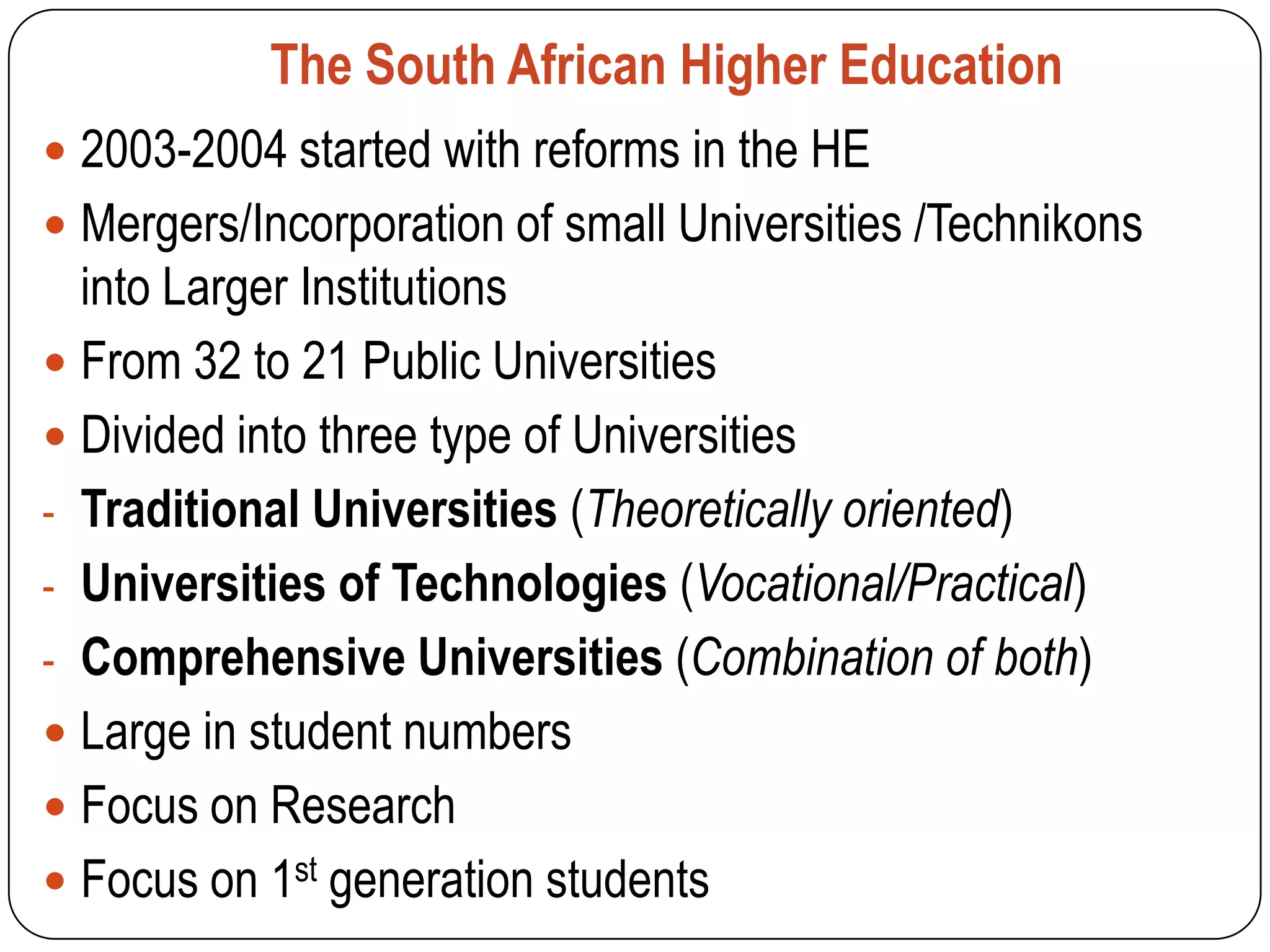
The South African Higher Education
 2003-2004 started with reforms in the HE
 Mergers/Incorporation of small Universities /Technikons
  into Larger Institutions
 From 32 to 21 Public Universities
 Divided into three type of Universities
- Traditional Universities (Theoretically oriented)
- Universities of Technologies (Vocational/Practical)
- Comprehensive Universities (Combination of both)
 Large in student numbers
 Focus on Research
 Focus on 1st generation students
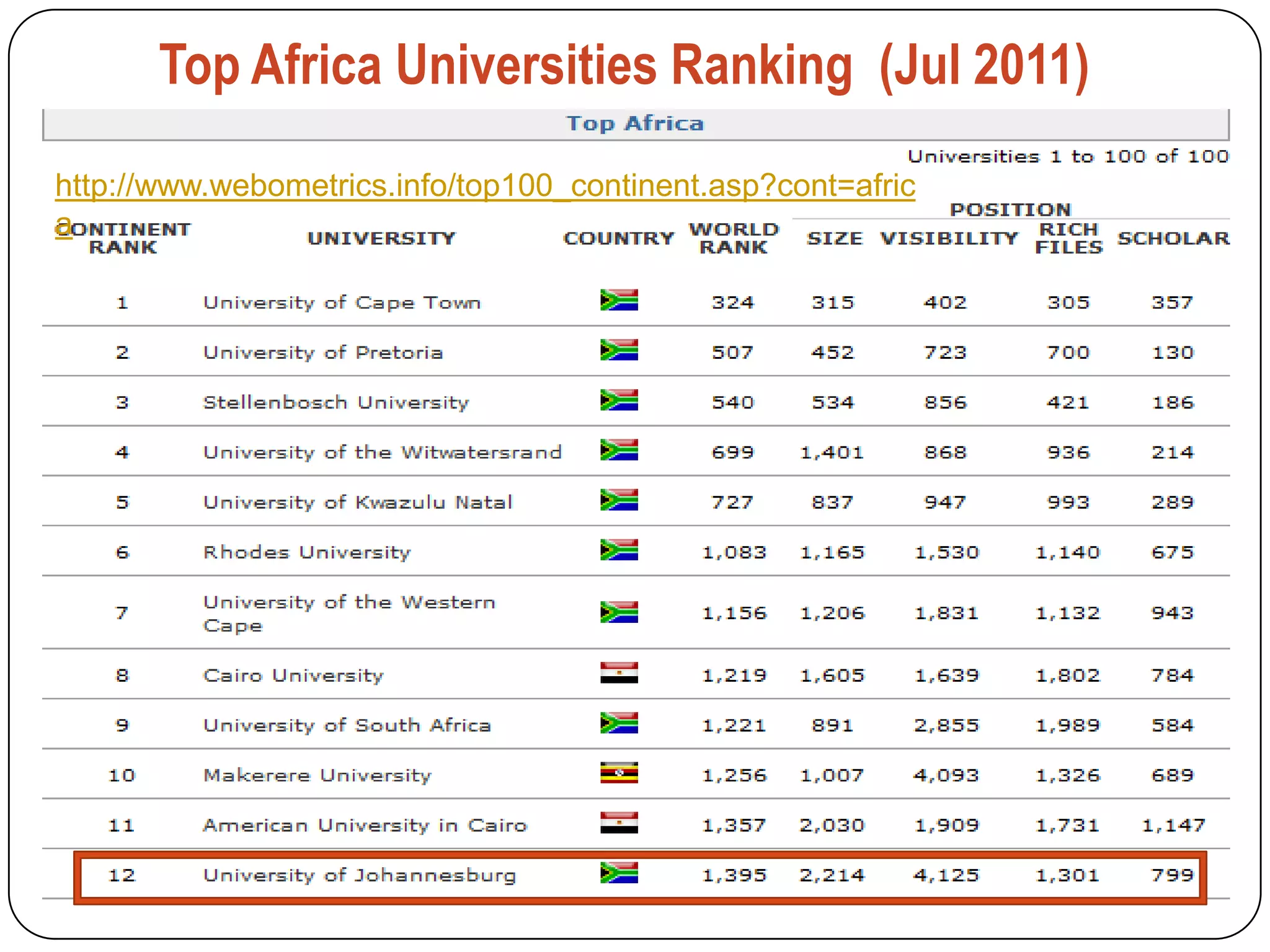
Top Africa Universities Ranking (Jul 2011)
http://www.webometrics.info/top100_continent.asp?cont=afric
a
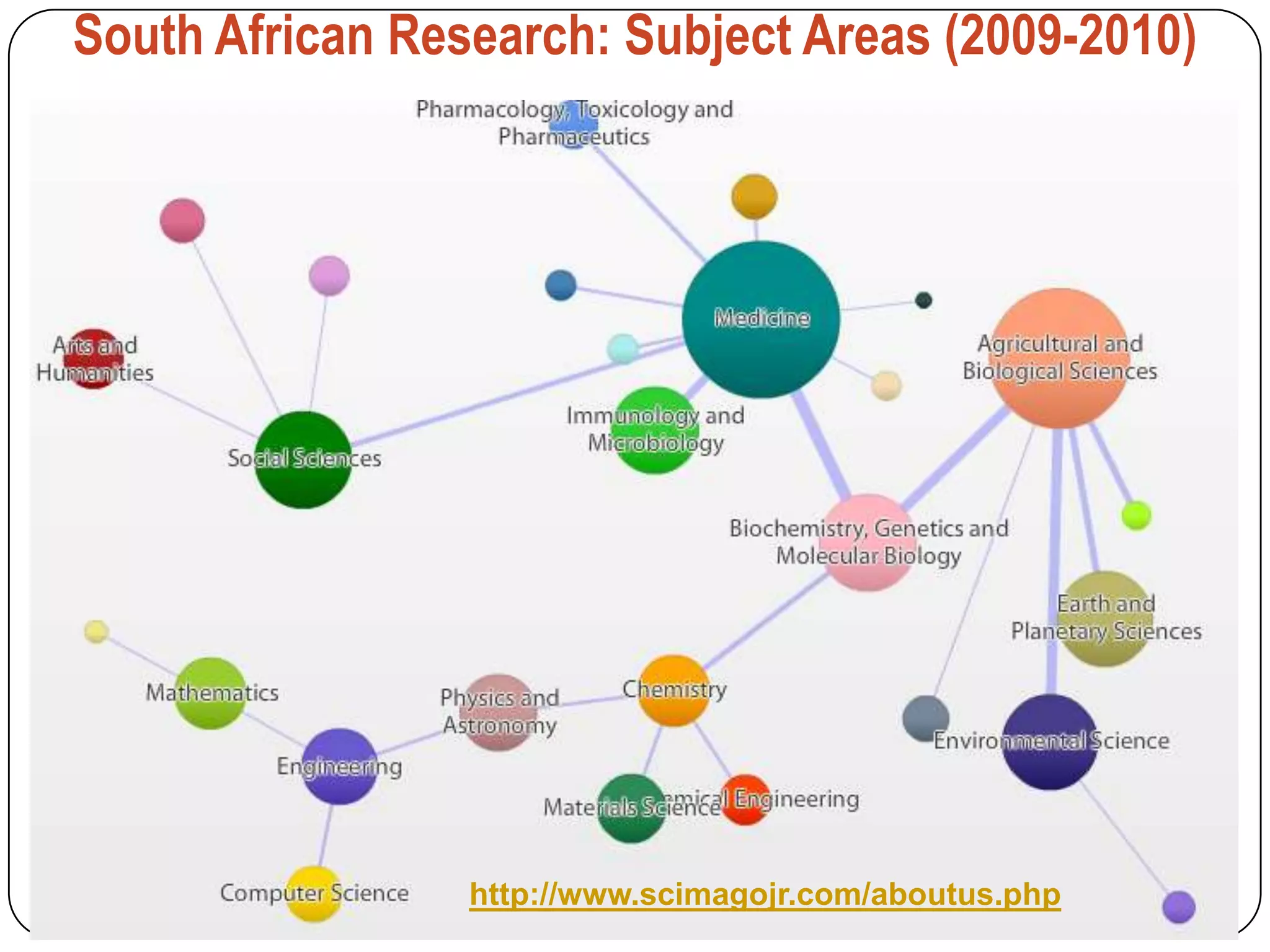
South African Research: Subject Areas (2009-2010)


                 http://www.scimagojr.com/aboutus.php
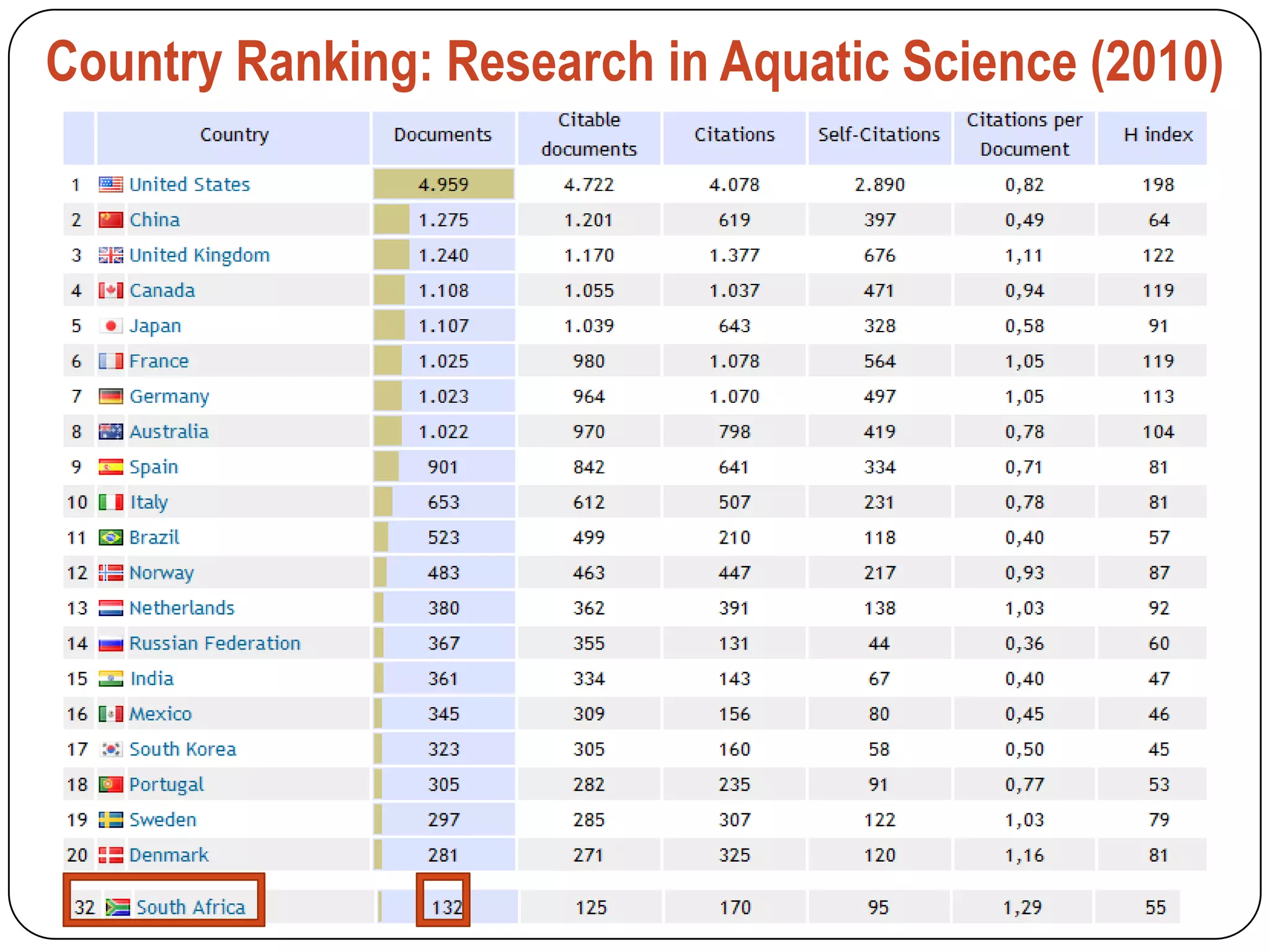
Country Ranking: Research in Aquatic Science (2010)
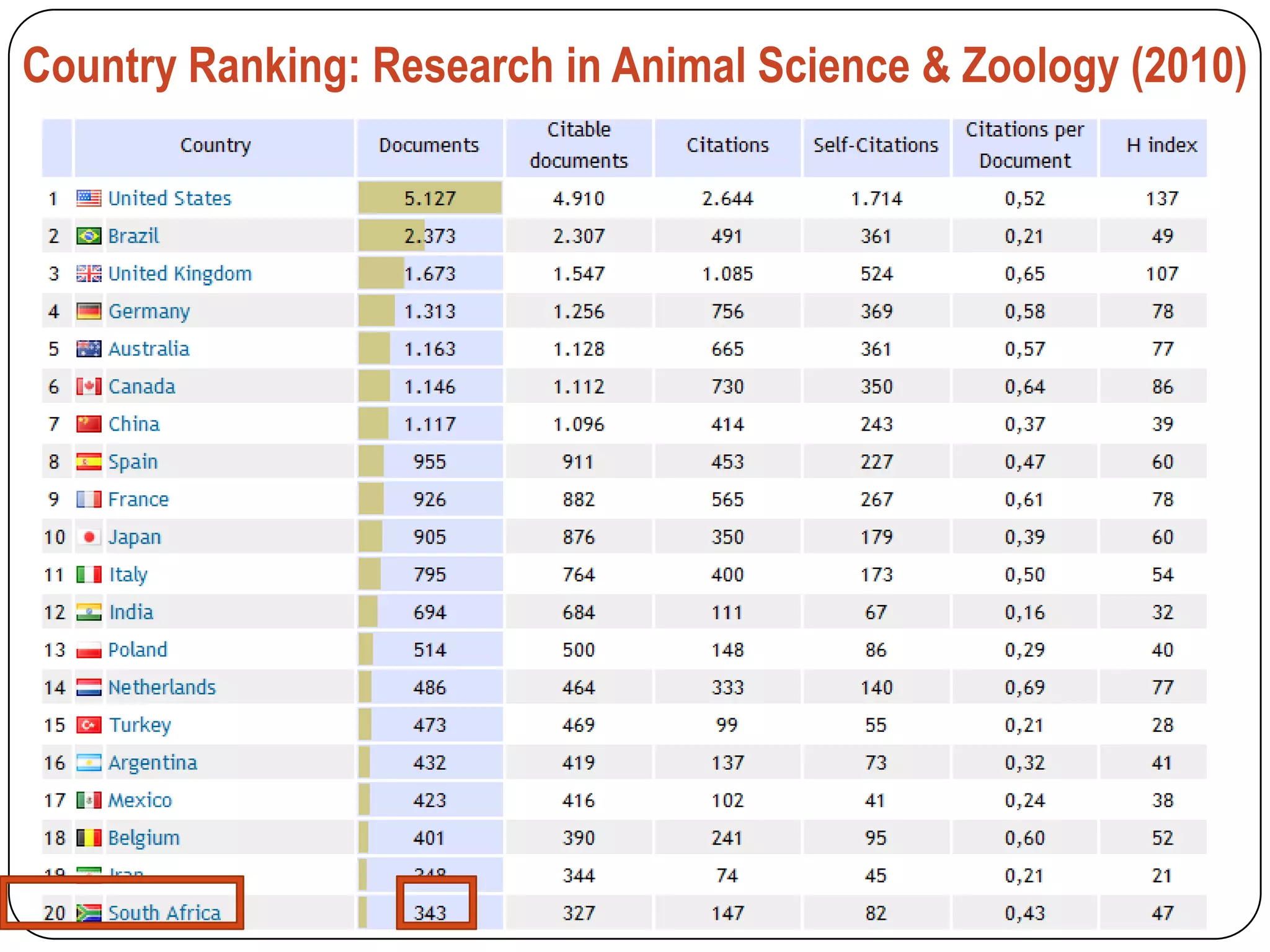
Country Ranking: Research in Animal Science & Zoology (2010)
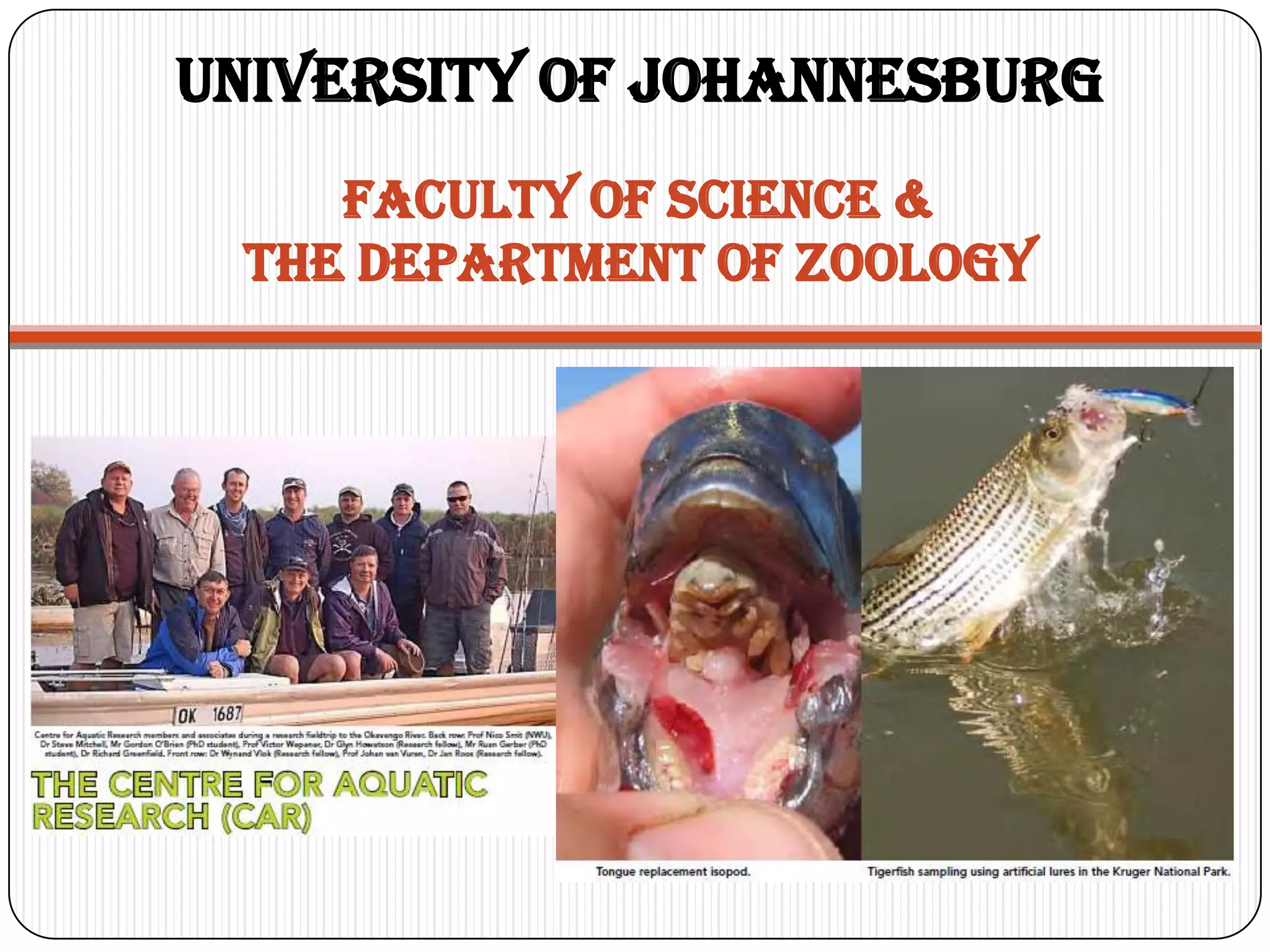
University of Johannesburg
    Faculty of Science &
 the Department of Zoology
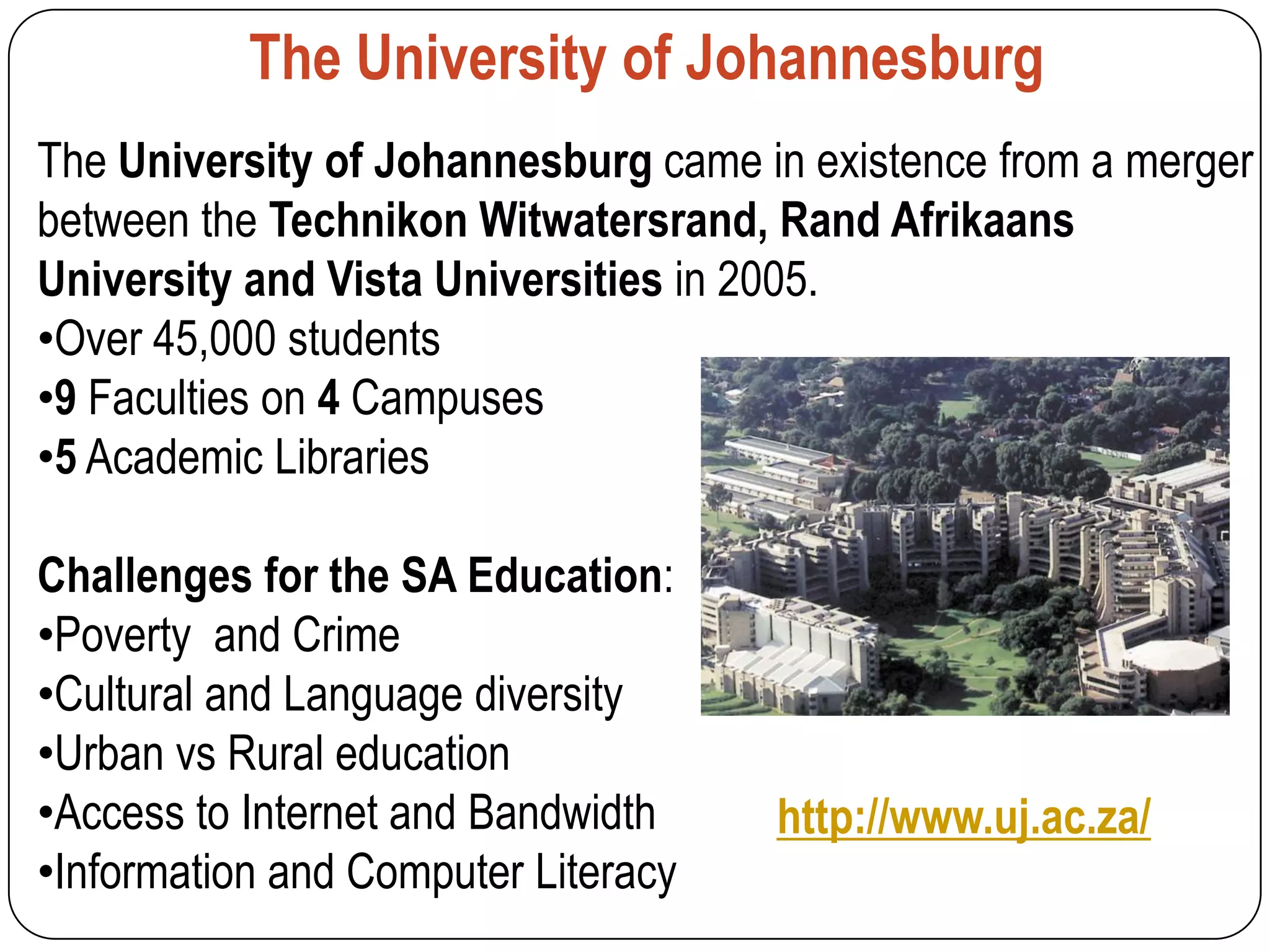
The University of Johannesburg
The University of Johannesburg came in existence from a merger
between the Technikon Witwatersrand, Rand Afrikaans
University and Vista Universities in 2005.
•Over 45,000 students
•9 Faculties on 4 Campuses
•5 Academic Libraries

Challenges for the SA Education:
•Poverty and Crime
•Cultural and Language diversity
•Urban vs Rural education
•Access to Internet and Bandwidth    http://www.uj.ac.za/
•Information and Computer Literacy
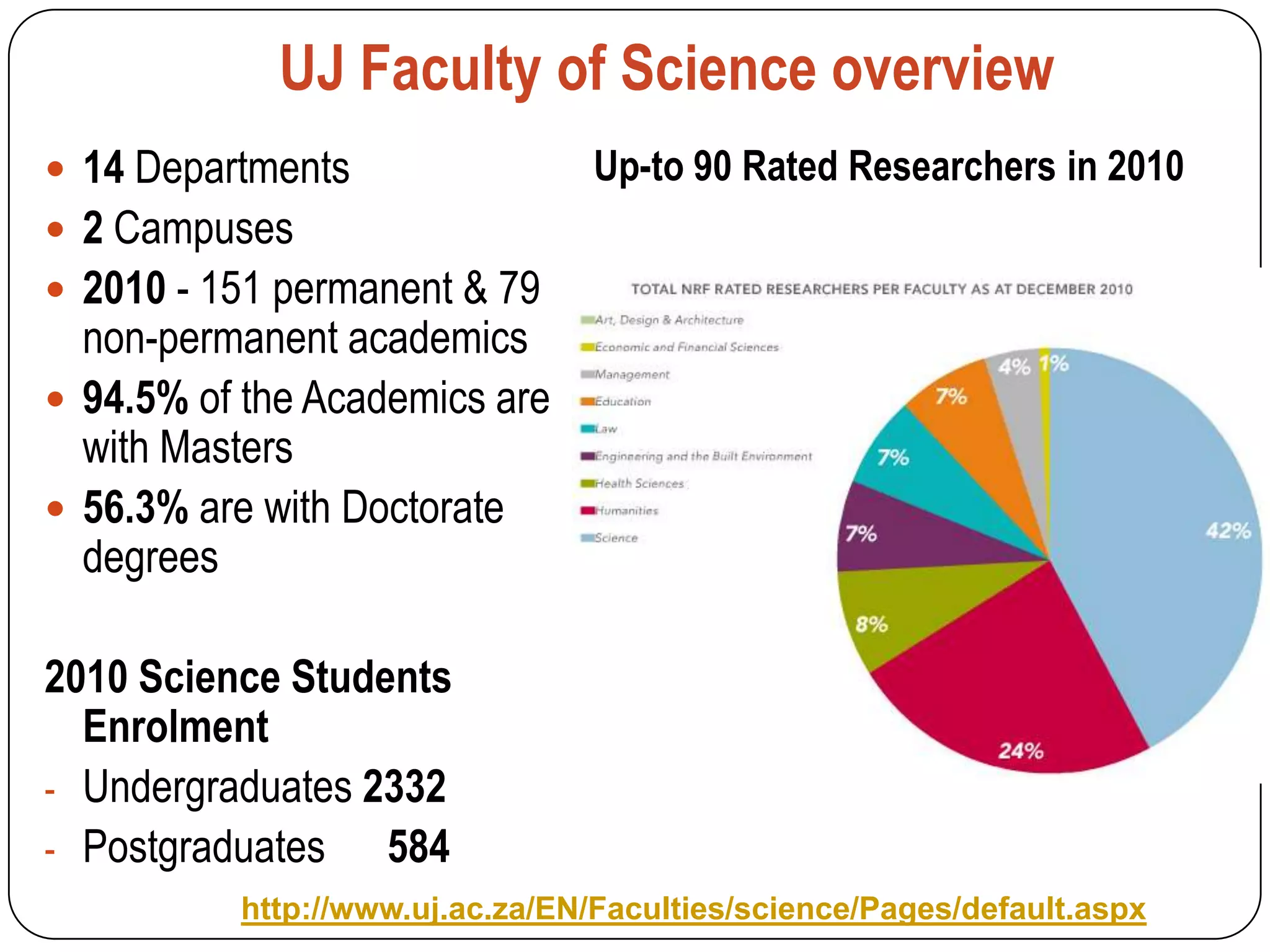
UJ Faculty of Science overview
 14 Departments                Up-to 90 Rated Researchers in 2010
 2 Campuses
 2010 - 151 permanent & 79
  non-permanent academics
 94.5% of the Academics are
  with Masters
 56.3% are with Doctorate
  degrees

2010 Science Students
  Enrolment
- Undergraduates 2332
- Postgraduates   584
          http://www.uj.ac.za/EN/Faculties/science/Pages/default.aspx
UJ Zoology Department
 In existence for 43 year
 Currently 10 academic staff members & 6 support staff
 Research active department
 Published almost 1000 manuscripts
 Well known for its work in freshwater biology, specifically
  with regard to biodiversity of freshwater animals and
  the effect of pollutants on the histology, morphology
  and physiology of animals.
 Lectures in Zoology, Human Physiology, Human
  Anatomy, Ocular Anatomy and Physiology and
  Microbiology – 17 semester courses, almost 750
  undergrads and almost 60 postgrads students
                                          Source
Zoology Department Research Areas (1)
 Current Research in Genetics
 Research in Fish Parasitology
 The Centre for Aquatic Research (CAR) research projects
 focuses into the field of fresh water and estuarine ecotoxicology.
 - Hartbeespoort Dam Water Monitoring and Algae Management
 Program
 - Monitoring of metallic and organic pollutants along the South
 African coastline
 - Ecological Risk Assessment for pesticides at Vaal harts Irrigation
 Scheme
 - Marine Fish Parasitic Isopods from Southern Africa
 - Ecological Risk Assessment of Nanomaterials in the Aquatic
 Environment, etc.
Zoology Department Research Areas (2)
 Research in Fish Histopathology and Reproductive
  Biology
 Research in Comparative Respiratory Functional
  Morphology
FETWater programme in Rivers and Wetlands
Aquarium facility
Collaborations:
 Students & Research Exchange with the University of
  Hong Kong
 Collaboration with the University of
  Hokkaido, Sapporo, Japan
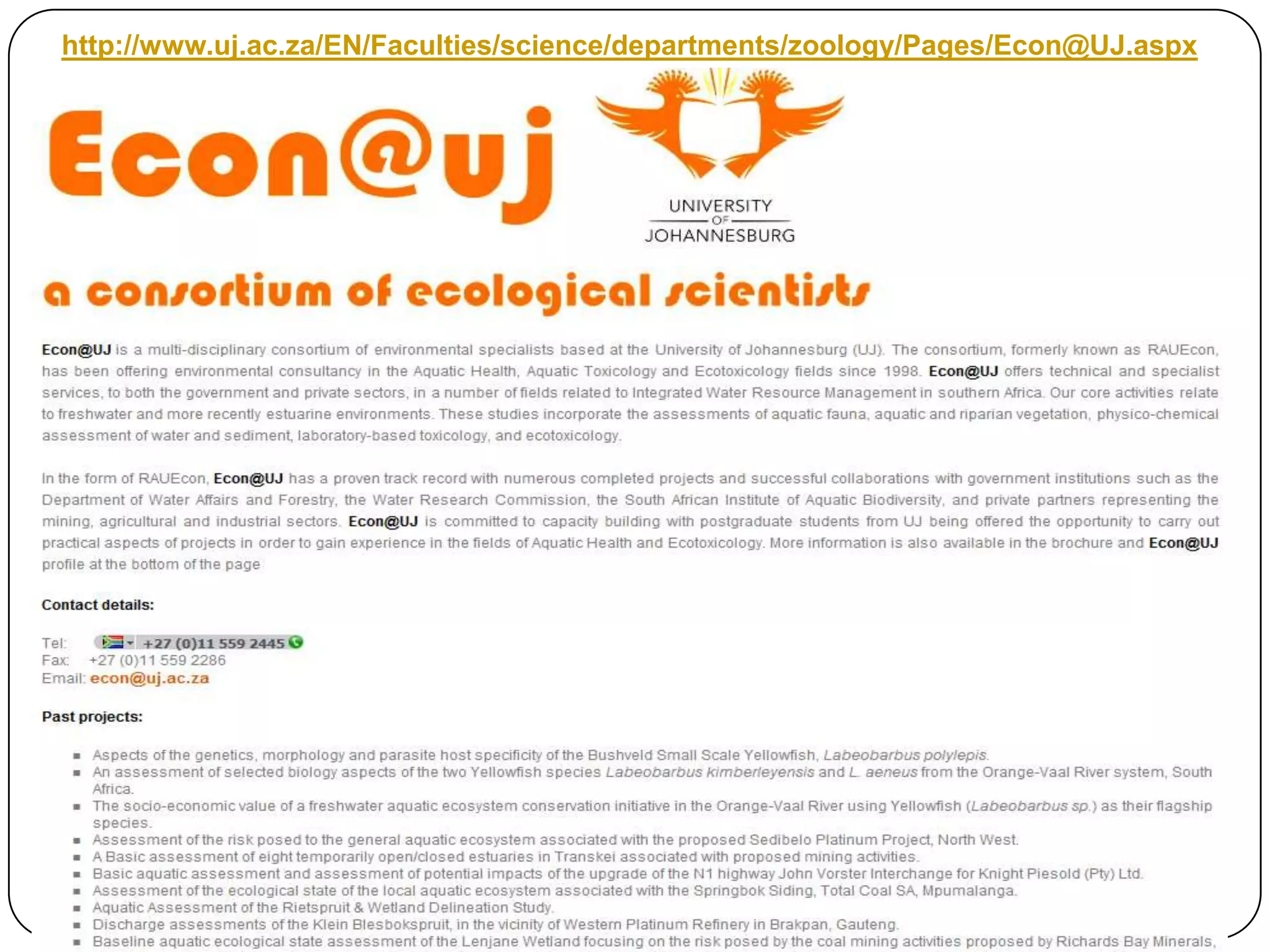
http://www.uj.ac.za/EN/Faculties/science/departments/zoology/Pages/Econ@UJ.aspx
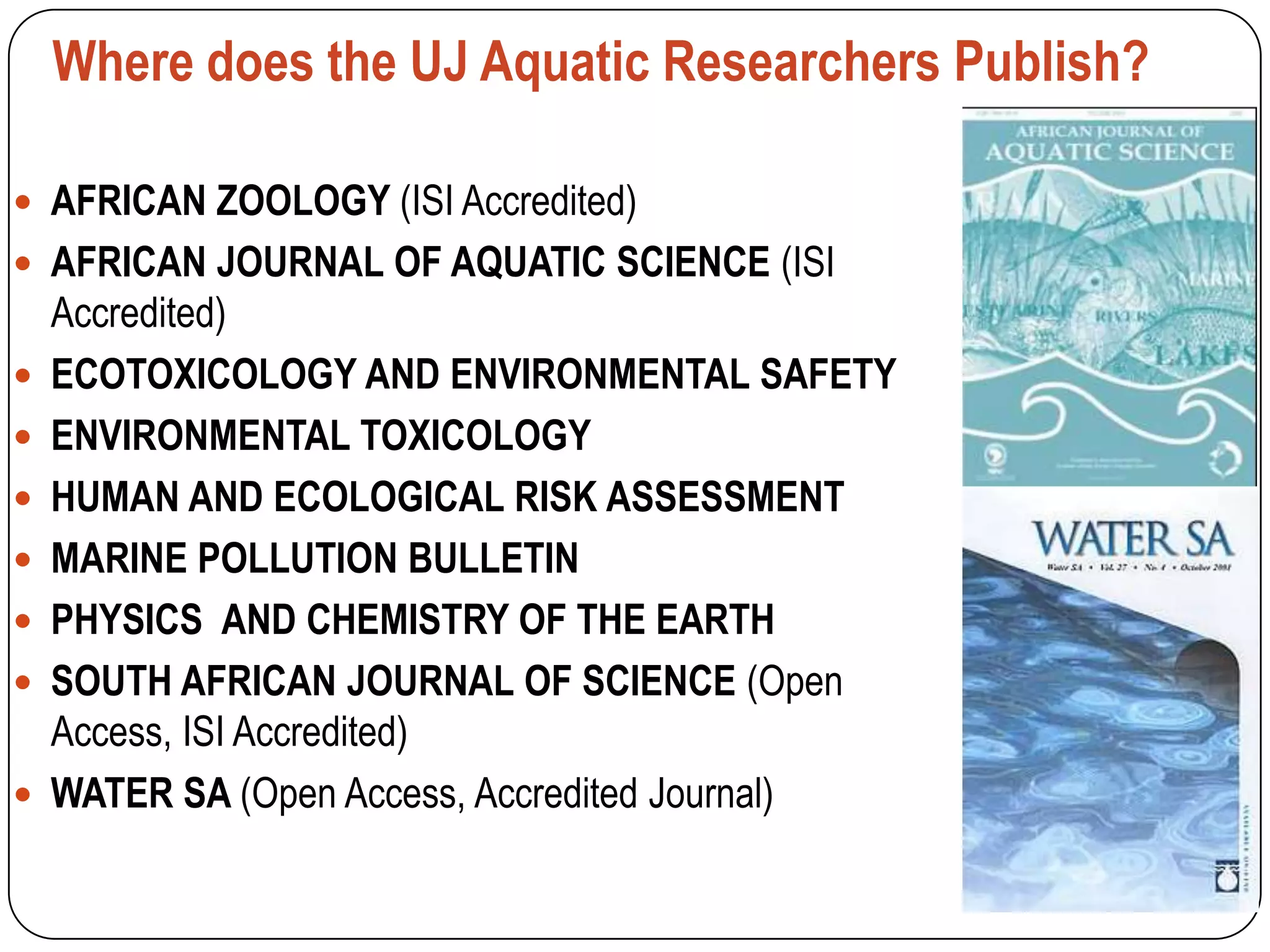
Where does the UJ Aquatic Researchers Publish?

 AFRICAN ZOOLOGY (ISI Accredited)
 AFRICAN JOURNAL OF AQUATIC SCIENCE (ISI
    Accredited)
   ECOTOXICOLOGY AND ENVIRONMENTAL SAFETY
   ENVIRONMENTAL TOXICOLOGY
   HUMAN AND ECOLOGICAL RISK ASSESSMENT
   MARINE POLLUTION BULLETIN
   PHYSICS AND CHEMISTRY OF THE EARTH
   SOUTH AFRICAN JOURNAL OF SCIENCE (Open
    Access, ISI Accredited)
   WATER SA (Open Access, Accredited Journal)
Online resources for
   zoology users
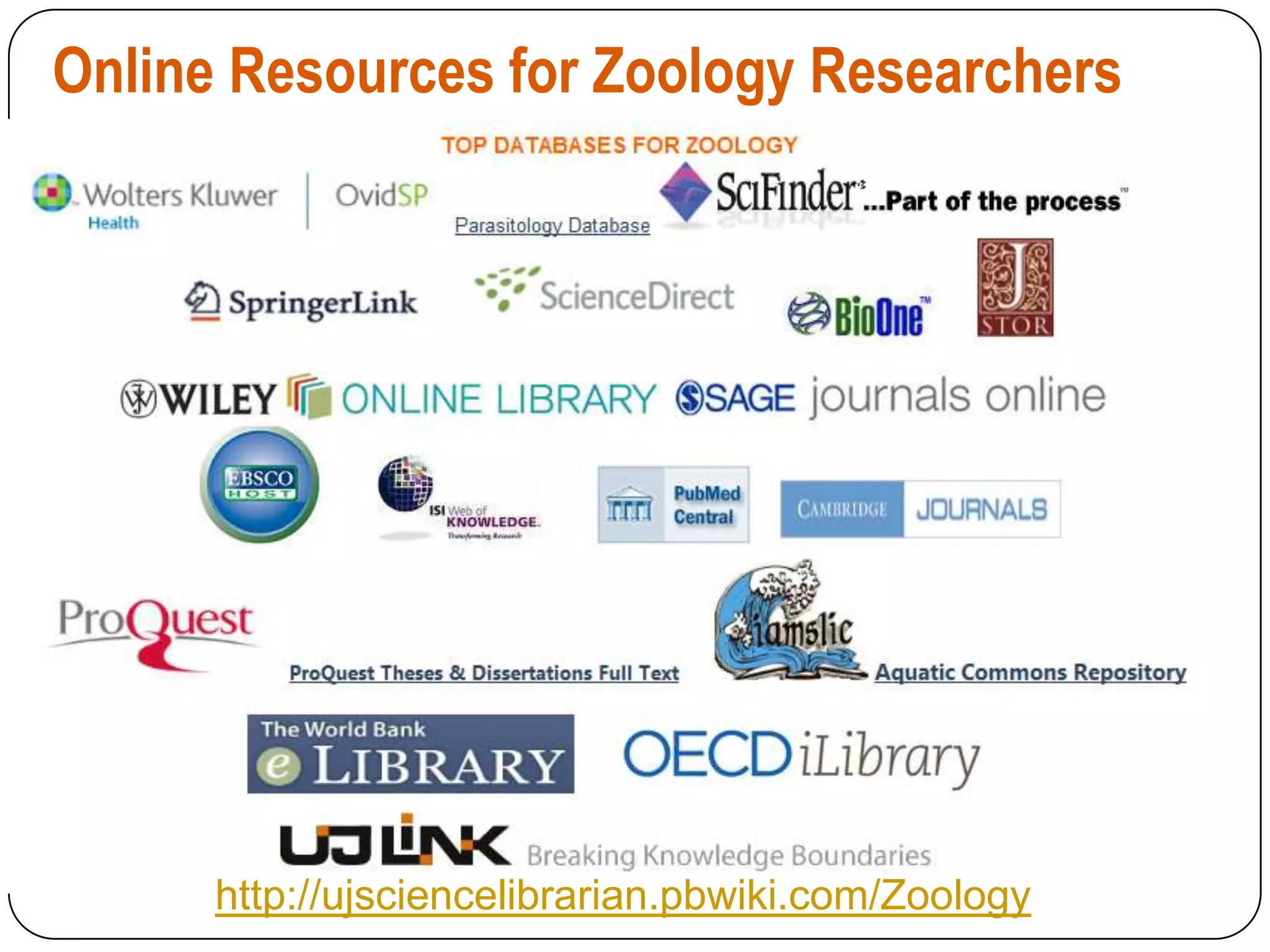
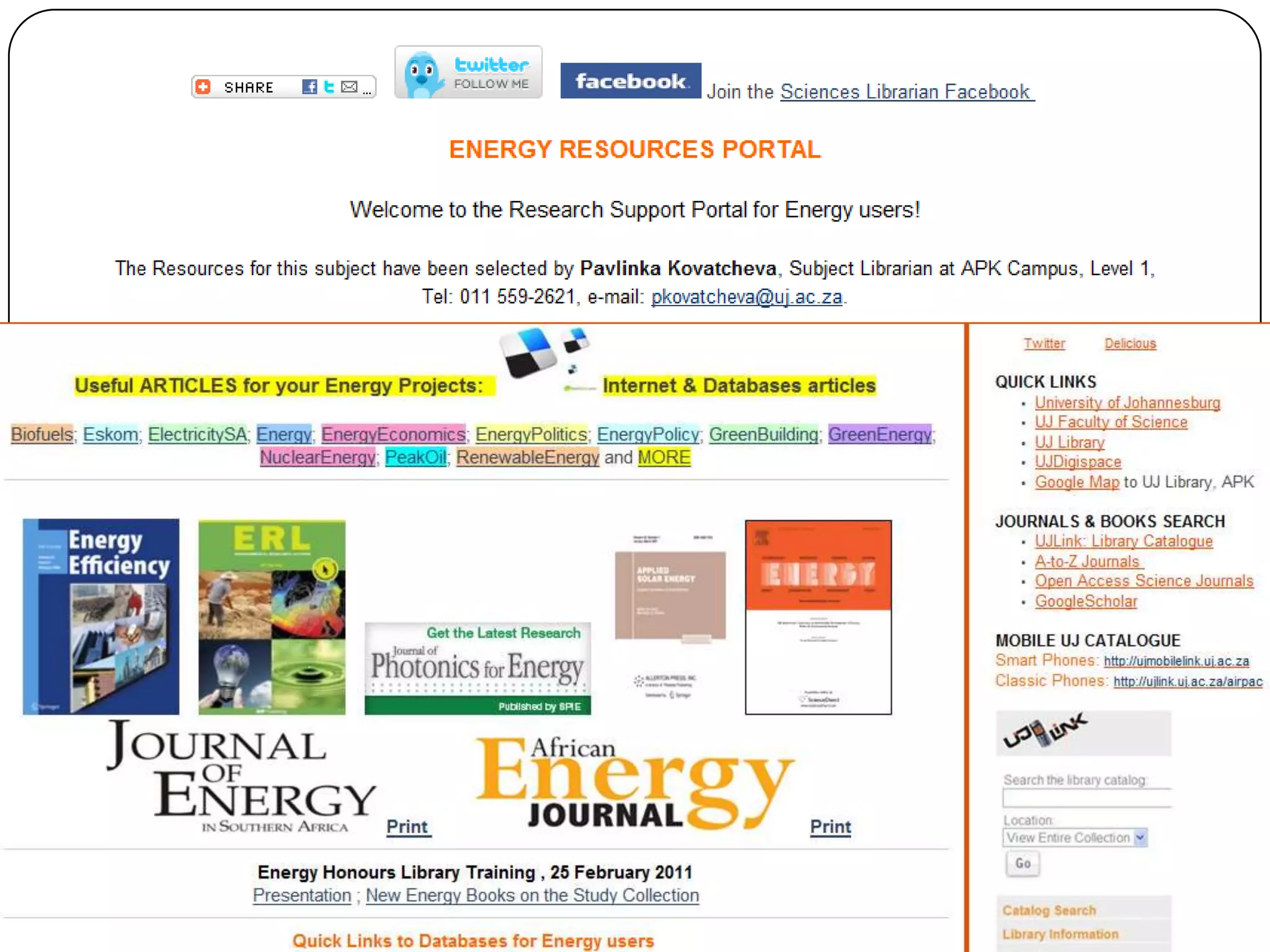
Online Resources for Zoology Researchers


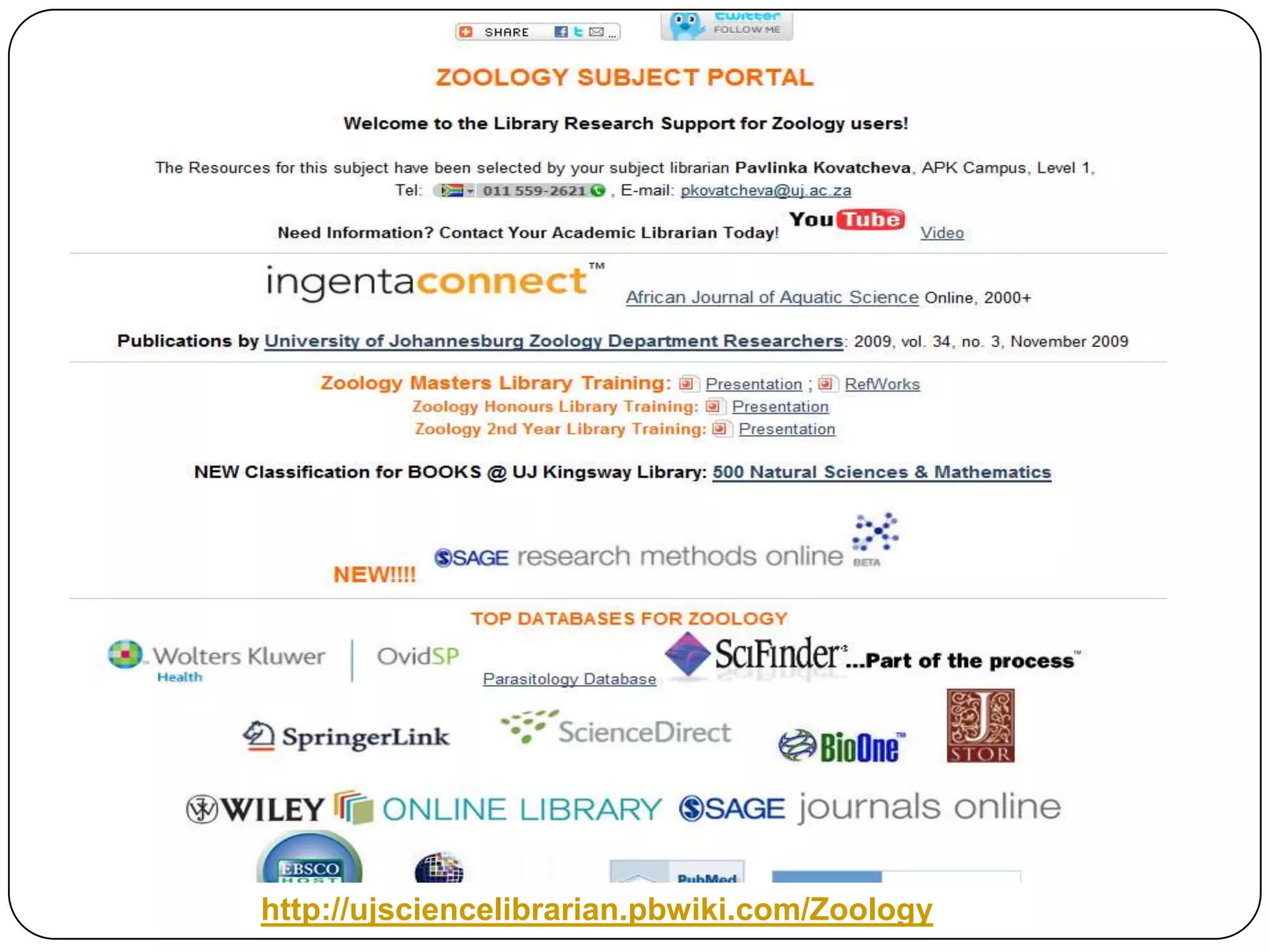
      http://ujsciencelibrarian.pbwiki.com/Zoology
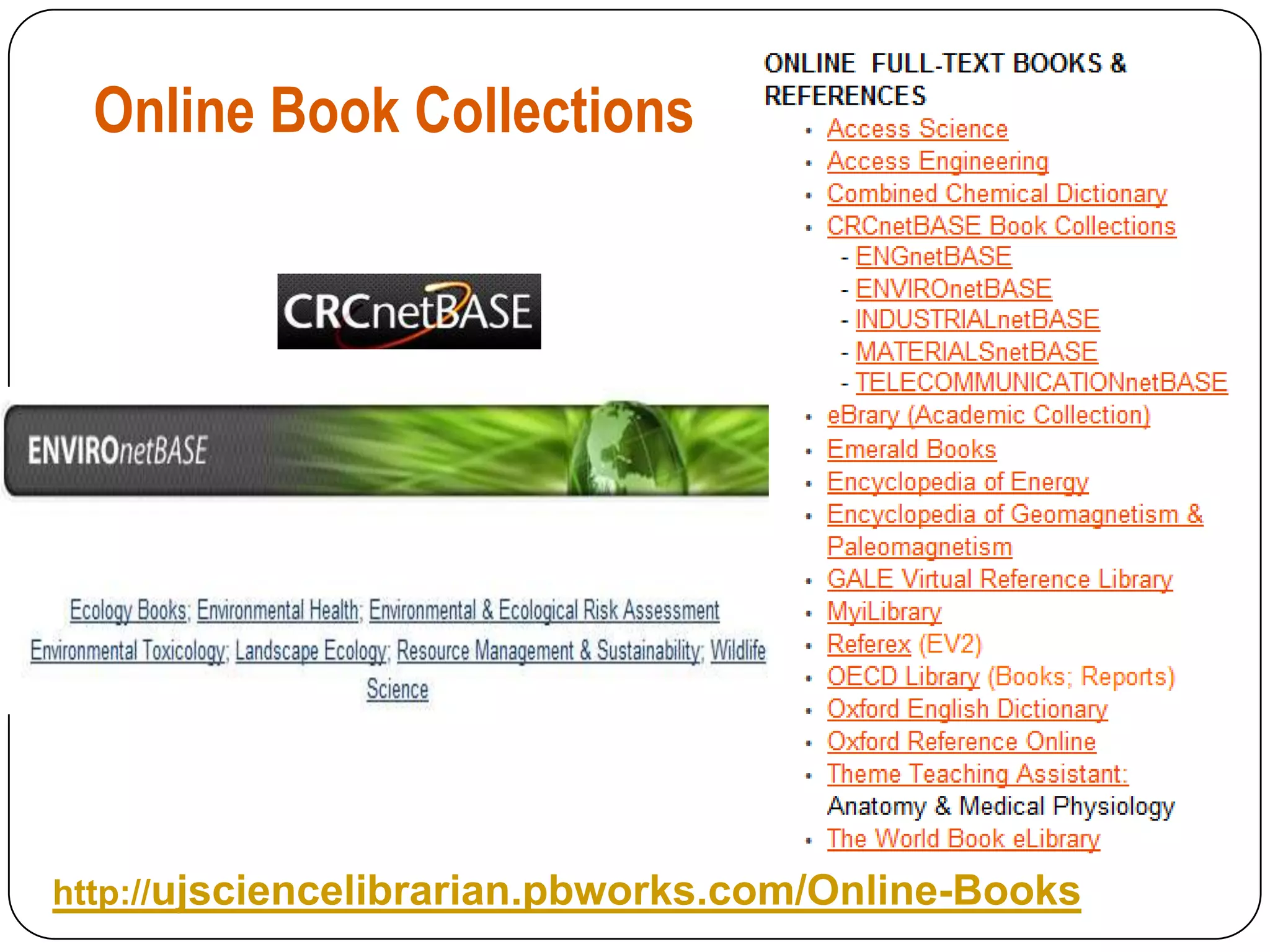
Online Book Collections


http://ujsciencelibrarian.pbworks.com/Online-Books
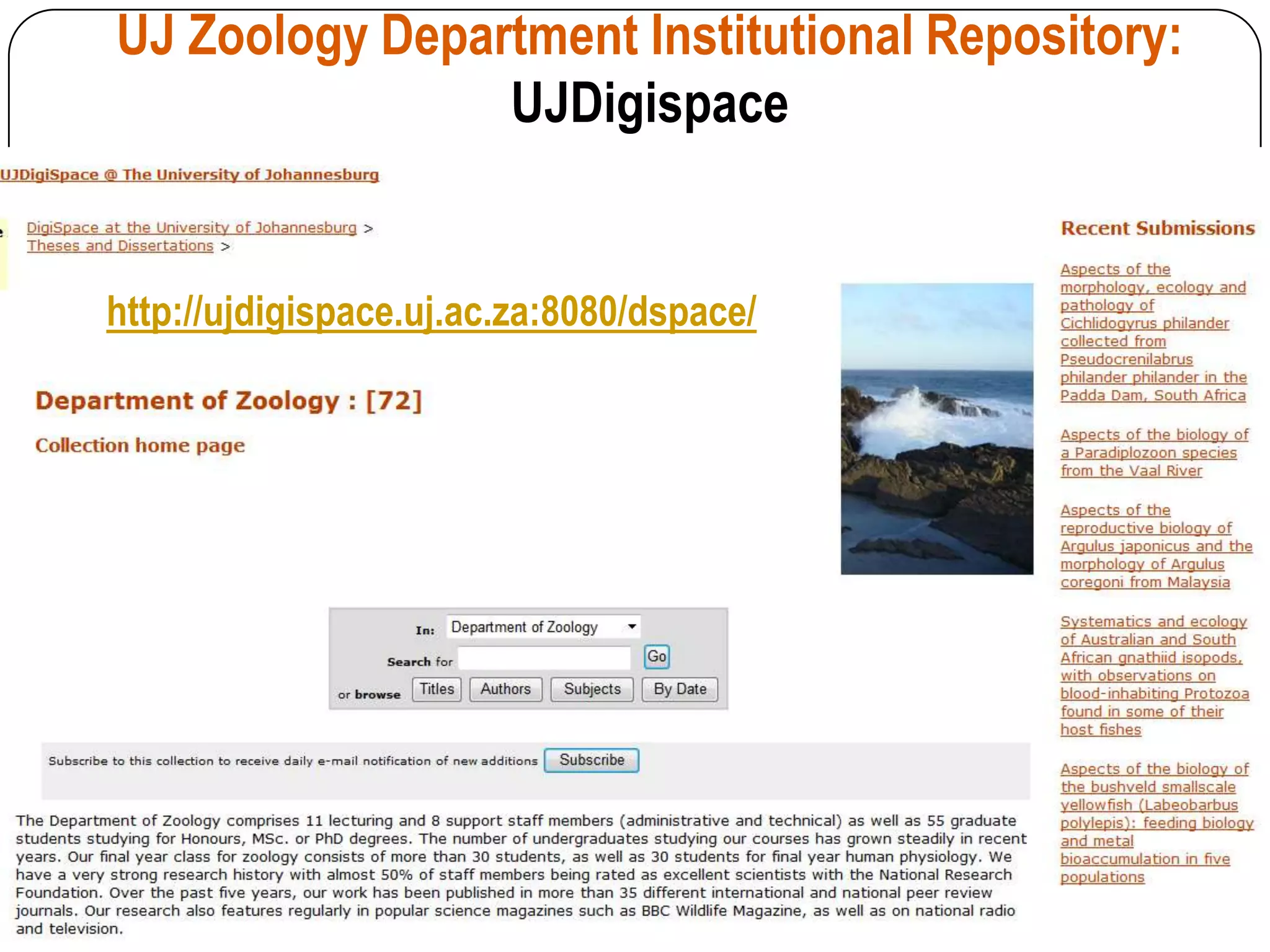
UJ Zoology Department Institutional Repository:
                UJDigispace


http://ujdigispace.uj.ac.za:8080/dspace/
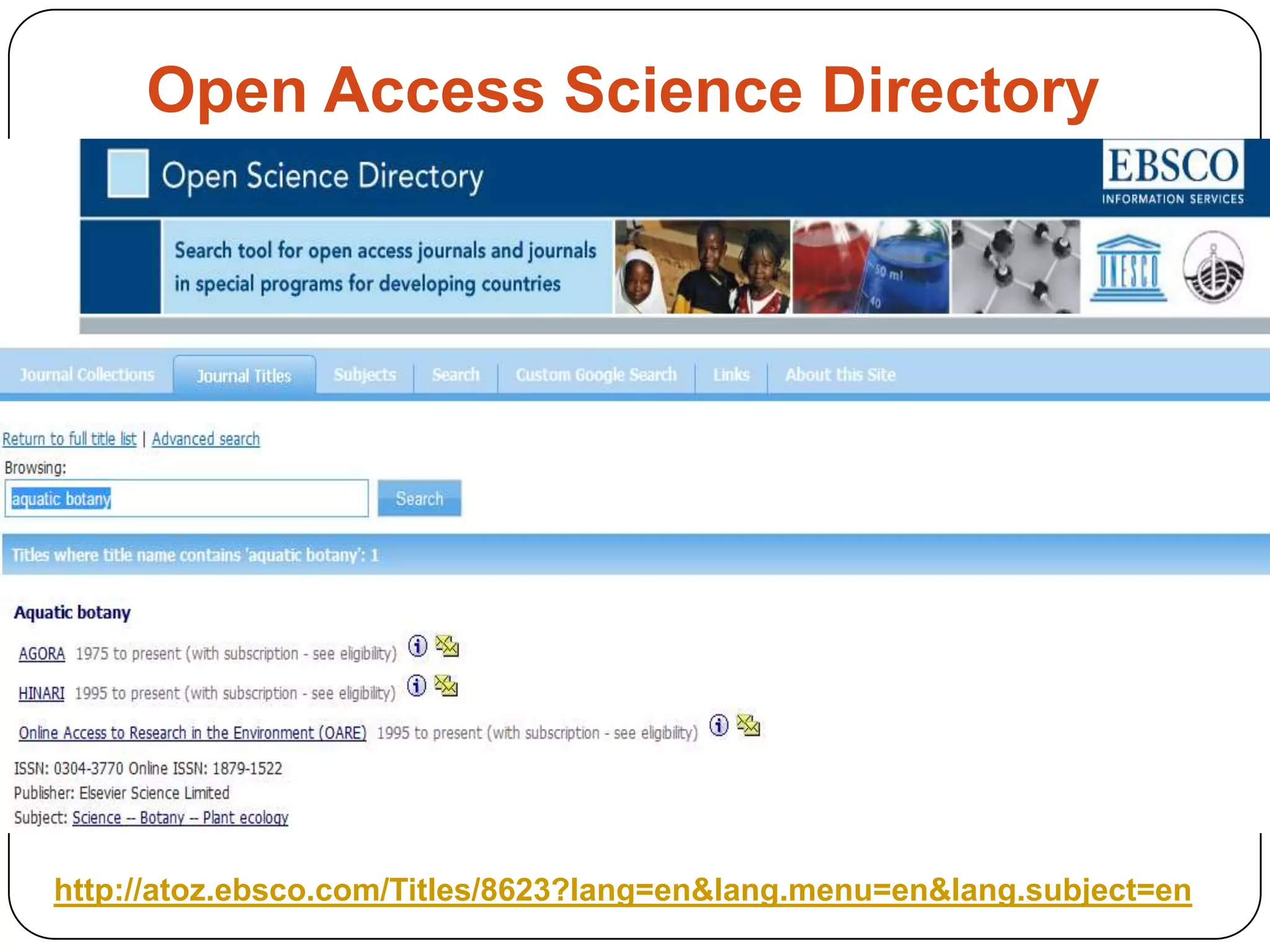
Open Access Science Directory


http://atoz.ebsco.com/Titles/8623?lang=en&lang.menu=en&lang.subject=en
the south African libraries


     The university of
  Johannesburg library
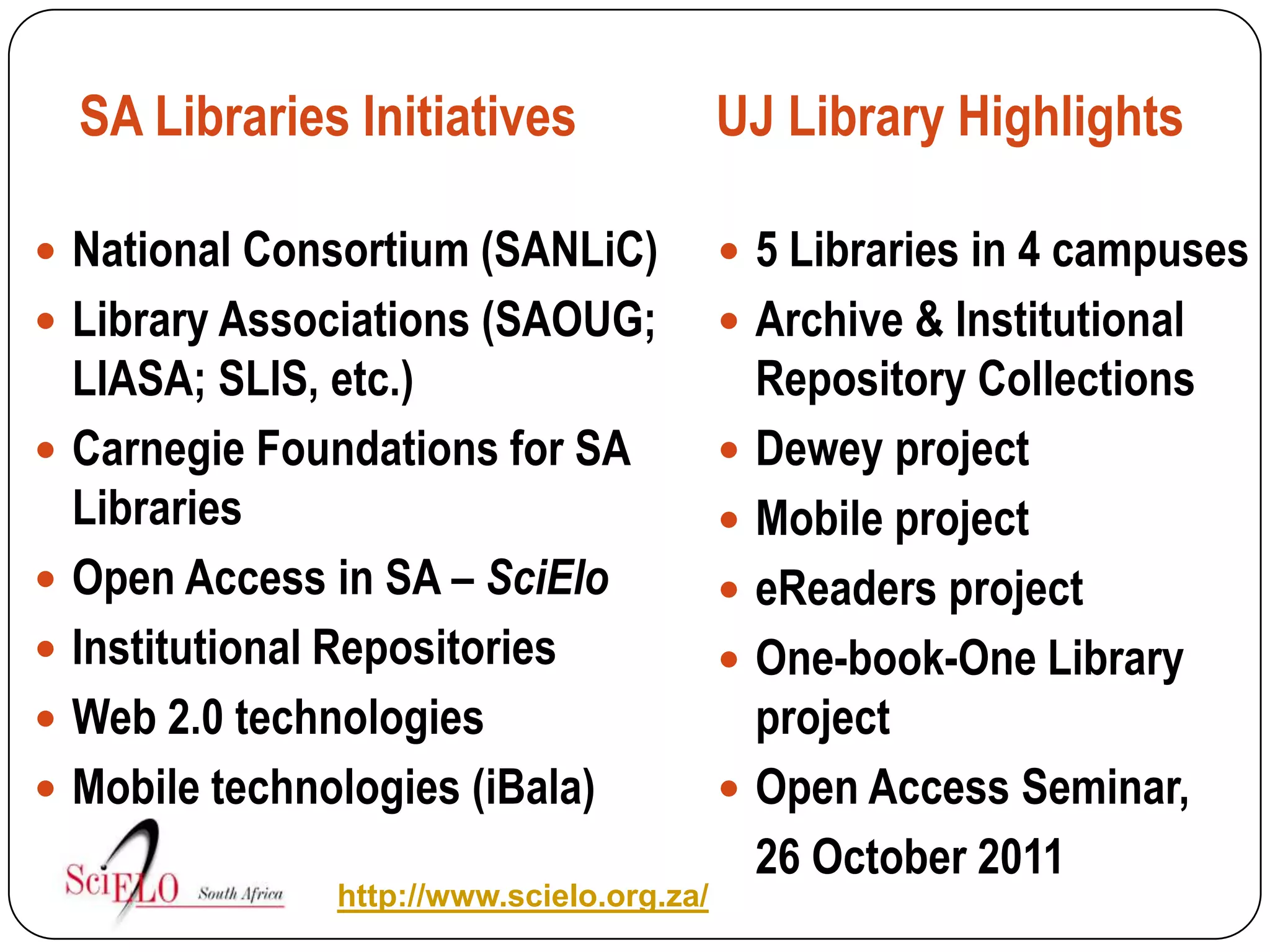
SA Libraries Initiatives                UJ Library Highlights

 National Consortium (SANLiC)               5 Libraries in 4 campuses
 Library Associations (SAOUG;               Archive & Institutional
    LIASA; SLIS, etc.)                          Repository Collections
   Carnegie Foundations for SA                Dewey project
    Libraries                                  Mobile project
   Open Access in SA – SciElo                 eReaders project
   Institutional Repositories                 One-book-One Library
   Web 2.0 technologies                        project
   Mobile technologies (iBala)                Open Access Seminar,
                                                26 October 2011
                http://www.scielo.org.za/
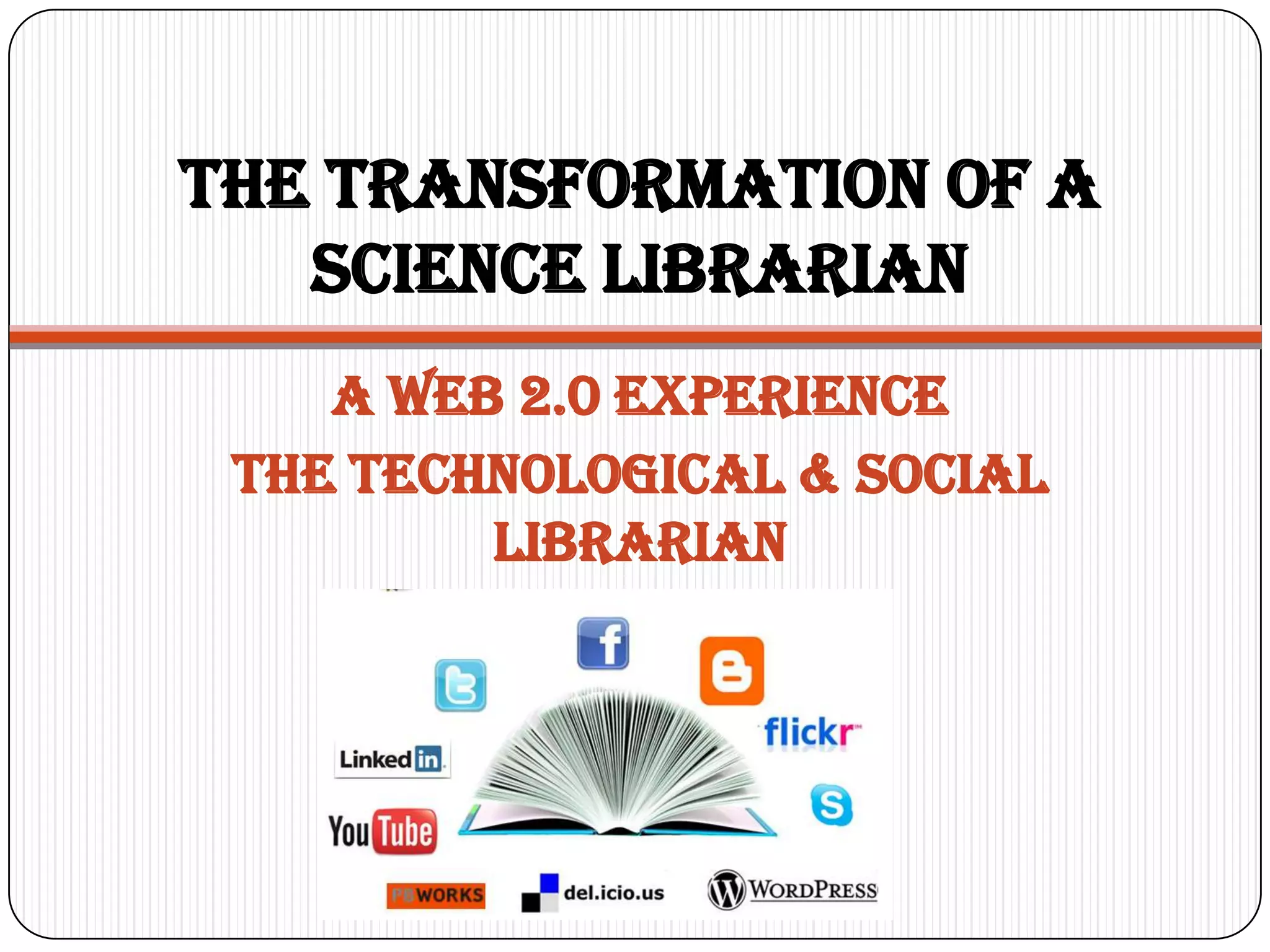
The Transformation of a
   Science Librarian
    A Web 2.0 experience
 The technological & social
         librarian
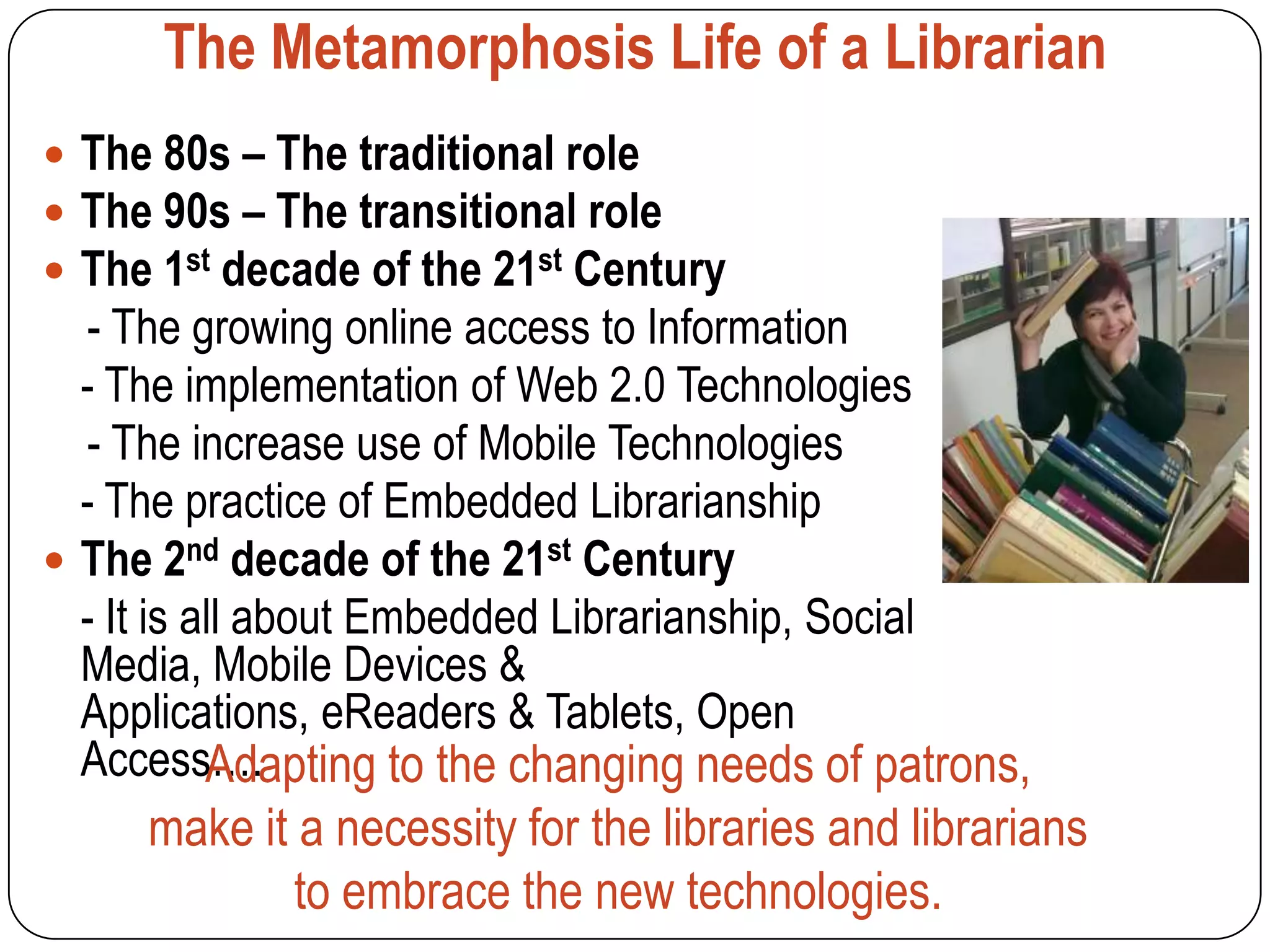
The Metamorphosis Life of a Librarian
 The 80s – The traditional role
 The 90s – The transitional role
 The 1st decade of the 21st Century
  - The growing online access to Information
  - The implementation of Web 2.0 Technologies
  - The increase use of Mobile Technologies
  - The practice of Embedded Librarianship
 The 2nd decade of the 21st Century
  - It is all about Embedded Librarianship, Social
  Media, Mobile Devices &
  Applications, eReaders & Tablets, Open
  Access…. Adapting to the changing needs of patrons,
     make it a necessity for the libraries and librarians
             to embrace the new technologies.
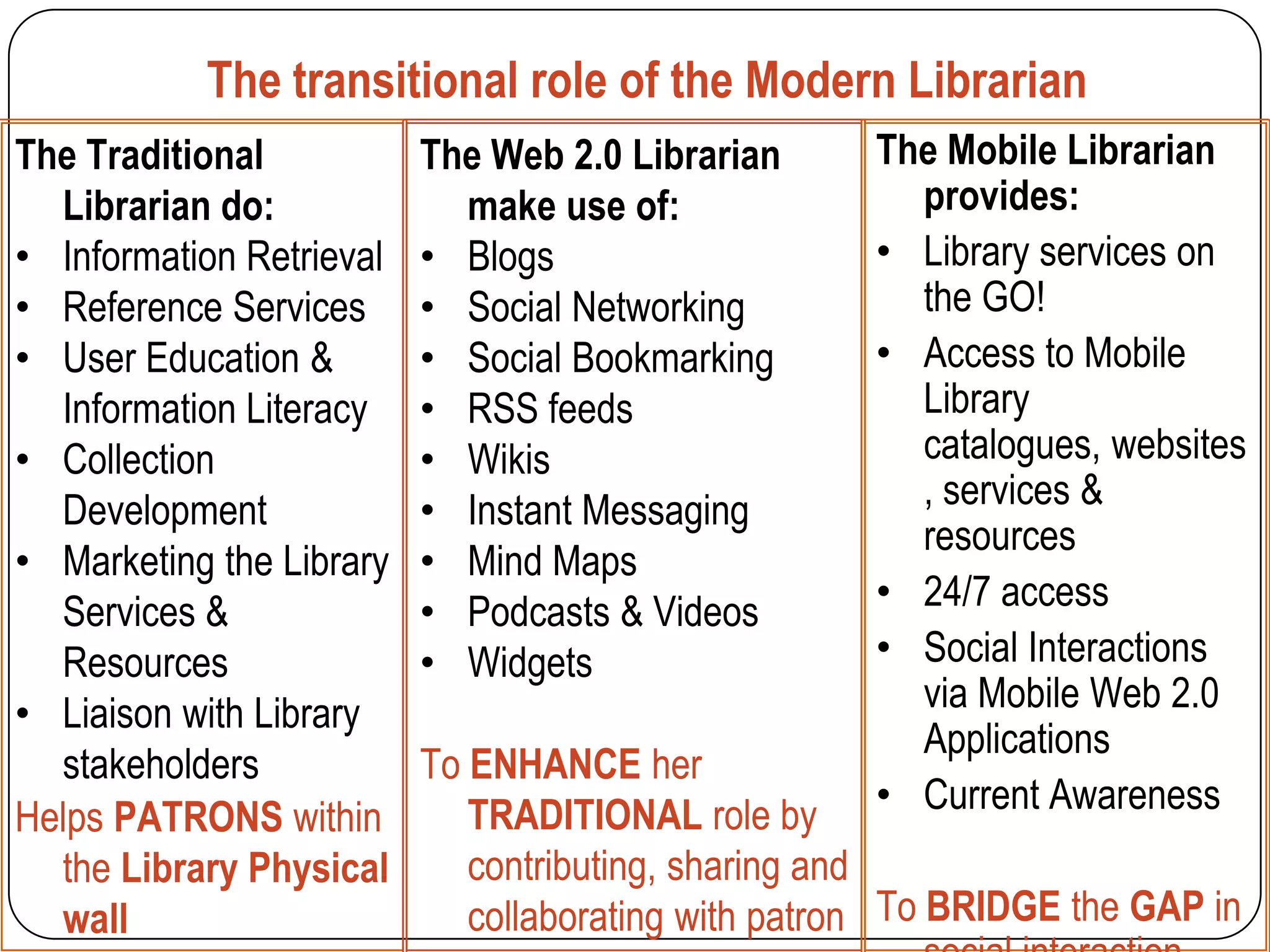
The transitional role of the Modern Librarian
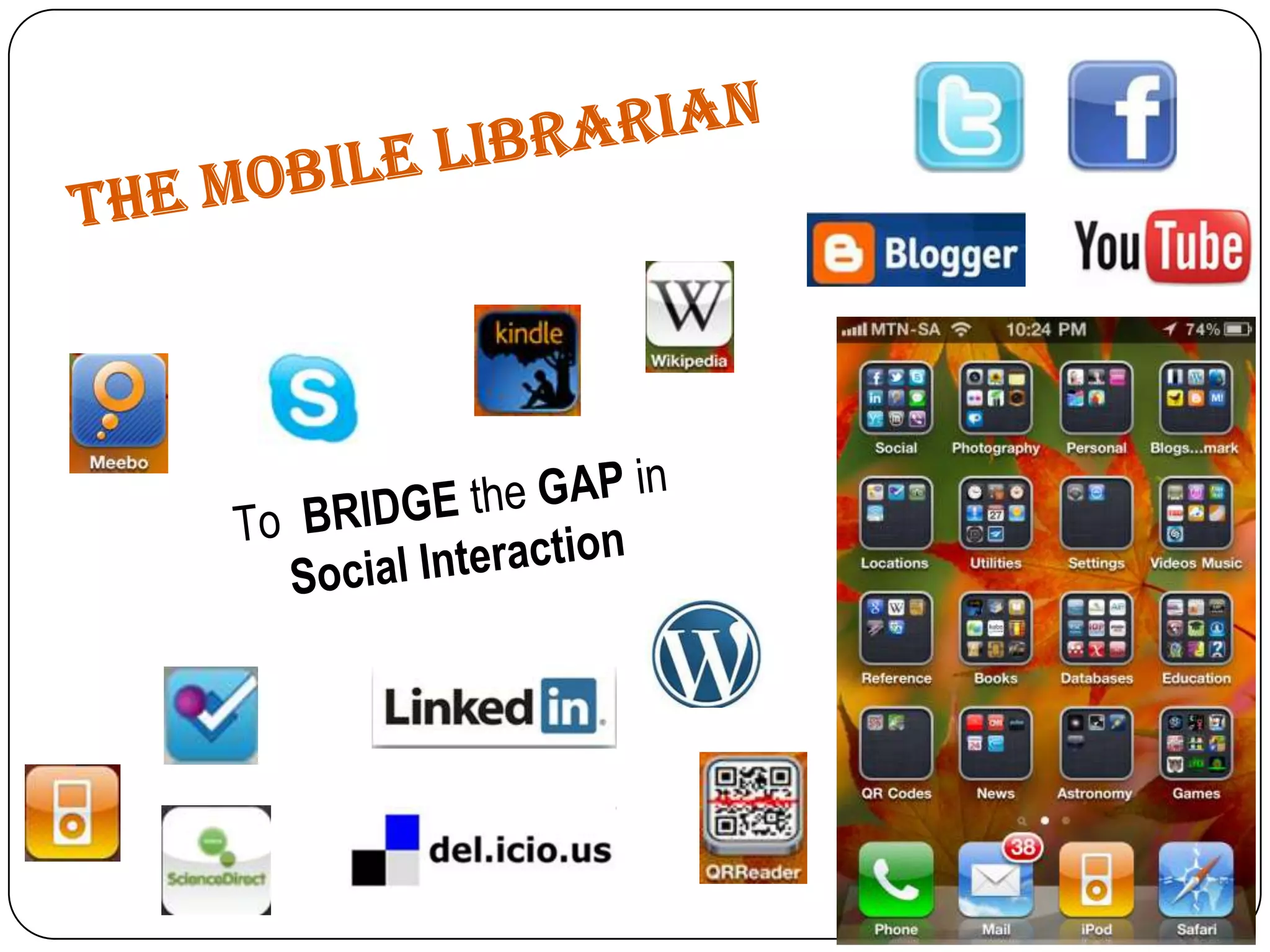
The Traditional           The Web 2.0 Librarian      The Mobile Librarian
  Librarian do:             make use of:               provides:
• Information Retrieval   • Blogs                    • Library services on
• Reference Services      • Social Networking          the GO!
• User Education &        • Social Bookmarking       • Access to Mobile
  Information Literacy    • RSS feeds                  Library
• Collection              • Wikis                      catalogues, websites
  Development             • Instant Messaging          , services &
                                                       resources
• Marketing the Library   • Mind Maps
  Services &              • Podcasts & Videos        • 24/7 access
  Resources               • Widgets                  • Social Interactions
• Liaison with Library                                 via Mobile Web 2.0
                                                       Applications
  stakeholders            To ENHANCE her
                             TRADITIONAL role by     • Current Awareness
Helps PATRONS within
  the Library Physical       contributing, sharing and
  wall                       collaborating with patron To BRIDGE the GAP in
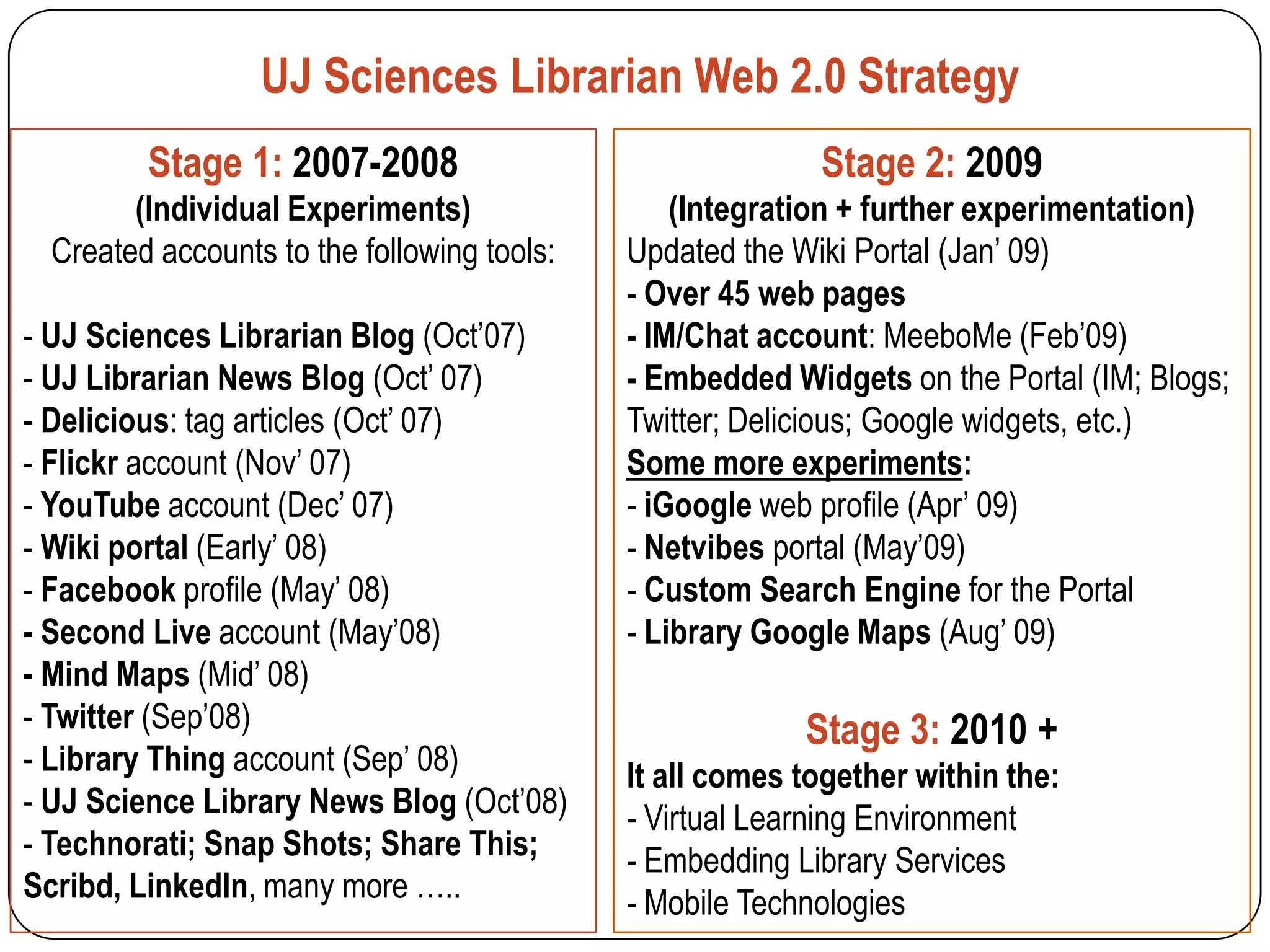
UJ Sciences Librarian Web 2.0 Strategy
         Stage 1: 2007-2008                                Stage 2: 2009
        (Individual Experiments)                 (Integration + further experimentation)
  Created accounts to the following tools:   Updated the Wiki Portal (Jan’ 09)
                                             - Over 45 web pages
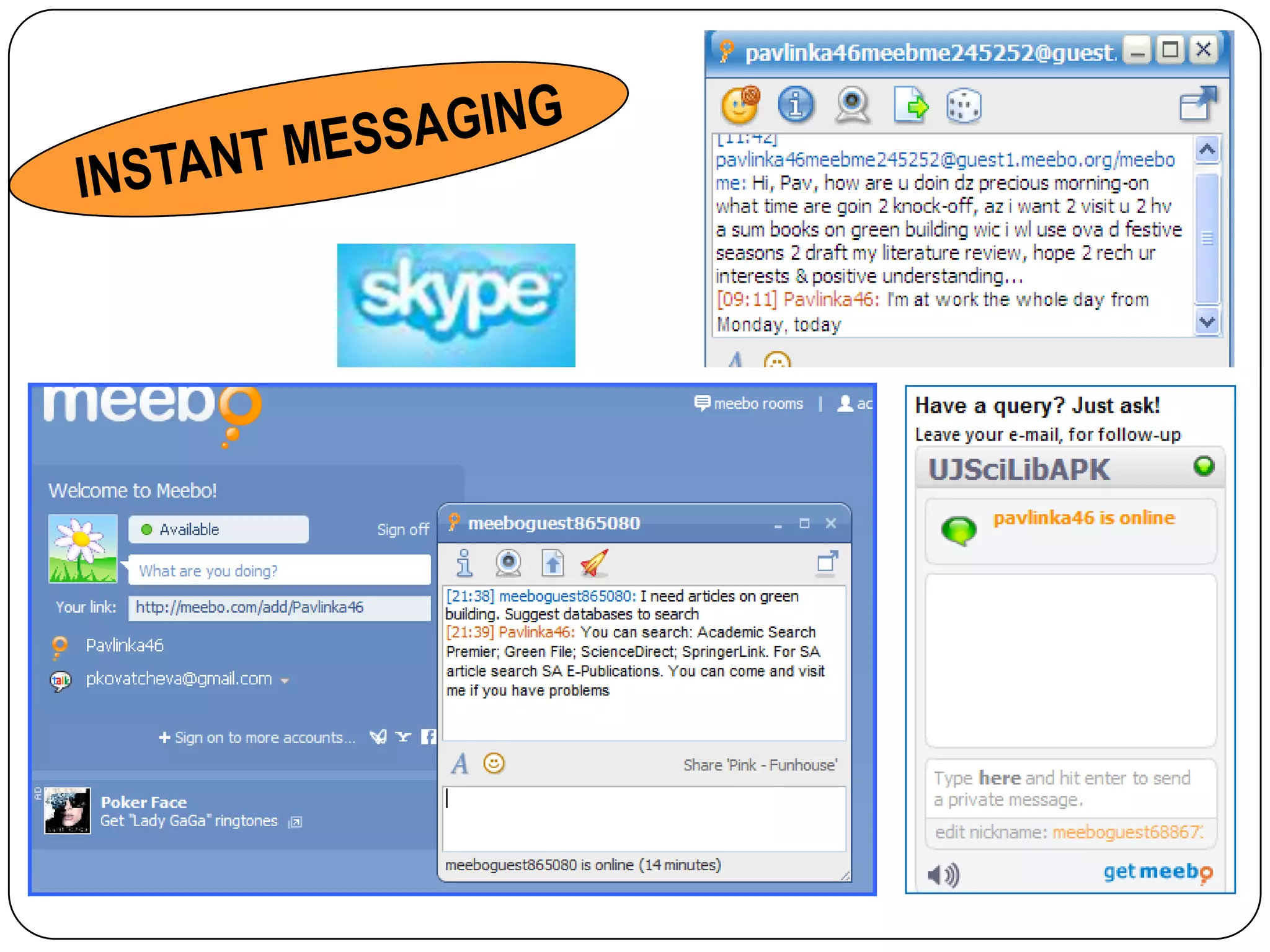
- UJ Sciences Librarian Blog (Oct’07)        - IM/Chat account: MeeboMe (Feb’09)
- UJ Librarian News Blog (Oct’ 07)           - Embedded Widgets on the Portal (IM; Blogs;
- Delicious: tag articles (Oct’ 07)          Twitter; Delicious; Google widgets, etc.)
- Flickr account (Nov’ 07)                   Some more experiments:
- YouTube account (Dec’ 07)                  - iGoogle web profile (Apr’ 09)
- Wiki portal (Early’ 08)                    - Netvibes portal (May’09)
- Facebook profile (May’ 08)                 - Custom Search Engine for the Portal
- Second Live account (May’08)               - Library Google Maps (Aug’ 09)
- Mind Maps (Mid’ 08)
- Twitter (Sep’08)                                        Stage 3: 2010 +
- Library Thing account (Sep’ 08)            It all comes together within the:
- UJ Science Library News Blog (Oct’08)      - Virtual Learning Environment
- Technorati; Snap Shots; Share This;        - Embedding Library Services
Scribd, LinkedIn, many more …..              - Mobile Technologies
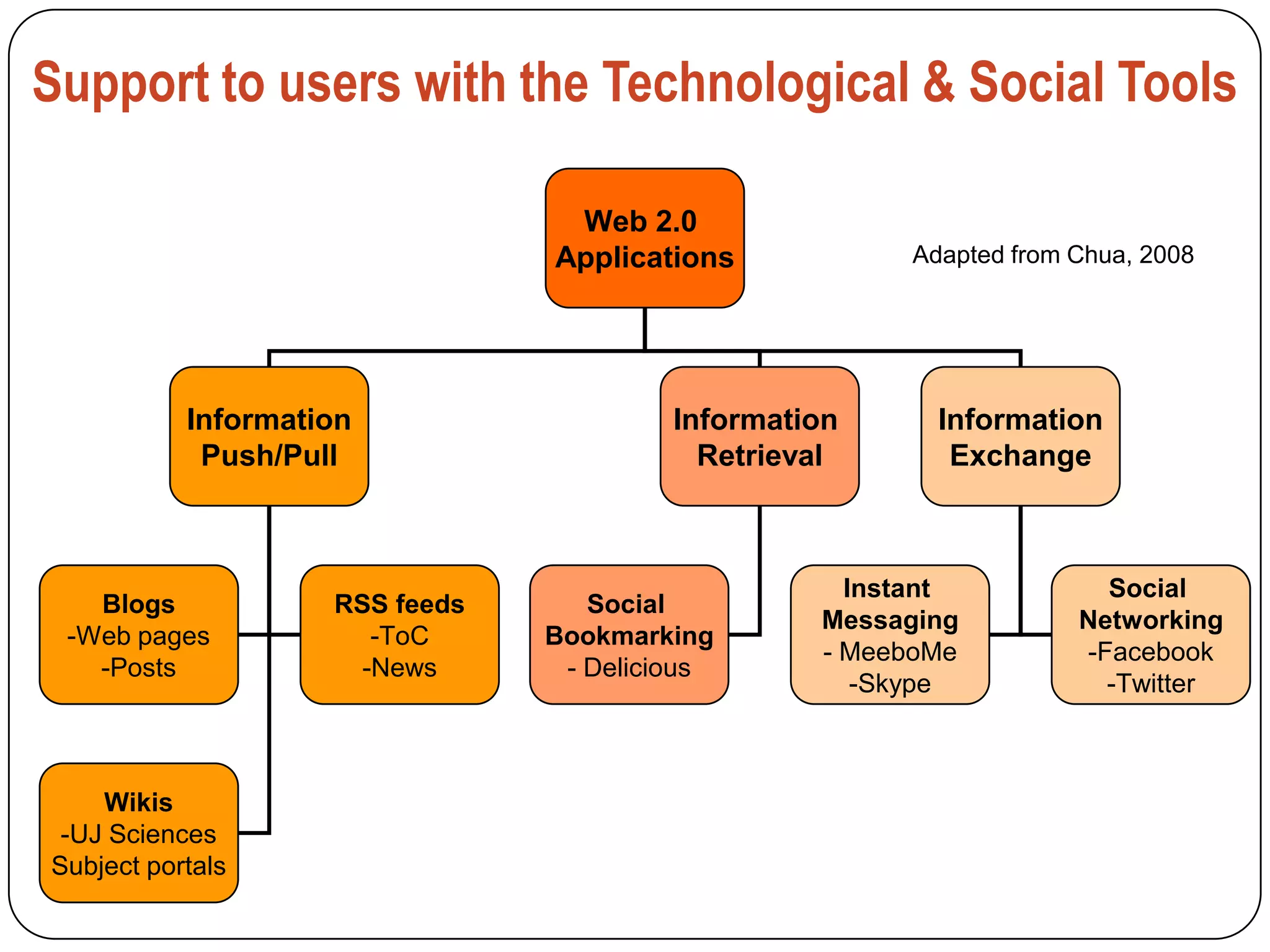
Support to users with the Technological & Social Tools

                                 Web 2.0
                                Applications           Adapted from Chua, 2008


           Information                   Information     Information
            Push/Pull                      Retrieval      Exchange


                                                    Instant           Social
   Blogs            RSS feeds      Social
                                                  Messaging         Networking
 -Web pages            -ToC     Bookmarking
                                                  - MeeboMe         -Facebook
   -Posts             -News      - Delicious
                                                     -Skype           -Twitter


    Wikis
 -UJ Sciences
Subject portals
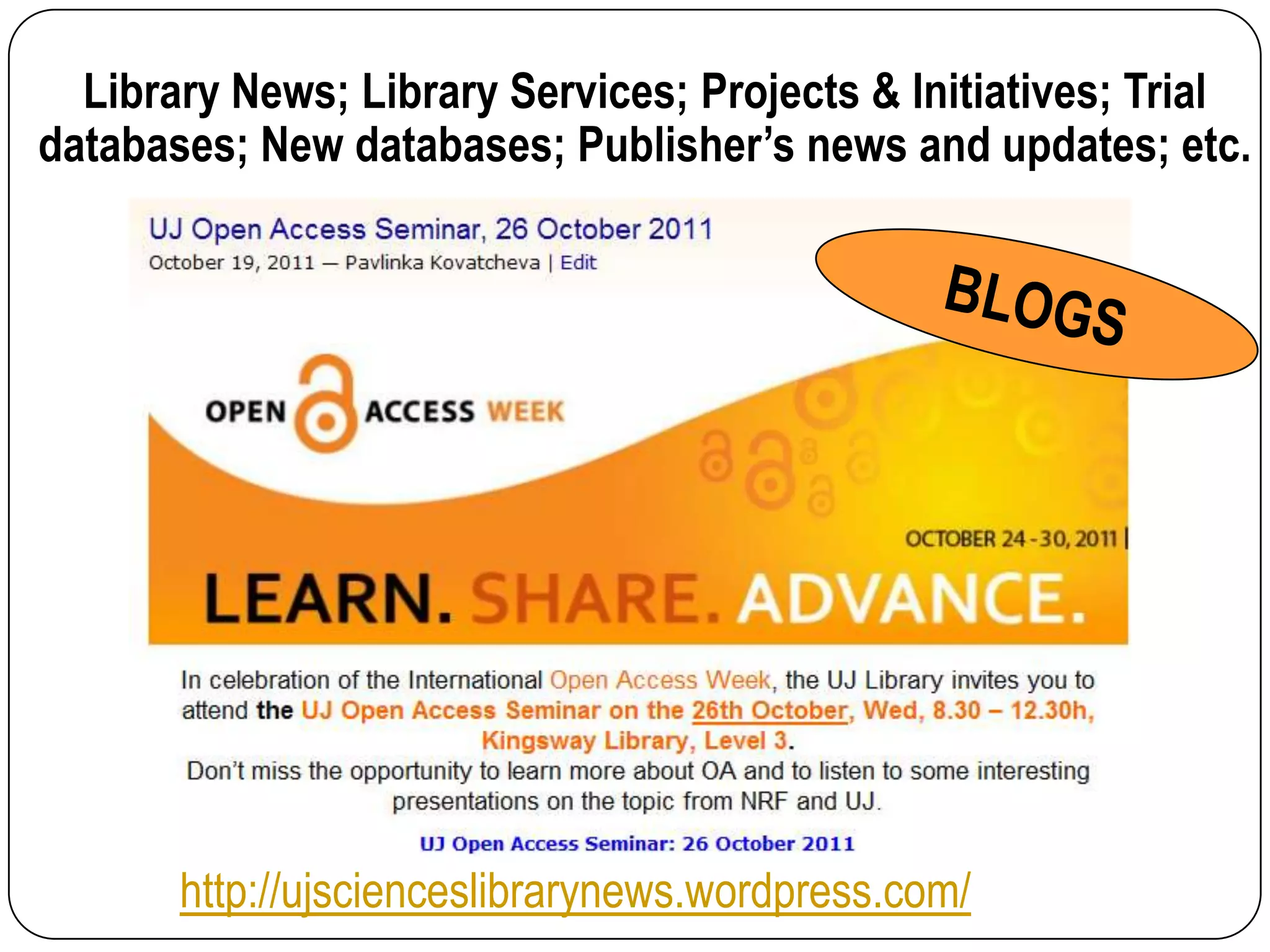
Library News; Library Services; Projects & Initiatives; Trial
databases; New databases; Publisher’s news and updates; etc.


       http://ujscienceslibrarynews.wordpress.com/
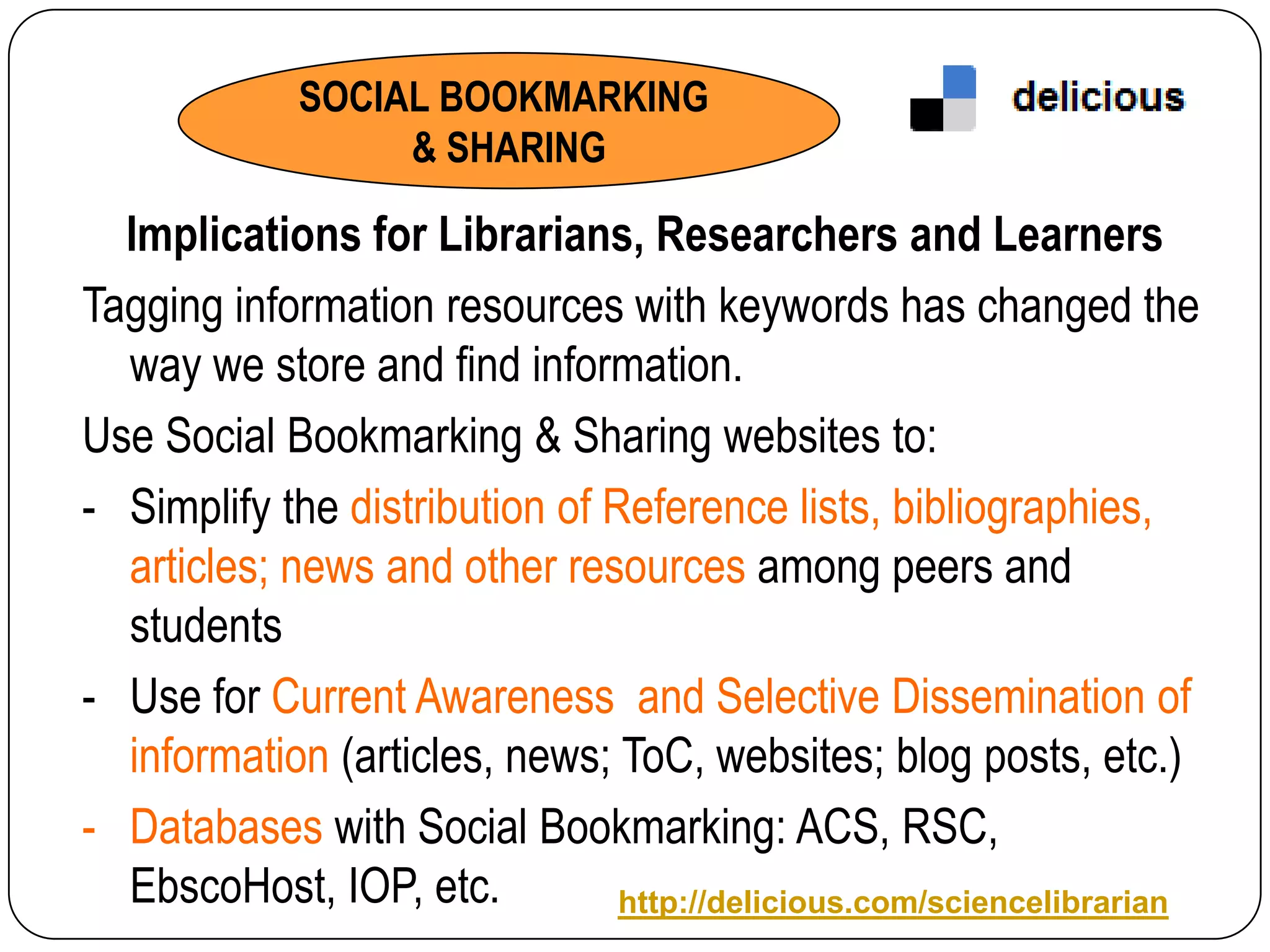
SOCIAL BOOKMARKING
                  & SHARING

  Implications for Librarians, Researchers and Learners
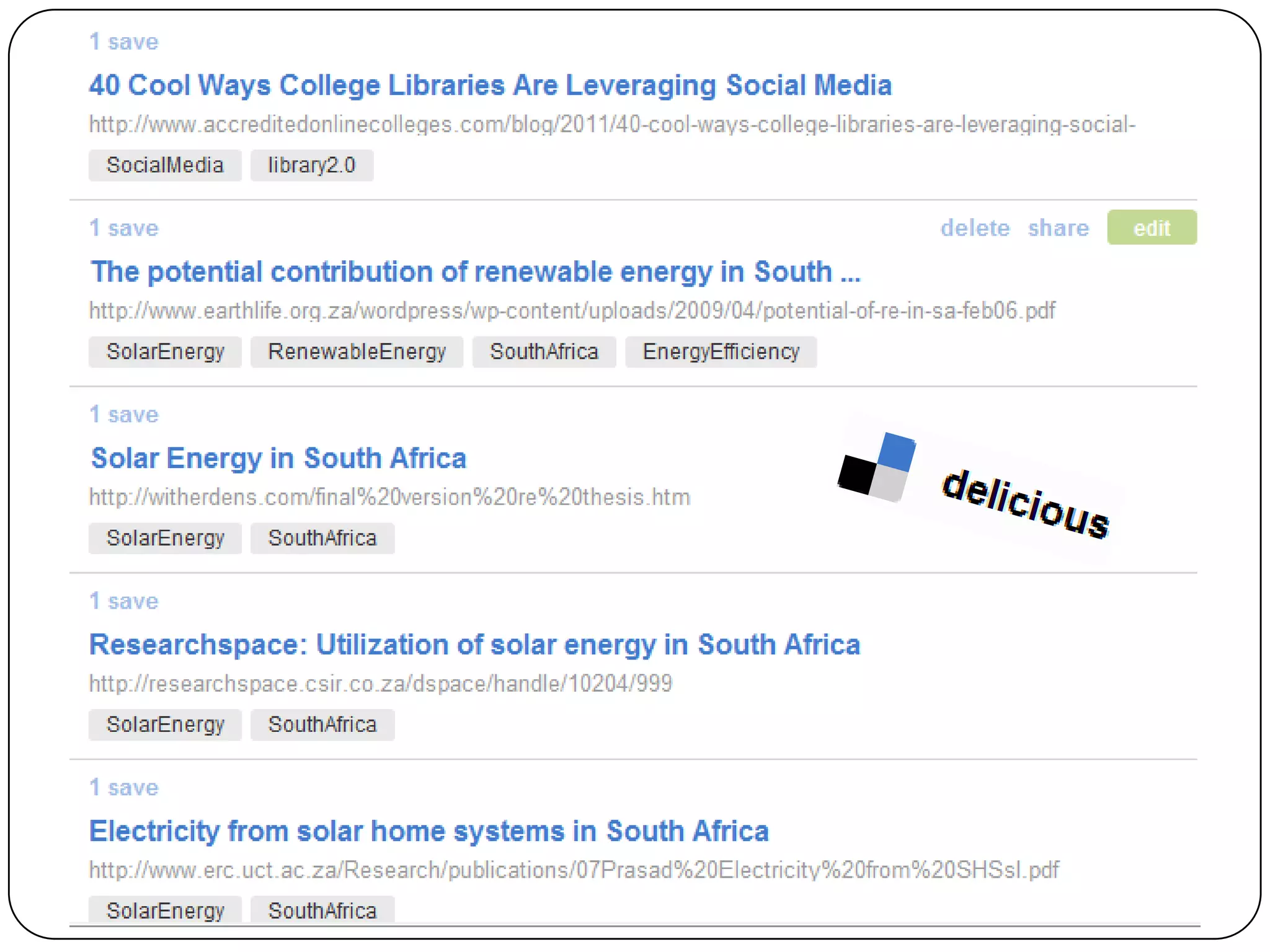
Tagging information resources with keywords has changed the
  way we store and find information.
Use Social Bookmarking & Sharing websites to:
- Simplify the distribution of Reference lists, bibliographies,
  articles; news and other resources among peers and
  students
- Use for Current Awareness and Selective Dissemination of
  information (articles, news; ToC, websites; blog posts, etc.)
- Databases with Social Bookmarking: ACS, RSC,
  EbscoHost, IOP, etc.          http://delicious.com/sciencelibrarian
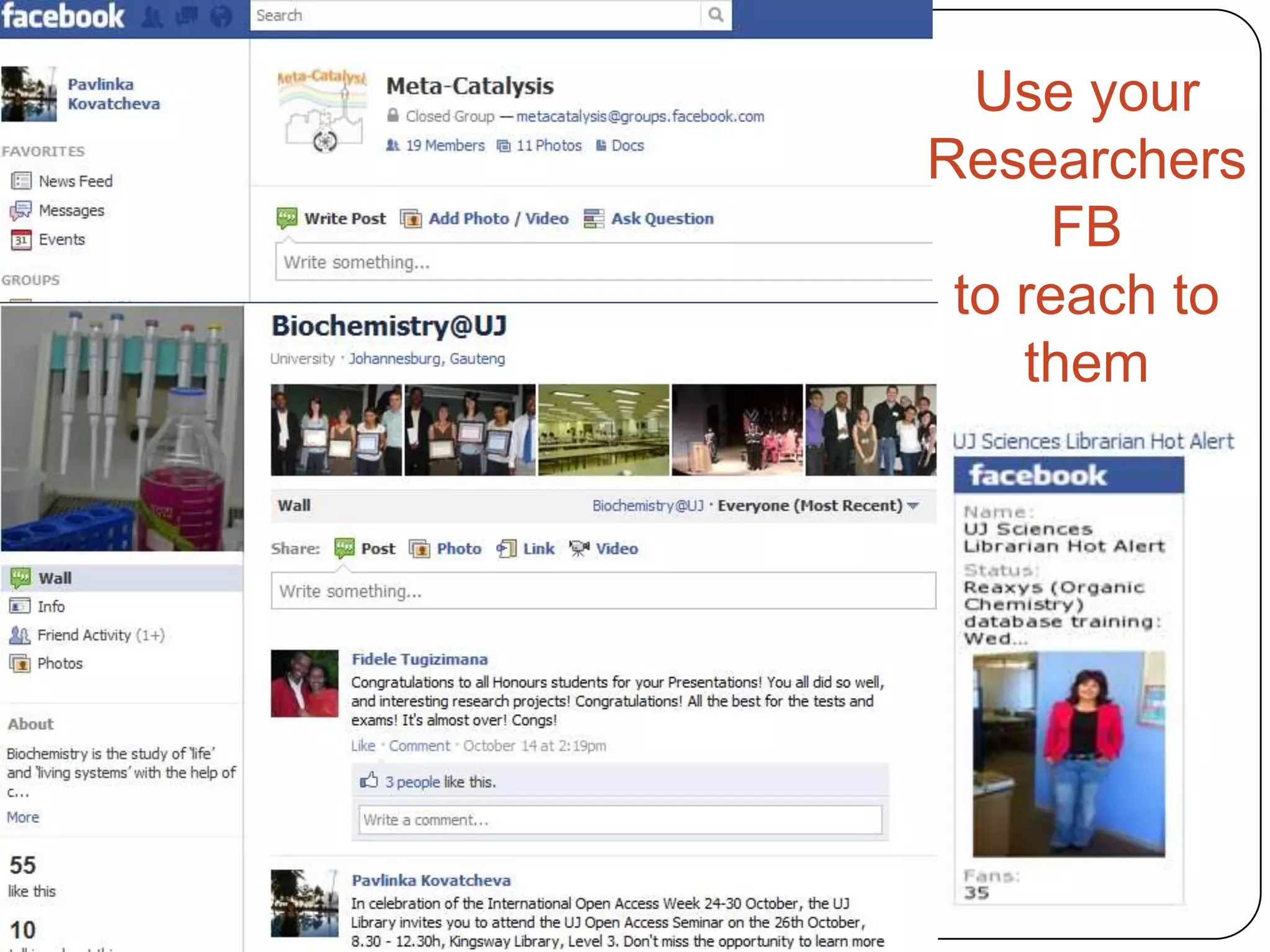
Use your
Researchers
     FB
 to reach to
    them
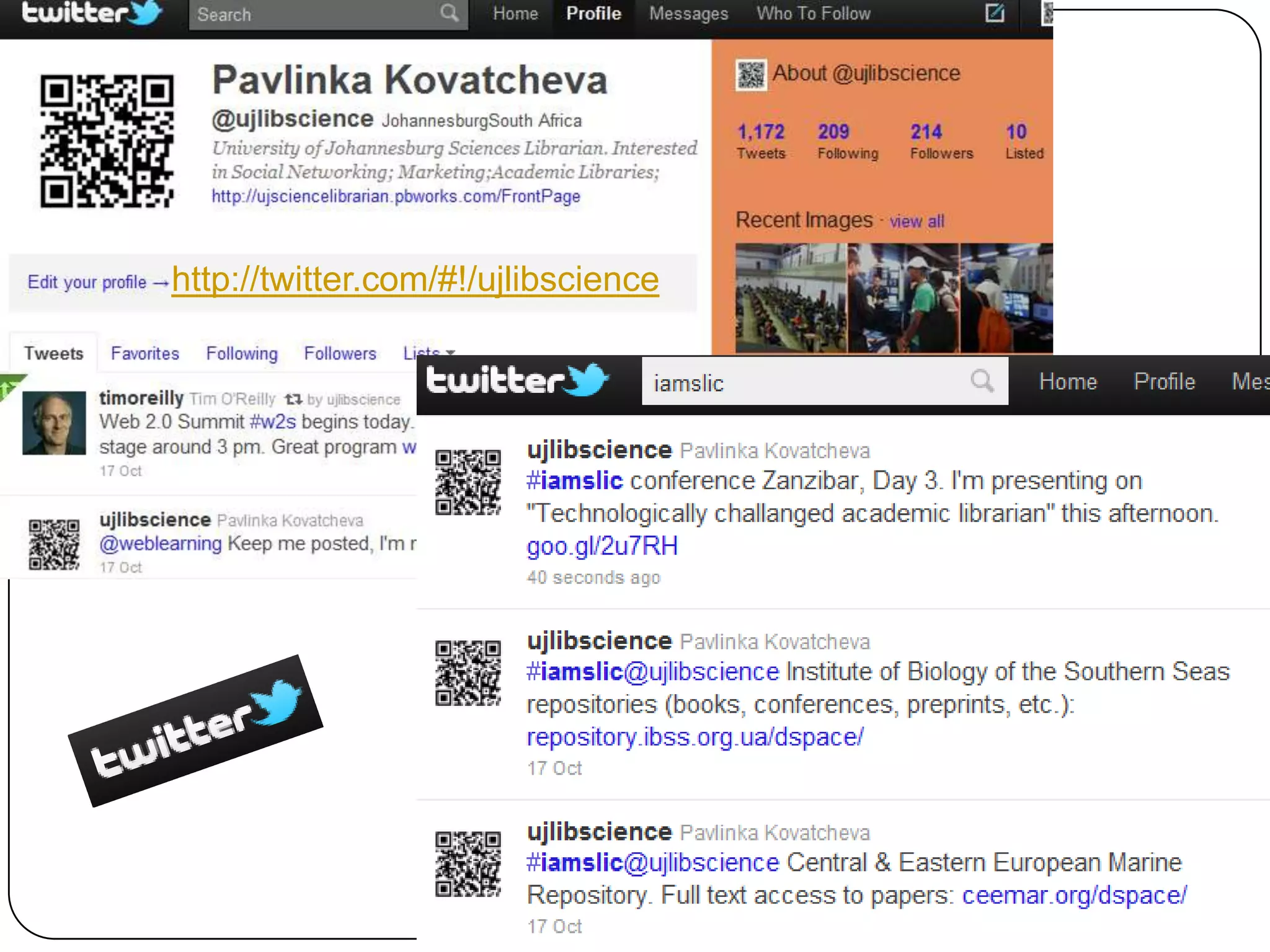
http://twitter.com/#!/ujlibscience
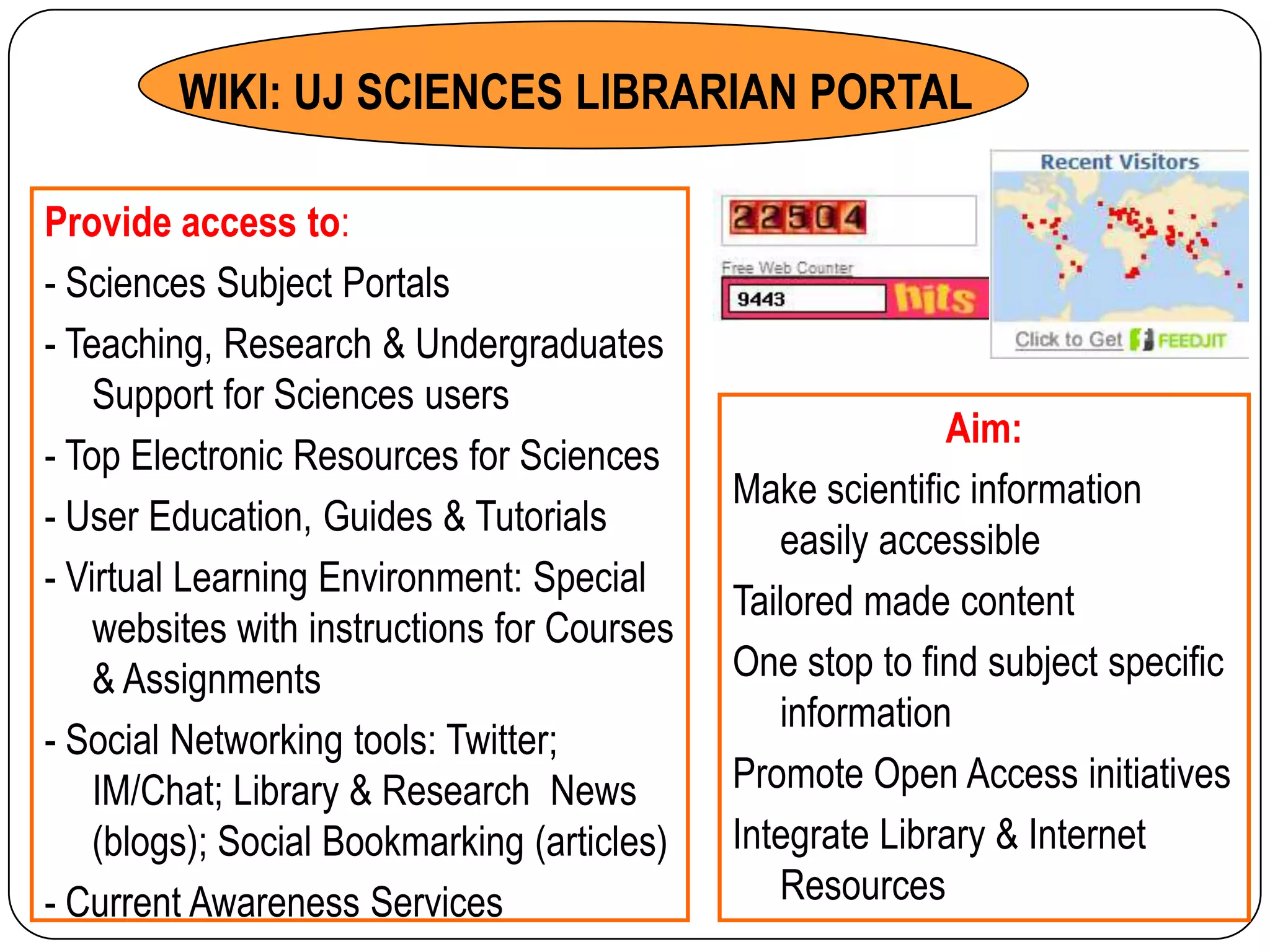
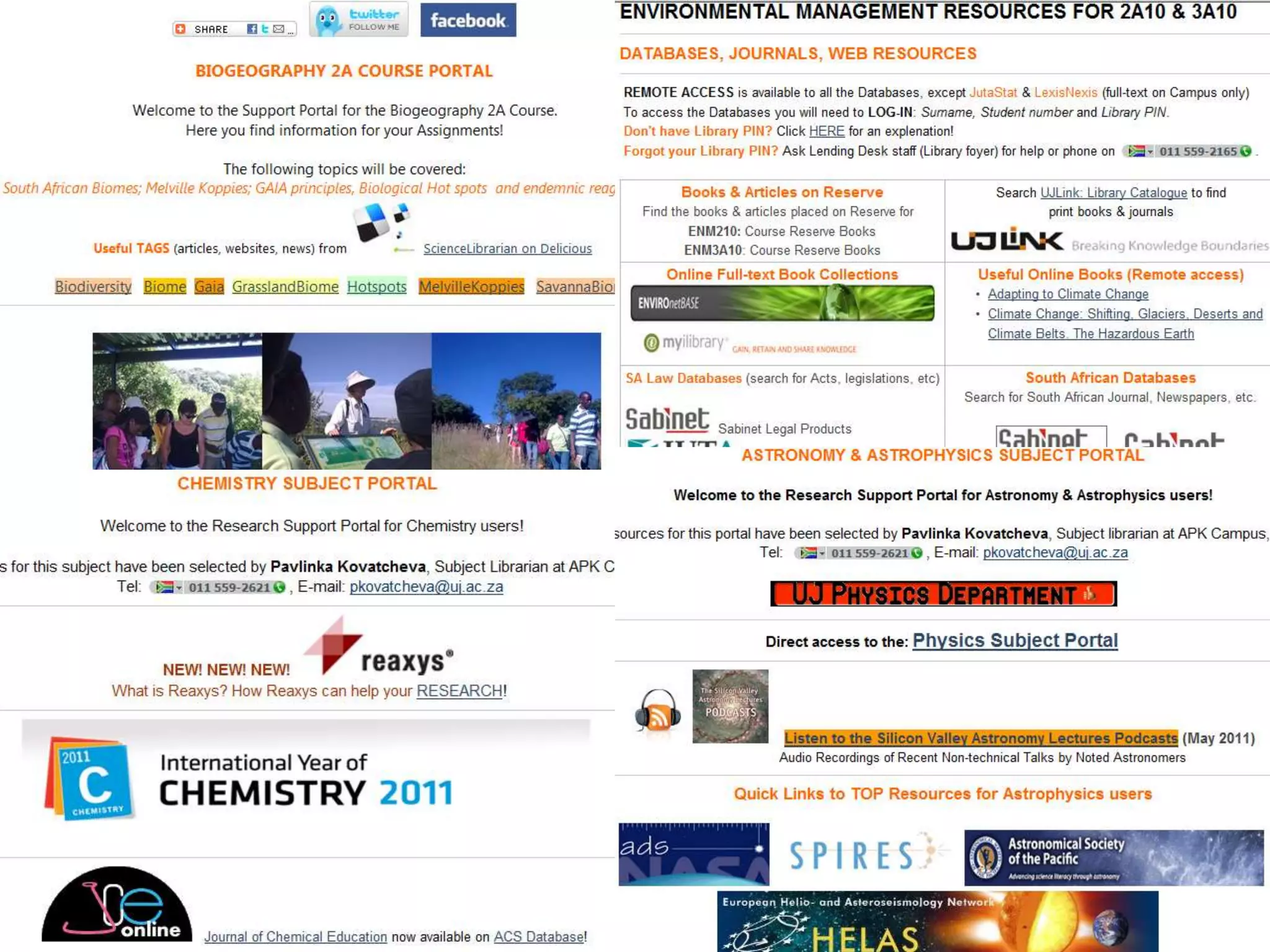
WIKI: UJ SCIENCES LIBRARIAN PORTAL

Provide access to:
- Sciences Subject Portals
- Teaching, Research & Undergraduates
    Support for Sciences users
                                                           Aim:
- Top Electronic Resources for Sciences
                                             Make scientific information
- User Education, Guides & Tutorials
                                                easily accessible
- Virtual Learning Environment: Special
                                             Tailored made content
    websites with instructions for Courses
    & Assignments                            One stop to find subject specific
                                                information
- Social Networking tools: Twitter;
    IM/Chat; Library & Research News         Promote Open Access initiatives
    (blogs); Social Bookmarking (articles)   Integrate Library & Internet
- Current Awareness Services                    Resources
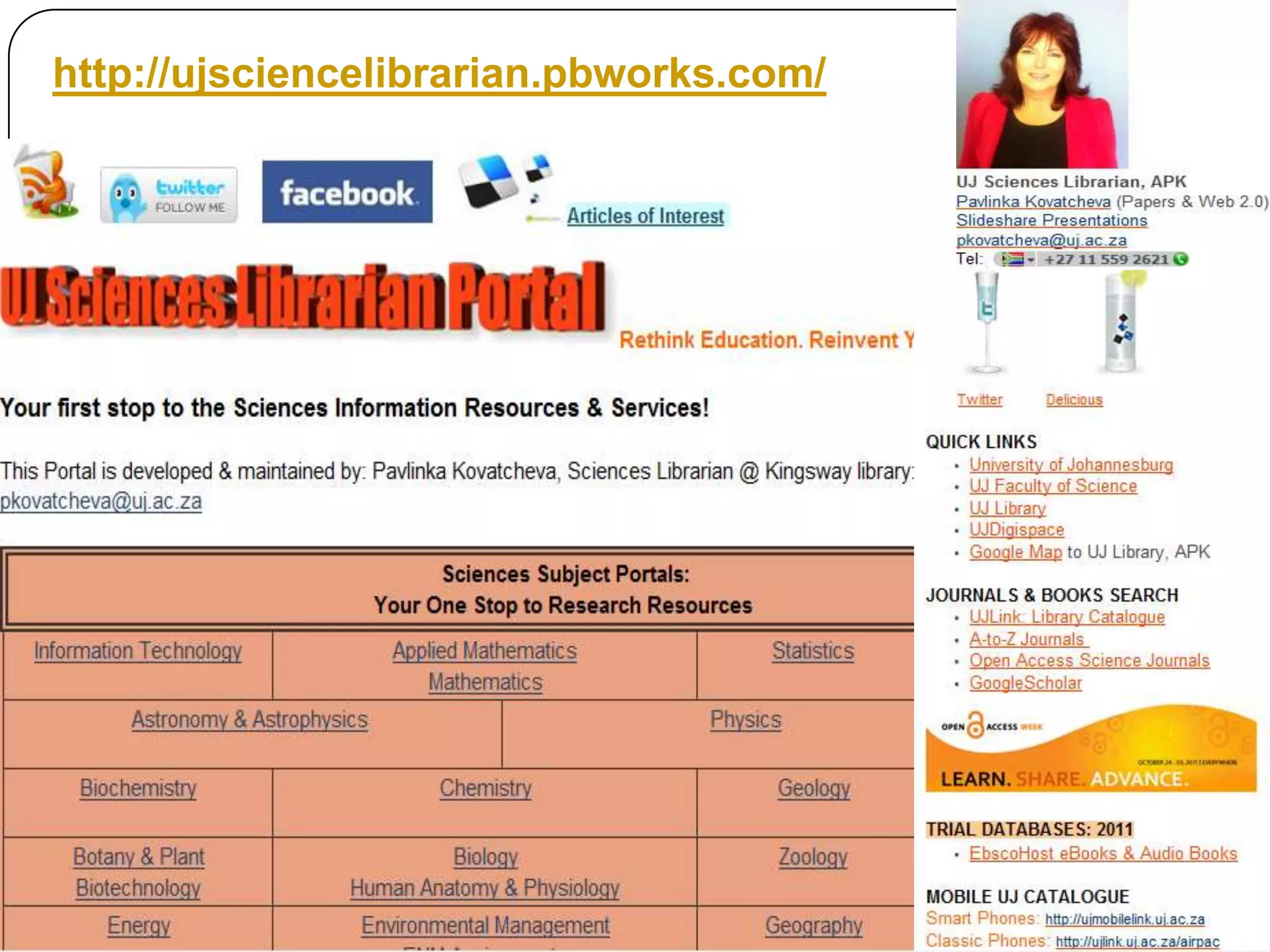
http://ujsciencelibrarian.pbworks.com/
http://ujsciencelibrarian.pbwiki.com/Zoology
The Transformation of a
   Science Librarian


 The Mobile experience
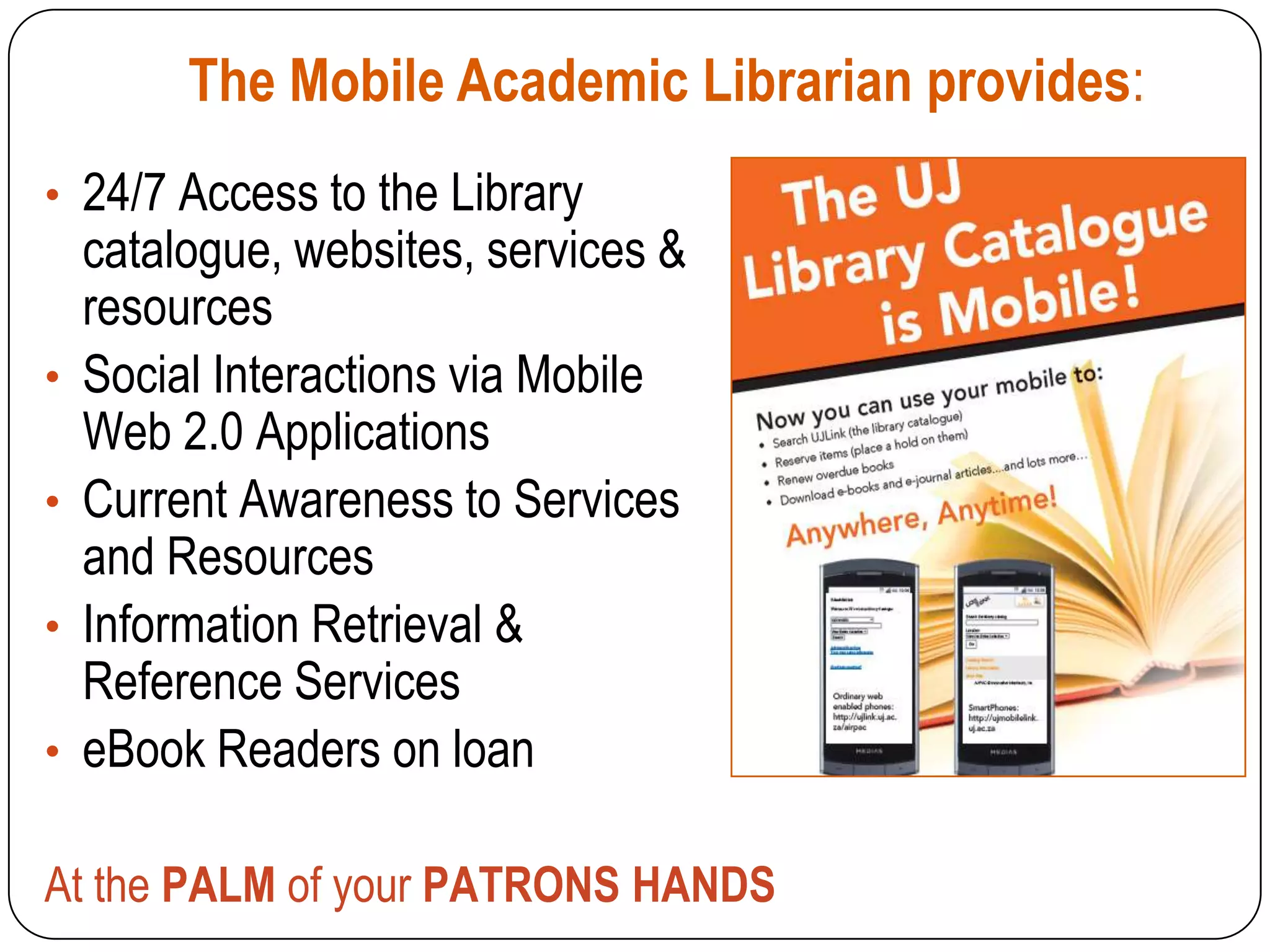
The Mobile Academic Librarian provides:
• 24/7 Access to the Library
    catalogue, websites, services &
    resources
•   Social Interactions via Mobile
    Web 2.0 Applications
•   Current Awareness to Services
    and Resources
•   Information Retrieval &
    Reference Services
•   eBook Readers on loan

At the PALM of your PATRONS HANDS
Why make use of the Web 2.0 Apps on your Mobile?
 Bridging the GAP in being connected & informed
 You are the Librarian on the GO!
 Increase the visibility of the Library & yourself as a librarian
 You are connected at any time to your Social Network community
 Use Twitter to tweet or re-tweet from
  conferences, workshops, while waiting in a queue or just walking
 Push notifications keeps you up-to-date with the latest news an
  developments in any area of interest
 To be able to train and advice your patrons of what they can
  access on their Mobile
 Mobile Access to Online books, Locations, Educational
  Applications, Entertainment, Research; Latest
  news, Chats, Photo sharing, Google are at the palm of your
  hand.
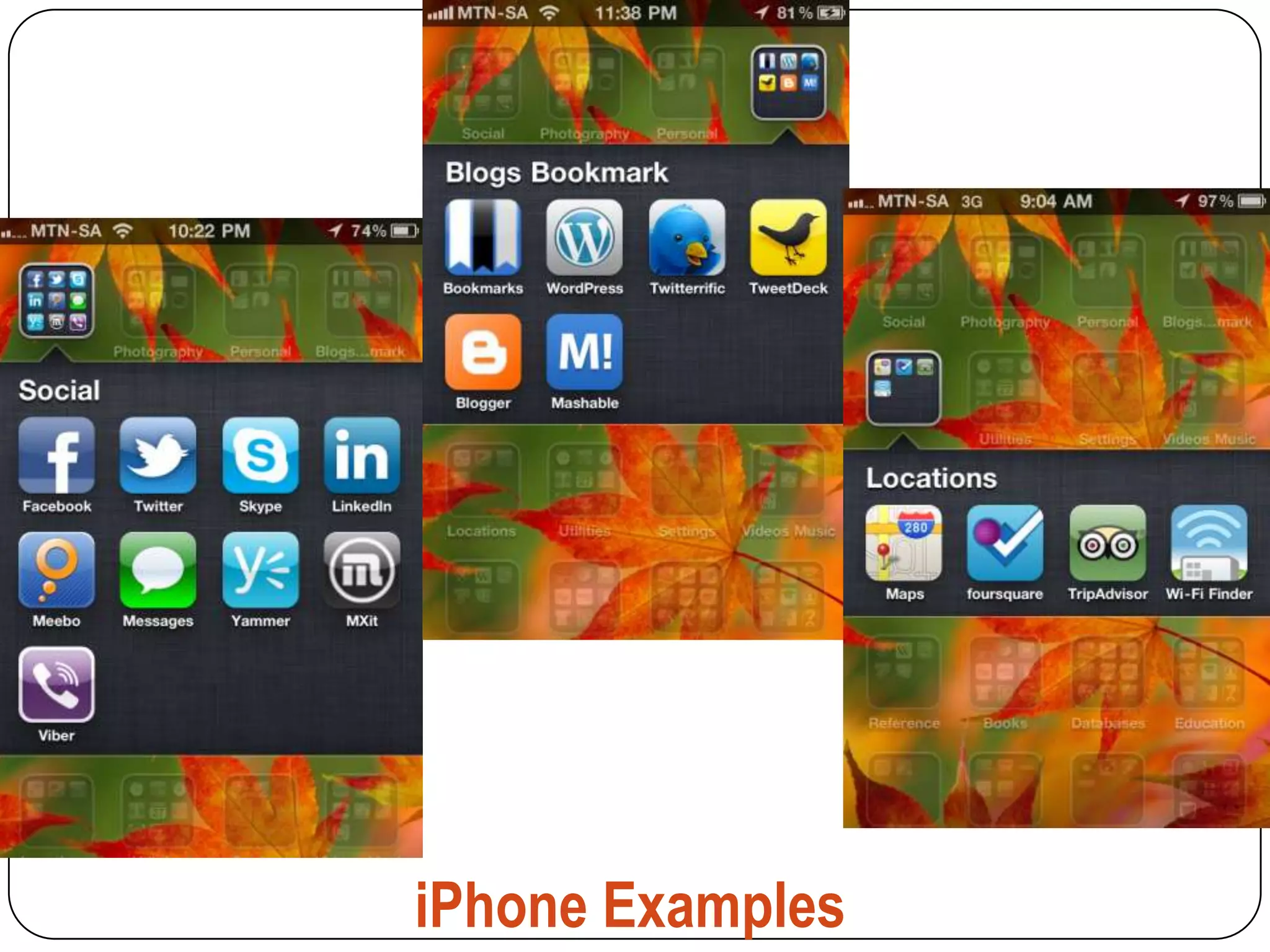
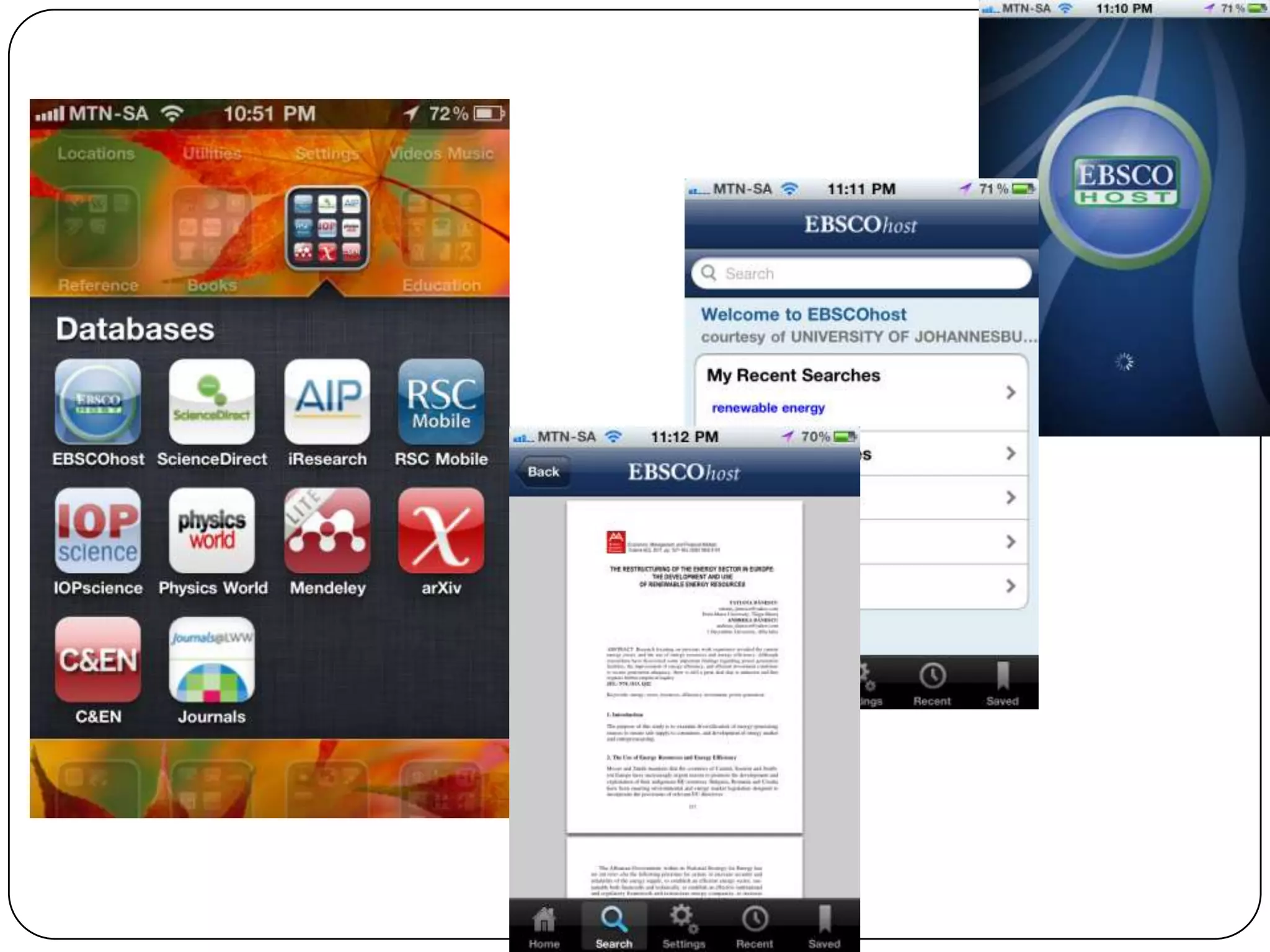
iPhone Examples
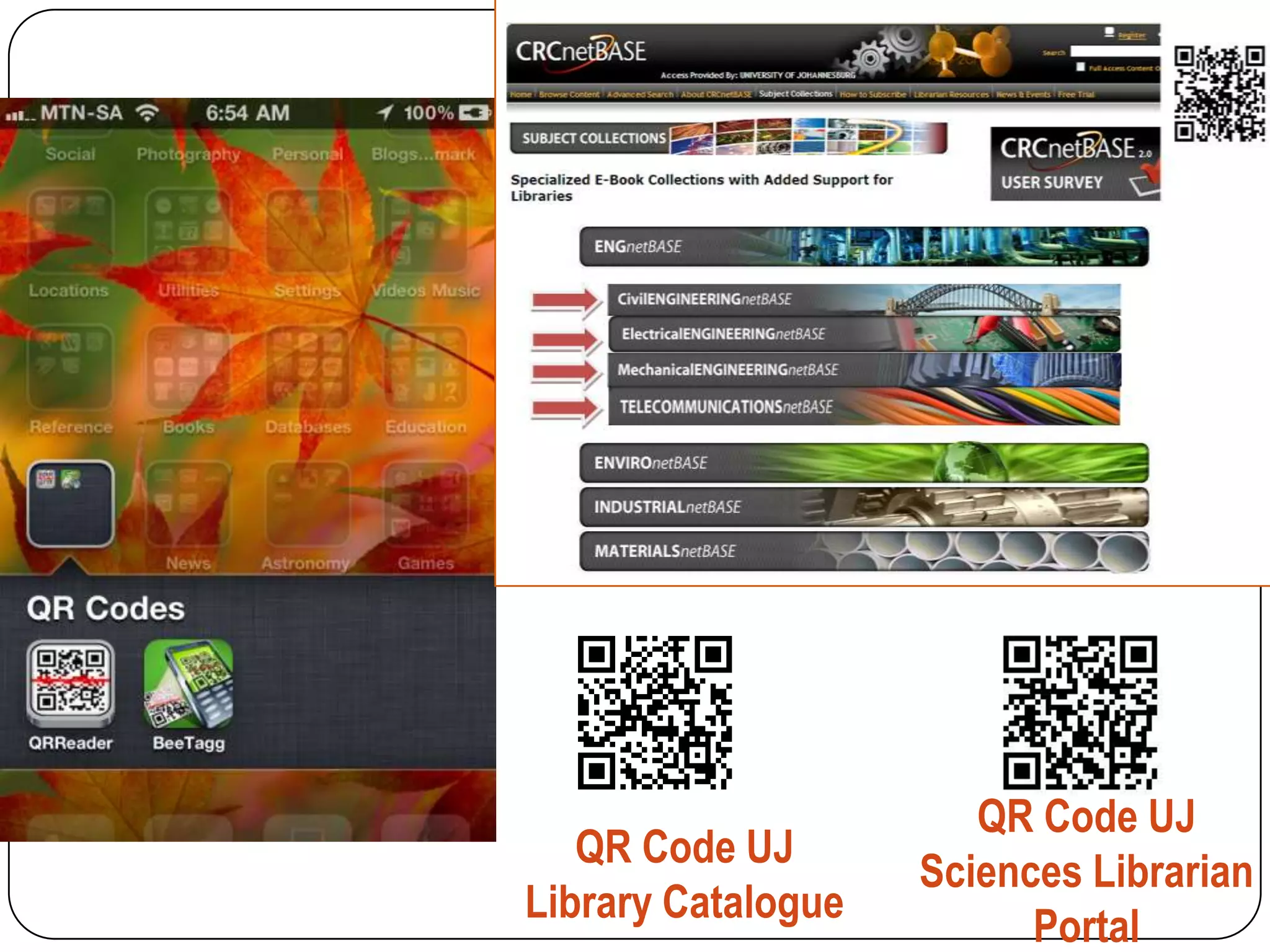
QR Code UJ
   QR Code UJ
                    Sciences Librarian
Library Catalogue
                          Portal
The Transformation of a
         Science Librarian
     The embedded experience
  “Embedded librarianship takes a librarian out of the
context of the traditional library and places him/her in an
     “on-site” setting or situation that enables close
   coordination and collaboration with researchers or
       teaching faculty” (Carlson & Kneale, 2011)
Embedded Librarianship is about …. (1)
     a Partnership with your Faculty and Students
Build relationships & increase the visibility of the
  Library Services by:
 Providing Information literacy instruction away from the
  Library facility (Lecture hall; Laboratories; Offices or
  Research facilities)
 Collaborate with the Faculty members on students’
  research projects (Library-Subject based assignments)
 Make use of Virtual Learning Environment to reach to
  students in their study space
 Attend faculty Workshops, Open
  Lecturers, Seminars, Classes and Practical tutorials
Embedded Librarianship is about …. (2)
      a Partnership with your Faculty and Students
Build relationships & increase the visibility of the
  library services by:
 Attend Faculty Board and Departmental meetings to
  learn about the latest on Research & Teaching, and
  information needs of its members
 Work together with Faculty to enhance the library
  presence in all relevant places.
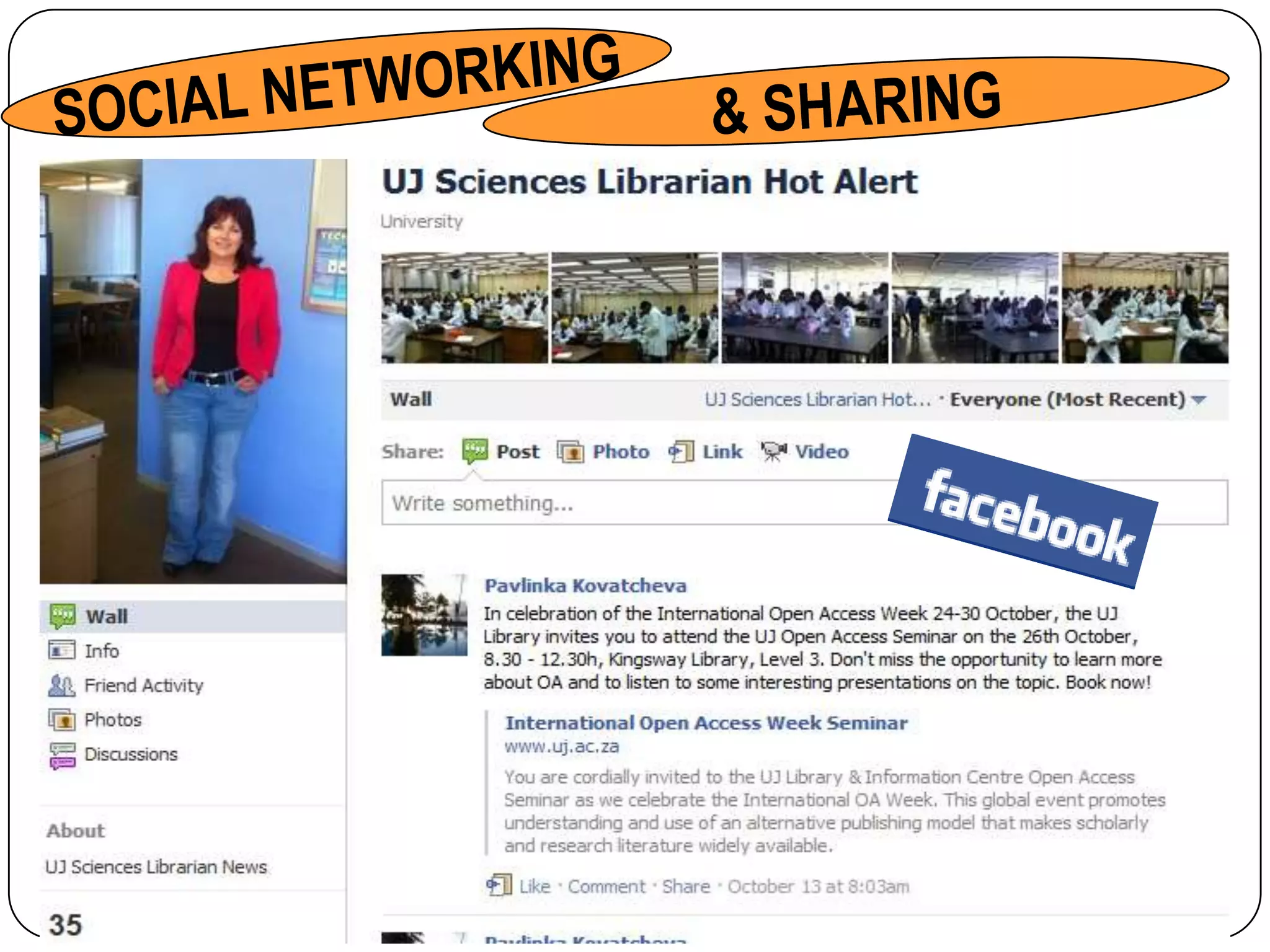
 Outreach to users by using Social Networking tools to
  communicate, share and collaborate.
 Make use of Mobile technologies to connect and
  provide services to patrons
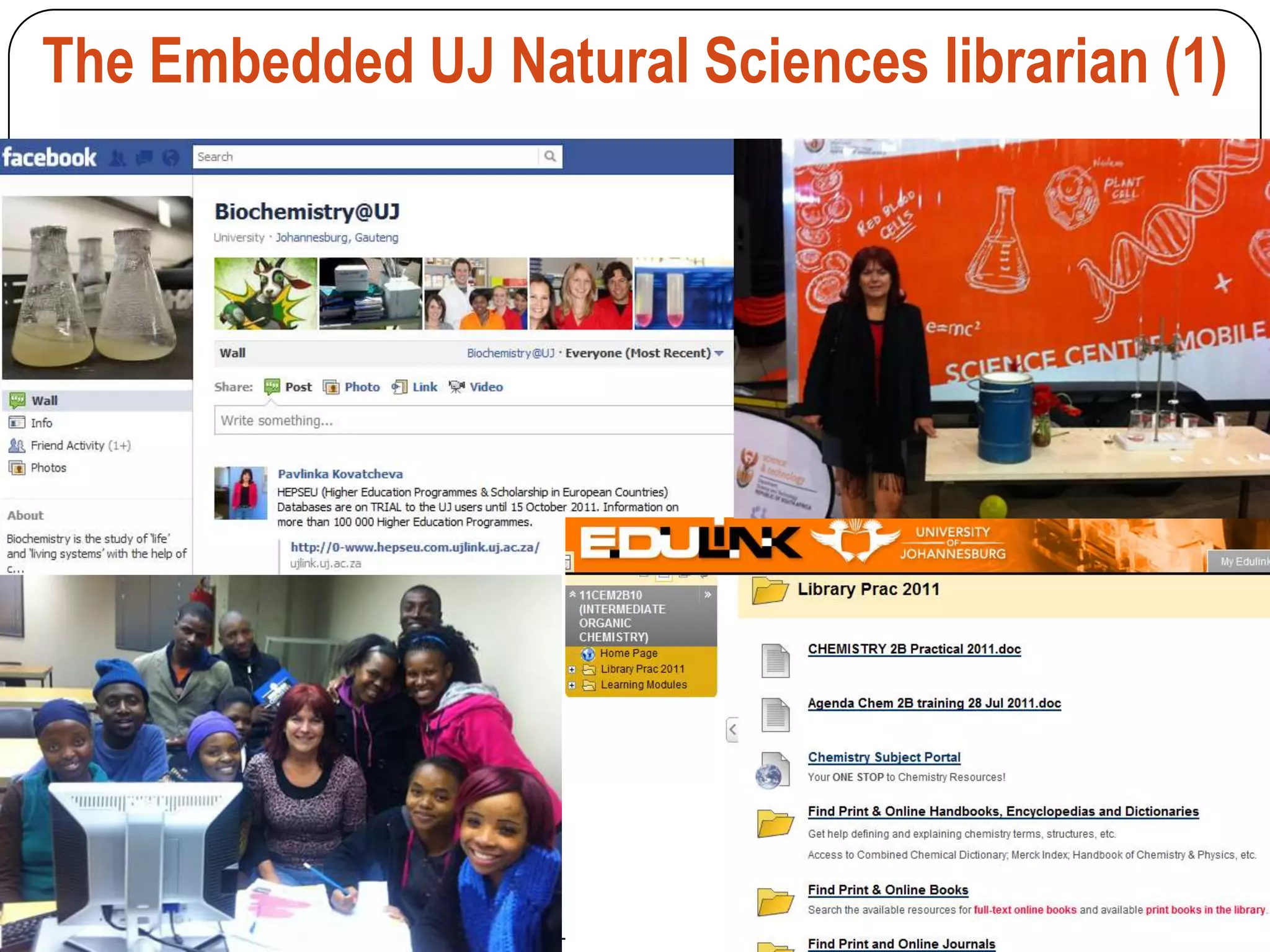
The Embedded UJ Natural Sciences librarian (1)
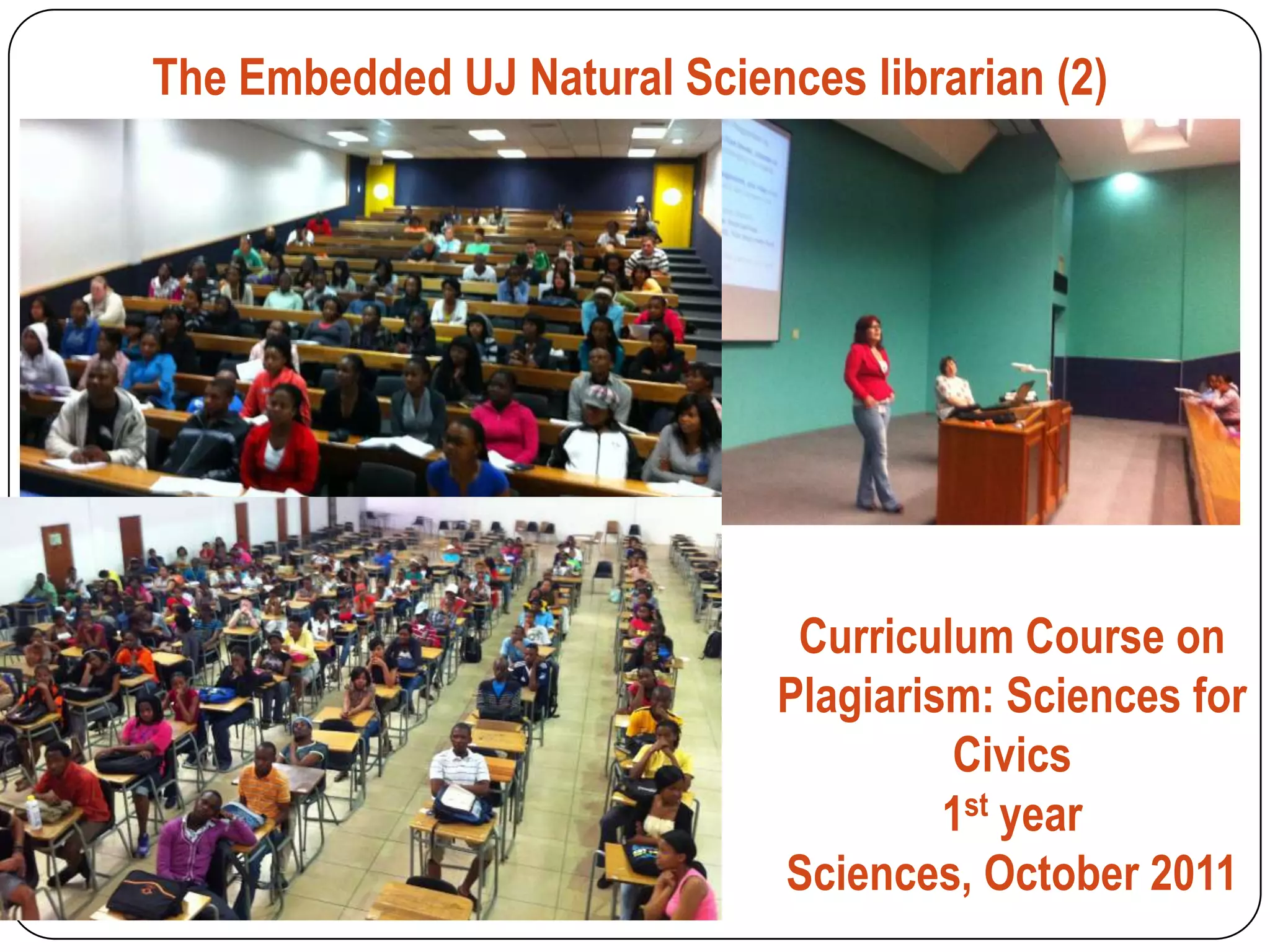
The Embedded UJ Natural Sciences librarian (2)


                               Curriculum Course on
                              Plagiarism: Sciences for
                                       Civics
                                       1st year
                              Sciences, October 2011
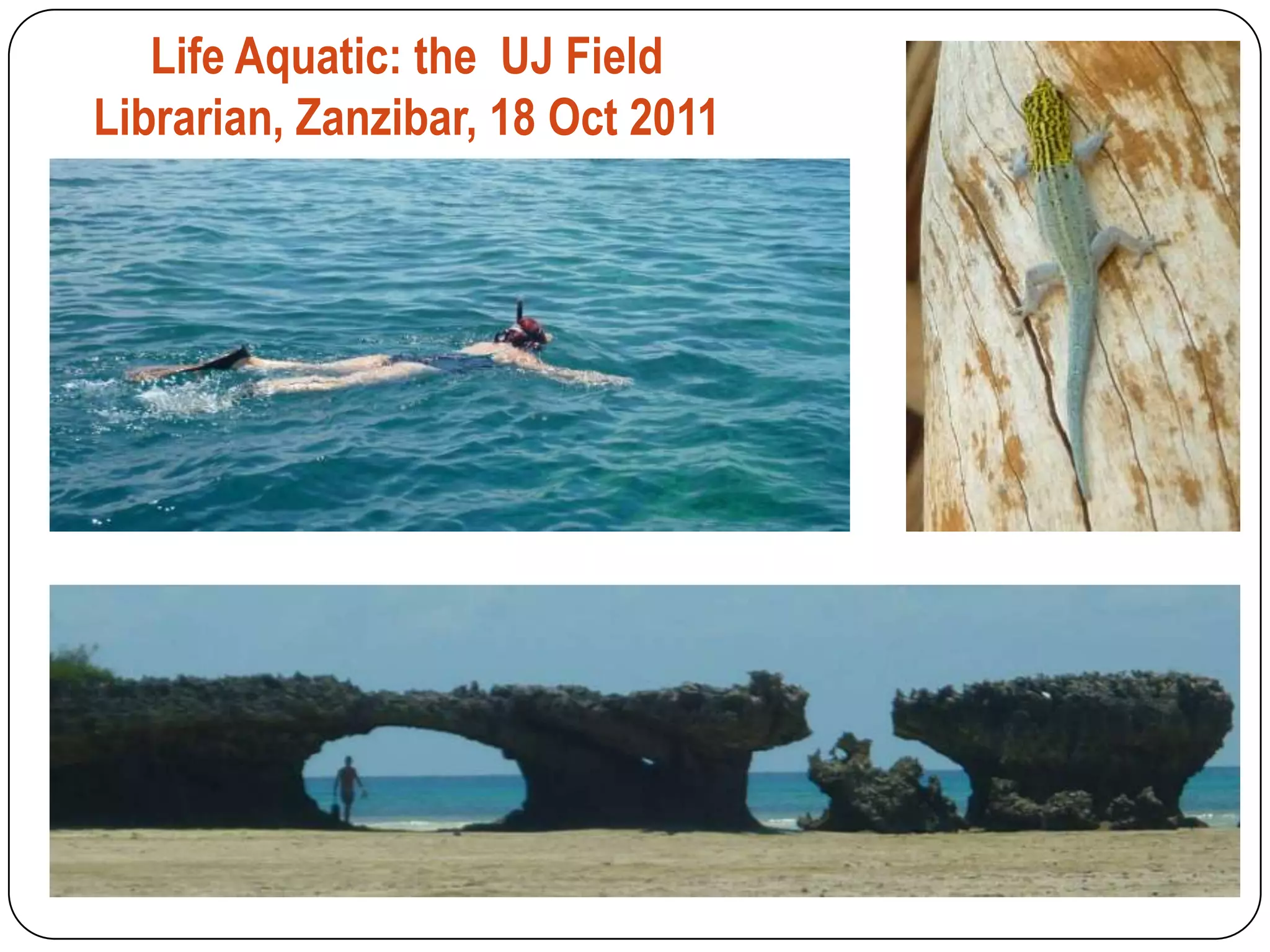
Life Aquatic: the UJ Field
Librarian, Zanzibar, 18 Oct 2011
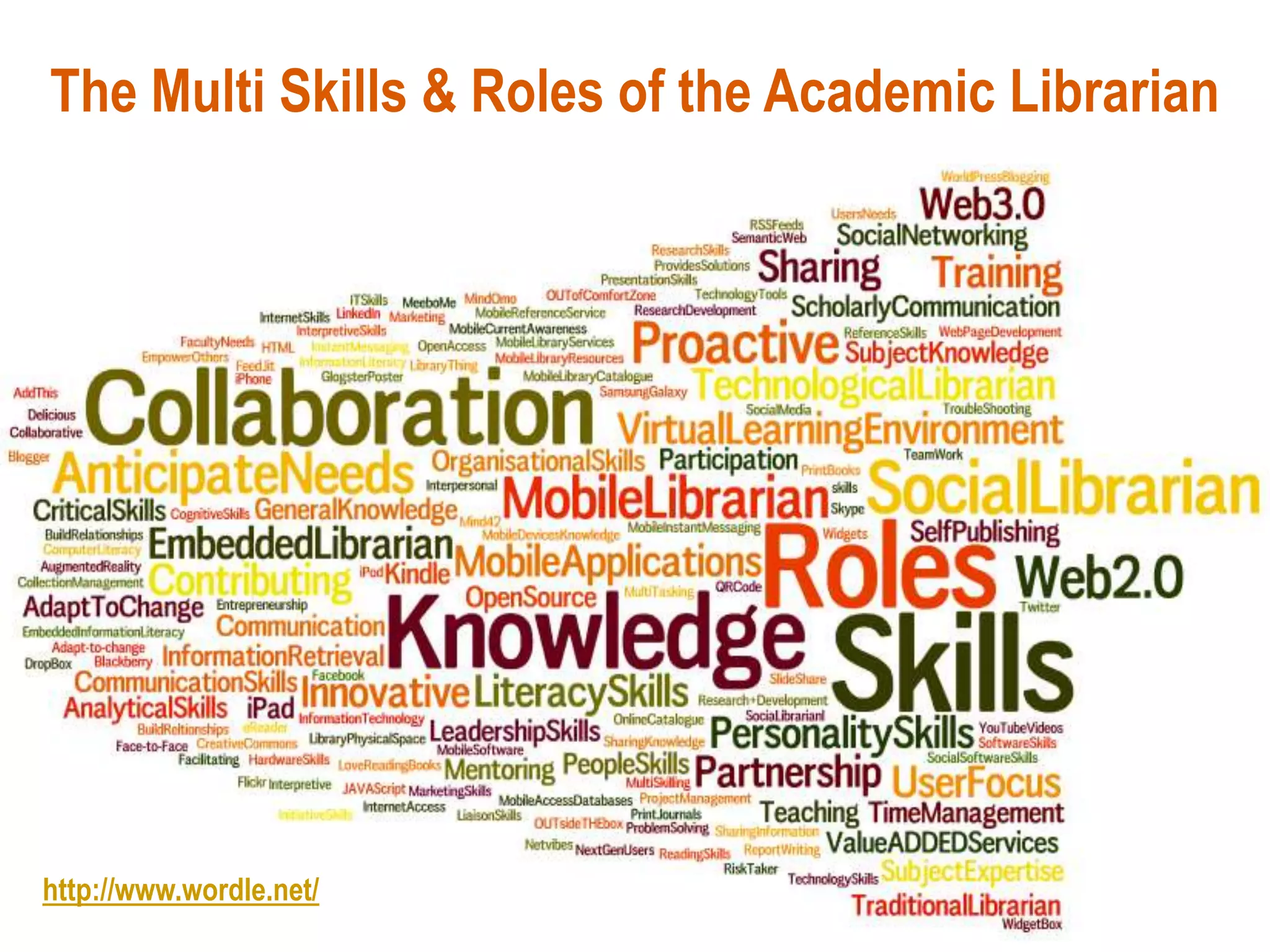
The Multi Skills & Roles of the Academic Librarian


http://www.wordle.net/
In Conclusion
 The Academic librarians are challenged on so many
  levels
 If we want to stay current we need to adapt to the
  changing world and the new research environments
 The library patrons use new tools to find and retrieve
  information, the librarians should lead the change and
  not be left behind
 Skills are learned, change is possible, social & mobile
  tools can be very helpful and we, the librarians, are
  still current and competitive

                   THANK YOU

The Technologically Challenged Academic Librarian: What has changed in the provision of information services in the age of social interactions?

  • 1.
    The Technologically ChallengedAcademic Librarian: What has changed in the provision of information services in the age of social interactions? Pavlinka Kovatcheva, Faculty Librarian: Natural Sciences pkovatcheva@uj.ac.za University of Johannesburg, South Africa IAMSLIC Conference 19 October 2011, Zanzibar, Tanzania
  • 3.
  • 4.
    The South AfricanHigher Education  2003-2004 started with reforms in the HE  Mergers/Incorporation of small Universities /Technikons into Larger Institutions  From 32 to 21 Public Universities  Divided into three type of Universities - Traditional Universities (Theoretically oriented) - Universities of Technologies (Vocational/Practical) - Comprehensive Universities (Combination of both)  Large in student numbers  Focus on Research  Focus on 1st generation students
  • 5.
    Top Africa UniversitiesRanking (Jul 2011) http://www.webometrics.info/top100_continent.asp?cont=afric a
  • 6.
    South African Research:Subject Areas (2009-2010) http://www.scimagojr.com/aboutus.php
  • 7.
    Country Ranking: Researchin Aquatic Science (2010)
  • 8.
    Country Ranking: Researchin Animal Science & Zoology (2010)
  • 9.
    University of Johannesburg Faculty of Science & the Department of Zoology
  • 10.
    The University ofJohannesburg The University of Johannesburg came in existence from a merger between the Technikon Witwatersrand, Rand Afrikaans University and Vista Universities in 2005. •Over 45,000 students •9 Faculties on 4 Campuses •5 Academic Libraries Challenges for the SA Education: •Poverty and Crime •Cultural and Language diversity •Urban vs Rural education •Access to Internet and Bandwidth http://www.uj.ac.za/ •Information and Computer Literacy
  • 11.
    UJ Faculty ofScience overview  14 Departments Up-to 90 Rated Researchers in 2010  2 Campuses  2010 - 151 permanent & 79 non-permanent academics  94.5% of the Academics are with Masters  56.3% are with Doctorate degrees 2010 Science Students Enrolment - Undergraduates 2332 - Postgraduates 584 http://www.uj.ac.za/EN/Faculties/science/Pages/default.aspx
  • 12.
    UJ Zoology Department In existence for 43 year  Currently 10 academic staff members & 6 support staff  Research active department  Published almost 1000 manuscripts  Well known for its work in freshwater biology, specifically with regard to biodiversity of freshwater animals and the effect of pollutants on the histology, morphology and physiology of animals.  Lectures in Zoology, Human Physiology, Human Anatomy, Ocular Anatomy and Physiology and Microbiology – 17 semester courses, almost 750 undergrads and almost 60 postgrads students Source
  • 13.
    Zoology Department ResearchAreas (1)  Current Research in Genetics  Research in Fish Parasitology  The Centre for Aquatic Research (CAR) research projects focuses into the field of fresh water and estuarine ecotoxicology. - Hartbeespoort Dam Water Monitoring and Algae Management Program - Monitoring of metallic and organic pollutants along the South African coastline - Ecological Risk Assessment for pesticides at Vaal harts Irrigation Scheme - Marine Fish Parasitic Isopods from Southern Africa - Ecological Risk Assessment of Nanomaterials in the Aquatic Environment, etc.
  • 14.
    Zoology Department ResearchAreas (2)  Research in Fish Histopathology and Reproductive Biology  Research in Comparative Respiratory Functional Morphology FETWater programme in Rivers and Wetlands Aquarium facility Collaborations:  Students & Research Exchange with the University of Hong Kong  Collaboration with the University of Hokkaido, Sapporo, Japan
  • 15.
  • 16.
    Where does theUJ Aquatic Researchers Publish?  AFRICAN ZOOLOGY (ISI Accredited)  AFRICAN JOURNAL OF AQUATIC SCIENCE (ISI Accredited)  ECOTOXICOLOGY AND ENVIRONMENTAL SAFETY  ENVIRONMENTAL TOXICOLOGY  HUMAN AND ECOLOGICAL RISK ASSESSMENT  MARINE POLLUTION BULLETIN  PHYSICS AND CHEMISTRY OF THE EARTH  SOUTH AFRICAN JOURNAL OF SCIENCE (Open Access, ISI Accredited)  WATER SA (Open Access, Accredited Journal)
  • 17.
    Online resources for zoology users
  • 18.
    Online Resources forZoology Researchers http://ujsciencelibrarian.pbwiki.com/Zoology
  • 19.
  • 20.
    UJ Zoology DepartmentInstitutional Repository: UJDigispace http://ujdigispace.uj.ac.za:8080/dspace/
  • 21.
    Open Access ScienceDirectory http://atoz.ebsco.com/Titles/8623?lang=en&lang.menu=en&lang.subject=en
  • 22.
    the south Africanlibraries The university of Johannesburg library
  • 23.
    SA Libraries Initiatives UJ Library Highlights  National Consortium (SANLiC)  5 Libraries in 4 campuses  Library Associations (SAOUG;  Archive & Institutional LIASA; SLIS, etc.) Repository Collections  Carnegie Foundations for SA  Dewey project Libraries  Mobile project  Open Access in SA – SciElo  eReaders project  Institutional Repositories  One-book-One Library  Web 2.0 technologies project  Mobile technologies (iBala)  Open Access Seminar, 26 October 2011 http://www.scielo.org.za/
  • 24.
    The Transformation ofa Science Librarian A Web 2.0 experience The technological & social librarian
  • 25.
    The Metamorphosis Lifeof a Librarian  The 80s – The traditional role  The 90s – The transitional role  The 1st decade of the 21st Century - The growing online access to Information - The implementation of Web 2.0 Technologies - The increase use of Mobile Technologies - The practice of Embedded Librarianship  The 2nd decade of the 21st Century - It is all about Embedded Librarianship, Social Media, Mobile Devices & Applications, eReaders & Tablets, Open Access…. Adapting to the changing needs of patrons, make it a necessity for the libraries and librarians to embrace the new technologies.
  • 26.
    The transitional roleof the Modern Librarian The Traditional The Web 2.0 Librarian The Mobile Librarian Librarian do: make use of: provides: • Information Retrieval • Blogs • Library services on • Reference Services • Social Networking the GO! • User Education & • Social Bookmarking • Access to Mobile Information Literacy • RSS feeds Library • Collection • Wikis catalogues, websites Development • Instant Messaging , services & resources • Marketing the Library • Mind Maps Services & • Podcasts & Videos • 24/7 access Resources • Widgets • Social Interactions • Liaison with Library via Mobile Web 2.0 Applications stakeholders To ENHANCE her TRADITIONAL role by • Current Awareness Helps PATRONS within the Library Physical contributing, sharing and wall collaborating with patron To BRIDGE the GAP in
  • 27.
    UJ Sciences LibrarianWeb 2.0 Strategy Stage 1: 2007-2008 Stage 2: 2009 (Individual Experiments) (Integration + further experimentation) Created accounts to the following tools: Updated the Wiki Portal (Jan’ 09) - Over 45 web pages - UJ Sciences Librarian Blog (Oct’07) - IM/Chat account: MeeboMe (Feb’09) - UJ Librarian News Blog (Oct’ 07) - Embedded Widgets on the Portal (IM; Blogs; - Delicious: tag articles (Oct’ 07) Twitter; Delicious; Google widgets, etc.) - Flickr account (Nov’ 07) Some more experiments: - YouTube account (Dec’ 07) - iGoogle web profile (Apr’ 09) - Wiki portal (Early’ 08) - Netvibes portal (May’09) - Facebook profile (May’ 08) - Custom Search Engine for the Portal - Second Live account (May’08) - Library Google Maps (Aug’ 09) - Mind Maps (Mid’ 08) - Twitter (Sep’08) Stage 3: 2010 + - Library Thing account (Sep’ 08) It all comes together within the: - UJ Science Library News Blog (Oct’08) - Virtual Learning Environment - Technorati; Snap Shots; Share This; - Embedding Library Services Scribd, LinkedIn, many more ….. - Mobile Technologies
  • 28.
    Support to userswith the Technological & Social Tools Web 2.0 Applications Adapted from Chua, 2008 Information Information Information Push/Pull Retrieval Exchange Instant Social Blogs RSS feeds Social Messaging Networking -Web pages -ToC Bookmarking - MeeboMe -Facebook -Posts -News - Delicious -Skype -Twitter Wikis -UJ Sciences Subject portals
  • 29.
    Library News; LibraryServices; Projects & Initiatives; Trial databases; New databases; Publisher’s news and updates; etc. http://ujscienceslibrarynews.wordpress.com/
  • 30.
    SOCIAL BOOKMARKING & SHARING Implications for Librarians, Researchers and Learners Tagging information resources with keywords has changed the way we store and find information. Use Social Bookmarking & Sharing websites to: - Simplify the distribution of Reference lists, bibliographies, articles; news and other resources among peers and students - Use for Current Awareness and Selective Dissemination of information (articles, news; ToC, websites; blog posts, etc.) - Databases with Social Bookmarking: ACS, RSC, EbscoHost, IOP, etc. http://delicious.com/sciencelibrarian
  • 33.
    Use your Researchers FB to reach to them
  • 34.
  • 35.
    WIKI: UJ SCIENCESLIBRARIAN PORTAL Provide access to: - Sciences Subject Portals - Teaching, Research & Undergraduates Support for Sciences users Aim: - Top Electronic Resources for Sciences Make scientific information - User Education, Guides & Tutorials easily accessible - Virtual Learning Environment: Special Tailored made content websites with instructions for Courses & Assignments One stop to find subject specific information - Social Networking tools: Twitter; IM/Chat; Library & Research News Promote Open Access initiatives (blogs); Social Bookmarking (articles) Integrate Library & Internet - Current Awareness Services Resources
  • 36.
  • 37.
  • 41.
    The Transformation ofa Science Librarian The Mobile experience
  • 43.
    The Mobile AcademicLibrarian provides: • 24/7 Access to the Library catalogue, websites, services & resources • Social Interactions via Mobile Web 2.0 Applications • Current Awareness to Services and Resources • Information Retrieval & Reference Services • eBook Readers on loan At the PALM of your PATRONS HANDS
  • 44.
    Why make useof the Web 2.0 Apps on your Mobile?  Bridging the GAP in being connected & informed  You are the Librarian on the GO!  Increase the visibility of the Library & yourself as a librarian  You are connected at any time to your Social Network community  Use Twitter to tweet or re-tweet from conferences, workshops, while waiting in a queue or just walking  Push notifications keeps you up-to-date with the latest news an developments in any area of interest  To be able to train and advice your patrons of what they can access on their Mobile  Mobile Access to Online books, Locations, Educational Applications, Entertainment, Research; Latest news, Chats, Photo sharing, Google are at the palm of your hand.
  • 45.
  • 46.
    QR Code UJ QR Code UJ Sciences Librarian Library Catalogue Portal
  • 48.
    The Transformation ofa Science Librarian The embedded experience “Embedded librarianship takes a librarian out of the context of the traditional library and places him/her in an “on-site” setting or situation that enables close coordination and collaboration with researchers or teaching faculty” (Carlson & Kneale, 2011)
  • 49.
    Embedded Librarianship isabout …. (1) a Partnership with your Faculty and Students Build relationships & increase the visibility of the Library Services by:  Providing Information literacy instruction away from the Library facility (Lecture hall; Laboratories; Offices or Research facilities)  Collaborate with the Faculty members on students’ research projects (Library-Subject based assignments)  Make use of Virtual Learning Environment to reach to students in their study space  Attend faculty Workshops, Open Lecturers, Seminars, Classes and Practical tutorials
  • 50.
    Embedded Librarianship isabout …. (2) a Partnership with your Faculty and Students Build relationships & increase the visibility of the library services by:  Attend Faculty Board and Departmental meetings to learn about the latest on Research & Teaching, and information needs of its members  Work together with Faculty to enhance the library presence in all relevant places.  Outreach to users by using Social Networking tools to communicate, share and collaborate.  Make use of Mobile technologies to connect and provide services to patrons
  • 51.
    The Embedded UJNatural Sciences librarian (1)
  • 52.
    The Embedded UJNatural Sciences librarian (2) Curriculum Course on Plagiarism: Sciences for Civics 1st year Sciences, October 2011
  • 53.
    Life Aquatic: theUJ Field Librarian, Zanzibar, 18 Oct 2011
  • 54.
    The Multi Skills& Roles of the Academic Librarian http://www.wordle.net/
  • 55.
    In Conclusion  TheAcademic librarians are challenged on so many levels  If we want to stay current we need to adapt to the changing world and the new research environments  The library patrons use new tools to find and retrieve information, the librarians should lead the change and not be left behind  Skills are learned, change is possible, social & mobile tools can be very helpful and we, the librarians, are still current and competitive THANK YOU

Editor's Notes

  • #13 nce
  • #16 Econ@UJ is multi-disciplinary consortium of environmental specialists based at the UJ.