Libraries in the Digital Age Life Beyond Google
Library 2.0, Embracing A new version of the Internet (version 2.0) is now available. Librarians are now free to abandon the old one. … from “A Librarian’s Guide to Etiquette”,  October 29 th , 2007
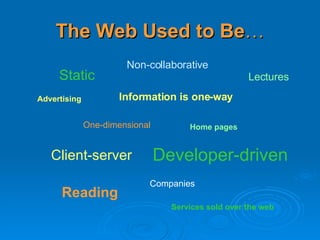
The Web Used to Be … Static Information is one-way Developer-driven One-dimensional Non-collaborative Client-server Reading Companies Home   pages Lectures Advertising Services sold over the web
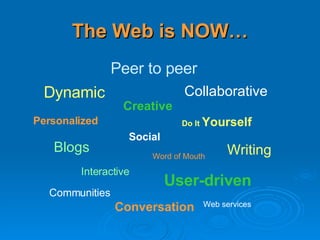
The Web is NOW… Dynamic Collaborative Personalized Social Do It  Yourself Interactive Creative User-driven Writing Peer to peer Communities Blogs Conversation Word of Mouth Web services
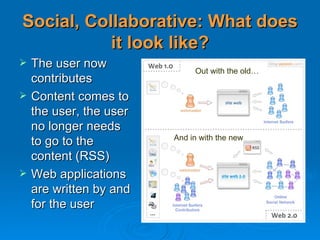
Social, Collaborative: What does it look like? The user now contributes Content comes to the user, the user no longer needs to go to the content (RSS) Web applications are written by and for the user Out with the old… And in with the new
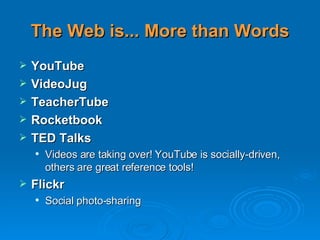
The Web is... More than Words YouTube VideoJug TeacherTube Rocketbook TED Talks Videos are taking over! YouTube is socially-driven, others are great reference tools! Flickr Social photo-sharing
The Web is …Social and Collaborative! Facebook and MySpace Social networking:  connecting with “friends”, creating networks, news feeds keep us “in the loop”. Del.icio.us Social bookmarking : sharing your favourites on the web LibraryThing Lib.rario.us Social  cataloguing !  Library technology becomes mainstream – organizing media is fun!
The Web is… “Do It Yourself” Wikis Allow users to collaboratively create, edit, link, and organize the content of a website, usually for reference material.  Often used to create collaborative websites and to power community websites.  Blogs Personalizing web content Technorati: Searching the Blogosphere RSS feeds and readers   The user’s experience is what counts: information goes to the user, the user doesn’t have to go to the information. Tagging User-driven “subject headings”.  A way of organizing web content.
The Web is… Libraries! WorldCat (OCLC) Search libraries around the world National Libraries Library of Congress Search the catalogue, and authority records online Amicus Canadian “Library of Congress” LibDex  Index of 18,000 libraries around the world
The Web is… Professional Web Junction OCLC and the Gates Foundation bringing you free professional development on the Web! Facebook Who is on Facebook? OCLC, Library of Congress, National Library of Canada, and hundreds of academic and public libraries. Library applications from Online catalogues to IM Reference Blogs! Librarian.net (Jessamyn West) Librarian in Black Stephen’s Lighthouse The Ubiquitous Librarian Free Range Librarian
Sick Sense of Humour, On Having A Respond to every reference question with the following phrase: “Well, let me check Wikipedia…” This will amuse you while alarming the library patron. Repeat as needed. …  from A Librarian’s Guide to Etiquette January 22 nd , 2008
Issues with 2.0 Authority control v. tagging  Authoritativeness of sources – where do they come from, are they correct/valid, how do we determine validity? Opinion v. fact, e.g. Blogs are editorials and don’t necessarily relate news in an objective manner “ Too many hands in the pot”

Libraries 2.0

  • 1.
    Libraries in theDigital Age Life Beyond Google
  • 2.
    Library 2.0, EmbracingA new version of the Internet (version 2.0) is now available. Librarians are now free to abandon the old one. … from “A Librarian’s Guide to Etiquette”, October 29 th , 2007
  • 3.
    The Web Usedto Be … Static Information is one-way Developer-driven One-dimensional Non-collaborative Client-server Reading Companies Home pages Lectures Advertising Services sold over the web
  • 4.
    The Web isNOW… Dynamic Collaborative Personalized Social Do It Yourself Interactive Creative User-driven Writing Peer to peer Communities Blogs Conversation Word of Mouth Web services
  • 5.
    Social, Collaborative: Whatdoes it look like? The user now contributes Content comes to the user, the user no longer needs to go to the content (RSS) Web applications are written by and for the user Out with the old… And in with the new
  • 6.
    The Web is...More than Words YouTube VideoJug TeacherTube Rocketbook TED Talks Videos are taking over! YouTube is socially-driven, others are great reference tools! Flickr Social photo-sharing
  • 7.
    The Web is…Social and Collaborative! Facebook and MySpace Social networking: connecting with “friends”, creating networks, news feeds keep us “in the loop”. Del.icio.us Social bookmarking : sharing your favourites on the web LibraryThing Lib.rario.us Social cataloguing ! Library technology becomes mainstream – organizing media is fun!
  • 8.
    The Web is…“Do It Yourself” Wikis Allow users to collaboratively create, edit, link, and organize the content of a website, usually for reference material. Often used to create collaborative websites and to power community websites. Blogs Personalizing web content Technorati: Searching the Blogosphere RSS feeds and readers The user’s experience is what counts: information goes to the user, the user doesn’t have to go to the information. Tagging User-driven “subject headings”. A way of organizing web content.
  • 9.
    The Web is…Libraries! WorldCat (OCLC) Search libraries around the world National Libraries Library of Congress Search the catalogue, and authority records online Amicus Canadian “Library of Congress” LibDex Index of 18,000 libraries around the world
  • 10.
    The Web is…Professional Web Junction OCLC and the Gates Foundation bringing you free professional development on the Web! Facebook Who is on Facebook? OCLC, Library of Congress, National Library of Canada, and hundreds of academic and public libraries. Library applications from Online catalogues to IM Reference Blogs! Librarian.net (Jessamyn West) Librarian in Black Stephen’s Lighthouse The Ubiquitous Librarian Free Range Librarian
  • 11.
    Sick Sense ofHumour, On Having A Respond to every reference question with the following phrase: “Well, let me check Wikipedia…” This will amuse you while alarming the library patron. Repeat as needed. … from A Librarian’s Guide to Etiquette January 22 nd , 2008
  • 12.
    Issues with 2.0Authority control v. tagging Authoritativeness of sources – where do they come from, are they correct/valid, how do we determine validity? Opinion v. fact, e.g. Blogs are editorials and don’t necessarily relate news in an objective manner “ Too many hands in the pot”