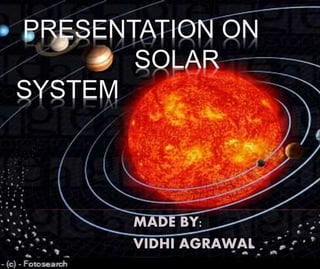
PRESENTATION ON
SOLAR
SYSTEM
MADE BY:
VIDHI AGRAWAL
 SOLAR SYSTEM
 STARS
 GALAXY
 PLANETS
 ASTEROIDS
 COMETS
 METEORS
 SATELLITES
SOLAR SYSTEM
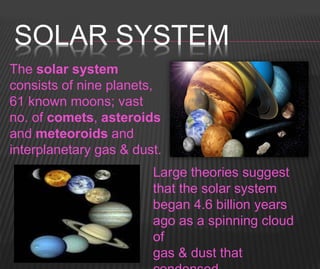
The solar system
consists of nine planets,
61 known moons; vast
no. of comets, asteroids
and meteoroids and
interplanetary gas & dust.
Large theories suggest
that the solar system
began 4.6 billion years
ago as a spinning cloud
of
gas & dust that
STARS
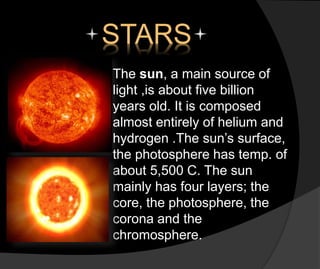
The sun, a main source of
light ,is about five billion
years old. It is composed
almost entirely of helium and
hydrogen .The sun’s surface,
the photosphere has temp. of
about 5,500 C. The sun
mainly has four layers; the
core, the photosphere, the
corona and the
chromosphere.
STARS
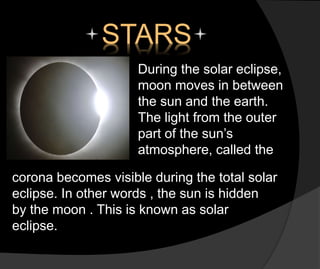
During the solar eclipse,
moon moves in between
the sun and the earth.
The light from the outer
part of the sun’s
atmosphere, called the
corona becomes visible during the total solar
eclipse. In other words , the sun is hidden
by the moon . This is known as solar
eclipse.
STARS
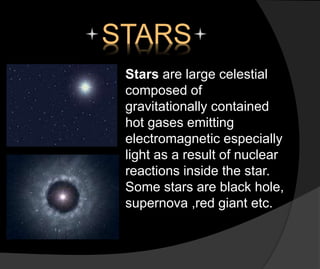
Stars are large celestial
composed of
gravitationally contained
hot gases emitting
electromagnetic especially
light as a result of nuclear
reactions inside the star.
Some stars are black hole,
supernova ,red giant etc.
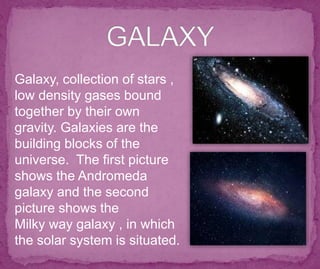
Galaxy, collection of stars ,
low density gases bound
together by their own
gravity. Galaxies are the
building blocks of the
universe. The first picture
shows the Andromeda
galaxy and the second
picture shows the
Milky way galaxy , in which
the solar system is situated.
A planet is a large round object in space
that orbits around a star. There are nine
planets in solar system. They are:
Mercury is the closest
planet to the sun. It is a
small, rocky planet. Its
surface has been heavily
cratered by meteorites. It
completes one revolution
around the sun in 88 days.
Venus is called the morning
and the evening star as it is
the brightest object in the
sky.Venus is the hottest
planet of solar system.
The fifth largest planet in
the solar system is earth.
Earth is the only planet
which support to life. It is
the third nearest planet to
the sun.
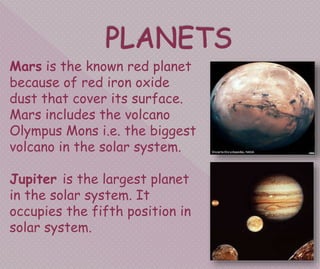
Mars is the known red planet
because of red iron oxide
dust that cover its surface.
Mars includes the volcano
Olympus Mons i.e. the biggest
volcano in the solar system.
Jupiter is the largest planet
in the solar system. It
occupies the fifth position in
solar system.
Saturn is the sixth planet
from the sun and second
largest planet in the solar
system. Saturn has a
beautiful ring system.
Uranus is the third largest
planet of the solar system.
It has 15 moons , 10 rings.
It has a blue- green color
due to methane.
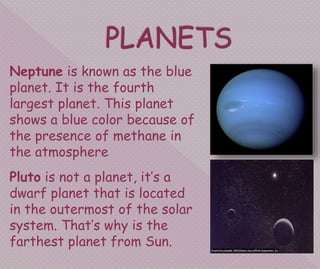
Neptune is known as the blue
planet. It is the fourth
largest planet. This planet
shows a blue color because of
the presence of methane in
the atmosphere
Pluto is not a planet, it’s a
dwarf planet that is located
in the outermost of the solar
system. That’s why is the
farthest planet from Sun.
ASTEROIDS
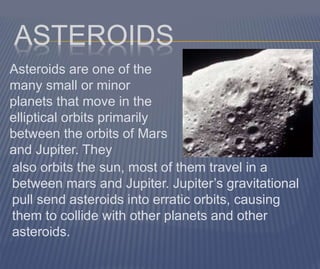
Asteroids are one of the
many small or minor
planets that move in the
elliptical orbits primarily
between the orbits of Mars
and Jupiter. They
also orbits the sun, most of them travel in a
between mars and Jupiter. Jupiter’s gravitational
pull send asteroids into erratic orbits, causing
them to collide with other planets and other
asteroids.
COMETS
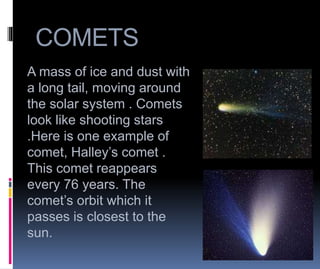
A mass of ice and dust with
a long tail, moving around
the solar system . Comets
look like shooting stars
.Here is one example of
comet, Halley’s comet .
This comet reappears
every 76 years. The
comet’s orbit which it
passes is closest to the
sun.
Meteors
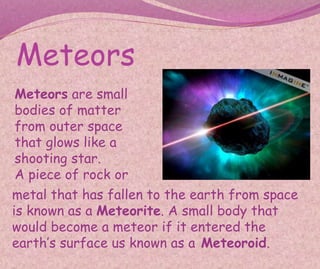
Meteors are small
bodies of matter
from outer space
that glows like a
shooting star.
A piece of rock or
metal that has fallen to the earth from space
is known as a Meteorite. A small body that
would become a meteor if it entered the
earth’s surface us known as a Meteoroid.
The Solar System
The Solar System
The Solar System

The Solar System

  • 1.
  • 2.
     SOLAR SYSTEM STARS  GALAXY  PLANETS  ASTEROIDS  COMETS  METEORS  SATELLITES
  • 3.
    SOLAR SYSTEM The solarsystem consists of nine planets, 61 known moons; vast no. of comets, asteroids and meteoroids and interplanetary gas & dust. Large theories suggest that the solar system began 4.6 billion years ago as a spinning cloud of gas & dust that
  • 5.
    STARS The sun, amain source of light ,is about five billion years old. It is composed almost entirely of helium and hydrogen .The sun’s surface, the photosphere has temp. of about 5,500 C. The sun mainly has four layers; the core, the photosphere, the corona and the chromosphere.
  • 6.
    STARS During the solareclipse, moon moves in between the sun and the earth. The light from the outer part of the sun’s atmosphere, called the corona becomes visible during the total solar eclipse. In other words , the sun is hidden by the moon . This is known as solar eclipse.
  • 7.
    STARS Stars are largecelestial composed of gravitationally contained hot gases emitting electromagnetic especially light as a result of nuclear reactions inside the star. Some stars are black hole, supernova ,red giant etc.
  • 8.
    Galaxy, collection ofstars , low density gases bound together by their own gravity. Galaxies are the building blocks of the universe. The first picture shows the Andromeda galaxy and the second picture shows the Milky way galaxy , in which the solar system is situated.
  • 9.
    A planet isa large round object in space that orbits around a star. There are nine planets in solar system. They are: Mercury is the closest planet to the sun. It is a small, rocky planet. Its surface has been heavily cratered by meteorites. It completes one revolution around the sun in 88 days.
  • 10.
    Venus is calledthe morning and the evening star as it is the brightest object in the sky.Venus is the hottest planet of solar system. The fifth largest planet in the solar system is earth. Earth is the only planet which support to life. It is the third nearest planet to the sun.
  • 11.
    Mars is theknown red planet because of red iron oxide dust that cover its surface. Mars includes the volcano Olympus Mons i.e. the biggest volcano in the solar system. Jupiter is the largest planet in the solar system. It occupies the fifth position in solar system.
  • 12.
    Saturn is thesixth planet from the sun and second largest planet in the solar system. Saturn has a beautiful ring system. Uranus is the third largest planet of the solar system. It has 15 moons , 10 rings. It has a blue- green color due to methane.
  • 13.
    Neptune is knownas the blue planet. It is the fourth largest planet. This planet shows a blue color because of the presence of methane in the atmosphere Pluto is not a planet, it’s a dwarf planet that is located in the outermost of the solar system. That’s why is the farthest planet from Sun.
  • 14.
    ASTEROIDS Asteroids are oneof the many small or minor planets that move in the elliptical orbits primarily between the orbits of Mars and Jupiter. They also orbits the sun, most of them travel in a between mars and Jupiter. Jupiter’s gravitational pull send asteroids into erratic orbits, causing them to collide with other planets and other asteroids.
  • 15.
    COMETS A mass ofice and dust with a long tail, moving around the solar system . Comets look like shooting stars .Here is one example of comet, Halley’s comet . This comet reappears every 76 years. The comet’s orbit which it passes is closest to the sun.
  • 16.
    Meteors Meteors are small bodiesof matter from outer space that glows like a shooting star. A piece of rock or metal that has fallen to the earth from space is known as a Meteorite. A small body that would become a meteor if it entered the earth’s surface us known as a Meteoroid.