SAVITRIBAI PHULE PUNE UNIVERSITY
DEPARTMENT OF EDUCATION AND EXTENSION
Name : Pranali Pandharinath Repale
Class : T.Y.B.Sc.B.Ed.
Roll no : 33
Subject : E-learning and Educational development
Subject Teacher : Mr. Mahesh Mali Sir
Topic : The Universe
Programme Name : B.Sc.B.Ed. ( integrated)
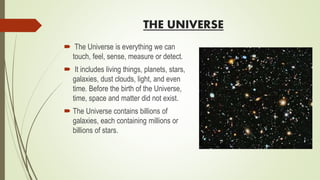
THE UNIVERSE
 The Universe is everything we can
touch, feel, sense, measure or detect.
 It includes living things, planets, stars,
galaxies, dust clouds, light, and even
time. Before the birth of the Universe,
time, space and matter did not exist.
 The Universe contains billions of
galaxies, each containing millions or
billions of stars.
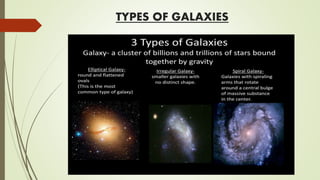
TYPES OF GALAXIES
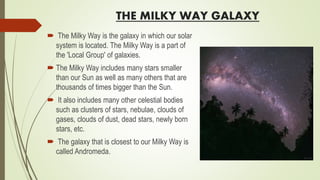
THE MILKY WAY GALAXY
 The Milky Way is the galaxy in which our solar
system is located. The Milky Way is a part of
the 'Local Group' of galaxies.
 The Milky Way includes many stars smaller
than our Sun as well as many others that are
thousands of times bigger than the Sun.
 It also includes many other celestial bodies
such as clusters of stars, nebulae, clouds of
gases, clouds of dust, dead stars, newly born
stars, etc.
 The galaxy that is closest to our Milky Way is
called Andromeda.
STARS
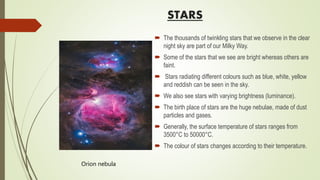
 The thousands of twinkling stars that we observe in the clear
night sky are part of our Milky Way.
 Some of the stars that we see are bright whereas others are
faint.
 Stars radiating different colours such as blue, white, yellow
and reddish can be seen in the sky.
 We also see stars with varying brightness (luminance).
 The birth place of stars are the huge nebulae, made of dust
particles and gases.
 Generally, the surface temperature of stars ranges from
3500°C to 50000°C.
 The colour of stars changes according to their temperature.
Orion nebula
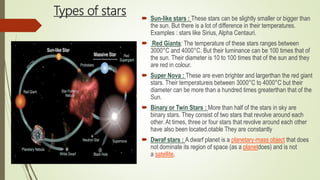
Types of stars  Sun-like stars : These stars can be slightly smaller or bigger than
the sun. But there is a lot of difference in their temperatures.
Examples : stars like Sirius, Alpha Centauri.
 Red Giants: The temperature of these stars ranges between
3000°C and 4000°C. But their luminance can be 100 times that of
the sun. Their diameter is 10 to 100 times that of the sun and they
are red in colour.
 Super Nova : These are even brighter and largerthan the red giant
stars. Their temperatureis between 3000°C to 4000°C but their
diameter can be more than a hundred times greaterthan that of the
Sun.
 Binary or Twin Stars : More than half of the stars in sky are
binary stars. They consist of two stars that revolve around each
other. At times, three or four stars that revolve around each other
have also been located.otable They are constantly
 Dwraf stars : A dwarf planet is a planetary-mass object that does
not dominate its region of space (as a planetdoes) and is not
a satellite.
The solar system
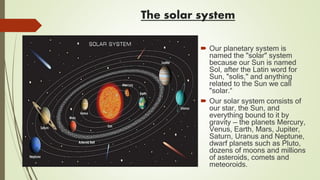
 Our planetary system is
named the "solar" system
because our Sun is named
Sol, after the Latin word for
Sun, "solis," and anything
related to the Sun we call
"solar.“
 Our solar system consists of
our star, the Sun, and
everything bound to it by
gravity — the planets Mercury,
Venus, Earth, Mars, Jupiter,
Saturn, Uranus and Neptune,
dwarf planets such as Pluto,
dozens of moons and millions
of asteroids, comets and
meteoroids.
THE SUN
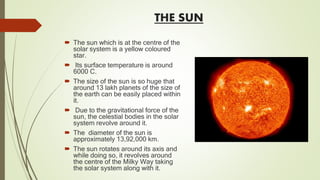
 The sun which is at the centre of the
solar system is a yellow coloured
star.
 Its surface temperature is around
6000 C.
 The size of the sun is so huge that
around 13 lakh planets of the size of
the earth can be easily placed within
it.
 Due to the gravitational force of the
sun, the celestial bodies in the solar
system revolve around it.
 The diameter of the sun is
approximately 13,92,000 km.
 The sun rotates around its axis and
while doing so, it revolves around
the centre of the Milky Way taking
the solar system along with it.
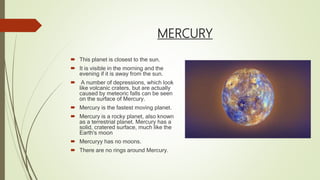
MERCURY
 This planet is closest to the sun.
 It is visible in the morning and the
evening if it is away from the sun.
 A number of depressions, which look
like volcanic craters, but are actually
caused by meteoric falls can be seen
on the surface of Mercury.
 Mercury is the fastest moving planet.
 Mercury is a rocky planet, also known
as a terrestrial planet. Mercury has a
solid, cratered surface, much like the
Earth's moon
 Mercuryy has no moons.
 There are no rings around Mercury.
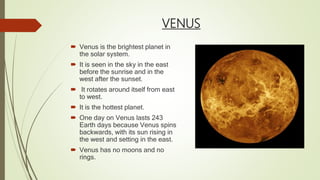
VENUS
 Venus is the brightest planet in
the solar system.
 It is seen in the sky in the east
before the sunrise and in the
west after the sunset.
 It rotates around itself from east
to west.
 It is the hottest planet.
 One day on Venus lasts 243
Earth days because Venus spins
backwards, with its sun rising in
the west and setting in the east.
 Venus has no moons and no
rings.
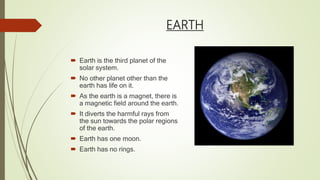
EARTH
 Earth is the third planet of the
solar system.
 No other planet other than the
earth has life on it.
 As the earth is a magnet, there is
a magnetic field around the earth.
 It diverts the harmful rays from
the sun towards the polar regions
of the earth.
 Earth has one moon.
 Earth has no rings.
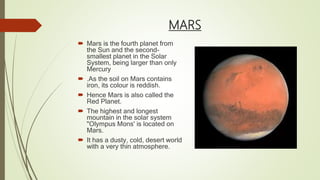
MARS
 Mars is the fourth planet from
the Sun and the second-
smallest planet in the Solar
System, being larger than only
Mercury
 .As the soil on Mars contains
iron, its colour is reddish.
 Hence Mars is also called the
Red Planet.
 The highest and longest
mountain in the solar system
"Olympus Mons' is located on
Mars.
 It has a dusty, cold, desert world
with a very thin atmosphere.
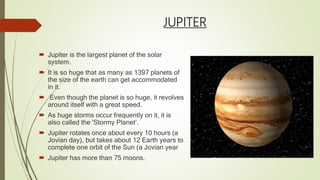
JUPITER
 Jupiter is the largest planet of the solar
system.
 It is so huge that as many as 1397 planets of
the size of the earth can get accommodated
in it.
 Even though the planet is so huge, it revolves
around itself with a great speed.
 As huge storms occur frequently on it, it is
also called the 'Stormy Planet’.
 Jupiter rotates once about every 10 hours (a
Jovian day), but takes about 12 Earth years to
complete one orbit of the Sun (a Jovian year
 Jupiter has more than 75 moons.
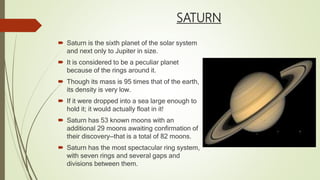
SATURN
 Saturn is the sixth planet of the solar system
and next only to Jupiter in size.
 It is considered to be a peculiar planet
because of the rings around it.
 Though its mass is 95 times that of the earth,
its density is very low.
 If it were dropped into a sea large enough to
hold it; it would actually float in it!
 Saturn has 53 known moons with an
additional 29 moons awaiting confirmation of
their discovery—that is a total of 82 moons.
 Saturn has the most spectacular ring system,
with seven rings and several gaps and
divisions between them.
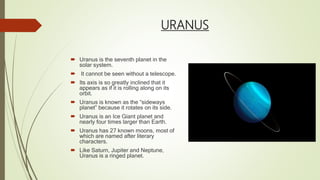
URANUS
 Uranus is the seventh planet in the
solar system.
 It cannot be seen without a telescope.
 Its axis is so greatly inclined that it
appears as if it is rolling along on its
orbit.
 Uranus is known as the “sideways
planet” because it rotates on its side.
 Uranus is an Ice Giant planet and
nearly four times larger than Earth.
 Uranus has 27 known moons, most of
which are named after literary
characters.
 Like Saturn, Jupiter and Neptune,
Uranus is a ringed planet.
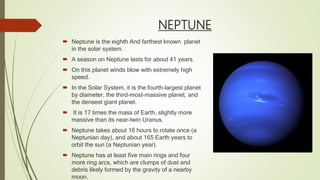
NEPTUNE
 Neptune is the eighth And farthest known planet
in the solar system.
 A season on Neptune lasts for about 41 years.
 On this planet winds blow with extremely high
speed.
 In the Solar System, it is the fourth-largest planet
by diameter, the third-most-massive planet, and
the densest giant planet.
 It is 17 times the mass of Earth, slightly more
massive than its near-twin Uranus.
 Neptune takes about 16 hours to rotate once (a
Neptunian day), and about 165 Earth years to
orbit the sun (a Neptunian year).
 Neptune has at least five main rings and four
more ring arcs, which are clumps of dust and
debris likely formed by the gravity of a nearby
moon.
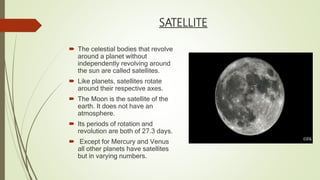
SATELLITE
 The celestial bodies that revolve
around a planet without
independently revolving around
the sun are called satellites.
 Like planets, satellites rotate
around their respective axes.
 The Moon is the satellite of the
earth. It does not have an
atmosphere.
 Its periods of rotation and
revolution are both of 27.3 days.
 Except for Mercury and Venus
all other planets have satellites
but in varying numbers.
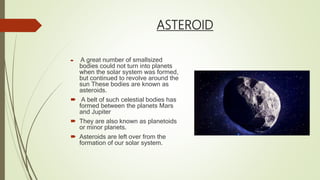
ASTEROID
 A great number of smallsized
bodies could not turn into planets
when the solar system was formed,
but continued to revolve around the
sun These bodies are known as
asteroids.
 A belt of such celestial bodies has
formed between the planets Mars
and Jupiter
 They are also known as planetoids
or minor planets.
 Asteroids are left over from the
formation of our solar system.
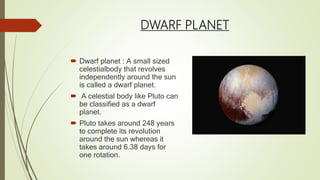
DWARF PLANET
 Dwarf planet : A small sized
celestialbody that revolves
independently around the sun
is called a dwarf planet.
 A celestial body like Pluto can
be classified as a dwarf
planet.
 Pluto takes around 248 years
to complete its revolution
around the sun whereas it
takes around 6.38 days for
one rotation.
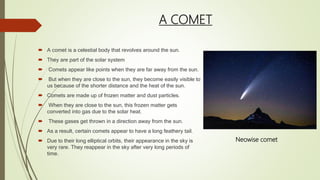
A COMET
 A comet is a celestial body that revolves around the sun.
 They are part of the solar system
 Comets appear like points when they are far away from the sun.
 But when they are close to the sun, they become easily visible to
us because of the shorter distance and the heat of the sun.
 Comets are made up of frozen matter and dust particles.
 When they are close to the sun, this frozen matter gets
converted into gas due to the solar heat.
 These gases get thrown in a direction away from the sun.
 As a result, certain comets appear to have a long feathery tail.
 Due to their long elliptical orbits, their appearance in the sky is
very rare. They reappear in the sky after very long periods of
time.
Neowise comet
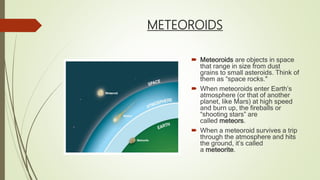
METEOROIDS
 Meteoroids are objects in space
that range in size from dust
grains to small asteroids. Think of
them as “space rocks."
 When meteoroids enter Earth’s
atmosphere (or that of another
planet, like Mars) at high speed
and burn up, the fireballs or
“shooting stars” are
called meteors.
 When a meteoroid survives a trip
through the atmosphere and hits
the ground, it’s called
a meteorite.
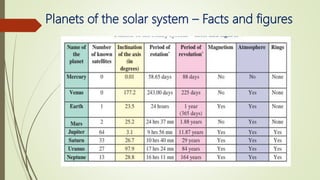
Planets of the solar system – Facts and figures
References
 https://astrobackyard.com/types-of-stars/
 https://solarsystem.nasa.gov/planets/earth/overview/
 https://en.m.wikipedia.org/wiki/Mars
 https://exoplanets.nasa.gov/what-is-an-exoplanet/what-is-the-
universe/
 https://hubblesite.org/science/galaxies

THE UNIVERSE

  • 1.
    SAVITRIBAI PHULE PUNEUNIVERSITY DEPARTMENT OF EDUCATION AND EXTENSION Name : Pranali Pandharinath Repale Class : T.Y.B.Sc.B.Ed. Roll no : 33 Subject : E-learning and Educational development Subject Teacher : Mr. Mahesh Mali Sir Topic : The Universe Programme Name : B.Sc.B.Ed. ( integrated)
  • 2.
    THE UNIVERSE  TheUniverse is everything we can touch, feel, sense, measure or detect.  It includes living things, planets, stars, galaxies, dust clouds, light, and even time. Before the birth of the Universe, time, space and matter did not exist.  The Universe contains billions of galaxies, each containing millions or billions of stars.
  • 3.
  • 4.
    THE MILKY WAYGALAXY  The Milky Way is the galaxy in which our solar system is located. The Milky Way is a part of the 'Local Group' of galaxies.  The Milky Way includes many stars smaller than our Sun as well as many others that are thousands of times bigger than the Sun.  It also includes many other celestial bodies such as clusters of stars, nebulae, clouds of gases, clouds of dust, dead stars, newly born stars, etc.  The galaxy that is closest to our Milky Way is called Andromeda.
  • 5.
    STARS  The thousandsof twinkling stars that we observe in the clear night sky are part of our Milky Way.  Some of the stars that we see are bright whereas others are faint.  Stars radiating different colours such as blue, white, yellow and reddish can be seen in the sky.  We also see stars with varying brightness (luminance).  The birth place of stars are the huge nebulae, made of dust particles and gases.  Generally, the surface temperature of stars ranges from 3500°C to 50000°C.  The colour of stars changes according to their temperature. Orion nebula
  • 6.
    Types of stars Sun-like stars : These stars can be slightly smaller or bigger than the sun. But there is a lot of difference in their temperatures. Examples : stars like Sirius, Alpha Centauri.  Red Giants: The temperature of these stars ranges between 3000°C and 4000°C. But their luminance can be 100 times that of the sun. Their diameter is 10 to 100 times that of the sun and they are red in colour.  Super Nova : These are even brighter and largerthan the red giant stars. Their temperatureis between 3000°C to 4000°C but their diameter can be more than a hundred times greaterthan that of the Sun.  Binary or Twin Stars : More than half of the stars in sky are binary stars. They consist of two stars that revolve around each other. At times, three or four stars that revolve around each other have also been located.otable They are constantly  Dwraf stars : A dwarf planet is a planetary-mass object that does not dominate its region of space (as a planetdoes) and is not a satellite.
  • 7.
    The solar system Our planetary system is named the "solar" system because our Sun is named Sol, after the Latin word for Sun, "solis," and anything related to the Sun we call "solar.“  Our solar system consists of our star, the Sun, and everything bound to it by gravity — the planets Mercury, Venus, Earth, Mars, Jupiter, Saturn, Uranus and Neptune, dwarf planets such as Pluto, dozens of moons and millions of asteroids, comets and meteoroids.
  • 8.
    THE SUN  Thesun which is at the centre of the solar system is a yellow coloured star.  Its surface temperature is around 6000 C.  The size of the sun is so huge that around 13 lakh planets of the size of the earth can be easily placed within it.  Due to the gravitational force of the sun, the celestial bodies in the solar system revolve around it.  The diameter of the sun is approximately 13,92,000 km.  The sun rotates around its axis and while doing so, it revolves around the centre of the Milky Way taking the solar system along with it.
  • 9.
    MERCURY  This planetis closest to the sun.  It is visible in the morning and the evening if it is away from the sun.  A number of depressions, which look like volcanic craters, but are actually caused by meteoric falls can be seen on the surface of Mercury.  Mercury is the fastest moving planet.  Mercury is a rocky planet, also known as a terrestrial planet. Mercury has a solid, cratered surface, much like the Earth's moon  Mercuryy has no moons.  There are no rings around Mercury.
  • 10.
    VENUS  Venus isthe brightest planet in the solar system.  It is seen in the sky in the east before the sunrise and in the west after the sunset.  It rotates around itself from east to west.  It is the hottest planet.  One day on Venus lasts 243 Earth days because Venus spins backwards, with its sun rising in the west and setting in the east.  Venus has no moons and no rings.
  • 11.
    EARTH  Earth isthe third planet of the solar system.  No other planet other than the earth has life on it.  As the earth is a magnet, there is a magnetic field around the earth.  It diverts the harmful rays from the sun towards the polar regions of the earth.  Earth has one moon.  Earth has no rings.
  • 12.
    MARS  Mars isthe fourth planet from the Sun and the second- smallest planet in the Solar System, being larger than only Mercury  .As the soil on Mars contains iron, its colour is reddish.  Hence Mars is also called the Red Planet.  The highest and longest mountain in the solar system "Olympus Mons' is located on Mars.  It has a dusty, cold, desert world with a very thin atmosphere.
  • 13.
    JUPITER  Jupiter isthe largest planet of the solar system.  It is so huge that as many as 1397 planets of the size of the earth can get accommodated in it.  Even though the planet is so huge, it revolves around itself with a great speed.  As huge storms occur frequently on it, it is also called the 'Stormy Planet’.  Jupiter rotates once about every 10 hours (a Jovian day), but takes about 12 Earth years to complete one orbit of the Sun (a Jovian year  Jupiter has more than 75 moons.
  • 14.
    SATURN  Saturn isthe sixth planet of the solar system and next only to Jupiter in size.  It is considered to be a peculiar planet because of the rings around it.  Though its mass is 95 times that of the earth, its density is very low.  If it were dropped into a sea large enough to hold it; it would actually float in it!  Saturn has 53 known moons with an additional 29 moons awaiting confirmation of their discovery—that is a total of 82 moons.  Saturn has the most spectacular ring system, with seven rings and several gaps and divisions between them.
  • 15.
    URANUS  Uranus isthe seventh planet in the solar system.  It cannot be seen without a telescope.  Its axis is so greatly inclined that it appears as if it is rolling along on its orbit.  Uranus is known as the “sideways planet” because it rotates on its side.  Uranus is an Ice Giant planet and nearly four times larger than Earth.  Uranus has 27 known moons, most of which are named after literary characters.  Like Saturn, Jupiter and Neptune, Uranus is a ringed planet.
  • 16.
    NEPTUNE  Neptune isthe eighth And farthest known planet in the solar system.  A season on Neptune lasts for about 41 years.  On this planet winds blow with extremely high speed.  In the Solar System, it is the fourth-largest planet by diameter, the third-most-massive planet, and the densest giant planet.  It is 17 times the mass of Earth, slightly more massive than its near-twin Uranus.  Neptune takes about 16 hours to rotate once (a Neptunian day), and about 165 Earth years to orbit the sun (a Neptunian year).  Neptune has at least five main rings and four more ring arcs, which are clumps of dust and debris likely formed by the gravity of a nearby moon.
  • 17.
    SATELLITE  The celestialbodies that revolve around a planet without independently revolving around the sun are called satellites.  Like planets, satellites rotate around their respective axes.  The Moon is the satellite of the earth. It does not have an atmosphere.  Its periods of rotation and revolution are both of 27.3 days.  Except for Mercury and Venus all other planets have satellites but in varying numbers.
  • 18.
    ASTEROID  A greatnumber of smallsized bodies could not turn into planets when the solar system was formed, but continued to revolve around the sun These bodies are known as asteroids.  A belt of such celestial bodies has formed between the planets Mars and Jupiter  They are also known as planetoids or minor planets.  Asteroids are left over from the formation of our solar system.
  • 19.
    DWARF PLANET  Dwarfplanet : A small sized celestialbody that revolves independently around the sun is called a dwarf planet.  A celestial body like Pluto can be classified as a dwarf planet.  Pluto takes around 248 years to complete its revolution around the sun whereas it takes around 6.38 days for one rotation.
  • 20.
    A COMET  Acomet is a celestial body that revolves around the sun.  They are part of the solar system  Comets appear like points when they are far away from the sun.  But when they are close to the sun, they become easily visible to us because of the shorter distance and the heat of the sun.  Comets are made up of frozen matter and dust particles.  When they are close to the sun, this frozen matter gets converted into gas due to the solar heat.  These gases get thrown in a direction away from the sun.  As a result, certain comets appear to have a long feathery tail.  Due to their long elliptical orbits, their appearance in the sky is very rare. They reappear in the sky after very long periods of time. Neowise comet
  • 21.
    METEOROIDS  Meteoroids areobjects in space that range in size from dust grains to small asteroids. Think of them as “space rocks."  When meteoroids enter Earth’s atmosphere (or that of another planet, like Mars) at high speed and burn up, the fireballs or “shooting stars” are called meteors.  When a meteoroid survives a trip through the atmosphere and hits the ground, it’s called a meteorite.
  • 22.
    Planets of thesolar system – Facts and figures
  • 23.
    References  https://astrobackyard.com/types-of-stars/  https://solarsystem.nasa.gov/planets/earth/overview/ https://en.m.wikipedia.org/wiki/Mars  https://exoplanets.nasa.gov/what-is-an-exoplanet/what-is-the- universe/  https://hubblesite.org/science/galaxies