Teaching Scrum Fundamentals
A quick guide to getting started
Bijay Jayaswal
Chief Product Officer, Naviata
Agenda
• How to get best out of this class
• Outlines of Scrum Framework
• Scrum Team
• Scrum Events
• Additional Resources
How to get best out of this class
• Be present
• Keep your cell phone and email off
• Take notes
• Ask questions
• Have fun!
• Be ready to do group work on assigned problems
• And ready to teach back to the class - and the trainer!
Outlines of Scrum Framework
What’s Scrum?
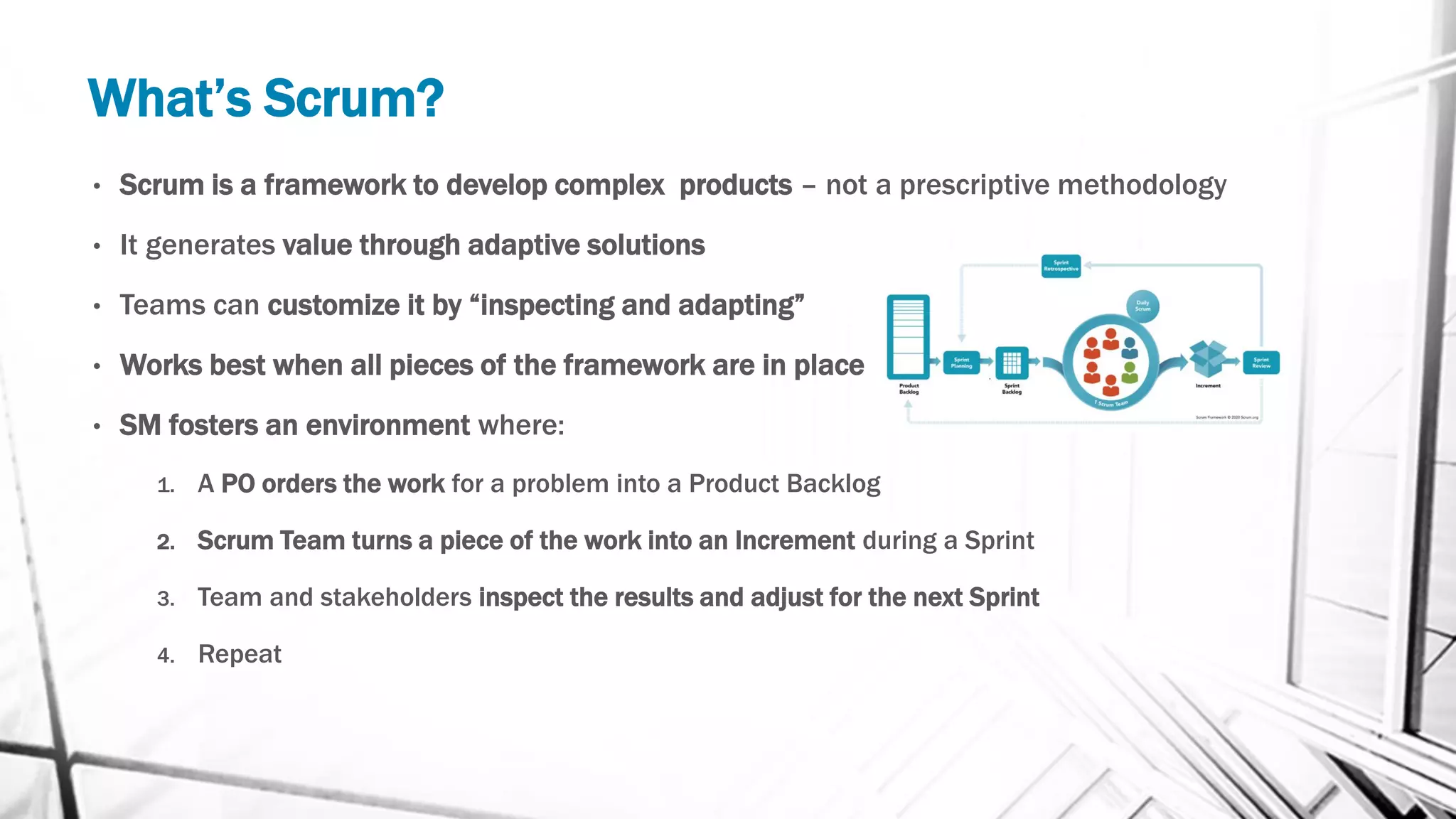
• Scrum is a framework to develop complex products – not a prescriptive methodology
• It generates value through adaptive solutions
• Teams can customize it by “inspecting and adapting”
• Works best when all pieces of the framework are in place
• SM fosters an environment where:
1. A PO orders the work for a problem into a Product Backlog
2. Scrum Team turns a piece of the work into an Increment during a Sprint
3. Team and stakeholders inspect the results and adjust for the next Sprint
4. Repeat
Scrum and Organizational Context
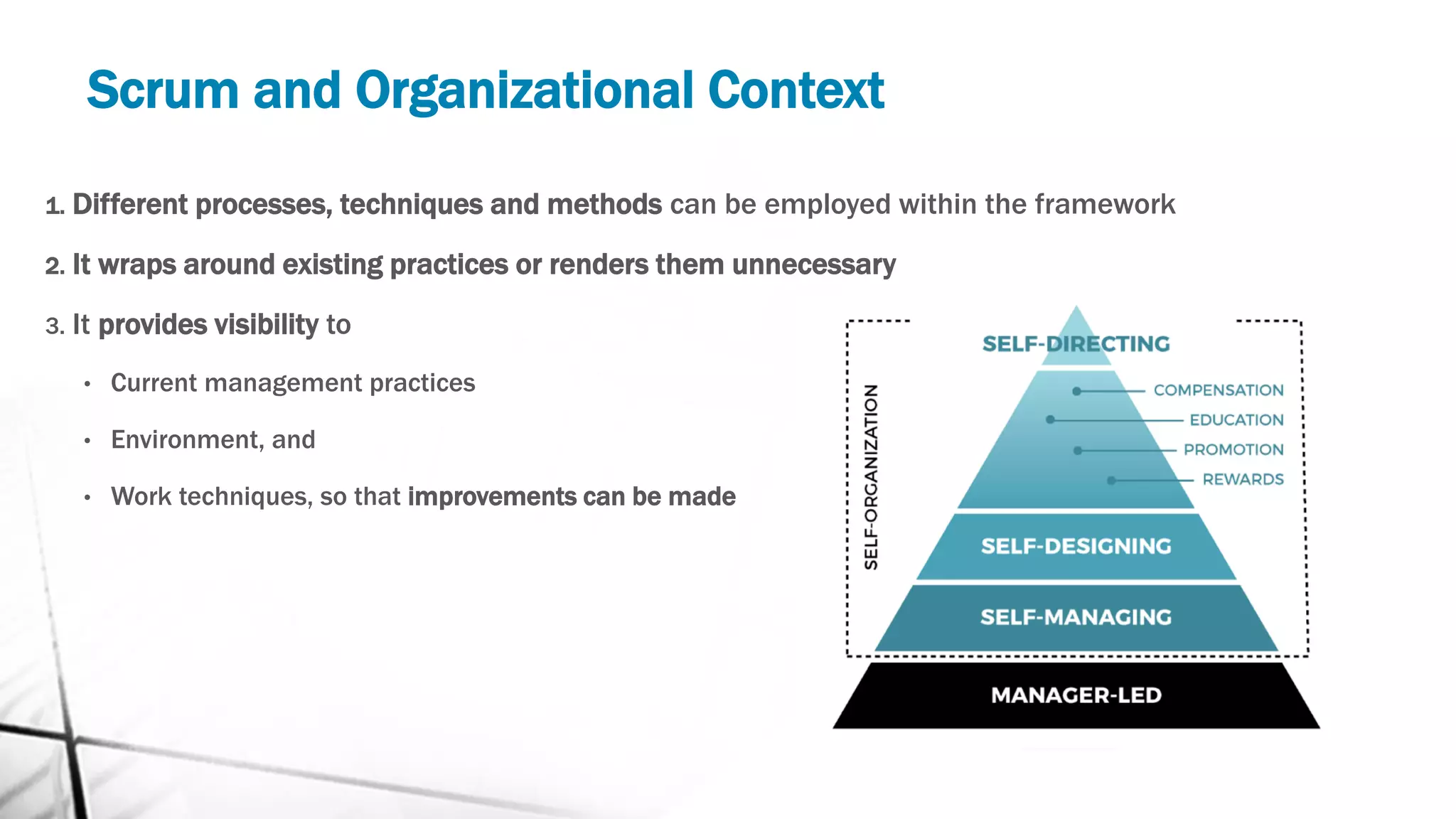
1. Different processes, techniques and methods can be employed within the framework
2. It wraps around existing practices or renders them unnecessary
3. It provides visibility to
• Current management practices
• Environment, and
• Work techniques, so that improvements can be made
Empiricism: Inspect and Adapt
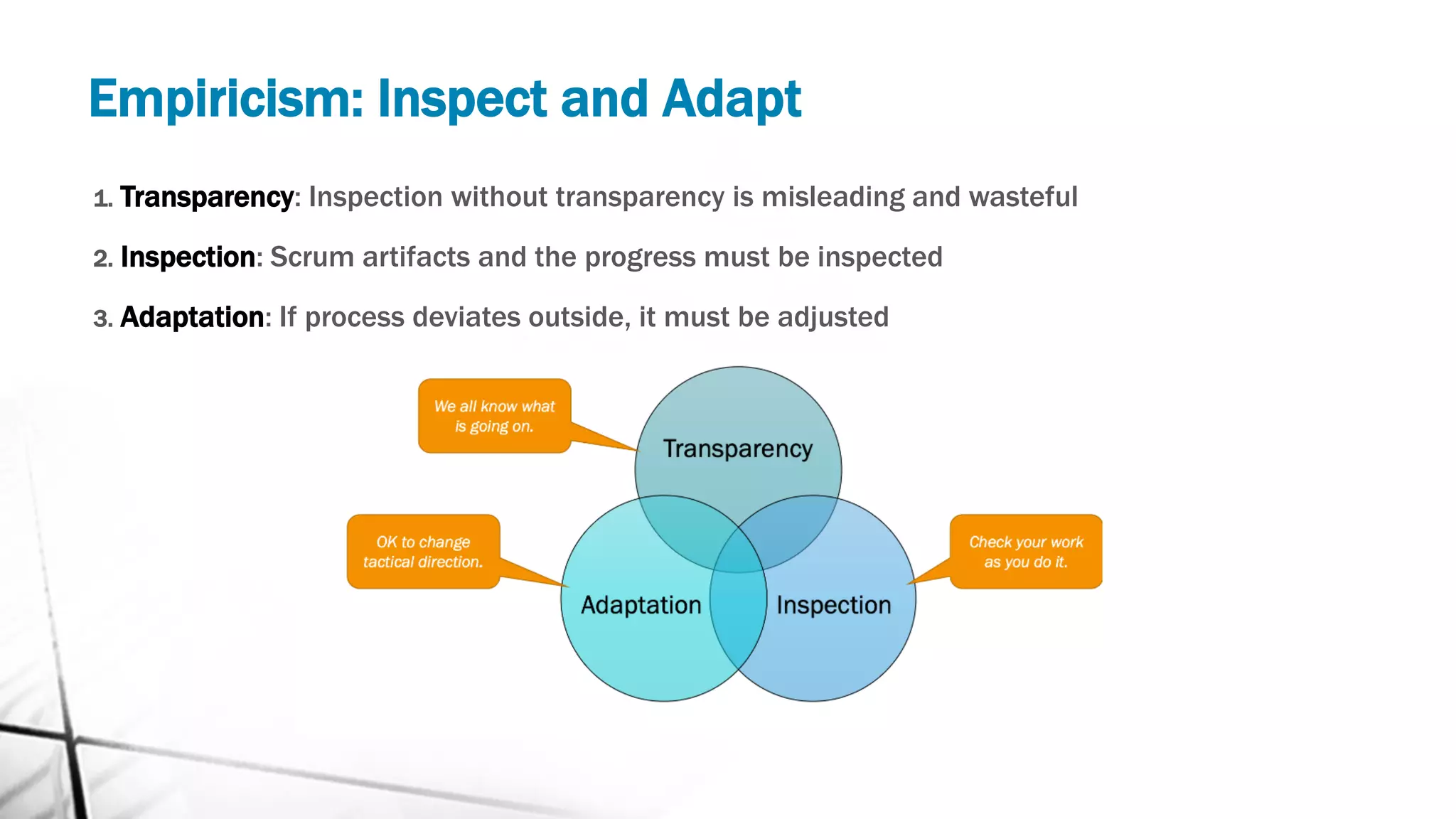
1. Transparency: Inspection without transparency is misleading and wasteful
2. Inspection: Scrum artifacts and the progress must be inspected
3. Adaptation: If process deviates outside, it must be adjusted
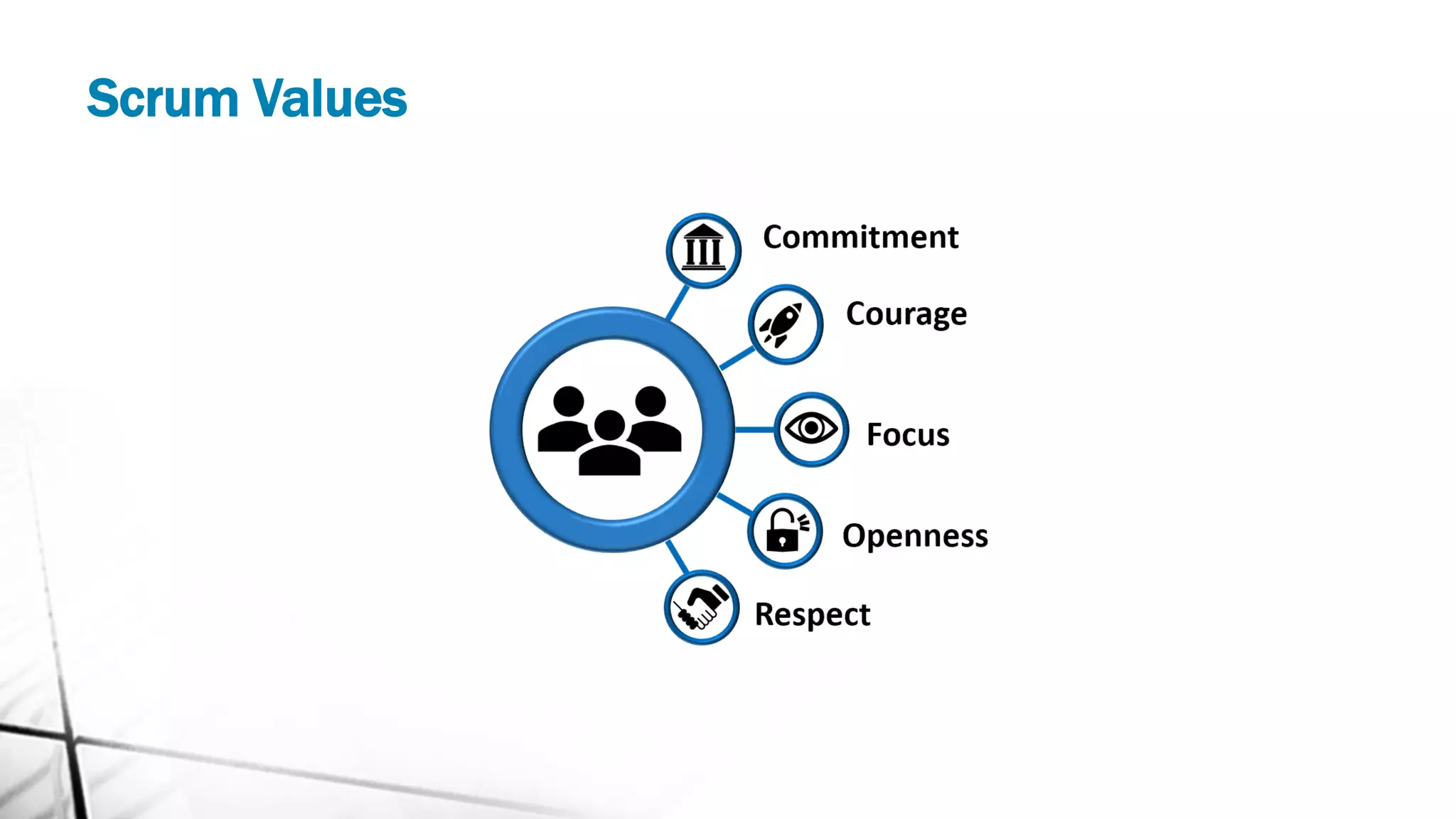
Scrum Values
Group Work 1: 15 Minutes
• Why has Scrum been purposefully developed to be a framework and not a methodology?
• What are the three theoretical components of empiricism?
• What are the five Scrum values and how do they matter?
All of you should be ready to teach back to the class. One of you may volunteer to do so.
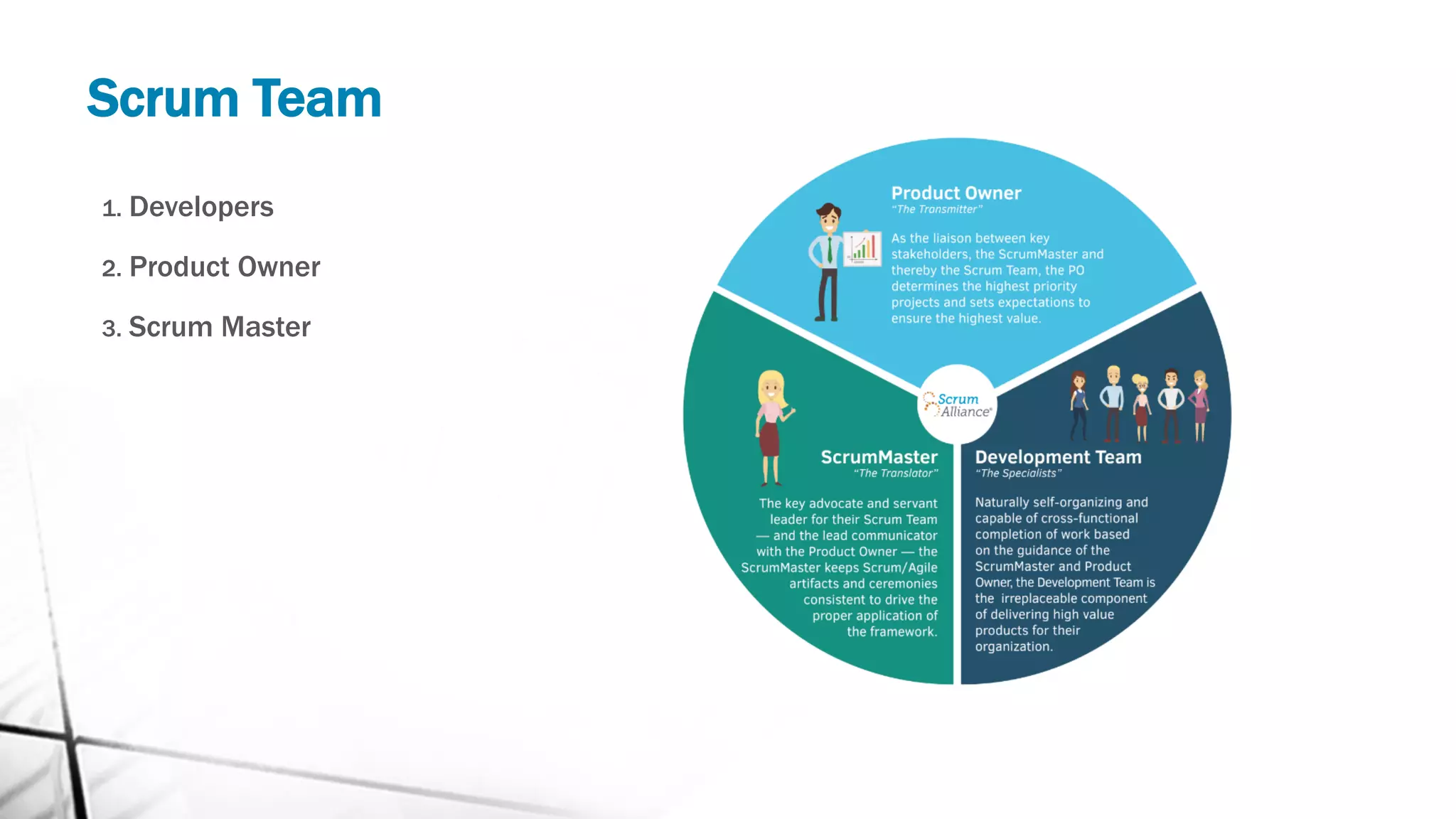
Scrum Team
Scrum Team
1. Developers
2. Product Owner
3. Scrum Master
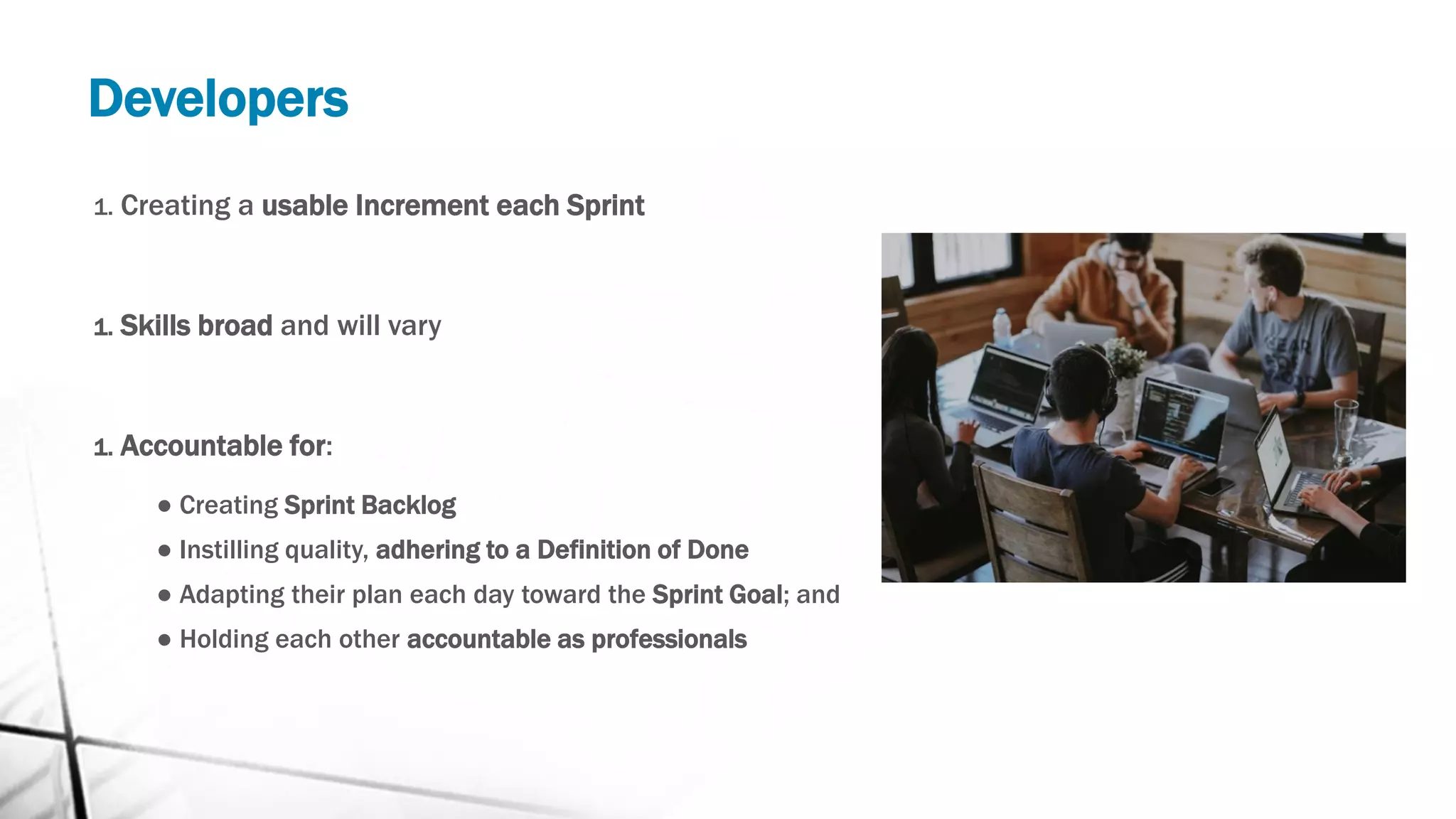
Developers
1. Creating a usable Increment each Sprint
1. Skills broad and will vary
1. Accountable for:
● Creating Sprint Backlog
● Instilling quality, adhering to a Definition of Done
● Adapting their plan each day toward the Sprint Goal; and
● Holding each other accountable as professionals
Product Owner
1. Maximizing the value of the product
1. Effective Product Backlog management:
● Developing and communicating the Product Goal
● Creating and communicating Product Backlog items
● Ordering Product Backlog items
● Ensuring that the Product Backlog is transparent and understood
2. For POs to succeed, the organization must respect their decisions
3. Represent the needs of stakeholders in the Product Backlog
Scrum Master: Serving the Scrum Team
Accountable for establishing Scrum as defined in the Scrum Guide:
• Helping everyone understand Scrum
• Is accountable for the Team’s effectiveness
• Enabling it improve its practices
• Serve the Team and the larger organization
Serves the Team in several ways, including:
• Coaching in self-management and cross-functionality
• Helping it focus on creating high-value Increments meeting DOD
• Removal of impediments
• Ensuring events are positive, productive, and within the timebox
Scrum Master: Serving the PO and the Organization
Serves the PO in several ways, including:
• Effective Product Goal definition and Product Backlog management
• Helping Team understand concise Product Backlog items
• Helping empirical product planning for a complex environment
• Facilitating stakeholder collaboration as needed
Serves the organization in several ways, including:
• Leading, training, and coaching the organization in adoption
• Planning and advising Scrum implementations
• Helping employees and stakeholders enact empirical approach
• Removing barriers between stakeholders and Scrum Teams.
Group Work 2: 15 Minutes
• Why collaboration between POs and the Developers is crucial to develop great products? Why
can this be enhanced?
• How can the SM serve the Scrum Team?
• How can the SM serve the Organization?
• What are the five Scrum values and how do they matter?
All of you should be ready to teach back to the class. One of you may volunteer to do so.
Scrum Events and Artifacts
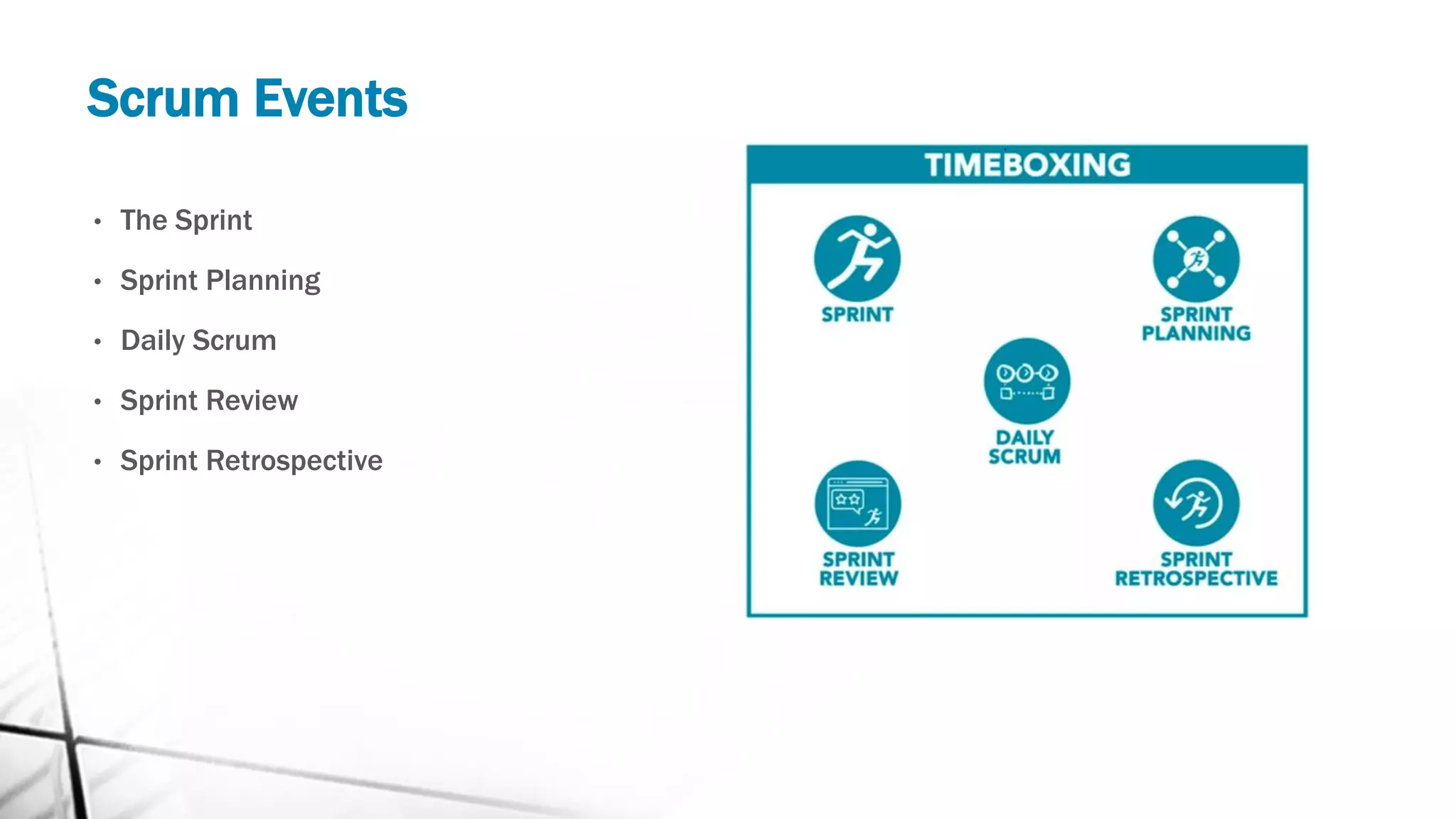
Scrum Events
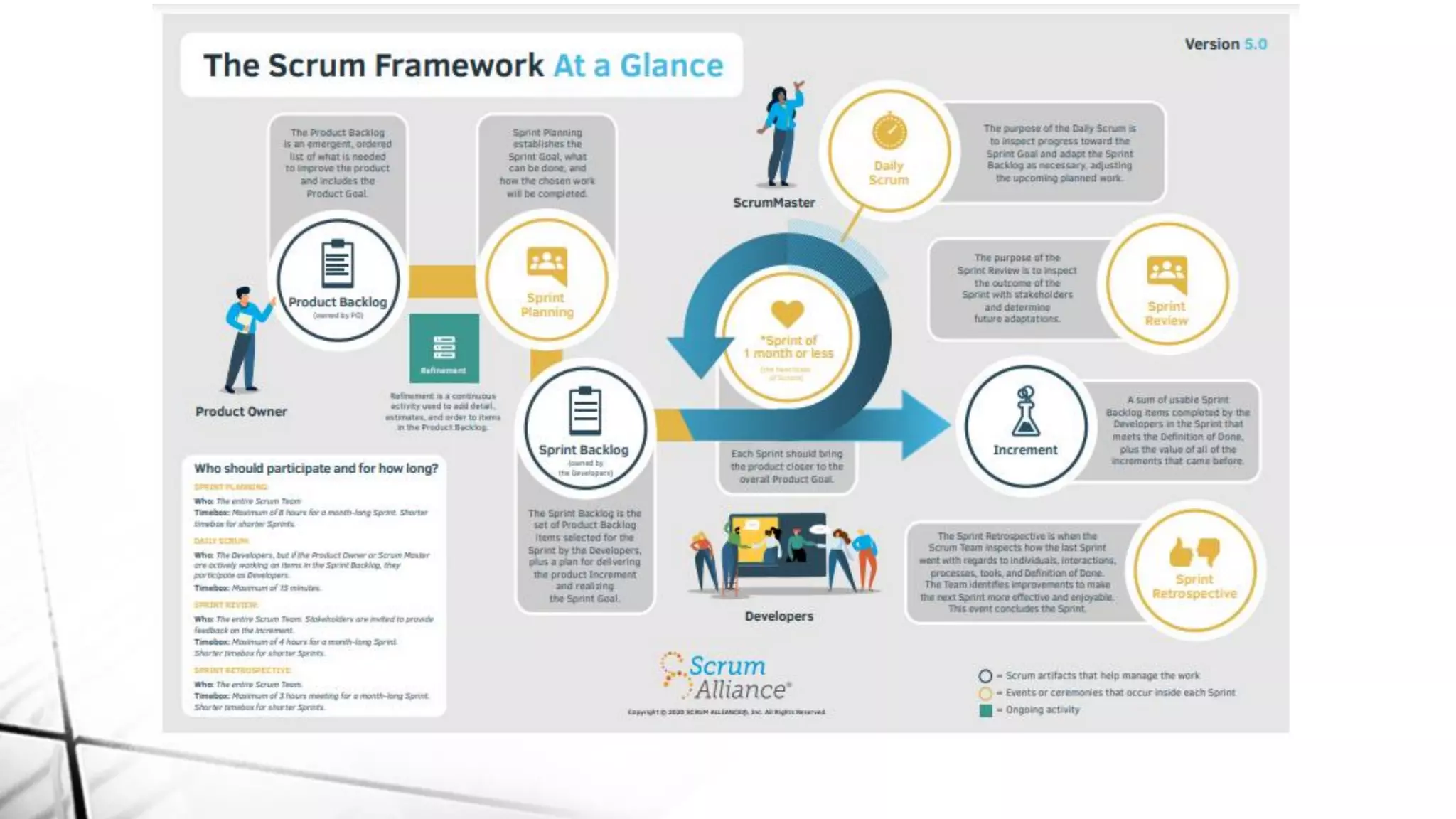
• The Sprint
• Sprint Planning
• Daily Scrum
• Sprint Review
• Sprint Retrospective
The Sprint
• Sprints are the heartbeat of Scrum
• Fixed length events of 1 month or less
• A new Sprint starts immediately after the previous Sprint
• Contains all the work including Sprint Planning, Daily Scrums, Review, and Retrospective
• During the Sprint:
• No changes that would endanger the Sprint Goal
• Quality does not decrease
• Product Backlog is refined; and
• Scope may be renegotiated with the PO
• Sprints enable predictability by ensuring inspection and adaptation
• When a Sprint is too long the Sprint Goal may become invalid, complexity may rise, and risk
increases.
• Shorter Sprints can be employed to generate more learning
Things to do before Sprint Planning
• Working Agreement
• Product Goal and Vision
• Product Backlog
Sprint Planning: Topic One
Sprint Planning addresses the following topics:
• Topic One: Why is this Sprint valuable?
• PO informs how the proposed work would create value
• Team collaborates to define a Sprint Goal to communicate its value
Sprint Planning: Topic Two
• Topic Two: What can be Done this Sprint?
• PO, the Developers select items from the Product Backlog to include in the current Sprint
• The Team may refine these items, which increases understanding/confidence
• The more Developers know about their performance, their capacity, and DOD, the more the confidence
Sprint Planning: Topic Three
• Topic Three: How will the chosen work get done?
• Often by decomposing Product Backlog items into smaller work items of one day or less
• How this is done is at the sole discretion of the Developers
• All proposed items must meet the DOD
• Sprint Goal, Product Backlog items selected, plus the plan for delivering them constitute Sprint Backlog
• Sprint Planning is timeboxed to a maximum of eight hours for a one-month Sprint.
• For shorter Sprints, the event is shorter
Daily Scrum
• Purpose is to inspect progress toward the Sprint Goal and adapt as needed
• Daily Scrum is a 15-minute event for the Developers of the Scrum Team
• If the PO or SM are working on items in the Sprint Backlog, they participate as Developers
• Can select whatever structure and techniques, as long as they focus on the Sprint Goal
• Improves self-management
• Improves communications, identify impediments, promotes quick decision-making
• Consequently, eliminate the need for other meetings
• Daily Scrum is not the only time Developers are allowed to adjust their plan
• They often meet throughout the day for more detailed discussions about adapting
Sprint Review
• Purpose is to inspect the outcome of the Sprint and future adaptations
• Team presents the results of the work and progress toward the Goal is discussed
• Team and stakeholders review what was accomplished in the Sprint
• Based on this information, attendees collaborate on what to do next
• Product Backlog may be adjusted to meet new opportunities
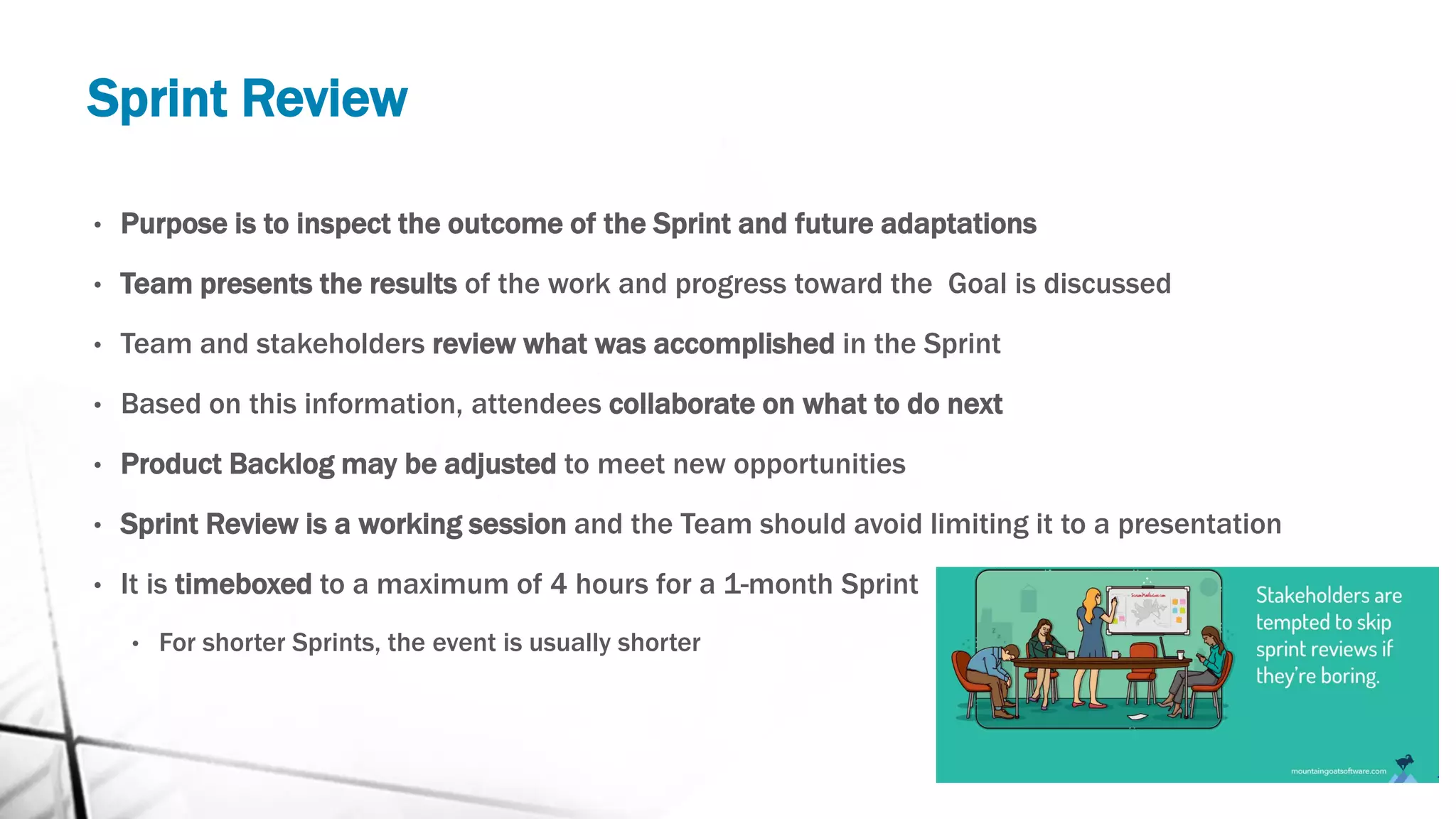
• Sprint Review is a working session and the Team should avoid limiting it to a presentation
• It is timeboxed to a maximum of 4 hours for a 1-month Sprint
• For shorter Sprints, the event is usually shorter
Sprint Retrospective
• Purpose is to plan ways to increase quality and effectiveness
• Team inspects how the last Sprint went with regards to interactions, processes, and DOD
• Assumptions that led them astray are identified and their origins explored
• Team discusses:
• What went well during the Sprint,
• What problems it encountered, and
• How those problems were (or were not) solved.
• Team identifies the most helpful changes to improve its effectiveness
• The most impactful improvements are addressed as soon as possible
• It is timeboxed to a maximum of three hours for a 1-month Sprint
• For shorter Sprints, the event is usually shorter
Scrum Artifacts
• Scrum’s artifacts represent work or value
• They are designed to maximize transparency of key information for learning and adaptation
• Provides means against which progress can be measured:
• For Product Backlog it is the Product Goal
• For Sprint Backlog it is the Sprint Goal
• For Increment it is the Definition of Done
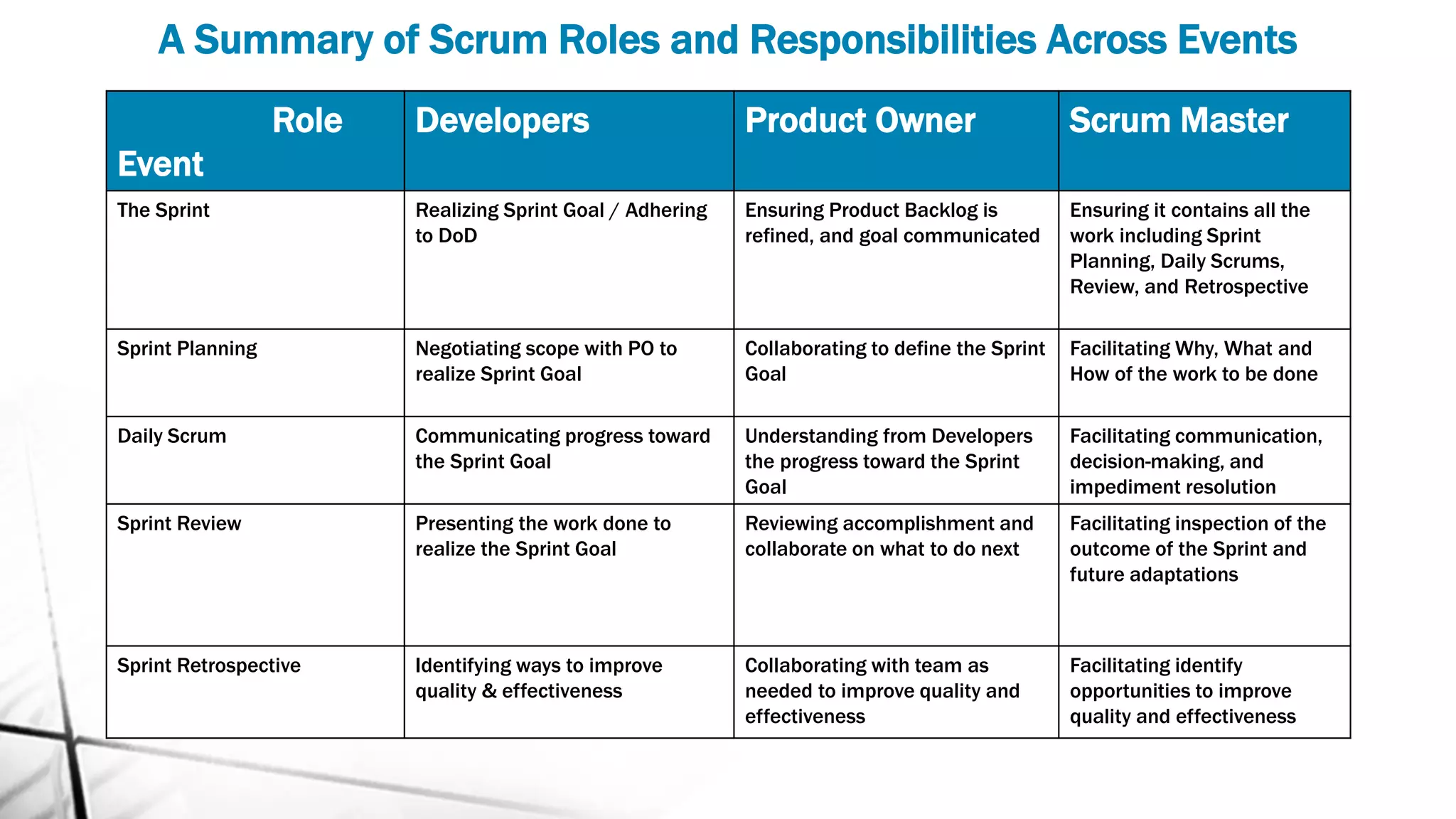
A Summary of Scrum Roles and Responsibilities Across Events
Role
Event
Developers Product Owner Scrum Master
The Sprint Realizing Sprint Goal / Adhering
to DoD
Ensuring Product Backlog is
refined, and goal communicated
Ensuring it contains all the
work including Sprint
Planning, Daily Scrums,
Review, and Retrospective
Sprint Planning Negotiating scope with PO to
realize Sprint Goal
Collaborating to define the Sprint
Goal
Facilitating Why, What and
How of the work to be done
Daily Scrum Communicating progress toward
the Sprint Goal
Understanding from Developers
the progress toward the Sprint
Goal
Facilitating communication,
decision-making, and
impediment resolution
Sprint Review Presenting the work done to
realize the Sprint Goal
Reviewing accomplishment and
collaborate on what to do next
Facilitating inspection of the
outcome of the Sprint and
future adaptations
Sprint Retrospective Identifying ways to improve
quality & effectiveness
Collaborating with team as
needed to improve quality and
effectiveness
Facilitating identify
opportunities to improve
quality and effectiveness
Group Work 3: 15 Minutes
• What are the five Scrum events and how are they important? Is any of these events
dispensable?
• What important roles, activities and artifacts you need before starting a Sprint?
• How do you make sure that you are ready for the next Sprint?
All of you should be ready to teach back to the class. One of you may volunteer to do so.
Additional Resources
1. https://scrumguides.org/
2. Working Agreements
3. Definition of Done
4. Backlog Refinement
Thank you

Teaching Scrum Fundamentals_A Quick Guide to Getting Started.pdf

  • 1.
    Teaching Scrum Fundamentals Aquick guide to getting started Bijay Jayaswal Chief Product Officer, Naviata
  • 2.
    Agenda • How toget best out of this class • Outlines of Scrum Framework • Scrum Team • Scrum Events • Additional Resources
  • 3.
    How to getbest out of this class • Be present • Keep your cell phone and email off • Take notes • Ask questions • Have fun! • Be ready to do group work on assigned problems • And ready to teach back to the class - and the trainer!
  • 4.
  • 6.
    What’s Scrum? • Scrumis a framework to develop complex products – not a prescriptive methodology • It generates value through adaptive solutions • Teams can customize it by “inspecting and adapting” • Works best when all pieces of the framework are in place • SM fosters an environment where: 1. A PO orders the work for a problem into a Product Backlog 2. Scrum Team turns a piece of the work into an Increment during a Sprint 3. Team and stakeholders inspect the results and adjust for the next Sprint 4. Repeat
  • 7.
    Scrum and OrganizationalContext 1. Different processes, techniques and methods can be employed within the framework 2. It wraps around existing practices or renders them unnecessary 3. It provides visibility to • Current management practices • Environment, and • Work techniques, so that improvements can be made
  • 8.
    Empiricism: Inspect andAdapt 1. Transparency: Inspection without transparency is misleading and wasteful 2. Inspection: Scrum artifacts and the progress must be inspected 3. Adaptation: If process deviates outside, it must be adjusted
  • 9.
  • 10.
    Group Work 1:15 Minutes • Why has Scrum been purposefully developed to be a framework and not a methodology? • What are the three theoretical components of empiricism? • What are the five Scrum values and how do they matter? All of you should be ready to teach back to the class. One of you may volunteer to do so.
  • 11.
  • 12.
    Scrum Team 1. Developers 2.Product Owner 3. Scrum Master
  • 13.
    Developers 1. Creating ausable Increment each Sprint 1. Skills broad and will vary 1. Accountable for: ● Creating Sprint Backlog ● Instilling quality, adhering to a Definition of Done ● Adapting their plan each day toward the Sprint Goal; and ● Holding each other accountable as professionals
  • 14.
    Product Owner 1. Maximizingthe value of the product 1. Effective Product Backlog management: ● Developing and communicating the Product Goal ● Creating and communicating Product Backlog items ● Ordering Product Backlog items ● Ensuring that the Product Backlog is transparent and understood 2. For POs to succeed, the organization must respect their decisions 3. Represent the needs of stakeholders in the Product Backlog
  • 15.
    Scrum Master: Servingthe Scrum Team Accountable for establishing Scrum as defined in the Scrum Guide: • Helping everyone understand Scrum • Is accountable for the Team’s effectiveness • Enabling it improve its practices • Serve the Team and the larger organization Serves the Team in several ways, including: • Coaching in self-management and cross-functionality • Helping it focus on creating high-value Increments meeting DOD • Removal of impediments • Ensuring events are positive, productive, and within the timebox
  • 16.
    Scrum Master: Servingthe PO and the Organization Serves the PO in several ways, including: • Effective Product Goal definition and Product Backlog management • Helping Team understand concise Product Backlog items • Helping empirical product planning for a complex environment • Facilitating stakeholder collaboration as needed Serves the organization in several ways, including: • Leading, training, and coaching the organization in adoption • Planning and advising Scrum implementations • Helping employees and stakeholders enact empirical approach • Removing barriers between stakeholders and Scrum Teams.
  • 17.
    Group Work 2:15 Minutes • Why collaboration between POs and the Developers is crucial to develop great products? Why can this be enhanced? • How can the SM serve the Scrum Team? • How can the SM serve the Organization? • What are the five Scrum values and how do they matter? All of you should be ready to teach back to the class. One of you may volunteer to do so.
  • 18.
  • 19.
    Scrum Events • TheSprint • Sprint Planning • Daily Scrum • Sprint Review • Sprint Retrospective
  • 20.
    The Sprint • Sprintsare the heartbeat of Scrum • Fixed length events of 1 month or less • A new Sprint starts immediately after the previous Sprint • Contains all the work including Sprint Planning, Daily Scrums, Review, and Retrospective • During the Sprint: • No changes that would endanger the Sprint Goal • Quality does not decrease • Product Backlog is refined; and • Scope may be renegotiated with the PO • Sprints enable predictability by ensuring inspection and adaptation • When a Sprint is too long the Sprint Goal may become invalid, complexity may rise, and risk increases. • Shorter Sprints can be employed to generate more learning
  • 21.
    Things to dobefore Sprint Planning • Working Agreement • Product Goal and Vision • Product Backlog
  • 22.
    Sprint Planning: TopicOne Sprint Planning addresses the following topics: • Topic One: Why is this Sprint valuable? • PO informs how the proposed work would create value • Team collaborates to define a Sprint Goal to communicate its value
  • 23.
    Sprint Planning: TopicTwo • Topic Two: What can be Done this Sprint? • PO, the Developers select items from the Product Backlog to include in the current Sprint • The Team may refine these items, which increases understanding/confidence • The more Developers know about their performance, their capacity, and DOD, the more the confidence
  • 24.
    Sprint Planning: TopicThree • Topic Three: How will the chosen work get done? • Often by decomposing Product Backlog items into smaller work items of one day or less • How this is done is at the sole discretion of the Developers • All proposed items must meet the DOD • Sprint Goal, Product Backlog items selected, plus the plan for delivering them constitute Sprint Backlog • Sprint Planning is timeboxed to a maximum of eight hours for a one-month Sprint. • For shorter Sprints, the event is shorter
  • 25.
    Daily Scrum • Purposeis to inspect progress toward the Sprint Goal and adapt as needed • Daily Scrum is a 15-minute event for the Developers of the Scrum Team • If the PO or SM are working on items in the Sprint Backlog, they participate as Developers • Can select whatever structure and techniques, as long as they focus on the Sprint Goal • Improves self-management • Improves communications, identify impediments, promotes quick decision-making • Consequently, eliminate the need for other meetings • Daily Scrum is not the only time Developers are allowed to adjust their plan • They often meet throughout the day for more detailed discussions about adapting
  • 26.
    Sprint Review • Purposeis to inspect the outcome of the Sprint and future adaptations • Team presents the results of the work and progress toward the Goal is discussed • Team and stakeholders review what was accomplished in the Sprint • Based on this information, attendees collaborate on what to do next • Product Backlog may be adjusted to meet new opportunities • Sprint Review is a working session and the Team should avoid limiting it to a presentation • It is timeboxed to a maximum of 4 hours for a 1-month Sprint • For shorter Sprints, the event is usually shorter
  • 27.
    Sprint Retrospective • Purposeis to plan ways to increase quality and effectiveness • Team inspects how the last Sprint went with regards to interactions, processes, and DOD • Assumptions that led them astray are identified and their origins explored • Team discusses: • What went well during the Sprint, • What problems it encountered, and • How those problems were (or were not) solved. • Team identifies the most helpful changes to improve its effectiveness • The most impactful improvements are addressed as soon as possible • It is timeboxed to a maximum of three hours for a 1-month Sprint • For shorter Sprints, the event is usually shorter
  • 28.
    Scrum Artifacts • Scrum’sartifacts represent work or value • They are designed to maximize transparency of key information for learning and adaptation • Provides means against which progress can be measured: • For Product Backlog it is the Product Goal • For Sprint Backlog it is the Sprint Goal • For Increment it is the Definition of Done
  • 29.
    A Summary ofScrum Roles and Responsibilities Across Events Role Event Developers Product Owner Scrum Master The Sprint Realizing Sprint Goal / Adhering to DoD Ensuring Product Backlog is refined, and goal communicated Ensuring it contains all the work including Sprint Planning, Daily Scrums, Review, and Retrospective Sprint Planning Negotiating scope with PO to realize Sprint Goal Collaborating to define the Sprint Goal Facilitating Why, What and How of the work to be done Daily Scrum Communicating progress toward the Sprint Goal Understanding from Developers the progress toward the Sprint Goal Facilitating communication, decision-making, and impediment resolution Sprint Review Presenting the work done to realize the Sprint Goal Reviewing accomplishment and collaborate on what to do next Facilitating inspection of the outcome of the Sprint and future adaptations Sprint Retrospective Identifying ways to improve quality & effectiveness Collaborating with team as needed to improve quality and effectiveness Facilitating identify opportunities to improve quality and effectiveness
  • 30.
    Group Work 3:15 Minutes • What are the five Scrum events and how are they important? Is any of these events dispensable? • What important roles, activities and artifacts you need before starting a Sprint? • How do you make sure that you are ready for the next Sprint? All of you should be ready to teach back to the class. One of you may volunteer to do so.
  • 31.
    Additional Resources 1. https://scrumguides.org/ 2.Working Agreements 3. Definition of Done 4. Backlog Refinement
  • 32.