Fundamental of Scrum
For Scrum Certification Exam
Presented by -
Tahmina Khatoon
Technical Project Manager
Brain Station 23 Ltd.
1
Objectives
● What is Agile?
● What is Scrum?
● When should we use scrum framework?
● How can we implement it?
● Some exam tips with related topics
2
Agile?
3
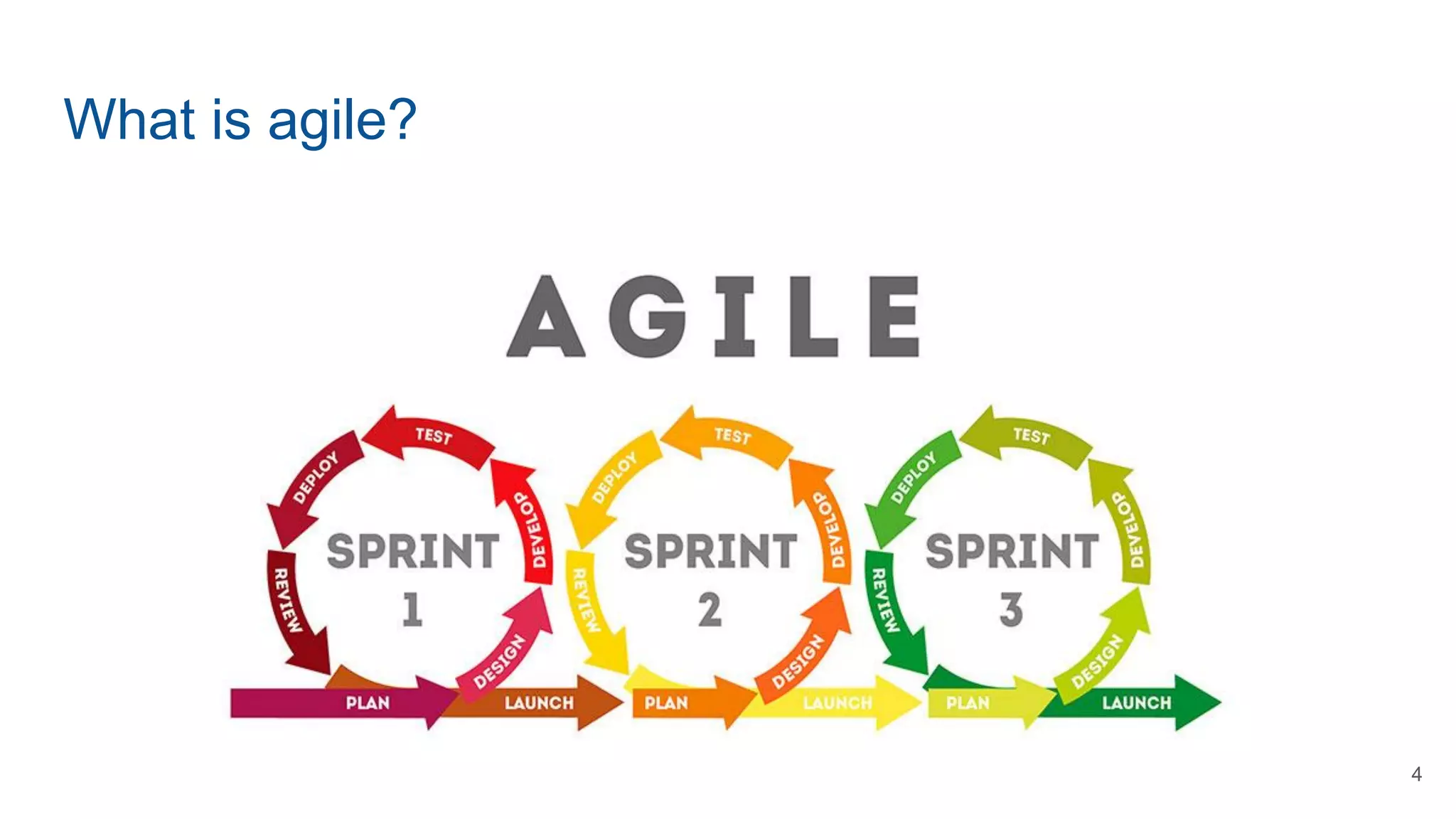
What is agile?
4
What is agile?
According to the Agile Practice Guide — developed jointly by PMI and the Agile
Alliance® and published in September 2017 — “agile” is an approach
to collaborative problem-solving for exploratory work
informed by “a mindset of values and principles as set forth
in the Agile Manifesto.” The agile mindset informs personal behavior,
ways of thinking and actions aligned with the Agile Manifesto values and
principles.
5
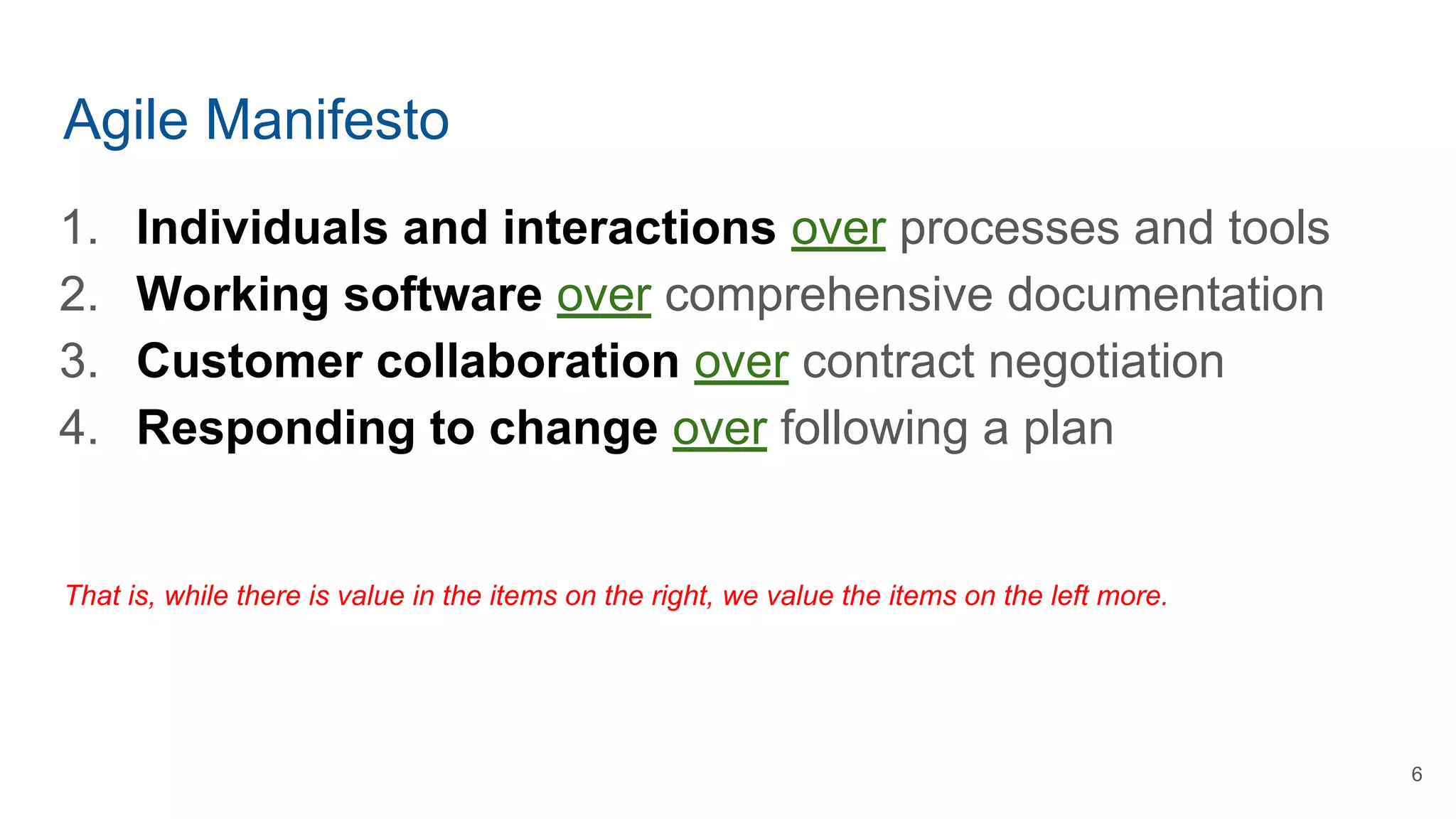
Agile Manifesto
1. Individuals and interactions over processes and tools
2. Working software over comprehensive documentation
3. Customer collaboration over contract negotiation
4. Responding to change over following a plan
That is, while there is value in the items on the right, we value the items on the left more.
6
Principles behind the Agile Manifesto
7
01.
Customer
Satisfaction
Our highest priority is to satisfy the
customer through early and
continuous delivery of valuable
software.
8
02.
Welcome
Change
Welcome changing requirements,
even late in development. Agile
processes harness change for the
customer's competitive advantage.
9
03.
Deliver
Frequently
Deliver working software frequently,
from a couple of weeks to a couple
of months, with a preference to the
shorter timescale.
10
04.
Work Together
Daily
Business people and developers
must work together daily throughout
the project.
11
05.
Motivation,
Environment,
Trust
Build projects around motivated
individuals. Give them the
environment and support they need,
and trust them to get the job done.
12
06.
Face-to-Face
Conversation
The most efficient and effective
method of conveying information to
and within a development team is
face-to-face conversation.
13
07.
Working
Software Working software is the primary
measure of progress.
14
08.
Sustainable
Pace
Agile processes promote
sustainable development. The
sponsors, developers, and users
should be able to maintain a
constant pace indefinitely.
15
09.
Technical
Excellence
Continuous attention to technical
excellence and good design
enhances agility.
16
10.
Simplicity
Simplicity--the art of maximizing the
amount of work not done--is
essential.
17
11.
Self-organization
The best architectures,
requirements, and designs emerge
from self-organizing teams.
18
12.
Reflection
At regular intervals, the team
reflects on how to become more
effective, then tunes and adjusts its
behavior accordingly.
19
Agile Frameworks
20
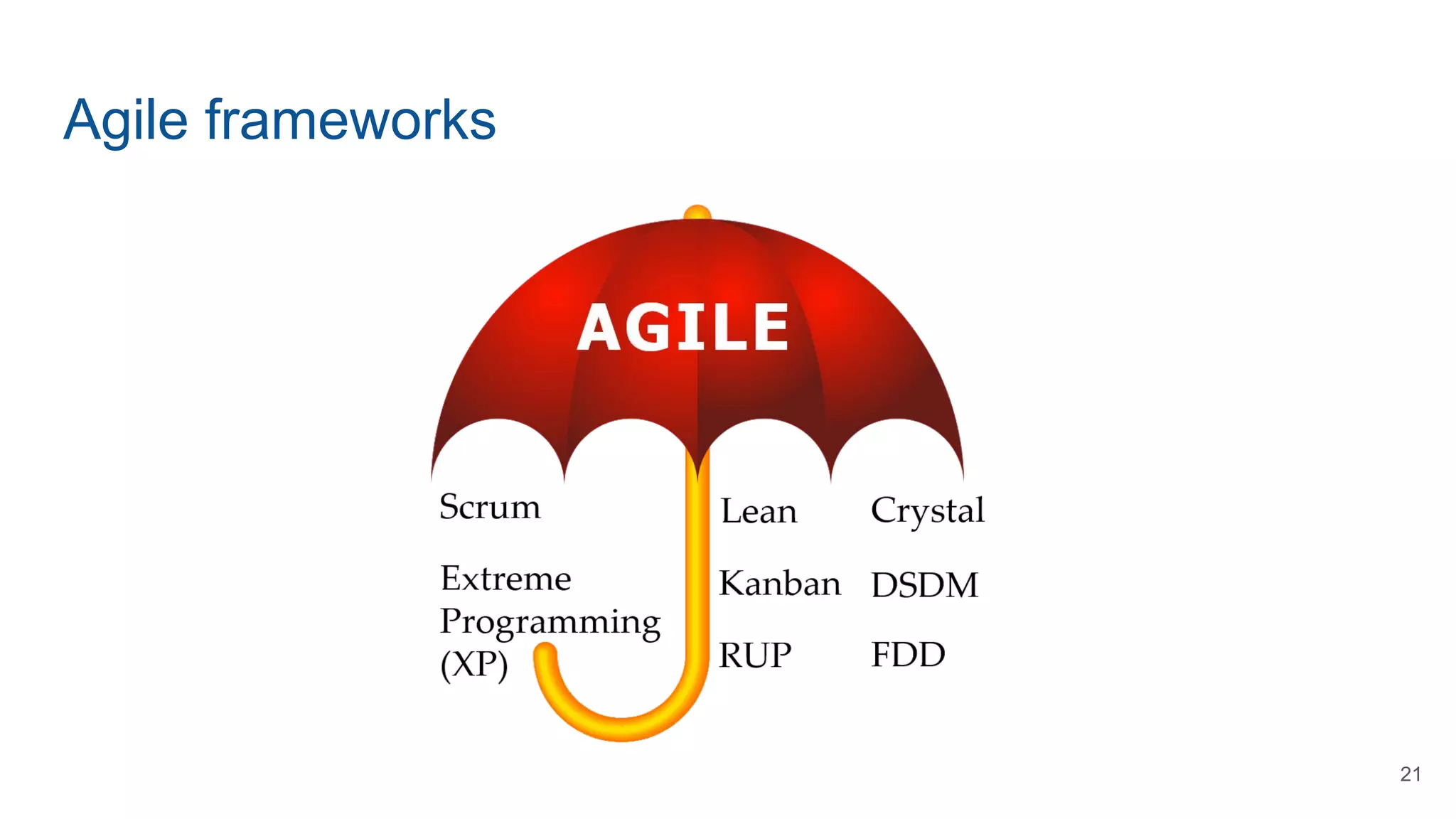
Agile frameworks
21
“Scrum is a framework for developing,
delivering, and sustaining
complex products.”
22
Jeff Sutherland & Ken Schwaber
23
Definition of Scrum
A framework within which people can address complex adaptive problems, while
productively and creatively delivering products of the highest possible value.
Scrum is:
● Lightweight
● Simple to understand
● Difficult to master
24
Scrum Framework
The Scrum framework consists of -
● Scrum Teams and their associated roles,
● Events,
● Artifacts, and
● Rules.
Each component within the framework serves a specific purpose and is essential
to Scrum’s success and usage.
25
Summary of Scrum (33
*4 * 5)
3 Pillars 3 Roles 3 Artifacts 4 Events 5 Values
Transparency
Commitment
Inspection
Adaptation
Scrum
Master
The
Team
Product
Owner
Sprint
Retrospective
Sprint
Review
Daily
Scrum
Sprint
PlanningProduct
Backlog
Sprint
Backlog
Increment
Courage
Focus
Openness
Respect
26
Scrum Theory
“Knowledge comes
only or primarily from
sensory experience”
Empirical process control theory,
or empiricism
John Locke
British Philosopher
27
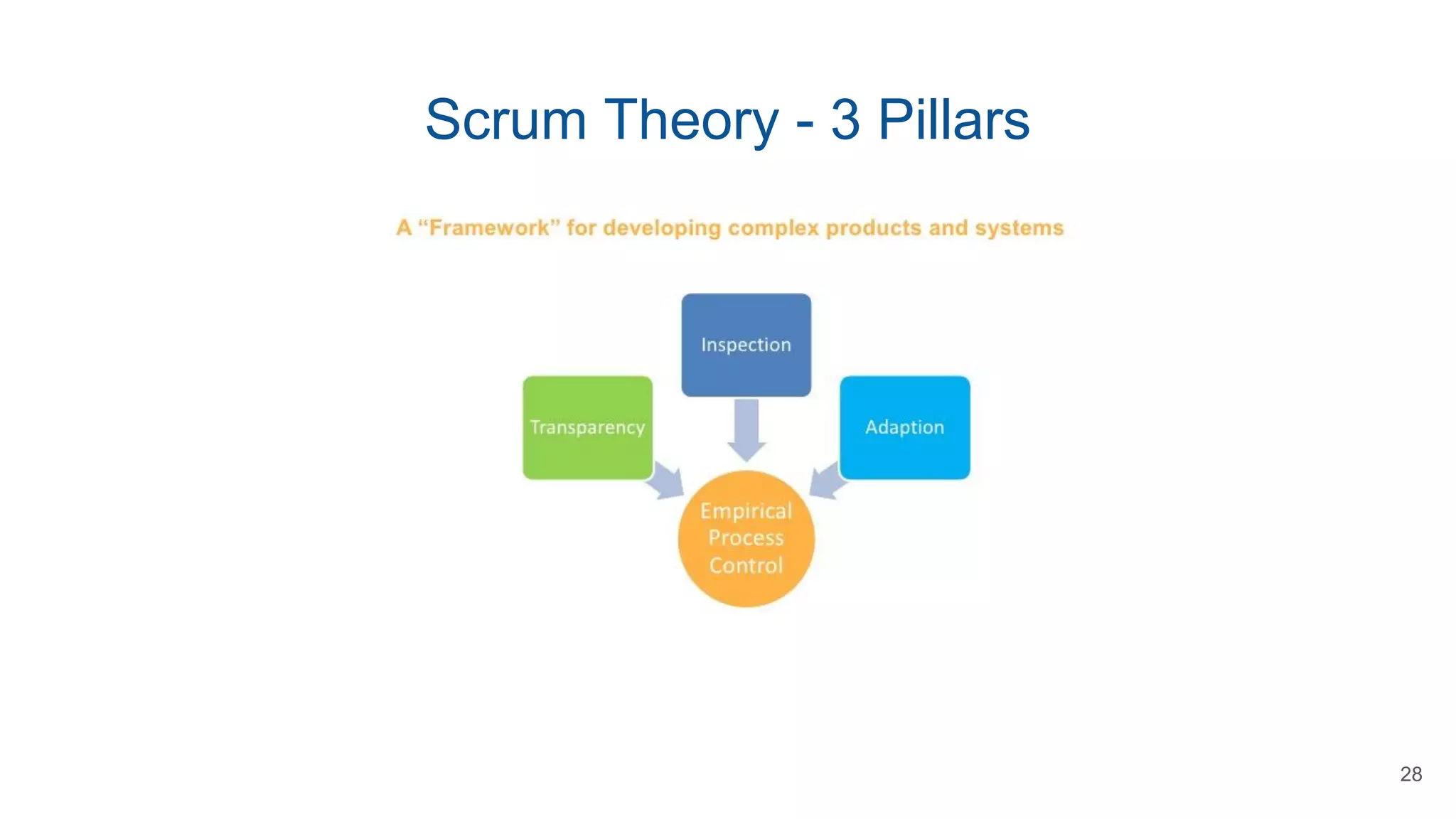
Scrum Theory - 3 Pillars
28
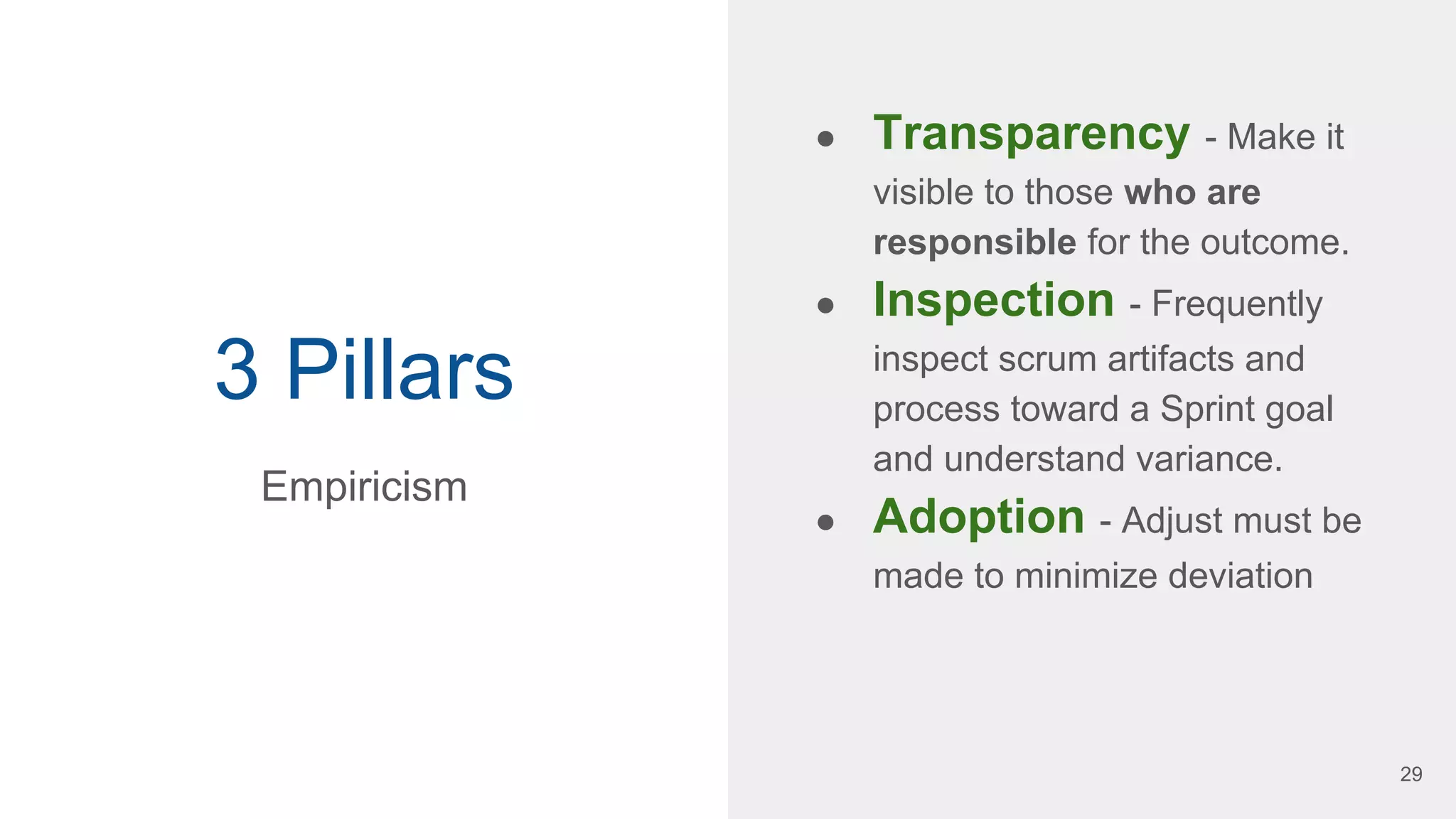
3 Pillars
● Transparency - Make it
visible to those who are
responsible for the outcome.
● Inspection - Frequently
inspect scrum artifacts and
process toward a Sprint goal
and understand variance.
● Adoption - Adjust must be
made to minimize deviation
Empiricism
29
5 Values
● Commitment
● Courage
● Focus
● Openness
● Respect
30
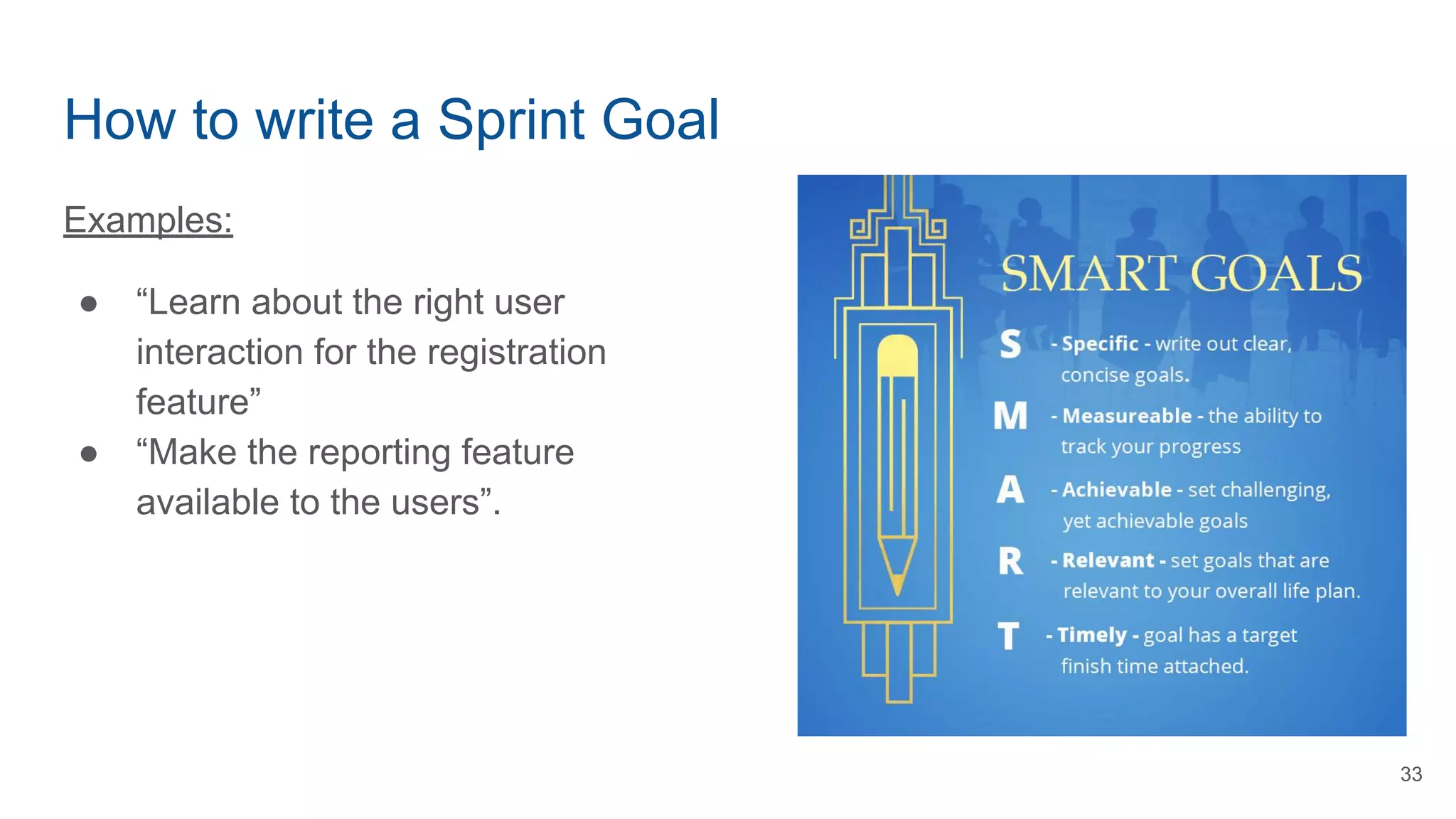
Sprint Goal
A sprint goal describes the purpose of a sprint.
It provides a shared objective, and states why it’s
worthwhile undertaking the sprint.
31
Exam tips
● 1 sprint 1 goal
32
How to write a Sprint Goal
Examples:
● “Learn about the right user
interaction for the registration
feature”
● “Make the reporting feature
available to the users”.
33
3 Artifacts
Product Backlog
Monitoring Progress Toward
Goals
Single source of requirements
for any changes to be made to
the product
Responsible:
Product Owner
Sprint Backlog
Monitoring Sprint Progress
Set of Product Backlog items
selected for the Sprint, plus a
plan for delivering the product
Increment and realizing the
Sprint Goal
Responsible:
Dev Team
Increment
Sum of all the Product Backlog
items completed during a Sprint
and the value of the increments of
all previous Sprints
The increment must be in useable
condition regardless of whether the
Product Owner decides to release it.
34
When multiple teams are working together, each team should maintain a separate
Product Backlog.
35
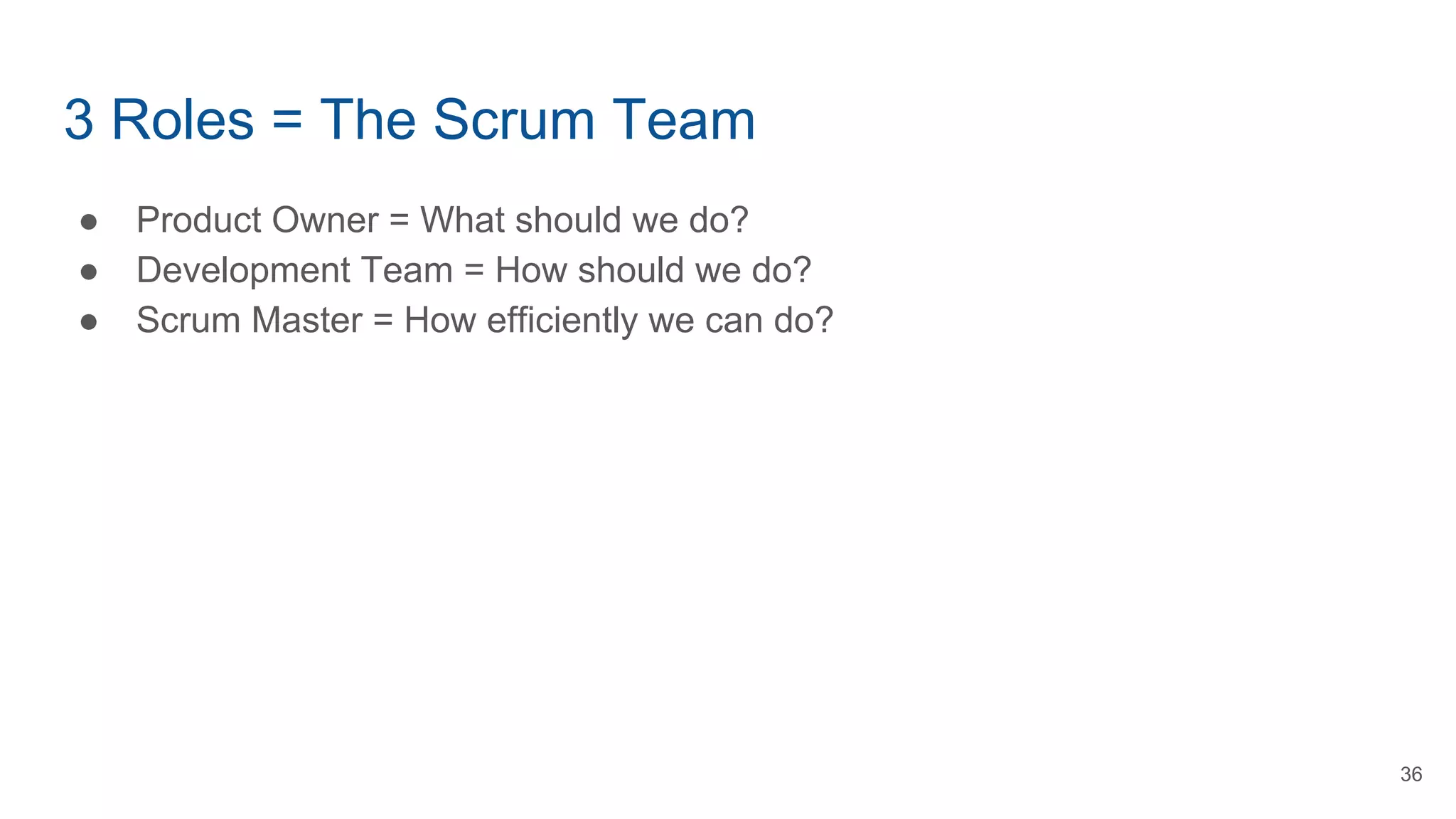
3 Roles = The Scrum Team
● Product Owner = What should we do?
● Development Team = How should we do?
● Scrum Master = How efficiently we can do?
36
Product Owner
● Clearly expressing Product Backlog items;
● Ordering the items in the Product Backlog to best achieve goals and
missions;
● Optimizing the value of the work the Development Team performs;
● Ensuring that the Product Backlog is visible, transparent, and clear to all, and
shows what the Scrum Team will work on next; and,
● Ensuring the Development Team understands items in the Product Backlog to
the level needed.
37
Exam tips
● Single Person: The Product Owner is one person, not a committee.
● Powerful Person: Product owners decision is final - everyone should respect
his decision.
● Knowledgeable Person: Must have sufficient knowledge about product.
38
Dev Team (6+-3)
● Self-organizing
● Cross-functional
● No titles regardless of the work being performed by the person
● No sub-team regardless of domains that need to be addressed like testing,
architecture, operations, or business analysis;
● Accountable to success of failure of the sprint
39
Exam Tips
● Dev team size: 3 - 9
● The Product Owner and Scrum Master roles are not included in this count
unless they are also executing the work of the Sprint Backlog.
● Responsible to conduct daily scrum
40
Scrum Master
● Servant-leader for the Scrum Team
● Responsible for promoting and supporting Scrum
● Serve to the Product owner
● Serve to the Dev Team
● Serve to the organization
41
Exam tips
● Scrum Master is a "management" position? Yes - but s/he does not manage
the team.
● No one from team should report to the scrum master
42
Scrum Events
● Sprint Planning
● Daily Scrum
● Sprint Review
● Retrospective
43
The Sprint - 1 month max
Heart of the scrum.
During sprint -
● No changes are made that would endanger the Sprint Goal;
● Quality goals do not decrease; and,
● Scope may be clarified and re-negotiated between the Product Owner and
Development Team as more is learned.
44
Exam Tips
● Canceling a sprint: Before sprint time box is over
● Canceling a sprint only by the product owner, but scrum master or dev team
can request to cancel
● If part of the work is potentially releasable, the Product Owner typically
accepts it, and remaining items should go to the product backlog for
re-estimate and re-prioritize.
Sprint cancellations are often traumatic to the Scrum Team, and are very uncommon.
45
Sprint Planning - 8 hours max
Facilitated by - Scrum Master
It answers the following two questions -
● What can be delivered in the Increment resulting from the upcoming Sprint?
● How will the work needed to deliver the Increment be achieved?
Team set a sprint goal.
Work planned for the first days of the Sprint by the Development Team is
decomposed by the end of this meeting, often to units of one day or less
46
Daily Scrum - 15 min max
Facilitated by - Team
● Same time, Same place
● No details discussion
● Rise impediments if exist
47
Sprint review - 4 hours max
Facilitated by - Product Owner
● This is an informal meeting, not a status meeting.
● Show demo to stakeholders
● No commitment from dev team
● Take feedbacks from the stakeholders
48
Sprint review includes -
● Attendees include the Scrum Team and key stakeholders invited by the
Product Owner;
● The Product Owner explains what Product Backlog items have been "Done"
and what has not been "Done";
● The Development Team discusses what went well during the Sprint, what
problems it ran into, and how those problems were solved;
● The Development Team demonstrates the work that it has "Done" and
answers questions about the Increment;
● The Product Owner discusses the Product Backlog as it stands.
49
Retrospective - 3 hours max
Facilitated by : Team
● Inspect how the last Sprint went with regards to people, relationships,
process, and tools;
● Identify and order the major items that went well and potential improvements;
and,
● Create a plan for implementing improvements to the way the Scrum Team
does its work.
50
Definition of Done = ?
● Vary significantly per Scrum
Team
● Same for all
● Ensure Transparency
51
Important Links
● https://www.romanpichler.com/blog/effective-sprint-goals/
● https://www.scrum.org/resources/suggested-reading-professional-scrum-master
● https://www.scrumguides.org/scrum-guide.html
● https://mlapshin.com/index.php/scrum-quizzes/sm-real-mode/
52
Questions?
53
Thank you
For your participation.
54

Fundamental of Scrum

  • 1.
    Fundamental of Scrum ForScrum Certification Exam Presented by - Tahmina Khatoon Technical Project Manager Brain Station 23 Ltd. 1
  • 2.
    Objectives ● What isAgile? ● What is Scrum? ● When should we use scrum framework? ● How can we implement it? ● Some exam tips with related topics 2
  • 3.
  • 4.
  • 5.
    What is agile? Accordingto the Agile Practice Guide — developed jointly by PMI and the Agile Alliance® and published in September 2017 — “agile” is an approach to collaborative problem-solving for exploratory work informed by “a mindset of values and principles as set forth in the Agile Manifesto.” The agile mindset informs personal behavior, ways of thinking and actions aligned with the Agile Manifesto values and principles. 5
  • 6.
    Agile Manifesto 1. Individualsand interactions over processes and tools 2. Working software over comprehensive documentation 3. Customer collaboration over contract negotiation 4. Responding to change over following a plan That is, while there is value in the items on the right, we value the items on the left more. 6
  • 7.
    Principles behind theAgile Manifesto 7
  • 8.
    01. Customer Satisfaction Our highest priorityis to satisfy the customer through early and continuous delivery of valuable software. 8
  • 9.
    02. Welcome Change Welcome changing requirements, evenlate in development. Agile processes harness change for the customer's competitive advantage. 9
  • 10.
    03. Deliver Frequently Deliver working softwarefrequently, from a couple of weeks to a couple of months, with a preference to the shorter timescale. 10
  • 11.
    04. Work Together Daily Business peopleand developers must work together daily throughout the project. 11
  • 12.
    05. Motivation, Environment, Trust Build projects aroundmotivated individuals. Give them the environment and support they need, and trust them to get the job done. 12
  • 13.
    06. Face-to-Face Conversation The most efficientand effective method of conveying information to and within a development team is face-to-face conversation. 13
  • 14.
    07. Working Software Working softwareis the primary measure of progress. 14
  • 15.
    08. Sustainable Pace Agile processes promote sustainabledevelopment. The sponsors, developers, and users should be able to maintain a constant pace indefinitely. 15
  • 16.
    09. Technical Excellence Continuous attention totechnical excellence and good design enhances agility. 16
  • 17.
    10. Simplicity Simplicity--the art ofmaximizing the amount of work not done--is essential. 17
  • 18.
    11. Self-organization The best architectures, requirements,and designs emerge from self-organizing teams. 18
  • 19.
    12. Reflection At regular intervals,the team reflects on how to become more effective, then tunes and adjusts its behavior accordingly. 19
  • 20.
  • 21.
  • 22.
    “Scrum is aframework for developing, delivering, and sustaining complex products.” 22
  • 23.
    Jeff Sutherland &Ken Schwaber 23
  • 24.
    Definition of Scrum Aframework within which people can address complex adaptive problems, while productively and creatively delivering products of the highest possible value. Scrum is: ● Lightweight ● Simple to understand ● Difficult to master 24
  • 25.
    Scrum Framework The Scrumframework consists of - ● Scrum Teams and their associated roles, ● Events, ● Artifacts, and ● Rules. Each component within the framework serves a specific purpose and is essential to Scrum’s success and usage. 25
  • 26.
    Summary of Scrum(33 *4 * 5) 3 Pillars 3 Roles 3 Artifacts 4 Events 5 Values Transparency Commitment Inspection Adaptation Scrum Master The Team Product Owner Sprint Retrospective Sprint Review Daily Scrum Sprint PlanningProduct Backlog Sprint Backlog Increment Courage Focus Openness Respect 26
  • 27.
    Scrum Theory “Knowledge comes onlyor primarily from sensory experience” Empirical process control theory, or empiricism John Locke British Philosopher 27
  • 28.
    Scrum Theory -3 Pillars 28
  • 29.
    3 Pillars ● Transparency- Make it visible to those who are responsible for the outcome. ● Inspection - Frequently inspect scrum artifacts and process toward a Sprint goal and understand variance. ● Adoption - Adjust must be made to minimize deviation Empiricism 29
  • 30.
    5 Values ● Commitment ●Courage ● Focus ● Openness ● Respect 30
  • 31.
    Sprint Goal A sprintgoal describes the purpose of a sprint. It provides a shared objective, and states why it’s worthwhile undertaking the sprint. 31
  • 32.
    Exam tips ● 1sprint 1 goal 32
  • 33.
    How to writea Sprint Goal Examples: ● “Learn about the right user interaction for the registration feature” ● “Make the reporting feature available to the users”. 33
  • 34.
    3 Artifacts Product Backlog MonitoringProgress Toward Goals Single source of requirements for any changes to be made to the product Responsible: Product Owner Sprint Backlog Monitoring Sprint Progress Set of Product Backlog items selected for the Sprint, plus a plan for delivering the product Increment and realizing the Sprint Goal Responsible: Dev Team Increment Sum of all the Product Backlog items completed during a Sprint and the value of the increments of all previous Sprints The increment must be in useable condition regardless of whether the Product Owner decides to release it. 34
  • 35.
    When multiple teamsare working together, each team should maintain a separate Product Backlog. 35
  • 36.
    3 Roles =The Scrum Team ● Product Owner = What should we do? ● Development Team = How should we do? ● Scrum Master = How efficiently we can do? 36
  • 37.
    Product Owner ● Clearlyexpressing Product Backlog items; ● Ordering the items in the Product Backlog to best achieve goals and missions; ● Optimizing the value of the work the Development Team performs; ● Ensuring that the Product Backlog is visible, transparent, and clear to all, and shows what the Scrum Team will work on next; and, ● Ensuring the Development Team understands items in the Product Backlog to the level needed. 37
  • 38.
    Exam tips ● SinglePerson: The Product Owner is one person, not a committee. ● Powerful Person: Product owners decision is final - everyone should respect his decision. ● Knowledgeable Person: Must have sufficient knowledge about product. 38
  • 39.
    Dev Team (6+-3) ●Self-organizing ● Cross-functional ● No titles regardless of the work being performed by the person ● No sub-team regardless of domains that need to be addressed like testing, architecture, operations, or business analysis; ● Accountable to success of failure of the sprint 39
  • 40.
    Exam Tips ● Devteam size: 3 - 9 ● The Product Owner and Scrum Master roles are not included in this count unless they are also executing the work of the Sprint Backlog. ● Responsible to conduct daily scrum 40
  • 41.
    Scrum Master ● Servant-leaderfor the Scrum Team ● Responsible for promoting and supporting Scrum ● Serve to the Product owner ● Serve to the Dev Team ● Serve to the organization 41
  • 42.
    Exam tips ● ScrumMaster is a "management" position? Yes - but s/he does not manage the team. ● No one from team should report to the scrum master 42
  • 43.
    Scrum Events ● SprintPlanning ● Daily Scrum ● Sprint Review ● Retrospective 43
  • 44.
    The Sprint -1 month max Heart of the scrum. During sprint - ● No changes are made that would endanger the Sprint Goal; ● Quality goals do not decrease; and, ● Scope may be clarified and re-negotiated between the Product Owner and Development Team as more is learned. 44
  • 45.
    Exam Tips ● Cancelinga sprint: Before sprint time box is over ● Canceling a sprint only by the product owner, but scrum master or dev team can request to cancel ● If part of the work is potentially releasable, the Product Owner typically accepts it, and remaining items should go to the product backlog for re-estimate and re-prioritize. Sprint cancellations are often traumatic to the Scrum Team, and are very uncommon. 45
  • 46.
    Sprint Planning -8 hours max Facilitated by - Scrum Master It answers the following two questions - ● What can be delivered in the Increment resulting from the upcoming Sprint? ● How will the work needed to deliver the Increment be achieved? Team set a sprint goal. Work planned for the first days of the Sprint by the Development Team is decomposed by the end of this meeting, often to units of one day or less 46
  • 47.
    Daily Scrum -15 min max Facilitated by - Team ● Same time, Same place ● No details discussion ● Rise impediments if exist 47
  • 48.
    Sprint review -4 hours max Facilitated by - Product Owner ● This is an informal meeting, not a status meeting. ● Show demo to stakeholders ● No commitment from dev team ● Take feedbacks from the stakeholders 48
  • 49.
    Sprint review includes- ● Attendees include the Scrum Team and key stakeholders invited by the Product Owner; ● The Product Owner explains what Product Backlog items have been "Done" and what has not been "Done"; ● The Development Team discusses what went well during the Sprint, what problems it ran into, and how those problems were solved; ● The Development Team demonstrates the work that it has "Done" and answers questions about the Increment; ● The Product Owner discusses the Product Backlog as it stands. 49
  • 50.
    Retrospective - 3hours max Facilitated by : Team ● Inspect how the last Sprint went with regards to people, relationships, process, and tools; ● Identify and order the major items that went well and potential improvements; and, ● Create a plan for implementing improvements to the way the Scrum Team does its work. 50
  • 51.
    Definition of Done= ? ● Vary significantly per Scrum Team ● Same for all ● Ensure Transparency 51
  • 52.
    Important Links ● https://www.romanpichler.com/blog/effective-sprint-goals/ ●https://www.scrum.org/resources/suggested-reading-professional-scrum-master ● https://www.scrumguides.org/scrum-guide.html ● https://mlapshin.com/index.php/scrum-quizzes/sm-real-mode/ 52
  • 53.
  • 54.
    Thank you For yourparticipation. 54