FUNCTIONS OF ART
The functions of art are classified into
three:
• Personal Functions of Art — are varied and highly subjective.
• Social Functions of Art — Art is considered to have social
function if it addresses a particular collective interest as
opposed to a personal interest.
• Physical Functions of Art — are the easiest to spot and
understand. It can be found in artworks that are crafted in order
to serve some physical purpose.
OTHER FUNCTIONS OF ART
•Music
•Sculpture
•Architecture
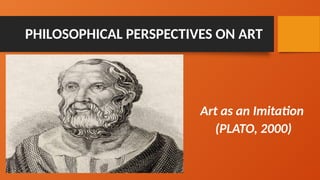
PHILOSOPHICAL PERSPECTIVES ON ART
Art as an Imitation
(PLATO, 2000)
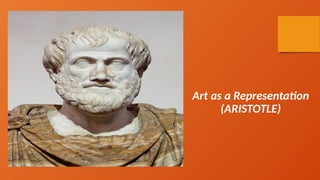
Art as a Representation
(ARISTOTLE)
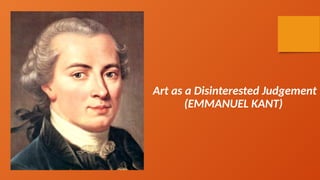
Art as a Disinterested Judgement
(EMMANUEL KANT)
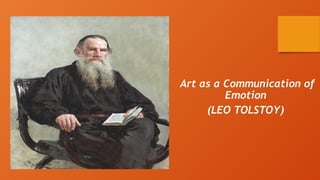
Art as a Communication of
Emotion
(LEO TOLSTOY)
SUBJECT AND CONTENT
SUBJECT
•Refers to the visual
focus or the image
that may be
extracted from
examining the
artwork.
CONTENT
•Is the meaning that
is communicated by
the artist or the art
to artwork.
Meanings:
TYPES OF SUBJECT
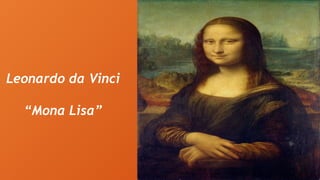
1.Representational Art (often termed as figurative
art)
— These types of art have subjects that refer to
objects or events occurring in the real world.
Leonardo da Vinci
“Mona Lisa”
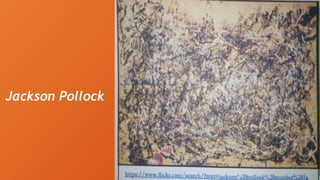
2. Non-representational Art (often termed non-
figurative art)
— does not make a reference to the real world,
whether it is a person, place, thing or even a
particular event.
Jackson Pollock
CONTENT IN ART
•Refers to the meaning or significance/or feeling
imparted by a work of art. This is not the same
thing as the work depicts.
•Content in Art may be classified as factual,
conventional, and subjective.
1. FACTUAL MEANING — This pertains to the most
rudimentary level of meaning for it may be extracted
form the identifiable or recognizable forms in the
artwork and understanding how these elements relate to
one another.
2. CONVENTIONAL MEANING — It pertains to the
acknowledged interpretation of the artwork using
motifs, signs, symbols and other cyphers as bases of its
meaning.
3. SUBJECTIVE MEANING — When subjective are
consulted, a variety of meaning may arise when a
particular work of art is read.
MEDIUMS OF VISUAL ARTS
Medium which comes from the Latin word “Medium“
means by which an artist communicates his idea. These
are the materials which are used by an artist to interpret
his feelings or thoughts.
VISUAL ARTS
•Visual Arts are those mediums that can be seen and
which occupy space.
•Visual Arts are those arts that can be perceived with
our eyes.
Most common visual arts:
Painting
Sculpture
Architecture.
TWO (2) CLASSES OF VISUAL ARTS
Dimensional or Two- Dimensional
Arts
➤ Painting
➤ Drawing
➤ Printmaking
➤ Photography
Three-Dimensional Arts
➤ Sculpture
➤ Architecture
➤ Landscape
➤ Community Planning
➤ Industrial Design
➤ Crafts
•ARTISTS
are the creators of
tangible or intangible
products as an
expression of creativity
and imagination for
purely aesthetic
reasons.
•ARTISANS
ARTISANS (craftsman) — are
the makers of products or
crafts, not only for aesthetic
value of creativity and for
decorative purposes but for
practical value, such as for
business aesthetic reasons.
purposes.
ART PRODUCTION PROCESS
❖Art is concerned with the actual doing and how
actions can be achieved seeing the art as pure
human expression.
❖Art production often entails an inherent
motivation, rationale and intentionality.
1.PRE-PLANNING/PRE-
PRODUCTION
2.PRODUCTION
3.POST-PRODUCTION
THREE (3) PARTS OF ART PRODUCTION
PRE-PRODUCTION
•Is the process of fixing some of the elements in
art (such as film, play or other performance).
PRODUCTION
•It is the act of creating output such as good or service
which has value that contributes to utility of
individuals.
POST-PRODUCTION
•This is the process of filmmaking, video
production, and photography.
ELEMENTS OF VISUAL ARTS
• Line
• Color
• Color Harmonies
• Texture
• Perspective
• Space
• Form
LINE — is an important at the disposal of every artist.
Through the lines, as in painting or sculpture, the
artist represents figures and forms.
COLOR — has the most aesthetic appeal among the
elements of visual arts. Delight in color is a universal
human characteristic. Color is a property of light.
When light goes out, color goes with it.
COLOR HARMONIES — may either be monochromatic
or adjacent.
• Monochromatic harmony - is made up of several
tones of one hue, like for instance orange, tan,
brown, and other tones from b the orange family.
• Contrasted Color Harmonies - colors which lie
directly opposite to each other in the color circle
are called complementary colors.IP
TEXTURE — is an element that deals more directly with
the sense of touch. It has to do with the characteristics
of surfaces which can be rough or smooth, fine, or
coarse, shiny or dull, plain or irregular. It is best
appreciated when an object is felt with the hands.
PERSPECTIVE — deals with the effect of distance upon
the appearance of objects, by means of which the eye
judges spatial relationships. It enables us to perceive
distance and to see the position of objects in space.
SPACE — In painting, as in architecture, space is for
great importance. The exterior of a building is seen as
it appears in space, while interior is s seen by one who
is inside an enclosure. Painting does not deal with
space directly.
FORM — applies to the overall design of work of art. It
describes the structure or a shape of an object.
ELEMENTS OF ART: AUDITORY
RHYTHYM — is the element of time in music.
DYNAMICS — is the relative loudness (or quietness of music)
MELODY — is the linear/horizontal presentation of pitch (the
highness or lowness of a musical sound).
HARMONY — is the virtualization of pitch. Often, harmony is
thought of as the art of combining pitches into chords.
TIMBRE — refers to the tone color.
TEXTURE — refers to the number of individual musical lines
(melodies) and the relationship these lines have to one
another.
MEDIUMS OF AUDITORY ARTS
Auditory Arts are those whose mediums can be
heard in which are expressed in time.
• Motion Pictures,
• Film, or Movies
• Theater
• Television or TV
MEDIUMS OF COMBINED ARTS(MIXED
MEDIA)
• Doing a charcoal sketch before painting
• Doing a pencil sketch before painting
• Combining watercolor with pastel in landscape
painting
NEW TRENDS IN PERFORMING ARTS
• Performing art tend appears to be on the rise.
• Live performance continues to grow elsewhere,
Broadway plays and live opera performances are
rising
• Even the demand for new trends of commercial
recordings in televisions and radios are stronger now
than ever.
TRANSCREATION
(CREATIVETRANSLATION)
• This is the process of adapting a message from one
language to another while maintaining its intent,
style, tone, and context.
PURPOSE OF TRANSCREATION
• Purpose of trans creation is to transfer the intent,
style, vocal tone, and emotional salience of the
message from the source language to that of the
targeted audience.
MUSIC TO TEXT
• In novel or poetry, one can generate music with
general feeling.
TEXT TO DANCE
• Its using a dialogue or text to influence and enhance
dance performance.
DANCE TO VISUAL ART
• The great majority of the evidence for dance
occurred in Ancient Greek which come from visual
art. Sculptures and paintings on pots represented
dancers. Relief sculpture in tombs included scenes
of dancers.
Principles of Design
• Balance: Achieving a sense of equilibrium
between elements in a design.
• Proportion: The size of elements relative to one
another and to the whole.
• Emphasis: Drawing attention to a particular
element in a design.
• Unity: Creating a sense of oneness and harmony.
Variety: Introducing elements that contrast and
complement one another.
• Movement: Using visual flow to guide the eye
through the design.
• Rhythm: Creating a sense of regularity and
repetition.
• Contrast: Highlighting differences between
elements.
• Hierarchy: Arranging elements in order of
importance.
• Repetition: Repeating elements to create a unified
THANK YOU
😇😇😇

art-app.pptx art appreciation docsuments

  • 1.
  • 2.
    The functions ofart are classified into three: • Personal Functions of Art — are varied and highly subjective. • Social Functions of Art — Art is considered to have social function if it addresses a particular collective interest as opposed to a personal interest. • Physical Functions of Art — are the easiest to spot and understand. It can be found in artworks that are crafted in order to serve some physical purpose.
  • 3.
    OTHER FUNCTIONS OFART •Music •Sculpture •Architecture
  • 4.
    PHILOSOPHICAL PERSPECTIVES ONART Art as an Imitation (PLATO, 2000)
  • 5.
    Art as aRepresentation (ARISTOTLE)
  • 6.
    Art as aDisinterested Judgement (EMMANUEL KANT)
  • 7.
    Art as aCommunication of Emotion (LEO TOLSTOY)
  • 8.
  • 9.
    SUBJECT •Refers to thevisual focus or the image that may be extracted from examining the artwork. CONTENT •Is the meaning that is communicated by the artist or the art to artwork. Meanings:
  • 10.
    TYPES OF SUBJECT 1.RepresentationalArt (often termed as figurative art) — These types of art have subjects that refer to objects or events occurring in the real world.
  • 11.
  • 12.
    2. Non-representational Art(often termed non- figurative art) — does not make a reference to the real world, whether it is a person, place, thing or even a particular event.
  • 13.
  • 14.
    CONTENT IN ART •Refersto the meaning or significance/or feeling imparted by a work of art. This is not the same thing as the work depicts. •Content in Art may be classified as factual, conventional, and subjective.
  • 15.
    1. FACTUAL MEANING— This pertains to the most rudimentary level of meaning for it may be extracted form the identifiable or recognizable forms in the artwork and understanding how these elements relate to one another. 2. CONVENTIONAL MEANING — It pertains to the acknowledged interpretation of the artwork using motifs, signs, symbols and other cyphers as bases of its meaning.
  • 16.
    3. SUBJECTIVE MEANING— When subjective are consulted, a variety of meaning may arise when a particular work of art is read.
  • 17.
    MEDIUMS OF VISUALARTS Medium which comes from the Latin word “Medium“ means by which an artist communicates his idea. These are the materials which are used by an artist to interpret his feelings or thoughts.
  • 18.
    VISUAL ARTS •Visual Artsare those mediums that can be seen and which occupy space. •Visual Arts are those arts that can be perceived with our eyes. Most common visual arts: Painting Sculpture Architecture.
  • 19.
    TWO (2) CLASSESOF VISUAL ARTS Dimensional or Two- Dimensional Arts ➤ Painting ➤ Drawing ➤ Printmaking ➤ Photography Three-Dimensional Arts ➤ Sculpture ➤ Architecture ➤ Landscape ➤ Community Planning ➤ Industrial Design ➤ Crafts
  • 20.
    •ARTISTS are the creatorsof tangible or intangible products as an expression of creativity and imagination for purely aesthetic reasons. •ARTISANS ARTISANS (craftsman) — are the makers of products or crafts, not only for aesthetic value of creativity and for decorative purposes but for practical value, such as for business aesthetic reasons. purposes.
  • 21.
    ART PRODUCTION PROCESS ❖Artis concerned with the actual doing and how actions can be achieved seeing the art as pure human expression. ❖Art production often entails an inherent motivation, rationale and intentionality.
  • 22.
  • 23.
    PRE-PRODUCTION •Is the processof fixing some of the elements in art (such as film, play or other performance).
  • 24.
    PRODUCTION •It is theact of creating output such as good or service which has value that contributes to utility of individuals.
  • 25.
    POST-PRODUCTION •This is theprocess of filmmaking, video production, and photography.
  • 26.
    ELEMENTS OF VISUALARTS • Line • Color • Color Harmonies • Texture • Perspective • Space • Form
  • 27.
    LINE — isan important at the disposal of every artist. Through the lines, as in painting or sculpture, the artist represents figures and forms. COLOR — has the most aesthetic appeal among the elements of visual arts. Delight in color is a universal human characteristic. Color is a property of light. When light goes out, color goes with it.
  • 28.
    COLOR HARMONIES —may either be monochromatic or adjacent. • Monochromatic harmony - is made up of several tones of one hue, like for instance orange, tan, brown, and other tones from b the orange family. • Contrasted Color Harmonies - colors which lie directly opposite to each other in the color circle are called complementary colors.IP
  • 29.
    TEXTURE — isan element that deals more directly with the sense of touch. It has to do with the characteristics of surfaces which can be rough or smooth, fine, or coarse, shiny or dull, plain or irregular. It is best appreciated when an object is felt with the hands. PERSPECTIVE — deals with the effect of distance upon the appearance of objects, by means of which the eye judges spatial relationships. It enables us to perceive distance and to see the position of objects in space.
  • 30.
    SPACE — Inpainting, as in architecture, space is for great importance. The exterior of a building is seen as it appears in space, while interior is s seen by one who is inside an enclosure. Painting does not deal with space directly. FORM — applies to the overall design of work of art. It describes the structure or a shape of an object.
  • 31.
  • 32.
    RHYTHYM — isthe element of time in music. DYNAMICS — is the relative loudness (or quietness of music) MELODY — is the linear/horizontal presentation of pitch (the highness or lowness of a musical sound). HARMONY — is the virtualization of pitch. Often, harmony is thought of as the art of combining pitches into chords. TIMBRE — refers to the tone color. TEXTURE — refers to the number of individual musical lines (melodies) and the relationship these lines have to one another.
  • 33.
    MEDIUMS OF AUDITORYARTS Auditory Arts are those whose mediums can be heard in which are expressed in time. • Motion Pictures, • Film, or Movies • Theater • Television or TV
  • 34.
    MEDIUMS OF COMBINEDARTS(MIXED MEDIA) • Doing a charcoal sketch before painting • Doing a pencil sketch before painting • Combining watercolor with pastel in landscape painting
  • 35.
    NEW TRENDS INPERFORMING ARTS • Performing art tend appears to be on the rise. • Live performance continues to grow elsewhere, Broadway plays and live opera performances are rising • Even the demand for new trends of commercial recordings in televisions and radios are stronger now than ever.
  • 36.
    TRANSCREATION (CREATIVETRANSLATION) • This isthe process of adapting a message from one language to another while maintaining its intent, style, tone, and context.
  • 37.
    PURPOSE OF TRANSCREATION •Purpose of trans creation is to transfer the intent, style, vocal tone, and emotional salience of the message from the source language to that of the targeted audience.
  • 38.
    MUSIC TO TEXT •In novel or poetry, one can generate music with general feeling.
  • 39.
    TEXT TO DANCE •Its using a dialogue or text to influence and enhance dance performance.
  • 40.
    DANCE TO VISUALART • The great majority of the evidence for dance occurred in Ancient Greek which come from visual art. Sculptures and paintings on pots represented dancers. Relief sculpture in tombs included scenes of dancers.
  • 41.
    Principles of Design •Balance: Achieving a sense of equilibrium between elements in a design. • Proportion: The size of elements relative to one another and to the whole. • Emphasis: Drawing attention to a particular element in a design. • Unity: Creating a sense of oneness and harmony.
  • 42.
    Variety: Introducing elementsthat contrast and complement one another. • Movement: Using visual flow to guide the eye through the design. • Rhythm: Creating a sense of regularity and repetition. • Contrast: Highlighting differences between elements. • Hierarchy: Arranging elements in order of importance. • Repetition: Repeating elements to create a unified
  • 43.