The Science Behind How Planes Fly


Introduction

To understand how planes fly we need to understand the science behind flying because the

basic principles of flight apply to all planes. From the Wright Brother’s first machine         to

modern Airbus, there has been no change in the science behind flying over the centuries.

A plane will maintain its flight if it maintains its control surfaces, that are mainly the ailerons,

elevator, rudder and the flaps. The elevators are located at the back of the plane and they

cause change in lift with small changes in movement. The ailerons control the longitudinal

axis and maintain the plane’s rolling activity. The rudder gives direction to the plane and is

located at the back of the plane. The flaps or the wings are the main reason behind the lift of

the plane and they are the most important for flight (Moore, 2008).

This paper tries to enumerate the different forces and laws behind the science of flying.


Aerodynamic Forces


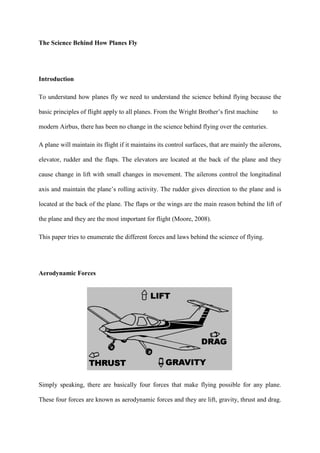
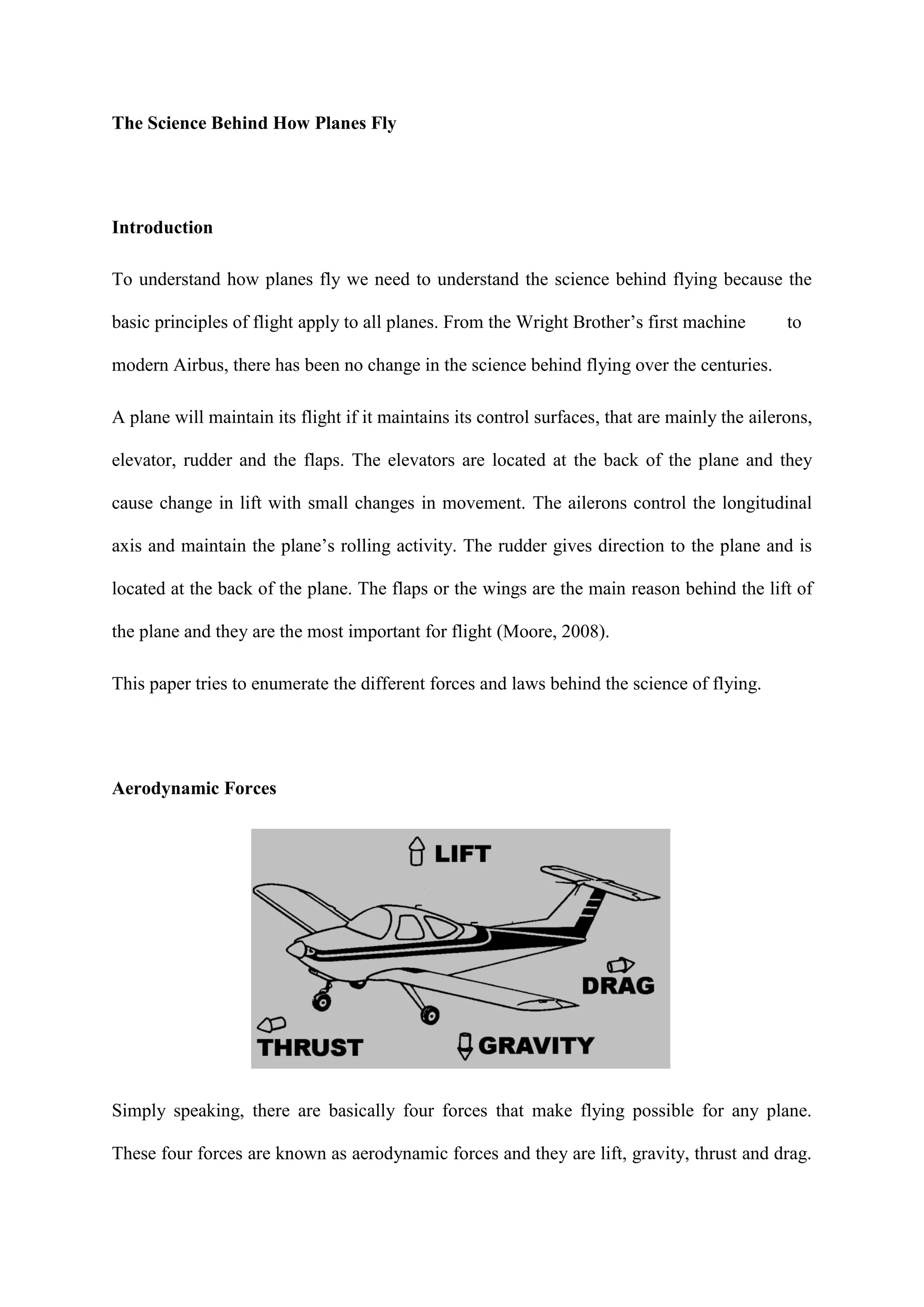
Simply speaking, there are basically four forces that make flying possible for any plane.

These four forces are known as aerodynamic forces and they are lift, gravity, thrust and drag.
Thrust and lift are the forces that keep the plane flying in the air (Moore, 2008). Thrust is

generated by the engine of the plane while the design of the plane gives them the required lift.

Thrust is required to overcome the drag that slows the plane. Drag is the resistance of air that

is created against the lift. It is the friction that is generated by passing air (Phillips, 2004). To

reduce the drag, planes are generally in streamlined shape. The lift is created by the wings of

the plane and it must be greater than gravity to keep the plane airborne. The gravity is the

force that is created by earth’s pull and the weight of the plane. During take-off, the plane

must be in such a state so that the thrust is able to overcome drag and the lift must overcome

gravity to make the plane fly (Phillips, 2004). Again, during flight, all the four forces must be

in balance to keep the plane airborne. In such times, the thrust must be equal to the drag and

the lift must be exactly equal to the weight of the plane. Whereas during landing, the thrust

must be reduced compared to the drag and the lift should also be reduced in comparison to

the gravity (Phillips, 2004).


Now, let us look at the popular and disputed principles behind lift and the science behind

flying.


Bernoulli’s Principle

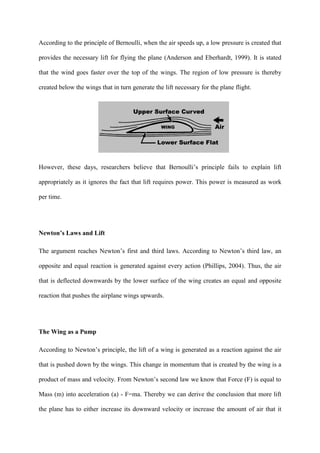
The top surface of the plane is more curved than the bottom to generate more lift than

opposing drag. This shape is known as aerofoil and it significantly helps in creating lift.
According to the principle of Bernoulli, when the air speeds up, a low pressure is created that

provides the necessary lift for flying the plane (Anderson and Eberhardt, 1999). It is stated

that the wind goes faster over the top of the wings. The region of low pressure is thereby

created below the wings that in turn generate the lift necessary for the plane flight.


However, these days, researchers believe that Bernoulli’s principle fails to explain lift

appropriately as it ignores the fact that lift requires power. This power is measured as work

per time.


Newton’s Laws and Lift

The argument reaches Newton’s first and third laws. According to Newton’s third law, an

opposite and equal reaction is generated against every action (Phillips, 2004). Thus, the air

that is deflected downwards by the lower surface of the wing creates an equal and opposite

reaction that pushes the airplane wings upwards.


The Wing as a Pump

According to Newton’s principle, the lift of a wing is generated as a reaction against the air

that is pushed down by the wings. This change in momentum that is created by the wing is a

product of mass and velocity. From Newton’s second law we know that Force (F) is equal to

Mass (m) into acceleration (a) - F=ma. Thereby we can derive the conclusion that more lift

the plane has to either increase its downward velocity or increase the amount of air that it
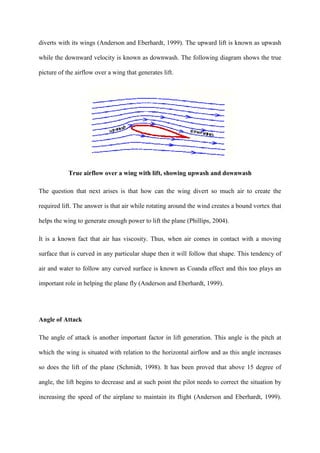
diverts with its wings (Anderson and Eberhardt, 1999). The upward lift is known as upwash

while the downward velocity is known as downwash. The following diagram shows the true

picture of the airflow over a wing that generates lift.


            True airflow over a wing with lift, showing upwash and downwash

The question that next arises is that how can the wing divert so much air to create the

required lift. The answer is that air while rotating around the wind creates a bound vortex that

helps the wing to generate enough power to lift the plane (Phillips, 2004).

It is a known fact that air has viscosity. Thus, when air comes in contact with a moving

surface that is curved in any particular shape then it will follow that shape. This tendency of

air and water to follow any curved surface is known as Coanda effect and this too plays an

important role in helping the plane fly (Anderson and Eberhardt, 1999).


Angle of Attack

The angle of attack is another important factor in lift generation. This angle is the pitch at

which the wing is situated with relation to the horizontal airflow and as this angle increases

so does the lift of the plane (Schmidt, 1998). It has been proved that above 15 degree of

angle, the lift begins to decrease and at such point the pilot needs to correct the situation by

increasing the speed of the airplane to maintain its flight (Anderson and Eberhardt, 1999).
Otherwise, the plane would be wing stalled due to the sudden loss in lift. It can be said that

the angle of attack is more important than viscosity of air. It is required to understand the

dynamics behind why planes fly.


Lift Requires Power

For a plane to sustain its speed and height there must be a lot of power involved. The wings

cannot generate enough lift unless there are strong engines to supply the necessary power.

The lift of a wing is proportional to the amount of air diverted down times the velocity of

squared of that diverted air (Anderson and Eberhardt, 1999). Simple speaking, as the speed of

the plane is increased, the amount of air that is diverted down by the wings also increases,

providing a subsequent upward pressure to lift the plane. Drag of the plane is also dependent

on power and it equals power divided by speed (Anderson and Eberhardt, 1999).

Generally, the wings of the plane are designed to reduce the drag of the plane and increase its

lift. During takeoff and landing, the flaps behind the wings extend to divert more air so that

they would create more lift by generating air pressure.


Controlling Flight of Plane

The pilot of the plane has to control the flight of the plane. He uses special control to make

the plane fly and keep it airborne. By using the throttle the pilot increases or decreases the

power of the engine. This in turn increases the speed of the plane and helps it to maintain

height. The pilot also uses the ailerons of the plane to make the plane roll while he uses the

rudder to control the yaw of the plane. Yaw is the turning of the plane while pitch is to make

the plane descend or climb altitude (Schmidt, 1998). The pilot controls the elevators located

at the back of the plane to maintain the pitch of the plane and he pushes the pedals to use the
brakes of the plane. All these controls are important to maintain the flight of the plane

(Schmidt, 1998).


Conclusion

In conclusion, we can state that there are several important laws behind the science of flying.

Firstly, the Newtonian principle describes that upward lift is derived by accelerating air mass

downward. Secondly, the power needed to lift the plane is dependent on the vertical velocity

of the air (Anderson, 1997). Thirdly, drag is incurred by accelerating the air mass forward.

Lastly, forward propulsion is gained by the power generated by the engines. There are several

other reasons behind safe flight that have been described above (Anderson, 1997). Moving air

has power to lift things up that has been seen from hot air balloons and this theory also

applies to plane flight (Moore, 2008). Overall, it can be stated that Newtonian principles

behind flight explains a lot of things but Bernoulli’s principle still holds true because without

generating air pressure the plane cannot lift and without lift there can be no flight.


References

Anderson, J. (1997). A History of Aerodynamics. Cambridge University Press.

Anderson, David. Eberhardt, Scott. (1999). How Airplanes Fly: A Physical Description of

Lift Level 3. Retrieved December 9, 2011, from http://www.allstar.fiu.edu/aero/airflylvl3.htm

Moore, Rob. (2008). Why Does It Fly? Cambridge Young Readers.

Phillips, W. F. (2004). Mechanics of Flight. J. Wiley & Sons.

Schmidt, L. (1998). Introduction to Aircraft Flight Dynamics. AIAA Press.

The science behind how planes fly

  • 1.
    The Science BehindHow Planes Fly Introduction To understand how planes fly we need to understand the science behind flying because the basic principles of flight apply to all planes. From the Wright Brother’s first machine to modern Airbus, there has been no change in the science behind flying over the centuries. A plane will maintain its flight if it maintains its control surfaces, that are mainly the ailerons, elevator, rudder and the flaps. The elevators are located at the back of the plane and they cause change in lift with small changes in movement. The ailerons control the longitudinal axis and maintain the plane’s rolling activity. The rudder gives direction to the plane and is located at the back of the plane. The flaps or the wings are the main reason behind the lift of the plane and they are the most important for flight (Moore, 2008). This paper tries to enumerate the different forces and laws behind the science of flying. Aerodynamic Forces Simply speaking, there are basically four forces that make flying possible for any plane. These four forces are known as aerodynamic forces and they are lift, gravity, thrust and drag.
  • 2.
    Thrust and liftare the forces that keep the plane flying in the air (Moore, 2008). Thrust is generated by the engine of the plane while the design of the plane gives them the required lift. Thrust is required to overcome the drag that slows the plane. Drag is the resistance of air that is created against the lift. It is the friction that is generated by passing air (Phillips, 2004). To reduce the drag, planes are generally in streamlined shape. The lift is created by the wings of the plane and it must be greater than gravity to keep the plane airborne. The gravity is the force that is created by earth’s pull and the weight of the plane. During take-off, the plane must be in such a state so that the thrust is able to overcome drag and the lift must overcome gravity to make the plane fly (Phillips, 2004). Again, during flight, all the four forces must be in balance to keep the plane airborne. In such times, the thrust must be equal to the drag and the lift must be exactly equal to the weight of the plane. Whereas during landing, the thrust must be reduced compared to the drag and the lift should also be reduced in comparison to the gravity (Phillips, 2004). Now, let us look at the popular and disputed principles behind lift and the science behind flying. Bernoulli’s Principle The top surface of the plane is more curved than the bottom to generate more lift than opposing drag. This shape is known as aerofoil and it significantly helps in creating lift.
  • 3.
    According to theprinciple of Bernoulli, when the air speeds up, a low pressure is created that provides the necessary lift for flying the plane (Anderson and Eberhardt, 1999). It is stated that the wind goes faster over the top of the wings. The region of low pressure is thereby created below the wings that in turn generate the lift necessary for the plane flight. However, these days, researchers believe that Bernoulli’s principle fails to explain lift appropriately as it ignores the fact that lift requires power. This power is measured as work per time. Newton’s Laws and Lift The argument reaches Newton’s first and third laws. According to Newton’s third law, an opposite and equal reaction is generated against every action (Phillips, 2004). Thus, the air that is deflected downwards by the lower surface of the wing creates an equal and opposite reaction that pushes the airplane wings upwards. The Wing as a Pump According to Newton’s principle, the lift of a wing is generated as a reaction against the air that is pushed down by the wings. This change in momentum that is created by the wing is a product of mass and velocity. From Newton’s second law we know that Force (F) is equal to Mass (m) into acceleration (a) - F=ma. Thereby we can derive the conclusion that more lift the plane has to either increase its downward velocity or increase the amount of air that it
  • 4.
    diverts with itswings (Anderson and Eberhardt, 1999). The upward lift is known as upwash while the downward velocity is known as downwash. The following diagram shows the true picture of the airflow over a wing that generates lift. True airflow over a wing with lift, showing upwash and downwash The question that next arises is that how can the wing divert so much air to create the required lift. The answer is that air while rotating around the wind creates a bound vortex that helps the wing to generate enough power to lift the plane (Phillips, 2004). It is a known fact that air has viscosity. Thus, when air comes in contact with a moving surface that is curved in any particular shape then it will follow that shape. This tendency of air and water to follow any curved surface is known as Coanda effect and this too plays an important role in helping the plane fly (Anderson and Eberhardt, 1999). Angle of Attack The angle of attack is another important factor in lift generation. This angle is the pitch at which the wing is situated with relation to the horizontal airflow and as this angle increases so does the lift of the plane (Schmidt, 1998). It has been proved that above 15 degree of angle, the lift begins to decrease and at such point the pilot needs to correct the situation by increasing the speed of the airplane to maintain its flight (Anderson and Eberhardt, 1999).
  • 5.
    Otherwise, the planewould be wing stalled due to the sudden loss in lift. It can be said that the angle of attack is more important than viscosity of air. It is required to understand the dynamics behind why planes fly. Lift Requires Power For a plane to sustain its speed and height there must be a lot of power involved. The wings cannot generate enough lift unless there are strong engines to supply the necessary power. The lift of a wing is proportional to the amount of air diverted down times the velocity of squared of that diverted air (Anderson and Eberhardt, 1999). Simple speaking, as the speed of the plane is increased, the amount of air that is diverted down by the wings also increases, providing a subsequent upward pressure to lift the plane. Drag of the plane is also dependent on power and it equals power divided by speed (Anderson and Eberhardt, 1999). Generally, the wings of the plane are designed to reduce the drag of the plane and increase its lift. During takeoff and landing, the flaps behind the wings extend to divert more air so that they would create more lift by generating air pressure. Controlling Flight of Plane The pilot of the plane has to control the flight of the plane. He uses special control to make the plane fly and keep it airborne. By using the throttle the pilot increases or decreases the power of the engine. This in turn increases the speed of the plane and helps it to maintain height. The pilot also uses the ailerons of the plane to make the plane roll while he uses the rudder to control the yaw of the plane. Yaw is the turning of the plane while pitch is to make the plane descend or climb altitude (Schmidt, 1998). The pilot controls the elevators located at the back of the plane to maintain the pitch of the plane and he pushes the pedals to use the
  • 6.
    brakes of theplane. All these controls are important to maintain the flight of the plane (Schmidt, 1998). Conclusion In conclusion, we can state that there are several important laws behind the science of flying. Firstly, the Newtonian principle describes that upward lift is derived by accelerating air mass downward. Secondly, the power needed to lift the plane is dependent on the vertical velocity of the air (Anderson, 1997). Thirdly, drag is incurred by accelerating the air mass forward. Lastly, forward propulsion is gained by the power generated by the engines. There are several other reasons behind safe flight that have been described above (Anderson, 1997). Moving air has power to lift things up that has been seen from hot air balloons and this theory also applies to plane flight (Moore, 2008). Overall, it can be stated that Newtonian principles behind flight explains a lot of things but Bernoulli’s principle still holds true because without generating air pressure the plane cannot lift and without lift there can be no flight. References Anderson, J. (1997). A History of Aerodynamics. Cambridge University Press. Anderson, David. Eberhardt, Scott. (1999). How Airplanes Fly: A Physical Description of Lift Level 3. Retrieved December 9, 2011, from http://www.allstar.fiu.edu/aero/airflylvl3.htm Moore, Rob. (2008). Why Does It Fly? Cambridge Young Readers. Phillips, W. F. (2004). Mechanics of Flight. J. Wiley & Sons. Schmidt, L. (1998). Introduction to Aircraft Flight Dynamics. AIAA Press.