Aeroelastic Flutter Analysis
Appalla Aditya Shiva
1005 – 17 – 745302
M.E. Turbomachinery
2017 - 2018
Scope:
• Understanding aeroelasticity.
• Aeroelastic Flutter.
• Turbomachine aeroelasticity
• Case studies in Aeroelastic Flutter
• References
Understanding aeroelasticity:
Aeroelasticity: the study of the interaction of inertial, structural and aerodynamic
forces on aircraft, buildings, surface vehicles etc.
• Static - deals with the static response of an elastic body to a fluid flow.
• Dynamic - deals with the body's vibrational response.
Several undesirable phenomena:
1. Divergence (static aeroelastic phenomenon)
2. Flutter (dynamic aeroelastic phenomenon)
3. Limit Cycle Oscillations (nonlinear aeroelastic phenomenon)
4. Vortex shedding, buffeting, galloping (unsteady aerodynamic phenomena)
Collar’s Triangle of Forces
Garrick’s Aerothermoelastic
Tetrahedron
• A E I – Aeroelasticity
• A H I – Stability and Heat
• A H E – Static Aerothermoelasticity
• H E I – Vibration and Heat
A E I H – Aerothermoelasticity
Aeroelastic Flutter:
Flutter: Dangerous phenomenon of vibration of structures subjected to
aerodynamic forces.
In an aircraft, as the speed of the wind increases, there may be a point at
which the structural damping is insufficient to damp out the motions which
are increasing due to aerodynamic energy being added to the structure. This
structural failure is called FLUTTER.
HOW DOES FLUTTER LOOK LIKE?
NASA’s Piper PA – 38 Aircraft
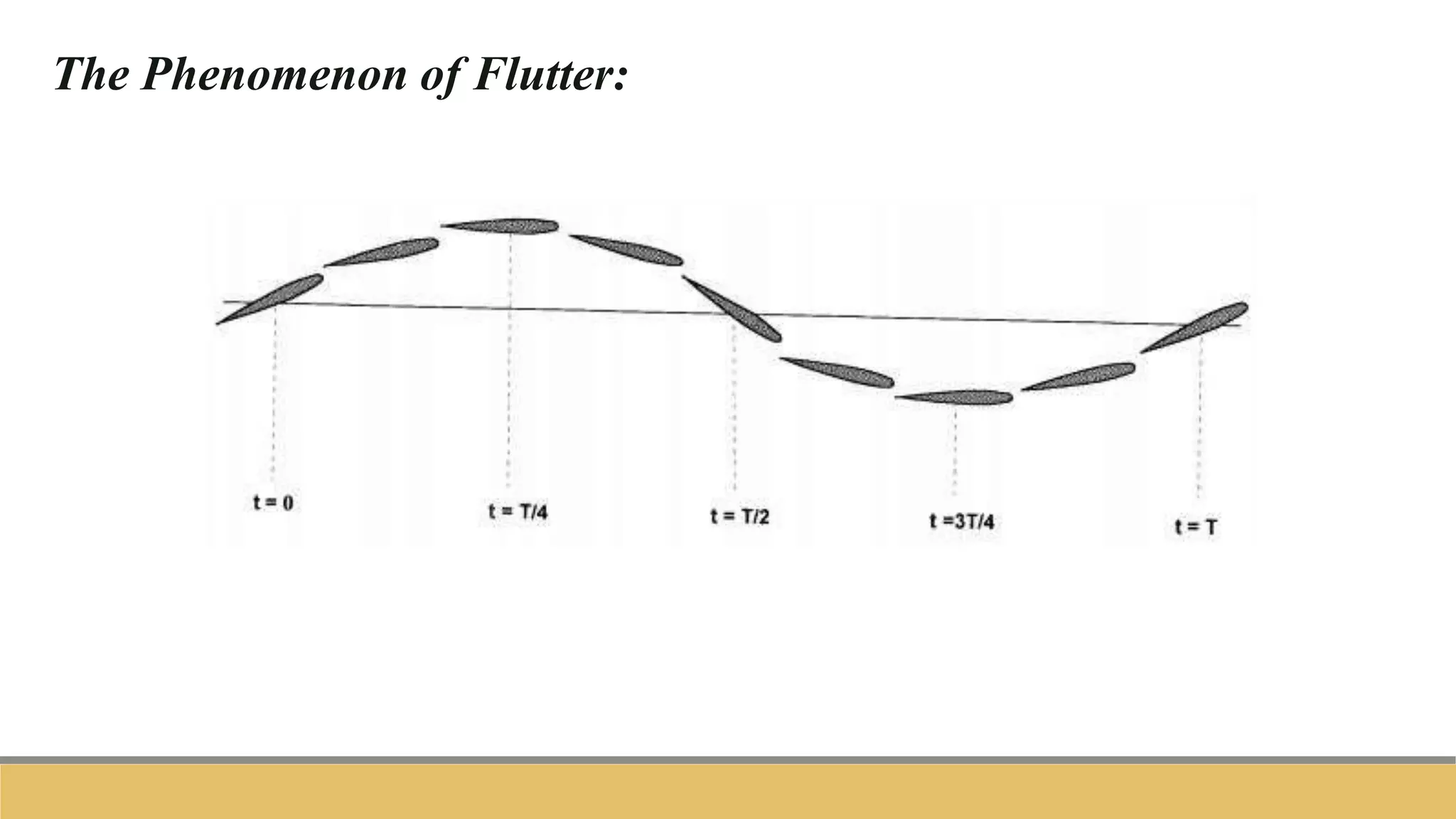
The Phenomenon of Flutter:
The Phenomenon of Flutter: Criteria of Stability
(a)
Marginal Stability Stable Flutter Unstable Flutter
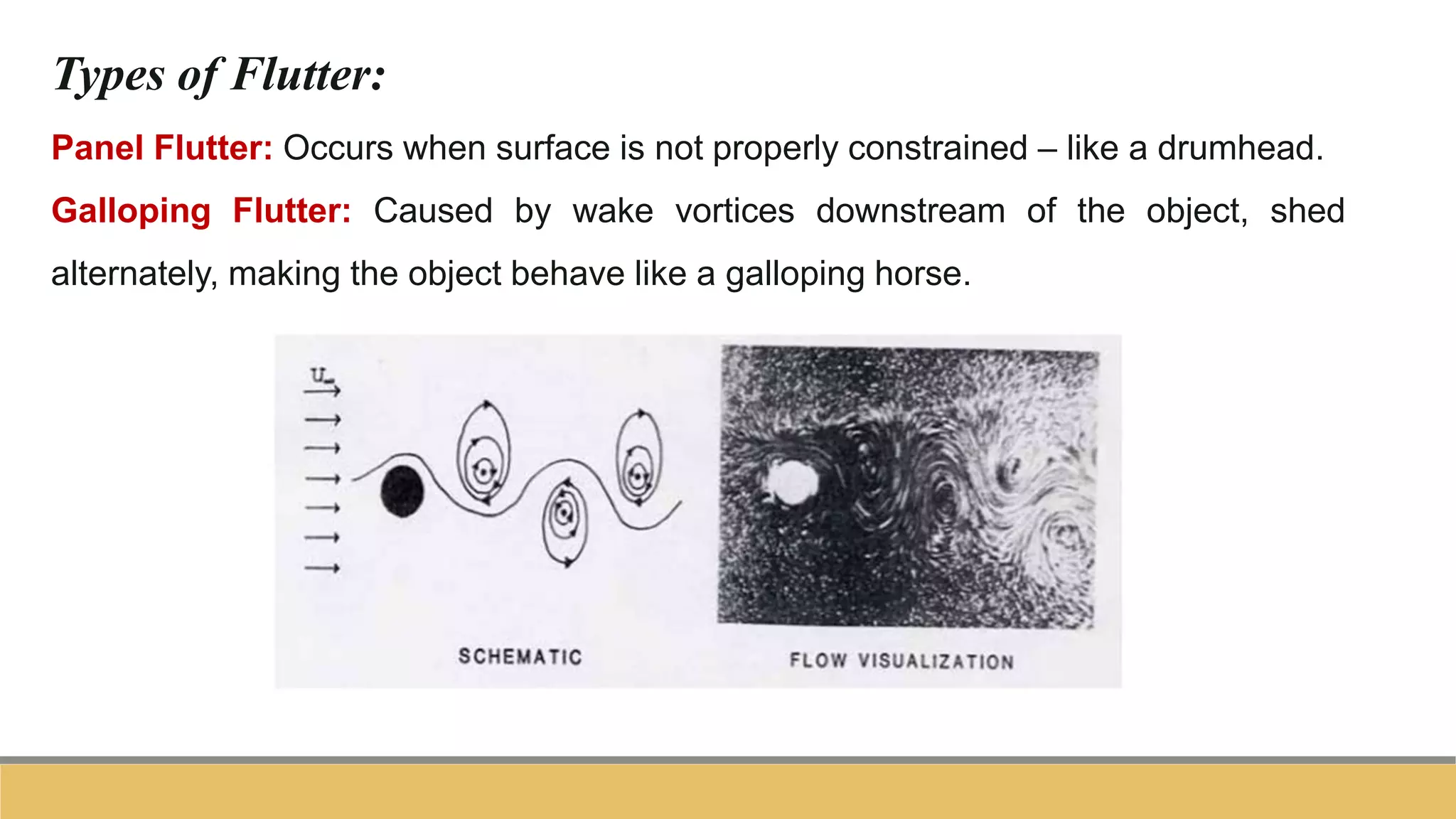
Types of Flutter:
Panel Flutter: Occurs when surface is not properly constrained – like a drumhead.
Galloping Flutter: Caused by wake vortices downstream of the object, shed
alternately, making the object behave like a galloping horse.
Types of Flutter (Contd.):
Stall Flutter: Torsional vibrations at stall speed with high loading conditions.
Limit Cycle Oscillations (LCO): Constant amplitude, periodic structural response
at frequencies that are those of the aeroelastically – loaded structure. Indicates flow
separation.
Engine Whirl Flutter: Precessional vibrations that occur on a flexibly mounted
engine - propeller combination.
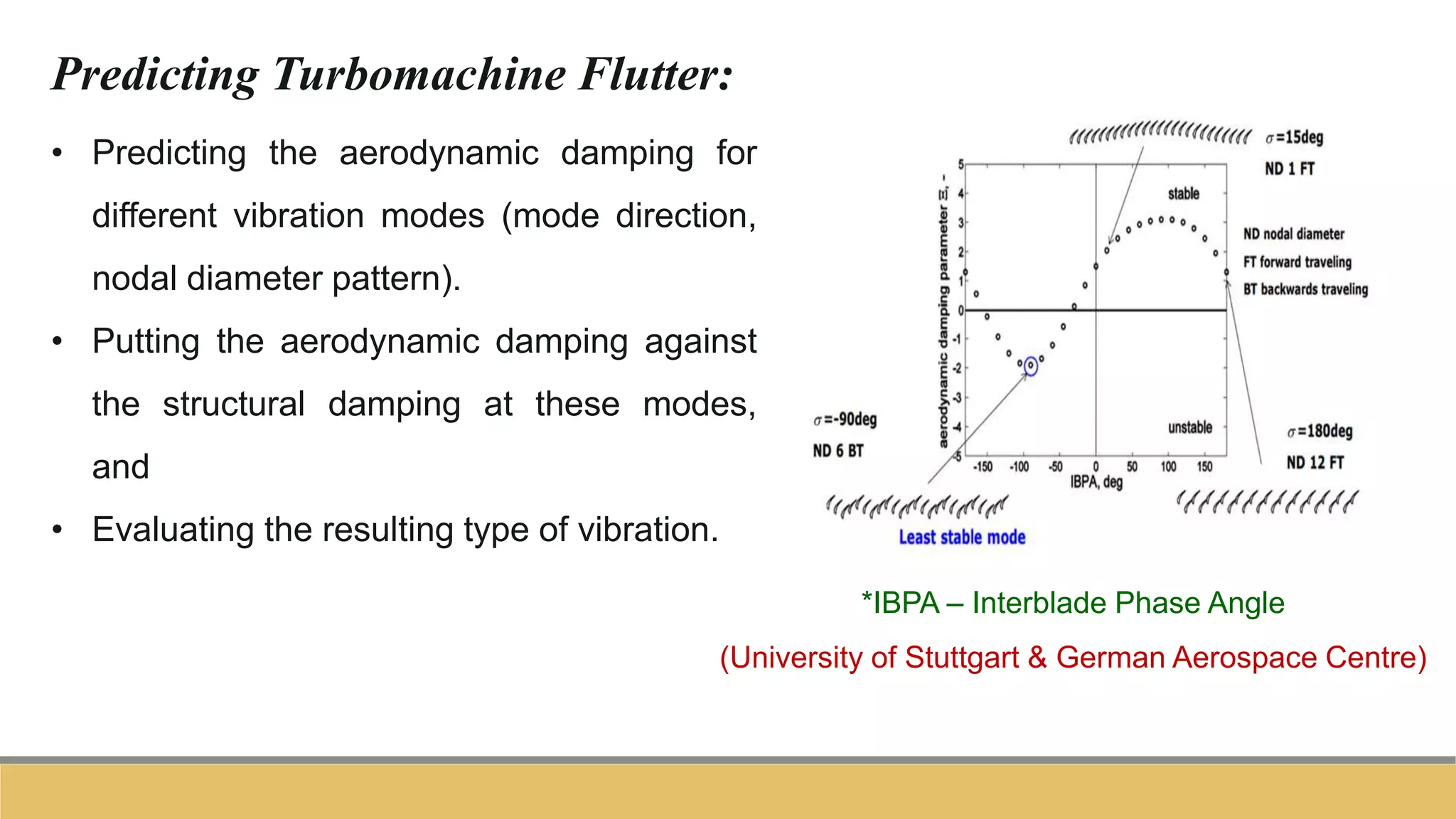
Predicting Turbomachine Flutter:
• Predicting the aerodynamic damping for
different vibration modes (mode direction,
nodal diameter pattern).
• Putting the aerodynamic damping against
the structural damping at these modes,
and
• Evaluating the resulting type of vibration.
*IBPA – Interblade Phase Angle
(University of Stuttgart & German Aerospace Centre)
Case Studies in Aeroelastic Flutter:
Case – 1:
Ganapathi and Varadan [1] performed material mode FEA analysis on laminated curved panels of
different materials to study the effect of supersonic flutter by accounting for aspect and thickness
ratios and the number of layers.
Graphs were plotted for critical dynamic pressure against an aspect ratio of 10 for orthotropic,
anisotropic & isotropic materials taking number of layers from 2 to 5 and ply angle from 0° -90°.
Results:
• The anisotropic 3 - layered panel and isotropic panel gave the best responses to the flutter due
to high directional stiffness.
• Coupling, bending, twisting etc influence the critical flutter speed and hence, flutter boundary.
• Flutter boundary is also affected by aspect ratio, irrespective of ply orientation.
Orthotropic Isotropic
Anisotropic with ply
angle b/w 0 and 90 deg.
Aeroeelastic Flutter

Aeroeelastic Flutter

  • 1.
    Aeroelastic Flutter Analysis AppallaAditya Shiva 1005 – 17 – 745302 M.E. Turbomachinery 2017 - 2018
  • 2.
    Scope: • Understanding aeroelasticity. •Aeroelastic Flutter. • Turbomachine aeroelasticity • Case studies in Aeroelastic Flutter • References
  • 3.
    Understanding aeroelasticity: Aeroelasticity: thestudy of the interaction of inertial, structural and aerodynamic forces on aircraft, buildings, surface vehicles etc. • Static - deals with the static response of an elastic body to a fluid flow. • Dynamic - deals with the body's vibrational response. Several undesirable phenomena: 1. Divergence (static aeroelastic phenomenon) 2. Flutter (dynamic aeroelastic phenomenon) 3. Limit Cycle Oscillations (nonlinear aeroelastic phenomenon) 4. Vortex shedding, buffeting, galloping (unsteady aerodynamic phenomena)
  • 4.
  • 5.
    Garrick’s Aerothermoelastic Tetrahedron • AE I – Aeroelasticity • A H I – Stability and Heat • A H E – Static Aerothermoelasticity • H E I – Vibration and Heat A E I H – Aerothermoelasticity
  • 6.
    Aeroelastic Flutter: Flutter: Dangerousphenomenon of vibration of structures subjected to aerodynamic forces. In an aircraft, as the speed of the wind increases, there may be a point at which the structural damping is insufficient to damp out the motions which are increasing due to aerodynamic energy being added to the structure. This structural failure is called FLUTTER. HOW DOES FLUTTER LOOK LIKE?
  • 7.
    NASA’s Piper PA– 38 Aircraft
  • 8.
  • 9.
    The Phenomenon ofFlutter: Criteria of Stability (a) Marginal Stability Stable Flutter Unstable Flutter
  • 10.
    Types of Flutter: PanelFlutter: Occurs when surface is not properly constrained – like a drumhead. Galloping Flutter: Caused by wake vortices downstream of the object, shed alternately, making the object behave like a galloping horse.
  • 11.
    Types of Flutter(Contd.): Stall Flutter: Torsional vibrations at stall speed with high loading conditions. Limit Cycle Oscillations (LCO): Constant amplitude, periodic structural response at frequencies that are those of the aeroelastically – loaded structure. Indicates flow separation. Engine Whirl Flutter: Precessional vibrations that occur on a flexibly mounted engine - propeller combination.
  • 13.
    Predicting Turbomachine Flutter: •Predicting the aerodynamic damping for different vibration modes (mode direction, nodal diameter pattern). • Putting the aerodynamic damping against the structural damping at these modes, and • Evaluating the resulting type of vibration. *IBPA – Interblade Phase Angle (University of Stuttgart & German Aerospace Centre)
  • 14.
    Case Studies inAeroelastic Flutter: Case – 1: Ganapathi and Varadan [1] performed material mode FEA analysis on laminated curved panels of different materials to study the effect of supersonic flutter by accounting for aspect and thickness ratios and the number of layers. Graphs were plotted for critical dynamic pressure against an aspect ratio of 10 for orthotropic, anisotropic & isotropic materials taking number of layers from 2 to 5 and ply angle from 0° -90°. Results: • The anisotropic 3 - layered panel and isotropic panel gave the best responses to the flutter due to high directional stiffness. • Coupling, bending, twisting etc influence the critical flutter speed and hence, flutter boundary. • Flutter boundary is also affected by aspect ratio, irrespective of ply orientation.
  • 15.
    Orthotropic Isotropic Anisotropic withply angle b/w 0 and 90 deg.