The Role of Automated Function Prediction in
the Era of Big Data and Small Budgets
Philip E. Bourne Ph.D.
Associate Director for Data Science
National Institutes of Health
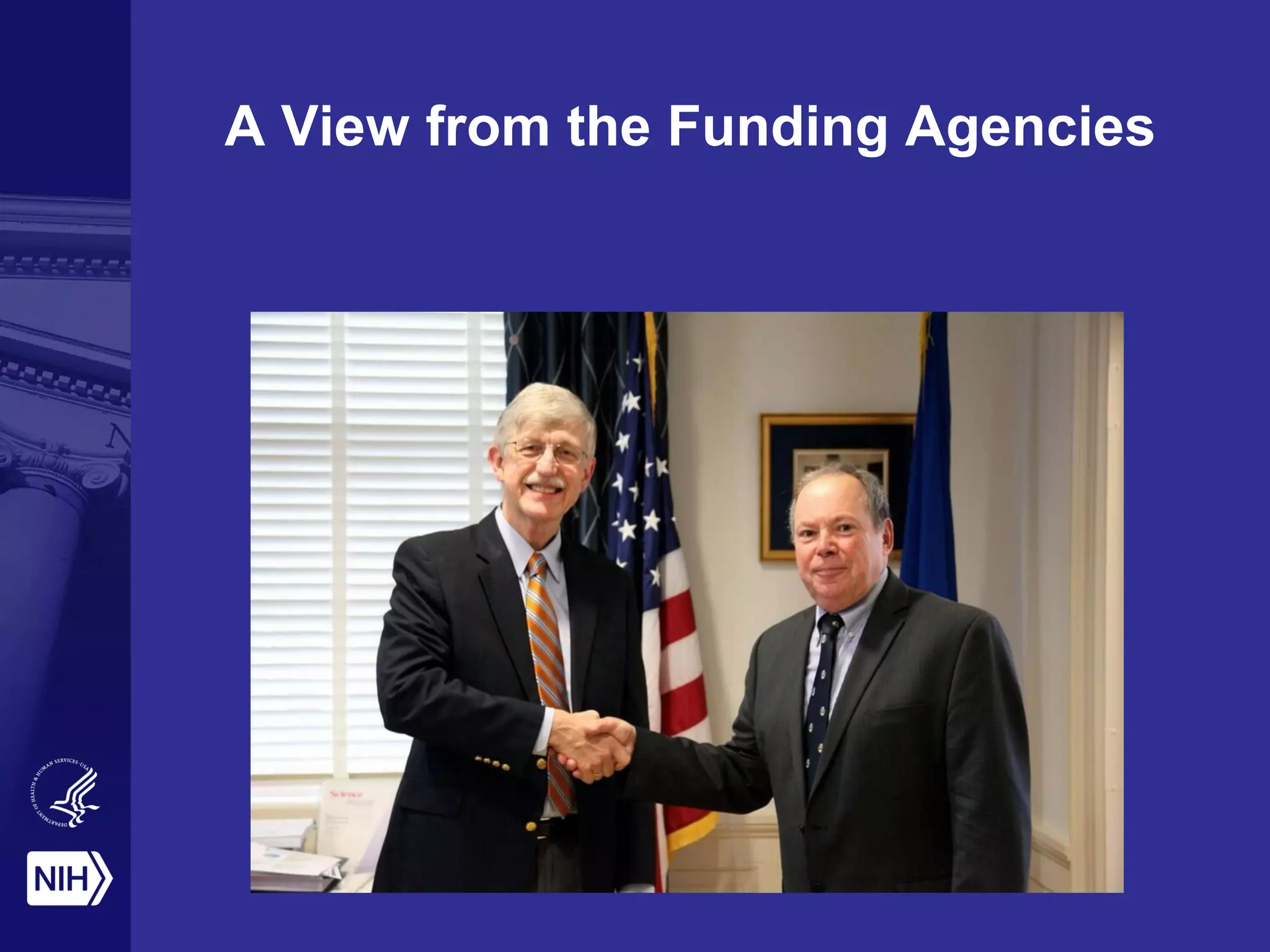
A View from the Funding Agencies
“It was the best of times, it was the
worst of times, it was the age of
wisdom, it was the age of foolishness,
it was the epoch of belief, it was the
epoch of incredulity, it was the season
of Light, it was the season of
Darkness, it was the spring of hope, it
was the winter of despair …”
Roughly translated…
A time of great (unprecedented?)
scientific development but limited
funding
A time of upheaval in the way we do
science
From a funders perspective…
A time to squeeze every cent/penny to
maximize the amount of research that
can be done
A time for when top down approaches
meet bottom up approaches
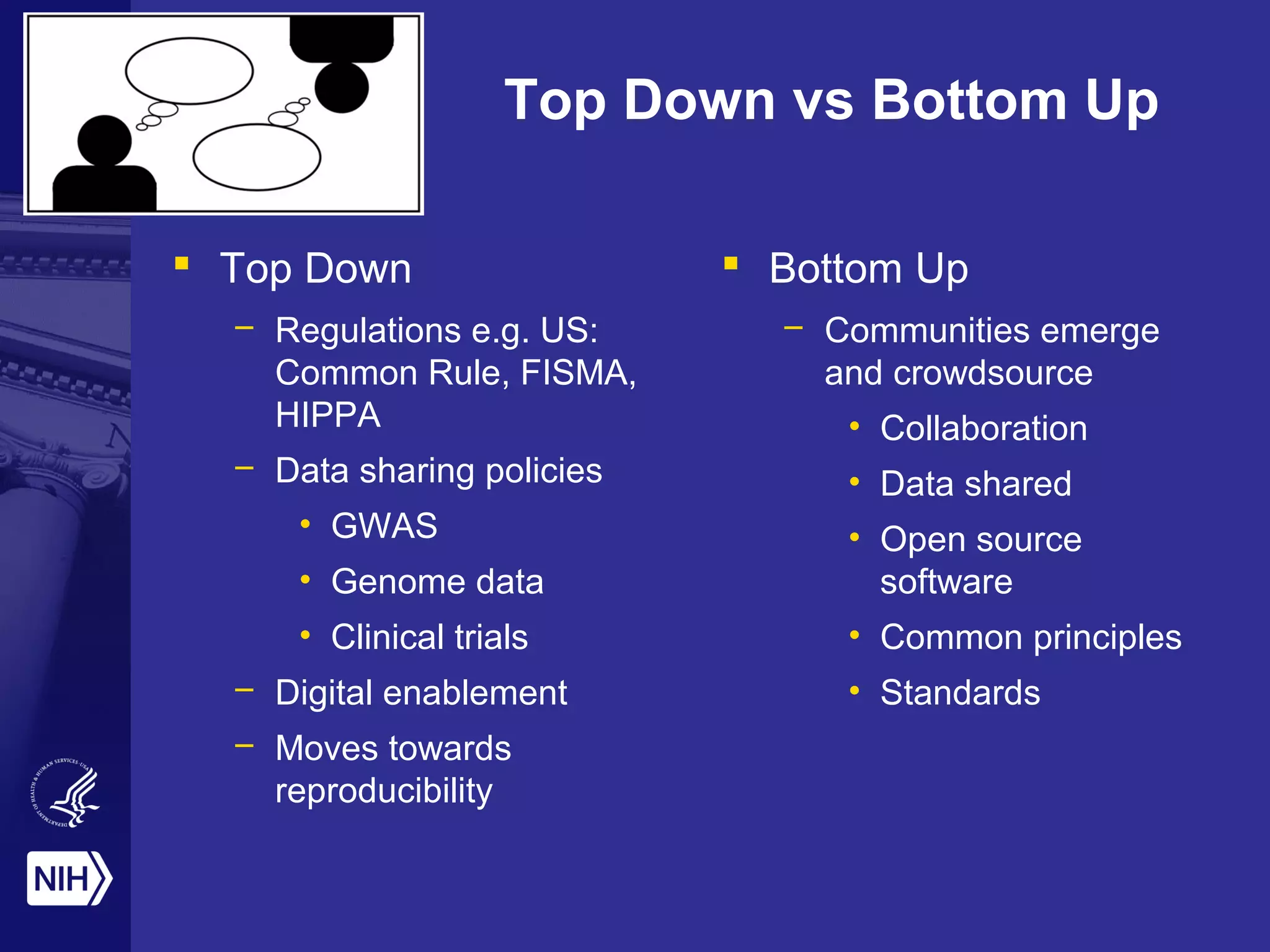
Top Down vs Bottom Up
 Top Down
– Regulations e.g. US:
Common Rule, FISMA,
HIPPA
– Data sharing policies
• GWAS
• Genome data
• Clinical trials
– Digital enablement
– Moves towards
reproducibility
 Bottom Up
– Communities emerge
and crowdsource
• Collaboration
• Data shared
• Open source
software
• Common principles
• Standards
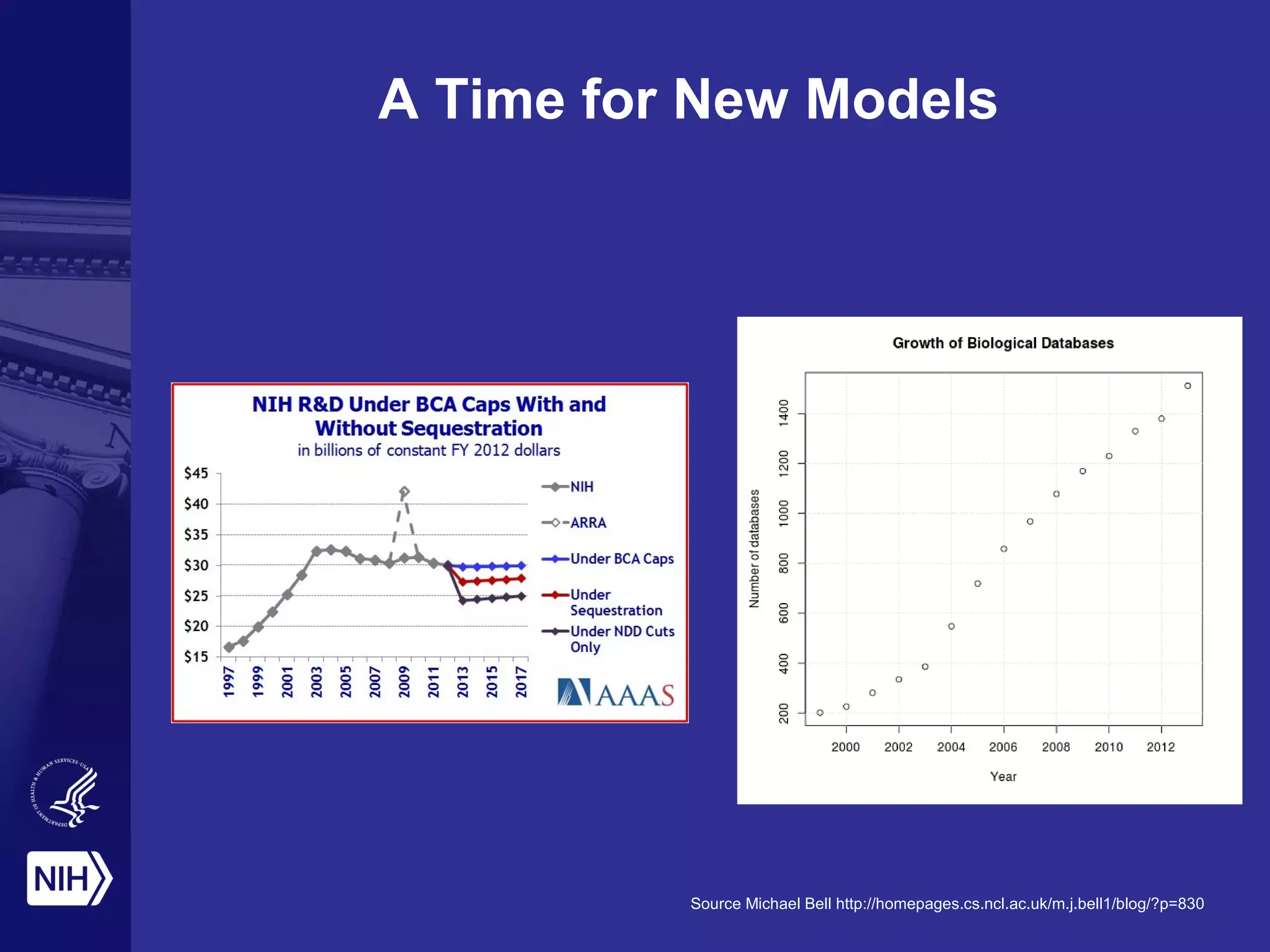
A Time for New Models
Source Michael Bell http://homepages.cs.ncl.ac.uk/m.j.bell1/blog/?p=830
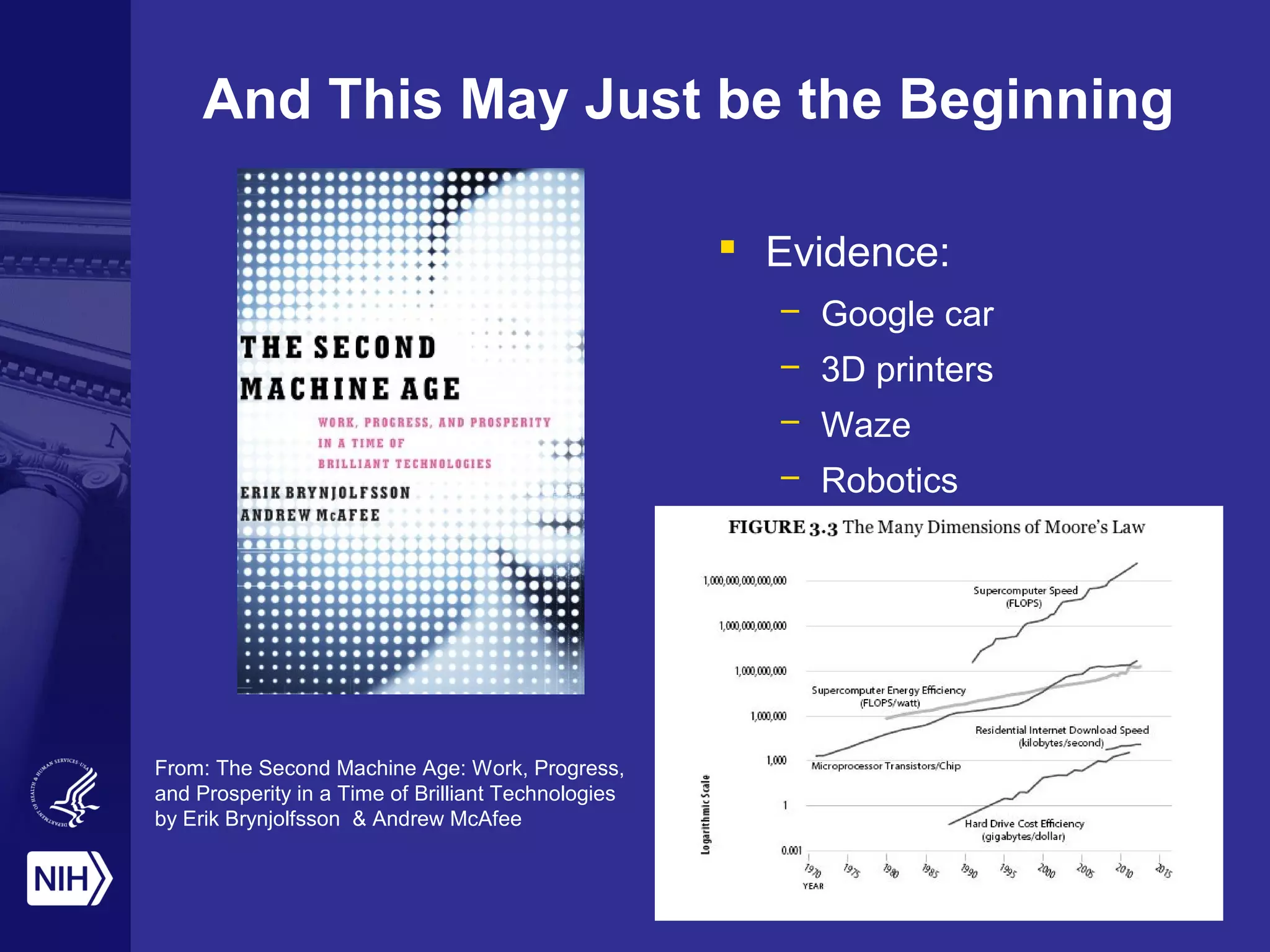
And This May Just be the Beginning
 Evidence:
– Google car
– 3D printers
– Waze
– Robotics
From: The Second Machine Age: Work, Progress,
and Prosperity in a Time of Brilliant Technologies
by Erik Brynjolfsson & Andrew McAfee
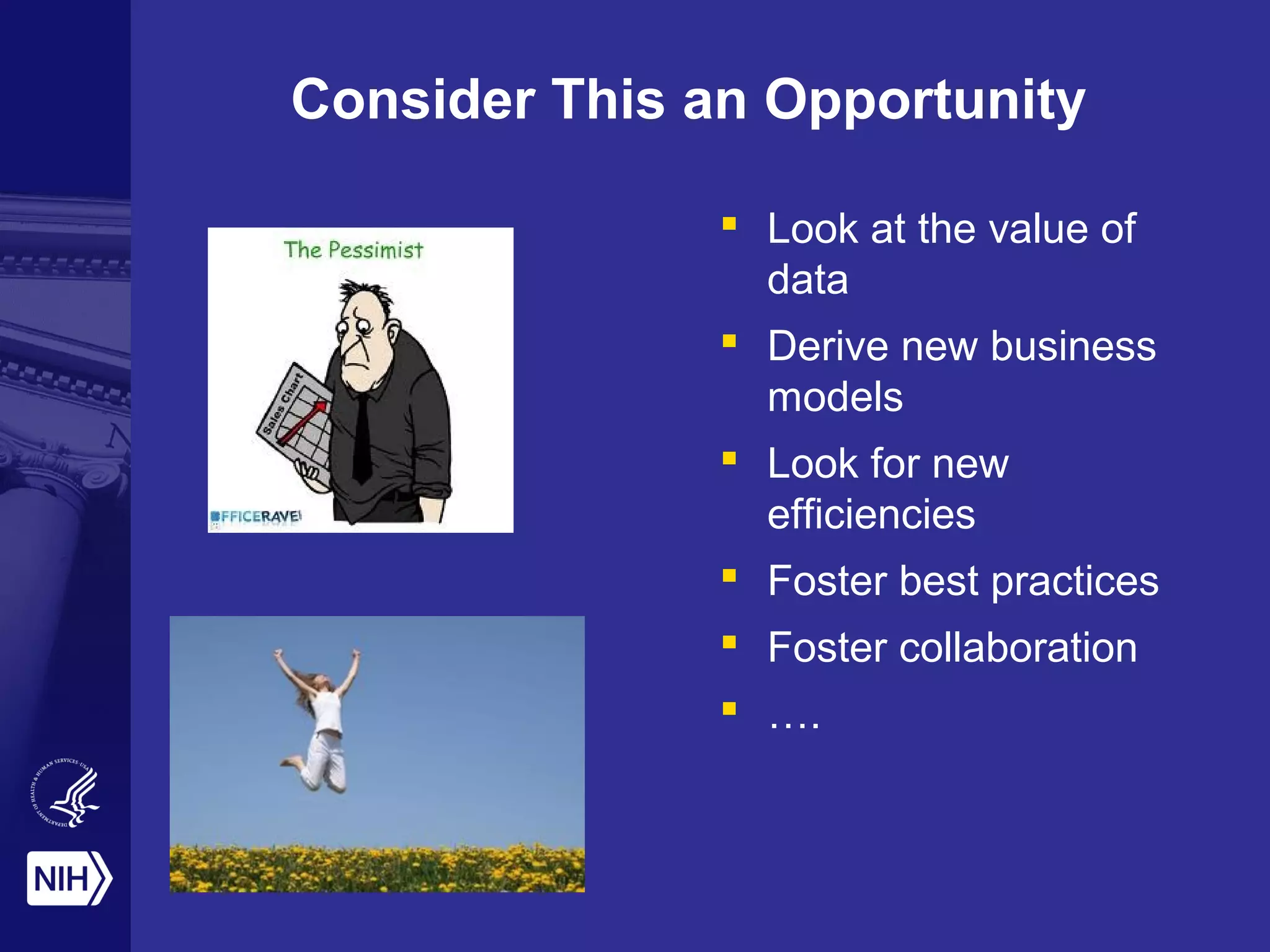
Consider This an Opportunity
 Look at the value of
data
 Derive new business
models
 Look for new
efficiencies
 Foster best practices
 Foster collaboration
 ….
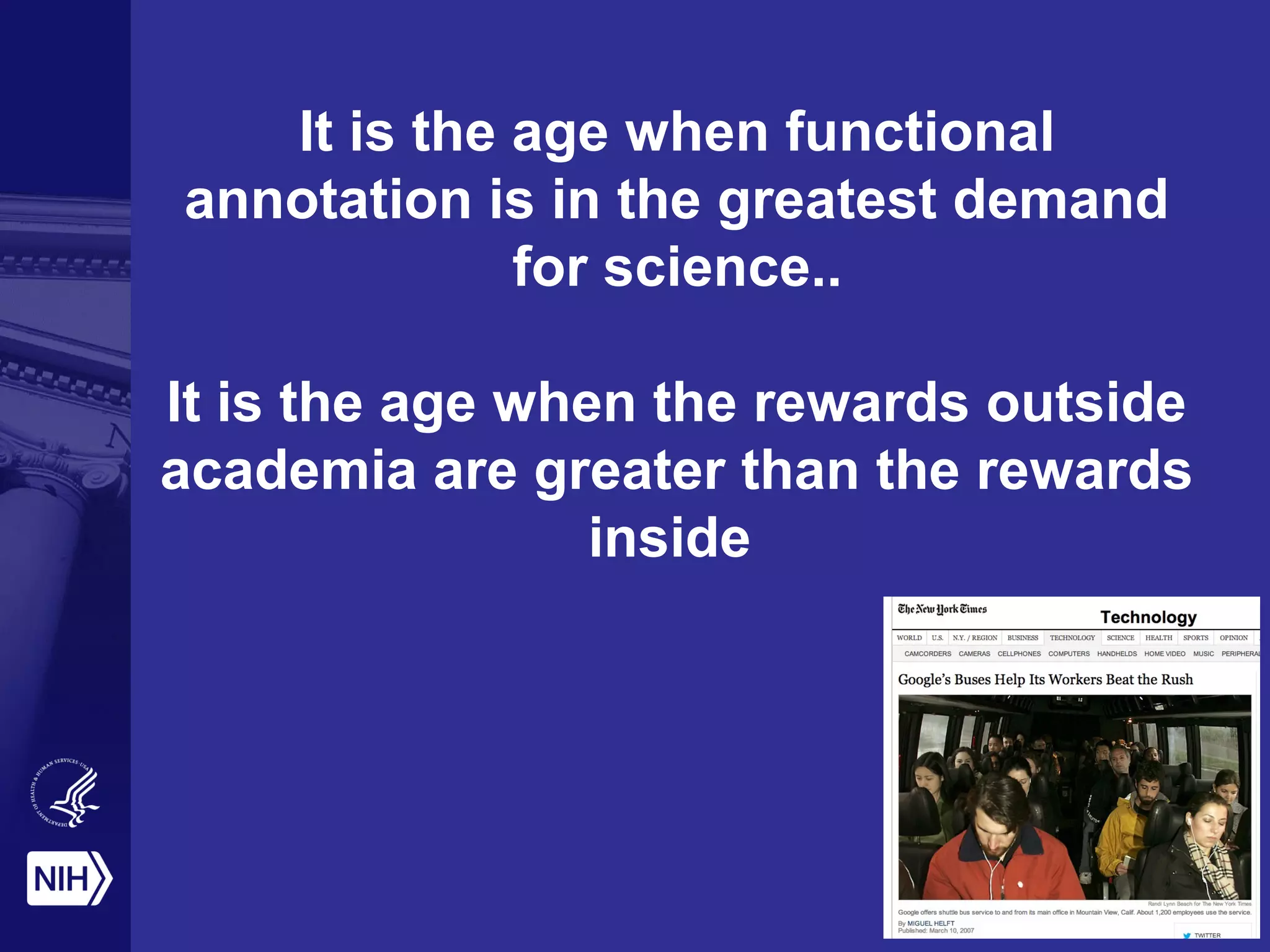
It is the age when functional
annotation is in the greatest demand
for science..
It is the age when the rewards outside
academia are greater than the rewards
inside
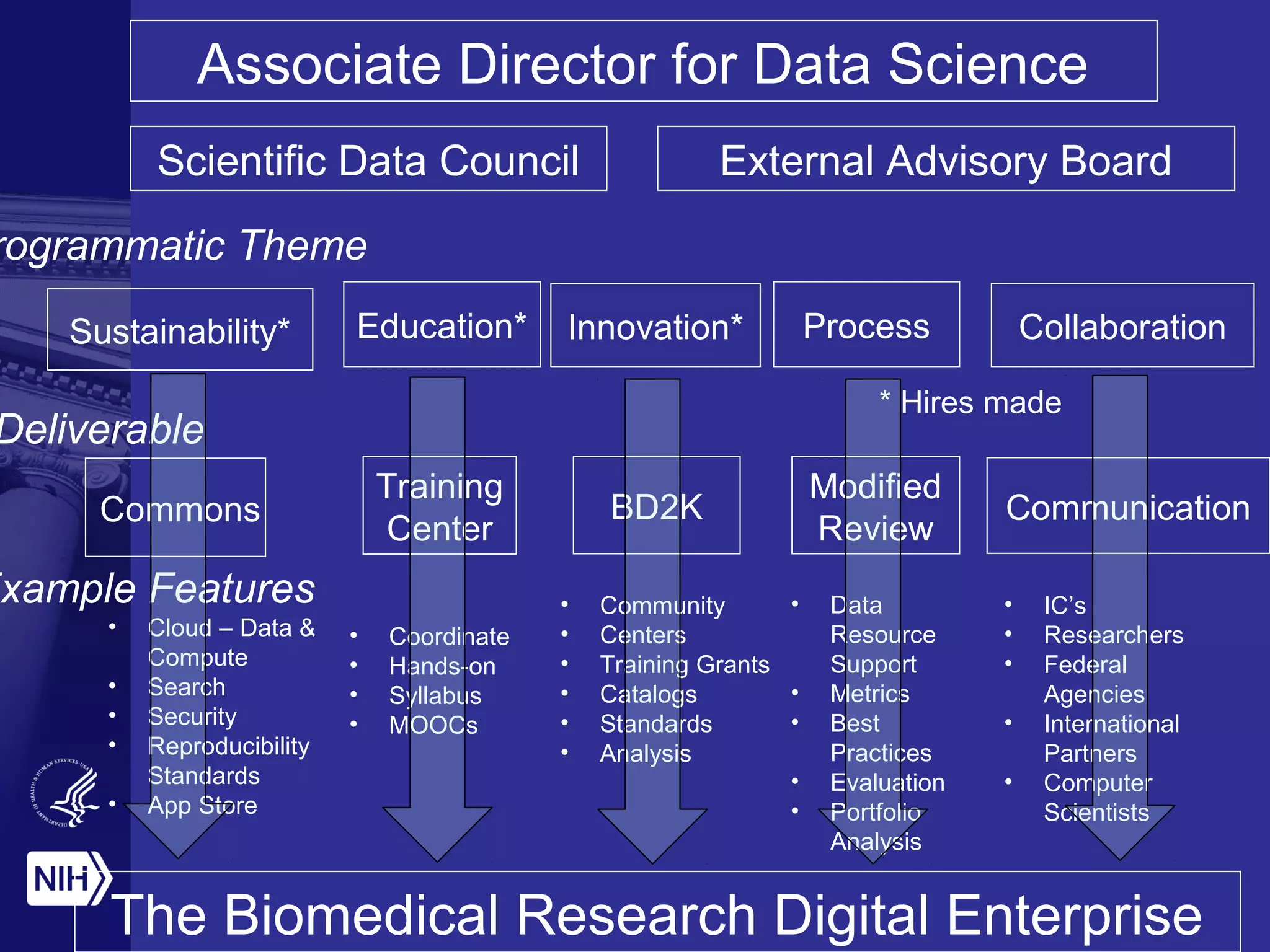
Associate Director for Data Science
Commons
Training
Center
BD2K
Modified
Review
Sustainability* Education* Innovation* Process
• Cloud – Data &
Compute
• Search
• Security
• Reproducibility
Standards
• App Store
• Coordinate
• Hands-on
• Syllabus
• MOOCs
• Community
• Centers
• Training Grants
• Catalogs
• Standards
• Analysis
• Data
Resource
Support
• Metrics
• Best
Practices
• Evaluation
• Portfolio
Analysis
The Biomedical Research Digital Enterprise
Communication
Collaboration
rogrammatic Theme
Deliverable
Example Features • IC’s
• Researchers
• Federal
Agencies
• International
Partners
• Computer
Scientists
Scientific Data Council External Advisory Board
* Hires made
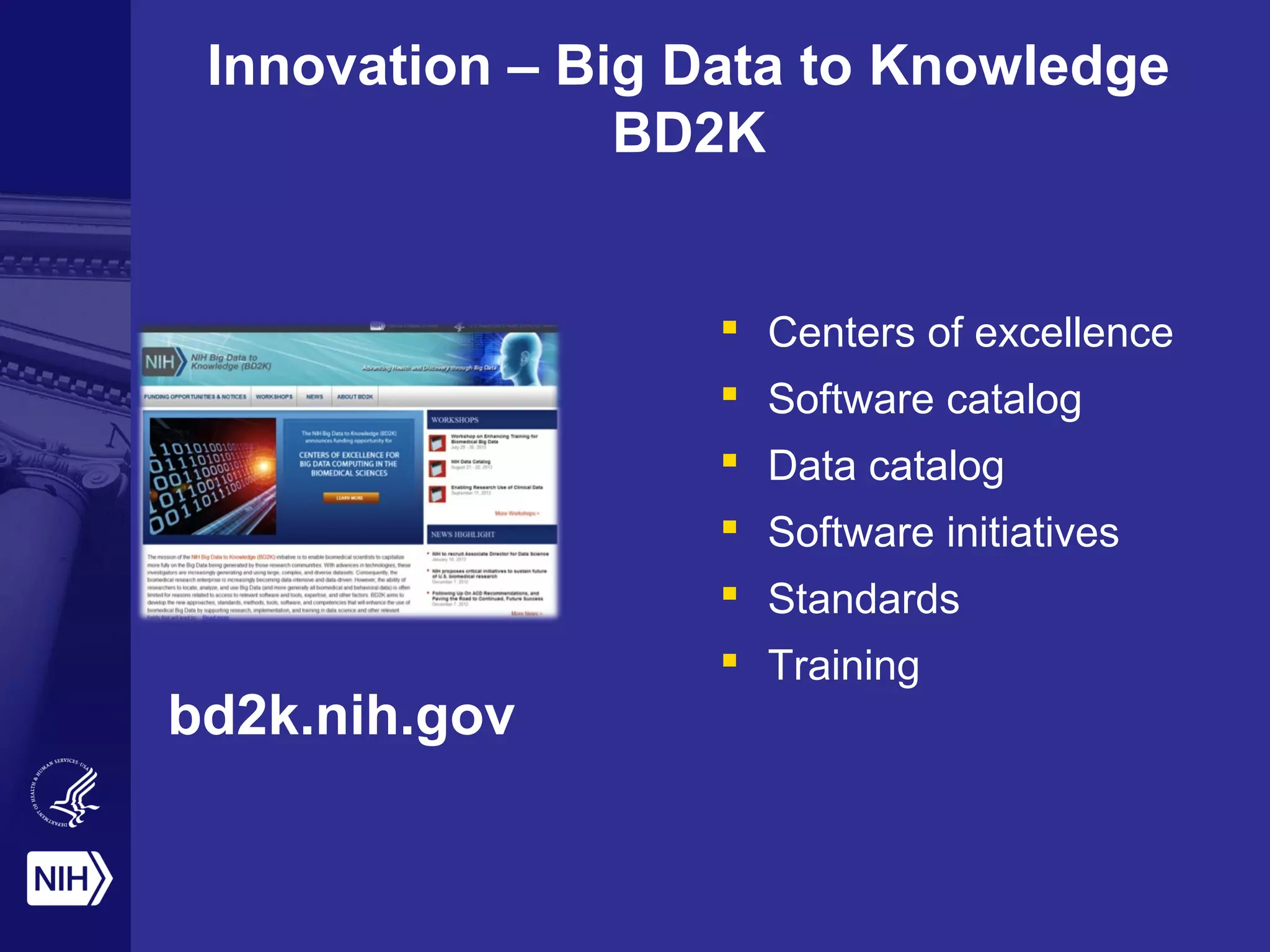
Innovation – Big Data to Knowledge
BD2K
 Centers of excellence
 Software catalog
 Data catalog
 Software initiatives
 Standards
 Training
bd2k.nih.gov
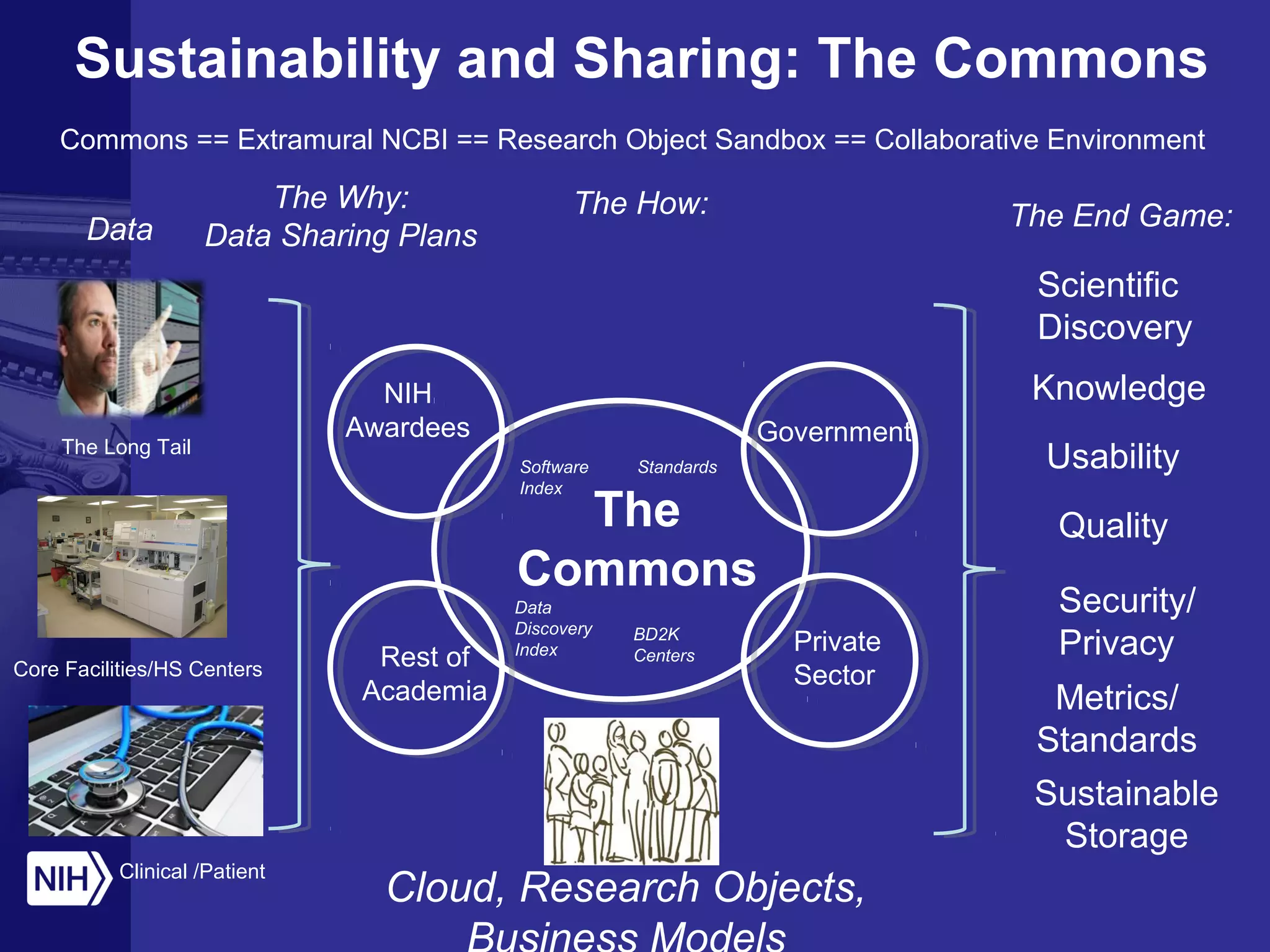
Sustainability and Sharing: The Commons
Data
The Long Tail
Core Facilities/HS Centers
Clinical /Patient
The Why:
Data Sharing Plans
The
Commons
Government
The How:
Data
Discovery
Index
Sustainable
Storage
Quality
Scientific
Discovery
Usability
Security/
Privacy
Commons == Extramural NCBI == Research Object Sandbox == Collaborative Environment
The End Game:
KnowledgeNIH
Awardees
Private
Sector
Metrics/
Standards
Rest of
Academia
Software Standards
Index
BD2K
Centers
Cloud, Research Objects,
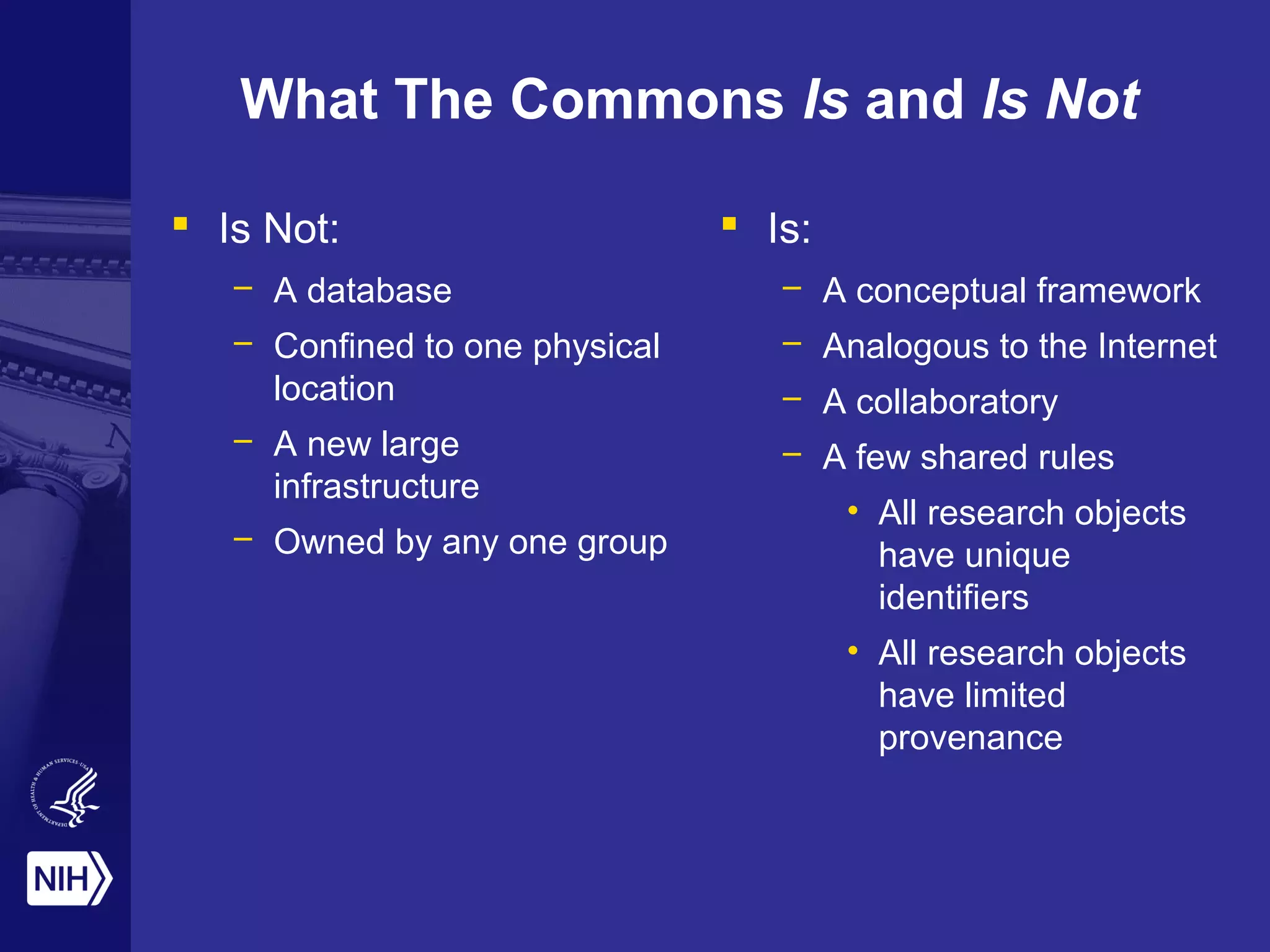
What The Commons Is and Is Not
 Is Not:
– A database
– Confined to one physical
location
– A new large
infrastructure
– Owned by any one group
 Is:
– A conceptual framework
– Analogous to the Internet
– A collaboratory
– A few shared rules
• All research objects
have unique
identifiers
• All research objects
have limited
provenance
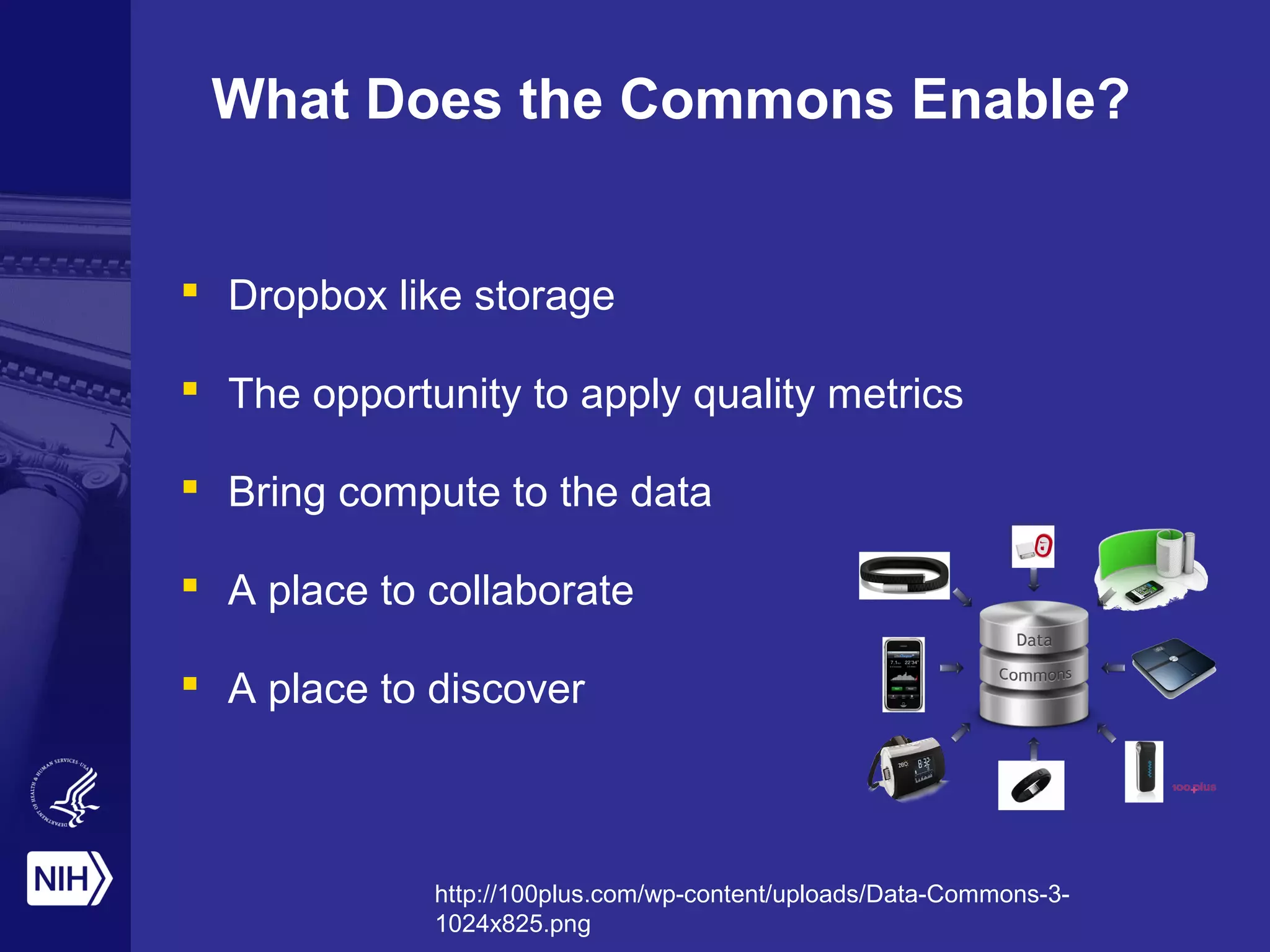
What Does the Commons Enable?
 Dropbox like storage
 The opportunity to apply quality metrics
 Bring compute to the data
 A place to collaborate
 A place to discover
http://100plus.com/wp-content/uploads/Data-Commons-3-
1024x825.png
[Adapted from George Komatsoulis]
One Possible Commons Business Model
HPC, Institution …
What Are the Benefits to Those Doing
Functional Annotation?
 Open environment in which to test new ideas – better
for crowdsourcing
 Opportunity to gain resources to run annotation
pipelines
 Opportunity to collaborate through provision of open
APIs
 Better characterization and accessibility to annotation
methods
Commons Pilots
 Define a set of use cases emphasizing:
– Openness of the system
– Support for basic statistical analysis
– Embedding of existing applications
– API support into existing resources
 Evaluate against the use cases
 Review results & business model with NIH leadership
 Design a pilot phase with various groups
 Conduct pilot for 6-12 months
 Evaluate outcomes and determine whether a wider
deployment makes sense
 Report to NIH leadership summer 2015
Some Acknowledgements
 Eric Green & Mark Guyer (NHGRI)
 Jennie Larkin (NHLBI)
 Leigh Finnegan (NHGRI)
 Vivien Bonazzi (NHGRI)
 Michelle Dunn (NCI)
 Mike Huerta (NLM)
 David Lipman (NLM)
 Jim Ostell (NLM)
 Andrea Norris (CIT)
 Peter Lyster (NIGMS)
 All the over 100 folks on the BD2K team
NIHNIH……
Turning Discovery Into HealthTurning Discovery Into Health

The Role of Automated Function Prediction in the Era of Big Data and Small Budgets

  • 1.
    The Role ofAutomated Function Prediction in the Era of Big Data and Small Budgets Philip E. Bourne Ph.D. Associate Director for Data Science National Institutes of Health
  • 2.
    A View fromthe Funding Agencies
  • 3.
    “It was thebest of times, it was the worst of times, it was the age of wisdom, it was the age of foolishness, it was the epoch of belief, it was the epoch of incredulity, it was the season of Light, it was the season of Darkness, it was the spring of hope, it was the winter of despair …”
  • 4.
    Roughly translated… A timeof great (unprecedented?) scientific development but limited funding A time of upheaval in the way we do science
  • 5.
    From a fundersperspective… A time to squeeze every cent/penny to maximize the amount of research that can be done A time for when top down approaches meet bottom up approaches
  • 6.
    Top Down vsBottom Up  Top Down – Regulations e.g. US: Common Rule, FISMA, HIPPA – Data sharing policies • GWAS • Genome data • Clinical trials – Digital enablement – Moves towards reproducibility  Bottom Up – Communities emerge and crowdsource • Collaboration • Data shared • Open source software • Common principles • Standards
  • 7.
    A Time forNew Models Source Michael Bell http://homepages.cs.ncl.ac.uk/m.j.bell1/blog/?p=830
  • 8.
    And This MayJust be the Beginning  Evidence: – Google car – 3D printers – Waze – Robotics From: The Second Machine Age: Work, Progress, and Prosperity in a Time of Brilliant Technologies by Erik Brynjolfsson & Andrew McAfee
  • 9.
    Consider This anOpportunity  Look at the value of data  Derive new business models  Look for new efficiencies  Foster best practices  Foster collaboration  ….
  • 10.
    It is theage when functional annotation is in the greatest demand for science.. It is the age when the rewards outside academia are greater than the rewards inside
  • 11.
    Associate Director forData Science Commons Training Center BD2K Modified Review Sustainability* Education* Innovation* Process • Cloud – Data & Compute • Search • Security • Reproducibility Standards • App Store • Coordinate • Hands-on • Syllabus • MOOCs • Community • Centers • Training Grants • Catalogs • Standards • Analysis • Data Resource Support • Metrics • Best Practices • Evaluation • Portfolio Analysis The Biomedical Research Digital Enterprise Communication Collaboration rogrammatic Theme Deliverable Example Features • IC’s • Researchers • Federal Agencies • International Partners • Computer Scientists Scientific Data Council External Advisory Board * Hires made
  • 12.
    Innovation – BigData to Knowledge BD2K  Centers of excellence  Software catalog  Data catalog  Software initiatives  Standards  Training bd2k.nih.gov
  • 13.
    Sustainability and Sharing:The Commons Data The Long Tail Core Facilities/HS Centers Clinical /Patient The Why: Data Sharing Plans The Commons Government The How: Data Discovery Index Sustainable Storage Quality Scientific Discovery Usability Security/ Privacy Commons == Extramural NCBI == Research Object Sandbox == Collaborative Environment The End Game: KnowledgeNIH Awardees Private Sector Metrics/ Standards Rest of Academia Software Standards Index BD2K Centers Cloud, Research Objects,
  • 14.
    What The CommonsIs and Is Not  Is Not: – A database – Confined to one physical location – A new large infrastructure – Owned by any one group  Is: – A conceptual framework – Analogous to the Internet – A collaboratory – A few shared rules • All research objects have unique identifiers • All research objects have limited provenance
  • 15.
    What Does theCommons Enable?  Dropbox like storage  The opportunity to apply quality metrics  Bring compute to the data  A place to collaborate  A place to discover http://100plus.com/wp-content/uploads/Data-Commons-3- 1024x825.png
  • 16.
    [Adapted from GeorgeKomatsoulis] One Possible Commons Business Model HPC, Institution …
  • 17.
    What Are theBenefits to Those Doing Functional Annotation?  Open environment in which to test new ideas – better for crowdsourcing  Opportunity to gain resources to run annotation pipelines  Opportunity to collaborate through provision of open APIs  Better characterization and accessibility to annotation methods
  • 18.
    Commons Pilots  Definea set of use cases emphasizing: – Openness of the system – Support for basic statistical analysis – Embedding of existing applications – API support into existing resources  Evaluate against the use cases  Review results & business model with NIH leadership  Design a pilot phase with various groups  Conduct pilot for 6-12 months  Evaluate outcomes and determine whether a wider deployment makes sense  Report to NIH leadership summer 2015
  • 19.
    Some Acknowledgements  EricGreen & Mark Guyer (NHGRI)  Jennie Larkin (NHLBI)  Leigh Finnegan (NHGRI)  Vivien Bonazzi (NHGRI)  Michelle Dunn (NCI)  Mike Huerta (NLM)  David Lipman (NLM)  Jim Ostell (NLM)  Andrea Norris (CIT)  Peter Lyster (NIGMS)  All the over 100 folks on the BD2K team
  • 20.
    NIHNIH…… Turning Discovery IntoHealthTurning Discovery Into Health

Editor's Notes

  • #7 Federal Information Security Management Act of 2002 The Health Insurance Portability and Accountability Act of 1996