THE REVOLT OF
1857
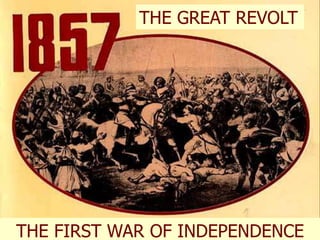
THE GREAT REVOLT
THE FIRST WAR OF INDEPENDENCE
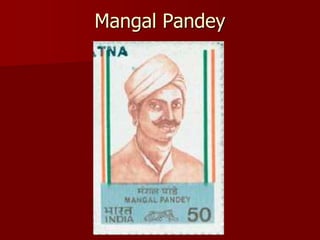
Mangal Pandey
THE OUT BURST
On 9th May 1857, on the parade
ground of Meerut, 85 Indian
troopers were court martialled.
Their Crime: -These troopers
had refused to load their rifles
with the new cartridges.
ABOUT THE NEW CARTRIDGE
A rumour had spread that the
new cartridge contained the
fat of cow and pig.
HINDUS COW WAS SACRED
MUSLIMS PIG MEAT WAS FOBIDDEN BY QURAN
SPREAD OF THE REVOLT
 On 10th May 1857 men of 3rd Light Cavalry
stormed the barracks jail and released
their comrades.
 Soon the Indian civilians joined the
mutineers and killed about 50 Europeans.
 The news spread like wild fire. The
already simmering anger against British
burst out into a violent storm.
Causes of the Revolt of 1857
Political Causes
Social Causes
Religious Causes
Economic Causes
Administrative Causes
Military Causes
POLITICAL CAUSES
Lord Dalhousie’s policy
of annexation and the
Doctrine of lapse had
made the Indian rulers
angry and insecure.
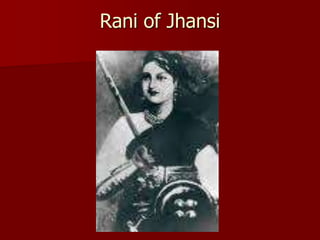
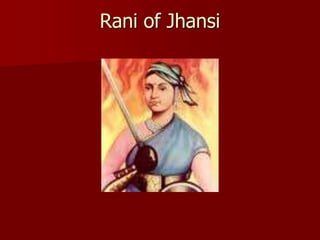
 The Rani of Jhansi Laxmibai was not
allowed to adopt a son.
 In case of disputed interpretation, the
decision of the East India Company was
binding & that of the court of the Directors
was final.
 Regal titles of the Nawab of Carnatic &
Tanjore were abolished. The imperial title
of the Moghul Emperor was discontinued
after Bahadur Shah II.
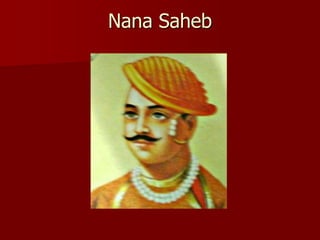
 The pension of Nana Saheb (Peshwa Baji
Rao II’s adopted son) was stopped.
Nana Saheb
Rani of Jhansi
Rani of Jhansi
In case of a dispute, the
decision of the East India
Company was binding
and that of the court of
the directors was final.
The Muslim feelings had
been badly hurt when after
the death of Bahadur Shah
II, Lord Canning took away
regal titles and Moghul
palaces.
Thousands became
unemployed when the
English, under Lord
Dalhousie annexed
Oudh.
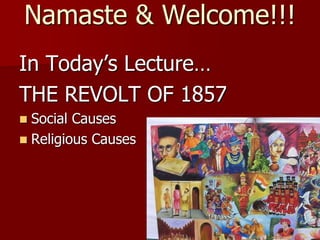
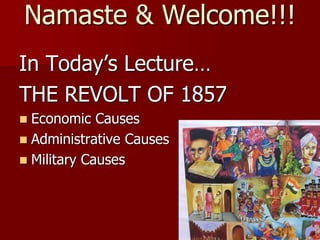
Namaste & Welcome!!!
In Today’s Lecture…
THE REVOLT OF 1857
 Social Causes
 Religious Causes
SOCIAL CAUSES
The British were
rude and used
abusive and
insultive language.
The practice of sati
was abolished. Child
marriage, infanticide
and polygamy were
not allowed.
The European juries
allowed European
criminals with little
or no punishment.
RELIGIOUS CAUSES
Hindus and
Muslims were
forced into
Christianity.
British Officers
abused the name of
Ram and Muhammad.
Idolatry was
denounced. Hindu
deities were ridiculed.
Namaste & Welcome!!!
In Today’s Lecture…
THE REVOLT OF 1857
 Economic Causes
 Administrative Causes
 Military Causes
ECONOMIC CAUSES
The British had drained
India of all her wealth
and natural resources by
selfish economic policies.
ADMINISTRATIVE CAUSES
Unrest spread among
the landlords of Bengal
when William Bentinck
took away rent free
estates from them.
Lord Dalhousie
confiscated
thousands of jagirs
in the Deccan.
After Oudh was
annexed, the estates
of Zamindars and
Taluqdars were
confiscated.
High posts and
handsome salaries were
given to the British. This
caused frustration
amongst Indians.
MILITARY CAUSES
Immense
discrimination
between the Indians
and the British.
The Indian sepoys were
deprived of high salaries
and promotions. The
highest post for an
Indian was that of the
Subedar.
New recruits had to
travel across the
sea. It was
forbidden as per
Hindu belief.
The British army
exposed its vulnerability
in the First Afghan war,
the Sikh war and the
Crimean war.
The Indian sepoys
were required to work
far off without extra
Bhatta or payment.
The privilege of free
postage enjoyed by the
sepoys was withdrawn
with the passing of the
Post Office Act 1854.
IMPORTANT CENTRES OF REVOLT
MEERUT
DELHI
OUDH
KANPUR
JHANSI & GWALIOR
MEERUT
 9 May 1857, 85 Sepoys were court martialled.
 They had refused to use new cartridges.
 Next day their companions attacked the jail.
 Sepoys were freed.
 Officers & Europeans were killed.
 Revolters headed towards Delhi.
 On 12th May 1857, Delhi was seized by rebels.
 Some Europeans were shot dead.
 Bhahadur Shah II was persuaded to support.
 Loss of Delhi was a prestige loss for British.
 On 14th September 1857, British attacked.
 On 20th September 1857, British regained Delhi.
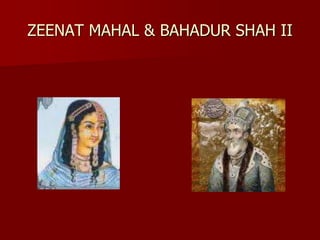
 Bahadur Shah & Zeenat Mahal fled to Humayun’s tomb.
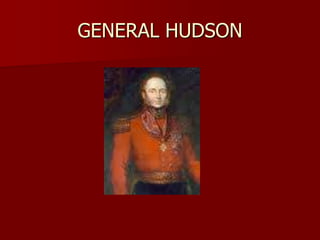
 But were followed & captured by General Hudson.
 3 sons killed & the king & queen exiled to Rangoon.
 The king died in 1862.
DELHI
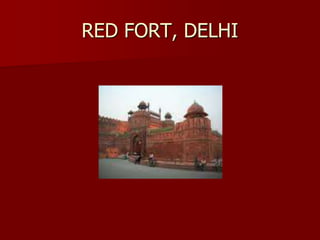
RED FORT, DELHI
ZEENAT MAHAL & BAHADUR SHAH II
GENERAL HUDSON
 Oudh annexed by Lord Dalhousie.
 The Nawab of Oudh exiled to Calcutta.
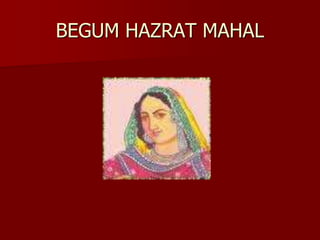
 But his wife Begum Hazrat Mahal and 11 year old son continued
to live in Oudh but in very poor condition.
 So people of Oudh were angry.
 The revolt broke out on 4th June 1857.
 Henry Lawrence, the British Resident, with some Europeans with
some hundred sepoys took refuge in a Residency.
 Begum seized Residency and killed Henry & some others.
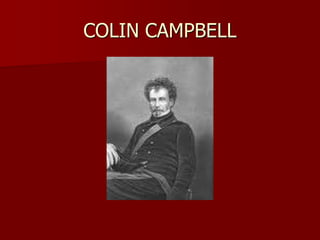
 In November, Sir Colin Campbell (Commander-in-Chief) attacked
with Gorkha regiment.
 In March 1858, the city was finally recaptured.
 The rebels driven to Nepal border to die in bad climate or
captured by Gorkhas.
OUDH (LUCKNOW)
BEGUM HAZRAT MAHAL
COLIN CAMPBELL
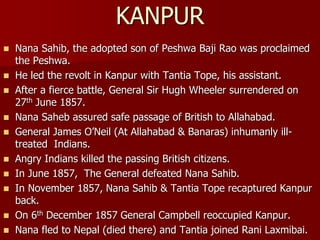
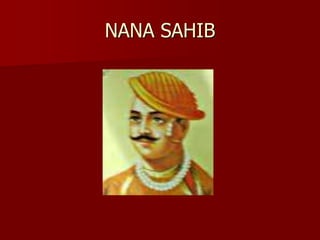
 Nana Sahib, the adopted son of Peshwa Baji Rao was proclaimed
the Peshwa.
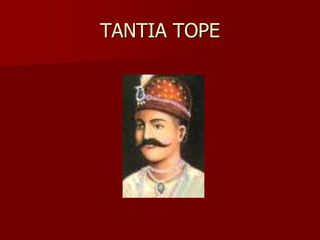
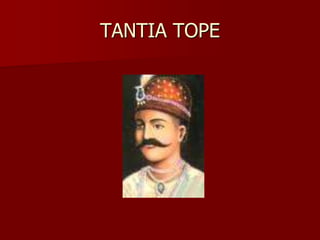
 He led the revolt in Kanpur with Tantia Tope, his assistant.
 After a fierce battle, General Sir Hugh Wheeler surrendered on
27th June 1857.
 Nana Saheb assured safe passage of British to Allahabad.
 General James O’Neil (At Allahabad & Banaras) inhumanly ill-
treated Indians.
 Angry Indians killed the passing British citizens.
 In June 1857, The General defeated Nana Sahib.
 In November 1857, Nana Sahib & Tantia Tope recaptured Kanpur
back.
 On 6th December 1857 General Campbell reoccupied Kanpur.
 Nana fled to Nepal (died there) and Tantia joined Rani Laxmibai.
KANPUR
NANA SAHIB
TANTIA TOPE
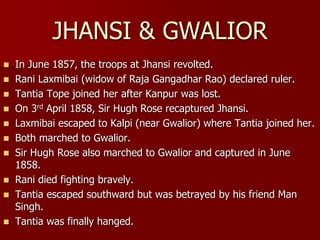
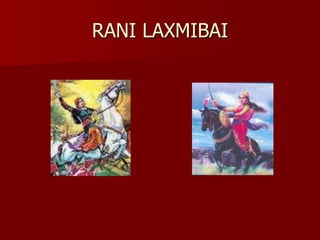
 In June 1857, the troops at Jhansi revolted.
 Rani Laxmibai (widow of Raja Gangadhar Rao) declared ruler.
 Tantia Tope joined her after Kanpur was lost.
 On 3rd April 1858, Sir Hugh Rose recaptured Jhansi.
 Laxmibai escaped to Kalpi (near Gwalior) where Tantia joined her.
 Both marched to Gwalior.
 Sir Hugh Rose also marched to Gwalior and captured in June
1858.
 Rani died fighting bravely.
 Tantia escaped southward but was betrayed by his friend Man
Singh.
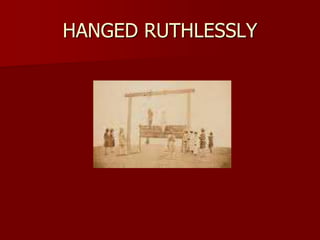
 Tantia was finally hanged.
JHANSI & GWALIOR
RANI LAXMIBAI
TANTIA TOPE
HANGED RUTHLESSLY
OTHER CENTRES OF REVOLT
Bareilly:
Khan Bahadur Khan proclaimed himself the ruler.
Bihar:
Zamindar Kunwar Singh raised the revolt
Banaras:
Banarasis organised a rebellion.
(All were subsequently suppressed by British)
OUTCOME
The revolt was
completely
suppressed and
crushed by July
1858.
CAUSES OF FAILURE OF THE
REVOLT
The revolt was localized and was
poorly organized.
The British had better resources than
the rebels.
The revolt was feudal in character.
The leaders lacked military skills.
The native princes did not join the
revolt.
MAJOR IMPACT OF THE REVOLT
… the revolt was considered to be an
awakener and the first effort towards the
freedom and independence.
…the British just considered it to be a mere military revolt.
IMPACT OF THE REVOLT
1) The control of Indian administration was
transferred form the company to the
crown by the GOI Act 1858
IMPACT OF THE REVOLT
2) The Queen promised to respect Rights &
dignity. General amnesty to all offenders
except murders.
IMPACT OF THE REVOLT
3) The Indian army was reorganised.
Included Sikhs, Gurkhas & Pathans.
IMPACT OF THE REVOLT
4) The Mughal dynasty ended with the
extinction of Bahadur Shah II & was
replaced by British Crown.
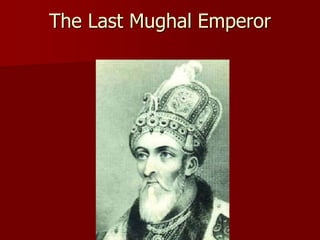
The Last Mughal Emperor
IMPACT OF THE REVOLT
5) Freedom of religion granted.
IMPACT OF THE REVOLT
6) As per Queen’s Proclamation, more
Indians joined the administration.
IMPACT OF THE REVOLT
7) Racial animosity increased.
IMPACT OF THE REVOLT
8) The British introduced the policy of Divide
& Rule that led to the partition of India in
1947.
IMPACT OF THE REVOLT
9) The British exploited the economy
further.

the-revolt-of-1857.ppt

  • 1.
  • 2.
    THE GREAT REVOLT THEFIRST WAR OF INDEPENDENCE
  • 4.
  • 5.
    THE OUT BURST On9th May 1857, on the parade ground of Meerut, 85 Indian troopers were court martialled. Their Crime: -These troopers had refused to load their rifles with the new cartridges.
  • 6.
    ABOUT THE NEWCARTRIDGE A rumour had spread that the new cartridge contained the fat of cow and pig. HINDUS COW WAS SACRED MUSLIMS PIG MEAT WAS FOBIDDEN BY QURAN
  • 7.
    SPREAD OF THEREVOLT  On 10th May 1857 men of 3rd Light Cavalry stormed the barracks jail and released their comrades.  Soon the Indian civilians joined the mutineers and killed about 50 Europeans.  The news spread like wild fire. The already simmering anger against British burst out into a violent storm.
  • 8.
    Causes of theRevolt of 1857 Political Causes Social Causes Religious Causes Economic Causes Administrative Causes Military Causes
  • 9.
    POLITICAL CAUSES Lord Dalhousie’spolicy of annexation and the Doctrine of lapse had made the Indian rulers angry and insecure.
  • 10.
     The Raniof Jhansi Laxmibai was not allowed to adopt a son.  In case of disputed interpretation, the decision of the East India Company was binding & that of the court of the Directors was final.  Regal titles of the Nawab of Carnatic & Tanjore were abolished. The imperial title of the Moghul Emperor was discontinued after Bahadur Shah II.  The pension of Nana Saheb (Peshwa Baji Rao II’s adopted son) was stopped.
  • 11.
  • 12.
  • 13.
  • 14.
    In case ofa dispute, the decision of the East India Company was binding and that of the court of the directors was final.
  • 15.
    The Muslim feelingshad been badly hurt when after the death of Bahadur Shah II, Lord Canning took away regal titles and Moghul palaces.
  • 16.
    Thousands became unemployed whenthe English, under Lord Dalhousie annexed Oudh.
  • 17.
    Namaste & Welcome!!! InToday’s Lecture… THE REVOLT OF 1857  Social Causes  Religious Causes
  • 18.
    SOCIAL CAUSES The Britishwere rude and used abusive and insultive language.
  • 19.
    The practice ofsati was abolished. Child marriage, infanticide and polygamy were not allowed.
  • 20.
    The European juries allowedEuropean criminals with little or no punishment.
  • 21.
    RELIGIOUS CAUSES Hindus and Muslimswere forced into Christianity.
  • 22.
    British Officers abused thename of Ram and Muhammad.
  • 23.
  • 24.
    Namaste & Welcome!!! InToday’s Lecture… THE REVOLT OF 1857  Economic Causes  Administrative Causes  Military Causes
  • 25.
    ECONOMIC CAUSES The Britishhad drained India of all her wealth and natural resources by selfish economic policies.
  • 26.
    ADMINISTRATIVE CAUSES Unrest spreadamong the landlords of Bengal when William Bentinck took away rent free estates from them.
  • 27.
  • 28.
    After Oudh was annexed,the estates of Zamindars and Taluqdars were confiscated.
  • 29.
    High posts and handsomesalaries were given to the British. This caused frustration amongst Indians.
  • 30.
  • 31.
    The Indian sepoyswere deprived of high salaries and promotions. The highest post for an Indian was that of the Subedar.
  • 32.
    New recruits hadto travel across the sea. It was forbidden as per Hindu belief.
  • 33.
    The British army exposedits vulnerability in the First Afghan war, the Sikh war and the Crimean war.
  • 34.
    The Indian sepoys wererequired to work far off without extra Bhatta or payment.
  • 35.
    The privilege offree postage enjoyed by the sepoys was withdrawn with the passing of the Post Office Act 1854.
  • 36.
    IMPORTANT CENTRES OFREVOLT MEERUT DELHI OUDH KANPUR JHANSI & GWALIOR
  • 37.
    MEERUT  9 May1857, 85 Sepoys were court martialled.  They had refused to use new cartridges.  Next day their companions attacked the jail.  Sepoys were freed.  Officers & Europeans were killed.  Revolters headed towards Delhi.
  • 38.
     On 12thMay 1857, Delhi was seized by rebels.  Some Europeans were shot dead.  Bhahadur Shah II was persuaded to support.  Loss of Delhi was a prestige loss for British.  On 14th September 1857, British attacked.  On 20th September 1857, British regained Delhi.  Bahadur Shah & Zeenat Mahal fled to Humayun’s tomb.  But were followed & captured by General Hudson.  3 sons killed & the king & queen exiled to Rangoon.  The king died in 1862. DELHI
  • 39.
  • 40.
    ZEENAT MAHAL &BAHADUR SHAH II
  • 41.
  • 42.
     Oudh annexedby Lord Dalhousie.  The Nawab of Oudh exiled to Calcutta.  But his wife Begum Hazrat Mahal and 11 year old son continued to live in Oudh but in very poor condition.  So people of Oudh were angry.  The revolt broke out on 4th June 1857.  Henry Lawrence, the British Resident, with some Europeans with some hundred sepoys took refuge in a Residency.  Begum seized Residency and killed Henry & some others.  In November, Sir Colin Campbell (Commander-in-Chief) attacked with Gorkha regiment.  In March 1858, the city was finally recaptured.  The rebels driven to Nepal border to die in bad climate or captured by Gorkhas. OUDH (LUCKNOW)
  • 43.
  • 44.
  • 45.
     Nana Sahib,the adopted son of Peshwa Baji Rao was proclaimed the Peshwa.  He led the revolt in Kanpur with Tantia Tope, his assistant.  After a fierce battle, General Sir Hugh Wheeler surrendered on 27th June 1857.  Nana Saheb assured safe passage of British to Allahabad.  General James O’Neil (At Allahabad & Banaras) inhumanly ill- treated Indians.  Angry Indians killed the passing British citizens.  In June 1857, The General defeated Nana Sahib.  In November 1857, Nana Sahib & Tantia Tope recaptured Kanpur back.  On 6th December 1857 General Campbell reoccupied Kanpur.  Nana fled to Nepal (died there) and Tantia joined Rani Laxmibai. KANPUR
  • 46.
  • 47.
  • 48.
     In June1857, the troops at Jhansi revolted.  Rani Laxmibai (widow of Raja Gangadhar Rao) declared ruler.  Tantia Tope joined her after Kanpur was lost.  On 3rd April 1858, Sir Hugh Rose recaptured Jhansi.  Laxmibai escaped to Kalpi (near Gwalior) where Tantia joined her.  Both marched to Gwalior.  Sir Hugh Rose also marched to Gwalior and captured in June 1858.  Rani died fighting bravely.  Tantia escaped southward but was betrayed by his friend Man Singh.  Tantia was finally hanged. JHANSI & GWALIOR
  • 49.
  • 50.
  • 51.
  • 52.
    OTHER CENTRES OFREVOLT Bareilly: Khan Bahadur Khan proclaimed himself the ruler. Bihar: Zamindar Kunwar Singh raised the revolt Banaras: Banarasis organised a rebellion. (All were subsequently suppressed by British)
  • 53.
  • 54.
    CAUSES OF FAILUREOF THE REVOLT The revolt was localized and was poorly organized. The British had better resources than the rebels. The revolt was feudal in character. The leaders lacked military skills. The native princes did not join the revolt.
  • 55.
    MAJOR IMPACT OFTHE REVOLT … the revolt was considered to be an awakener and the first effort towards the freedom and independence. …the British just considered it to be a mere military revolt.
  • 56.
    IMPACT OF THEREVOLT 1) The control of Indian administration was transferred form the company to the crown by the GOI Act 1858
  • 57.
    IMPACT OF THEREVOLT 2) The Queen promised to respect Rights & dignity. General amnesty to all offenders except murders.
  • 58.
    IMPACT OF THEREVOLT 3) The Indian army was reorganised. Included Sikhs, Gurkhas & Pathans.
  • 59.
    IMPACT OF THEREVOLT 4) The Mughal dynasty ended with the extinction of Bahadur Shah II & was replaced by British Crown.
  • 60.
  • 61.
    IMPACT OF THEREVOLT 5) Freedom of religion granted.
  • 62.
    IMPACT OF THEREVOLT 6) As per Queen’s Proclamation, more Indians joined the administration.
  • 63.
    IMPACT OF THEREVOLT 7) Racial animosity increased.
  • 64.
    IMPACT OF THEREVOLT 8) The British introduced the policy of Divide & Rule that led to the partition of India in 1947.
  • 65.
    IMPACT OF THEREVOLT 9) The British exploited the economy further.