THERebellionof 1857
Made by
Ranjeet
[9160392]
Piyush
[9160390]
Contents
• Origins Of The Rebellion
• Timeline Of The Rebellion
• Suppression of Rebellion
• Interpretations of Rebellion
• Pattern Of The Rebellion
• Leadership Of The Rebellion
• Rebellion of Subaltern: Sepoys, Peasants and Artisans
• Awadh In Revolt
• Firangi Raj And The End Of A World
• What The Rebel Wanted
• Against The Symbols Of Oppression
• The Search For Alternative Power
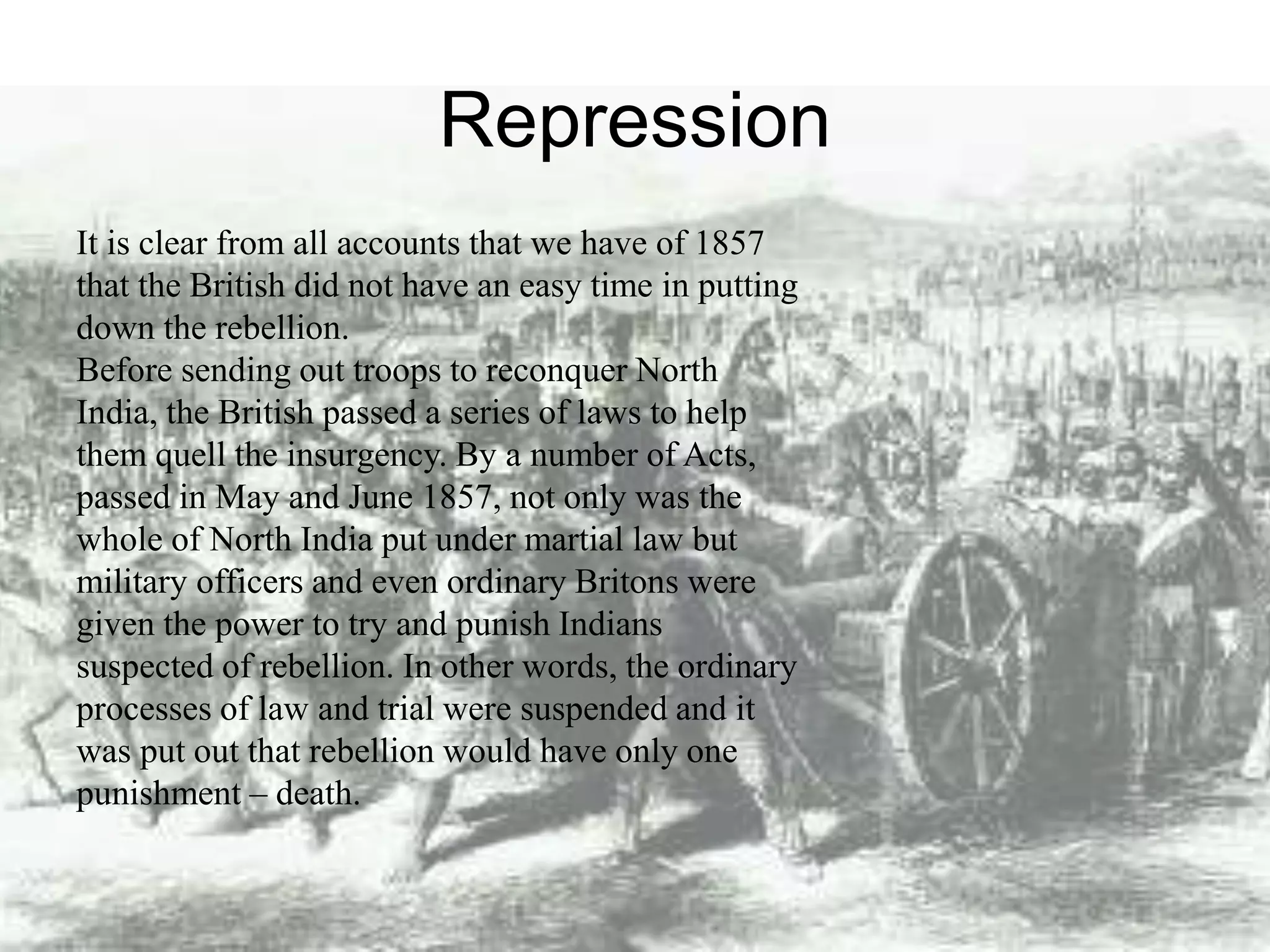
• Repression
• Images Of Revolt
• Celebrating The Saviours
• Vengeance And Retribution
• No Time For Elemency
• Natonalist Imageries
• Movies Inspired By Independence War
• Movies Inspired By This Revolt
• Administrative Changes
Certificate
• This is to certify that this project has been
made by Ranjeet and Piyush of class XII-F on
the topic of The Rebellion Of 1857 under the
guidence of our Respected History teacher
Mr.K Ramesh and have been completed it
successfully.
Yours truly
Ranjeet And Piyush
Acknowledgement
• At the onset, We would like to thank the Almighty
God without which this project would not have
been possible. I thank our Respected History
Teacher Mr. K Ramesh who gave us this golden
opportunity to do this project on the topic of The
Rebellion Of 1857. And we also thanks for his
cordial support, exemplary guidance, monitoring
and constant encouragement. We obliged to our
friends and parents for their valuable guidance
and co-operation during the period of this task.
The blessing help and guidance was a deep
inspiration to us.
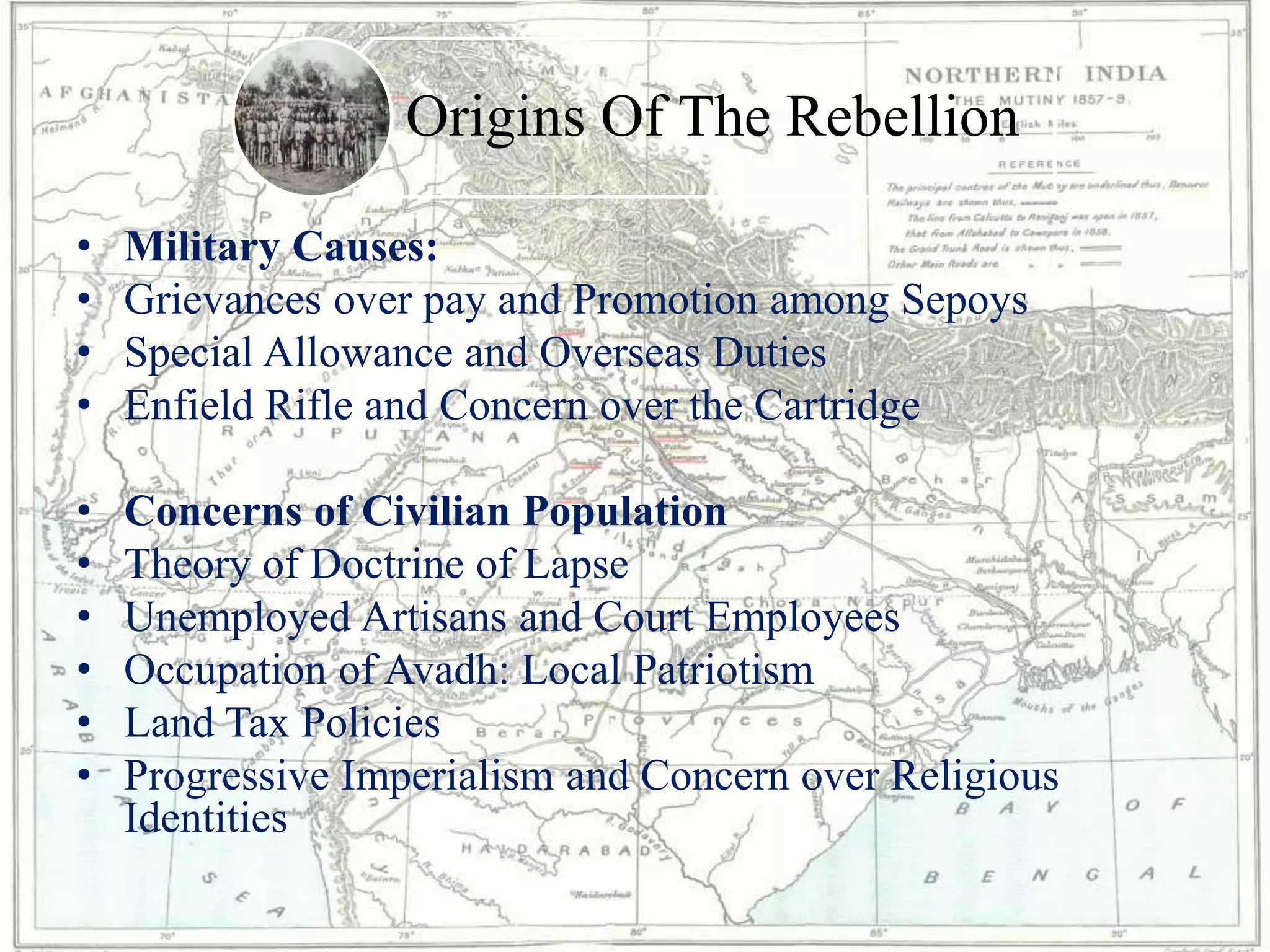
Origins Of The Rebellion
• Military Causes:
• Grievances over pay and Promotion among Sepoys
• Special Allowance and Overseas Duties
• Enfield Rifle and Concern over the Cartridge
• Concerns of Civilian Population
• Theory of Doctrine of Lapse
• Unemployed Artisans and Court Employees
• Occupation of Avadh: Local Patriotism
• Land Tax Policies
• Progressive Imperialism and Concern over Religious
Identities
Timeline Of The Rebellion
On February 26, 1857 Discontent among the 19th
Bengal Native Infantry (BNI) regiment.
At Barrackpur near Calcutta, on March 29, 1857,
Mangal Pandey of the 34th BNI attacked and injured
his British sergeant on the parade ground.
On 9 May, 85 troopers of the 3rd Light Cavalry at
Meerut refused to use their cartridges. They were
imprisoned, sentenced to ten years of hard labour,
and stripped of their uniforms in public.
On 11 May the rebels reached Delhi, where they
were joined by other Indians from the local bazaar,
and attacked and captured the Red Fort (Lal Qila),
killing five British, including a British officer and
two women. Lal Qila was the residence of the
Mughal Emperor Bahadur Shah Zafar II and the
sepoys demanded that he reclaim his throne. At first
he was reluctant, but eventually he agreed to the
demands and became the leader of the rebellion.
Rebellion erupted in the state of Awadh (also known
as Oudh, in modern-day Uttar Pradesh) very soon
after the events in Meerut. The British commander
of Lucknow, Henry Lawrence, had enough time to
fortify his position inside the Residency compound.
British forces numbered some 1700 men, including
loyal sepoys.
Rebellion in Kanpur in June 1857
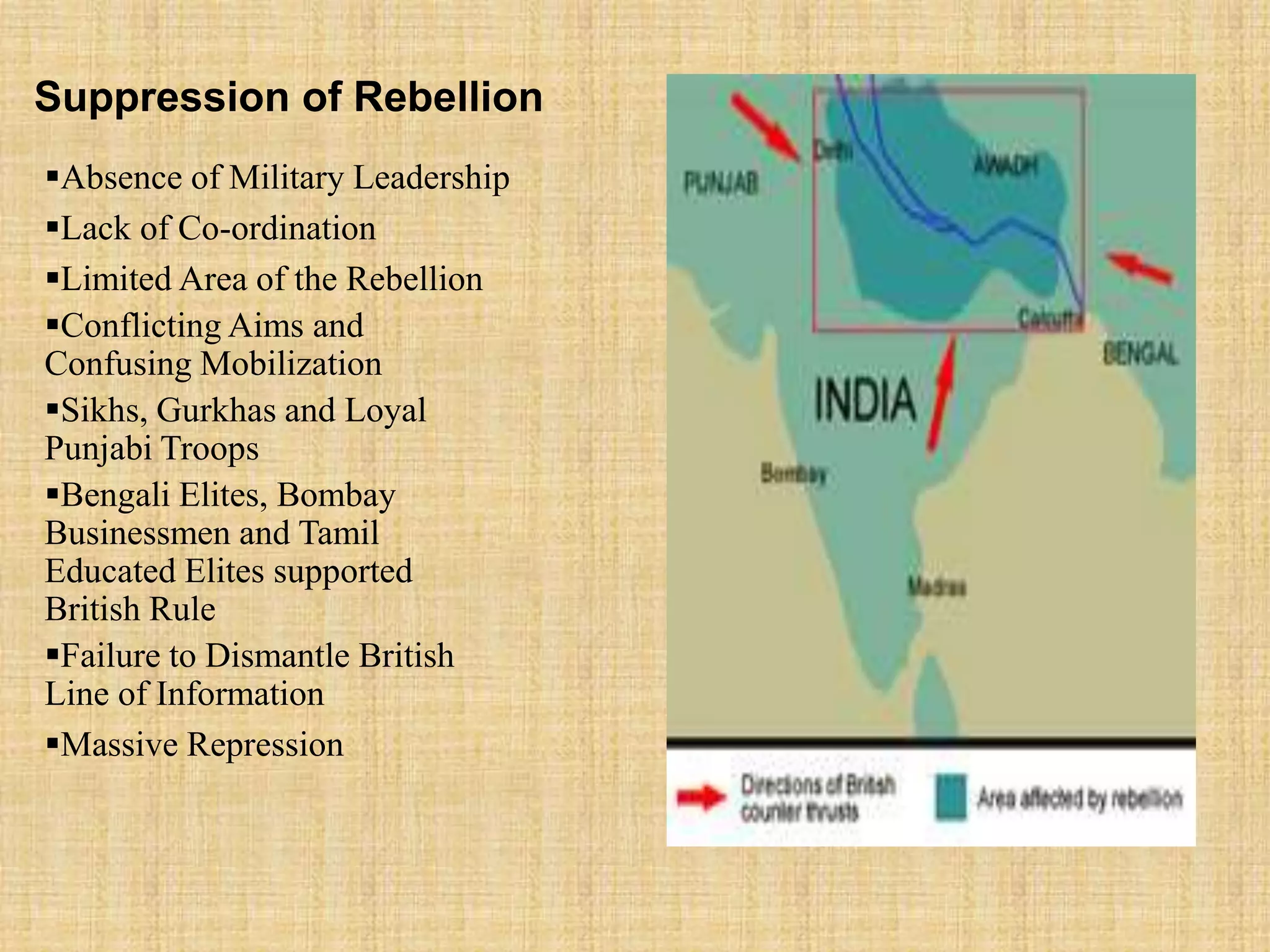
Suppression of Rebellion
Absence of Military Leadership
Lack of Co-ordination
Limited Area of the Rebellion
Conflicting Aims and
Confusing Mobilization
Sikhs, Gurkhas and Loyal
Punjabi Troops
Bengali Elites, Bombay
Businessmen and Tamil
Educated Elites supported
British Rule
Failure to Dismantle British
Line of Information
Massive Repression
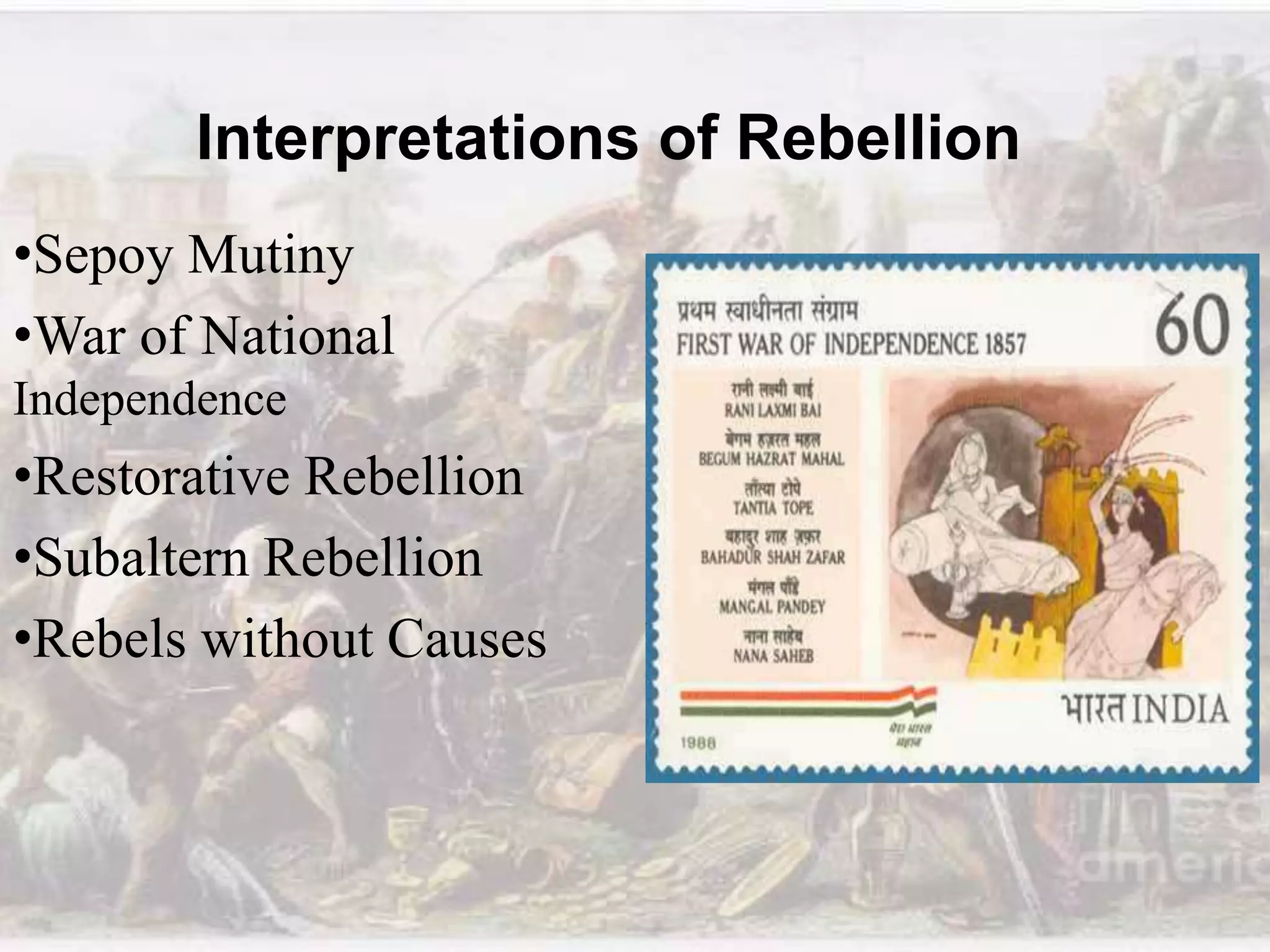
Interpretations of Rebellion
•Sepoy Mutiny
•War of National
Independence
•Restorative Rebellion
•Subaltern Rebellion
•Rebels without Causes
Pattern Of The Rebellion
If one were to place the dates of these mutinies
in chronological order, it would appear that as
the news of the mutiny in one town travelled to
the next the sepoy there took up arms. The
sequance of events in every cantonment
followed a similar pattern.
Leadership Of The Rebellion
• Bahadur Shah Jafar ((1775-1862)
• Nana Saheb (1824-)
• Tantia Tope
• Rani Laxmibai (1830-1858)
• Kunwar Singh
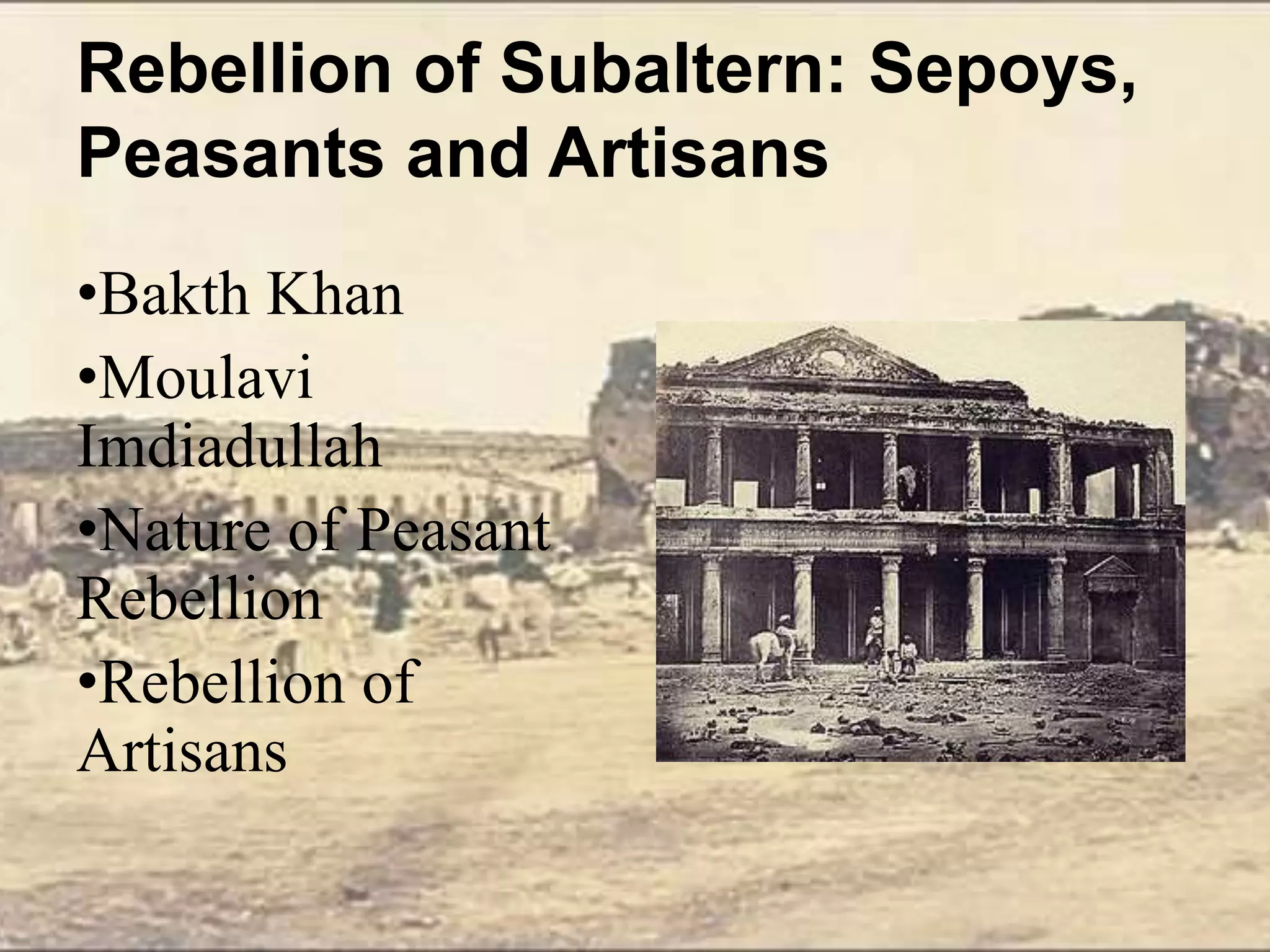
Rebellion of Subaltern: Sepoys,
Peasants and Artisans
•Bakth Khan
•Moulavi
Imdiadullah
•Nature of Peasant
Rebellion
•Rebellion of
Artisans
Awadh In Revolt
• In 1851 Governor General Lord Dalhousie described
the kingdom of Awadh as “a cherry that will drop into
our mouth one day”. Five years later, in 1856, the
kingdom was formally annexed to the British Empire.
The conquest happened in stages. The Subsidiary
Alliance had been imposed on Awadh in 1801. By the
terms of this alliance the Nawab had to disband his
military force, allow the British to position their troops
within the kingdom, and act in accordance with the
advice of the British Resident who was now to be
attached to the court. Deprived of his armed forces, the
Nawab became increasingly dependent on the British to
maintain law and order within the kingdom.
Firangi Raj And The End Of A World
A chain of grievances in Awadh linked prince,
taluqdar, peasant and sepoy. In different ways they came
to identify firangi raj with the end of their world – the
breakdown of things they valued, respected and held
dear. A whole complex of emotionsThe annexation
displaced not just the Nawab.
It also dispossessed the taluqdars of the region. The
countryside of Awadh was dotted with the estates
and forts of taluqdars who for many generations had
controlled land and power in the countryside
What The Rebel Wanted
As victors, the British recorded their own trials and
tribulations as well as their heroism. They dismissed
the rebels as a bunch of ungrateful and barbaric
people. The repression of the rebels also meant
silencing of their voice. Few rebels had the
opportunity of recording their version of events.
Moreover, most of them were sepoys and ordinary
people who were not literate. Thus, other than a few
proclamations and ishtahars (notifications) issued
by rebel leaders to propagate their ideas and
persuade people to join the revolt, we do not have
much that throws light on the perspective of the
rebels. Attempts to reconstruct what happened in
1857 are thus heavily and inevitably dependent on
what the British wrote. While these sources reveal
the minds of officials, they tell us very little about
what the rebels wanted.
Against The Symbols Of
Oppression
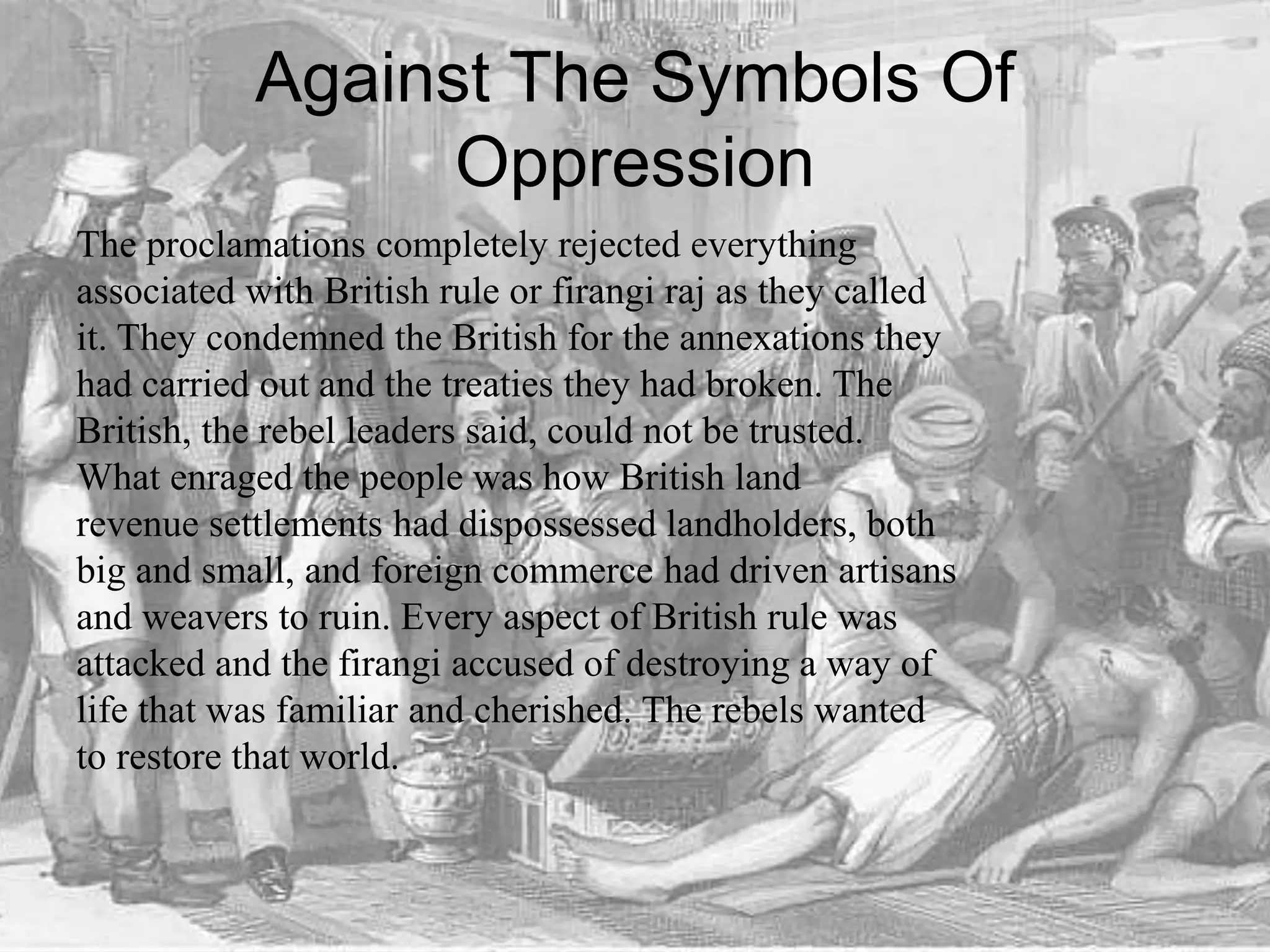
The proclamations completely rejected everything
associated with British rule or firangi raj as they called
it. They condemned the British for the annexations they
had carried out and the treaties they had broken. The
British, the rebel leaders said, could not be trusted.
What enraged the people was how British land
revenue settlements had dispossessed landholders, both
big and small, and foreign commerce had driven artisans
and weavers to ruin. Every aspect of British rule was
attacked and the firangi accused of destroying a way of
life that was familiar and cherished. The rebels wanted
to restore that world.
The Search For Alternative Power
Once British rule had collapsed, the rebels in places
like Delhi, Lucknow and Kanpur tried to establish
some kind of structure of authority and
administration. This was, of course, short-lived but
the attempts show that the rebel leadership wanted
to restore the pre-British world of the eighteenth
century. The leaders went back to the culture of the
court. Appointments were made to various posts,
arrangements made for the collection of land revenue
and the payment of troops, orders issued to stop loot
and plunder. Side by side plans were made to fight
battles against the British. Chains of command were
laid down in the army. In all this the rebels harked
back to the eighteenth-century Mughal world – a
world that became a symbol of all that had been lost.
Repression
It is clear from all accounts that we have of 1857
that the British did not have an easy time in putting
down the rebellion.
Before sending out troops to reconquer North
India, the British passed a series of laws to help
them quell the insurgency. By a number of Acts,
passed in May and June 1857, not only was the
whole of North India put under martial law but
military officers and even ordinary Britons were
given the power to try and punish Indians
suspected of rebellion. In other words, the ordinary
processes of law and trial were suspended and it
was put out that rebellion would have only one
punishment – death.
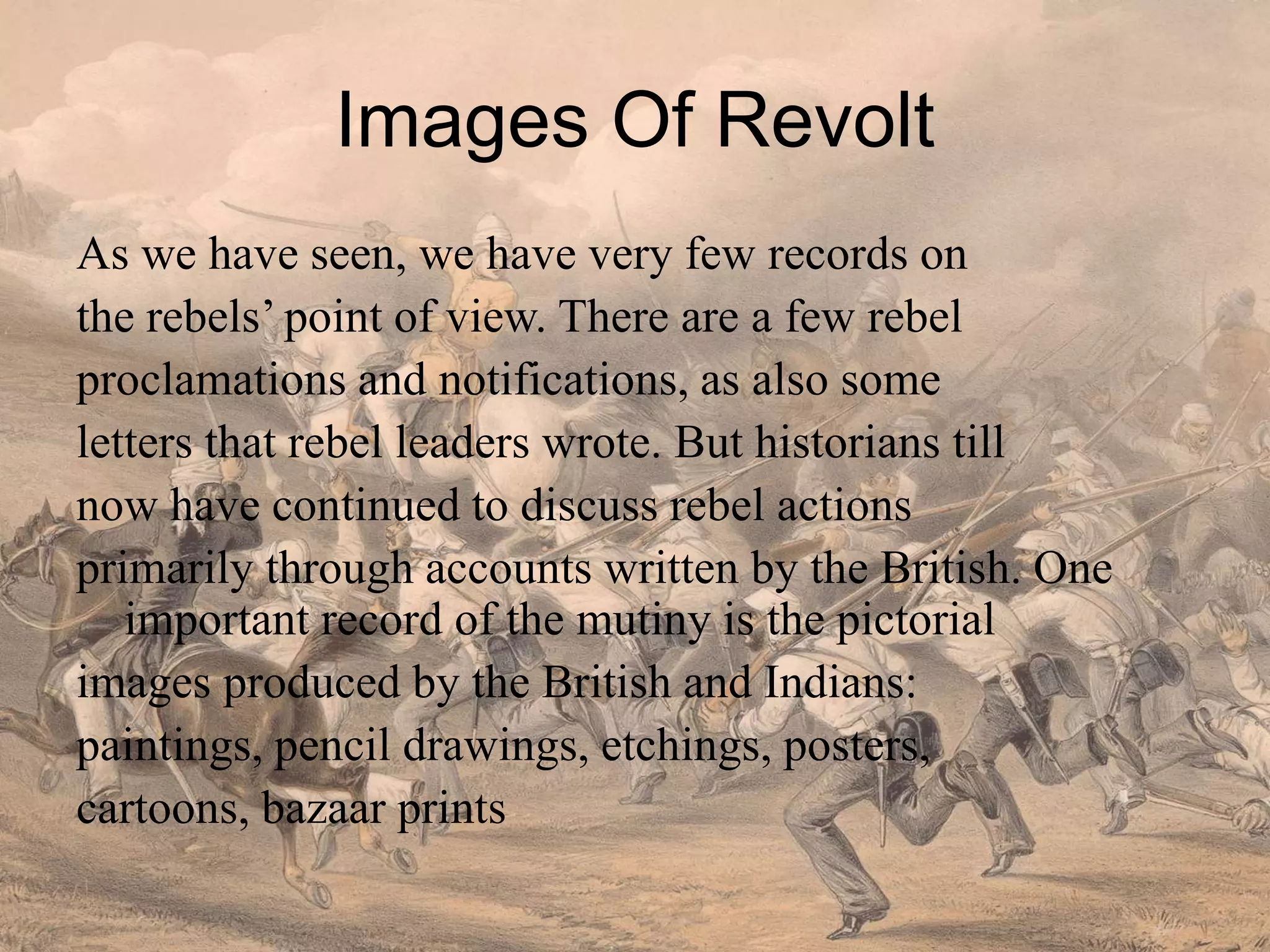
Images Of Revolt
As we have seen, we have very few records on
the rebels’ point of view. There are a few rebel
proclamations and notifications, as also some
letters that rebel leaders wrote. But historians till
now have continued to discuss rebel actions
primarily through accounts written by the British. One
important record of the mutiny is the pictorial
images produced by the British and Indians:
paintings, pencil drawings, etchings, posters,
cartoons, bazaar prints
Celebrating The Saviours
British pictures offer a variety of images that were
meant to provoke a range of different emotions and
reactions. Some of them commemorate the British
heroes who saved the English and repressed the
rebels. “Relief of Lucknow”, painted by Thomas Jones
Barker in 1859, is an example of this type. When
the rebel forces besieged Lucknow, Henry Lawrence,
the Commissioner of Lucknow, collected the
Christian population and took refuge in the heavily
fortified Residency. Lawrence was killed but the
Residency continued to be defended under the
command of Colonel Inglis. On 25 September James
Outram and Henry Havelock arrived, cut through
the rebel forces, and reinforced the British
garrisons.
Vengeance And Retribution
As waves of anger and shock spread in Britain,
demands for retribution grew louder. Visual
representations and news about the revolt created a
milieu in which violent repression and vengeance were
seen as both necessary and just. It was as if justice
demanded that the challenge to British honour and
power be met ruthlessly. Threatened by the rebellion,
the British felt that they had to demonstrate their
invincibility. In one such image (Fig. 11.13) we see
an allegorical female figure of justice with a sword in
one hand and a shield in the other. Her posture is
aggressive; her face expresses rage and the desire for
revenge. She is trampling sepoys under her feet while
a mass of Indian women with children cower with fear.
No Time For Elemency
At a time when the clamour was for vengeance, pleas
for moderation were ridiculed. When Governor
General Canning declared that a gesture of leniency
and a show of mercy would help in winning back
the loyalty of the sepoys, he was mocked in the
British press.
In one of the cartoons published in the pages of
Punch, a British journal of comic satire, Canning is
shown as a looming father figure, with his protective
hand over the head of a sepoy who still holds an
unsheathed sword in one hand and a dagger in the
other, both dripping with blood (Fig.11.17) – an
imagery that recurs in a number of British pictures
of the time.
Natonalist Imageries
The national movement in the twentieth century drew
its inspiration from the events of 1857. A whole world
of nationalist imagination was woven around
the revolt. It was celebrated as the First War of
Independence in which all sections of the people of
India came together to fight against imperial rule. In
popular prints
Rani Lakshmi Bai is usually portrayed in battle
armour, with a sword in hand and riding a horse – a
symbol of the determination to resist injustice and
alien rule.
Movies Inspired By Independence War
•Shaheed is a 1965 Hindi film starring Manoj
Kumar depicting Bhaghat Singh's life. At the 13th
National Film Awards, Shaheed claimed the award
for Best Feature Film in Hindi, the Nargins Dutt
Award for Best Feature Film on National
Integration and the award for Best Screenplay for
B. K. Dutt and Din Dayal Sharma.
Incredible Fact:
The screenplay inputs in this version of the film
were in fact contributed by Bhagat Singh's close
supporter Batukeshwar Dutt himself adding to the
classicality of the film.
Movies Inspired By This Revolt
•Mangal Pandey: The Rising starring Aamir
Khan as Mangal Pandey, Rani Mukherjee as a
prostitute and Amisha Patel as a woman about
to die under “Sati pratha” and saved later, was
ace director Ketan Mehta’s attempt to unroll
real life incidences of the first freedom
revolutionary of the nation.
Incredible Fact:
The Bharatiya Janata Party had sought a ban on
the film, saying it depicts fabrication and
includes character assassination of Mangal
Pandey by showing him stopover at the house
of a prostitute. The film was damned for
presenting twisted history, use of too much
music and over-publicised Aamir Khan’s hair-
do. But the film opened to mixed reviews and
is still considered one of the worthy period
“freedom” films made in the country.
Movies Inspired By Independence War
•This iconic portrayal is depicted in the shining
performance of Sachin Khedekar in Shyam Benegal’s
(2004) Netaji Subhas Chandra Bose: The Forgotten Hero
(aka Bose: The Forgotten Hero). The film begins with
Netaji giving up the post of president of the Indian
National Congress, then heads to Europe to meet Hitler
requesting the latter’s support and his success in forming
the Indian National Army comprising Indian POWs with
the support of Japan. The film culminates with India
gaining freedom on 15th August 1947, but the legend to
which India had due so much, vanished.
Incredible Fact:
Bose’s posthumous Bharat Ratna Award (1992) was
withdrawn due to lack of evidence of his death, which has
been the subject of arguments. Although, it was
announced by Japan that Netaji died in a plane crash in
Taiwan on August 18, 1945, there have been three
Government of India commissions to find out if Subhas
Chandra Bose died in the plane crash. The third Indian
commission that was chosen for enquiring into this stated
in its report tabled in the Parliament in May 2006 that the
news about Bose's "death" was dramatic to assist a flee to
the USSR. It has been suspected that the Indian
government and political leadership were attentive that
Bose may have been alive and in custody in Soviet Union,
but opted to overlook this concept post-Independence.
Administrative Changes
•The Transfer of Power
•Declaration of Queen Victoria
•No rise in Land Revenue
•Decline of Muslim Aristocracy in Indo-
Gangetic Plains
•Military Changes and the Idea of
Martial Race
•Indian Army for Imperial Cause
•Arms Act and Vernacular Press Act of
1878
•Criminal Tribes Act of 1871
•Technocratic State
•Alliance with conservative forces
•Racial Tensions
•New Empire
Thank You

Rebellion of 1857

  • 1.
  • 2.
    Contents • Origins OfThe Rebellion • Timeline Of The Rebellion • Suppression of Rebellion • Interpretations of Rebellion • Pattern Of The Rebellion • Leadership Of The Rebellion • Rebellion of Subaltern: Sepoys, Peasants and Artisans • Awadh In Revolt • Firangi Raj And The End Of A World • What The Rebel Wanted • Against The Symbols Of Oppression • The Search For Alternative Power • Repression • Images Of Revolt • Celebrating The Saviours • Vengeance And Retribution • No Time For Elemency • Natonalist Imageries • Movies Inspired By Independence War • Movies Inspired By This Revolt • Administrative Changes
  • 3.
    Certificate • This isto certify that this project has been made by Ranjeet and Piyush of class XII-F on the topic of The Rebellion Of 1857 under the guidence of our Respected History teacher Mr.K Ramesh and have been completed it successfully. Yours truly Ranjeet And Piyush
  • 4.
    Acknowledgement • At theonset, We would like to thank the Almighty God without which this project would not have been possible. I thank our Respected History Teacher Mr. K Ramesh who gave us this golden opportunity to do this project on the topic of The Rebellion Of 1857. And we also thanks for his cordial support, exemplary guidance, monitoring and constant encouragement. We obliged to our friends and parents for their valuable guidance and co-operation during the period of this task. The blessing help and guidance was a deep inspiration to us.
  • 5.
    Origins Of TheRebellion • Military Causes: • Grievances over pay and Promotion among Sepoys • Special Allowance and Overseas Duties • Enfield Rifle and Concern over the Cartridge • Concerns of Civilian Population • Theory of Doctrine of Lapse • Unemployed Artisans and Court Employees • Occupation of Avadh: Local Patriotism • Land Tax Policies • Progressive Imperialism and Concern over Religious Identities
  • 6.
    Timeline Of TheRebellion On February 26, 1857 Discontent among the 19th Bengal Native Infantry (BNI) regiment. At Barrackpur near Calcutta, on March 29, 1857, Mangal Pandey of the 34th BNI attacked and injured his British sergeant on the parade ground. On 9 May, 85 troopers of the 3rd Light Cavalry at Meerut refused to use their cartridges. They were imprisoned, sentenced to ten years of hard labour, and stripped of their uniforms in public. On 11 May the rebels reached Delhi, where they were joined by other Indians from the local bazaar, and attacked and captured the Red Fort (Lal Qila), killing five British, including a British officer and two women. Lal Qila was the residence of the Mughal Emperor Bahadur Shah Zafar II and the sepoys demanded that he reclaim his throne. At first he was reluctant, but eventually he agreed to the demands and became the leader of the rebellion. Rebellion erupted in the state of Awadh (also known as Oudh, in modern-day Uttar Pradesh) very soon after the events in Meerut. The British commander of Lucknow, Henry Lawrence, had enough time to fortify his position inside the Residency compound. British forces numbered some 1700 men, including loyal sepoys. Rebellion in Kanpur in June 1857
  • 7.
    Suppression of Rebellion Absenceof Military Leadership Lack of Co-ordination Limited Area of the Rebellion Conflicting Aims and Confusing Mobilization Sikhs, Gurkhas and Loyal Punjabi Troops Bengali Elites, Bombay Businessmen and Tamil Educated Elites supported British Rule Failure to Dismantle British Line of Information Massive Repression
  • 8.
    Interpretations of Rebellion •SepoyMutiny •War of National Independence •Restorative Rebellion •Subaltern Rebellion •Rebels without Causes
  • 9.
    Pattern Of TheRebellion If one were to place the dates of these mutinies in chronological order, it would appear that as the news of the mutiny in one town travelled to the next the sepoy there took up arms. The sequance of events in every cantonment followed a similar pattern.
  • 10.
    Leadership Of TheRebellion • Bahadur Shah Jafar ((1775-1862) • Nana Saheb (1824-) • Tantia Tope • Rani Laxmibai (1830-1858) • Kunwar Singh
  • 11.
    Rebellion of Subaltern:Sepoys, Peasants and Artisans •Bakth Khan •Moulavi Imdiadullah •Nature of Peasant Rebellion •Rebellion of Artisans
  • 12.
    Awadh In Revolt •In 1851 Governor General Lord Dalhousie described the kingdom of Awadh as “a cherry that will drop into our mouth one day”. Five years later, in 1856, the kingdom was formally annexed to the British Empire. The conquest happened in stages. The Subsidiary Alliance had been imposed on Awadh in 1801. By the terms of this alliance the Nawab had to disband his military force, allow the British to position their troops within the kingdom, and act in accordance with the advice of the British Resident who was now to be attached to the court. Deprived of his armed forces, the Nawab became increasingly dependent on the British to maintain law and order within the kingdom.
  • 13.
    Firangi Raj AndThe End Of A World A chain of grievances in Awadh linked prince, taluqdar, peasant and sepoy. In different ways they came to identify firangi raj with the end of their world – the breakdown of things they valued, respected and held dear. A whole complex of emotionsThe annexation displaced not just the Nawab. It also dispossessed the taluqdars of the region. The countryside of Awadh was dotted with the estates and forts of taluqdars who for many generations had controlled land and power in the countryside
  • 14.
    What The RebelWanted As victors, the British recorded their own trials and tribulations as well as their heroism. They dismissed the rebels as a bunch of ungrateful and barbaric people. The repression of the rebels also meant silencing of their voice. Few rebels had the opportunity of recording their version of events. Moreover, most of them were sepoys and ordinary people who were not literate. Thus, other than a few proclamations and ishtahars (notifications) issued by rebel leaders to propagate their ideas and persuade people to join the revolt, we do not have much that throws light on the perspective of the rebels. Attempts to reconstruct what happened in 1857 are thus heavily and inevitably dependent on what the British wrote. While these sources reveal the minds of officials, they tell us very little about what the rebels wanted.
  • 15.
    Against The SymbolsOf Oppression The proclamations completely rejected everything associated with British rule or firangi raj as they called it. They condemned the British for the annexations they had carried out and the treaties they had broken. The British, the rebel leaders said, could not be trusted. What enraged the people was how British land revenue settlements had dispossessed landholders, both big and small, and foreign commerce had driven artisans and weavers to ruin. Every aspect of British rule was attacked and the firangi accused of destroying a way of life that was familiar and cherished. The rebels wanted to restore that world.
  • 16.
    The Search ForAlternative Power Once British rule had collapsed, the rebels in places like Delhi, Lucknow and Kanpur tried to establish some kind of structure of authority and administration. This was, of course, short-lived but the attempts show that the rebel leadership wanted to restore the pre-British world of the eighteenth century. The leaders went back to the culture of the court. Appointments were made to various posts, arrangements made for the collection of land revenue and the payment of troops, orders issued to stop loot and plunder. Side by side plans were made to fight battles against the British. Chains of command were laid down in the army. In all this the rebels harked back to the eighteenth-century Mughal world – a world that became a symbol of all that had been lost.
  • 17.
    Repression It is clearfrom all accounts that we have of 1857 that the British did not have an easy time in putting down the rebellion. Before sending out troops to reconquer North India, the British passed a series of laws to help them quell the insurgency. By a number of Acts, passed in May and June 1857, not only was the whole of North India put under martial law but military officers and even ordinary Britons were given the power to try and punish Indians suspected of rebellion. In other words, the ordinary processes of law and trial were suspended and it was put out that rebellion would have only one punishment – death.
  • 18.
    Images Of Revolt Aswe have seen, we have very few records on the rebels’ point of view. There are a few rebel proclamations and notifications, as also some letters that rebel leaders wrote. But historians till now have continued to discuss rebel actions primarily through accounts written by the British. One important record of the mutiny is the pictorial images produced by the British and Indians: paintings, pencil drawings, etchings, posters, cartoons, bazaar prints
  • 19.
    Celebrating The Saviours Britishpictures offer a variety of images that were meant to provoke a range of different emotions and reactions. Some of them commemorate the British heroes who saved the English and repressed the rebels. “Relief of Lucknow”, painted by Thomas Jones Barker in 1859, is an example of this type. When the rebel forces besieged Lucknow, Henry Lawrence, the Commissioner of Lucknow, collected the Christian population and took refuge in the heavily fortified Residency. Lawrence was killed but the Residency continued to be defended under the command of Colonel Inglis. On 25 September James Outram and Henry Havelock arrived, cut through the rebel forces, and reinforced the British garrisons.
  • 20.
    Vengeance And Retribution Aswaves of anger and shock spread in Britain, demands for retribution grew louder. Visual representations and news about the revolt created a milieu in which violent repression and vengeance were seen as both necessary and just. It was as if justice demanded that the challenge to British honour and power be met ruthlessly. Threatened by the rebellion, the British felt that they had to demonstrate their invincibility. In one such image (Fig. 11.13) we see an allegorical female figure of justice with a sword in one hand and a shield in the other. Her posture is aggressive; her face expresses rage and the desire for revenge. She is trampling sepoys under her feet while a mass of Indian women with children cower with fear.
  • 21.
    No Time ForElemency At a time when the clamour was for vengeance, pleas for moderation were ridiculed. When Governor General Canning declared that a gesture of leniency and a show of mercy would help in winning back the loyalty of the sepoys, he was mocked in the British press. In one of the cartoons published in the pages of Punch, a British journal of comic satire, Canning is shown as a looming father figure, with his protective hand over the head of a sepoy who still holds an unsheathed sword in one hand and a dagger in the other, both dripping with blood (Fig.11.17) – an imagery that recurs in a number of British pictures of the time.
  • 22.
    Natonalist Imageries The nationalmovement in the twentieth century drew its inspiration from the events of 1857. A whole world of nationalist imagination was woven around the revolt. It was celebrated as the First War of Independence in which all sections of the people of India came together to fight against imperial rule. In popular prints Rani Lakshmi Bai is usually portrayed in battle armour, with a sword in hand and riding a horse – a symbol of the determination to resist injustice and alien rule.
  • 23.
    Movies Inspired ByIndependence War •Shaheed is a 1965 Hindi film starring Manoj Kumar depicting Bhaghat Singh's life. At the 13th National Film Awards, Shaheed claimed the award for Best Feature Film in Hindi, the Nargins Dutt Award for Best Feature Film on National Integration and the award for Best Screenplay for B. K. Dutt and Din Dayal Sharma. Incredible Fact: The screenplay inputs in this version of the film were in fact contributed by Bhagat Singh's close supporter Batukeshwar Dutt himself adding to the classicality of the film.
  • 24.
    Movies Inspired ByThis Revolt •Mangal Pandey: The Rising starring Aamir Khan as Mangal Pandey, Rani Mukherjee as a prostitute and Amisha Patel as a woman about to die under “Sati pratha” and saved later, was ace director Ketan Mehta’s attempt to unroll real life incidences of the first freedom revolutionary of the nation. Incredible Fact: The Bharatiya Janata Party had sought a ban on the film, saying it depicts fabrication and includes character assassination of Mangal Pandey by showing him stopover at the house of a prostitute. The film was damned for presenting twisted history, use of too much music and over-publicised Aamir Khan’s hair- do. But the film opened to mixed reviews and is still considered one of the worthy period “freedom” films made in the country.
  • 25.
    Movies Inspired ByIndependence War •This iconic portrayal is depicted in the shining performance of Sachin Khedekar in Shyam Benegal’s (2004) Netaji Subhas Chandra Bose: The Forgotten Hero (aka Bose: The Forgotten Hero). The film begins with Netaji giving up the post of president of the Indian National Congress, then heads to Europe to meet Hitler requesting the latter’s support and his success in forming the Indian National Army comprising Indian POWs with the support of Japan. The film culminates with India gaining freedom on 15th August 1947, but the legend to which India had due so much, vanished. Incredible Fact: Bose’s posthumous Bharat Ratna Award (1992) was withdrawn due to lack of evidence of his death, which has been the subject of arguments. Although, it was announced by Japan that Netaji died in a plane crash in Taiwan on August 18, 1945, there have been three Government of India commissions to find out if Subhas Chandra Bose died in the plane crash. The third Indian commission that was chosen for enquiring into this stated in its report tabled in the Parliament in May 2006 that the news about Bose's "death" was dramatic to assist a flee to the USSR. It has been suspected that the Indian government and political leadership were attentive that Bose may have been alive and in custody in Soviet Union, but opted to overlook this concept post-Independence.
  • 26.
    Administrative Changes •The Transferof Power •Declaration of Queen Victoria •No rise in Land Revenue •Decline of Muslim Aristocracy in Indo- Gangetic Plains •Military Changes and the Idea of Martial Race •Indian Army for Imperial Cause •Arms Act and Vernacular Press Act of 1878 •Criminal Tribes Act of 1871 •Technocratic State •Alliance with conservative forces •Racial Tensions •New Empire
  • 27.