Proposal Development
                       GRC || RWJF
  "[T]here is too little emphasis ... on what it means to do independent research."
                          -William Bowen and Neil Rudenstein
                              In Pursuit of the Ph.D. 1992
Proposal Development


• Developing your thesis/dissertation proposal is
 one of your most important moments in grad
 school

• It also happens to be the least-institutionalized
 part of grad school
Proposal Development


• What you’ve done to get this far:
     • Excel in academic programing
     • Follow a course list provided to you
     • Work though a program made for you
Proposal Development


• Your Academic program has been like riding
 on a plane. Difficult, but the path has been
 prepared.
Proposal Development


• From now on, you must
    • Develop your own research paradigm
    • Set your own path & schedule
    • Determine your own criteria for success
Proposal Development


• Your proposed research is like skydiving - you
 are in control, and your path is (mostly) your
 decision
Proposal Development


• And as everyone knows, the hardest part about
 skydiving is jumping off a moving plane
Proposal Development

• Two important things to always consider on
 every paragraph in the proposal:

    • Are you staying focused on your research
      question?

    • Do you have the concerns of your
      committee in mind?
Proposal Development


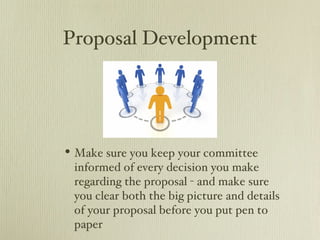
• Make sure you keep your committee
 informed of every decision you make
 regarding the proposal - and make sure
 you clear both the big picture and details
 of your proposal before you put pen to
 paper
Proposal Development


• A good proposal has only one criteria for
 success - passing muster by the members
 of your committee
Outline


• Sketch out an outline of your proposal:
     • Include page length estimates, content,
      even citations

     • A detailed outline can form a useful
      roadmap
Mechanics
• What’s in a proposal?
    • Introduction
    • Problem Statement
    • Conceptual/Theoretical Framework
    • Data Collection & Analytical Methods
    • Significance
    • Timeline
Mechanics


• Introduction
    • The easiest part - a simple statement of
      the field, the problem, and a hint at your
      research.
Problem Statement


• What is the outstanding issue in your field that
 you seek to address?

• What is missing from the status quo?
Problem Statement


• In other words, you need to pass the “so what?”
 test - how do you capture your audience’s
 interest?
Conceptual/Theoretical
        Framework

• What literature is relevant to the problem?
• Have a good mix of old and new articles
• Any gaps that you see in important papers?
• The most important part of this section is your
 analysis
Conceptual/Theoretical
        Framework


• This section does two things.
     • First, it establishes the context of your
      work

     • Second, it demonstrates how much you
      are invested in it.
Conceptual/Theoretical
     Framework


• Make a space for your work in your field.
• Put elegance over expanse - keep the
 discussion as succinct and focused as
 possible.
Data Collection Methods


• Where are you getting data?
• From who?
• Do you have permission?
• IRB?
Data Collection Methods


• This section should clearly convey the raw
 materials you will use in your work.
Analytical Methods


• Quantitative? Qualitative?
• How will you assess significance?
Analytical Methods


• Your methods should do two things:
    • Reinforce your potential contributions to
      the field

    • Set expectations for what you can deliver
Significance


• What are the broader impacts of your
 research?

• What changes?
Significance


• The significance section helps demonstrate
 that you understand the broader impacts of
 your work - a critical factor in any professional
 researcher
Timeline


•“In preparing for battle, I have always found
 that plans are useless but planning is
 indispensable” - Dwight D. Eisenhower
Proposal Development


• All of these concepts are fundamentally
 different than anything college or primary
 education has prepared you for
Proposal Development


• How to get started?
Proposal Development
  • Take a moment to write down your ideal
     graduation schedule. Important landmarks:

              • Proposal Defense
              • Completion of Data Collection
              • Completion of Data Analysis
              • Completion of Writing

“In preparing for battle, I have always found that plans are useless but
planning is indispensable” - Dwight D. Eisenhower
Proposal Development


• Take a look at your schedule post-proposal -
 this will form the baseline for your data
 collection and analytical methods

     • Can you accomplish your desired
      methodological goals with the timeline
      you have?
Proposal Development


• Every literary agent and book publisher knows
 that the author will always be late on turning in
 a manuscript after a timeline is settled upon - it
 is no different for Masters/Doctoral students
Proposal Development


• Give your self more time than you think you’ll
 need when negotiating a timeline - it is better
 to overestimate and then overachieve than to
 underestimate and underachieve in the eyes of
 your committee
Research Design

• Your proposal is code for research design
     • What are your hypotheses?
     • Will the data you gather help evaluate
      those hypotheses?

     • Will the analytical methods you use help
      assess the hypotheses?
Research Design


• Your proposal should serve as foreshadowing
 of how you will write a grant proposal, or
 oversee a larger project.
Proposal Development


• Develop an Outline
• Develop a Timeline
• Keep a continuous dialog with your Committee

Proposal development

  • 1.
    Proposal Development GRC || RWJF "[T]here is too little emphasis ... on what it means to do independent research." -William Bowen and Neil Rudenstein In Pursuit of the Ph.D. 1992
  • 2.
    Proposal Development • Developingyour thesis/dissertation proposal is one of your most important moments in grad school • It also happens to be the least-institutionalized part of grad school
  • 3.
    Proposal Development • Whatyou’ve done to get this far: • Excel in academic programing • Follow a course list provided to you • Work though a program made for you
  • 4.
    Proposal Development • YourAcademic program has been like riding on a plane. Difficult, but the path has been prepared.
  • 5.
    Proposal Development • Fromnow on, you must • Develop your own research paradigm • Set your own path & schedule • Determine your own criteria for success
  • 6.
    Proposal Development • Yourproposed research is like skydiving - you are in control, and your path is (mostly) your decision
  • 7.
    Proposal Development • Andas everyone knows, the hardest part about skydiving is jumping off a moving plane
  • 8.
    Proposal Development • Twoimportant things to always consider on every paragraph in the proposal: • Are you staying focused on your research question? • Do you have the concerns of your committee in mind?
  • 9.
    Proposal Development • Makesure you keep your committee informed of every decision you make regarding the proposal - and make sure you clear both the big picture and details of your proposal before you put pen to paper
  • 10.
    Proposal Development • Agood proposal has only one criteria for success - passing muster by the members of your committee
  • 11.
    Outline • Sketch outan outline of your proposal: • Include page length estimates, content, even citations • A detailed outline can form a useful roadmap
  • 12.
    Mechanics • What’s ina proposal? • Introduction • Problem Statement • Conceptual/Theoretical Framework • Data Collection & Analytical Methods • Significance • Timeline
  • 13.
    Mechanics • Introduction • The easiest part - a simple statement of the field, the problem, and a hint at your research.
  • 14.
    Problem Statement • Whatis the outstanding issue in your field that you seek to address? • What is missing from the status quo?
  • 15.
    Problem Statement • Inother words, you need to pass the “so what?” test - how do you capture your audience’s interest?
  • 16.
    Conceptual/Theoretical Framework • What literature is relevant to the problem? • Have a good mix of old and new articles • Any gaps that you see in important papers? • The most important part of this section is your analysis
  • 17.
    Conceptual/Theoretical Framework • This section does two things. • First, it establishes the context of your work • Second, it demonstrates how much you are invested in it.
  • 18.
    Conceptual/Theoretical Framework • Make a space for your work in your field. • Put elegance over expanse - keep the discussion as succinct and focused as possible.
  • 19.
    Data Collection Methods •Where are you getting data? • From who? • Do you have permission? • IRB?
  • 20.
    Data Collection Methods •This section should clearly convey the raw materials you will use in your work.
  • 21.
    Analytical Methods • Quantitative?Qualitative? • How will you assess significance?
  • 22.
    Analytical Methods • Yourmethods should do two things: • Reinforce your potential contributions to the field • Set expectations for what you can deliver
  • 23.
    Significance • What arethe broader impacts of your research? • What changes?
  • 24.
    Significance • The significancesection helps demonstrate that you understand the broader impacts of your work - a critical factor in any professional researcher
  • 25.
    Timeline •“In preparing forbattle, I have always found that plans are useless but planning is indispensable” - Dwight D. Eisenhower
  • 26.
    Proposal Development • Allof these concepts are fundamentally different than anything college or primary education has prepared you for
  • 27.
  • 28.
    Proposal Development • Take a moment to write down your ideal graduation schedule. Important landmarks: • Proposal Defense • Completion of Data Collection • Completion of Data Analysis • Completion of Writing “In preparing for battle, I have always found that plans are useless but planning is indispensable” - Dwight D. Eisenhower
  • 29.
    Proposal Development • Takea look at your schedule post-proposal - this will form the baseline for your data collection and analytical methods • Can you accomplish your desired methodological goals with the timeline you have?
  • 30.
    Proposal Development • Everyliterary agent and book publisher knows that the author will always be late on turning in a manuscript after a timeline is settled upon - it is no different for Masters/Doctoral students
  • 31.
    Proposal Development • Giveyour self more time than you think you’ll need when negotiating a timeline - it is better to overestimate and then overachieve than to underestimate and underachieve in the eyes of your committee
  • 32.
    Research Design • Yourproposal is code for research design • What are your hypotheses? • Will the data you gather help evaluate those hypotheses? • Will the analytical methods you use help assess the hypotheses?
  • 33.
    Research Design • Yourproposal should serve as foreshadowing of how you will write a grant proposal, or oversee a larger project.
  • 34.
    Proposal Development • Developan Outline • Develop a Timeline • Keep a continuous dialog with your Committee